


With the Opéra National de Paris celebrating its 350th anniversary with a sumptuous season ranging from Alessandro Scarlatti’s Il Primo Omicidio (1707) through 19th-century masterpieces such as Tristan und Isolde, Simon Boccanegra, and Les Troyens, through to Michael Jarrell’s new opera Bérénice, it’s important to remember that opera in Paris got its start outside the city center, at Louis XIV’s Château de Versailles.
Louis XIV, known as the Sun King, wanted to have an opera house at Versailles and went as far as hiring designers and designating its location in the palace. For financial reasons, the house was not built during his lifetime, and the court instead staged opera (and ballet and theater) in various locations on the palace grounds, including a palace salon and the stables. For these performances, temporary theaters would be built, then destroyed. During Louis XIV’s reign, despite the lack of an opera house, works by French composers, including Lully and others, were staged at Versailles.
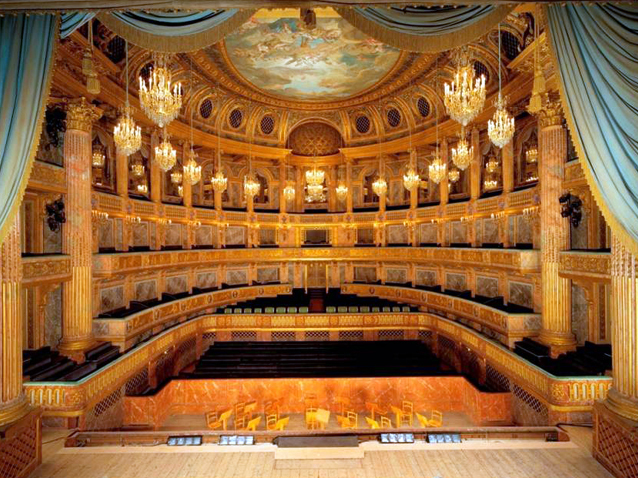
Louis XV was less interested in the performing arts than his great-grandfather, but because of the traditions surrounding royal weddings, which included a ball, a banquet, and an opera, he decided, in 1768, to build an opera house. His first architect, Jacques-Ange Gabriel, had been working on plans for an opera house since his appointment in 1742, and voilà! By the 1770 wedding of the future Louis XVI to Marie-Antoinette, the Royal Opera House had been built. (Read more.)
More HERE. Share









4 comments:
Not exactly. 1) the first Opera house in France was in Paris, Palais-royal, and first operas were staged at Saint-Germain mainly, not in Versailles. Alceste and Persée y Lully were staged in the cour de Marbre, and the stables, yes, during Louis XIV's reign; then most operas were given as concerts, while staged at Fontainebleau during Louis XV's reign. The great theatre of 1770, being too costly, was used for weddings and some visits by foreign kings only, and during the reign of the last King, at the end, operas were stage on the New Comedy. Meanwhile since 1763, the little comedy showroom was a little improved, letting some operas and mainly comic operas or ballets, to be staged
So true, Anita. Thank you for the additional information, very helpful.
I think you would also be interested in this story, which is about Antoinette's last public attendance of an opera play while still under house arrest at the Tuileries shortly before the events of August 10th which led to the end of the French monarchy. To quote a moving excerpt from the below account written by an English contemporary who was visiting Paris in the Summer of 1792:
"In one of the acts a duet is sung by the soubrette and the valet, where Madame Dugazon says: Ah! Comme j'aime ma maîtresse [Ah! How I love my mistress]. As she looked particularly at the Queen at the moment she said this, some Jacobins, who had come into the playhouse, leapt upon the stage, and if the actors had not hid Madame Dugazon, they would have murdered her. They hurried the poor Queen and family out of the house, and it was all the Guards could do to get them safe into their carriages."
https://revolution.chnm.org/d/332
Yes, a sad incident, thanks for sharing with us.
Post a Comment