Showing posts with label Music. Show all posts

Tuesday, April 21, 2026

My Lagan Love

https://blogger.googleusercontent.com/img/b/R29vZ2xl/AVvXsEjyEQRMpFkqbMvqB7C7W-i9Ezcc0UxzHNCJo2RLGF3jebVNqCYy0-6WGLEcR4fn0QlwxPIH0_fvSIfBzZl1yHZy_A9XIbVQTKj5q8lEi0wKwMoecYplzUWtkMAGdcnOYFFzntS5_0GBPeE/s1600/My+Lagan+Love.jpg
Where Lagan stream sings lullaby
There blows a lily fair

The twilight gleam is in her eye

The night is on her hair

And like a love-sick
leánan sídhe
She has my heart in thrall

Nor life I own nor liberty

For love is lord of all.


Her father sails a running-barge

'Twixt
Leamh-beag and The Druim;
And on the lonely river-marge

She clears his hearth for him.

When she was only fairy-high

Her gentle mother died;

But dew-Love keeps her memory

Green on the Lagan side.


And often when the beetle's horn

Hath lulled the eve to sleep

I steal unto her shieling lorn

And thru the dooring peep.

There on the cricket's singing stone,

She spares the bogwood fire,

And hums in sad sweet undertone

The songs of heart's desire


Her welcome, like her love for me,

Is from her heart within:

Her warm kiss is felicity

That knows no taint of sin.

And, when I stir my foot to go,
'Tis leaving Love and light

To feel the wind of longing blow
From out the dark of night.


Where Lagan stream sings lullaby

There blows a lily fair

The twilight gleam is in her eye

The night is on her hair

And like a love-sick
leánan sídhe
She has my heart in thrall

Nor life I owe nor liberty

For love is lord of all.


(from an old Irish song)
A beautiful rendition, HERE, HERE and HERE.

To quote from Mary O'Hara's notes on this song, from her book A Song For Ireland:

The leánan sídhe (fairy mistress) mentioned in the song is a malicious figure who frequently crops up in Gaelic love stories. One could call her the femme fatale of Gaelic folklore. She sought the love of men; if they refused, she became their slave, but if they consented, they became her slaves and could only escape by finding another to take their place. She fed off them so her lovers gradually wasted away - a common enough theme in Gaelic medieval poetry, which often saw love as a kind of sickness. Most Gaelic poets in the past had their leanán sídhe to give them inspiration. This malignant fairy was for them a sort of Gaelic muse. On the other hand, the crickets mentioned in the song are a sign of good luck and their sound on the hearth a good omen. It was the custom of newly-married couples about to set up home to bring crickets from the hearths of their parents' house....

undefined
Waterhouse's "Hylas and the Nymphs"


Share

Tuesday, March 17, 2026

Bards

It has always fascinated me how the telling of stories was held in high regard in Irish culture. Here is a little history:

In medieval Ireland, bards were one of two distinct groups of poets, the other being the fili. According to the Early Irish law text on status, Uraicecht Becc, bards were a lesser class of poets, not eligible for higher poetic roles as described above. However, it has also been argued that the distinction between filid (pl. of fili) and bards was a creation of Christian Ireland, and that the filid are were more associated with the church.[3]

Irish bards formed a professional hereditary caste of highly trained, learned poets. The bards were steeped in the history and traditions of clan and country, as well as in the technical requirements of a verse technique that was syllabic and used assonance, half rhyme and alliteration, among other conventions. As officials of the court of king or chieftain, they performed a number of official roles. They were chroniclers and satirists whose job it was to praise their employers and damn those who crossed them. It was believed that a well-aimed bardic satire, glam dicenn, could raise boils on the face of its target.

The bardic schools were extinct by the mid 17th century in Ireland and by the early 18th century in Scotland.

The bards played an important role in preserving the traditions and legends of the Irish people, as well as their genealogical connections. Stories were passed on through poems, songs, ballads and the loricas. According to one article:

Bards are found in Celtic cultures (Ireland, Scotland, Wales, Manx and Brittany) and a rough equivalent can be found in Norse culture, too, where they were known as "scops."

There is no real equivalent to the Celtic Bard in Anglo-Saxon England, however.

In Ireland and Scotland, the use of the word "Bard" apparently fell into some disrepute, as the records we have show that the Bard was simply a minor poet, while the "filidh" (seer) or the "ollave" (master poet) occupied the former status and functions of the Bard....

The word "Bard," in Wales, denoted a master-poet. In Ireland it meant a poet who was not an Ollave, one who had not taken all the formal training. Apparently even the lower-status Irish Bard was on a level with the Welsh Bard in knowledge and poetic education, however, and these were what I have termed "hedge-bards," above.

In the Celtic cultures, the Bard/Filidh/Ollave was inviolate. He could travel anywhere, say anything, and perform when and where he pleased. The reason for this was, of course, that he was the bearer of news and the carrier of messages, and, if he was harmed, then nobody found out what was happening over the next hill. In addition, he carried the Custom of the country as memorized verses...he could be consulted in cases of Customary (Common) Law. He was, therefore, quite a valuble repository of cultural information, news, and entertainment.

Share

Thursday, February 19, 2026

Fully Human Lives: The Jazz Greatness of Kurt Elling

 Jazz is to some people what opera is to me. From Mark Judge at Chronicles:

Elling is the premier male jazz vocalist in America. He’s been nominated for eight Grammys and won two. Elling also very plainly adores American jazz music. That seems like an obvious thing to say about a jazz singer, but in Elling’s case, it is clear that his love for it is all-consuming because it is infectious. His heart seemed to expand whenever he lovingly spoke of “this music” or of artists like Duke Ellington, Wayne Shorter, and John Scofield.

Even as so much of our culture stares into a digital AI void , the best music, Elling said, still comes from acoustic instruments, which hit you in the “right here.”  When he said “here” Elling put a fist to his chest—as well as to the backside and the brain. No matter how much AI takes over, Elling was saying, we are souls. We want to live fully human lives and feel things with all of our being.

I’ve been following Elling since 2008, when I first saw him perform—and at the same location. Elling, a former divinity student at the University of Chicago, had then commingled the lyrics of the jazz standard “My Foolish Heart” with the poetry of St. John of the Cross. Seeing him do this in concert for the first time, I was seized with a kind of spiritual rapture. As the Biblical translator Stephen Mitchell once said about encountering God, it was a feeling so big that it wasn’t inside of me but I was inside of it.

In 2010 I was able to interview the singer at Blues Alley in Georgetown. This time around, in 2026, I got to meet Elling backstage before the show. He was joined by Daniel Jamieson, the conductor of the new Strathmore Jazz Orchestra.

“When I agreed to take on the role of conductor of the Strathmore Jazz Orchestra,” Jamieson said,

one of my core stipulations was that this orchestra would never function as a backup band. The musicians themselves are the heart of the project. I want this ensemble to be presented with the same artistic importance and visibility as any guest soloist we bring in. The players are the identity of this orchestra, and I am committed to building a culture that places them at the center of every performance. 

There was no mistake about that at this concert as the orchestra was the beating heart of the performance. (Read more.)


Share

Thursday, February 12, 2026

Marie-Antoinette and Music

File:Antoinette at the spinet.jpg

From Royal Central:
Whilst musical talent in the eighteenth century was judged to be an appropriate feminine accomplishment, Marie Antoinette’s personal relationship with music was a special one, which reached far beyond mere natural inclination. Music proved to be in many ways, perpetually present, like a main character in her life story, giving parallel to key events or lending them at least, poignant expression. Her love and patronage of the music of the composer Christoph Willibald Glück, whose works she did much to promote in France, reaches back even further than Marie Antoinette’s birth, because the composer’s official inauguration in the role of composer of “theatrical and chamber music” took place in 1755 at a court ball at the summer palace of Laxenburg, when her mother, Maria Theresia, was roughly three months pregnant with her, the Empress’s fifteenth child.

When Archduchess Maria Antonia (“Antoine”) of Austria, the future Marie Antoinette was recorded as singing a French song as early as three-years-old, for the name day of her father, the Holy Roman Emperor Franz I, in 1759. She also met the young Wolfgang Amadeus Mozart, who gave his first concert at Schönbrunn Palace, the magnificent Habsburg summer residence on the outskirts of Vienna, in 1762, in the presence of the Empress and the Imperial Family, with the boy prodigy from Salzburg performing on the harpsichord. As Austrian Archduchess, Marie Antoinette’s young love of music was expressed in the painting of her at the spinet by Franz Xaver Wagenschön, a delightful image now part of the Kunsthistorisches Museum collections. The art is arresting, showing Marie Antoinette poised to turn the pages of her music, with one hand delicately resting on the keys. She is dressed in a day dress of blue satin, trimmed with fur, possibly of sable. It is proof, in any was needed, of her early commitment to what would be, a lifelong relationship. (Read more.)

Share

Wednesday, February 4, 2026

Petrushka


Stravinky's 0riginal costume design for Petrushka


Original 1911 set design for Petrushka

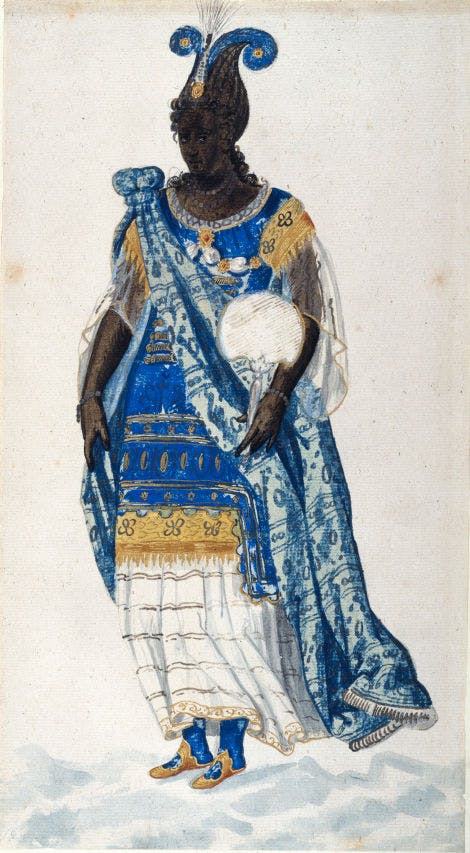
When I was a child my grandmother gave us a record with stories from famous ballets, including musical excerpts from Petrushka. We were entranced by it; my sister and I tried dancing to Petrushka when we were very small; from what I have read since, we were not alone in being swept up into the drama. Composed by Igor Stravinsky (1882-1971) for Sergei Diaghilev's Ballets Russes, Petrushka debuted in 1911 at the Théâtre du Chatelet in Paris. The mysterious, magical tale of love and revenge unfolds at a Russian Shrovetide fair, centering around a puppet called "Petrushka," who in Pinocchio-style comes to life. To summarize:
Petrushka ("Petey") is the story of three puppets - the forlorn and homely Petrushka, a beautiful ballerina, and a mysterious and gaudily dressed Moor - brought to life by their showman master at a Russian Shrovetide fair. Petrushka tries to express his love for the ballerina, but she has eyes only for the Moor. The frustrated Petrushka is subdued by the scimitar-wielding Moor, but the puppet's ghost has the last laugh by thumbing his nose at everyone. All this takes place within the context of the fair, full of dances by nannies, coachmen, masqueraders, crowds and even a dancing bear.
In Russian culture, the puppet character of "Petrushka" was rather like "Punch," a rude, comic Everyman, the butt of every joke. Stravinsky endows him with human feelings; as Petrushka attempts to rise from his baseness, his strivings lead to his destruction, only to gain immortality in the end.
Stravinsky's music captures the carnival atmosphere of Maslenitsa, the Russian version of Mardi Gras, with all its color and passion. As one commentator describes:
Subject and music appear to reflect the Russian nature. Gogol and Mussorgsky are there. Everything is reflected in the score with a sure and reckless mastery —the movement and tumult of the crowd; the gait and aspect of each leading figure; and the grotesque agonies of the helpless one. A shriek of...trumpets in different keys is the motto of Petrouchka's protest. The composition is permeated with Russian folk-melodies and also street songs marvelously treated.
"Fair"
In his day, Stravinsky was considered avant-garde since his music was a bit different from what had gone before. His work was part of the explosion of creativity that brightened the last days of imperial Russia, called the "Silver Age." On one level, Petrushka is an echo of a time that is gone; on another, it conveys the spirit of the Russian people which Communism was not able to destroy. I enjoy listening to Petrushka more than ever, especially during Shrovetide. 

Listen HERE.

Share

Monday, January 19, 2026

Opera in the Modern World

 From the New York Post:

Jonas Kaufmann will no longer sing at London’s Royal Opera House — because, of all things, the pay is too low. “I don’t know how you do it,” the tenor recently told BBC Radio. In the same interview, he revealed that he won’t bother singing at the Metropolitan Opera anymore, either, though that’s about ideological differences. For a singer like Kaufmann — arguably the biggest star in all of opera — to swear off two of the world’s top-five opera houses is not merely eyebrow raising. It is cataclysmic.

“I feel so sorry for the next generation,” he lamented. Nearly every singer who has ever pursued an operatic career has pondered whether anything the business has to offer is worth the hassle: the heartache of losing engagements or rejection, the stress over one’s vocal health, the missed holidays, the travel, all of it. In the past, a comforting thought would have been that, if only one can perhaps achieve the top levels of the business, all will be well. And now, the very top of the business is telling us that all is certainly not well. (Read more.)

Share

Monday, January 5, 2026

Cardinal Sarah on Sacred Music

From The National Catholic Register:

The vital importance of sacred music to the liturgy, the need for every Catholic to be watchful and prepared for the Four Last Things, and the recognition that only Christ’s kingship will bring true peace were among the key messages Cardinal Robert Sarah brought to the United States late last year.

Cardinal Sarah’s visit to the U.S. was centered around the launch of his new book, The Song of the Lamb: Sacred Music and Heavenly Liturgy, co-written with Church musician Peter Carter. 

In two talks on Nov. 21 and 22, 2025, delivered at Princeton University, where Carter serves as director of sacred music for the Aquinas Institute, Cardinal Sarah underscored that at a time when, for decades, the Church’s liturgy has “too often been instrumentalized,” it is important to understand what the liturgy is and why sacred music is a central part of divine worship. 

Noting that the liturgy “has become politicized” in recent decades, the prefect emeritus of the Dicastery for Divine Worship and the Discipline of the Sacraments also defended those who have legitimately highlighted abuses, denouncing as “wrong” the fact that some Church authorities have “persecuted and excluded” these critics.

Recalling Benedict XVI’s hermeneutic of continuity between the reformed and pre-reformed liturgy and the late pontiff’s emphasis on “what earlier generations held as sacred remains sacred and great for us too,” Cardinal Sarah said liturgical abuse detracts from the twofold nature and purpose of the liturgy: to “render to Almighty God the worship that is his due” and to recognize that the liturgy “is not about what we do,” but rather about what the Lord “does for us and in us.” 

Through the worship offered by the Church in her liturgical rites, “we are sanctified,” Cardinal Sarah stressed, which is why “full, conscious and actual participation in the liturgy is essential.” By participation, he said he was not referring to many external actions but rather attuning “our minds and hearts and souls” to the “meaning of the sacred rites and chants and prayers of the Church’s liturgy.”  

“That is how we ‘plug-in’ to, or connect with, the saving action of our Lord Jesus Christ in the liturgical rites,” he said. “This, my friends, is why the liturgy is ‘sacred.’” (Read more.)

Share

Saturday, January 3, 2026

The Rise of Balls in English Society

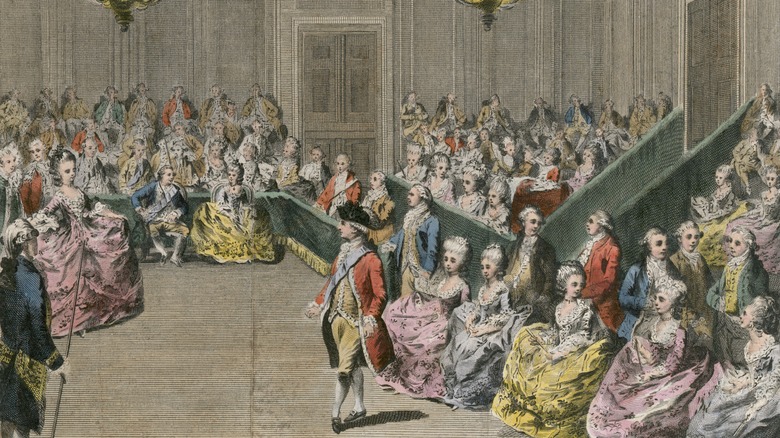
Ball at St James's Palace, London, on the night of the birthday of Queen Charlotte, Consort of King George III. From the Mayson Beeton Collection 

From Gilded Heiresses:

Balls became an essential part of British high society by the late 17th century, evolving from smaller gatherings of the aristocracy into lavish events held at private homes, exclusive clubs, and assembly rooms. They served to introduce young debutantes—women of high social rank eligible for marriage—into society. By the Regency period (early 19th century), the ball was central to the British social season—a time when families gathered in London to partake in a series of fashionable events. (If you’re a Bridgerton fan, then I’m sure you’ll be familiar with this concept!)

By the Victorian era, these social gatherings became even more extravagant and ritualised, with balls scheduled almost nightly during the peak of the season. Lavish decorations, grand musical performances, and intricate rules of etiquette defined these evenings. A strictly policed guest list underscored the exclusivity of these balls, and receiving an invitation was the ultimate status symbol.

World War I may have marked the beginning of their decline, but some of Britain’s legendary balls remain celebrated for their splendour and the lasting impact they had on the structure of British high society. I’m sure that many books could be written about individual balls and the scandalous dramas that happened, but here are a few of my favourites. (Read more.)


The history of Queen Charlotte's ball. From Grunge:

 Traditionally, Queen Charlotte's Ball required strict adherence to the rules, as reported by Town and Country. Not surprising considering the queen's love of formality and age-old customs. Debutantes had to wear formal gowns, complete with trains. Among their accessories, they carried fans, floral bouquets, and three feathers in their hair. At its high point, the Ball culminated in getting presented before the queen, who stood next to a massive birthday cake to receive debutantes. When each debutante came before the sovereign, they curtseyed respectfully.

According to History Extra, curtseying proved no joke. Today's debutantes continue to spend months practicing this unnatural yet elegant move. To execute it, practitioners must place their left knee in a locked position behind the right. Next, they bow deeply while facing the queen (or cake in later years). In other words, this move required plenty of balance.

Soon, the party had developed into the premier debutante ball of the burgeoning season where eligible bachelorettes hoped to snag a prize-worthy husband. They ultimately had a year to complete their mission or risk the spinster label, a fate no woman wanted to have thrust involuntarily upon her. Oddly enough, the cake and the curtseying tradition continues today featuring an audacious and towering confection. (Read more.)

Share

Sunday, December 28, 2025

The Coventry Carol

Christmas is tinged with sorrow. From A Clerk at Oxford:
Lullay, lullay, thou little tiny Child,
By, by, lully, lullay.
Lullay, lullay, thou little tiny child.
By, by, lully, lullay.

O sisters too, how may we do,
For to preserve this day
This poor youngling for whom we sing,
By, by, lully, lullay.

Herod the King, in his raging,
Charged he hath this day
His men of might, in his own sight,
All young children to slay.

Then woe is me, poor child, for thee,
And ever mourn and may,
For thy parting, nor say nor sing,
By, by, lully, lullay.
The Coventry Carol is among the medieval carols most often heard today, and I find the popularity of this profoundly sad song at Christmastime intriguing. As John of Grimestone's lullaby suggests, there are actually a considerable number of medieval lullabies which share the mood of the Coventry Carol: somewhere between lullaby and lament, full of melancholy and pity for the child being comforted, whether it's Herod's victims, the Christ-child, or any human baby born into a weeping world. (Here's another beautiful example.) I wonder if the popularity of the Coventry Carol today indicates that it expresses something people don't find in the usual run of joyful Christmas carols - this song of grief, of innocence cruelly destroyed. Holy Innocents is not an easy feast for a modern audience to understand, and I'll confess I find the medieval manuscript images of children impaled on spears just horrible - but then, they are meant to be, and they're horrible because they're all too close to the reality of the world we live in. The idea that this is incongruous with the Christmas season (as you often hear people say) is largely a modern scruple, I think. It's our modern idea that Christmas is primarily a cheery festival for happy children and families - our images of Christmas joy, both secular and sacred, are all childlike wonder and picture-perfect families gathered round the tree. This is very nice, of course, for those who have (or are) children, or happy families, but for those who don't - those who have lost children or parents, who face loneliness or exclusion, who want but don't have children, family, or home - it can be deeply painful. (Read more.)
Share

Saturday, December 27, 2025

Jesus Christ the Apple Tree


It is St. John's day, which is the name-day of my late father. This early American carol was one of his favorites. It invokes images of Eden and the lost earthly paradise, while bringing to mind the Tree of Life which is the Cross. From Hymns and Carols of Christmas:
1. The tree of life my soul hath seen,
Laden with fruit and always green:
The trees of nature fruitless be
Compared with Christ the apple tree.

2. His beauty doth all things excel:
By faith I know, but ne'er can tell
The glory which I now can see
In Jesus Christ the apple tree.

3. For happiness I long have sought,
And pleasure dearly I have bought:
I missed of all; but now I see
'Tis found in Christ the apple tree.

4. I'm weary with my former toil,
Here I will sit and rest awhile:
Under the shadow I will be,
Of Jesus Christ the apple tree.

5. This fruit doth make my soul to thrive,
It keeps my dying faith alive;
Which makes my soul in haste to be
With Jesus Christ the apple tree.
From The Thinking Housewife: "The lyrics were written by an unknown poet in the 18th century and call to mind the tradition in the Middle Ages of decorating Christmas trees with apples, symbolic of the Tree of Knowledge." (Read more.)

The Tree of Life and Death


Share

The Man Behind 'The Nutcracker'

 From The Conversation:

So how does The Nutcracker and the Mouse King fit into this strange body of work?

Hoffmann’s original tale is no innocent sugarcoated fantasy. The story was written for his friend Hitzig’s children, Marie and Fritz. It is a veiled critique of the strictures Hitzig and his social class placed on his children’s freedom.

The story is, tellingly, set in a household named Stahlbaum, or “Steel Tree”: a fortress of sorts that is infiltrated by the mysterious Drosselmeier. 

In Hoffmann’s tale, Marie is positioned as the novice who must learn to use and trust her imagination. Only her imaginative vision can animate – literally and metaphysically – the mundane world that surrounds her and fulfil her dreams and desires. Drosselmeier is a figure analogous to Hoffmann, cultivating Marie Hitzig’s imagination within and outside of the story.

This clashing of worlds is not without its trauma. Hoffmann’s story ends on a sombre note, with Marie’s visions being dismissed by her family as nonsense. Mocked into outward submission, she never speaks of these adventures again. Ridiculed as a dreamer, she becomes reserved. But in her mind’s eye, she returns from time to time to “those glorious days”.

Hoffmann’s ending leaves us suspended between sadness at the suppression of Marie’s childhood imagination and triumph at the quiet persistence of her imaginative spirit. (Read more.)

Share

Wednesday, December 24, 2025

“Tomorrow Shall Be My Dancing Day”

 From The Imaginative Conservative:

William Sandys (1792-1874) was an antiquarian by hobby—a “person who collects or studies old things” or “a student of the past,” according to Webster’s. The things Sandys happened to collect were Christmas songs. His 1833 publication Christmas Carols Ancient and Modern helped to launch the Victorian revival of the holiday, a revival that followed centuries of puritan neglect.[*] Sandys claimed in his book to have unearthed English yuletide songs dating back four centuries. Making their first appearance in print were many carols we now take for granted, such as “The First Noel,” “God Rest Ye Merry, Gentlemen,” and “Hark, the Herald Angels Sing.”

Although it hasn’t soared to those heights of popularity, “Tomorrow Shall Be My Dancing Day” is richly fascinating nonetheless. The text has turns of phrase redolent of the Middle Ages or Renaissance, yet no source for the song prior to Sandys has been found. What is most remarkable about “Dancing Day” is that it narrates the entire story of Christ’s life in Christ’s own voice, and that it describes the story of salvation with the image of a dance:

Tomorrow shall be my dancing day;
I would my true love did so chance
To see the legend of my play,
To call my true love to the dance.

Refrain:

Sing, oh! My love, oh! My love, my love, my love,
This have I done for my true love.

Most scholars agree that the text goes back far earlier than 1833, with the phrase “legend of my play” a possible clue that the carol was connected to the medieval mystery plays. Musicologists Hugh Keyte and Andrew Parrott write:

It seems possible that ‘Tomorrow shall be’ was devised to be sung and danced at the conclusion of the first day of a three-day drama . . . The actor portraying Christ would have sung the verses and the whole company and audience the repeats of the refrains.

Hymn texts in which Christ himself speaks—a device one commentator refers to as vox Christi—are rare, making a theatrical origin for “Dancing Day” even more likely.

Mystery plays were one of the three distinctive medieval forms of theater, the other two being miracle plays and morality plays. All three types evolved out of short scenes performed in church by the clergy as an adjunct to the liturgy and depicting biblical subjects such as the Creation, Adam, and Eve, or the Last Judgment. Mystery plays eventually moved out of church premises into the village square, often traveled from town to town on wagons, and became increasingly elaborate.

As the plays traveled to various locales, they were often advertised by the players in a song called a “banns.” If our carol originally formed part of a mystery play about the life of Christ, the “dancing day” on the “morrow” might refer to the subsequent part of the play, treating the Redemption.

Most striking is the relationship between Christ and humanity being likened to that of a lover and his “true love,” with the refrain’s expressive repetitions of “my love.” This motif hearkens back to the love poetry of the Song of Songs, in which the lover and beloved are traditionally interpreted as representing Christ and the church or Christ and the soul. The idea of Christ and humanity being united as bridegroom and bride is a classic Christian motif, but we are surprised to find it in a popular Christmas carol, and even more to find the image extended to depict Christ as our dancing partner. There is a good amount of theology and scripture in “Dancing Day,” such as the treatment of the Incarnation:

Then was I born of a virgin pure;
Of her I took fleshly substance.
Thus was I knit to man’s nature
To call my true love to the dance.

In a manger laid and wrapped I was,
So very poor; this was my chance,
Betwixt an ox and a silly poor ass,
To call my true love to my dance.

(Read more.)


Share

Irish Christmas Blessings and Carols

From Ireland Calling:
Carols are also important in an Irish Christmas. Ireland has its fair share of original carols such as The Wexford Carol and While Shepherds Watched Their Flocks by Night. Many others have been translated into Irish and performed by leading artists. These are some of Ireland’s best known Christmas blessing and carols.

The Wexford Carol is one of the most famous and most popular hymns to come out of Ireland. Its origins are uncertain but it certainly dates back several centuries. It originated in Co Wexford and first came to wider prominence due to the work of William Grattan Flood who was the organist at St Aidan’s Cathedral in Enniscorthy. He first came across the carol when he heard it being sung by a local singer in Wexford in the 19th century. He started to perform it at Christmas services in the cathedral and it was later published in the Oxford Book of Carols. It soon became a standard in carol books across the world. (Read more.)
Share

Friday, December 19, 2025

"The Holly and the Ivy"


The holly and the ivy, when they are both full grown,
Of all the trees that are in the wood, the holly bears the crown.
Refrain:
Oh, the rising of the sun and the running of the deer,
The playing of the merry organ, sweet singing in the choir.
The holly bears a blossom as white as lily flower,
And Mary bore sweet Jesus Christ to be our sweet saviour
Refrain
The holly bears a berry as red as any blood,
And Mary bore sweet Jesus Christ to do poor sinners good.
Refrain
The holly bears a prickle as sharp as any thorn,
And Mary bore sweet Jesus Christ on Christmas Day in the morn.
Refrain
The holly bears a bark as bitter as any gall,
And Mary bore sweet Jesus Christ for to redeem us all.
Refrain
It is an old English carol, the original of which was a song about the complexity of male and female relationships. David Beaulieu of About.com explains:
So where does the ivy come into play in the song, "The Holly and the Ivy?" Except for its appearance alongside holly in the opening stanza, it isn't even mentioned in the song. If this one, insignificant reference to ivy were struck from the lyrics, in what way would the song suffer? And if your answer is, "Not at all," then the next logical question to ask is: Why is the carol not titled simply, "The Holly," instead of, "The Holly and the Ivy?"
....The answer may lie in the fact that "The Holly and the Ivy" is based on older songs, such as "The Contest of the Holly and the Ivy" ....
In "The Contest of the Holly and the Ivy," ivy plays a role equally important to that of holly. The mention of ivy in the first stanza (and the last stanza, which merely repeats the first) in "The Holly and the Ivy" is therefore a hold-over, a remnant from an earlier era, a fragment pointing to music with a very different meaning. The influence of the earlier songs about the holly and the ivy was apparently so strong that the ivy was given a cameo appearance in this one, too -- despite the fact that only the holly has any major role to play in it.
What we see played out in "The Contest of the Holly and the Ivy" and similar songs (perhaps dating back to medieval times) is the rivalry between men and women, thinly disguised as a contest between the holly and ivy. Holly was conceived of as being masculine in the plant symbology of the time, probably because it is more rigid and prickly; while the softer ivy is associated with the feminine in this tradition.
According to an article at Dave's Garden:
Using ivy as decoration also dates back to the time of the Romans, who associated it with Bacchus (the Roman equivalent of the Greek Dionysus, god of wine and intoxication). Ivy was a symbol of fidelity and marriage, and was often wound into a crown, wreath or garland.[3] It also served as a symbol of prosperity and charity, and thus it was adopted by the early Christians, for whom it was a reminder to help the less fortunate. In early England, it was considered bad luck to use ivy alone in decorating for Christmas, and would give the woman of the house the upper hand.
The same site explains the symbolism of holly:
The practice of ornamenting the home with holly began with the Romans, who regarded it as an omen of good fortune and a symbol of immortality. They sent congratulatory wreaths of holly to newlyweds, and also used it as a gift during the festival of Saturnalia (a celebration which itself is based partly on Greek and Egyptian solstice observances). As early Christians adopted the practice of decorating with the plant, holly took on religious associations--namely, that the spiky leaves represented Christ’s crown of thorns, and the red berries his blood....
The Christmas carol “The Holly and The Ivy is an example of how ancient beliefs were absorbed by the Christian church. The song we sing today was recorded by a folk song collector named Cecil Sharp, who heard it sung in Chipping Camden, Gloucestershire, in 1909:[5]

The holly and the ivy,
When both are full well grown.
Of all the trees that are in the wood,
The holly bears the crown.

Oh, the rising of the sun,
The running of the deer.
The playing of the merry organ,
Sweet singing in the choir.
Subsequent verses transform the carol into a Christian song. Dr. Ian Bradley, of the St. Andrews University School of Divinity in Scotland, writes that the although the lyrics focus on the holly as a symbol of Christ, ivy is also mentioned because of the carol’s basis on an older medieval song in which the plants personify men and women. In the earlier song, holly and ivy were equals, with holly representing goodness and masculinity; ivy standing for evil (or at least weakness) and femininity.[6]
To the medieval mind, the male was considered the dominant sex, and a support for the weaker and more delicate female, thus the rigid holly shrub and the twining ivy vine must have seemed like natural embodiments of those traits. The original meaning of “The Holly and the Ivy” is a reminder that there has always been a subtle and humorous (sometimes not so subtle and humorous) competition between men and women for dominance. These two tough plants may represent the struggle between the sexes, but they can also be seen as a celebration of male and female cooperation and interdependence. (Read more.)

(Artwork from Karen) Share

Friday, December 12, 2025

The Hidden History of Carols

It seems that in the Middle Ages caroling parties could be a bit wild. Most people do not realize that carols were not just for Christmas but every feast day had its carols, and some were more bawdy than religious. To quote:
 The story of Christmas caroling is full of unexpected surprises. The practice itself has gone through many changes over the centuries, and our perception of caroling today is based only on the very recent history. We think of Christmas caroling as a wholesome, and even religious, activity. Caroling seems to speak of the beauty, innocence, and magic of the Christmas season. However, in researching this practice, I have discovered that caroling was not as innocent as we might think. In fact, the act of caroling was actively combatted by the Church for hundreds of years.

Uncovering the origins of caroling has proven difficult. Some sources give the 14th or 15th centuries as the earliest date for caroling. I believe the reason for this is because this is the period when caroling began to be adopted by the church, and this is when carols first began to be written down. However, there is much evidence that caroling was around long before that. We don’t have written carols from the early periods, but what we do have are edicts from the Church and recorded sermons which make reference to caroling. (Read more.)
Share

Star of the Sea: Marian Devotion through the Prism of a Medieval English Hymn

 From Avellina Balestri at Fellowship and Fairydust:

Devotion to the Blessed Virgin Mary has played an integral role in Christian devotion since the early days of the Church, and continues to be a vital part of the daily devotions of Catholic, Orthodox, and even some denominations of Protestant Christians to this day. Once a year, during the season of Christmas, even those who typically do not engage in Marian devotion find reason to shed a spotlight on this Jewish maiden’s role in the salvation of mankind. But it is my firm belief that all Christians should have ample cause to honor her all year long, particularly during the Lenten and Easter seasons, as a vital thread in the fabric of our spiritual lives.

     I find particular inspiration in the soaring poetry of the Middle Ages in honor of the Virgin and believe it to be a wonderful method of sharing the Catholic understanding of Mary’s place in the Christian life and why we pay her homage. Harkening back to the Age of Chivalry, we can see how the culture telescoped (and indeed, colorfully kaleidoscoped) the various attributes of the Blessed Mother in light of their own understanding of the world around them, still grounded in a monarchical system. As such, she is seen as the highest of all Queens, and given royal adulation. 

     One hymn in particular, “Star of the Sea”, captures the freshness and vigor of the Marian devotion in the age of a united Christendom and explains quite poetically and movingly the feelings of the Catholic populace of medieval England. The lyrics are a mix between Latin, the language of the Church, and Middle English, the language of the people which had come into vogue in legal and liturgical works alike during the reign of King Henry V (1413-1422). For the purposes of this analysis, I will use the translation into modern English. 

      The hymn begins by hailing Mary as “Fairest and brightest of them all, even the star of the sea, brighter than the daylight.” This is a testament to the belief in the Immaculate Conception. This teaching, simply explained, means that for the special calling assigned to Mary to be mother of Jesus Christ, she was preserved from the stain of Original Sin, that inheritance of susceptibility to temptation that has plagued humanity since the first fall of Adam and Eve. Cooperating with this singular grace, applied to her ahead of time through the future death of her divine son, she lived a life free from sin and full of grace. (Read more.)


Share

Sunday, November 30, 2025

'Conditor Alme Siderum'

Creation of the Stars

 My favorite Advent hymn. From A Clerk of Oxford:

Among the Office Hymns for Advent is 'Conditor Alme Siderum', best known in translation today as 'Creator of the stars of night'. Intended to be sung in the evening, as the early dusk of a winter night descends, this hymn praises God as the creator of the stars - those stars which seem to shine so much more brightly in a cold and frosty sky. It draws a parallel between the darkness which envelops us each day and a yet deeper darkness, 'the world's evening hour', which Christ, bright as the sun, illuminates by his entry into the world.

 [...]

Creator of the stars of night,
Thy people’s everlasting light,
O Jesu, Saviour of us all,
Hear thou thy servants when they call.

Thou, grieving at the bitter cry
Of all creation doomed to die,
Didst come to save our ruined race
With healing gifts of heavenly grace.

Thou camest, Bridegroom of the bride,
As drew the world to evening-tide;
Proceeding from a virgin shrine,
The Son of Man, yet Lord divine.

At thy great name exalted now
All knees must bend, all hearts must bow;
And things in heaven and earth shall own
That thou art Lord and King alone.

To thee, O holy One, we pray
our judge in that tremendous day,
preserve us, while we dwell below,
from every onslaught of the foe.

All praise, eternal Son, to thee,
whose advent sets thy people free,
whom with the Father we adore,
and Spirit blest, for evermore.
The best-known translation today is from the 19th century, but the hymn was first rendered into English about 800 years before that. In an Anglo-Saxon hymnal from 11th-century Canterbury, the Latin hymn is accompanied by a version in English, not a poetic translation but a full word-by-word gloss. It begins 'Eala, ðu halga scyppend tungla' ('hail, thou holy creator of the stars') and contains some recognisable vocabulary, most notably in the third verse, where the hymn alludes to Psalm 18: Christ, like the sun, comes forth 'as a bridegroom coming out of the bridal chamber'. In Old English, this is 'brydguma of brydbure', 'bridegroom from bridal bower'. (Read more.)

Share

Saturday, November 22, 2025

The Imperial Family at the Opera

Emperor Francis Stephen and Empress Maria Theresa at the opera with all of their children. Marie-Antoinette is the smallest girl in the blue dress. (Via Treasure for your Pleasure.) Share

Thursday, November 6, 2025

Gluck's 'Orpheus and Eurydice'


November 2 is the birthday of Marie-Antoinette. Christoph Willibald Gluck was Marie-Antoinette's music teacher and her favorite composer, whom she introduced to France after she became queen in 1774. Among his most famous operas is Orpheus and Eurydice, which originally debuted in Vienna in 1762. It is a fitting opera to listen to during the month of the Holy Souls, when so many prayers are offered for the dead, since it is based upon the myth of Orpheus, who tried to release his beloved wife from the underworld. Unlike the myth, the opera of Gluck has a happy ending. One of the loveliest pieces from Orpheus and Eurydice is the "Dance of the Blessed Spirits." It is interesting that the queen so loved this opera; to listen to it is to have a glimpse into her soul.


Share

Sunday, October 26, 2025

King Charles Receives Royal Confrater Title

 From Vatican News:

Ut unum sint – “That they may they one.” A horizon of “hope” for the future characterized the atmosphere in the Papal Basilica of Saint Paul Outside the Walls, during the ceremony conferring the title of Royal Confrater on King Charles III of England took place at the Basilica of Saint Paul Outside the Walls, during his state visit to the Vatican alongside Queen Camilla. The ecumenical celebration was presided over by Abbot Donato Ogliari, in the presence of Cardinal Archpriest of the Papal Basilica James Michael Harvey; the Archbishop of York and Primate of England, Stephen Cottrell; and the Moderator of the General Assembly of the Church of Scotland, Rosie Frew.

The Royals entered the basilica through the Holy Door, then were accompanied down the aisle by Cardinal Harvey, Abbot Ogliari, Archbishop Cottrell, and Moderator Frew while the congregation sang Hosanna to the Son of David in the version of Orlando Gibbons, Gentleman of the Chapel Royal from 1605 to 1625. The music was performed by the Schola of the Abbey of Saint Paul Outside the Walls, the lay clerks of St. George’s Chapel at Windsor Castle, and the children of St. James’s Royal Chapel in London; at the organ was Christian Almada, Titular Organist of the Papal Basilica.

After a brief stop in front of the altar, Cardinal Harvey and Abbot Ogliari led the monarchs in a moment of prayer at the tomb of the Apostle Paul. Here, Archbishop Cottrell prayed that the congregation may bear witness to the Gospel “in the darkness of our time.” King Charles and Queen Camilla then took their seats as the choir sang Sing Joyfully by William Byrd, also a Gentleman of the Chapel Royal in the late 16th and early 17th centuries. (Read more.)

Share