Happy Birthday, Andrea!
Share


.jpg) |
| "The Banshee Appears" |
The bean-sidhe (woman of the fairy) may be an ancestral spirit appointed to forewarn members of certain ancient Irish families of their time of death. According to tradition, the banshee can only cry for five major Irish families: the O'Neills, the O'Briens, the O'Connors, the O'Gradys and the Kavanaughs. Intermarriage has since extended this select list.Here is a more detailed description from Irish Culture and Customs:
The Bean Sidhe or Banshee makes her appearance when someone in the household is about to die. She haunts only the families of the "high Milesian race" - those whose names have an "O", "Mac" or other prefix. One exception to this rule has been granted by virtue of the Irish poets who have given her to some of the Norman-Irish families - the FitzGerald's for example. In any event, she heralds the demise of only those who are of authentic noble stock and it is with great dread when her piercing "caoine" or keening is heard. In many respects, this mysterious creature resembles traditional Irish keeners or mourners of old; as with her mortal counterparts, those who have seen her describe her as drawing a comb through her hair, similar to tearing the hair out in anguish, which the ancient mourners used to do. Incidentally, or maybe not, while the Banshee is considered benign, she supposedly has a sister force who isn't; this force is called the Lianhan Sidhe and her sole purpose is to seek the love of mortal men. Their desire for her ultimately destroys them.The banshee, according to legend, is usually heard at night, but sometimes in the morning, and at noon. An old Irish poem refers to the appearance of the Banshee in the morning:
Hast thou heard the Banshee at morn,There were a few banshee stories among some of my older relatives. (I suppose being descended from the Kavanaughs and the O'Neills as well as the O'Connors made them especially worthy of hauntings!) Irish lore is full of tales of the preternatural; the banshee is definitely one of the most interesting.
Passing by the silent lake,
Or walking the fields by the orchard?
Alas! that I do not rather behold
White garlands in the hall of my fathers.


The medal Pro Ecclesia et Pontifice was instituted by Pope Leo XIII (17 July, 1888, "Quod Singulari") in memory of his golden sacerdotal jubilee, and bestowed on those women and men who had merited well by aiding and promoting, and by other excellent ways and means assisted in making the jubilee and the Vatican Exposition successful. This decoration was made a permanent distinction only in October, 1898 (Giobbio, see below). Its object is to reward those who in a general way deserve well of the pope on account of services done for the Church and its head. The medal is of gold, silver or bronze. The decoration is not subject to chancery fees. The medal is a cross made octangular in form by fleurs-de-lis fixed in the angles of the cross in a special manner. The extremities of the cross are of a slightly patonce form. In the centre of the cross is a small medal with an image of its founder, and encircling the image are the words LEO XIII P. M. ANNO X (tenth year of his pontificate). On the obverse side are the papal emblems in the centre, and in the circle surrounding the emblems the motto PRO DEO ET PONTIFICE is stamped. On the obverse surface of the branches of the cross are comets — which with the fleurs-de-lis form the coat of arms of the Pecci family. On the reverse side are stamped the words, PRIDIE (left branch); KAL. (top branch); JANUAR. (right branch); 1888 (at the foot). The ribbon is purple, with delicate lines of white and yellow on each border. The decoration is worn on the right side of breast.Fergus Joseph O'Connor was the son of Charles and Emily O'Connor of Long Point Farm, born on April 1, 1879, Easter Sunday. As Fergus' second son and namesake wrote of him: "It's hard to describe a man with such integrity of character. He was the perfect son to his parents -- the brother to his only sister and complete support to his family." (Dr. Fergus James O'Connor, Because You asked For It)
His concern for his students was not limited to their professional development. Working in an area fraught with deep moral implications, he instilled in future obstetricians sound ethical principles to guide them in making crucial decisions which would crucially affect the lives of their patients. Moreover, he was not merely a professor to his students; they all regarded him as a personal friend, and so he was.By the late 1930’s he was delivering one third of all the babies in Kingston. He had many poor patients who could not pay, but to Fergus being a doctor was a vocation, not a career. However, he would gratefully accept an offering such as a bag of potatoes in the place of money, so that he could feed his family. He eventually became Chief of Obstetrics at the Hotel Dieu Hospital in Kingston and remained so for almost half a century. He delivered his last baby at age eighty-four.


1. The tree of life my soul hath seen,From The Thinking Housewife: "The lyrics were written by an unknown poet in the 18th century and call to mind the tradition in the Middle Ages of decorating Christmas trees with apples, symbolic of the Tree of Knowledge." (Read more.)
Laden with fruit and always green:
The trees of nature fruitless be
Compared with Christ the apple tree.
2. His beauty doth all things excel:
By faith I know, but ne'er can tell
The glory which I now can see
In Jesus Christ the apple tree.
3. For happiness I long have sought,
And pleasure dearly I have bought:
I missed of all; but now I see
'Tis found in Christ the apple tree.
4. I'm weary with my former toil,
Here I will sit and rest awhile:
Under the shadow I will be,
Of Jesus Christ the apple tree.
5. This fruit doth make my soul to thrive,
It keeps my dying faith alive;
Which makes my soul in haste to be
With Jesus Christ the apple tree.
 |
| The Tree of Life and Death |
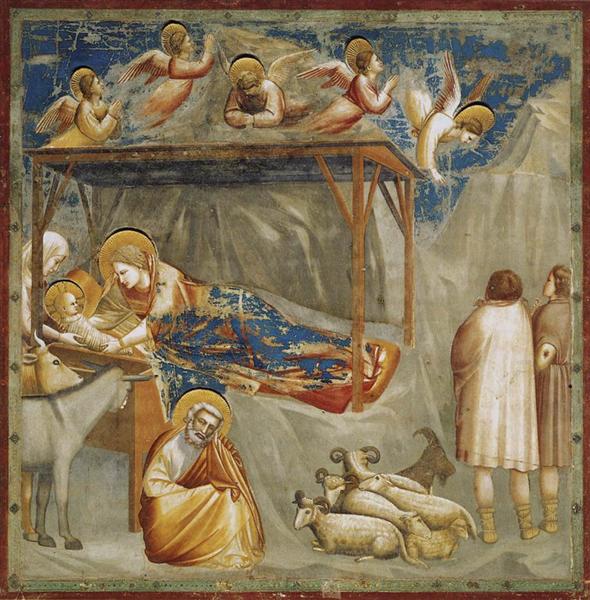 |
| The Nativity by Giotto |
Welcome, all wonders in one sight!
Eternity shut in a span;
Summer in winter; day in night;
Heaven in earth, and God in man.
Great little one, whose all-embracing birth
Lifts earth to heaven, stoops heav’n to earth.~ from "In the Holy Nativity of Our Lord" by Richard Crashaw
From my cousin's blog, Sensible Surgery and the Classical Physician:
The worst thing the (first) Marcos administration did was that they made corruption a standard practice. In any government agency where bids are made and contracts are awarded, it is “SOP” (standard operating procedure) that a certain percent of the contract amount will go back to the congressman, to the governor, to the head of the office, etc. Only around 30% is spent on the actual project. Corruption is normalized and expected. No need for whispers or back room deals.
[...]
Corruption is so enmeshed in our system that it would be near impossible to find a leader that has not benefitted from it or is not participating in it. But I do believe that they do so in varying degrees as well. A leader who has never been accused of corruption is a start (or if they have, only to a minimal degree). Not having any proven connections to corruption, pending court cases, or criminal convictions is another (albeit a low bar). Such leaders and politicians do exist. Jessie Robredo and his widow Leni was certainly among those people. Vico and a few handful other Mayors fit the criteria. NONE of the sitting senators do with the exception of Risa Hontiveros. Bam and Kiko by sheer family connection and length of career have probably benefited from the system, but certainly not to the degree of a Jinggoy Estrada.
As for policies, there are many good ones in isolation, but what’s more important is to support and enact policies that go toward the same direction and which fit a unified vision. Rolling back the VAT to 10% is a good idea, so is putting the budget on a blockchain. Both policies lead to a smaller more transparent government. In contrast, a policy that gives more budget to such and such an agency or a law the approves the construction of new infrastructure may NOT always be good, because it only leads to the government getting bigger, requiring more resources, and ultimately going deeper in debt. (Read more.)
From GMA:
ShareThe 29-year-old is a mom of three. She said she made the choice to live with her 84-year-old grandmother, her mother, and her younger sister to prioritize stability and financial freedom.
"Between my grandma, my mom and my sister, they kind of all just, like, help out. And the price of rent -- I pay my mom a portion versus having my own mortgage," Jade Lowe explained.
The U.S. Census Bureau estimates housing costs are still unsustainable for many households, with rent in the U.S. averaging $1,406 and the median mortgage coming in at $1,902. About 1 in 3 adults between the ages of 18 and 34 also still live in their parents' home.
Jade Lowe said it's a choice she doesn't regret at all.
"It allowed me to still live my best life in my 20s. It allowed me to honestly just be happy and not have to worry about those extra expenses. I get to keep it, and I get to put it in my savings," she said. "It means everything, honestly." (Read more.)
 |
| Blasket Islands |
 |
| On the way to Killarney Cathedral |
ShareDo you recall the first time you ever heard the “Londonderry Air” (or as it is more frequently called, “Danny Boy?” I can’t recall a time when I did not know that song. But if I had to guess, I’d bet that my first experience of it came from watching old TV reruns of “Make Room for Daddy” as a kid. The star of that show, Danny Thomas, was a beloved entertainer, singer, actor, and later television producer. And for obvious reasons, his producers adapted (and jazzed up!) “Danny Boy” to become his theme song. In 1953, when Thomas premiered his show, there couldn’t have been a person in the world who was not familiar with that song. But (other than from Ireland!), just where did it come from?
Well, I wasn’t just spinning my wheels when I began this post talking about collectors. I’ve covered many folk songs over the past few years at Word & Song. But in the case of the “Londonderry Air,” the song might easily have fallen into oblivion but for a few dedicated collectors of songs, and particularly of folk songs, back in the 19th century. Some people guess that the tune is linked to a couple of other folk songs even older than that. But we know that the tune itself first appeared in print, unnamed, in "The Ancient Music of Ireland” ( published by The Society for the Preservation and Publication of the Melodies of Ireland, 1855). The editor of that book, George Petrie, had been about the business of literally collecting old Irish folk tunes which had never been notated, much less published. The unnamed air — along with a good number of other genuine old Irish tunes — had been notated and sent to Mr. Petrie by yet another song collector, Miss Jane Ross of Limavady in County Derry, in Northern Ireland. (Read more.)
 |
| Brigit's Lorica |
An eloquent and glowing review of The Paradise Tree from The Portland Book Review:
Elena Maria Vidal’s The Paradise Tree is the haunting saga of the O’Connor family. The reader follows the life of blacksmith Daniel O’Connor, an Irish catholic who migrates to Canada in pursuit of economic and religious freedom. O’Connor flees Ireland with a rosebush and the “Paradise Tree,” a wooden crucifix. He begins a new life in Ontario, where he cultivates his home and raises a family in a new world fraught with its own sets problems—some old, some new.
A sprawling historical novel, told from multiple perspectives, The Paradise Tree takes us into the lives of the O’Connor family in a voice that is thorough and rich. Vidal’s writing is sensory and visceral. The reader feels as if she is a member of the O’Connor family, slunk in the corner watching, rooting for the characters, feeling for the characters, and taking on their conflicts, joys, and burdens. We are told the harrowing tale of the O’Connor family in scenes that we feel we are a part of, and when necessary, a narrative voice that moves the story to it’s bittersweet conclusion as we leap along in time with the family.
Vidal’s meticulous research brings the O’Connor’s’ world to life. Lush provocative details enrich the novel instead of distracting from it: “Time for the ceilidh!”…Patrick brought out his bodhran, a wide drum…The general idea of the ceilidh was that each member of the company would contribute to the entertainment of the others with a song, story, a dance, or recitation.” Vidal’s novel is rich with history. She manages to enlighten the reader of the customs, traditions, and folklore of the O’Connor family through factual anecdotes and observations, as well as poetry and song, while moving the story forward instead of bogging us down in showy, didactic details. Whether we are discovering the “shillelagh” wielding “Orangemen,” or sitting down to a goose roasted over a spit and smelling the simmering parsnips on Christmas Eve, we are given a thorough history lesson without the lectures, the notes, and—thank goodness—the exams.
The Paradise Tree does what good novels should. It tells us a story, it shows us what it means to be human—replete with the triumphs, sadness, and conflicts entailed in being human—while whisking us away to another world that is not our own. For 232 pages we are extracted from our lives and into the lives of the O’Connor family. We root for them. We feel their hardships. We feel their connection and disconnection as a family while we are shown a distant time and place, filled with potentially unfamiliar folkways. In the end we are pleasantly reminded that the O’Connors’ story is just as much ours as we traverse the familiar territory of faith, family, and love, and how we still find ourselves dancing in the face of seemingly insurmountable odds.
(Read more.)


 |
| Mother Mary Paula |
As many people know, I taught there in the 80's and 90's, was married there, and was close to the nuns. Lately, it was sold by the Archdiocese of Baltimore and made into a hotel. The gloriously beautiful chapel has been transformed into a bar, resulting in outrage from former students and teachers. I wrote a letter in protest, which the Frederick Post published. The blasphemous outrage recently came to the attention of Fox News:
More than 3,000 people have signed a petition urging the owners of a chapel-turned bar in a Maryland Marriott property to abstain from serving liquor from the former high altar.
Catholics are asking the Wye Oak Tavern in the recently opened luxury boutique Visitation Hotel in Frederick, Md., to restore the dignity of the chapel. The restaurant features a bar around the former high altar, which is flanked by large stained-glass windows and statues of kneeling angels.
The restaurant, which opened on Dec. 19, is located in the former chapel of the Visitation Convent and Academy, a Catholic all-girls school that was established in 1846. It shuttered its doors in June 2016 due to low enrollment and was then purchased in 2017 and opened as a hotel in 2024.
"Even though the chapel was properly deconsecrated - for the girls of Visitation, for Christians, and for people of goodwill everywhere, this is an evident and painful misuse of the space," the petition reads.
"We, Visitation Academy alumni, concerned citizens of Frederick, Maryland, and others dismayed by the use of this space, request you to make the necessary changes as soon as possible to restore its dignity and respect its holy heritage - either by removing the altar and tabernacle or relocating the bar to another location," the petition adds.
Koren told Fox News Digital the petition was delivered to the hotel on Thursday morning and that a meeting with hotel management had been requested, but she said they have not heard back.
The Visitation Hotel notes on its website that following its sale in 2017, the site was no longer consecrated.
"The sale stipulated that the property and chapel be used for non-religious purposes," the hotel website states. "Sacred objects have been removed from the chapel. Any remaining items are present solely to maintain the building's historical character, as required by secular authorities." (Read more.)
My essay on Mother Mary Paula, HERE.

"When therefore you shall see the abomination of desolation, which was spoken of by Daniel the prophet, standing in the holy place: he that readeth let him understand." ~ St. Matthew 24:15
I wrote to the Frederick News-Post in response to the announcement of opening of The Wye Oak Tavern in the former Visitation Academy Chapel.
It seems the local parish priest tried to have the sacred images
removed to avoid profanation, but the Frederick Historical Society would
not let them be taken down. Unbelievable. Here is my letter:
It is with pure horror that I viewed the photo of the Visitation Academy Chapel turned into a bar, in the Tuesday, December 3, 2024 edition of the Frederick News Post.. Any Catholic, especially anyone who ever worshiped there, would surely feel the same. I went to daily Mass in that chapel, as well as to funerals, baptisms, First Communions, and weddings, including my own. I would never be able to stroll in for a drink and neither would anyone in my acquaintance. What is called a "de-consecration" we call a desecration. Because that chapel was consecrated to God alone and, according to canon law, should have been dismantled before being sold for secular use. I do not blame the builders or new owners; those responsible belong to the Archdiocese of Baltimore who sold holy ground for profane purposes. Well, I guess they really needed the money. I do wish that the statues of the angels and the painting of the Holy Family over the altar had been removed. Surely some church would have wanted to buy them. Oh well. Whatever happens in that bar occurs in the sight of the angels.Share
A beloved poem in our household. From Poems Ancient and Modern:
Children naturally find this kind of thing very funny. Sometimes it’s only children who find this kind of thing very funny. But what impels children to listen over and over and over to poems from Milne’s 1924 When We Were Very Young is the same thing that makes even sensible grownups consent to read them aloud. These poems do far more than simply push that button of the child’s desire to delight in getting one over on the adults.
In “Disobedience,” for example, the precise Latin hexameters give the tale of James and his mother its irresistible bounce, even while they are an echo of something more elevated. That frisson of dissonance extends the joke. In today’s Poem of the Day, in which the adult speaker can’t figure out why Mary Jane is kicking and screaming, the humor is similarly twofold and embedded in its form. (Read more.)

Last month my daughter and I accompanied our parish priest and several parishioners on a pilgrimage to Ireland. We traveled with Mark Forrest, the Irish tenor, a grand gentleman. We saw the West and the South of Ireland, stopping at holy places along the way. I have written a great deal about my Irish ancestors, the Kerry-O'Connors, including a novel about them entitled The Paradise Tree. However, I had never set foot in Ireland. I was immediately struck with the feeling of having come home. It was a strange feeling, since I had never been there and everything was new, new but familiar at the same time. Thousands of years of Irish ancestral memory must be deep in my DNA. (Read more.)

I am listening to Vanished Kingdoms by Norman Davies and the second chapter is about the lost Pictish Kingdom of the Rock or Strathclyde, also known by the Britons as Alt Clut. Some scholars think it might be the site of the legendary Camelot. St. Patrick probably came from there as well, as did my MacLachlan ancestors. From The History Files:
The tribe of the Damnonii were never fully conquered by Rome. Instead, at some point during the Roman occupation of Britain they seem to have created an independent kingdom of their own in the region of Scotland that is now known as Strathclyde. This kingdom quickly became known by the Brythonic name of its capital at Dumbarton: Alt Clut or Alclud ('Rock of the Clyde'), or Alcluith (an older version of the name). Centred on the Clyde headwaters and its capital of Dumbarton, the kingdom's borders can only be vaguely estimated. They seem to have stretched a little north of the Antonine line, then over to the ridge of the Campsie Fells (roughly between Lennoxtown and Balfron, and taking in the later county of Dumbarton), up towards Loch Lomond where two huge ice age stone deposits both bear names that possibly mark out a British border (see AD 711, below), and westwards to the head of Loch Long. Its southern border seems usually to have abutted that of Galwyddel (Galloway), while to the north it was bordered by Pictland, to the north-east and east by the Guotodin, and to the south-east by Caer Guendoleu.
Essentially re-established in AD 382 by Magnus Maximus, it may in fact have been much older. The original first century Roman conquest of southern Scotland did not include Alt Clut's British Damnonii territory, although there were periods when it later fell under Roman administration. For the most part, however, it seems to have remained independent. Certainly it was one of the few British kingdoms never to be conquered by the English or Normans, instead eventually being taken over by the Scottish crown. Its southern region of Cumbria was gained after the fall of North Rheged and a period of possession by Bernicia, and simply bore the name of its 'people of the same land', the Cymri, which is the same source of the name for Cymru (Wales).
Many of Alt Clut's kings are obscure or are only poorly attested. Only two stand out - Coroticus and Rhiderch Hael. Many of them are often only known by the Welsh or Irish versions of their names. Little of the Cumbric dialect of Brythonic which was used by the Britons between the walls was written down by them. Mostly their actions were recorded either due to Irish attacks on the coast or by Welsh storytellers who were remembering events from several generations away in time. Where both Alt Clut's British and later Welsh forms are known, the latter is always shown last. Edward Dawson suggests the theory that the somewhat mysterious Attacotti of AD 364 could be the Alt Clut Britons....(Read more.)
From English Monarchs:
The kingdom emerged after Roman rule was withdrawn from Britain at the beginning of the fifth century. Its capital was Dumbarton Rock, a 240 feet high twin-peaked volcanic rock with the River Clyde on one side and the River Leven on two more, 'the Fortress of the Britons', known as Alt Clut in brythonic Celtic. A Celtic settlement on Dunbarton Rock was first recorded in a letter of St Patrick to King Ceretic, the British King of Strathclyde in about AD450. In which he complained about a raid the Britons had made on his Irish converts.
Strathclyde covered the area from Loch Lomond to the Celtic kingdom of Rheged around the Solway. At the head of Loch Lomond in Glen Falloch a great boulder, known as the Clach nam Breatann, the Stone of the Britons marked the northern reaches of Strathclyde.
It was bordered to the north by Pictland, to the north-east and east by the Goutodin, and to the south by Caer Guendoleu, and Galwyddel. the kingdom's southern region of Cumbria was acquired after the demise of North Rheged and acquired its name from its people, the Cymri, or comrades, from which same source the Welsh people referred to themselves as Cymru. (Read more.)
From Sean Poage:
Alt Clut, as part of what the Welsh called “The Old North” is full of fascinating history and legend and likely the longest-lived of the Brythonic kingdoms. Their imposing citadel at Dumbarton was never taken until the year 870, when the defenders ran out of water after a four month Viking siege. The king, his family and hundreds of Britons were taken as slaves to Dublin.
This finally gave the Scots their chance and it appears that Alt Clud becomes a mixed Gaelic and Brythonic kingdom, known as Strathclyde. This means “Valley of the River Clyde”, the center of power of the region. The Scots would fully take over Strathclyde by the mid eleventh century, controlling as far south as Cumbria until the end of the eleventh century. (Read more.)
From Kings and Queens:
Ceretic Guletic was king of Alt Clut in the 5th Century AD. He was identified with Coroticus a Britonnic warrior mentioned on a letter by Saint Patrick. One of the letters is addressed to the warband of the Coroticus people. The letter mentions the enslavement of newly Christianised Irish and the sale of Christians
‘Soldiers whom I no longer call my fellow citizens or citizens of the Roman saints, but fellow citizens of the devils, in consequence of the evil deeds; who live in death after the hostile rite of the barbarians; associates of the Scots and Apostate Picts; desirous of glutting themselves with the blood of innocent Christians, multitudes of whom I have begotten in God and confirmed in Christ.’
In the letter Patrick announces that he has excommunicated Coroticus’ men. The connection between Coroticus to Ceretic Guletic is based largely on the 8th Century AD gloss to Patrick’s letter. It has been suggested that sending the letter provoked the trial Patrick mentions in the Confession. The ‘Apostate’ Picts are the southern Picts that were converted by Saint Ninian and ministered to by Palladius who subsequently left Christianity. The Northern Picts of Flortriu were later converted by Saint Columba in the 6th Century AD. As they were not yet Christian they would not have been called Apostate.
From using the above you would be able to date Ceretic in the 5th Century AD. Ceretic also appears in the Harleian genealogies of the rulers of Alt Clut. This lists his father as Cynloyp, grandfather as Cinhil and great-grandfather as Cluim. It is from this source we get the nickname Guletic which means land-holder. In the Book of Armagh he is called ‘Coirthech rex Aloo’ or Ceretic, King of the Height (of the Clyde). (Read more.)
A site both pixilated and interesting. From Land of the Fae:
I subsequently found out that this whole area is tied up with the earliest myths of King Arthur and Merlin. I believe that when Britons migrated from Strathclyde to Wales and Corwall that they carried the stories of King Arthur and Merlin with them and transfered the stories to places that were more familiar to them.
Arthuret is the site of the Battle of Arderydd that was fought in AD 573 between the pagan king Gwendollau and the Christian kings Riderch, Peredur and Gwrgi. Riderch was the king of Alt Clut (Dumbarton). Gwendollau was defeated and his court magician Myrddin (Merlin) went mad with grief and fled to the woods of Celidon where he lived on wild food and became a prophet. (Read more.)
For further reading, go HERE.
Meanwhile, I highly recommend:

 Share
Share

Whoever you are, wherever your people came from, and whatever you enjoy doing with your free time, I don’t hesitate for a moment to recommend purchasing Elena Maria Vidal’s latest historical fiction novel The Paradise Tree.
The book begins in mid-19th century Ireland around the time of the Great Famine, a time in Ireland when Irish Catholics were discriminated against and persecuted by British landowners and occupiers. Main character Daniel O’Connor (who is based upon the stories and descriptions of Vidal’s own great-great-great-grandfather) strikes off for a new and better life in the New World.And, it is better — well, at least, Daniel O’Connor and his bride, Brigit, don’t ever again know in Ontario, Canada, the pains of starvation they knew too well in Ireland. But, no new home one may find for one’s self and one’s family is ever exactly Eden, of course. And, no one’s family life is perfect and without strain, loss, or seasons of deep sadness. No man’s work is free of difficulty in this hard, fallen world. And, it seems, no culture or society is without its own forms of bigotry.Despite their tribulations throughout the years, the O’Connors’ family (a vibrant, large family of 11 children) is one which is primarily shaped and formed by deep and abiding religious faith, married love, family tenderness and fidelity. As well as a good deal of enjoyable Irish wit and wisdom, with a touch of fascinating “mystical” Irish folklore. Vidal’s description of Irish immigrant life brings deeper understanding of the background and experiences of my countless delightful and much-loved friends of Irish heritage.For me the quality of a book depends a great deal upon having likable, relatable characters. The Paradise Tree is filled with deeply likable characters about whom the reader comes to care very much, and desires to know better…and personally. It also has a few richly described dastardly characters.I can say from a personal perspective that this book is an inspiring read for those beginning their own families who desire to know just how Catholic families in generations past kept and handed down the Faith to their children and their children’s children.
Above all, the O’Connor story is of re-birth, carrying on and going forward in hope for the future with a faith that sustains. (Read more.)

 |
| "Call to Arms" by Edmund Blair Leighton |
With an especially stormy election season already in progress, we once again see on display the disdain which many people have for the American political progress. I think some of my co-religionists long for some mythical Catholic kingdom where there was no political in-fighting, no crassness or crudeness, no mob acclaim for a popular leader. Such a place never existed, I am afraid. The politics surrounding the papal throne for two thousand years has at times resembled The Godfather, Parts I, II, and III. A great deal of scheming and bribery surrounded the election of the Holy Roman Emperor. Every medieval kingdom belonging to what we call Christendom had its murders and back-stabbing. Even Camelot had its intrigues.
I have noticed that many devout people seem to shun politics like the plague, not wishing to sully themselves and their holy thoughts with the its grubbiness. I do not blame them. I sought the refuge of a cloistered monastery when I was twenty-five so I would never have to think about politics again. Having no vocation to the cloister, and realizing that I had to make a go of it, not in the France of King St. Louis, but in Maryland, USA, in the mid-90's, I began to follow the political news. It became a matter for my prayers, more than it had been in the past.
However, as the years passed, my roles changed. On becoming a wife, mother, homeowner, homeschooling parent, single-mother, and care-giver, the events of the world of politics became more a matter of concern. When you are trying to launch a young person into the world you have to care that crime is on the rise and that going into Baltimore may mean a carjacking.You have to find out if there is anything you can do, other than intense prayer, to make the country, state and county a better, safer place. So I have gradually become more and more active in local politics, as my family and work duties permitted. I found that there is much to be done. Signs to be posted, letters and articles to write. We always need more volunteers. With so much a stake, good, honest people really need to become more involved.
When you live in a country which is on the path to losing its national sovereignty due to the bad policies of the Left, and when the radical Democrats are pushing the trans agenda as well as abortion without limits, then action is required. When you realize that we are in a war, a war of words but a war nevertheless, then that is the time for citizens of a free country to act. Prayer is vital in this current battle, which is essentially spiritual warfare above all else. In an election where every vote counts, we are fighting to win hearts and minds, and such battles are fruitless without prayer.
While the longing to withdraw from the world and retreat into the desert like
the old saints and prophets can be overwhelming at such a time, we are
reminded that even Elias became politically involved for the sake of
his people. Likewise from even the early Church
saints were called to political action, even to the leading of armies.
As Catholics we know that patriotism is a virtue akin to piety, and
while it may be lived out in a monastery by monks and nuns, the laity is
called to take an active role. St. Francis de Sales wrote of this
extensively in Introduction to the Devout Life. Being holy is performing the duties of our state in life. A
nun may retreat from battle. But if a soldier flees from battle,
abandoning his comrades, it is not a virtue but a vice. We are in a huge
battle of words, being fought in the media and online. All are needed.
Every citizen in a country where the people have a say in their own
government have a duty not only to be informed but to act when
necessary.
 |
"Jeanne d'Arc" (2010), Mikael C-Hayes |
From The Abbey of Misrule:
Tobar Gráinne, the well we were seeking, was supposed to lie on the top of some hills. One of the hills contained a collection of neolithic tombs, said to be around 4,500 years old. There was also, as the sign indicates, a mass rock. Mass rocks are common in Ireland, and are often marked like this. Back in the late seventeenth and early eighteenth centuries, the Irish Parliament, under the control of the Protestant Ascendancy which had been importing landowners from England and Scotland to settle, and ultimately convert, Catholic areas of the country, instituted a series of laws known collectively as the Penal Laws, which in many places made it difficult or impossible to celebrate the Catholic Mass.Share
Edmund Burke, the original conservative philosopher, described the Penal Laws as ‘a machine of wise and elaborate contrivance, as well fitted for the oppression, impoverishment and degradation of a people, and the debasement in them of human nature itself, as ever proceeded from the perverted ingenuity of man.’ Those who were oppressed by them though, did not always take their degradation lying down. Refusing to relinquish their faith, priests would hold secret masses in remote parts of the countryside, or in houses or barns. A ‘mass rock’ is simply a flat stone, usually in a remote place, which was used as an altar for one of these surreptitious masses. (Read more.)

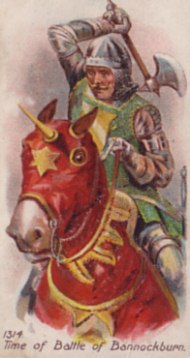
Robert, on the other hand, was under no illusions at to what he would face the following day. Despite the high spirits flowing from the day's victories, the English army was still intact and greatly outnumbered him. His victories that day would allow him to withdraw with honor which is what he planned to do until an English knight, Sir Alexander de Seton, made his way to the Scottish camp. Brought before Robert, he told of the weak and dispirited condition of their army and pledged on his own life that if Robert was to fight the following day, he would win. Robert, therefore, has two choices if he chose to fight. He could remain with his back to the wood in a defensive position and risk being outflanked or to attack before the English could properly deploy, forcing them to fight on unfavorable ground - he chose the latter.
The Scot army rose at dawn on the 24th and by 3:45am it was light enough to see clearly. As they celebrated mass, those who had shown great courage were knighted, including Randolph and Douglas. Full of confidence from the previous day, they formed their divisions and received the order to advance.
Advancing in echelon, Douglas to the left, Randolph at the centre and Edward Bruce to the right, they poured from the wood with a cry. Robert remained with the cavalry and his own division to the flank of Edward Bruce out of sight of the English.
The English, with their split force, were temporarily stunned at the Scottish advance believing they would fight defensively and allowed them to within 100 yards before the order for them to form was given. Suddenly, the Scots halted and dropped to their knees in prayer. Seeing this, Edward sneered, "They kneel to ask for mercy." Sir Ingram de Umfraille, a Scot in English employ replied, "You say sooth now, they ask for mercy, but not of you. Those men will win or die." The king simply replied, "Be it so" and ordered the English advance. (More here.)
Scots, wha hae wi' Wallace bled,
Scots, wham Bruce has aften led,
Welcome to your gory bed
Or to victorie!
Now's the day, and now's the hour:
See the front o' battle lour,
See approach proud Edward's power
Chains and slaverie!
Wha will be a traitor knave?
Wha can fill a coward's grave?
Wha sae base as be a slave?
Let him turn, and flee.
To the Scots, who had faced many betrayals by their own, there was nothing lower than a false friend. To be a liar and a traitor was to be a coward; to be a coward was to be a slave. But on June 24, 1314, courage and loyalty prevailed over tyranny.
More background from Historic UK:
Following the killing of an English sheriff by William Wallace, revolts broke out in Scotland and on 11th September at the Battle of Stirling Bridge, Wallace defeated English forces led by John de Warenne. The following month the Scots raided northern England...Wallace was appointed Guardian of Scotland in March; however in July Edward invaded again and defeated the Scottish army, led by Wallace at the Battle of Falkirk. Following the battle Wallace went into hiding...Further campaigns by Edward in 1300 and 1301, led to a truce between the Scots and English. (Read more.)
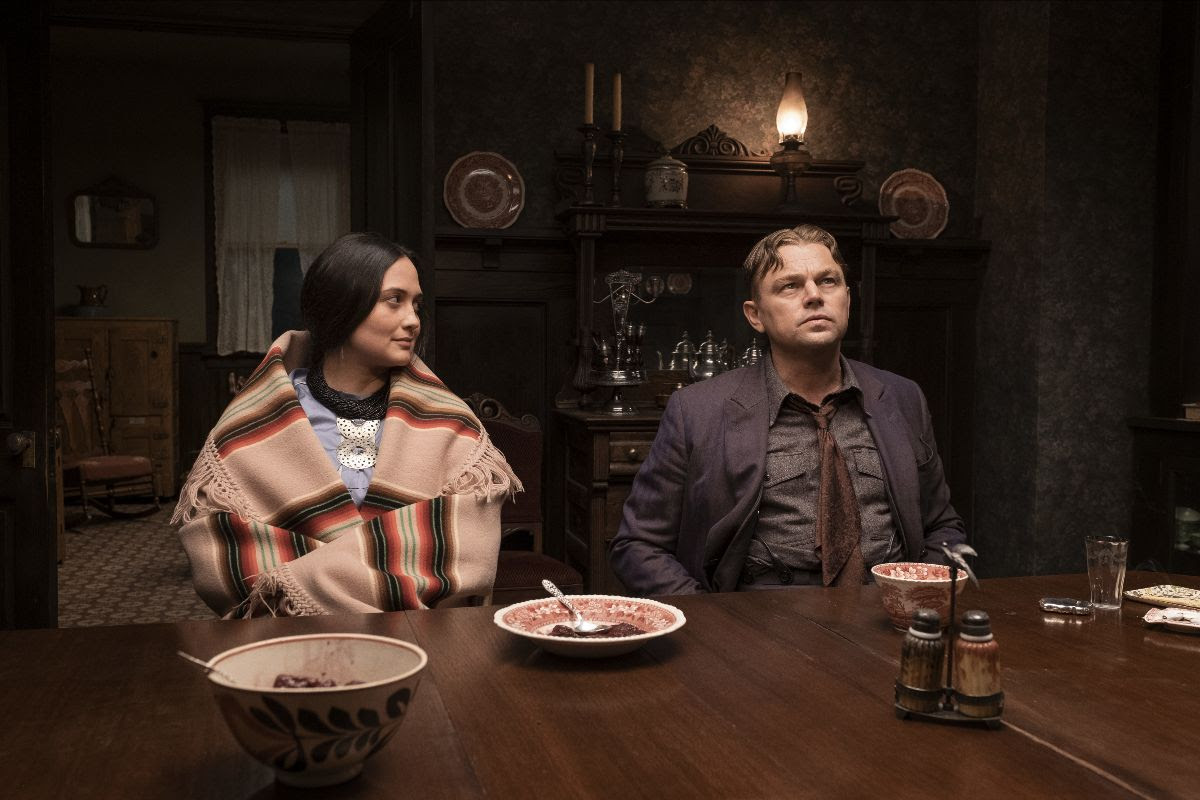
Ernest Burkhart: You know, you got, you got nice color skin. What color would you say that is?
Mollie Burkhart: My color. ~from Killers of the Flower Moon (2023)
The latest Scorsese masterpiece is Killers of the Flower Moon. Well-acted, with magnificent scenery, filmed on location in Oklahoma, the beauty creates an unsettling contrast with the cold-blooded violence against innocent people. Molly Burkhart, played by Lily Gladstone, is particularly unforgettable, radiating wisdom and innocence even as she is overcome by unspeakable sorrow. I highly recommend reading the book by David Grann as well. I read the book before seeing the movie and it added to my appreciation of the depth of evil portrayed on the screen. Once again Native Americans are betrayed by Christian people who pledged to honor their commitments. In the case of the Osage in the film, most appear to be not only Christian but Catholic. The heroine Mollie Burkhart is a devout Catholic, shown in the film assisting at Mass and praying the rosary. She also prays outside in the Osage fashion; there is a lot of overlap between the rituals of the Church and the native rituals. The white people in whom they place their trust are for the most part Freemasons, who want the oil-rich property of the Osage at any price. They really think they have no obligation to honor their word to the Osage, making for a tragedy of unfathomable proportions. There are good white people who helped Molly and her family, such as the parish priest, Molly's housekeeper Vera (portrayed by my cousin Norma Jean), and the G-men sent from Washington to solve the serial killings, most of which are made to look like suicides. The majority of the murders are unsolved to this day.
From The Paris Review:
The larger setting is one of the most insidious criminal conspiracies in American history, a period known as the Osage Reign of Terror, wherein the white cattle rancher William King Hale colluded with associates, including Ernest, his nephew, to steal Osage oil fortunes. Sometimes this scheme involved white men marrying into Osage families and then sometimes murdering their new lovers. In the photograph, Mollie gazes over at Ernest, who’s looking up at the ceiling. In the frame, she is a Mona Lisa in semi-profile, a muse of multitudinous moods. What is that inscrutable expression on her face? Is she being coy? Flirtatious? Is that an inquisitive look? Or one of bemusement? Is she laughing at her beau, or at her predicament—the condition of falling in love with a racist doofus she knows is mainly interested in her money? (Oof.) (Read more.)
After many forced removals, the Osage acquired land in Oklahoma which turned out to be rich in oil. According to True West:
The Osage had a reputation for being fierce and powerful warriors. During the relocation of the Cherokee into Oklahoma in the early 1830s, they clashed with the Osage in a series of battles, forcing the U.S. to build Fort Gibson to protect the Cherokee. By this time, the Osage were hunting the Kiowa, who had just been expelled from the Black Hills by the Sioux. In 1883, the Osage slaughtered hundreds of Kiowa women and children at an unprotected village at Cutthroat Gap in the Wichita Mountains, leaving their cut-off heads in pots for the Kiowa warriors to find.
Treaties with the U.S. gradually forced the Osage onto a reservation in Kansas while they were employed as scouts for the U.S. Army against hostile plains tribes such as the Cheyenne. By the end of the Civil War, Kansas settlers wanted the lands of the Osage reservation. The Johnson administration placed pressure on the tribe to move to Indian Territory, modern-day Oklahoma, offering to buy their lands at 19 cents an acre. Tribal elders stalled until Ulysses S. Grant became president then sold their reservation lands to the new administration at $1.25 an acre.
With this money, the Osage managed to purchase from the Cherokee nearly 1.5 million acres, or most of the Osage Hills, with mineral rights and a greater degree of sovereignty than most tribes enjoyed. The tribe then auctioned off grazing leases for Kansas and Texan cattle ranchers, which made them one of the wealthiest tribes in the United States even before the Burbank Oil Field was discovered in 1897. The Osage demanded and received 10 percent of all revenues derived from oil found within the county, which was also their reservation. (Read more.)
The members of the tribe found themselves wealthy, but the wealth attracted a criminal element. From the Oklahoman:
Leading up to Oklahoma statehood, the U.S. Congress passed the 1906 Osage Allotment Act, legislating that property and mineral income be distributed equally among the more than 2,200 members of the tribe. One equal share became known as a headright — one right per head — and once a headright owner dies, it passes to the next legal heir, even if that heir wasn't Osage. Headrights allowed Osage to earn royalties on oil sales. Those looking for a share of those profits had to pay them for leases to explore and produce oil on their land, too. As demand grew and more and more oil was discovered, it generated millions of dollars for the Osage. In 1921, the federal government mandated that the Osage people were incapable of managing their own wealth and assigned court-appointed white guardians to them, many of whom often swindled them out of their fortunes. According to Grann, the Osage were considered the wealthiest people per capita in the world, earning $30 million in 1923, the equivalent of $400 million dollars today. (Read more.)
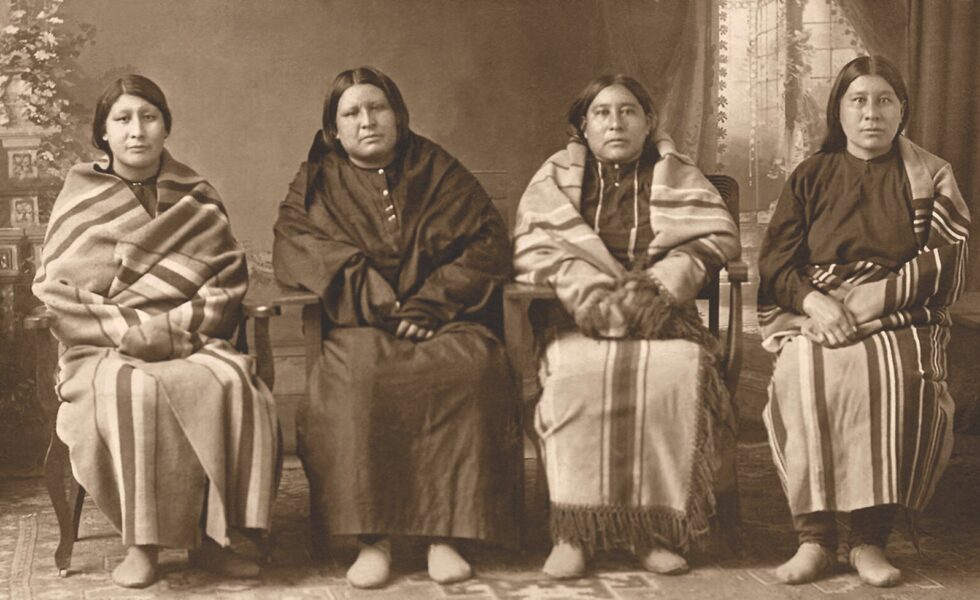 | ||
| The real Mollie Burkhart, second from right, with her three sisters |
 |
| Mollie and her sisters in the film |
More on the casting, HERE.
My second cousin Norma Jean plays the part of Vera, the maid of the heroine Mollie. From WWNY:
Norma Jean got started in acting at the Watertown Little Theatre as a teen.“I remember the director telling me, ‘You don’t think you know what you’re doing, but you know what you’re doing,’” she said. “And I ran with that.” She eventually moved to California to pursue her dreams of acting, picking up roles in theater and film, eventually landing her in the right audition for “Killers of the Flower Moon.”
“Martin Scorsese is my favorite director of all time,” she said, “so I was elated and so nervous.” The movie is based on a true story from Oklahoma in the 1920s, when greedy white men started killing Native Americans from the Osage Nation for their oil rights. Vera is the housekeeper to the main characters, played by Leonardo DiCaprio and Lily Gladstone.
“They bring me to set the first day and I knew I was going to be meeting Leo and Lily and Mr. Scorsese,” she said. “Of course, it’s intimidating at first, but each one of us has the same Screen Actors Guild card in our packet — we’re all actors.” The movie has been a long time in the making. Norma Jean spent five months filming in Oklahoma in 2021.
“It really helped the character development as well because we were all immersed in that land where it all really happened and immersed in the people and that’s what pulled at my heartstrings,” she said. She says growing up in the north country was just the beginning of this path, which has aligned her with some of the greatest movie stars of our time.
“I’m 56 now, I was 54 when I got the role,” she said. “I never gave up and I was never willing to give up. You’ve got to have that tenacity in everything you do and that’s the message, kids.” (Read more.)
 |
| Norma Jean as Vera |