Showing posts with label Jesus. Show all posts

Monday, October 5, 2026

The Angelic Salutation And The Black Death

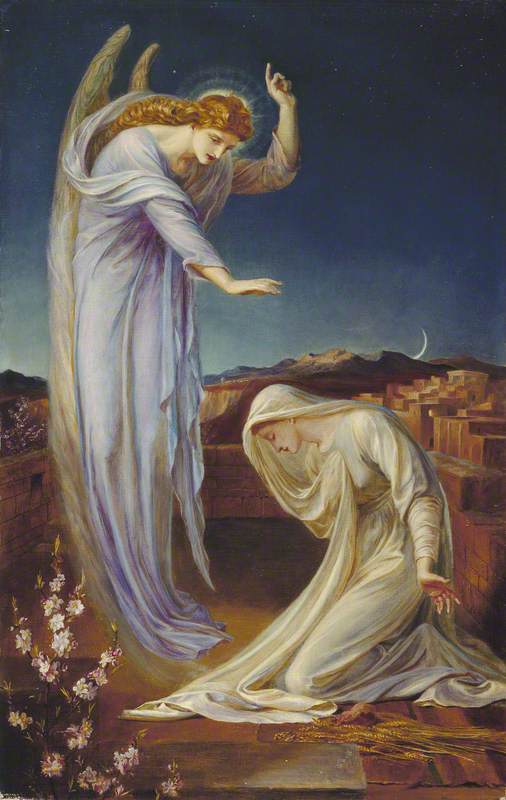
The Annunciation ~ Frederic James Shields
From Aleteia:
This second part (“Holy Mary, Mother of God, pray for us sinners now, and at the hour of our death”) is believed by many to have been added during the plague to ask for the Blessed Mother’s protection from the fatal disease. Venerable Fulton J. Sheen explains this origin in his book The World’s First Love.
Since it seizes upon the two decisive moments of life: “now” and “at the hour of our death,” it suggests the spontaneous outcry of people in a great calamity. The Black Death, which ravaged all Europe and wiped out one-third of its population, prompted the faithful to cry out to the Mother of Our Lord to protect them at a time when the present moment and death were almost one.
An expert in Marian devotion, Fr. Donald H. Calloway, confirms this conclusion in his book Champions of the Rosary and explains how, “After the Black Death, the second half of the Hail Mary began to appear in the breviaries of religious communities, especially those of the Mercedarians, Camaldolese, and Franciscans … the people of the 14th century greatly needed the ‘hope-filled’ dimension of the second half of the Hail Mary prayer.” (Read more.)
Share

Saturday, October 3, 2026

The "Hail Mary" Over the Centuries

From English Historical Fiction Authors:
From Christianity’s earliest days, the Virgin Mary was an advocate for the faithful, an intercessor who would plead their case to God. Devotional images of her go back to the second century, and more Christians started to name their daughters Mary toward the end of the fourth century.

A novelist studying early medieval times can easily see her importance. Charlemagne dedicated a newly built basilica at Aachen to her. On a smaller scale, a scribe wrote, “The book was given to God and His Mother by Dido [of Laon]. Anyone who harms it will incur God’s wrath and offend His Mother.”

No surprise, then, that Christians wanted a prayer just for her. When I first wrote The Cross and the Dragon, I assumed the Ave Maria always had its current form. I just needed the Latin translation for my characters.

Imagine my surprise when my editor informed me that Ave Maria was a lot shorter in the eighth century. “Hail, Mary, full of grace,” or words to that effect go back to the sixth century, so I could have my characters praying “Ave Maria, gratia plena.”

But it apparently took a few more centuries for the prayer to get longer. Two Anglo-Saxon manuscripts from around 1030 include “benedicta tu in mulieribus et benedictus fructus ventris tui” (“blessed are you among women and blessed is the fruit of your womb”). In the 12th century, churchmen accept the greeting to Mary as a form of devotion, as familiar as the Apostle’s Creed and the Lord’s Prayer.

And so the salutation persisted, accompanied by a gesture of homage such as genuflecting, kneeling, or bowing the head. Some saints said the Ave Maria 50 to 150 times a day. (Read more.)
Share

Education and the Moral Life

 From Mater et Magistra:

Practical Steps for Forming a Sound Conscience

  1. Seek Wisdom, Not Just Knowledge – The study of theology, philosophy, and the lives of the saints provides a framework for understanding moral truth. Reading Scripture and the Catechism with a heart open to God’s love helps ground our moral reasoning in faith, not fear.

  2. Cultivate a Relationship with God – Moral decisions should flow from love, not dread. Regular prayer, particularly the Rosary and mental prayer, fosters a deeper trust in God's mercy and guidance.

  3. Practice the Virtue of Prudence – Not every decision is a moral crisis. Learning to distinguish between mortal and venial sin, and recognizing when a choice is simply a matter of prudential judgment, brings clarity and peace.

  4. Confess Regularly, But Not Excessively – Frequent Confession is a gift, but for those struggling with scrupulosity, it can become a source of unnecessary distress. A regular confessor who understands this struggle can provide reassurance and help in forming a balanced conscience.

  5. Trust in Divine Mercy – St. Thérèse of Lisieux reminds us that God’s mercy is greater than our weaknesses. Trusting in His love frees us from the crippling burden of perfectionism and allows us to live joyfully in His grace.

  6. Avoid Unnecessary Doubt – If a person has made an honest effort to discern a moral decision and still experiences doubt, they should trust that God does not demand absolute certainty but a sincere heart. Seeking spiritual direction can also provide clarity.

  7. Remember: God Calls Us to Peace – Christ repeatedly tells us, “Be not afraid.” A moral life lived in love brings peace, not endless anxiety. The more we grow in virtue, the more we can rest in the knowledge that God is guiding us.

(Read more.)


Share

Friday, October 2, 2026

St. Hildegard’s Encounter With Angels & Their Music

 From Catholic Exchange:

St. Hildegard of Bingen, a Doctor of the Church, was not just a Benedictine superior, mystic, diplomat, woman of letters, naturopath, and linguist but also a composer. She left us with seventy-seven liturgical chants, hymns, and sequences and a liturgical drama: The Order of the Virtues. Fr. Pierre Dumoulin wrote that these works make up one of the richest repertoires of medieval music. Yet they are not the fruit of a composition work, strictly speaking, but the transcription of celestial harmonies that the saint perceived through her visions.

Hildegard actually contemplated the heavenly myriads. “Some radiated like fire. Others were completely clear. Still others glit­tered like stars. It was a concert of voices that was like the sound of the sea.” She thought that the angel was man’s model. The angel reminded St. Hildegard that praise was her vocation: “Man, God’s creature, must praise Him because his soul is made to live in praise, like the angels.”

The Fall contributed to disturbing the original harmony whose memory lives in us and which we must rediscover: “The canticle of praise is rooted in the Church according to celestial harmony through the Holy Spirit.” St. Gregory said it before her: music is the most elevated of all hu­man activities. Hildegard believed that “when man’s spirit is well directed, he hears the song of the angels.” “The soul is itself a symphony, and it harmonizes everything.” She wrote that “the cohort of the angels yearns for God. It recognizes Him throughout the symphony of its praises and celebrates its past and present eternal mysteries.” (Read more.)
Share

Thursday, October 1, 2026

The 4 Sins that Cry Out to Heaven for Vengeance

 From Trad West:

There are sins Scripture describes as ‘crying out to Heaven’. The Church preserves that warning in the Catechism, paragraph 1867.

Traditionally, they are grouped into four: deliberate murder [the shedding of innocent blood], the sin of Sodom, oppression of the poor, and defrauding workers of their wages.

The sin of Murder:
Start with Abel. Cain killed his brother, but burying the victim did nothing to conceal the crime from God. His brother’s blood cried out from the ground.

The Sin of Sodom:
Then we have Sodom, whose sins brought it under the judgment of God. What was their sin? Scripture gives two descriptions:
>Arrogance, greed, neglect of the poor (Ezek 16,49-50)
>Sexual immorality and perversion (Jude 1,7)

The fire that fell on Sodom was a warning for all generations. Our generation is more wicked than Sodom, some exorcists say we’re more wicked than the generation of the flood. Food for thought. (Read more.)

Share

Monday, September 28, 2026

The Gaze That Tells Us Who We Are

 From Dominique Seraphin:

“God does not love us because we are valuable. We are valuable because God loves us.”

I have read those words many times. Each time, they seem to reach a little deeper.

It is easy to admire Fulton Sheen for what he accomplished. He was a brilliant scholar, a gifted preacher, a bishop, an author, and a pioneer who used radio and television to bring the Gospel into people’s homes. He knew how to speak about eternal things in a way that made people stop and listen.

But the part of his life that moves me most happened away from the cameras.

At his priestly ordination, Sheen promised to spend a Holy Hour each day before the Blessed Sacrament. He kept that promise for the rest of his life. Before he spoke publicly about Christ, he went to be with Christ. Before he asked others to listen, he listened. He brought his work, his questions, his gifts, and his need before Jesus in the Eucharist.

I wonder how many of his most powerful words began in that silence.

There is something beautiful about a man whose voice reached millions choosing, day after day, to be quiet before the Lord. The world knew Sheen for what he could say and do. In the chapel, he could simply be a beloved son in the presence of his Father.

Maybe that is why his words about our value carry such weight.

We hear “Jesus loves you” so often that we can forget how astonishing it is. We may readily believe that God loves humanity, the Church, our families, and the people we pray for. Yet when His love becomes personal—when we have to say, Jesus loves me, knowing everything about me—we sometimes hesitate.

We know the parts of ourselves we would rather hide. We remember the harsh words we said yesterday, the resentment we keep revisiting, the prayer we promised to make time for and didn’t. We know how quickly we compare ourselves with someone who seems more patient, more generous, more joyful, or more holy. (Read more.)

Share

Saturday, September 26, 2026

Jesus by Another Name

 From The Logres Institute:

Unlike many other authors, we have explicit writings from Lewis explaining what he was trying to portray. In the remainder of this article, I presume that Rice is writing from a position of ignorance. To cure his lack of knowledge, I invite him to acquire a copy of Lewis’s Letters to Children before he writes about Narnia in the future. Lewis was transparent in his explanations, and his actual letters to the children who wrote to him explain why Christians are justly upset by this casting decision. You mess with Jesus, and you mess with the literal foundations of the Christian faith. Aslan is Jesus, in another world.

To truly understand Lewis, one must read Lewis; and more of his writings than just Narnia. Any claims on what he thought as he wrote the Narnia tales need to be backed by primary source material to be valid, not by opinion that fits one’s own personal narrative. Lewis’s replies to his youngest readers provide helpful insight.

In a letter written by Lewis from Magdalen College Oxford, 22nd. January 1952, Lewis writes to a child named Carol about how to pronounce Aslan and who He is:

Dear Carol,

It is a pleasure to answer your question. I found the name in the notes to Lane’s Arabian Nights: it is the Turkish for Lion. I pronounce it Ass-lan myself. And of course I meant the Lion of Judah. I am so glad you liked The Lion, the Witch and the Wardrobe. I hope you will like the sequel (Prince Caspian) which came out in November.

Yours sincerely,

C.S. Lewis

(Read more.)


Share

Monday, September 21, 2026

Christianity in the Disembodied Age


From Hilary White at The Sacred Images Project:

When reading the New Testament through our usual theological lens of a grand cosmic drama, it’s easy to miss the significance of the kind of work done by most of the named protagonists. The first Apostles, Peter, Andrew, James and John are all fishermen. And Thomas, Bartholomew and Philip probably were too. Paul of Tarsus - a highly educated Pharisee and Roman citizen - is described as a tentmaker, though the Greek skēnopoios may mean something closer to a general leatherworker or maker of canvas goods, and his friends Aquila and Priscilla practised the same trade. Tabitha (also called Dorcas) was a seamstress.

There were a few representatives of what we might today call the “middle class”1. Lydia was a successful cloth merchant who specialised in the famous purple cloth of the region. Luke was a physician (and painter), Matthew and Zaccheus were both publicans (tax collectors for the Romans) a profession despised by the Jews, of course, though lucrative. Cornelius and Julius were centurions in the Roman army. Zenas (Titus 3:13) is identified as a lawyer.

Later the movement attracted members of the upper echelons, including Erastus, who is identified by Paul as the city of Corinth’s director of public works2. The wealthy, slave-owning convert Philemon was an upper-class patrician, probably a Romanised Greek and landowning civic politician in the city of Colossae. Very interestingly, Paul refers to Philemon3 as a “dear friend and fellow worker” in his letter about the escaped slave Onesimus.

But we get the general tone from Paul of how deeply work, and often manual work, was morally incorporated into early Christian thinking. “We labour, working with our own hands, (1 Corinthians). “We worked night and day,” ( 1st Thessalonians) and “if anyone will not work, neither shall he eat,” (2 Thessalonians).

In fact it would never have occurred to any person of that time that work - an occupation of some kind, whether manual or domestic labour, artisan craft or mercantile trade, or even senatorial-rank political involvement - was something embarrassing to be escaped in favour of a life of pure leisure and entertainment. On the contrary, Christians taught that whatever work you did it should be ordered to the Christian goals of salvation. (Obviously this meant there were some trades and professions you could not enter, like prostitution, gladiatorial combat, making idols for the temples, etc.) (Read more.)

Share

Friday, September 18, 2026

The De-Christianization of France

 From The War on Beauty:

France has been in a process of de-Christianization since the Revolution in 1789 when Catholicism was outlawed and replaced with a new atheistic cult called ‘The Cult of Reason.’ A lot of people were surprised by the recent mockery of the Last Supper at the Olympic Games, but this isn’t the first time there has been an outright assault on the Catholic Church in France, nor is this the worst instance (shockingly).

After the Catholic monarchs and Ancien Régime were violently couped in 1789, a new anti-religious, and clearly satanic totalitarian government came to power and immediately severed all ties with the Church. Along with the persecution of the aristocracy, normal French people/ peasants, including thousands of clergy were martyred for not renouncing their Catholic beliefs.

This was the first big move in shifting France away from a faith-based society to one that worships reason, science, and man’s own ‘intelligence’ as the new God. The new regime went so far as to remove all crosses and religious symbols in the country including from graveyards, ceased all Catholic schooling, and not only closed all churches but forcibly confiscated them from the diocese to fund the new government. (Read more.)


Share

Thursday, September 17, 2026

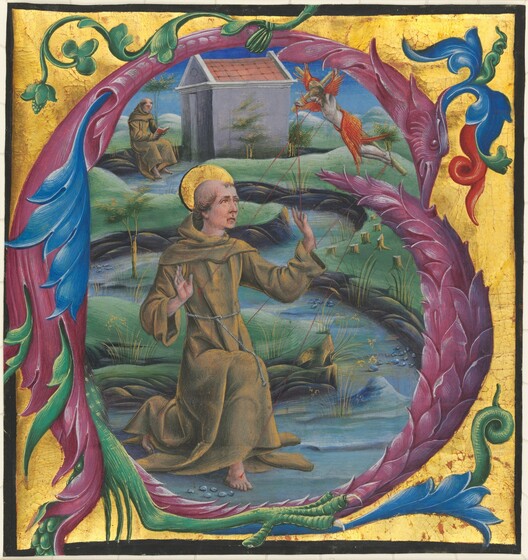
Heavenly Earth: Images of Saint Francis at La Verna

A 2018 exhibition. Today is the feast of the stigmata of St. Francis. From The Leaven:
WASHINGTON (CNS) — St. Francis of Assisi’s reception of the stigmata, the wounds of Christ, at La Verna in Italy and its depiction by artists beginning in the 15th century is the focus of a National Gallery of Art exhibit. “Heavenly Earth: Images of Saint Francis at La Verna” includes 30 pieces of Franciscan art centered on the miraculous 13th-century event. The exhibit was to open Feb. 25. Ginger Hammer, an assistant curator at the museum in Washington, said the display focuses on an “unprecedented event in Western spirituality.” No one in recorded history had experience such an occurrence before St. Francis did in 1224.

It happened while St. Francis was meditating on the passion of Christ during one of his regular retreats in the mountain wilderness. “He wanted to understand the very suffering that Christ endured. The result of his prayers reportedly is that a seraph, or six-winged angel, approached him enfolding the image of Christ on the cross. When the seraph departed, the actual wounds of Christ’s passion were transferred to the body of Francis,” Hammer told Catholic News Service Feb. 20 during a media preview. “That had never happened before and it was quite remarkable that through his own endeavors something mystical of this magnitude could happen to a human being,” she said.

A Franciscan sanctuary and museum complex mark the La Verna site today and continues to welcome pilgrims. The event was so extraordinary that artists over the centuries have tried to capture it to share with others. The exhibit focuses on work in various media from the 15th through 18th centuries. (Read more.)
More information at the National Gallery of Art website, HERE. Share

Sunday, September 13, 2026

Our Lady of Scherpenheuvel


Marie de' Medici had great devotion to Mary under her title of Our Lady of Scherpenheuvel, giving a reproduction of the statue to her daughter Henrietta Maria for one of her chapels in London where it was used by the Confraternity of the Most Holy Rosary. From Wikipedia:

Even before the official approbation of the cult of Our Lady of Scherpenheuvel, pilgrims took particles of the oak tree with them as pious souvenirs. Several stories of miracles attributed to the intercession by the Virgin relate of the thaumaturgic power of this Scherpenheuvel or Montague wood. Following the approbation, Archbishop Hovius ordered the tree to be cut down. It was divided in several parts. Some remained with the sanctuary; one particularly large piece was given to Albert and Isabella. Most of this Montague wood was used to make images of the Virgin Mary. Distributed as gifts among princes, nobles and clergy, they helped to disseminate the cult of Scherpenheuvel.[13]

Quite a few Belgian churches and convents came to possess an image carved in Montague wood. Well known examples remain in the Church of St. Charles Borromeo in Antwerp, the Church of St. Hilonius in Izegem and the chapel of the Capuchins in Enghien. In the Grand Duchy of Luxembourg, the statue of the national patron saint, Our Lady Comforter of the Afflicted or Our Lady of Luxembourg, is believed to contain Montague wood. A smallish statue of the Virgin and Child in Montague wood was taken by St. Marguerite Bourgeoys to Montreal and stands presently on her tomb in the Notre-Dame-de-Bon-Secours Chapel.[14]

Some places of worship became closely associated with the cult of Scherpenheuvel. In the vicinity of their château of Mariemont, Albert and Isabella founded the priory of Montaigu in the present day municipality of Morlanwelz. In the town of Gray a statue of the Virgin made out of Montague wood became the object of a regional devotion. Likewise in the Franche-Comté, the statue donated to the priory of Bellefontaine in Brussey came to attract many pilgrims.[15] In the proximity of the Spanish Court, the Convent of Las Descalzas Reales obtained an altar dedicated to Nuestra Señora de Monteagudo.

The House of Lorraine had a particular devotion for Scherpenheuvel. Cardinal Charles of Lorraine, prince-bishop of Strasbourg, founded a chapel dedicated to Our Lady of Scherpenheuvel in the noviciate of the Jesuits at Nancy. After his death in 1607, his sister Antoinette completed the project with an altarpiece depicting the ducal family venerating Our Lady of Scherpenheuvel. The chapel served as the repository of the embalmed hearts of the members of the House of Lorraine until 1720.[16] The cult was also greatly favored by the French Queen Marie de' Medici. During her regency, the Discalced Augustinians obtained a statue in Montague wood at their church of Notre-Dame-des-Victoires. During her exile, she donated one statue in Montague wood to the city council of Cologne and another to the monastery of the Discalced Carmelites of that city. While serving the Catholic household of her daughter, Queen Henrietta Maria, the Queen's Chapel of St James's Palace likewise had an altar with a Madonna in Montague wood.[17] (Read more.)


(Image Source) 

A history of the original statue, HERE.

Share

Saturday, September 12, 2026

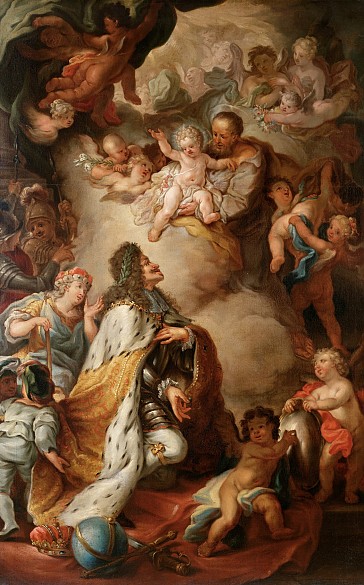
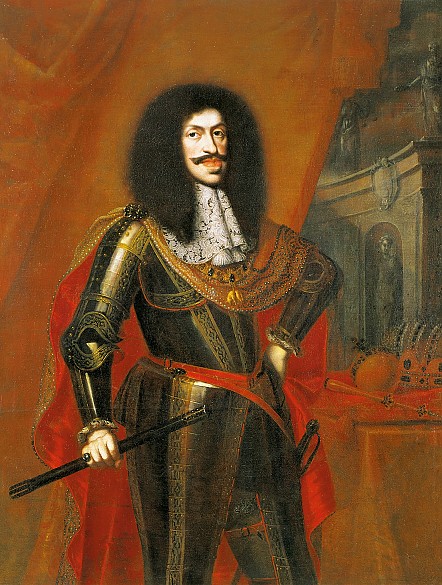
St. Joseph and Emperor Leopold I


Holy Roman Emperor Leopold I is shown kneeling before the Child Jesus, Who blesses him from the arms of His foster-father St. Joseph. (Via The World of the Habsburgs.) Leopold is known as the "Baroque Emperor" and was a first cousin of Louis XIV of France, as their mothers were sisters. He was also a former brother-in-law of Louis' Queen, Maria Teresa of Austria (Spain), for he had been married to her younger sister, the Infanta Margarita, painted by Velasquez. Also from The World of the Habsburgs:

Leopold I was a defining figure in the history of the Habsburg dynasty. His reign saw the consolidation of the Monarchy after the Thirty Years’ War and the decisive victories against the Ottoman Empire that enabled the Habsburg Monarchy to become one of the leading Great Powers in Europe.

Leopold himself was however a shy, indecisive character who effaced himself behind his imperial persona. He was not a ‘radiant’ monarch, being almost grotesquely ugly and afflicted with an extreme example of the Habsburg jaw. It is said that he had his physical deficits emphasized in portraits of himself out of humility. The emperor compensated for his personal shortcomings with the nimbus of his sublime office. Leopold’s adversary Louis XIV once remarked that it was not the emperor in person that he feared but his ‘miracle’.

Leopold was steeped in the majesty of imperial office, emphasizing its religious aspect above all else. The victory over the Ottoman Empire which had put a stop to its westward expansion served pro-Habsburg propaganda as an ideal instrument to stylize Emperor Leopold as the protector of Christendom. Thus as the donor of the Plague Column on the Graben in Vienna, Leopold is represented kneeling in humility as he recommends his realm to the heavenly powers. On another occasion the emperor referred to himself as the ‘least and most unworthy servant of the Holy Virgin Mary’.

[...]

One positive aspect of his personality was his pronounced artistic gifts, in particular for music. He was himself an enthusiastic musician and the author of several compositions, the quality of which should not be underestimated. Opera was his great passion. Important occasions at court were staged as allegorical Baroque spectacles with no expense spared. (Read more.)

More on Emperor Leopold's wives and children, HERE.

Marriage of Leopold I to his third wife Eleonore Magdalene of Neuburg

Eleonore Magdalene of Neuburg, Emperor Leopold's third wife, was very devout and had wanted to be a Carmelite nun. Instead she became the mother of seven children and a wife who helped her husband rule a great empire. She had her sons educated by the Jesuits. She was the grandmother of Empress Maria Theresa and great-grandmother of Marie-Antoinette. More about Empress Eleonore, HERE.

Eleonore and Leopold


Here is my book, in which I discuss the Habsburg patrimony in the life of Marie-Antoinette.

Share

Meet Hildegard of Bingen, the German Mystic Who Destigmatized Women’s Health

 From Literary Hub:

For Hildegard of Bingen, the German mystic, scientist, composer, and philosopher, women’s maternal bodies were not corrupting and degrading, but strong, nurturing, and creative. Hildegard, who was born at the end of the eleventh century, is the first known female medical writer in Europe during the High Middle Ages. Most of the era’s discourse about human generation came from monks and theologians who vowed never to have any contact with women’s bodies. But Hildegard introduced into the Christian medical tradition compassionate and celebratory theories about physical maternity that were inspired by her own bodily experiences and those of the women she cared for.

Hildegard was a Catholic abbess of the Benedictine Order. The tenth child of a noble family, Hildegard was tithed to the Disibodenberg, a monastery nestled between two rivers in Germany’s Rhineland‑Palatinate region, when she was born. After being cloistered when she was eight, she took her vows at fourteen and became a nun. Hildegard prized virginity as the highest state of womanhood, and she never experienced biological motherhood. But her commitment to spiritual motherhood did not stop her from thinking seriously about conceiving, bearing, and birthing. (Read more.)

Share

Friday, September 11, 2026

Justice Without Vengeance

 From Sensus Fidelium:

A Catholic reflection on mental illness, psychiatric medication, moral responsibility, and the online appetite for condemnation

There are crimes so terrible that words seem almost indecent beside them. Children are dead. A husband or wife is left with a home emptied of the people who made it a home. Grandparents bury grandchildren. Families who expected ordinary joys instead spend the rest of their lives asking a question that may never be answered: How could this have happened?

That is where any discussion of the Lindsay Clancy case must begin, not with politics, pharmaceutical companies, courtroom personalities, or social-media arguments, but with Cora, Dawson, and Callan Clancy. They were innocent children whose lives were taken. Nothing said about their mother’s mental condition can restore them or make what happened less objectively horrific.

But beginning with the victims does not require us to end with vengeance.

The recent mistrial in Lindsay Clancy’s case came after jurors were unable to agree on whether she was criminally responsible when she killed her three children in January 2023. Her defense maintained that postpartum psychosis and bipolar disorder had deprived her of the ability to appreciate the wrongfulness of her actions. Prosecutors argued that she remained capable of planning, choosing, and understanding what she was doing. The disagreement was not about whether the children died by her hand. It was about the condition of the mind and will behind that hand. Associated Press

That distinction is uncomfortable. It is also profoundly Catholic. (Read more.)

Share

Thursday, September 3, 2026

The Art of Pilgrimage


September is the month of Our Lady of Sorrows. From The Way of Beauty:

Pope Benedict XVI, in The Spirit of the Liturgy, identified three authentic traditions of Christian liturgical art: the iconographic, the Gothic, and the Baroque. Each is a legitimate expression of the Christian understanding of the human person and our relationship to God, and each communicates that understanding through a distinct visual language, thereby promoting prayer and worship among the faithful. The iconographic tradition, which dominated Christian art in both East and West until the 12th century, portrays man as he will be in heaven: transfigured, luminous, outside ordinary space and time. The Baroque, which developed in the 17th century, portrays fallen historical man in this life, in the full drama of suffering and grace. The Gothic stands between them, and it is the art most characteristic of the high medieval period in the West.

The Gothic is an authentic and distinct style of liturgical art that developed organically in the West from the iconographic prototype. As the change was gradual, any attempt to date its beginning involves some arbitrary choice. Most commentators settle on the mid-12th century, coinciding broadly with the completion of what is generally considered the first Gothic church, the Abbey of St Denis in Paris, in 1144. The name ‘Gothic’ was coined by High Renaissance commentators as a term of contempt. They held it to be a barbaric style belonging to the period of cultural decline that they believed had begun when the Goths overran the Roman Empire in the West a thousand years earlier. Historians today do not generally share that view of cultural decline, but the name stuck. Even those of us who admire Gothic culture and art continue to use it!

The impetus for the departure from the iconographic prototype stemmed from an increased emphasis on the reliability of human experience and the value of information received through the senses. This led to a greater curiosity about and appreciation of the natural world. Such appreciation was not new: Christians had always relied on sensory information and valued the beauty of the cosmos. What was different was the degree of weight now placed upon them.

Tied to this was the conviction that our world, though fallen and imperfect, is nevertheless good, ordered, and beautiful. There may be evil and suffering in the world, and it may not be as good and beautiful as it ought to be, but it remains God’s creation. This appreciation of the natural world and confidence in our ability to know it through the senses sparked curiosity and a desire to observe it more closely. One effect was the rise of scientific inquiry; another, the one that concerns us here, was an increased naturalism in art, a greater correspondence to natural appearances. The devotion to rational inquiry bound up with this cultural movement also led to a new approach to learning and to the establishment of the great universities, among them those of Paris and Oxford. (Read more.)


Share

A Monastery to ‘Last a Thousand Years’

 From NCR:

A community of Discalced Carmelite sisters is using centuries-old methods to build a monastery in hopes that it will serve as “a beacon of light” for generations to come in Fairfield, Pennsylvania. When the sisters of the Carmel of Jesus, Mary, and Joseph realized they had outgrown their 1940s monastery in the Diocese of Harrisburg, they knew they wanted to build their next home “in a way that is designed to last,” that would speak to St. Teresa of Ávila’s vision for their charism, Catherine Bauer, the director of marketing and development for the sisters, told EWTN News. “And by that, they mean last a thousand years.”

Bucking modern architecture and building conventions, the Fairfield sisters have opted to build their monastery using old-world methods including traditional stonemasonry and timber framing. While the scale of the monastery “will be on the smaller side,” according to Bauer, “it’s more about the stonework, the authenticity of building from the ground up using no nails, no glue, [and] no electricity running through it.” (Read more.)

Share

Sunday, August 30, 2026

The Catholic Revival

 From Mark Judge at Hot Air:

Sergio Infante, a professor at Yale, is on a mission from God. He’s determined to make sure the new Catholic revival energizing Generation Z is woke. Contra Professor Infante, it is essential that the new wave of young Catholics be anti-communist. I’d like to encourage them to sign up for the Anti-Communist Film Festival, which will be held at the Victims of Communism Museum in Washington, D.C. in October. Registration is free. Here is Professor Infante from his piece in Slate:

Around the United States, as you’ve probably heard, Gen Z Catholics are heading to the pews in eye-popping numbers. They meet up in pizzerias and follow one another on social media. They flock to Catholic student organizations, which are booming. And at Yale University, where I teach Latin American and global history, they attend classes and public lectures to learn about their faith.

(Read more.)


Share

Tuesday, August 25, 2026

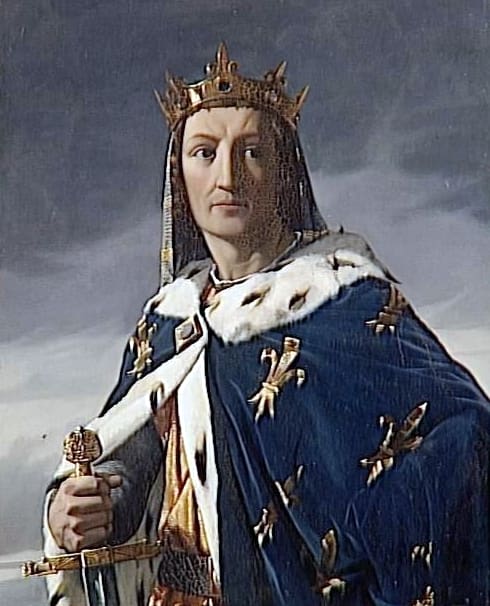
Saint Louis IX and Politics


 From Catholicism:

Today is the feast of King Saint Louis of France. As the formerly Christian West is sliding further into the tyranny of liberalism, it is balm to the soul to consider that the people in Louis’ France were freer than we are today. They were free from big government meddling in their lives and their wallets. And they were free in the most important way, for Saint Louis believed in a Christian order wherein the State was neither inimical nor neutral to the Church, but was the Church’s helper in securing the happiness, temporal and eternal, of her subjects.

Our modern “freedom,” by contrast, is servitude.

Sad to say, Saint Louis’ own grandson, Philip IV (“the Fair” — called so on account of his outward looks, not his inward dispositions!) was greedy to rob the Church of her influence in civil society. It has long struck me as ironic that this same Philip, who was so ill disposed to the traditional role of the Church in statecraft, was also the one who persecuted the Knights Templar, robbing them of their possessions and murdering their leaders. One of his victims was Jacques de Molay, the twenty-third and last Grand Master of the Templars. The reason I find all this ironic, is that the Freemasons, who are much closer to Philip than to de Molay in their ideology, falsely take the murdered Templar as one of their own heroes — among other ways, by naming their young men’s fraternal organization, “DeMolay International.” Philip IV, who murdered Jacques de Molay, also persecuted Pope Boniface VIII, a great pope who defended — as I’ve pointed out elsewhere — the same traditional alliance of throne and altar that Philip’s saintly grandfather believed in. That tradition, known as “the doctrine of the two swords,” was eloquently put forth in Unam Sanctam, a bull written in direct opposition to Philip the Fair.

It was Boniface VIII, by the way, who canonized Saint Louis IX. (Read more.)


More HERE.


Also from Catholicism:

The custom of genuflecting (literally, in Latin, “bending the knee”) for the Incarnation (“…and the Word was made Flesh…”) in the Creed, was begun by Saint Louis IX, King of France, who knelt out of devotion when he heard the words sung at Mass one day. This is something of a holy mirror of the secular custom of standing for the “Hallelujah Chorus” in Handel’s Messiah. (King George II was so stirred during the performance that he rose to his feet in excitement. When the king stands, everybody stands, even during a concert.) Similarly, thanks to Louis’ piety, and the French respect for their monarch, the King of Kings is saluted with a genuflection every time his Holy Incarnation is recalled in the Credo of the Roman Rite. (Read more.)


Share

Sunday, August 23, 2026

The Modesty Fallacy

 Worrying about female modesty has become an obsession among many Christians. Yes, there is more flesh exposed than there was in past times. But there is such cult-like behavior in many Catholic circles, including homeschooling groups, that has nothing to do with Church teaching nor with Sacred Scripture. I knew one group of young mothers where no one could wear cologne. Another group is saying you cannot take Catholic children to the beach because of what they might see. People make up their own rules that have nothing to do with tradition but with their own irks and quirks. They are the new Puritans. And as a historian I can tell you that standards of modesty among Catholics have changed and fluctuated a great deal for 2000+ years. I will  never forget the reaction of a devout lady when she was shown the original edition of my novel Trianon with the beautiful LeBrun portrait of Marie-Antoinette and her children on the cover. "She's wearing a low-cut dress!" was the exclamation. As for immodesty being connected to rape, Muslim women are raped even when they are covered from head to toe. And what about all the nuns raped by Communists? And I have lamented about all the young Catholic women making themselves deliberately unattractive in ugly, shapeless clothes as a badge of piety.

Lindsay T. has an interesting series of articles on her substack.

The virtue of modesty is defined in the Catechism as “a virtue of the heart” which “guides how one looks at others and behaves toward them in conformity with the dignity of persons”.[7] How men and women dress is important, but judgement of one’s degree of modesty is not the responsibility of the on-looker. In fact, the on-looker should employ modesty in how he looks and behaves towards the other person.

Pope John Paul II, in his book Love and Responsibility, also places responsibility of chaste thoughts on the on-looker:

The virtue of chastity is underdeveloped in anyone who is slow to affirm the value of the person and allows the values of sex to reign supreme: these, once they take possession of the will distort one’s whole attitude to a person of the other sex. The essence of Chastity consists in quickness to affirm the value of the person in every situation.[8]

If an onlooker is tempted to lust by a woman wearing yoga pants or spaghetti straps, I would suggest their attitude towards the other sex has been distorted; they have allowed “the values of sex to reign supreme.” The focus should be on affirming “the value of the person in every situation.”

The culture around Franciscan University, though it professes to teach and encourage a Catholic sexual ethic, has proven repeatedly that it does not affirm “the value of the person in every situation” when it comes to cases of harassment and assault. In fact, it has repeatedly favored the perpetrator—which is most often male—and has scapegoated alleged victims—who are most often female. The questions that female students have received upon reporting harassment or assault prove the strength of the prevailing group theory: It can’t be the man’s fault. There must be something the girl did to incite, invite, or welcome that behavior.

[....]

As a Catholic woman and mother, it concerns and affects me when, at the local Catholic high school, a teacher who is also a Franciscan graduate tells a classroom that “rape culture” is a product of feminism (See Krason: “The sexual harassment frenzy… is the latest poison from the Sexual Revolution”) and many men’s lives have been ruined by false accusations. This group theory that women are responsible for men’s purity is a part of their cultural evangelism. The University’s sexual assault misinformation spreads with conviction. As long as this group theory can subsist—that women are responsible for male virtue—then the friars can sidestep accountability. A University that has protected abusers (who are overwhelmingly male) and mishandled (overwhelmingly female) students’ reports of harassment and assault will be seen as not only blameless, but as a conservative institution battling the woke, feminist agenda of “rape culture” (I hope that sounds as crazy to you as it does to me). (Read more.)

NOTE: Yes, there is a jab at Trump for something coarse he said years ago. He was saying how rich and powerful men are often able to get away with grotesque behavior towards women. He was not advocating the bad behavior, which is obvious when one hears the entire conversation.

Share

Saturday, August 22, 2026

Death of the Great God Pan

 From The Greek Reporter:

One of the strangest stories to survive from the ancient world of the Greeks tells of a mysterious voice heard across the sea announcing something almost unthinkable. According to the voice, the Greek god Pan was dead.

The story was recorded by the Greek philosopher and historian Plutarch in his work On the Obsolescence of Oracles, written during the Roman period. Rather than recounting a familiar myth about a god battling monsters or interfering in human affairs, Plutarch presented the episode almost like a contemporary report. He included named witnesses, specific geographical locations, and even an investigation allegedly ordered by the Roman emperor.

The story raises an enduring mystery about what Plutarch believed had happened and why the death of Pan would have been considered such a remarkable event. It also offers a glimpse into how ancient Greeks understood their gods, oracles, and the changing religious world around them. (Read more.)


Share