Showing posts with label Scripture. Show all posts

Thursday, September 3, 2026

The Art of Pilgrimage


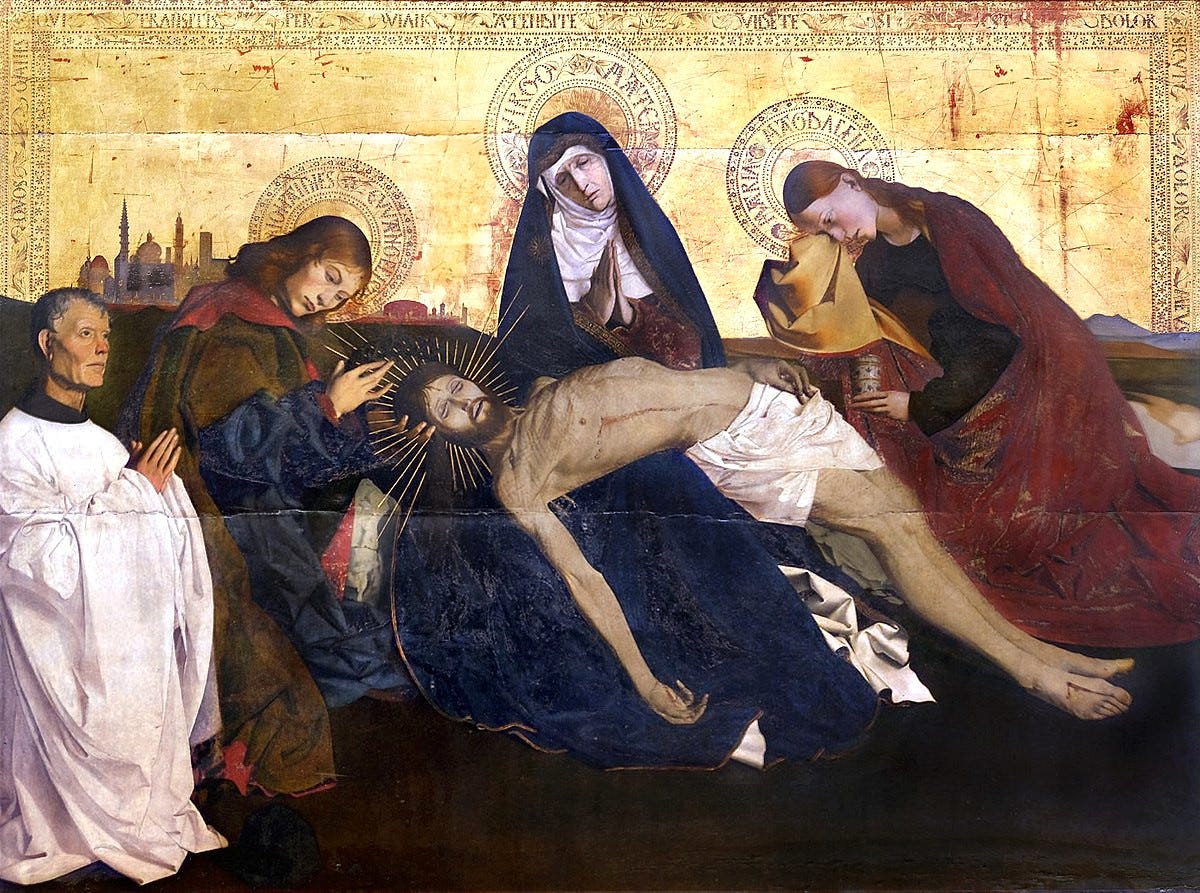
September is the month of Our Lady of Sorrows. From The Way of Beauty:

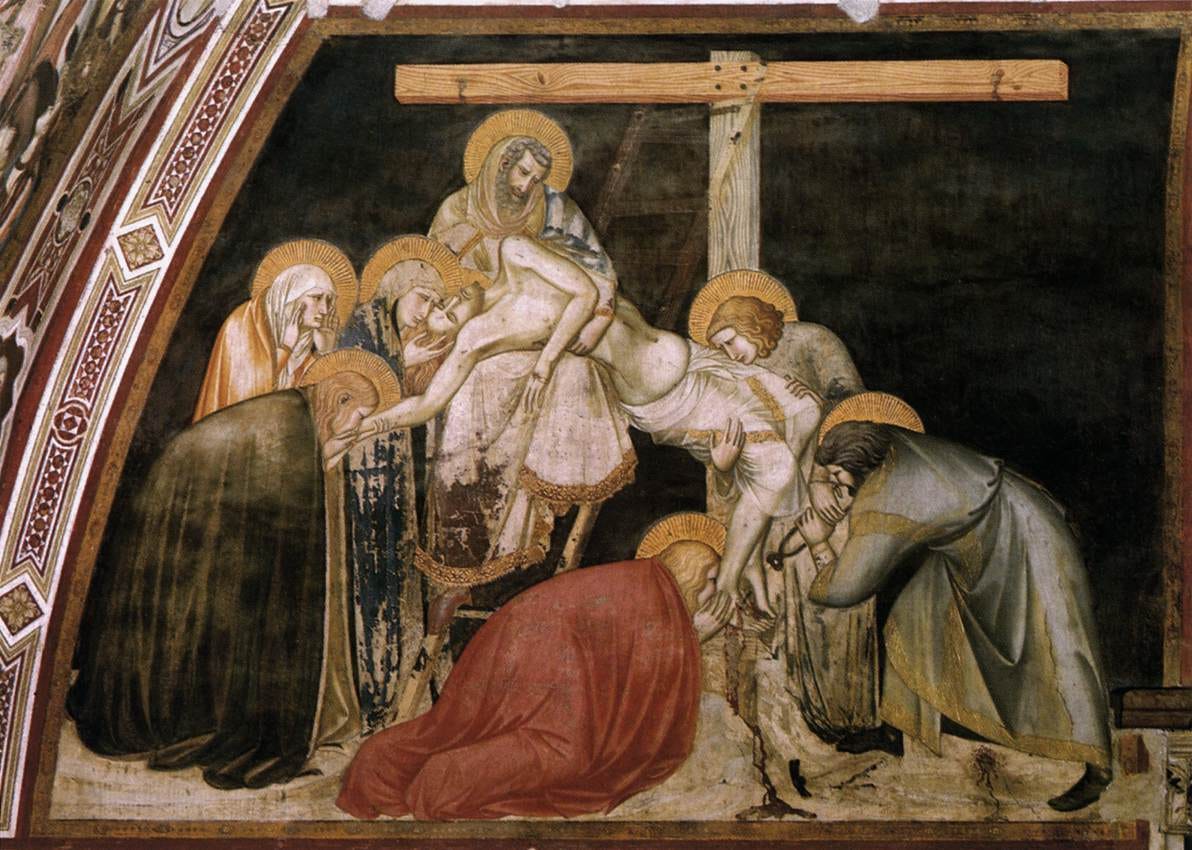
Pope Benedict XVI, in The Spirit of the Liturgy, identified three authentic traditions of Christian liturgical art: the iconographic, the Gothic, and the Baroque. Each is a legitimate expression of the Christian understanding of the human person and our relationship to God, and each communicates that understanding through a distinct visual language, thereby promoting prayer and worship among the faithful. The iconographic tradition, which dominated Christian art in both East and West until the 12th century, portrays man as he will be in heaven: transfigured, luminous, outside ordinary space and time. The Baroque, which developed in the 17th century, portrays fallen historical man in this life, in the full drama of suffering and grace. The Gothic stands between them, and it is the art most characteristic of the high medieval period in the West.

The Gothic is an authentic and distinct style of liturgical art that developed organically in the West from the iconographic prototype. As the change was gradual, any attempt to date its beginning involves some arbitrary choice. Most commentators settle on the mid-12th century, coinciding broadly with the completion of what is generally considered the first Gothic church, the Abbey of St Denis in Paris, in 1144. The name ‘Gothic’ was coined by High Renaissance commentators as a term of contempt. They held it to be a barbaric style belonging to the period of cultural decline that they believed had begun when the Goths overran the Roman Empire in the West a thousand years earlier. Historians today do not generally share that view of cultural decline, but the name stuck. Even those of us who admire Gothic culture and art continue to use it!

The impetus for the departure from the iconographic prototype stemmed from an increased emphasis on the reliability of human experience and the value of information received through the senses. This led to a greater curiosity about and appreciation of the natural world. Such appreciation was not new: Christians had always relied on sensory information and valued the beauty of the cosmos. What was different was the degree of weight now placed upon them.

Tied to this was the conviction that our world, though fallen and imperfect, is nevertheless good, ordered, and beautiful. There may be evil and suffering in the world, and it may not be as good and beautiful as it ought to be, but it remains God’s creation. This appreciation of the natural world and confidence in our ability to know it through the senses sparked curiosity and a desire to observe it more closely. One effect was the rise of scientific inquiry; another, the one that concerns us here, was an increased naturalism in art, a greater correspondence to natural appearances. The devotion to rational inquiry bound up with this cultural movement also led to a new approach to learning and to the establishment of the great universities, among them those of Paris and Oxford. (Read more.)


Share

Tuesday, August 25, 2026

Saint Louis IX and Politics


 From Catholicism:

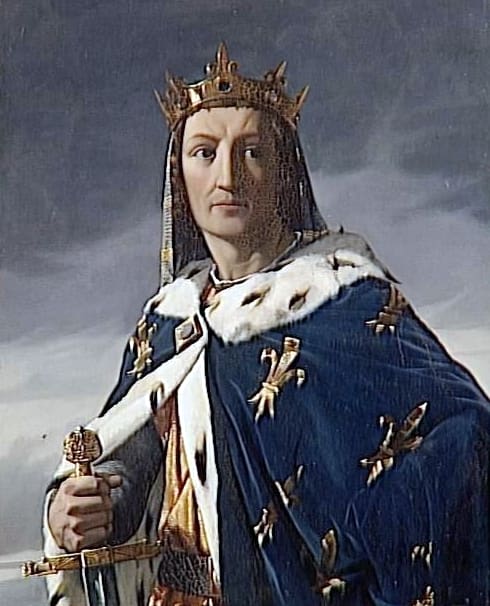
Today is the feast of King Saint Louis of France. As the formerly Christian West is sliding further into the tyranny of liberalism, it is balm to the soul to consider that the people in Louis’ France were freer than we are today. They were free from big government meddling in their lives and their wallets. And they were free in the most important way, for Saint Louis believed in a Christian order wherein the State was neither inimical nor neutral to the Church, but was the Church’s helper in securing the happiness, temporal and eternal, of her subjects.

Our modern “freedom,” by contrast, is servitude.

Sad to say, Saint Louis’ own grandson, Philip IV (“the Fair” — called so on account of his outward looks, not his inward dispositions!) was greedy to rob the Church of her influence in civil society. It has long struck me as ironic that this same Philip, who was so ill disposed to the traditional role of the Church in statecraft, was also the one who persecuted the Knights Templar, robbing them of their possessions and murdering their leaders. One of his victims was Jacques de Molay, the twenty-third and last Grand Master of the Templars. The reason I find all this ironic, is that the Freemasons, who are much closer to Philip than to de Molay in their ideology, falsely take the murdered Templar as one of their own heroes — among other ways, by naming their young men’s fraternal organization, “DeMolay International.” Philip IV, who murdered Jacques de Molay, also persecuted Pope Boniface VIII, a great pope who defended — as I’ve pointed out elsewhere — the same traditional alliance of throne and altar that Philip’s saintly grandfather believed in. That tradition, known as “the doctrine of the two swords,” was eloquently put forth in Unam Sanctam, a bull written in direct opposition to Philip the Fair.

It was Boniface VIII, by the way, who canonized Saint Louis IX. (Read more.)

 

More HERE.


Also from Catholicism:

The custom of genuflecting (literally, in Latin, “bending the knee”) for the Incarnation (“…and the Word was made Flesh…”) in the Creed, was begun by Saint Louis IX, King of France, who knelt out of devotion when he heard the words sung at Mass one day. This is something of a holy mirror of the secular custom of standing for the “Hallelujah Chorus” in Handel’s Messiah. (King George II was so stirred during the performance that he rose to his feet in excitement. When the king stands, everybody stands, even during a concert.) Similarly, thanks to Louis’ piety, and the French respect for their monarch, the King of Kings is saluted with a genuflection every time his Holy Incarnation is recalled in the Credo of the Roman Rite. (Read more.)


Share

Traditions: The Chapel Veil

 From Catholic 365:

The chapel veil is also called a mantilla, and is worn by Catholic women to honor the Lord as truly present in the Eucharist. This is a very old tradition and is also a symbol of imitation of Mary, the Mother of God. The wearing of the Mantilla is an act of veiling a woman's physical beauty, so that the beauty of God may be glorified instead. It is also a way of emulating Mary, our mother, who is the archetype of purity and humility.  Moreover, the mantilla, or chapel veil, signifies the role of women as a life-bearing vessel.  The chalice holding the blood of Christ is veiled until the Preparation of the Gifts, and the tabernacle is veiled between Masses. Both of these vessels hold the Eucharist – the very life of Christ. (Read more.)

Share

Sunday, August 23, 2026

The Modesty Fallacy

 Worrying about female modesty has become an obsession among many Christians. Yes, there is more flesh exposed than there was in past times. But there is such cult-like behavior in many Catholic circles, including homeschooling groups, that has nothing to do with Church teaching nor with Sacred Scripture. I knew one group of young mothers where no one could wear cologne. Another group is saying you cannot take Catholic children to the beach because of what they might see. People make up their own rules that have nothing to do with tradition but with their own irks and quirks. They are the new Puritans. And as a historian I can tell you that standards of modesty among Catholics have changed and fluctuated a great deal for 2000+ years. I will  never forget the reaction of a devout lady when she was shown the original edition of my novel Trianon with the beautiful LeBrun portrait of Marie-Antoinette and her children on the cover. "She's wearing a low-cut dress!" was the exclamation. As for immodesty being connected to rape, Muslim women are raped even when they are covered from head to toe. And what about all the nuns raped by Communists? And I have lamented about all the young Catholic women making themselves deliberately unattractive in ugly, shapeless clothes as a badge of piety.

Lindsay T. has an interesting series of articles on her substack.

The virtue of modesty is defined in the Catechism as “a virtue of the heart” which “guides how one looks at others and behaves toward them in conformity with the dignity of persons”.[7] How men and women dress is important, but judgement of one’s degree of modesty is not the responsibility of the on-looker. In fact, the on-looker should employ modesty in how he looks and behaves towards the other person.

Pope John Paul II, in his book Love and Responsibility, also places responsibility of chaste thoughts on the on-looker:

The virtue of chastity is underdeveloped in anyone who is slow to affirm the value of the person and allows the values of sex to reign supreme: these, once they take possession of the will distort one’s whole attitude to a person of the other sex. The essence of Chastity consists in quickness to affirm the value of the person in every situation.[8]

If an onlooker is tempted to lust by a woman wearing yoga pants or spaghetti straps, I would suggest their attitude towards the other sex has been distorted; they have allowed “the values of sex to reign supreme.” The focus should be on affirming “the value of the person in every situation.”

The culture around Franciscan University, though it professes to teach and encourage a Catholic sexual ethic, has proven repeatedly that it does not affirm “the value of the person in every situation” when it comes to cases of harassment and assault. In fact, it has repeatedly favored the perpetrator—which is most often male—and has scapegoated alleged victims—who are most often female. The questions that female students have received upon reporting harassment or assault prove the strength of the prevailing group theory: It can’t be the man’s fault. There must be something the girl did to incite, invite, or welcome that behavior.

[....]

As a Catholic woman and mother, it concerns and affects me when, at the local Catholic high school, a teacher who is also a Franciscan graduate tells a classroom that “rape culture” is a product of feminism (See Krason: “The sexual harassment frenzy… is the latest poison from the Sexual Revolution”) and many men’s lives have been ruined by false accusations. This group theory that women are responsible for men’s purity is a part of their cultural evangelism. The University’s sexual assault misinformation spreads with conviction. As long as this group theory can subsist—that women are responsible for male virtue—then the friars can sidestep accountability. A University that has protected abusers (who are overwhelmingly male) and mishandled (overwhelmingly female) students’ reports of harassment and assault will be seen as not only blameless, but as a conservative institution battling the woke, feminist agenda of “rape culture” (I hope that sounds as crazy to you as it does to me). (Read more.)

NOTE: Yes, there is a jab at Trump for something coarse he said years ago. He was saying how rich and powerful men are often able to get away with grotesque behavior towards women. He was not advocating the bad behavior, which is obvious when one hears the entire conversation.

Share

Friday, August 21, 2026

Jason Arday and Jesus the Vulnerable God

 From Mark Judge at Hot Air:

Jason Arday was an academic at Cambridge who got exposed for lying about his past and plagiarizing his papers. Some conservatives are blaming Arday’s death on DEI, while the left says he was undone by racism. While it is important that frauds get called to account, it’s also possible to recognize that the “shame storm” of modern witch hunts can also be too much for some people to bear — and that sometimes the shame storm is out of proportion to the actual crime. (Some shame storms are also entirely created by the media.) 

    While everyone has been dissecting Arday’s academic career and past, I kept thinking of him in those last moments when he decided to take his own life. When he fell terrified and abandoned. He deserved the blowback from his actions, but did not deserve to die. There is a way through these valleys, although suicidal ideation is a hard cross to bear. And the frenzy of commentary following Arday's death is a little too gleeful. Perhaps the wisdom of Pat Buchanan should apply here: “When God puts his hand on a man, I take mine off.”

 The journalist Helen Andrews called the phenomenon of the media swarming a target a “shame storm.” In 2019 Andrews was publicly embarrassed on television when an old boyfriend began insulting her about how their relationship ended. Her shame was debilitating: “Everyone at work was supportive, but no amount of support could counteract the paranoia that settled in over the next weeks and months. My colleagues probably didn’t believe the woman they worked alongside was secretly a comic-book ­villain—but surely the suspicion had been planted? I never knew whether someone on the subway was giving me a second glance because he knew me, or because he recognized me from the video. Fellow journalists reported back to me from conferences where [my ex-boyfriend] Todd expatiated on my depravity at length—in one case, before an audience that included my boss.” (Read more.)


Share

Wednesday, August 19, 2026

The King's Touch


I knew the French and English monarchs prayed over those afflicted with scrofula but I did not know it was done in Scotland. When Charles I was crowned King of Scots in June, 1633, he continued the ancient ceremony. From The Scotsman:
Charles had already been crown by the English in 1626, this was the first coronation in Scotland since that of King James VI in 1567, and more notably, the first time an adult had been crowned as our monarch since that of James IV in 1458, who was 15, not an adult? Okay let’s go further back to King James I, he was 30, happy now? The abbey of Scone, traditional place of coronations up to 1424, had been destroyed, and for this occasion the ceremonial was located in the remains of Holyrood abbey, which had seen the coronation of King James II in 1437.

All that remained of the abbey was the nave, the remainder of the church having been demolished in 1570, and the structure was now restored for the occasion. Charles was baptised in the Chapel Royal at Holyrood Palace in 1600 by David Lindsay, Bishop of Ross, and created Duke of Albany, the traditional title of the second son of the King of Scotland.

[...]

While researching this I found an article about Charles and the “laying on of hands” a ceremony he performed while at Holyrood, a practice said to have been performed by all the Stewart monarchs but discontinued by the Hanoverian’s. Bonnie Prince Charlie though is said to have performed it during the 45. (Read more.) 

This is of particular interest to me since Louis XVI was a direct descendant of Charles I. King Louis treasured the ancient healing ceremony and celebrated it several times a year, not just at his coronation, as described in my book.

More HERE.


Share

Saturday, August 15, 2026

Merciful Love through Mary

 From Vultus Christi:

Those familiar with the devotion of total consecration to Jesus through Mary will be familiar with all these ideas. Saint Louis de Montfort says that, through Mary, every little work becomes acceptable, and even its imperfections are entirely cleansed. He recommends Mary as merciful. He states that those who take other ways have more (not less) “obscure nights, combats, strange agonies, craggy mountains, cruel thorns, and frightful deserts.” But he affirms that “by the path of Mary, we pass more gently and more tranquilly.” And because the offering of ourselves is so little, he states that we do well to offer ourselves through Mary so that Mary will offer herself with us.

Perhaps the most remarkable similarity, though, is the way that both the Oblation to Merciful Love and Total Consecration to Mary involve the handing over of everything: all we are, have, and possess, such that we die and show up at the judgment seat with empty hands, without a single good work or spiritual treasure. And yet in the case of both, this engenders confidence. We are freed to do everything and give everything — no matter how small or imperfect — for love alone with confidence that, if we truly keep nothing for ourselves, neither farthing or penny, we will be clothed with riches that are not our own, the riches of Jesus Christ and His Holy Mother. With such similarities, the question naturally arises about the compatibility of the two. Is it merely the case that some are attracted to offering themselves to Merciful Love and others to Mary, or is there, perhaps, a way in which the two fit together into a single whole? This is the question we hope to explore over the coming days.

But first, let us take a closer look at true devotion and total consecration to Mary. (Read more.)

Share

Saturday, August 1, 2026

Sacred Geometry and Gothic Rose Windows

 From  Laboratorio Fiore Scriptorium via Hilary White at The Sacred Images Project:

Geometry in the Middle Ages was not just calculation and measurement, but a sacred language capable of uniting heaven and earth, the visible and the invisible. Every line and proportion thus brought to life a prayer in stone, a tangible testimony of faith carved in numbers.

"Sacred Geometry and Gothic Rose Windows, from Architecture to Miniature": a course designed for those more comfortable with technical drawing than with hand-drawn. Originally offered a few years ago, it is now available again—upon request—for small groups of at least three people. (Read more.)

Share

Wednesday, July 29, 2026

The Art of Conversation

 From Return to Order:

Conversation is a vast theme. Outlining some principles that should guide our conversations can help us better understand the topic. This will help us see the true value and scope of this important art. I hope our discussion will not be a lecture but a conversation about how to converse.

First, the principle that should guide our choice of topics and our comments should be the good of others. We must seek to do good for those with whom we converse. In other words, conversation is a precious means of apostolate, that is, a means of spreading the Faith to others. Thus, our attitude towards conversation must be like that of an apostle who acts with zeal and passion.

 Second, we have a vast field to work in since the characteristics of the Church are unfathomable. God is infinite, so we have always had much to say about the Church and God. Conversations aimed at spreading our thinking are an important part of our mission as Catholics. We converse to bring souls closer to the Catholic Church and Christian civilization. (Read more.)

Share

Sunday, July 26, 2026

Narrative Icons


From Hilary White at The Sacred Images Project:

One of the most useful distinctions made by people who analyse art is between an image that simply presents something, and an image that tells a story. A portrait of a king, a still life of a bowl of fruit, a simple landscape, or an icon of Christ Pantocrator asks us to contemplate a single subject. They are essentially static images, like a single object in a dark room under a spotlight. Nothing is happening, and nothing is about to happen. It’s just Him and you.

But iconography is about making a visual statement about some eternal reality, even when the image itself is a story being told. We are all familiar with the single-figure icons of course, but there are narrative icons as well. The Nativity icon is a good example of this, where a single image will have several elements of a story presented as if they’re all happening at the same visual “time”1. The format here is to have the most important thing - the Nativity itself - in the centre, with all the side adventures going on around it.

This is called “continuous narrative,” in which the same characters appear multiple times within a single image to depict successive moments in a story. Time is compressed into one pictorial space. But instead of reading left-to-right like a comic strip, the viewer follows the action throughout the composition.

This technique goes back to classical Roman art (for example, Trajan’s Column) and was taken east by Byzantine artists, where it became especially common in manuscript illumination, fresco cycles, and some icons. (Read more.)


Share

Friday, July 10, 2026

The Original Nakedness and Shame

Adão e Eva Expulsos | Cathopic 

 From Justi Andreasen:

It is true that Adam and Eve before the Fall were naked and not ashamed. But the old Christian writers did not think of them as bare in our poor modern way. They say man was clothed with glory. That is to say, there was a rightness in him which made outer covering unnecessary. The body was not a trouble because the soul was not yet at war with itself. St. Ephrem says they were surrounded by glory. One can say it more simply still: grace had not yet gone out of them.

As the serpent is called the most subtle of the beasts, it is the most "naked" and closest to nature. It belongs to the raw pull of undifferentiated matter, the current that drags everything back toward dust. The serpent is not evil because it is powerful. It is dangerous because it is uncovered by any purpose higher than itself. It has not been named and integrated by Adam.

So when Adam and Eve ate, they felt shame because something had been lost. Like the serpent, they were now uncovered, no longer clothed in higher purpose. They had broken the law and, with it, the purpose God had given them. And so they snatch fig leaves.

Then comes that strange and merciful thing. God makes them garments of skin. The world is hard now, and He clothes them for hardness. Leaves are for summer. They will not do outside Eden. Since then men have been making larger and larger versions of the same defense. Clothes, houses, laws, customs, walls, roofs, medicine: all these are ways by which fallen creatures make life possible in a fallen world. (Read more.)

Share

Thursday, July 2, 2026

I Think I Am Finally Beginning to Understand the Thirty Years War

 From Gruntled History Teacher:

Before the war, Germany was one of the richest and most developed regions of Europe, with an extraordinary medieval network of towns and trade networks that had grown up throughout the Middle Ages, and a convoluted constitutional system that defies explanation (then or now), but which actually worked better than is generally credited. But the Thirty Years War devastated large parts of the country so badly that, in German cultural memory, the 17th century is nearly as dark as the 20th.

It’s the war that tore Germany apart, and laid the seeds for later German national history, with all its accompanying baggage. But it also played a pivotal role in the nationalist histories of Germany, France, Spain, Denmark, Sweden, and the Netherlands. For the Enlightenment, it was the war that delegitimized Christendom and allowed science and reason to supplant religion. American religious freedom, pluralism, and toleration, have long been contrasted with the devastation of Europe’s wars of religion.

For military historians, the Thirty Years War has been the war that crystallized the military revolution and the rise of the fiscal-military state. International Relations theorists still describe the modern world as Westphalian, referring to the Peace of Westphalia that ended the war and established a system of sovereign states as the default international order. Catholic and Protestant historiographies naturally championed their respective sides, and all the major figures of the war have long been cast as heroes or villains according to whoever held the pen. The history of the Thirty Years War has been fought over and contested almost as much as the war itself. (Read more.)


Share

Wednesday, July 1, 2026

The Challenge of the Eucharistic Heart of Jesus

 From Charles Coulombe at 1P5:

But as with everything Catholic in the Americas, devotion to the Sacred Heart long predates the United States.  Although Spain opened up the Evangelisation of the Western Hemisphere, it was in New France that this devotion took root, with the arrival of St. Marie de l’Incarnation, who founded the Ursuline Order in Canada in 1632, half a century before Our Lord began appearing to St. Margaret Mary Alacoque.  Nine years later, Catherine Symon de Longpré, Mother Catherine of Saint Augustine in religion, brought devotion to the Sacred Hearts of Jesus and Mary to Canada, along with her veneration for Marie des Vallées, with whom she was in contact.

On March 17, 1727, King Philip V of Spain, grandson of Louis XIV, wrote to Benedict XIII, asking him to approve the Office and Mass of the Sacred Heart for the kingdoms and states of the Spanish  Crown – the bulk of these were of course Spanish America and the Philippines; from this time on, the cultus of the Sacred Heart had official approbation in the Viceroyalties of the Americas.

In the newly independent United States, the Jesuit Mission at Conewago, Pennsylvania was renamed in honour of the Sacred Heart in 1787, when a new church was built.  A minor Basilica to-day, it was the first parish church named after the Sacred Heart in the United States – and possibly in the Western Hemisphere.

Inspired by the French Voeu Nationale, Gabriel García Moreno (1821-1875), President of the Republic of Ecuador, consecrated his country to the Sacred Heart of Jesus.  He was assassinated two years later, as he left the cathedral of Quito where he had just completed his customary adoration.  But he established what became the template for National Consecrations to the Sacred Heart across the globe.  In keeping with St. Margaret Mary Alacoque’s request to Louis XIV, it was done by both the Head of State, the Legislature, and the Bishops of the Country.  This emphasises that the Faith ought to encompass both Church and State.  Following Ecuador’s example, several Central and South American countries undertook this national consecration in the following years – the first being the Republic of El Salvador in 1874. (Read more.)

Share

Tuesday, June 30, 2026

History of the Christian Altar


From Shawn Tribe at The Liturgical Arts Journal:

Altars are (or ought to be at least), architecturally and liturgically, the central focal point of the interior of our churches. Given their evident importance, it is no surprise that there can be much in the way of disagreement as to what the ideal form of the altar is. Debates rage about free-standing altars versus altars with grand reredoses attached to them.

It was through the consideration of the different forms of the altar, particularly through the pursuits of the Liturgical Movement, that the idea arose of taking a brief look at the history and development of its forms. I. Early Christian Antiquity If we look to the earliest time of Christian antiquity, there are two early forms of altar that can be identified. One is those of the house-churches, which were wooden and in table form. Some of the Eucharistic frescoes of the Roman catacombs may give some sense of this form:
The "Fractio Panis" fresco in the Capella Greca of the Roman catacomb of St. Priscilla
The second form was the use of the stone tombs of the martyrs as altars. This custom is thought to trace to the first quarter of the 2nd century. Marble tops were placed upon the tombs for the Mass to be celebrated upon.
The Fractio Panis fresco of the Capella Greca, which belongs to this period is located in the apse directly above a small cavity which Wilpert supposes to have contained the relics of a martyr, and it is highly probable that the stone covering this tomb served as an altar. (The Catholic Encyclopedia)

(Read more.)

At San Clemente in Rome, although the church was built facing west, Mass was offered facing east. The congregation would face east as well. From Shawn Tribe at The Liturgical Arts Journal:

I cannot definitively explain why the church was laid out this way as a glance at the property would suggest that it could easily have been orientated, which is to say, designed so that one's movement through the church was from west to east, toward the rising sun. All the churches built by Constantine in Rome were laid out "backwards" this way (except Santa Croce in Gerusalemme, which was built into an existing building), and I can only guess that this was done in part to imitate the Temple at Jerusalem.

There are other possibilities as well. The priest offering the Holy Sacrifice is facing east, of course--the design of the altar makes it impossible for Mass to be offered any other way. It is thought that in antiquity the assembly would actually turn around and face east with the celebrant, putting the Sanctuary behind them. This is not as strange as it might at first sound. A shepherd is always behind his flock. This is why the celebrant always comes last in procession. Furthermore, the church building symbolizes the Barque of Peter. In fact, the word nave derives from the Latin navis, which means boat. So the Sanctuary is where the helm in an ancient ship would be--at the back.

We have a dual movement, then. We move into the church building toward the west, and then we turn around at a certain point in the liturgy and proceed east. Now consider for a moment St. Germanus' text. He says that the Sanctuary is an image of the tomb in which Christ was buried; the Altar is "the spot in the tomb where Christ was placed"; and the apse corresponds to the cave in which He was buried. So perhaps our movement from east to west toward the Sanctuary, toward the setting sun, is actually a representation of our burial with Christ. And turning around and proceeding east, toward the rising sun, represents our sharing in His Resurrection. (Read more.)

Share

Sunday, June 28, 2026

Meditation on the Tree of Knowledge


 From Justi Andreasen at Reclaiming the Biblical Worldview:

What if the fruit in Eden was never meant to remain untouched, and the transgression lay in the manner of its taking?

Most readers approach Genesis 3 as a simple account of disobedience. The command is given, the boundary is crossed, and the punishment follows. Yet this familiar reading leaves one question largely unexplored: What was the Tree of the Knowledge of Good and Evil for? In other words, why would a good God place a forbidden tree in Paradise?

St. Ephrem the Syrian offers a different vision. He describes the Tree as a veil, a living boundary akin to the curtain separating the Holy Place from the Holy of Holies. Its presence did not signal permanent exclusion. It marked a space into which one must be worthy to step. Adam and Eve were not barred forever. They were being formed for a gift.

“He planted the Tree of Knowledge, endowing it with awe, hedging it in with dread, so that it might straight way serve as a boundary to the inner region of Paradise.” -St. Ephrem, Hymn III, 3

A boundary implies not absolute prohibition but ordered approach. The Temple clarifies the pattern. The veil did not exist to enforce distance but to protect what was holy until the priest was ready to enter. Entry required preparation. When King Uzziah (a ruler who unlawfully entered the Temple to perform priestly rites reserved for consecrated priests) forced his way past the boundary, his presumption disfigured him. The Tree functioned in the same way. It stood as a threshold within creation, a sign that maturity unfolds in time. The fruit was to be received when the creature had grown into obedience.

This holds true in ordinary situations as well. Consider claiming a driver’s license without undergoing formation. You would place yourself and others at risk, because you would be exercising responsibility without the formation required to carry it safely. Or consider falsifying your CV to obtain a high position. The title might come quickly, but the strain would follow just as quickly. You would find yourself overwhelmed, and the team around you would feel the instability of leadership that has not been earned. Had the role been the fruit of your labour, had you been promoted through recognition of real competence, the weight of it would rest on something solid, and the order of the group would hold. (Read more.)

Share

Saturday, June 20, 2026

The Christology of the Stairs: Medieval Raised Sanctuaries vs. Modern "Worship Spaces"

 From Hilary White at The Sacred Images Project:

Visitors to the medieval churches of Umbria and Tuscany are often surprised by an architectural feature that is found surviving in great abundance in our area; raised or elevated sanctuaries in our most ancient churches. That is, the place where the liturgical actions happen, that we are used to seeing conducted right in front of us, is set on a high platform, sometimes as much as 15 feet above the level of the nave, and mostly impossible to see.

We’re used to the sanctuary part of the church being raised at least a few feet above the level of the nave, often with the altar raised again on a stepped platform, but several meters? So high the congregation can’t see anything?

Architecture always catechizes. We all know that Catholic church architecture is used to express particular beliefs about the nature of reality, Christology, man’s relationship with God and his proper place in creation. Most Catholic churches, until the middle of the twentieth century, were built on a cruciform floor plan. The church itself is the image of the crucified Christ; the faithful literally enter into the symbol. Medieval builders extended this symbolic language far beyond the floor plan. Every aspect of the building could be made to communicate theological truths. These ancient stone churches emerge from a worldview that understands reality itself as hierarchical, which the designers of the elevated sanctuaries took very literally.

 Why are so many ancient churches in Umbria and Tuscany built with sanctuaries raised high above the congregation, sometimes so high that much of the liturgy would have been difficult to see? It has very little to do with practicality and a great deal to do with how medieval Christians understood Christ, the Mass, heaven, earth and the structure of reality itself. (Read more.)


Share

Tuesday, June 16, 2026

The Meaning of America’s Consecration to the Sacred Heart

 From NCR:

The first is that June 11 was the date in 1899 when Pope Leo XIII consecrated the world to the Sacred Heart of Jesus. Exactly one century later, on June 11, 1999, St. John Paul II wrote, somewhat astonishingly, “The consecration of the human race in 1899 represents an extraordinarily important step on the Church's journey.”

Few Catholics today are aware of the consecration of the human race to the Sacred Heart 127 years ago. Few would consider that act, as John Paul II did, “an extraordinarily important step on the Church’s journey.” But John Paul II saw something that most historians and journalists, secular and Catholic, miss: the objective significance of an act of consecration.

Our prayer matters. Our entrusting ourselves and the world to God matters — just as Jesus’ consecration to the Father and self-offering on Calvary for our salvation matters, and matters a lot. (Read more.)


Share

Friday, June 12, 2026

Roger Scruton: Philosophical Christian and Scourge of Nihilism Par Excellence

 From The Public Discourse:

Carl R. Trueman has written yet another lucid and penetrating book that gets to the heart of our present cultural and spiritual discontent. Published earlier this year to critical acclaim, The Desecration of Man: How the Rejection of God Degrades Our Humanity persuasively argues that the death of man is a necessary byproduct of the rejection of God, and that no decent or morally serious society can long survive the absence of Christian faith and theistic affirmation. Divorced from the truth that human beings are created “in the image and likeness of God,” human dignity cannot be credibly upheld. So far, so good.  

Trueman, however, goes further. He is convinced that anything less than a robust recognition of the imago dei is nihilistic, a rejection of man that flows from a “refusal of God-given obligations, the transgression of God-given limits, and the rejection of God-given ends.” We must therefore choose between the truth of Christ’s Gospel and nihilism tout court—there is, Trueman insists, no “middle path” available to us. This leads him to define nihilism in such a broad and capacious  way that many who self-consciously fight against, and indeed reject, the nihilist temptation nonetheless are, or would be, relegated to the camp of Nietzsche’s “Madman” (who thunderously declared that “God is dead,” modern man having killed him).   

There is something unjust and peremptory about Trueman’s all-or-nothing approach. For example, despite his own obvious indebtedness to the English conservative philosopher Roger Scruton (drawing freely as he does on Scruton’s accounts of desecration and pornography as “moral pollution” and his Goethe-inspired identification of Satanic evil with “the spirit that forever negates”), Trueman ultimately consigns his intellectual “hero,” as he once called him, to the camp of nihilism. Too many reviewers, moreover, have uncritically followed Trueman in this judgment. Here, I hope to set the record straight.   

For Trueman, Scruton’s evident sympathy for the Christian religion is reduced to an “instrumental” appreciation of it “as a profound source of cultural good.” Trueman thus reduces Scruton’s remarkably rich reflections on religion and the “sacred” to the rather crude view that neither of them is true, but they “are good things for the organization of society.” Even here one has to note: tertium non datur. That is, there are more options than these binaries. Indeed, one has to say that Trueman presents a caricature of the late English philosopher and man of letters as a defender of the “spiritual residue” of Christianity rather than the Christian faith itself. Because, in Trueman’s view, Scruton is insufficiently dogmatic (which one can acknowledge), he turns out to be a mere aesthete, a defender of “exalted and beautiful thoughts about truth, goodness, and beauty.” By pigeonholing Scruton as nothing but a Kantian philosopher, Trueman makes him appear nothing more than “a cultural Christian” who appeals to “the language of truth … to justify taste.”  

However, Scruton’s intellectual debts went well beyond the German philosopher of the noumenal and phenomenal distinction and were remarkably wide ranging. He drew on Plato’s as well as Jan Patočka’s rich conception of the “care of the soul”; Aristotle’s articulation of the cardinal virtues; Burke’s eloquent defense of tradition, prudence, and ordered liberty against ideological fanaticism; and Hegel’s account of the necessarily “situated” character of ethical community. To these, he added careful attention to the moral witness of those who struggled in the east of Europe against the totalitarian lie in the second half of the twentieth century, and, not least, the New Testament’s affirmation and highlighting of forgiveness and neighbor love in lives lived well, lives truly open to the manifold intimations of “eternity” in time. Moreover, one could argue that Scruton was more indebted to Kant’s refusal to reduce human persons to impersonal objects bereft of souls and lacking in moral responsibility or “mutual accountability.” None of this is remotely the thought of a nihilist. (Read more.)

Share

Saturday, June 6, 2026

"Your Virtues and Your Kindness"

Our Lady (or perhaps the virtue of Faith, since she carries the cross) and Marie-Antoinette hold the Gospels for Louis XVI as he makes his coronation oath. The picture is accompanied by the following verse:
The hands of Divinity
Louis, sends you the crown
The scepter, the sword, the law gives to you
But it is your virtues and your kindness
Which assures you the throne in our hearts.
Share

Thursday, June 4, 2026

Living by the Rule

 From The Conversation:

Curating Living by the Rule: Contemporary Meets Medieval, we were aware that the idea of “living by the rule” might sound off-putting to some visitors – too close to simply doing what you’re told. It also sits uneasily with the individualism of our age, in which meaning is often framed in terms of personal fulfilment or even “optimisation”. Rules, by contrast, point to our dependence on others and the obligations that come with it.

It is important, though, not to confuse Benedict’s “Rule” with modern laws or regulations. The term comes from the Greek kanon, via the Latin regula, meaning a pattern, model or yardstick: something to guide judgment rather than dictate behaviour. Unlike modern faith in impersonal rules, Benedict’s approach is strikingly flexible. Nothing is so fixed that it cannot be adapted, or even set aside, in light of different people and circumstances.

Translating these ideas into an exhibition was far from straightforward. (Read more.)

Share