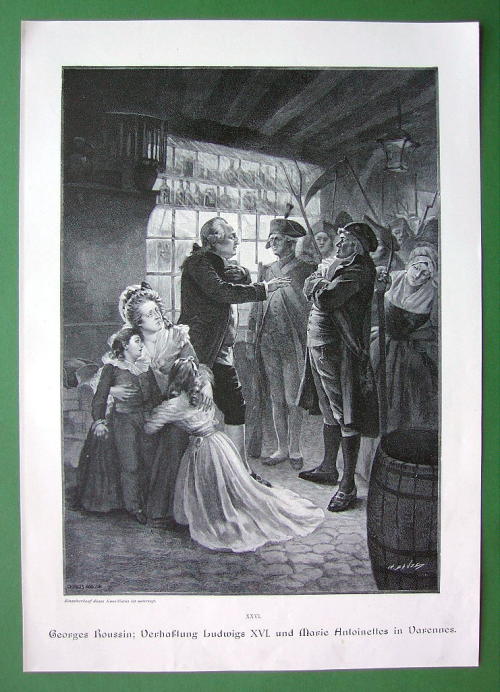
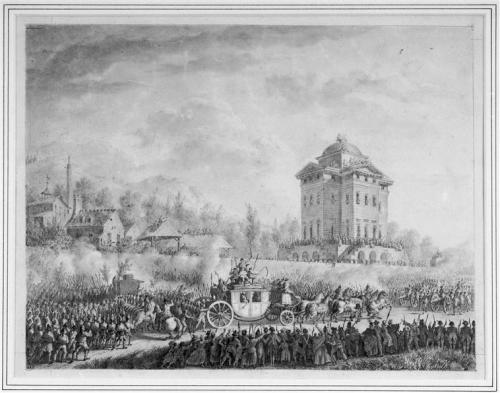
"Tremble, tyrant; the people have risen;" and they held it before the windows of my father who, though he was not visible himself, could see all and hear their cries of "Down with Veto!" and other horrors. This lasted until three o'clock, when the garden was at last freed. The crowd then passed through the Place du Carrousel to the courtyards of the Tuileries, but quietly,
and it was generally thought they were returning to their faubourgs.
During this time our family were in the rooms on the courtyard side, absolutely alone and observing all that went on; the gentlemen of the suite and the ladies dined on the other side. Suddenly we saw the populace forcing the gates of the courtyard and rushing to the staircase of the château. It was a horrible sight to see, and impossible to describe–that of these people, with fury in their faces, armed with pikes and sabres, and pell-mell with them women half unclothed, resembling Furies.
Two of the ushers wishing to run the bolts of my father's door, he prevented it and sprang himself into the next room to meet the rioters. My aunt followed him hastily, and hardly had she passed when the door was locked. My mother and I ran after her in vain; we could not pass, and at that moment several persons came to us, and finally, the guard. My mother cried out: "Save my son!" Immediately some one took him in his arms and carried him off. My mother and I, being determined to follow my brother, did all we could against the persons who prevented us from passing; prayers, efforts, all were useless, and we had to remain in our room in mortal anxiety. My mother kept her courage, but it almost abandoned her when, at last, entering my brother's room she could not find him. The persons who, on her own order, had carried him away lost their heads, and in the confusion, took him up higher in the château, where they thought him in greater safety. My mother then sent for him and had him brought back to his room. There we awaited, in the silence of profound anxiety, for news of what had happened to my father.
Returning to him, I must resume at the moment when he passed through the door which was then locked against
us. As soon as he thought the danger passed the king dismissed his suite, so that no one was with him but my Aunt Élisabeth, [Maréchal de Mouchy (who in spite of his 77 years and my father's order persisted in remaining), two old ushers, the brave Acloque, commander of the division of the National Guard, an example of fidelity in the uniform of rebellion],
1 and M. d'Hervilly, lieutenant-colonel of the new King's-Guard, who, seeing the danger, ran to call the Guard and collected about twenty grenadiers, but on reaching the staircase he found only six had followed; the others had abandoned him. My father was therefore almost alone when the door was forced in by one sapeur, axe in hand raised to strike him, but [here] by his coolness and imperturbable courage my father so awed the assassin that the weapon fell from his hand,–an event almost incomprehensible. It is said that some one cried out: "Unhappy man, what are you about to do?" and that those words petrified him; for my part I think that what restrained that wretch was Divine Providence and the ascendancy that virtue always maintains over crime.
The blow having thus failed, the other accomplices, seeing that their leader had let himself be cowed, dared not execute their evil designs. Of all this mass of the populace, there were certainly very few who knew precisely what they were expected to do. To each had been given twenty sous and a musket; they were sent in drunk with orders to insult us in every imaginable way. Their leader, Santerre, had brought them as far as the courtyard, and there he awaited the success of his enterprise. He was desperate on learning that his stroke had missed, and he came near being killed himself by a man in the château, who aimed for him,
and was prevented from shooting only by remonstrances as to the danger to which he exposed my father; for if Santerre were sacrificed the brigands would surely avenge him.
My father was nevertheless obliged to allow all these wretches to go through the rooms of the château, and, standing himself in a window with my aunt, he watched them pass before him and heard the insults with which they overwhelmed him. It was on this horrible day that my father and my aunt each made a memorable speech. At the moment of the greatest danger a soldier came up to the king and said to him, "Sire, fear nothing." My father took his hand and laid it on his own heart. "Does it beat hard, grenadier?" he said. Shortly before, my Aunt Élisabeth, being mistaken for the queen, saw herself exposed to the utmost fury of the brigands; some one near was about to make her known. "Do not undeceive them," cried my aunt with sublime devotion.
This dreadful situation lasted from half-past three in the afternoon till eight at night. Pétion, mayor of Paris, arrived, pretending to be much astonished on hearing of the danger the king had run. In haranguing the people he had the impudence to say: "Return to your homes with the same dignity with which you came." The Assembly, seeing that the stroke had missed, changed its tone, pretended to have been ignorant of everything, and sent deputation after deputation to the king expressing the grief it feigned to feel for his danger.
Meantime my mother, who, as I said, could not rejoin the king, and was in her apartment with my brother and me, was a long time without hearing any news. At last, the minister of war came to tell her that my father was well; he urged her to leave the room where we then were, as it was
not safe, and we therefore went into the king's little bed-chamber. We were scarcely there before the rioters entered the apartment we had just left. The room in which we now were had three doors: one by which we had entered, another opening upon a private staircase, a third communicating with the Council Chamber. They were all three locked, but the first two were attacked, one by the wretches who were pursuing us, the other by men who came up the little staircase, where we heard their shouts and the blows of their axes.
In this close danger my mother was perfectly calm; she placed my brother behind every one and near the door of the Council Chamber, which was still safe, then she placed herself at the head of us all. Soon we heard some one at the door of the Council Chamber begging to enter. It was one of my brother's servants, pale as death, who said only these few words: "Madame, escape! the villains are following me." At the same instant, the other doors were forced in. In this crisis my mother hastily ordered the third door opened and passed into the Council Chamber, where there were, already, a number of the National Guard and a crowd of wretches.
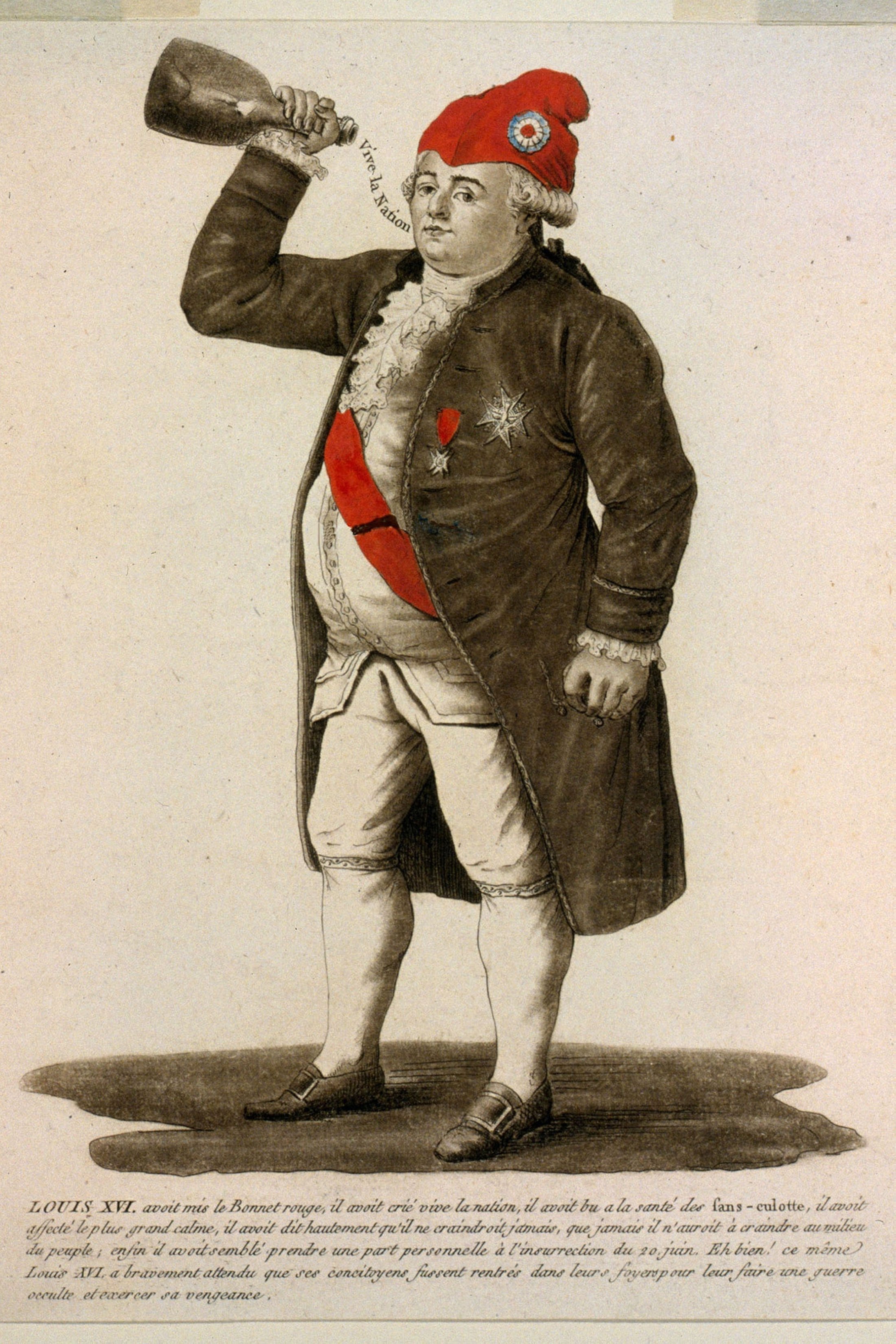
My mother said to the soldiers that she came to take refuge with her son among them. The soldiers instantly surrounded us; a large table standing in the middle of the Chamber, served my mother to lean upon, my brother was seated on it, and the brigands defiled past it to look at us. We were separated from my father by only two rooms, and yet it was impossible to join him, so great was the crowd. We were therefore obliged to stay there and listen to all the insults that these wretches said to us as they passed. A half clothed woman dared to come to the table with a bonnet rouge in her hand and my mother was forced to let her
[Page 236] place it on her son's head; as for us, we were obliged to put cockades on our heads. It was, as I have said, about eight o'clock when this dreadful procession of rioters ceased to pass and we were able to rejoin my father and aunt. No one can imagine our feelings at that reunion; they were such that even the deputies from the Assembly were touched. My brother was overcome with fatigue and they put him to bed. We stayed together for a time, the room being full of deputies. An hour later they went away, and about eleven o'clock, after having passed a most terrible day, we separated to get some rest . . . .
The next day Pétion came again to play the hypocrite, saying he had heard of more assemblings of the people and he had hastened to defend the king. My father ordered him to be silent; but as he still tried to protest his attachment, my father said: "Be silent, monsieur; I know your thoughts." (
Read more.)
Louis XVI was mocked with the "Red Cap of Liberty" which was displayed at the Paris Olympics. From
In ancient Rome, freed slaves were dressed in a white cap called a
pileus. Brutus, who betrayed Caesar, chose this cap, which symbolizes
freedom, as an expression of Rome's return to the republic, and engraved
it on the coin he minted. But this fez, which looks like the white cap
worn by Albanians today, actually had nothing to do with the red
Phrygian cap.
With the American Revolution, the pileus became an omen of
revolutionaries, anarchists, and republicans. It resurfaced with the
protests against the Stamp Act of 1765 when Britain imposed a direct
stamped paper tax on the British colonies in America.
In particular, a figure of British parliamentarian John Wilkes –
nicknamed the "Devil," and known for his support of the American rebels –
with this cap became very popular among the rebels known as the "Sons
of Liberty."
French anarchists, who inherited this symbol from the American
Revolution, preferred the Phrygian cap instead of the pileus. Thus, this
red hermetic cap became the symbol of the French revolutionaries and
freedom from 1789 onwards. For example, in a sculpture made by French
artist Joseph Chinard in 1794, representing the revolution and the
republic, a Phrygian cap was placed on the head of a woman in Roman
attire. (Read more.)





.jpg)