Showing posts with label Charles Coulombe. Show all posts

Monday, June 1, 2026

The Real Pride Month

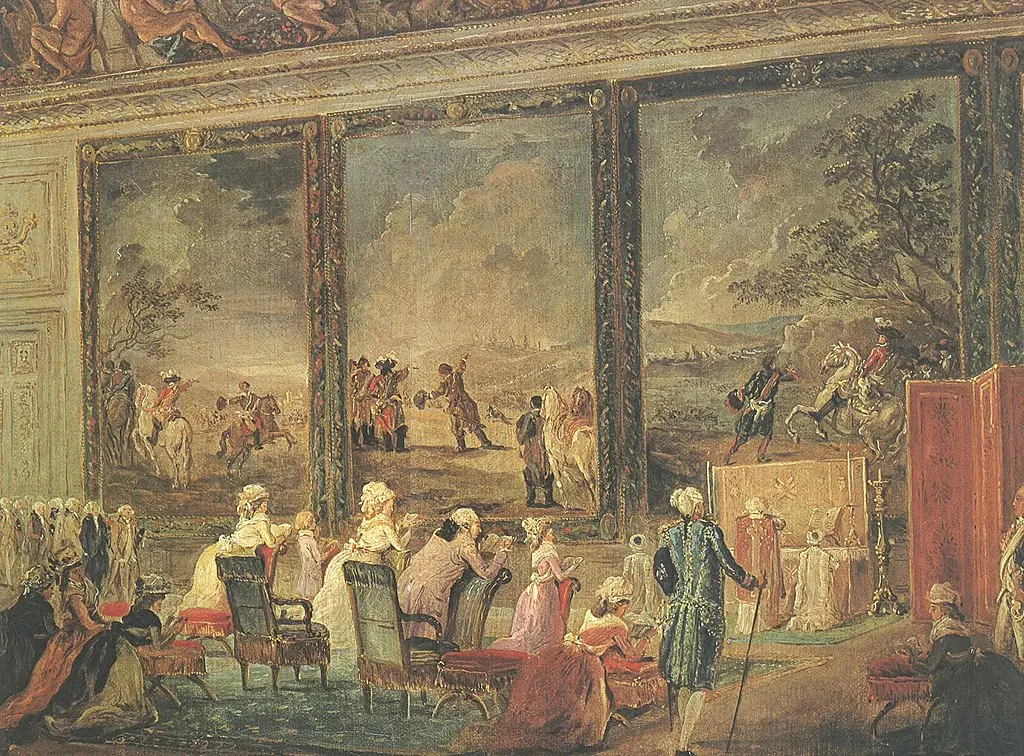
Madame Elisabeth, Dauphin Louis-Charles, Marie-Antoinette, Louis XVI and Madame Royale assisting at Mass at the Tuileries

 From The European Conservative:

Such dislike, though, would be a mistake, because June has a much older and worthier title: the Month of the Sacred Heart. Not well known outside Catholic circles, devotion to the Sacred Heart of Jesus is in one sense as old as Christianity, when St. Longinus’ lance pierced it and out flowed blood and water, prefiguring Baptism and the Eucharist. In the Patristic and medieval eras, saints and mystics wrote of it, and of the salvific nature of the wounds and precious blood of Christ. In the latter period, these were ever more bound up with the growth of devotion to the Blessed Sacrament (and miracles arising therefrom) and the stories of the Holy Grail. It was under the banner of the Five Wounds that the Pilgrimage of Grace marched out against Henry VIII in defence of the Old Religion.

Our current version, though, dates back to the 17th century, with the revelations of St. Margaret Mary Alacoque. While bound up with making reparation to the Saviour who loves us so much, and suffered death to redeem us, the devotion from the beginning has had a social aspect. One of the requests made to St. Margaret Mary by Jesus was that Louis XIV consecrate his kingdom to the Sacred Heart and place the emblem on his flags and battle colours. This he did not do. But the devotion was taken up by many other royals: Queen Henriette Marie, consort of England’s Charles I; her daughter-in-law, Marie of Modena, James II’s queen; King Augustus I of Poland; King Philip V of Spain; Louis XV’s consort, Queen Marie Leczinska; her father, King Stanislaus of Poland, and her son, the Dauphin Louis; King Augustus III of Poland; Elector Maximilian III of Bavaria; SG Madame Elisabeth of France; her brother, King Louis XVI, who consecrated France privately to the Sacred Heart, and vowed to so publicly if he regained his throne; Maria, Queen of Portugal; King Charles X of France; Henri V, de jure king of France; SG King Francesco II of the Two Sicilies; Archduke Franz Ferdinand of Austria-Hungary, and his wife Sophie; Bl. Emperor-King Karl of Austria-Hungary, and his wife, SG Zita; King Alfonso XIII of Spain; Albert I, King of the Belgians; Carlist heir Alfonso Carlos I; and a host of others down to the present. 

Such counterrevolutionaries as the Vendeens, the Tiroleans under Andreas Hofer, the Spanish Carlists, and the Mexican Cristeros adopted it as their special badge. Garcia Moreno, president of Ecuador, consecrated his country to the Sacred Heart with its bishops in 1873. Following this, several Latin American countries began performing this national consecration: El Salvador (1874), Venezuela (1900), Colombia (1902), Nicaragua (1920), Costa Rica (1921), Brazil (1922), and Bolivia (1925). In Europe, Ireland’s bishops followed suit in 1873, Spain in 1919, and Poland in 1920. Across Europe and the world, shrines were dedicated in honour of the Sacred Heart—most notably that of Montmartre in Paris. In architecture alone, the Sacred Heart devotion has given the world a priceless treasure to be proud of, to say nothing of the stalwart folk who rallied around the emblem in defence of Christendom’s soul. (Read more.)


Once again, we try to make it clear that Marie-Antoinette never made a comment about cake, brioche, etc. And she was not a spendthrift but probably spent less than other queens, and definitely less than all the mistresses. From All That's Interesting:

Some historians have suggested that revolutionaries caught wind of the quote “Qu’ils mangent de la brioche” from Rousseau’s writings, then falsely credited it to their despised queen as a form of propaganda. But even this does not hold up to modern scrutiny.

The earliest known source that connected the phrase to Marie Antoinette was the French writer Jean-Baptiste Alphonse Karr. In an 1843 issue of the journal Les Guêpes, Karr wrote that he found the quote originally in a “book dated 1760,” which he said meant that the rumor about Marie Antoinette must have been false, as she’d have been about five years old at the time the book was published. So, it’s very possible that the French citizens were indeed circulating the propaganda against the queen, though clearly not everyone was buying it.

Why, then, has the misquote carried on for nearly 300 years?

“It did not come to be misattributed to Marie Antoinette during the 18th century, but during the Third French Republic starting in 1870, when a careful program of reconstructing the historical past took place,” Denise Maior-Barron, an adjunct professor at Claremont Graduate University in California, told Live Science.

While the French Revolution of 1789 is considered to be the major revolution in France’s history, it is not the only time the French people rose up against their government.

Towards the end of the 19th century, France saw another major shift in power when members of the Third French Republic dethroned Napoleon III following his failed war against Prussia. Those same republicans then sought to effectively rewrite bits of France’s history to paint key figures in a different light — particularly, the disfavored queen Marie Antoinette.

“The masterminds of the French Revolution destroyed the French monarchy by continually attacking, and eventually destroying, its most important symbols: the king and the queen of France,” Maior-Barron said. “For this reason the ‘Let them eat cake’ type of clichés persist.” (Read more.)

Share

Thursday, April 23, 2026

The Second Partition of Poland

 From Charles Coulombe:

THE First Partition of Poland was a dreadful blow, not just to Polish morale, but that of the Lithuanians, Belarusians, and Ukrainians with whom they shared the Commonwealth. The Allied Powers — Russia, Prussia, and Austria — that had undertaken the First Partition were watchful over any signs of independence that the Polish King and government might exert. Russia in particular supervised both the meeting of the Sejm and the Permanent Council made up of pro-Russian nobles and now deputed to carry on most of the business of governing. Stanislaus’ royal prerogative was restricted, so that he lost the right to confer noble titles, and military promotions and to appoint ministers and senators. Provincial Governorships, and Crown lands would be auctioned off. With the King reduced to seeming impotence, and the government firmly in pro-Russian hands, it seemed that the Commonwealth was now a complete puppet.

But King Stanislaus was a wily man. There was strong Conservative opposition to the Council, made up of nobility who feared loss of their own powers to a resurgent central government. The King became adept at playing the two sides off against each other and creating his own King’s party. Moreover, although his own powers had been severely clipped, his ability to influence and cajole became if anything ever stronger. He became very adept at mitigating or frustrating the worst of legislation that the Russians favoured. In secret, with trusted advisers, he created a reform programme. But while the King was able to slow the rate of decay, his opponents in the Sejm were able to block his reforms.

This standoff would continue for almost two decades. But on the wider world, things were happening. In 1781, Austria and Russia allied as a means of countering — and, they hoped, eventually conquering — the Ottomans (Catherine the Great had one of her grandsons named Constantine, in hopes that he would reign over a new Byzantine Empire). Stanislaus attempted to join this alliance, reasoning that it would strengthen Poland-Lithuania, and buy the country some independence. They were unable to agree on terms, but in 1787, the two Christian Empires went to war with the Muslim one. In response, Stanislaus convoked the “Great Sejm” the following year, which would sit for four years. Then in 1789, the revolution in France began, and that country created a constitution. (Read more.)

Share

Thursday, April 2, 2026

Blessed Karl, Clericalism and Lay Church Governance

 From Charles Coulombe at One Peter 5:

In many ways, Austro-Hungarian Emperor-King Franz Joseph epitomised the traditional relationship between the lay and clerical powers of the Church. As with the other Crowned Heads of Europe, he had inherited a particular style of Catholic devotion peculiar to his own dynasty – the Pietas Austriaca. Bound up with a veneration of the True Cross and the Passion, the Blessed Sacrament and the Sacred Heart, the Blessed Virgin and St. Joseph (the family patron), this religiosity had led to the tremendous collection of relics at the Hofburg, the Imperial Palace in Vienna. The Maundy Thursday Footwashing and the Corpus Christi procession were highlights of court life in Vienna, and in 1898 Franz Joseph led the Imperial Family in observing the Consecration of All Mankind to the Sacred Heart, led by Leo XIII in Rome. In the canon of the Mass, the Good Friday Collects, and the Holy Saturday Exsultet, the Emperor was prayed for by name.

Franz Joseph was crowned and anointed King of Hungary in 1867. As Emperor-King he appointed the Cardinals, Archbishops, and Bishops, subject to Papal approval. Exempt from this were Salzburg and Olomouc, their metropolitans being elected by the cathedral chapters, and the former ‘Salzburg dioceses’ of Seckau, Lavant, and Gurk. The Archbishop of Salzburg had the right of appointment for Seckau and Lavant, the occupation of Gurk was regulated in a mixed manner, that is, the Emperor proposed two candidates, the subsequent nomination was made by the Archbishop of Salzburg. The Nuncio had to be consulted to make sure that the choice was not obnoxious to the Pope – either disapproval would derail the process; the separate Austrian and Hungarian ministries of Worship and Education would do the research, but it was Franz Joseph who had to approve the choices, both for Latin and Eastern Rite Catholic Bishops. Moreover, he had to bear in mind that some of his appointees would sit in one or more legislatures within the Monarchy.

There were three national parliaments. In the Upper House – House of Lords (Herrenhaus) of the Austrian Parliament could be found the prince-archbishops of Vienna, Prague, Salzburg, Görz, and Olmütz, the archbishops of Lemberg and Zara, the Byzantine Catholic archbishop of Lemberg, the Armenian Catholic archbishop of Lemberg, and the Greek Orthodox archbishop of Czernowitz, as well as the prince-bishops of Brixen, Breslau (although located in what was then Germany, for the diocesan territory in Austrian Silesia), Krakau, Seckau, Trient, Laibach, Lavant, and Gurk. In the Hungarian Upper House, the Főrendiház or “House of Magnates,” had an even higher proportion of ecclesiastical members – although it was also more interfaith than Austria’s: forty-two dignitaries of the Catholic and Orthodox Churches, including the Primate, Archbishops, Bishops, Abbots, and various other high officials, and thirteen representatives of the Protestant confessions. The annexation of Bosnia in 1908 presented a challenge in creating representative institutions for a region that had never known them. But while Bosnian diet (Sabor) would only one have one house, it would also have religious representatives appointed by the Monarch. These were, in deference to the Muslim majority, the Reis, who was the principal of Muslims’ granted lands, and the Muslims’ regional leader from Mostar; four Metropolitans and the president of the Orthodox community; the Catholic archbishop and two province members of Franciscan order of Bosnia and Herzegovina; and the Sephardic rabbi of the higher order. The various provincial diets in the Austrian half of the Monarchy also numbered the local Catholic bishops in their number.

Another religious duty that Franz Joseph took very seriously was that of funding missions – even though Austria-Hungary had no colonies. The Catholic Church in Scandinavia, Albania, and Bulgaria (Latin and Byzantine in that case) was heavily funded by the Emperor, as was the Church in the Holy Land and Egypt (the Coptic Catholic Church was funded from its beginning thereby, and Franz Joseph paid for the building of the Latin Catholic Cathedral of St. Catherine in Alexandria, where, ironically, the remains of  his wartime enemy King Victor Emmanuel III would rest until their recent repatriation to Italy). But since 1826, very largely out of funds given by both Franz Joseph and his two immediate predecessors, a large amount of this largesse went to the Church in the United States. Through an organisation called the Leopoldinenstiftung – the “Leopoldine Foundation” – the Habsburgs and many of their subjects poured millions of dollars into the American Church, founding 400 parishes, subsidising wholly or partly 300 missionaries (such as St. John Neumann and Ven. Bishop Baraga), and sending an endless flow of vestments, statues, stained glass, liturgical implements, and the like. A great deal of dynastic money went to Eastern Rite churches in the United States as well. Unfortunately, the outbreak of war in 1914 ended the flow of generosity – which, of course, would be repaid by Woodrow Wilson’s insistence of the deposition of Franz Jospeh’s successor, his exile, and the partition of his domains. (Read more.)

Share

Monday, March 9, 2026

What’s Going on in England?

 From Charles Coulombe:

Love her or hate her, the United Kingdom of Great Britain and Northern Ireland retains a deep hold on the imaginations of those nations which have sprung from her — including our own, as witness the popularity of Downton Abbey. But, as we all know, both President Trump and his Under Secretary of State for Public Diplomacy, Sarah Rogers, have been regularly criticising British Prime Minister Sir Keir Starmer for what they characterise as his attacks on free speech and tolerance for “groomer gangs.” So just what is going on?

Well, quite a bit, actually. But first — what are “groomer gangs?” These are packs of immigrant Pakistani men who in various ways inveigle underage native British girls — some as young as 11 — into prostitution. This erupted into public notice with a documentary and some trials in 2013; but it has been going on since the 1980s. From 2008 to 2013, Sir Keir was director of public prosecutions (DPP), thusly head of the Crown Prosecution Service (CPS). This body conducts criminal prosecutions in England and Wales. It has been heavily alleged that he was “soft” on the groomers — warning them instead of prosecuting them. A great many police and local political figures have been caught up in the scandal — most of whom are themselves Pakistani or of Pakistani descent.

Now, there are a lot of connected issues bobbing around Britain right now. “Two-tier policing,” for example, where native Britons guilty of thoughtcrime online are prosecuted and imprisoned, but non-whites who rape, murder, pillage and/or burn are allowed to go free. Non-white protesters are protected; white ones — as in those who protested the July 29, 2024 mass stabbing at a Taylor Swift-themed yoga and dance workshop in Southport, perpetrated by the 17-year-old son of Rwandan immigrants — are harshly suppressed. The internet constantly puts out stories of immigrants attacking native, while the government thunders against racism and tries to throttle freedom of speech. Local council elections the Labour Party might lose are being postponed for various reasons. In a word, Sir Keir seems hell-bent on making 1984 a reality.

Of course, in some ways Sir Keir is simply following Tony Blair’s lead. As Blair began the campaign to push most of the hereditary peers out of the House of Lords, Sir Keir has expelled the last of them. Blair’s invention of a Supreme Court and vivisecting the office of Lord Chancellor had helped make Sir Keir’s pantomime totalitarianism possible. At this point then, the question might be asked — but what of the Tories (a.k.a., the Conservative Party)? (Read more.)

Share

Sunday, March 1, 2026

The Restoration of the Monarchy in England and France

picture, King Charles II, London, street, crowd, soldiers
Charles II and his brother James Duke of York (James II) in 1660 upon their return to England after years of exile

 I have written a novel about the Bourbon Restoration and am working on one about the Stuart Restoration. From Charles Coulombe:

Despite enormous amounts of internal plotting and occasional violent opposition – often centred in either country’s “Celtic Fringe” – neither revolutionary regime was ended by internal action on the part of the exiled Monarch’s supporters.  Rather, in the case of the British Isles, Restoration was imposed by General Monck and the army; in France, it was the victorious Allies of 1814 and 1815.  Nevertheless, in both countries, once the deed was done, the returning Kings were greeted rapturously by their once-estranged and now chastened subjects.

Both Restorations saw an explosion in literature and the other arts.  The London stage, freed from Puritan suppression, turned out and performed endless numbers of plays, while the surviving Cavalier poets happily turned out masterpieces.  Romanticism, in full swing upon the return of the King to Paris, was dizzying in effect upon all of the arts.  Both Restorations were heavily equipped with dandies and wits of all sorts, enjoying the revival of intellectual freedom the respective restored Monarchies brought in their wake.

Another happy benefit of the Restorations in both countries was the revival of Catholicism.  In the British Isles, it was partial, but still very much in the air.  St. Claude de La Colombiere was the confessor for some time to Charles II’s Catholic Queen, Catherine of Braganza, and the King would enter the Church on his deathbed.  In France, the Church began a rapid programme of revival that would outlast the Restoration and encompass most of the 19th century; but its roots were definitely laid down during this era.

Both Restorations had a particular drawback, which was a rise in public immorality of all sorts.  In part this was because the revolutionary regimes had been so very oppressive.  Liberation did not just mean the freedom to do the right thing – it also meant that fallen nature would have its way.  Nor did it help that neither restored  King – Charles II nor Louis XVIII – had a tremendous reputation for morality – and both would die without any legitimate children.  But they both did have enormous charm. (Read more.)

Share

Thursday, January 22, 2026

The Unknown Crusaders of World War II

 From Catholicism:

For those who have read my recent series for Catholicism.org, The Intelligent American’s Guide to the French Right, the varied nature of the French Right in particular complicated the great question of the day. One thing that is important to remember is just how hated Communism was by the French Right in particular and the European Right in general: they had witnessed since 1918 the murder of the Russian Imperial Family; the horrors of the Russian Civil War; Communist atrocities in Hungary, Slovakia, and Bavaria during short-lived Soviet regimes in those countries; the Communist-inspired war on the Church in Mexico in the 1920s; the atrocities committed by the Communists in Spain during the 1936-39 Civil War there; and the collaboration with the invading Germans by the Communists subsequent to the 1939 Hitler- Stalin pact. It was only with the German invasion of the Soviet Union in 1941 that Communists throughout the world suddenly remembered patriotism — and worked to take control of the Resistance Movements — and tried, with some success, to take them over.

As we chronicled in the earlier series, most of the French and European Right regarded the National Socialists as a movement of the left — “Brown-Shirted Bolsheviks.” But defeat at their hands forced the Men of the Right into all sorts of practical considerations. Who were the greater threat to what was left of old Christendom: the Soviets, or the National Socialists? This question divided the European and French Right, and its effect can be seen in the life of Fr. Georges Grasset, whom Gary describes in the following pages as “…the priest I most would have wanted as my spiritual director during my lifetime as a Catholic.” Fr. Grasset’s participation came about due to his devout allegiance to Count Pierre Louis de La Ney du Vair, a deeply anti-Nazi organiser of youth for Vichy France.

In the event, of course, given the vast numbers of Russians and other ex-Soviet citizens who joined the German ranks, had Hitler been sincere about a Paneuropean Crusade against Bolshevism, he would no doubt have won the war. But it was more important to him and the National Socialist leadership to follow out their racial doctrines on the Eastern Front than to defeat the enemy. Thus, to many Russians and Central Europeans, they made Stalin look like a preferable alternative.

In the long run, of course, those of the European Right who chose resistance against the Axis turned out no better than those who chose collaboration. In the new post-1945 Europe created by the Soviet-American Dyarchy, there would be no room for the kind of countries or the kind of Continent envisioned by such people before the War. It was for precisely that kind of Christendom forbidden by the victors of 1945 — which doubtless would equally have been forbidden had the Axis triumphed — that the staff and contributors of Triumph, of whom Gary was a prominent member, struggled. This present time of fog and vagueness could use a little more of Gary’s famous clarity. (Read more.)

Share

Thursday, January 1, 2026

Giving Voice to the Fatherless

 From One Peter 5:

Following the regicide of King Louis XVI of France on the 21st January 1793, and the immense shockwave that rippled through Europe after the murder of His Most Christian Majesty, Pope Pius VI gave a famous address in which he not only argued that Louis had died a Christian martyr, but that monarchy was the “more excellent” form of regime than republican democracy. This was a re-articulation of what had long been taught by churchmen, albeit not magisterially. In his letter on kingship to the King of Cyprus, St Thomas Aquinas wrote that “it is best for a human multitude to be ruled by one person” (De Regno, Chapter III). One of the keys to this perennial teaching on the superiority of monarchy as a form of government might be found in an expression that was dear to the jurists of Ancien Regime France. They would say: “The king is the father of the fathers of the society.” The family, arising from the Sacrament of Holy Matrimony, was the model for the political community and so the regime was paternal.

Likewise for Spanish jurist Professor Miguel Ayuso, monarchy as a political form, “is nothing else than the continuation of a society, which consists of families through the continuity of one family, the royal family, symbolising the continuity and vitalisation of each and every one of the families of the realm.”[1] It is no mere coincidence then, that monarchy’s fortunes are at such a nadir in our age in which the multitude reject the natural realities of the family and patriarchal authority. Coulombe frequently evokes the consequences of the lack of long-term thinking that follows in contemporary supposedly “democratic” regimes: great spiritual alienation, chronic short-termism, and an all-important “spoils system” (amusingly a “trough” in Coulombe’s idiom) by which the rulers of today only rule to accrue and maintain power and enrich themselves. As Ayuso writes, and Coulombe echoes throughout his work, when “the elective principle is the only variable that determines the regime – political life is exhausted in the electoral process, becoming more and more discontinuous.”[2]

Miguel Ayuso has provocatively said: “Today there are no monarchies.” There is the British monarchy, the Nordic monarchies and the monarchies of the Low Countries, but these are all parliamentary monarchies. This he calls “a contradiction in terms” because monarchy is personal. Personal command means the responsibility of the exercise of power is personal. Today this does not exist because where there are kings, at least in the formerly-Christian world, they are tied by parliamentarianism. This would be analogous to a father no longer exercising power over his wife and children and these subordinates governing the family. In such a scenario paternal authority would have been renounced. Coulombe, however, does not go so far as to claim there are no monarchies and makes an impassioned defence of those, admittedly Liberal institutions that remain. (Read more.)

Share

Tuesday, July 29, 2025

The Unholy Trinity of the American Public School

 From Charles Coulombe:

Perhaps nothing is more indicative of the decline of American culture than the development — if it can be called that — of the American public school system in the past five decades. In every possible respect — academic, cultural, moral, and yes, religious, it has been in a flight from excellence for decades. But For those who believe this to be a process beginning in the 1960s — or even the 50s, when such provocative reports as Why Johnny Can’t Read were published — this writer must submit that, ultimately, it began with independence. Of course, given the strength of the Western Academic Tradition, from whence our system derives, it took a long time; but it seems well-nigh accomplished in our day.

In Christendom, education was intended to open the student’s mind to God and assist his salvation; to teach him to use his intellect for that end and for the lesser ones encompassed in employing a free and formed intellect for understanding the world around him and taking his place at his own level in both Church and State. Naturally, this implies a society ordered to Man’s true last end.

But the newly independent United States would require a new model; this was to make good Americans of the disparate peoples of the colonies, and to assimilate the immigrants as they arrived. Over time, three men would arise who would transform the face of American public education into what we have now.

The first was Noah Webster (1748-1853), a New England Yankee, best known for the fact that in his famous dictionary, he created our idiosyncratic English spelling — a move resisted by Washington Irving, no less. Extremely influential in education as well, he sought to tear American students’ attention away from the Old World whence their fathers had come. Moreover, education for Webster must do more than educate; it must indoctrinate: “It is an object of vast magnitude that systems of education should be adopted and pursued which may not only diffuse a knowledge of the sciences but may implant in the minds of the American youth the principles of virtue and of liberty and inspire them with just and liberal ideas of government and with an inviolable attachment to their own country.” While this last may sound laudable to us to-day, it was revolutionary then. Moreover, as we see now, a lot depends upon whose definition of “just and liberal ideas of government” is used.

His near contemporary, fellow New Englander Horace Mann (1796-1859), is called the “Father of Public Education.” He took things further, and made of public education itself a sort of secular religion: “What the church has been for medieval man, the public school must become for democratic and rational man. God would be replaced by the concept of the public good.” For him, reduction of all religions and ethnicities to a single “American,” who would think in a manner Mann considered rational, was the whole point of education. But coupled with this in Mann was a rigid moralism — a sort of secularised Puritanism. (Read more.)

Share

Saturday, June 21, 2025

Against Sorcery: A Guide

 One of the best explanations of Church teachings on various phenomena that I have ever read. Apparently there was a debate somewhere online. Puritanism, which sees the devil everywhere, is alive and well. Charles Coulombe posted the following. Brilliant. From El Antiguo:

Some readers may already feel discomfort, perhaps even alarm. But I believe this stems not from true disagreement, but confusion over terminology. The critics of what they describe as ‘occult’ sympathies (really just classical Neoplatonic Realism) within contemporary “trad” Catholicism are conflating distinct traditions and terms—Hermeticism, theurgy, natural magic, Gnosticism, symbolism, etc.—without academic, historical, or theological nuance. This only increases confusion. Worse, it leads to a kind of moral panic wherein any language of cosmic participation, hierarchy, correspondence, or symbolic efficacy is flattened into the word “magic,” and then condemned wholesale, regardless of how those words and concepts were employed by the Fathers, the Doctors of the Church, or even Christ Himself in His teaching and signs. (Read more.)


Part II, HERE.

Part III, HERE.

Share

Wednesday, March 19, 2025

Can Ireland Revive?

 From Charles Coulombe:

To be sure, after the successive victories of Cromwell and William III (who, to no one’s comfort, was an ally of the then-Pope when he defeated King James II at the Battle of the Boyne), Catholic Ireland was subjected to successive injustices.  I am certainly proud of Daniel O’Connell, whose work liberated not only his countrymen but his British co-religionists from the worst disabilities they had laboured under.  I certainly love the Irish rebel songs.  But I know – both being founded by members of the Masonic Order – that the Fenians and the Orange Lodges, despite their mutual hatred had the same grips and countersigns.  I know that the agitation for Home Rule ruined the work of men like George Wyndham and Horace Plunkett.  I know that DeValera’s overthrow of the 1922 Treaty ensured that the Ulstermen would not trust the South.  I know that Frs. Denis Fahey and Edward Cahill were prophetic as regards what would happen to Irish society.  I know that both the Provos and the UDA of my childhood and youth – while keen on kneecapping the unarmed, leaving bombs, and murdering single members of the other side – never indulged in pitched battles with each other, unlike the street gangs of LA, whose combats I witnessed growing up.  That Sinn Fein was instrumental in convincing the Southern Irish to vote in infanticide and sodomy was bad enough; but then they teamed up with the ministers of the Crown to enforce the former on Ulster.  Yet it is weirdly heartwarming to see Orangemen and Nats marching arm-in-arm to oppose immigration.

At any rate, given the heroic self-image Irishmen of every stripe have of their particular histories, modern Ireland presents a pathetic picture.  Whereas in most countries, the modern immoralities were imposed upon unwilling countries by judicial or parliamentary fiat (however much their decadent populations may love them now), in Ireland, overwhelming majorities endorsed them.  This, of course, is partly due to the perceived and real decadence of the Catholic Church in Ireland, which from 1932 to 1973 held a particular moral sway over the Island, the Irish Constitution of 1937 recognising “the special position of the Holy Catholic Apostolic and Roman Church as the guardian of the Faith professed by the great majority of the citizens.”  Of course, even as Frs. Cahill and Fahey predicted, this seemingly secure position was in reality a slippery slope that would one day end where we are.  A good barometre of spiritual power in Ireland has historically been the Chapel Royal in Dublin Castle, one time seat of the British Viceroys in Ireland.  Built in 1814 as an Anglican edifice, in 1942 it was consecrated as the Catholic Church of the Holy Trinity.  Since 1983 it has been a “nonsectarian meditation space,” thus reflecting the religiosity – if we may call it that – of Ireland’s current ruling elites.

Ireland surely presents a desperate picture to-day, to be sure.  But much remains.  Speaking at the Roundtower Association Conference in Galway last month, commemorating the 100th anniversary of Quas Primas, I was impressed by the people that turned up.  These were not merely nostalgics, pining for the days of The Quiet Man.  They were resolutely looking to Ireland’s future – a Catholic future.  Among the attendees was an Anglo-Irish – and Anglican – college student from Wexford, currently attending university in Dublin.  He is being drawn to the Faith, not least because he has a deep understanding of Irish history.(Read more.)

Share

Thursday, July 25, 2024

A New Charter

 From Charles Coulombe at The European Conservative:

Knights came in many different varieties. Originally, knighthood could be bestowed by any other knight, a bishop, or a sovereign; but in time, the latter claimed to be the sole owner of that power. Nevertheless, the great independent orders of knighthood—the Templars, Hospitallers (later Malta), Teutonic Knights, etc.—retained their independence after the fall of Jerusalem, although the first of those suffered a terrible suppression. Then followed the knights of the royal orders, such as Britain’s Garter, France’s St. Esprit, and Burgundy/Austria/Spain’s Order of the Golden Fleece. There were also hereditary knighthoods granted, along with the British equivalent, the Baronets.

The nobility and knights were considered one class or estate in mediaeval society, with the churchmen being another, and commoners (depending on the country, often including the gentry and the patricians) being the third. In some places, the commons were divided, and there were four rather than three estates. But many were the pictures in the Middle Ages that depicted priest, knight, and peasant, each with a phrase indicating their respective position in the collective order: “I defend all” by the knight; “I bless all,” by the priest, and “I feed all,” by the peasant.

As the Middle Ages wore on, representatives of these estates took on ever more responsibility; if their Emperor or King needed extra money, they would be convoked and asked to fund whatever difficulty had arisen. In England, the abbots and bishops (‘Lords Spiritual’) and titled nobility (‘Lords Temporal’) were brought together in one House of Lords. The House of Commons arose from the joint gatherings of the representatives of the boroughs with landowners returned by their neighbours from the various counties—the ‘Knights of the Shire.’ These developments were paralleled across Europe, with nobility and knights sitting in what became Upper Houses throughout the Continent. Alongside the monarchs and the Church, the nobility became the great patrons of art, music, and dance, even as they pioneered hunting and dotted the countryside from Portugal and Ireland to Russia with their great houses and castles. But these arrangements would totter and fall. (Read more.)

Share

Thursday, April 11, 2024

The Narrative of Lies

 From Charles Coulombe at The European Conservative:

In his Soirées de St. Petersburg, Josesph de Maistre famously wrote, that, for the three hundred years up to that point, history “had been a constant conspiracy against the truth.” These lines, which first appeared in print in 1821, are an obvious reference to Martin Luther’s theses of Wittenberg and the bloviations of the partisans of the Reformation, Enlightenment, and the French and associated revolutions. Sadly, in 2024, we must add two centuries to that tally.

The right understanding of history is absolutely essential to the right understanding of the present; without it, we do not know where we are. Orwell wrote that “Who controls the past controls the future: who controls the present controls the past.” These famous and once-familiar lines are more than an apt bon mot from 1984. They are—consciously or otherwise—standard operating procedure for government, media, and the education industry today. It is why so much of what those institutions present as history is, to be plain, a tissue of lies.

The best way to answer a lie is to refute it. This may be done in one of two ways: by lengthy, reasoned discourse, with sufficient annotations and footnotes to prove one’s point, when presented with an error by one seeking the truth; or by forceful, sharp retort, when the other’s object is to silence or destroy the truth itself. It is vital to tailor the response to the questioner: the sincere seeker will be repulsed by a snide or caustic answer, while the mere antagonist will ridicule erudition itself. In this article, it is the latter type of questioner with whom we shall deal—after all, it takes whole libraries to help the former! So let us explode a few widespread lies. (Read more.)


Share

Tuesday, March 26, 2024

Against Pettiness

 From 1P5:

St. Thomas Aquinas wrote of Magnanimity in great detail in the Summa, Christianising it by adding humility and charity to its strengths:
Magnanimity by its very name denotes stretching forth of the mind to great things. Now virtue bears a relationship to two things, first to the matter about which is the field of its activity, secondly to its proper act, which consists in the right use of such matter. And since a virtuous habit is denominated chiefly from its act, a man is said to be magnanimous chiefly because he is minded to do some great act. Now an act may be called great in two ways: in one way proportionately, in another absolutely. An act may be called great proportionately, even if it consist in the use of some small or ordinary thing, if, for instance, one make a very good use of it: but an act is simply and absolutely great when it consists in the best use of the greatest thing.
From this ideal of magnanimity came the Code of Chivalry, which in turn would give birth (thanks to the Romantic Movement of the early 19th century with its rediscovery of Medieval values) the Code of the Gentleman. Mark Girouard describes it thusly:
By the end of the nineteenth century a gentleman had to be chivalrous, brave, straightforward and honourable, loyal to his monarch, country, and friends, unfailingly true to his word, ready to take issue with anyone he saw ill-treating a woman, a child, or an animal. He was a natural leader of men, and others unhesitatingly followed his lead. He was invariably gentle to the weak; above all he was always tender, respectful and courteous to women.
That this survived in the 20th century may be shown by the Emily Post’s introduction the first edition of her etiquette book:
Far more important than any mere dictum of etiquette is the fundamental code of honour, without strict observance of which no man, no matter how “polished,” can be considered a gentleman. The honour of a gentleman demands the inviolability of his word, and the incorruptibility of his principles; he is the descendant of the knight, the crusader; he is the defender of the defenseless, and the champion of justice— or he is not a gentleman.
Even in my far-off youth this was still seen as the ideal – with corresponding qualities for ladies. The Boy Scouts, the Knights of Columbus, the American Legion, and for that matter, even the school attempted to reinforce these qualities in the young; it was a battle lost by the time I entered college in 1978. (Read more.)

Share

Friday, February 2, 2024

The High Cost of Re-Enchantment

 From Charles Coulombe at The European Conservative:

Despite the best efforts of society and those in charge to depress us, January still retains a great deal of magic—which is only fitting, given that the Twelve Days last until the Epiphany, and Tolkien’s birthday sits in the middle of them on January 3. Indeed, traditionally the season lasts until Candlemas Eve on February 1. Moreover, there are quite a few feasts of varying types to be celebrated during this time. In late January, Scotsmen around the world celebrate Burns Night, honouring their national bard. Following a more or less set format, this observance features bagpipes, toasts, candles, and, of course, whiskey, to say nothing of haggis, the ‘chieftain of the pudding race.’ Across France, and in select places in Belgium, Italy, and elsewhere, there shall be Requiem Masses for Louis XVI around the anniversary of his murder on January 21. Aachen and Frankfurt give themselves up to celebrating—liturgically and otherwise—the great Emperor, Charlemagne, around his feast day on January 28, and two days later, Charles I of England, Scotland, and Ireland sees the anniversary of his murder marked in various parts of the Anglosphere. Not least of these is his statue at Trafalgar Square, close to where he was murdered at Whitehall. In all of these observances, an ancient magic seems to live again.

Since the 1960s at least, pundits have written about the ‘disenchantment’ of modern life, by which they mean its reduction to dull, machine-like ‘modernity.’ Back then, books like Theodore Roszak’s The Making of a Counter-Culture and Charles Reich’s The Greening of America spoke of the youth movements of that time as efforts in breaking a soulless technocracy, and returning the country or the planet to some fancied state of bliss. This was the era when Tolkien’s Lord of the Rings became popular. Although bemused by much of what the young of that era did, the Professor also pointed out “the behavior of modern youth, part of which is inspired by admirable motives such as anti-regimentation, and anti-drabness, a sort of lurking romantic longing for ‘cavaliers’, and is not necessarily allied to the drugs or the cults of faineance and filth.” Alongside such stirrings came such organisations as Cambridge’s Christmas Revels, the Renaissance Faires, and the Society for Creative Anachronism. But enjoyable as such activities may be for the participants, they don’t do much for the rest of us and—as with the Christmas season—they pass by eventually.

Moreover, recognition of this issue far predates the 1960s. Max Weber was the first to become very excited about the concept. Much of Carl Jung’s work is animated by a desire to ‘resacralise’ reality through the use of symbols. Guenon and the Perennialists go on and on about the same thing. But, to be sure, the issue predates all of them. It might well be said to date back to the Romantic revolt against the ideals of the Enlightenment, which resulted in the horrors of the French Revolution and the Napoleonic Wars. That having been said, as the 19th century wore on with the growth of Scientism and Social Darwinism, there were any number of imaginative responses, ranging from the Occult Revival to the birth of fantasy literature. Obviously, none of these reactions had worked by the dawn of the 21st century. (Read more.)


Share

Sunday, January 7, 2024

The Aragorn Option

 Let us not forget St. Joan of Arc who saved France by restoring a king. And Mary Queen of Scots who died for being a Catholic sovereign. From Charles Coulombe at The European Conservative:

All that is gold does not glitter,

Not all those who wander are lost;

The old that is strong does not wither,

Deep roots are not reached by the frost.

From the ashes a fire shall be woken,

A light from the shadows shall spring;

Renewed shall be blade that was broken,

The crownless again shall be king.

― J.R.R. Tolkien, The Fellowship of the Ring

Despite the coming of the New Year, we are far from done with Christmas and its magic. Indeed, the Twelve Days land us on the Epiphany―the day of the Three Kings―and the season continues more or less merrily along until Candlemas on February 2. It is one of the few things remaining in our society that the vast majority of people can still find common rejoicing in―however obscure its origins and meaning may have been made by the dominant circles in that society. One is still reminded that “the King of Kings salvation brings,” even as―in America, anyway―the Christmas decorations are stripped away in stores and replaced with St. Valentine’s Day hearts. The immense varieties of Christmas customs in the various nations and regions of the world at once underline the distinctiveness of each and yet their union in observing the birth of Our Saviour in their own particular ways. It really can be no surprise that in assembling the 21 volumes of The Enchanted World, a sort of encyclopaedia of global folklore, the editors of Time-Life Books gave Christmas its own book―the only holiday to get one.

This enchanted time, dedicated to the birth of a King at once Heavenly and Earthly, has a great many Monarchical overtones, not least because of Christ’s Royal status. The Three Kings who visited him are enshrined in Cologne’s cathedral; their secondary place of veneration is their longtime shrine at Milan’s Sant’ Eustorgio basilica. Indeed, the Epiphany itself has been a feast much loved by Royalty. As Dom Gueranger puts it, 

The race of Emperors like Julian and Valens was to be followed by Monarchs, who would bend their knee before this Babe of Bethlehem, and offer him the homage of orthodox faith and devoted hearts. Theodosius, Charlemagne, our own Alfred the Great and Edward the Confessor, Stephen of Hungary, the Emperor Henry II, Ferdinand of Castile, Louis IX of France are examples of Kings who had a special devotion to the Feast of the Epiphany. Their ambition was to go, in company with the Magi, to the feet of the Divine Infant, and offer him their gifts. At the English Court, the custom is still retained, and the reigning Sovereign offers an ingot of Gold as a tribute of homage to Jesus the King of Kings; the ingot is afterwards redeemed by a certain sum of money.

Indeed, even to-day, the sending of the three gifts to the Chapel Royal to be blessed with is as much a part of King Charles III’s observances as his Christmas speech and the trip to Sandringham church.

The latter part of January presents the anniversary of Louis XVI’s murder on January 21, the feast of Bl. Charlemagne on January 28, and, for Anglicans, the murder of Charles I on January 30, which are reminders of both the triumph and tragedy of Christian Monarchy. Here we see Charlemagne, father of Europe and first Holy Roman Emperor, sandwiched between two men who died for the very ideal of Kingship, the triumphant Frank exhibited a leadership deriving its authority from God and the Church, wielded according to traditional laws, and in itself contradicting the kind of leadership―grasping, ignorant, cowardly, and bloodthirsty―that dominates the World to-day.

The Romantic impulse is to look back at the Monarchs of yore, such as those cited by Dom Gueranger, and reflect on how many, from Britain’s King Arthur to Charlemagne to Portugal’s King Sebastian, are seen in the folklore of their peoples as being ready to return in messianic fashion when most needed by their erstwhile subjects. No less an author than J.R.R. Tolkien made such a return or restoration key to the plot of his Lord of the Rings. Aragorn, for so long the wandering heir to the glorious throne in the style of Bonnie Prince Charlie, wins at last and in a Charlemagne-like style, begins the restoration of a world wrecked by evil. It is a vision that has been acted out several times in history and is deeply rooted in the human psyche. Looking at the moral and mental midgets in charge of things to-day, one could hardly be blamed for wanting such a thing in our time. (Read more.)


Share

Saturday, December 2, 2023

Remembrance and Resistance

 From Charles Coulombe:

Father Christmas, the gift bringer in England, has in recent decades been fused with the very different American Santa Claus (himself a distorted version of Central Europe’s St. Nicholas). But his origins are utterly unlike those of the genial New Yorker. He was originally conceived of by the 17th century Cavaliers as a personification of the good old customs of Christmas which had been banned by the Puritans. He was seen as a sort of ally. An overtly political figure, he might well be seen as one again to-day by those of us who trace our ideas to those Cavaliers.

In any case, celebration of Advent and Christmas customs across the Continent needs to be done with the reconversion of the Continent in mind. The fact is that all that was best in the Old World revisits the place for the Christmas season. Processions, bonfires, public prayers, and songs in praise of the Christ child re-enchant the European countryside. Moreover, they do so in a way that the vast majority of people—often enough uncaring the rest of the year—are happy to join in.

Above all, this should be a time to remind ourselves that all of our efforts on behalf of our countries, our culture, and our Faith should themselves be gifts to the Newborn King; in this, way we can avoid the idolatry of the things themselves that is always such a huge temptation for human beings. In the figures of Bl. Karl, Charlemagne, St. Louis, St. Ferdinand, or any of the other great heroes and saints of our peoples, we must see individuals who themselves saw their position as being one of pointing believers to Christ. (Read more.)

Share

Saturday, July 8, 2023

If the Glorious Fourth Had Not Happened

From Charles Coulombe at Catholicism:

Of course, it was Louis XVI’s economic, governmental, and military reforms that made the French victory over Britain in the Revolution possible — after almost a century of defeats at the hands of the British and their Continental allies. But in the end, it was a pyrrhic victory. Not only were many of the French officers who served in North America infected with the ideas of the Enlightenment and had their Catholicism weakened thereby, the treasury was emptied by the conflict. As a result, when an Icelandic volcano’s aftermath ruined the French crops in 1788, the royal treasuries and granaries from which aid would have flowed to the starving were empty. Thus was born the Great Hunger, which in turn led successively to the convening of the Assembly of Notables, the Estates General, and at last the French Revolution, in which the King, his Queen, Marie Antoinette, his son the “lost Dauphin,” and his sister, Servant of God Madame Elisabeth, all lost their lives; his brothers, the future Louis XVIII and Charles X were forced into exile. The horrors of the Revolution engulfed France and all of Europe, raging on until the defeat of Napoleon in 1815.

But in our new timeline, none of this happened. No American Revolution meant no French Revolution: no driving of countless Monarchs into death or exiles; no slaughters in places like the Vendee and Tyrol; no Reign of Terror; above all, no assault on the Church, save what the Enlightenment — bereft in this timeline of the United States as a claimed example of their principles made concrete — could eat away at among the literate. Spain was not invaded by Napoleon, and so the bloody wars of Latin American Independence did not occur. Neither the Holy Roman Empire nor the Papal States collapsed; the Miguelist and Carlist Wars, the Mexican War, the 1848 Revolutions, the Crimean War, Italian and German Reunification, American Civil War, Franco-Prussian War, the Portuguese and Russian Revolutions, the World Wars, and so many conflicts down to our own time did not occur. Oceans of blood and countless architectural and artistic treasures were spared. Without this heavy historical burden, life to-day in our mythical 2023, where altar and throne remain as powerful as ever they were, is paradise! (Read more.)

Share

Tuesday, May 2, 2023

Revolutions and Failed Restorations


I was privileged to be invited by Connor to take part in a discussion with some very illustrious company.

Share

Friday, March 17, 2023

Ultramontanism: A Means Not an End

 From Charles Coulombe at Crisis:

As the Investiture controversy and the Guelph and Ghibelline struggle showed, while both the popes and the emperors (and kings) agreed in basic principles about their relationship, conflict often arose regarding the concrete application of these principles. Nevertheless, such opponents of papal politics as Dante could not be considered as other than faithful Catholics, regardless of their stances in these areas.

Indeed, if various popes chastised wayward monarchs such as England’s Henry II and the Holy Roman Emperor Henry VI, it took Emperor Otto I to end the century long pornocracy in Rome, and Emperor Sigismund to end the Great Schism. If popes had to approve the choice of Holy Roman Emperor, he (and the kings of France and Spain) had the right to veto any one candidate for the papacy they thought inappropriate for the job.

But as mentioned, this rocky but ultimately successful marriage began to unravel as a result of the Protestant Revolt, whereby the Catholic Church was forcibly separated from several Christian States, whose rulers created substitute ecclesiastical bodies to replace the Church on the one side and to act as departments of state on the other. The great power politics of the 16th and 17th centuries led to the seemingly undying enmity between the kings of France and the Habsburgs, during which the papacy would support first the former (hence Urban VIII’s backing the Swedes against Emperor Ferdinand II in the Thirty Years’ War, and the latter’s famous comment that he would “be the champion of the Church despite the Pope”) and then the latter (which resulted in the pope chanting the Te Deum when news of the Battle of the Boyne came in 1690). 

In the 18th century, a more integrally Catholic policy prevailed at Rome, whereby the popes tried to reconcile Bourbons and Habsburgs and encouraged both to support Stuart restoration in the British Isles. Eventually, this would bear fruit in 1755, when the two dynasties did ally—an alliance sealed with the marriage of the future Louis XVI with Marie Antoinette. Unfortunately, it was two centuries too late to end the Protestant or the Muslim menace to Christendom. 

The revolution of 1789 began the creation of the secular State we know today, in which religion of any kind exists purely at the whim of the temporal rulers of a given country—as exhibited during the Covid lockdown. But as nation after nation through the course of the 19th century found its Catholics pitted against their temporal rulers, a very different attitude toward the papacy arose among them. Before, if there was a conflict between a Catholic ruler and the pope, believing Catholics did not automatically presume the pope was right; moreover, in any such dispute, the temporal ruler would attempt to show that he was actually working harder for the good of the Church than his pontifical opponent. Bishops, priests, and laity would have to try to make sense of the situation on that basis.

But now, from Portugal to Poland and throughout the Americas, the 19th century saw papacy and national Churches together in conflict with liberal regimes who made no secret of their opposition to the Church as such—and to its Faith. Under such conditions, the pope went from being the religious head of the Church who might or might not be correct in the political arena, to being the beleaguered religious and political leader of the faithful across the globe. This was a role particularly suited to Blessed Pius IX, who not only had to offer moral support to his embattled children in foreign lands but was directly attacked by the forces of Liberalism in the persons of Cavour and Garibaldi. 

In response, he called for volunteers from all over the Catholic world to defend him. These truly gallant and heroic young men—the Papal Zouaves—rallied to Pius’ banner. From across the planet, they came; often enough, they and/or their families were veterans of the Church’s struggles against the revolution in their own homelands. They saw their service in the Papal States as a continuation of those struggles and, indeed, as a latter-day Crusade.

From all of the political and military conflicts besetting the Church in this era arose ultramontanism. Capped by the definition of Papal Infallibility at Vatican I, followed almost immediately by the definitive (so far!) loss of the Papal States, this in turn gave the Holy Father a redoubled moral authority. The multiplication of Catholic Parties in various countries (forerunners of the now defanged and secularized Christian Democratic parties) under Leo XIII, as well as his timely and useful writings on the social issues, reinforced the high repute of the Vicar of Christ. 

World War I and the ruin of Austria-Hungary—the last Catholic great power—ushered in the interwar Catholic Revival, when the lack of Catholic temporal power was seen in many quarters as an advantage, and when, if anything, Catholic politics became even more clerical. Certainly, the direct leadership of the clergy in the Catholic parties in the Netherlands, Belgium, Austria, Slovenia, Czechoslovakia, and elsewhere was seen as a very good thing indeed (although the same tendency in the United States pitted Fr. Coughlin against Msgr. John Ryan). 

World War II propelled the almost ghostly figure of Pius XII into interstellar heights in the general Catholic imagination—heights which he clambered even higher, if possible, as a result of his postwar advocacy of the persecuted Church in the newly Communist Captive Nations and patronage of De Gasperi, Schuman, and Adenauer (themselves all considered for beatification). This prestige was duly passed on to St. John XXIII.

Perhaps only someone of Pius XII’s sterling reputation could have put through the liturgical changes he oversaw (alterations in Holy Week, abolition of most octaves, etc.) with barely a note of dissent. So, too, with John XXIII’s tinkering with the calendar. Indeed, it was the view of the pope as virtually the Oracle at Delphi that initially allowed Paul VI to alter so much with relatively little adverse reaction—although for those who did so react, the full force of Roman power was brought to bear. (Read more.)

Share

Thursday, September 29, 2022

Ukraine and the Casualty of Truth

 From Charles Coulombe at 1P5:

It is ironic that three days before the Russian invasion of Ukraine on February 24 of this year, I had the privilege of speaking with Franz Ferdinand’s great-great nephew, the Archduke Karl von Habsburg on another matter. On the one hand, he was certain Putin would invade, and I was just as certain he would not; as it happens, I was dead wrong, and His Imperial and Royal Highness was dead right. On the other hand, the Archduke had just worked with his daughter on the documentary Navalny, which “Follows the man [Alexander Navalny] who survived an assassination attempt by poisoning with a lethal nerve agent in August 2020. During his months-long recovery he makes shocking discoveries about the attempt on his life and decides to return home,” as IMDB informs us. As might be expected – added to the warnings of his father Otto, son of the last Emperor of Austria, who made Putin’s acquaintance when the latter was still a KGB agent – this experience had not made the Archduke a fan of the current Russian government. He asked me why so many American Conservatives were fans of Putin.

Herein lies the rub, and to the best of my ability I shall try to tease out the various strands of ambiguity that enfold the current conflict for many American and other Conservatives. There are two major narratives to this war, and what seems obvious to the holders of one is invisible to those of the opposite persuasion. So let’s begin.

Firstly, for many Americans, before there was Putin, there was Obama. His gender-bending administration presided over a great many horrific things, from the imposition of gay marriage (thanks to the Supreme Court) to his own executive order cutting off Federal funding – that is, free lunches – to public schools that would not allow boys who self-identify as girls to use girls lavatories and shower-rooms. His cavalier dismissal of those who “cling to guns or religion” – indeed, his supercilious manner and obvious contempt for those who disagreed with him – made Putin look good.

This is an important thing to understand; all the while Obama was lashing what most believers held sacred, Putin was doing just the opposite – praising Christianity and promoting Russian Orthodoxy. Regardless of his sincerity or lack thereof, his words fell upon parched American ears. Nor was that all; while Obama was forcing gender confusion down his subjects’ throats, on June 30, 2013 Putin signed into law a “anti-Gay propaganda bill” which was designed to shield schoolchildren from early exposure to “alternative lifestyles.” For many in the United States, beset by officially sponsored “drag queen story hours,” this seemed like manna from heaven – but it predictably roused outrage in the breast of the American president. A year before the clashes in Syria and Ukraine, the American-Russian relationship took a dive from which it has not recovered. The overthrow of pro-Russian elected Ukrainian president  Viktor Yanukovych (a popular rising against a Russian stooge or an illegal Western-backed coup against a legal president, depending upon whom you are speaking to) in February of 2014 did not help matters.

Of course, the hatred of Putin by the Left was merged with their hatred of Trump after his insolent victory in 2016; thusly was manufactured the myth of “Russia stealing the election.” In time, Trump’s supporters would make the same claim about 2020’s snout-counting on a very different basis. Regardless of any of that, once Biden and company were resettled in the White House, it was inevitable that Obama’s feud with Putin would be picked up once more. It was just as inevitable that the new president would do his best to make Putin look good in the eyes of his Conservative opponents. These, in turn, whilst contemplating the fresh horrors pouring out of Pennsylvania Avenue, were reluctant to condemn or to find fault with a man who in their eyes looked so much better that the Sleepy if not Senile Chief Executive. In many ways, Biden has been Putin’s best propagandist. I myself have often said that because of Putin’s rhetoric – especially during his support of the anti-ISIS effort and in response to the social and “moral” policies of the Western leaders – he would one day be the most powerful politician in Europe. (Read more.)

Share