Showing posts with label Charles II. Show all posts

Friday, July 31, 2026

"Beautiful Love Story"

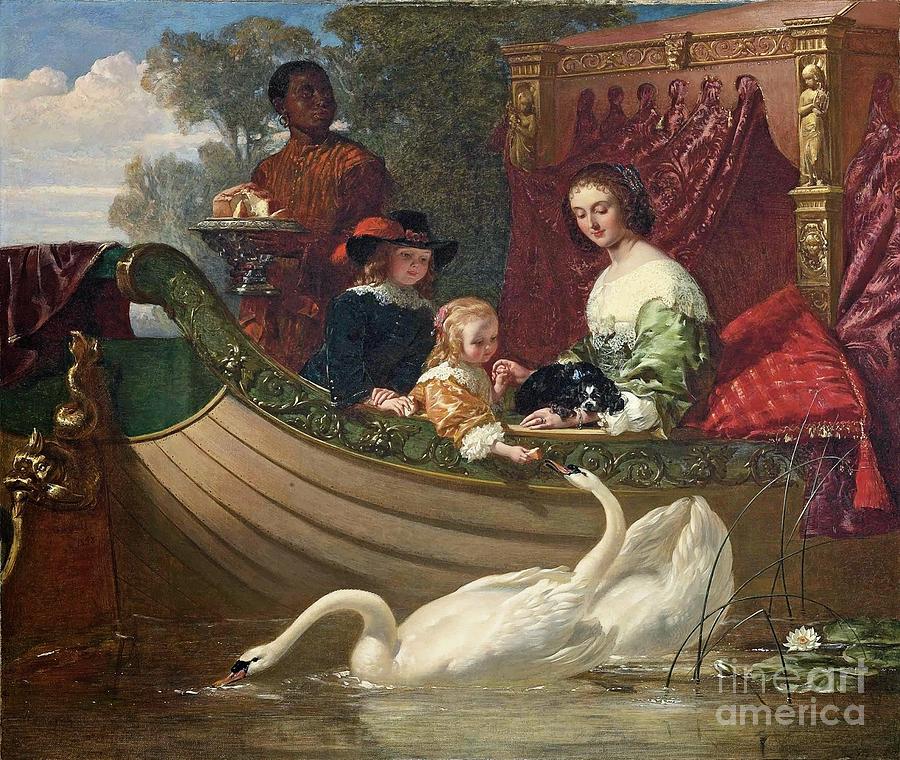
Henrietta Maria with two of her Children

Charles I and Henrietta Maria with Charles Prince of Wales and Mary the Princess Royal

The Queen doing Penance at Tyburn

A glowing review from Pursuing Stacie:
I have a huge love for classics. Little Women, Jane Eyre, Anne of Green of Gables…I will reach for these novels again and again, and then sigh happily about 3, 428 times throughout the story. This was exactly my experience while reading My Queen, My Love: A Novel of Henrietta Maria. It just has that rare classic, cozy, wholesome feel. Mind you, there’s plenty of suspense and intrigue. But the story is just so good!

The author skillfully fleshes out the characters and story of Charles and Henrietta, allowing her readers to sink into the novel. When I was about three chapters in, I realized with a start that I had not only completely missed my bedtime, but had forgotten altogether that I was reading a book, so engrossed was I in the story. (Have you ever read a book that feels like a movie?) (You’re about to.)

While the author set a scene masterfully, she also brought these historical characters to life in rich detail. (Might I suggest Googling their names as you meet them, by the way? So fun to put a face to the new friend that you’ve just made.) I adored Henrietta and will carry her with me always. But truly, each character was dynamic and real. From the beautiful love story to the suspense that only villainy can bring, this novel is perfect from beginning to end. (Read more.)

Because the two of them worked hard to make their marriage work, they ended up deeply in love with each other which made it satisfying. There is plenty of drama, politics, and courtly intrigue that will engage the reader to keep turning the page! I can’t wait to read the next book in the series to learn what comes next for Queen Henrietta Maria of England! I recommend this for fans of Jean Plaidy, Alison Weir, and Philippa Gregory! My Queen, My Love is a promising start to an enthralling series on one of England’s most tragic queens! (Read more.)

My Queen, My Love and Generalissima are available from Amazon.
Share

Sunday, July 19, 2026

My Guest Post for Tony Riches


 My thanks to Tony for such a wonderful opportunity! From The Writing Desk:

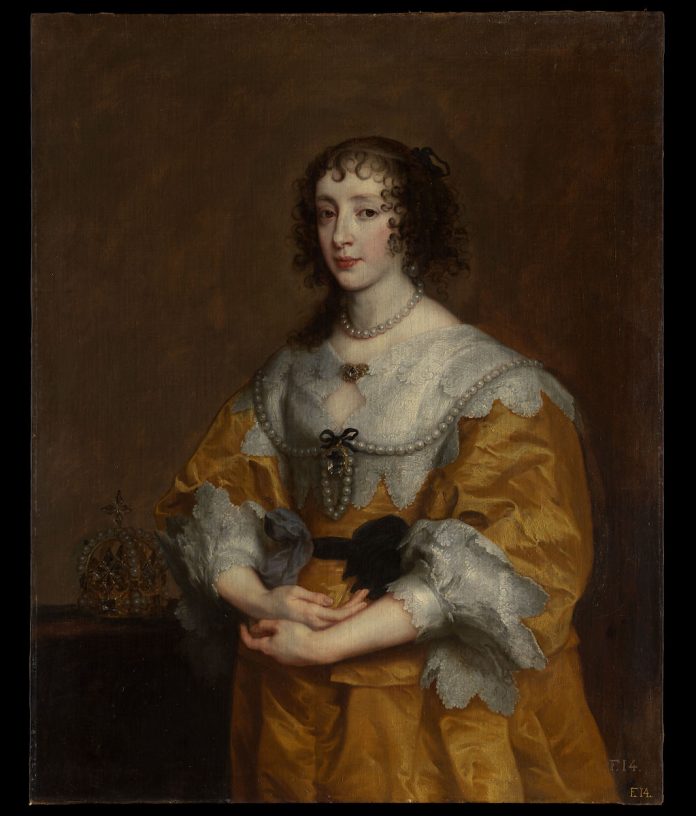
Wife of the ill-fated Charles I, the colony named for her was intended to be a refuge for Roman Catholics, the Catholic religion being forbidden in the Three Kingdoms. In my room as a teenager there was a print of the Van Dyck portrait of Henrietta Maria, the original of which is in the National Gallery of Art in Washington, D.C. Called “Mary” by her subjects, the second Stuart queen of England peers down from the portrait with her black eyes, which contemporaries described as large, sparkling and beautiful. Her dark curls with auburn highlights contrast against the deep marine blue shimmer of a silk dress, with the salmon-pink bows and elaborate white cuffs and high starched collar. A wide-brimmed plumed black hat was of the type made famous by the cavaliers who later fought for her husband in the English Civil Wars. 

The white plumes are reminiscent of the one made famous by her father Henri IV of France, which he wore into battle so that his men could always find him. Like her father, Henrietta Maria was not afraid to stand out, remaining a devoted Catholic in a land where her faith was banned, becoming the number one lawbreaker, while also striving to be a traditionally obedient wife, as was expected. But the expectations placed upon her made her life a tightrope walk which almost broke her.

The life of Henrietta Maria of France (1609-1669) was turbulent from the beginning. Half-Bourbon and half-Medici, her father, the famous Henri IV, was assassinated when she was an infant. Brought up by her mother, the Queen Regent Marie de’ Medici, to be a devout Catholic, she also mastered ballet, singing, and acting, skills which she would use in masques to entertain the Bourbon Court and later the Stuart Court. At fifteen she was sent to marry Charles Stuart, grandson of Mary Queen of Scots, who had just succeeded his father James I to the throne of the Three Kingdoms. 

While Charles I never converted to Catholicism, as had been hoped by many, his relationship with his wife was profoundly spiritual, enhancing the intense physical passion between them. After the initial clashing of cultures and personalities, theirs became one of the most devoted in the history of royal marriages, and was blessed with nine children. During the troubles which led to the English Civil War, Henrietta Maria became a liability to Charles because of her religion and her meddling, both perceived and actual. But her courage and her devotion fuelled the royalist cause, as she sold her jewels to raise money for arms and led soldiers to aid her husband. 

The challenges the royal couple faced in their early years of marriage are told in Book 1 of the Henrietta of France trilogy, My Queen, My Love. Book 2 will deal with the Civil Wars and Book 3 will be about the Queen’s widowhood as well as the adventures of her surviving children.

My view of historical fiction is that the author attempts to paint a portrait of the past with words. A historical novel is like a portrait come to life, allowing the reader to step into the past. Authenticity is vital, and that comes only from thorough research. While it is not always possible to visit the historical places that play a part in the novel, it helps. 

The internet has been a gift to historical fiction writers, making accessible old documents, manuscripts, pictures and books that one once had to travel far to find. I found the original program of the 1623 masque performed by Anne of Austria and Henrietta of France at the Louvre during Shrovetide. It was at the rehearsal of the masque that Charles Stuart first saw Henrietta during his incognito visit to Paris. Such primary sources, like the Queen’s letters, are indispensable for creating a living portrait.

So much of what people think they know about Henrietta Maria has been filtered secondhand through multiple writers, some of whom view her as a frothy but tiresome fanatic who led her husband into ruin. This is often accompanied by the perception of the Queen as a dangerous seductress, who used her French wiles in the boudoir to subject Charles to her will. 

And others decide that Charles was not enough for her but she had lovers such as Henry Jermyn who actually told her what to do, while fathering her children. Just as her enemies called her the “popish brat of France,” she has been portrayed erroneously either as a sex fiend soaked with crazed religiosity, or as a shy, pious pawn. (Read more.)

Novel available HERE.

Share

Monday, June 8, 2026

Writing Seventeenth-century Fiction

 From The Seventeenth Century Lady:

Not a Chronos title, but reviewing Gerard Fitzgibbon’s Kingdom Overthrown: Ireland and the Battle for Europe 1688–1691 for the Irish Examiner also profoundly broadened my understanding of the 1600s, revealing it as an era of international conflict, sectarian violence, and colonial ambition. Through accounts of the Williamite-Jacobite wars in Ireland, one witnesses how Catholic and Protestant divisions were not theological disagreements at all, but a means to determine land ownership, political rights, loyalty, and often life itself. To a budding novelist, the story created a rich framework for writing about conflict. Accounts of the battles of the Boyne, Aughrim, and Limerick reveal not heroic romantic warfare but exhaustion, famine, mud, terror, and brutality. Fitzgibbon’s descriptions of soldiers dying slowly from musket wounds, starvation spreading after scorched-earth campaigns, and divided leadership among the Jacobites all help strip away modern romanticism about war which I strive to bring to the novel.

Recurring truths about the 17th century kept popping up. Reputation could destroy lives. Religion shaped identity and loyalty. War was brutal and constant. Empire displaced entire populations. Survival depended on adaptability. People feared God, plague, famine, and political betrayal. Honour mattered. Bloodlines mattered. Religious identity mattered. Death was common and often sudden.

Having been provided with the building blocks of a believable historical world, dynastic ambition, war, exile, colonial expansion, and survival inside brutally unstable political systems, slowly my novel started taking shape. The sensory details contained within works I’d read were equally valuable to help me write about the texture of daily life… velvet gowns, sweat beneath brocade, banquets, candle wax. (Read more.)


Share

Saturday, May 30, 2026

Henrietta Maria: Number One Lawbreaker

Henrietta Maria holding a butterfly

 My guest post at an amazing site called Novels Alive
.

In the lone tent, waiting for victory,
She stands with eyes marred by the mists of pain,
Like some wan lily overdrenched with rain:
The clamorous clang of arms, the ensanguined sky,
War’s ruin, and the wreck of chivalry
To her proud soul no common fear can bring:
Bravely she tarrieth for her Lord the King,
Her soul a-flame with passionate ecstasy.
~from “Henrietta Maria” by Oscar Wilde

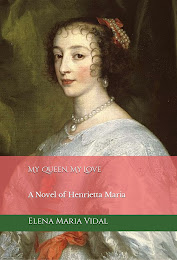
Henriette-Marie of France, or “Henrietta Maria,” is the protagonist of my new novel My Queen, My Love (Mayapple Books, November 25, 2021), the first of the Henrietta of France Trilogy. It is the story of the fifteen-year-old princess Henriette-Marie who is mandated by the Pope and by her brother the King of France to convert the English back to Catholicism by marrying their King, Charles I. Meanwhile, the Catholic Faith is outlawed in the British Isles, so as Queen she becomes the number one lawbreaker. The powerful Duke of Buckingham tries to thwart her growing influence with her husband. And England has become known as a place where queens lose their heads. 

[...]

As Regent, Queen Marie chose to avoid war by making peace with the other Catholic powers of Spain and the Holy Roman Empire. She believed that Catholic monarchies should unite to keep Protestantism at bay. She sent her youngest daughter Henriette to marry in England because she believed there was a chance of bringing Charles I into Catholicism. So at fifteen years old Henriette-Marie aka Henrietta Maria was sent to marry Charles Stuart, who was a decade or so older. The royal couple initially clashed over culture and religion. They quarreled whenever together and so avoided each other for weeks at a time. When they finally did fall in love, theirs became one of the most devoted in the history of royal marriages, and was blessed with nine children. (Read more.)

A review from Gwendalyn's Books:

Henrietta is one to root for as we see the very young bride overcome so many obstacles. Particularly because she is a devout Catholic, and by the actions of the villainess character, George Villiers.

The author take great care to include a vast amount of characters, which made for a more rewarding read for me. A book to catapult its readers into the turbulent era of England in the 1600’s. From the beginning I was hooked and read this one in a day.

Historical fiction at its finest. This was an exceptional portrait of a the wife of Charles I. Brought stunningly to life, with seamless narration and three dimensional characters, a true treasure piece of historical fiction.

E.M. Vidal meticulous research and descriptive writing, has brought one of England’s most tragic queens, Henrietta Maria, vividly to life. (Read more.)

Share

Friday, May 29, 2026

Baby Charles

 King Charles II as a baby, born on May 29, 1630 (OS). From the National Portrait Gallery:

This is the earliest known portrait of the future king. It was painted, according to the French inscription, when he was four months and fifteen days old. At this age he was described by his mother, Henrietta Maria, as 'so fat and so tall that he is taken for a year old'. The painting was probably sent to the prince's godmother and grandmother, Marie de' Medici, Queen Mother of France. The dog, held by the ear, is a toy spaniel, a breed which later came to be associated with Charles as King. (Read more.)


Share

Tuesday, April 14, 2026

Deeply Moving Story That Brings History to Life

https://img.atlasobscura.com/DvYHne_6kA2SOBPoV10Rlq4EP8ntOOmxkpaqFHZY-u4/rt:fill/w:1200/el:1/q:81/sm:1/scp:1/ar:1/aHR0cHM6Ly9hdGxh/cy1kZXYuczMuYW1h/em9uYXdzLmNvbS91/cGxvYWRzL2Fzc2V0/cy8wNmVmN2Y4MjJk/MmVlYWVhYzhfS2lu/Z19DaGFybGVzX0lf/YW5kX1ByaW5jZV9S/dXBlcnRfYmVmb3Jl/X3RoZV9CYXR0bGVf/b2ZfTmFzZWJ5Lmpw/Zw.jpg 

A review of Generalissima from "Silver Rose":

I had previously read the first volume of this trilogy a few years ago and was captivated by the romance of King Charles I and Queen Henriette-Marie. In Book 2, they spend more time apart, but it remains romantic, leading to very poignant and memorable moments when either reuniting, departing, or, for example, attempting to read one another's encoded letters with frustration and yearning. Overall, there is much more focus on their children also in this novel. Elena Maria Vidal's superpower is her ability to vividly depict characters based on real-life historical figures so that your emotional investment and curiosity lead you to look them up. After doing so in some cases before finishing GENERALISSIMA, I actually ended up noticing foreshadowing when returning to the book. (Of course, it may be more prudent to wait to avoid spoilers. ;) ) There are other key figures that likewise warranted that Google search, among them Jeffrey the Dwarf. He had a unique personality, but I found myself intrigued in general:

While referring to their short stature rather than any sort of fantasy context, the mention of dwarfs—and even, while not seen, a giant—allowed, when coupled with beautifully lyrical references to Arthurian legend, a splash of a fairy-tale essence amidst a grittier plot. That isn't to say that fairy tales are without danger or the real within the fantastical, for they are, but, rather, that the overall tone is different here and more intense than in the first book. Nevertheless, beauty, love, and faith shine through, and there are moments of joy and Light. There is a dance scene set to "Greensleeves" that may be envisioned as one of merry yet almost ethereal times past. There are moments of prayer and Confession in even the most dismal of circumstances. While I don't wish to give spoilers, I must also mention a particular scene on the beach that is stirring in its mixture of intensity, hope, and, in other respects, overwhelming emotion. The courage of the principal characters is truly noteworthy. Of course, it is quite a moment when the title of the book comes into play. (Read more.)


Share

Sunday, March 1, 2026

The Restoration of the Monarchy in England and France

picture, King Charles II, London, street, crowd, soldiers
Charles II and his brother James Duke of York (James II) in 1660 upon their return to England after years of exile

 I have written a novel about the Bourbon Restoration and am working on one about the Stuart Restoration. From Charles Coulombe:

Despite enormous amounts of internal plotting and occasional violent opposition – often centred in either country’s “Celtic Fringe” – neither revolutionary regime was ended by internal action on the part of the exiled Monarch’s supporters.  Rather, in the case of the British Isles, Restoration was imposed by General Monck and the army; in France, it was the victorious Allies of 1814 and 1815.  Nevertheless, in both countries, once the deed was done, the returning Kings were greeted rapturously by their once-estranged and now chastened subjects.

Both Restorations saw an explosion in literature and the other arts.  The London stage, freed from Puritan suppression, turned out and performed endless numbers of plays, while the surviving Cavalier poets happily turned out masterpieces.  Romanticism, in full swing upon the return of the King to Paris, was dizzying in effect upon all of the arts.  Both Restorations were heavily equipped with dandies and wits of all sorts, enjoying the revival of intellectual freedom the respective restored Monarchies brought in their wake.

Another happy benefit of the Restorations in both countries was the revival of Catholicism.  In the British Isles, it was partial, but still very much in the air.  St. Claude de La Colombiere was the confessor for some time to Charles II’s Catholic Queen, Catherine of Braganza, and the King would enter the Church on his deathbed.  In France, the Church began a rapid programme of revival that would outlast the Restoration and encompass most of the 19th century; but its roots were definitely laid down during this era.

Both Restorations had a particular drawback, which was a rise in public immorality of all sorts.  In part this was because the revolutionary regimes had been so very oppressive.  Liberation did not just mean the freedom to do the right thing – it also meant that fallen nature would have its way.  Nor did it help that neither restored  King – Charles II nor Louis XVIII – had a tremendous reputation for morality – and both would die without any legitimate children.  But they both did have enormous charm. (Read more.)

Share

Thursday, February 26, 2026

Mary Henrietta of England

The daughter of Charles I and mother of William III.
Wishing to imitate the French tradition of the firstborn daughter of the King being known as Madame Royale, the French-born Queen consort wanted to do something similar for her own daughter. So, in 1642 King Charles I gave Princess Mary the title of Princess Royal, establishing a new tradition in the British Royal Family. Even as a tiny child, the new Princess Royal was immediately the center of marriage negotiations. Originally, King Charles had wished his daughter to marry into the Spanish Royal Family to secure a long-lasting alliance between Britain and Spain. His own father had tried to see him married to a Spanish princess as King James had hoped that Britain could act as the great peace-maker between the Catholic and Protestant powers as the wars between the two sides were tearing Europe apart. This was a long-standing ambition of the House of Stuart, to emerge as the monarchy that restored peace, if not unity, to Christendom. (Read entire post.)
Share

Thursday, February 5, 2026

"Dramatic and Compelling"


From the Historical Novel Society:

Generalissima is the second volume in Vidal’s trilogy on Queen Henrietta Maria, wife of King Charles I of England and sister to Louis XIII of France. This installment traces her life from the unrest that sparked the civil wars of the Three Kingdoms to her dramatic flight to France in 1644.

The novel is divided into two parts. The first centres on the queen’s twin obsessions: converting Charles and their family to Roman Catholicism and preventing the marriage of their eldest daughter to the Prince of Orange. But as the Puritans gain strength, Charles refuses decisive action and Henrietta departs with their older children, carrying her jewels and valuables to sell for arms and munitions in Europe. The second part follows Henrietta in her role as Generalissima, revealing a resolve and strategic boldness that Charles lacks. She is willing to take the risks that might have preserved the monarchy, yet as a French, Catholic woman, she is not heeded. By 1644, after a series of dramatic events, the stage is set for the trilogy’s final volume. (Read more.)


Generalissima available, HERE.

Share

Tuesday, February 3, 2026

"A Woman Determined to Protect Her Family"


 From Amy at Novels Alive:

A woman determined to protect her family must make calculated decisions amid turmoil in 17th-century England.

Author Elena Maria Vidal delivers a compelling look at Queen Henrietta-Maria in Generalissima, marking the second installment of the Henrietta of France Trilogy.

The author applies a layer of historical fiction to enhance the challenges faced by the royal family, most notably the civil wars. Through historical detail, the author recreates a time period of unrest, not limited to the anti-Catholic movement.

As the second in a series, it is challenging to fully appreciate the author’s work without reading it in sequence. Queen Henrietta appears to be a sympathetic character, especially pertaining to her children. The scene involving Mary’s wedding night at age 9 is only one example.

Generalissima expounds upon the complexity of Queen Henrietta-Maria and the mark she leaves behind. (Read more.)
Share

Thursday, January 22, 2026

"Generalissima"--Queen Henrietta Maria and the English Civil War

From author Stephanie Mann:

This is the second volume in a trilogy of historical novels about Queen Henrietta Maria, the wife of King Charles I; mother of Kings Charles II and James II and therefore grandmother of the Old Pretender and great-grandmother of the Young Pretender and the Cardinal Pretender.

In this book the author traces the lives of the Queen and her family from 1640 to 1644, from the Royal palaces of Saint James, Wimbledon, Whitehall, Hampton Court, to The Hague in the Netherlands, the battlefields of the English Civil War, through betrayals--especially by Lucy Fairfax, one of her ladies-in-waiting--and attacks on Henriette (as she is called throughout the book) because she is a Catholic; storms and battles at sea, the death of her mother, pregnancies, separations, her efforts and love for her husband and her disappointments that he has not always fulfilled the promises of their marriage contract, times in York, Oxford, Cornwall, and France!

Throughout all these conflicts, dangers, and adventures, Vidal's narration, use of dialogue, and description are vivid, personal, and often poignant. (Read more.)


Share

Wednesday, November 12, 2025

The Youth of Charles, Prince of Wales

 Charles II 

Please do listen to historian Mark Turnbull discuss with author Claire Hobson the trauma experienced by Charles II during the Civil War at the CavalierCast, HERE. And more about his life, HERE.

Share

Tuesday, September 16, 2025

"A Powerful Portrayal of a Queen, a Wife and a Mother"

undefined

 undefined

 I am honored to post this review of Generalissima by author Christina Croft.

 In this fascinating novel, Elena Maria Vidal takes the reader behind the scenes into the life of Henrietta Maria, consort of the ill-fated Charles I, as the country stands on the verge of civil war. With tensions mounting between the King and Parliament, the author skillfully builds suspense through moving dialogue and exquisite descriptions; and the reader cannot help but empathize with the Catholic Queen in a Protestant country that has not yet fully emerged from a century of bloody religious conflict. The vivid narrative not only captures the essence of Henrietta’s quiet courage in the face of ill-health, bereavement, suspicion and treachery, during of the most turbulent periods in British history, but also provides a powerful portrayal of a Queen, a wife and a mother, sustained by her commitment to her faith and her family. Based on meticulous research, the novel is both informative and inspiring – yet another truly rewarding read from this excellent author! Christina Croft, author of Martyrs of the English Reformation: 1535-1681


Generalissima is available, HERE.

Share

Monday, September 8, 2025

Generalissima: A Novel of Henrietta Maria


 Now in paperback. From the Amazon page:

"In this, the second part of the Henrietta of France trilogy, once again Elena Maria Vidal relies on strong characters based on meticulously researched historical facts to tell her story. Feel for the family of King Charles I as their country is riven by a civil war. Meet, again or for the first time, his unpopular French-born wife, a Catholic in a hostile country that was Protestant for only about a century then. But most of the time here she is simply a mother who of course wants to protect her children, who include the future kings Charles II and James II. The political intrigue and real risk of losing her life are not only on the battlefields of the English Civil War, nor only a war between king and subjects, but extend even to the queen's inner circle as she no longer knows who or what to trust. Except, that is, for her faith, which she surreptitiously tries to teach to her legally Protestant little ones. Dive into history presented with a human touch!" John Beeler, Journalist

 "Good historical fiction requires thorough research, and I enjoy research. The storyline is basically provided for you; all the author has to do is weave the historical events together in a coherent and entertaining manner. The challenge for the historical fiction writer is to maintain the integrity of the historical persons, remembering that those who were real people have the right to be presented as close as possible to how they were in life...There is something about certain persons that reaches out to you from the past, the past being like Alice's mirror that she climbs through into another universe. People who faced hardships with courage, fortitude and faith have always appealed to me. By studying their lives and recreating what we discover into a living portrait we historical fiction writers are able to invite others to join us in our journeys into the past." from an interview with Elena Maria Vidal by Avellina Balestri at Fairydust and Fellowship

undefined
William Harvey, the Prince of Wales and the Duke of York at the Battle of Edgehill by W.F. Yeames.
Share

Wednesday, September 3, 2025

The Henrietta of France Trilogy, Book Two

 
 Now on Kindle. Paperback version coming soon. From the Amazon page:
As the Three Kingdoms totter on the brink of anarchy, Henriette-Marie, queen of Charles I, strives to bring up their lively, growing family. In addition to her own health problems, she worries about the welfare of her mother the Dowager Queen of France, who sought refuge in London only to find herself under attack. As Henriette faces choices which may separate herself from her beloved husband and children, she seeks help from the Pope and the Irish Catholics. Meanwhile, Henriette's spy, Wat Montagu, informs her that there is a traitor within the royal household. Determined to save the throne, Henriette eventually decides to sell her jewels in order to raise an army. In spite of storms and near shipwreck as well as the attempts of her enemies to kill her, Henriette is able to return to her husband's side with an army, earning for herself the moniker of "Generalissima."

"With commendably strong accuracy of historical detail, Elena overlays a fictional interpretation of the most momentous events of Henrietta Maria’s life; the lead up to – and outbreak of - the civil wars (also known as Britain’s Wars of the Three Kingdoms). With evident passion for this much overlooked period, she tracks the queen and her family, taking readers behind palace doors to imagine how they might have reacted to the seismic events they faced." —from the Foreword by
Mark Turnbull, author of The Private Life of Charles I

"In her latest novel on Queen Henrietta Maria as in her previous historical works, Elena Maria Vidal shows her great appreciation for the layers of whatever world she inhabits as an author. She immerses us in the material, intellectual, and spiritual culture that shapes the characters as they face the catastrophe of civil war and the tumult of religious division. King Charles and Queen Henrietta Maria, complex and often misunderstood monarchs, are intimately revealed here through their warm family life, which the author paints with vivid linguistic color. We also meet various other historical figures who make their mark upon the Isles, from Mary Ward to Oliver Cromwell, bound together by an aura of destiny already prophesied by Britain's Arthurian myths." —Avellina Balestri, author of
All Ye That Pass By

Generalissima is another beautiful historical novel (the second in The Henrietta of France Trilogy) by Elena Maria Vidal, which drew me into the story from the very beginning, continuing the narrative from Book One. The author’s superb research and solid, polished story-telling allow these historical characters to become living, breathing people. With the popularity of the ‘pulp fiction’ genre, I, for one, enjoy the rich settings, well-developed characters, and exquisite prose of this talented author. I highly recommend this book to anyone who enjoys crisp writing and fascinating history.” —Ellen Gable, award-winning author of Where Angels Pass

“Elena Vidal does true justice to Queen Henrietta Maria, a beguiling Stuart heroine whose deep faith and love underpinned her bravery in a turbulent era. Alive with intrigue and studded with gems of detail,
Generalissima captures the reader from the very outset.” —Justine Brown, author of The Private Life of James II

“From the first words of the Prologue, you're there with the Royal Family in the picture Gallery. Limned by a great historical novelist, each episode in this second volume of Vidal's ‘Henrietta of France Trilogy’ develops the characters and explores the challenges they face with vivid description and riveting action. Vidal depicts Queen Henrietta Maria's love and loyalty to her husband King Charles I and her family in the throes of the English Civil War sympathetically and realistically. Volume Three can't appear soon enough! —Stephanie A. Mann, blogger and author of
Supremacy and Survival: How Catholics Endured the English Reformation


Kindle edition, HERE.

Share

Tuesday, August 19, 2025

The Stuart Joint Monarchs in Art

Mary (1631–1660), Princess Royal and Princess of Orange
Mary Stuart, daughter of Charles I, the Princess Royal

 From Andrea Zuvich at ArtUK:

When King Charles II – the 'Merry Monarch' – died in 1685, he left behind not only his grieving widow, Catherine of Braganza, but also many children. None of these, however, were legitimate, all having been born to other women. Therefore none of them could become his heir.

As a result of this situation, Charles's younger brother, James, Duke of York, inherited the throne by default. At this point, James had two legitimate daughters from his first marriage to Anne Hyde: Mary (born 1662) and Anne (born 1665). As Duchess of York, Anne Hyde commissioned popular artist Peter Lely to create a series of portraits of the most beautiful women at court, which came to be known as the 'Windsor Beauties'.

In this portrait, we see James and Anne together (a later version, now in the Royal Collection, features their daughters, Mary and Anne). Anne, Duchess of York, died from breast cancer in 1671, aged only 34. Two years later, James married Mary of Modena, a much younger Roman Catholic, Italian princess. For some years, the couple suffered the tragic losses of their children. As a result, Mary of York, the eldest surviving child from his first marriage, was the presumed heiress, and here she is around age 12. The Anglo-Dutch Wars began in the 1650s, so Stuart Britain was often at odds with the Dutch Republic, despite a marital alliance between Mary, Princess Royal, the daughter of Charles I and Henrietta Maria, and Willem II of Orange. This union was unhappy and marred further by Willem's death from smallpox a little over a week before their only child, William, was born in 1650. The boy grew up to have health challenges of his own, including asthma. He was widely considered unattractive both in his physical form and with regard to his personality (he came across as cold and irritable).(Read more.)


Share

Tuesday, July 29, 2025

The Exile of Charles II

 undefined

 From Caroline Willcocks at The Seventeenth Century Lady:

Shakespeare’s play “As You Like It” has been seen by historians as a metaphor for Charles’s exile.  He is likened to the exiled Duke, living in the magical Forest of Arden.  It is this dreamlike quality which I find fascinating.  There is no doubt that Charles and his court lived for some of the time in a pleasurable limbo, where dancing, music and hunting were engaged in with passion, as were affairs of the heart. But there were also times when he struggled to keep any form of court going. In my books, I have a running joke about the quality of the wine the courtiers drink. Most of them were not paid and had to support themselves. My protagonist earns his keep from acting as an escort to wealthy but lonely women.

There was no secure future.   Looking forward a few months, the exiles could have found themselves back in the splendour of Whitehall, or dead on an English battlefield. What was possibly even worse, they might have been inexorably relegated, as time went on, to insignificance and poverty. No wonder they escaped into living for the day. Here were a number of young, good-looking aristocrats facing a fearful future. Is it any surprise that the licentiousness which marked Charles II’s later Restoration court started in exile?

At this time, spies were suspected of lurking at every corner.  Both Charles and the Parliament used spies.  And who was to know whether a fellow Englishman or woman was exactly who they said they were?  The idea that many had something to hide has intrigued me.  While they were hiding their political allegiances, who was to say they weren’t hiding anything else?   There was always the threat of assassination. As writer, I revel in this high-stakes game where death is always in the background.  At times, I’ve felt I was writing a farcical seventeenth-century version of “You Only Live Twice.” (Read more.)


Share

Saturday, July 26, 2025

"Charming and Engaging"


 A review of My Queen, My Love from royal historian Theodore Harvey at Royal World:

Most Americans are probably not aware that the US state of Maryland was originally named after Queen Henrietta Maria (1609-1669), daughter of King Henri IV of France (1553-1610) and wife of the ill-fated King Charles I of England (1600-1649). Readers seeking an introduction to this unjustly neglected historical figure would do well to immerse themselves in this charming and engaging book by Elena Maria Vidal, who appropriately enough lives in Maryland.

"My Queen, My Love," which covers the title character's life from her childhood in France through the births of her own children in the 1630s on the eve of the English Civil War, is a historical novel, so includes fictionalized dialogue, but is firmly based on historical research like any biography. Its style vividly brings the complex and colourful world of the 17th century to life, from Italy [homeland of her mother Marie de Medici (1573-1642)] to France to England. The central importance of religion is evident from the outset. Daughter of the pragmatic convert Henri IV, the devoutly Catholic Henrietta Maria finds herself in an impossible situation as wife of the staunch Anglican Charles I in what is by then a predominantly and fervently Protestant country, with even the King's own high church Anglicanism increasingly deemed too "catholic" by some. While the author clearly shares Henrietta Maria's devout Roman Catholicism, it is to Vidal's credit that the sincerity of King Charles who believes that his Church of England is truly Catholic is depicted in a well-rounded manner. I particularly appreciated the writer's evident love of liturgical beauty as reflected in lavish descriptions of Catholic ceremonies including sacred music. Henrietta Maria's enjoyment of the secular arts, so scandalous to the dour Puritans especially her own participation in Masques, is a consistent theme as well.

Anglicans like me who revere Charles as a Martyr, aware of his and his wife's fervent loyalty to each other during the terrible trials of the Civil War which (after the time period covered by this book) would end in his execution and her widowhood, are accustomed to thinking of their marriage as an ideal devoted Christian one, as indeed it later became. However it must be admitted that this was not always the case. While vaguely aware that King Charles and Queen Henrietta Maria had had difficulties in the early years of their marriage, I had not thought much about the details until I read this book. One sensitive issue is that in order to gain French approval for their 1625 marriage Charles had had to make various promises, particularly those related to the Queen's Catholicism, that once back in England he finds himself unable to keep. It particularly galls her, understandably, that money from her dowry ended up being used to fund a war with her native France! While Vidal's Henrietta Maria never falters in her ultimately heroic love for Charles, the reader can also see without dismissing his point of view how Charles might have felt frustrated at times. (Read more.)


Share

Friday, July 25, 2025

Recusant Queen: The White Martyrdom of Henrietta Maria

Queen Henrietta Maria wearing the diamond cross given her by Pope Urban VIII
 

Kristen Van Uden Theriault wrote a most insightful and poignant review of My Queen, My Love at Catholic Exchange:

After the Anglican revolution of Henry VIII, the English royal house was divided. Protestant Elizabeth I died with no issue. Despite Mary Queen of Scots’ heroic witness unto death for the true Faith, her son James was effectively hijacked by her enemies and groomed into a Tudor heir. By the time James’ son Charles ascended the throne, the Stuart dynasty was strongly within the Protestant camp, though his potential conversion remained a hoped-for (or dreaded) eventuality.The long line of English Catholic martyrs marched forward even during the “tolerant” reign of the Stuarts....Anti-Catholic sentiment reigned supreme.  The “ringing island” rang no longer, instead clamoring dissonant peals of error.

Into this hostile territory entered a young Catholic princess, Henrietta Maria of France. The daughter of Henry IV, a French Huguenot, and Catholic Marie de’Medici, Henrietta was sent not only as a political envoy, as was the routine purpose of royal marriages, but also as a religious ambassador. Her parents’ marriage, by which the Church partially attempted to heal the French Huguenot schism, provided a model, albeit a rocky one.

The marriage of Henrietta and Charles required a dispensation from the pope, as Catholics were forbidden to marry non-Catholics except in extreme or unusual circumstances. The dispensation came with a weighty caveat: that Henrietta would endeavor to convert her husband, and consequently his country, back to the true Faith. Henrietta was instructed to imitate saint Berthe, who had converted her pagan husband, and sent into the spiritual war zone.

Henrietta arrived in England at the tender age of fifteen, with this outsized supernatural mission to complete. (Read more.)


Book available, HERE.

Share

Saturday, July 19, 2025

Highlights of St James's Palace

 The Tapestry Room at St James's Palace.

 From the Royal Trust Collection:

Originally known as the ‘Consort’s Presence Chamber’, the Tapestry Room features a spectacular original fireplace that survives from the reign of Henry VIII. In one of the carved quatrefoils (a design made of four intersecting lobes) you can see the initials ‘H’ and ‘A’ for Henry and his second wife, Anne Boleyn, which are intertwined with a true lover’s knot.  

This room is best-known for its display of tapestries that tell the story of Vulcan and Venus from Homer’s Odyssey. Charles I, when Prince of Wales, commissioned a suite of nine tapestries from the Mortlake tapestry workshop, the designs for which may have been adapted from an earlier series owned by Henry VIII on the same subject. Following Charles's execution in 1649, most of his collection of art (including the tapestries) was sold, and the suite was dispersed across Europe along with countless other works. (Read more.)


Share