


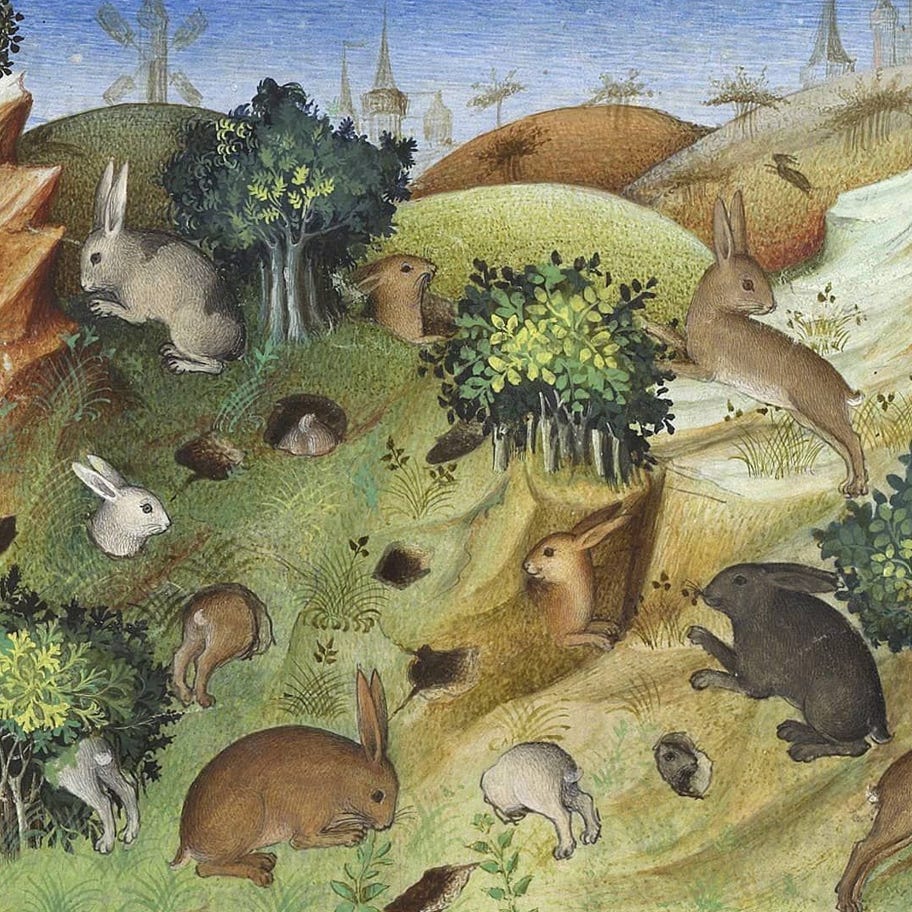
From Hilary White at The Sacred Images Project:
In the 13th century, Latin translations of Aristotle flooded European universities. Aristotle wrote extensively about physis (nature) as an intrinsic, active principle of motion and change within the material world. The idea was, broadly, that the physical world was not inert or lifeless. Each natural thing possesses an internal principle governing its characteristic movement and development.
Going back to the simple little grazing rabbit or the bird tending its nest, according to Aristotle’s physis, natural things possess their own principles of movement and development. And you can see this principle at work. An acorn looks nothing like an oak tree, but it grows into an oak because it contains the principle of “oakness” and its nature is to grow into the fulfilment of that principle.
When Aristotle became the foundation of Christian philosophy, thinkers like Thomas Aquinas and Bonaventure had to find a way to understand this in a way that did not end in Pantheism. The obvious question had to have a coherent Christian answer: If nature itself is imbued with an active energetic force that creates, shapes and moves things, does that mean nature has its own independent power separate from God? If nature does all the work, does that mean God is relegated to being a passive bystander, perhaps something like what later thinkers would call the “watchmaker” deity who made everything like a machine that runs on its own, and then left?
The solution was obvious: God’s power of creation is combined with His will to sustain everything that exists in existence from moment to moment. And everything He created is endowed with an inherent nature and functions according to that nature. Everything has characteristic powers, activities or behaviours and ways of developing inherent to it. The rabbit grazes and burrows; the bird builds its nest and sings; the acorn develops into an oak because they were all created with those powers and instincts. (Read more.)









No comments:
Post a Comment