


Thomas Merton on Noise
1 week ago


From Tierney's Real News:
ShareA new study by the CDC shows that the number of young teenage girls who identify as gay, bisexual or transgender has FALLEN by 50% in just the past two years. CDC data shows the explosion among ninth-grade girls was never organic. It was social engineering via influencers, schools, and retail - and now the numbers are crashing.
Starting about 10 years ago, the percentage of young teenage girls who suddenly identified as bisexual (or gay) skyrocketed by 300%! It peaked under the Obama-Biden regime in 2021 at 32%. One out of three 9th grade girls were calling themselves bisexual, transgender or gay in 2021! WTH.
A new study by the CDC shows that it has fallen from 32% to 17% in the past two years. Praise God! (Read more.)
From The Medieval Scholar:
ShareKnighthood and nobility must nevertheless be distinguished. A nobleman’s son inherited family relationships and might inherit property; he did not simply inherit his father’s personal accolade. Late medieval records could distinguish nobles who were knights from nobles who remained esquires. The candidate needed promotion if he wished to cross that particular boundary.[1,5]
The household offered a setting in which inherited standing could become demonstrated usefulness. It brought young men into contact with experienced adults, obligations, and patterns of conduct. Historian Arie van Steensel describes noble education in the Burgundian Low Countries as substantially practical, with young nobles spending time at different courts. He also stresses regional variation: the dukes did not make noble culture uniform throughout their territories.
That helps explain why a family connection mattered without treating birth as the whole story. An introduction could secure an opportunity to serve. It could not, by itself, show whether the young man could make himself useful, handle responsibility, or sustain a reputation among those whose opinion mattered. (Read more.)

Here also on the 16th of October, 1793 fell a once beauteous head- now whitened by sorrow not by age- and venerable for the angelic purity and patience, the royal courage and Christian submission with which it had exchanged the most brilliant crown of the world for a crown of thorns, and that again for the crown of martyrdom. Here died the QUEEN- one of the noblest and the purest, and yet, if human judgments be alone weighed, the most unfortunate of women- tried in almost every possible agony of affliction- except a guilty conscience- and in that exception finding the consolation for all. She arrived at this scene of her last and greatest triumph, jolted in a common cart, and ascended the scaffold amidst the vociferations of a crowd of furies, whom we hesitate to acknowledge as of her own sex. Never in that gorgeous palace, on which she now cast a last calm look, did she appear more glorious- never was she so really admirable as she was at that supreme moment of her earthly release. ~from History of the guillotine. Revised from the 'Quarterly review.' By John Wilson Croker

On reaching the scaffold she inadvertently trod on the executioner's foot. "Pardon me," she said, courteously. She knelt for an instant and uttered a half-audible prayer; then rising and glancing towards the towers of the Temple, "Adieu, once again, my children," she said. "I go to rejoin your father."--LAMARTINE (Quoted in Madame Campan's Memoirs)

I was a queen, and you took away my crown; a wife, and you killed my husband; a mother, and you deprived me of my children. My blood alone remains: take it, but do not make me suffer long.~ Marie-AntoinetteLast letter of Marie-Antoinette.
Why we are all poor. From Tierney's Real News:
ShareI’m worn out with people moaning: “Our grandparents could buy a house on one paycheck, but now we can’t even afford rent on two!”
QUIT YOUR BITCHING!!!!!!
Grandpa didn’t have a $90 month internet bill, a $130 phone bill, seven app subscriptions at $72 month, an Amazon addiction for $200 month, Netflix, Paramount or HBO for another $112 month and his haircuts didn’t need a ‘stylist’!
Yeah, maybe because Grandma wasn’t dropping half her income on $14 iced lattes and avocado toast shaped like art projects. Back then, if they wanted coffee, they boiled it at home in a dented pot. It tasted like burnt rubber and regret — but it woke you up and cleaned your pipes. And Grandma wasn’t “out to brunch.”
You think she had time for mimosas and hashtags? She was making something called ‘whatever’s left in the fridge’ and feeding six people with it. (Read more.)
From CR:
The culminating moment of the papal journey was the Mass celebrated at the Place de la Concorde, in the heart of Paris, on the afternoon of September 26th, before an immense crowd estimated at 800,000 people. An event of profound symbolic character, given what this square once represented.
The Place de la Concorde, designed in 1755 by the architect Ange-Jacques Gabriel, was originally known as the Place Louis XV. The French Revolution changed the history of this site forever. The great square became the principal theater of Jacobin capital executions, and in 1792 it was renamed the Place de la Révolution. The guillotine transformed capital punishment into a public spectacle before which the Republic demonstrated its power to suppress all “enemies of the people.” On January 21, 1793, King Louis XVI was beheaded there; on October 16 of the same year, Queen Marie Antoinette followed. The crime of Louis XVI was that of being a king. What was condemned to death by the Revolutionary Tribunal was not the man but the monarchical institution he represented. The square conceived to celebrate the oldest Catholic monarchy in Europe thus became the site of its symbolic annihilation. “The mere title of king,” Robespierre proclaimed, “draws down the scourges of war upon the troubled nation.” But Robespierre himself, following Danton, was guillotined at the Place de la Concorde in 1794: the Revolution devoured its children without mercy.
Pope Pius VI, in the allocution Quare lacrymae delivered in Consistory on June 17, 1793, attributed to Louis XVI “the glory of martyrdom.” He declared: “Who could ever doubt that this king was put to death out of hatred for the Faith and in contempt of the dogmas of Catholicism?” At the origin of the trial and condemnation of the French sovereign, Pius VI explained, lay the “impious ideologies” of “perverse philosophers” — the leading figures of the Enlightenment. From the very beginning of his pontificate, with the bull Inscrutabile Divinae of December 25, 1775, the Pontiff, addressing the Christian people and their pastors, had expressed his anguish at seeing that “restless and furious men, as though driven by an irresistible passion for novelty, do not hesitate to attack the very foundations of rational nature and endeavor — if they could — to subvert them entirely.” The principal revolutionary instrument was the flood of books inspired by Enlightenment ideas that had inundated France since the reign of Louis XV. For this reason, Pius VI exhorted the French bishops: “Remove the evil from among you — that is, with great energy and solicitude, strive to eliminate from your flock all these poisoned books.”
The Enlightenment constitutes a decisive phase of that ideological process which, from the humanist and Protestant Revolution, has led in less than five centuries to the Communist Revolution. Lenin wrote: “We shall probably have to follow… the advice that Engels once gave to the German socialists: to translate and disseminate among the masses the French Enlightenment and atheist publications of the eighteenth century.” But if it is true that the Revolution must continually renew its errors, an authentic Catholic reaction cannot cease to combat those errors, which have spread throughout the world and have unfortunately penetrated even within the Church. Leo XIV himself appeared to overlook the historical significance of the Enlightenment, describing it in his address at the Élysée Palace on September 25 as “a stage that brought to the world important achievements in the domain of human rights.” And yet, the following day, before his meeting with the synodal assembly, the Pope paused in prayer in the garden adjacent to the Institut Catholique, before the plaque bearing the inscription Hic ceciderunt — “Here they fell” — marking the spot where, in September 1792, approximately 115 priests and bishops suffered martyrdom for refusing to renounce their fidelity to the See of Peter. The murderers of these witnesses of the faith — later beatified by the Church — were steeped in precisely that Enlightenment ideology which aimed to eradicate the Christian roots of society. The Festival of the Goddess Reason celebrated in the Cathedral of Notre-Dame on November 10, 1793, marked the apogee of the dechristianization sought by the “Philosophy of the Enlightenment.” It was for this reason that Pius XI, in his address of October 17, 1926, on the occasion of the beatification of the martyrs of the September massacres, recalled “the upheaval of the public order which, at the end of the eighteenth century, had its origin in France and swept away all things, sacred and profane, raging not only against the king and the nobility, but above all against the Church and her ministers. Most wicked men, who had unlawfully seized power, masking under the appearance of philosophy the hatred that animated them against the Church, strove with all their might to blot out the very name of Christian.” (Read more.)
From Plinio Corrêa de Oliveira:
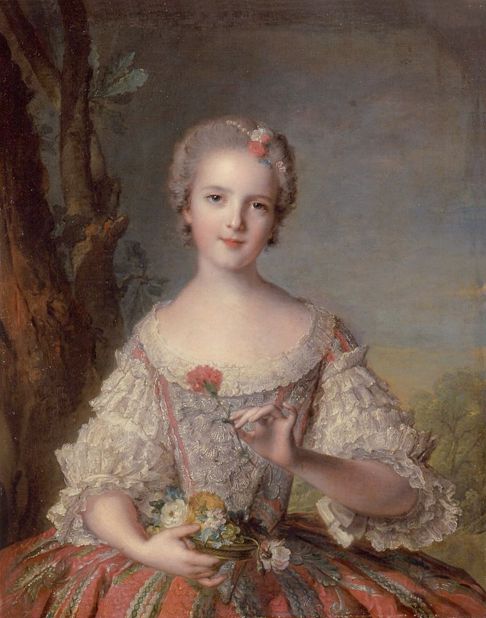
ShareWishing to enter the convent, while attending the Countess of Rupelmonde’s reception of the habit at the Carmel, she decided to join that Order. She began to prepare herself for it by studying the rule of St. Teresa and slowly abstaining from the comfort that surrounded her. She would stay away from the heated area of the castle during periods of appalling cold.Therefore, this event took place nineteen years before the French Revolution broke out.
She could not stand the smell of candles and only overcame this repugnance after years of effort. Finally, she obtained the consent of the king and on February 20, 1770, entered the Carmelites of Saint Denis. France admired her example, and Pope Clement XIV wrote the princess to express his happiness at seeing his pontificate marked by such a comforting event for religion.In the convent, she fought hard for her companions to stop distinguishing her from the others. She also worked to overcome her difficulty in staying a long time on her knees, a grace she obtained after a novena to St. Louis Gonzaga. She received the habit on September 10, 1770, clad in the mantle of Saint Teresa, owned by the Carmelites of Paris, and took the name of Sister Therese of Saint Augustine.What an honor to receive the habit clad in the mantle of Saint Teresa!Later named mistress of novices, she excelled in that difficult work, manifesting constant joy in the midst of the difficulties she encountered. Later she was unanimously elected mother superior. When the Visitor General of the Carmelites brought the news to the king, he said that Sister Therese had only had one vote against her. ‘So,’ Louis XV replied, ‘was there a vote against her?’ ‘Yes, Sire,’ answered the prelate, ‘but it was her own vote.’(Read more.)
From AMAC:
Share“First and foremost, no one should spy on you in your car. You should be able to control every signal coming in or going out of your car,” Rep. Warren Davidson, R-Ohio, a co-sponsor of the House legislation, told Just the News. “The data that you're creating in it is really your data. You should have a property right in that. We're a long ways off from being able to get full control of that.”
“In the meantime, I think, hopefully, we can at least agree China shouldn't be able to do that,” he added during a wide-ranging interview on the Just the News, No Noise television show.”
The bill Davidson has cosponsored is called the Connected Vehicle Security Act, and it has a companion in the Senate introduced by his home state Sen. Bernie Moreno, R-Ohio. The legislation has attracted support from all political spectrums, including liberal senators like Elissa Slotkin.
The legislation has also won support from the powerful United Autoworkers Union (UAW). The UAW has approximately 392,447 active members, along with over 580,000 retired members, its website says.
“Our national and economic security relies on a strong US auto industry,” UAW President Shawn Fain said when the legislation was unveiled. “The American Dream was launched and sustained out of good union auto jobs here in the United States. If we want to rebuild US manufacturing and raise standards for the working class, we can’t keep offshoring and outsourcing our auto industry, driving a global race to the bottom for short-term corporate profits," he said.
“By building on and strengthening the existing connected vehicles rule, this legislation puts common sense guardrails on a major threat to our nation’s auto industry,” he added. (Read more.)
It is not sufficient to love souls in the secret of our heart, working and sacrificing ourselves for them; this love must also be manifested exteriorly by an agreeable and pleasant manner, in such a way that those who approach us may feel themselves loved, and consequently encouraged to confidence and to trust. A rude, brusque or impatient manner might even cause some to go away offended, and perhaps, even scandalized. The apostle may well have a heart of gold, rich in charity and zeal, but if he maintains a rough and sharp exterior, he closes access to souls, and considerably diminishes the good he could realize. The saints, while being very supernatural, never neglected these human qualities of charity. St. Francis de Sales liked to say that, as more flies are attracted with a drop of honey than with a barrel of vinegar, so more hearts are conquered by a little sweetness than by rough manners. And St. Teresa of Jesus, who wished her daughters to be united by the bond of pure supernatural charity, did not believe it superfluous to make recommendations of this kind: "The holier you are, the more sociable you should be with your sisters...." (The Way of Perfection) This is very useful advice for anyone who wishes to win souls for God.

From Tierney's Real News:
Police have not identified the shooters publicly. Police also said neither of the two shooting victims are students at Eden Prairie or Minnetonka. Police say that the victims are from St. Paul - which is miles away. Police responded to reports of gunfire outside Aerie Stadium at Eden Prairie High School at around 8:40 pm on Friday. The school grounds were cleared while the game was underway. Two Somalis from St. Paul who were “known to the cops” were transported to a hospital for treatment of non-life-threatening injuries.Eden Prairie is a suburb of Minneapolis. Minnesota Democrats love to blame the gun instead of the criminals and heathens behind the gun and cancel our traditions instead of defend our country! This is a major reason I finally left Minnesota in 2022! (Read more.)
From The Enterprise:
ShareIn February 2023, a copy of the Quran that a 14-year-old autistic boy had brought to his school in Wakefield, England, was dropped and lightly scuffed. No law in England makes that a crime. Within days, however, the boy had received death threats, and his mother stood before a crowd in a local mosque, with a police officer in the room, apologizing for what her son had done. A secular country watched a family submit to a blasphemy rule that Parliament had abolished in 2008.
Liberal societies measure freedom by asking what the state forbids. By that measure the Wakefield mother was free, and so, in the same sense, would be a Dearborn engineer who quietly stops ordering wine at company dinners. In either case, the state forbids nothing. Something else does. The economist Timur Kuran named the mechanism preference falsification in his 1995 book Private Truths, Public Lies. People misrepresent their private views when dissent is costly, and each public act of conformity raises the price of dissent for everyone else. Moderates cannot find one another because each sees only the rest of the conforming faces. Outsiders mistake the conformity for consensus.
Selection, more than conspiracy, explains who sets those demands. The devout volunteer for the mosque board, write the checks, and teach the weekend and afternoon school. The moderate who disagrees rarely fights; he simply attends less, which is what Albert Hirschman called exit, and every exit leaves the institution more orthodox than the community it claims to represent. Gulf money and imams trained in Saudi Arabia, Egypt, and Pakistan accelerate the sorting. Yusuf al-Qaradawi, who helped found the European Council for Fatwa and Research in 1997, predicted that Islam would return to Europe through preaching rather than conquest. In France, Bernard Rougier’s 2020 study of the suburbs documented entire ecosystems of mosques, bookshops, associations, and sports clubs under Islamist rule. (Read more.)
From Of Home and Womanhood:
SharePeople are overwhelmed and tired all the time. You would not simply say to someone in medical school that because it is hard, therefore it is wrong to do. Or someone running a marathon should just quit because it hurts. We constantly do hard, difficult, painful things, and that does not make these things bad, most of the time it means the opposite. And parenthood is the exact same way.
We should be able to say that motherhood can sometimes be exhausting without treating children as some sort of disease in which fewer children is the cure. We should be able to listen and offer help to mothers without just dismissing them for having what we deem “too many children”. So how many children exactly are we allowed to have before we lose the right to ever complain about anything? And why is it that motherhood seems to be the only difficult thing in life we treat as some sort of mistake, just because of how difficult it is? This and more is what we are covering in the podcast episode. We are talking about the double standards we have for mothers, why saying I am “overwhelmed” has somehow become a direct insult against how many children you have, and why most of all, I refuse to believe that the answer to the hard parts of life and loving others is to simply have less people to love. (Read more.)
From Letters from the Old World:
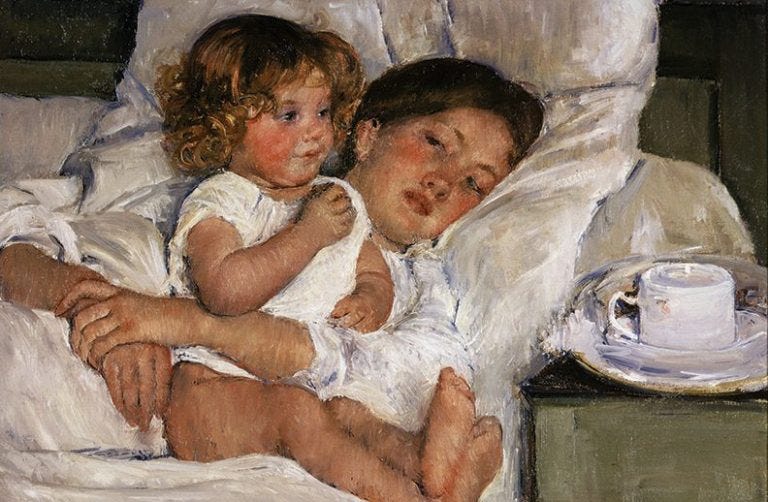
ShareWhile aesthetics are of great importance, the weight that gives them meaning comes from something much deeper than appearances. Elegance is not limited to clothing, although that is frequently the first impression a woman makes, and thus why the career woman reads as “aspirational” upon a cursory glance. True elegance, however, comes from a rightly-ordered life. This is why Girlbossing at the expense of home and children can never achieve the depth of elegance intrinsic to motherhood; mothers have earned a level of dignity and refinement through great personal sacrifice: their bodies, their focus, their nights, their mornings, their days and years.
All of the difficulty, all of the messiness, give the beauty of it a dimension that cannot be replicated by, “My boss was mean to me at work” or “I stayed an extra two hours at the office before coming home to cry and drink wine with my cat.” Underneath one life is a sense of vibrant fecundity, while underneath the other is the hollow realization that everything you have in the world is going to die with you. The deliberate uglification of motherhood has served to corrupt and subvert our understanding of these roots. It’s time our aesthetic perceptions better reflected the truth. (Read more.)
From Imperator:
ShareThe Church has always upheld, in continuity with Sacred Scripture and the wisdom of the Greco‑Roman tradition, that capital punishment is just when the sword is wielded by legitimate authority and ordered to the common good.
Echoing this perennial teaching, St Thomas Aquinas teaches in the Summa Theologiae that as minister of divine justice, the civil ruler may licitly take life when a malefactor’s deeds have gravely wounded the order of justice and threaten the community.
He teaches that one who threatens the harmony of the state has, by his own deliberate act, fallen away from the order of reason and thereby forfeited his claim to those goods that exist for the wellbeing of the political community. Such a man may therefore be removed by public authority just as a surgeon amputates a gangrenous limb for the health of the whole body lest it spread corruption throughout the entire organism.
He further affirms that capital punishment is not just retributive but also protective of the common good, since it restores the order of justice and prevents the spread of further evils, whether through recidivism or by the corrupting example given to others.
Aquinas is clear that in committing such acts, the life of the malefactor is forfeit, and their possibility of repentance does not override the community’s right to safety and security, nor the authority of the civil ruler to defend the commonwealth through proportionate punishment. (Read more.)
From The Western Spirit:
ShareIn 1492, Christopher Columbus sailed west across the Atlantic with three ships, hoping to find a new route to Asia, but instead reached the Caribbean and began a new chapter in the history of Europe and the Americas. What many people do not realize is that his voyage was connected to the centuries-long conflict between Christian Europe and the Muslim world that controlled trade routes to the East. For generations, European merchants depended on trade networks that connected the Mediterranean with the wealthy markets of Asia, but many of these routes passed through territories controlled by Muslim rulers, who profited from the trade.
Then, in 1453, the Ottoman Turks conquered Constantinople, bringing the ancient Christian capital of the Byzantine Empire under Muslim rule and strengthening Ottoman control over trade in the eastern Mediterranean. European rulers already had good reasons to search for alternative routes to Asia, and the growing power of the Ottomans made the prospect even more attractive. While the Portuguese explored the possibility of sailing around Africa, Columbus proposed something much more ambitious: reaching Asia by sailing west across the Atlantic.
The rulers who eventually agreed to finance his expedition were Ferdinand and Isabella, the Catholic monarchs of Spain, who had just completed the Reconquista by capturing Granada, the last Muslim kingdom on the Iberian Peninsula, in January 1492. (Read more.)

We move to her last few days and in a newspaper article referring to her time in the Conciergerie which confirmed that the total number of prisoners in Paris prisons at that time as being some 2,989. Life, although extremely cramped, was described as being one of mirth and gaiety, guzzling Bordeaux with their dinner which was described as splendid and sumptuous, suppers consisted of ham and salad* – how accurate a reflection of the truth we could not say.
According to the St James’s Chronicle of November 21, 1793 Marie’s situation was in stark contrast, she was confined to a small cell, half underground and a mere 8 feet by feet –
‘her bed was made of straw, one mattress and an old tattered coverlid, and terrible to tell she was continually and in all situations in the presence of four Gens d’Armes, who never quitted her chamber. Her food was such as given to common prisoners ; her health was visibly declining; her hair became grey; and the monsters fearing her natural death might deprive them of their wretched victim hurried her to the scaffold.
Share(Read more.)Some days before her death she was wearing black and even sleeping in her mournful attire, expecting every instant to be dragged from her bed of woe by executioners. She wished to die in mourning for her unfortunate consort, but the barbarous regicides deprived her even of this last consolation and compelled her to put on a white waistcoat’.
An interesting comparison, although there are those who question whether we worship the same deity as Muslims. The old crusaders saw them as pagans. From Tierney's Real News:
ShareLook closely at how Islam began and how Communism began, and a clear pattern appears. Both took ideas that already existed and worked, then changed them so the founders and their followers could claim ownership and control. The result in both cases has been division.
Both men followed the same logic:
Take something that already functions.
Declare it incomplete or corrupt.
Supply a new, corrected version that puts the founder and his successors at the center.
Use that new version to bind followers together while separating them from everyone else.
The result is a system built for authority and control.
Both men also made a claim of exclusive, final authority. Muhammad claimed to be the last prophet, replacing Jesus Christ, and carrying all news laws from Gabriel. Marx claimed to have discovered the scientific laws of history that would end class conflict. Each claim demanded that everything before it be set aside. Nothing shows the pattern better than Muhammad’s use of Gabriel. (Read more.)
From Letters from the Old World:
ShareModern discourse understands that beauty and the divine are inextricably linked: as theologian and priest Hars Urs Von Balthasar said, “every experience of beauty, points to infinity”.
Why then do so many not make the connection between this truth and how they choose to dress? Is caring how you look always mere pride or vanity? Many assume so.
Often “it’s what’s on the inside that counts” is interpreted as “it’s only the inside that counts.” A moral truth is thus perverted into license for aesthetic neglect, as though appearance should not matter at all.
But you know this isn’t true. And so does God.
Consider the instructions for His sanctuary as described in Exodus; gold lamp stands decorated with flowers, colorful linen curtains, cherubim designs, leather and wood fixtures, etc.
Likewise, God commanded Aaron to wear sacred garments with “gold, and blue, purple and scarlet yarn, and fine linen” so as to “give him dignity and honor.”
Clearly, presentation matters.
This is not a God who rejects the value of aesthetics, but one who understands and uses them to his own ends. In this way, beauty in appearance can reflect a divine purpose. God wanted his temple to be beautiful because it mattered that it was beautiful.
Today, we’ll show you that dressing well isn’t vanity, but in fact one of the simplest ways you can respect yourself, improve your community, and honor God.
By the end of this article, you’ll understand the theological importance of how you dress, and why you have a sacred duty to dress your best. (Read more.)
 |
| David's "Tennis Court Oath" with a glimpse of lightening striking the Royal Chapel |
You are young, you brim with ambition, you want to change the world; you are an artist. You’ve been admitted to your field’s most prestigious institute, and won the favor of the top collector in the land. But your country is plagued by social inequality and galloping inflation. Political crises cascade one atop the other. Is art enough, right now? Or should you turn your art into something else — something more engaged, more dogmatic, more like propaganda?
And when the world changes, then how far will you go? Perhaps all the way into the halls of power, where you will adopt a zeal no one foresaw. When your allies execute their foes, you’ll cheer them along. When they get murdered themselves, you’ll glorify them as martyrs. You’ll end up in prison, pleading for brushes and pencils, and re-emerge in a country eager to forget what you’ve done.
In 2022 our museums and streaming services deliver daily sales pitches of culture’s “power” and “relevance.” Our discourse boils art down to the dullest political messaging. It all sounds like children’s story hour in the shadow of Jacques-Louis David, the artist-moralist who depicted the French Revolution with lethal purity. In the 1780s, he eradicated the lightness and joy of the Rococo in stern history paintings drawn from classical examples. Then, when the Bastille fell, he channeled that Roman rectitude into images of current events, and right into political life.
We’re not talking about some creative soul who went to a protest or two. With David we are talking about the greatest artist of his generation, the most influential for the next, who was — in the original sense of the word — a terroriste. Friend and ally of Robespierre throughout the Reign of Terror, David sat in the revolutionary parliament and joined its most fearsome committees. He would both design the new republic and sign the death warrants of counterrevolutionaries real and perceived. (Cancel culture, forsooth.) In 1792, when the king’s fate came before the National Convention, Citizen David proudly cast his vote to send Louis XVI to the guillotine. (Read more.)
 |
| David's sketch of Marie-Antoinette on the way to the guillotine |
From Tierney's Real News:
ShareSince the beginning of the Republic, American presidents of both parties have barred, expelled, or fenced off foreigners and foreign powers they judged a danger to the country’s security, sovereignty, or constitutional order.
They did it to anarchists after a president was murdered. They did it to Communists for most of the Cold War. They did it to Iranian visa holders during the hostage crisis. They did it with warships when the Barbary Muslim pirates seized American sailors, and again when the Soviet Communists put missiles in Cuba - ninety miles from Florida.
That record is the premise of this newsletter: a sovereign nation gets to decide who enters and on what terms, and America has used that power against ideological and security threats again and again. Don’t let anyone tell you the idea that America has a right to decide who gets to enter and live here is unthinkable, un-American, or bigoted. That is a lie, it is amnesia and it is a mistake.
I’m going to tell you the history of America removing past threats (including Muslim and Communist threats) in sequential order including the presidential record, two cases where force rather than visas did the job, what immigration looked like before 1965, what changed that year, how Communism was fought in law, how Islam began and grew and became a threat to the West, and what lawful options exist for keeping Sharia out of American law. (Read more.)
I certainly won't be watching. But the popes held public executions for hundreds of years as did most Catholic monarchs, including canonized saints. It was perceived as a matter of safety for innocent people, and thus the duty of the ruler. It would not have occurred to anyone that it was a bad thing to execute a murderous criminal in the town square/marketplace. Only if the person was clearly innocent, like St. Joan of Arc, did people object. The Soviets were big on private executions. People would just disappear. Their loved ones never knew what became of them. Also, private executions can lead to doubt whether the person really died. Interesting take here from a few years ago:
The Grand Duchy of Tuscany had become the first sovereign state to ban the death penalty in 1786, 10 years before Bugatti took up his ax. It did so under the influence of Italian essayist Cesare Beccaria, whose 1764 anti-death penalty tract “On Crimes and Punishments” is considered a classic.
So strong had Italian aversion to capital punishment become that when an anarchist named Angelo Bresci assassinated King Umberto I in 1900, Italian courts sentenced him to life in prison. It was the first time a man had killed a European king (without toppling his regime) and not been executed.
Yet the Catholic church was never part of this development. The guillotine was busy up to the very last minute of the pope-king’s regime. Its final use came on July 9, 1870, just two months before Italian revolutionaries captured Rome.
What explains this stubbornness? In part, that Catholic standby -- tradition. Christian writers since the fourth century had defended capital punishment.
St. Augustine did so in The City of God. “Since the agent of authority is but a sword in the hand [of God], it is in no way contrary to the commandment ‘Thou shalt not kill’ for the representative of the state’s authority to put criminals to death,” he wrote.
Augustine saw the death penalty as a form of charity. “Inflicting capital punishment … protects those who are undergoing it from the harm they may suffer … through increased sinning, which might continue if their life went on.”
Aquinas followed Augustine in the 13th century in Summa Contra Gentiles. “The civil rulers execute, justly and sinlessly, pestiferous men in order to protect the state,” he wrote.
The Cathechism of the Council of Trent, issued in 1566, solidly endorsed capital punishment as an act of “paramount obedience” to the fifth commandment against murder.
Nor was this tradition confined to the Middle Ages. As late as Sept. 14, 1952, Pope Pius XII echoed its logic. “It is reserved to the public power to deprive the condemned of the benefit of life, in expiation of his fault, when already he has dispossessed himself of the right to live,” he said.
The leading abolitionists of the 18th and 19th centuries were Enlightenment-inspired critics of revealed religion. Popes defended their right to send people to death because to do otherwise seemed tantamount to abandoning belief in eternal life.
Catholic scholar James Megivern summed up the tradition this way: “If tempted to waver, one needed only to consult the bedrock authorities from Aquinas to Suarez. Questioning it could seem an act of arrogant temerity. If one did not believe in the death penalty, what other parts of the Christian faith might one also be daring or arrogant enough to doubt or deny?”
All of which makes the shift in thinking under John Paul II astonishing.
In the 1995 encyclical Evangelium Vitae, John Paul wrote that the only time executions can be justified is when they are required “to defend society,” and that “as a result of steady improvements … in the penal system such cases are very rare if not practically nonexistent.”
When the new Catechism of the Catholic Church appeared, it did not ban capital punishment, but expressed a strong preference for “bloodless means.” Such strategies, it said, “better correspond to the concrete conditions of the common good and are more in conformity to the dignity of the human person.” (Read more.)
From The Enterprise:
Think about what we already accept. The Sixth Amendment guarantees the accused a public trial. In Richmond Newspapers v. Virginia (1980), Chief Justice Warren Burger traced the open courtroom from the English assizes through the colonial courthouse and concluded that “a presumption of openness inheres in the very nature of a criminal trial.” Burger’s reason had nothing to do with whether spectators enjoy trials. A judge who knows he is being watched is less likely to cut corners, a prosecutor under observation is more careful with the truth, and a public that can see justice done is more likely to believe it was done. Every one of those reasons applies with greater force to the moment when the state actually kills a man. The trial decides whether the government may take a life. The execution is the taking. We have arranged things so that the deliberation is open and the act is hidden, which is exactly backward.
For most of American history nobody would have found that arrangement natural. Colonial hangings took place in town squares and courthouse yards, usually with a sermon. Pennsylvania and New York began moving executions inside prison walls in the 1830s, and the other states followed over the next 70 years, with Virginia still hanging men publicly in Richmond until 1907. Britain made the same move in 1868 with the Capital Punishment Amendment Act. What strikes you about the 1866 parliamentary debate that preceded it is that almost nobody in the chamber wanted to abolish hanging. The question was whether the public should see it. Defenders of the old practice argued that publicity was the only guarantee the sentence was carried out, and that it was carried out the same way against a lord as against a laborer. Opponents answered that the crowds at Newgate treated the morning as a holiday. Both sides were right; the opponents won, and the rule they left behind, that the state should inform the public of executions without letting it watch, has governed Anglo-American practice ever since.
The American endpoint came on August 14, 1936, in Owensboro, Kentucky, when something like 20,000 people turned out to see Rainey Bethea hanged. Kentucky permitted public hanging for rape but required murderers to die inside the penitentiary, so prosecutors charged Bethea with rape alone even though he had confessed to killing his victim. The crowd behaved like the Newgate crowd, with vendors and picnics, and the national press was appalled. Kentucky abolished public hanging in 1938. Since then an American execution has been witnessed by a few dozen designated people, officials, a handful of reporters, relatives of the victim, a representative of the condemned, while the rest of the country reads a wire story the next morning. (Read more.)

This picture is a romanticized image of a young squire making his prayer vigil before the Blessed Sacrament, as was the custom before being knighted. There was no set code of chivalry for the medieval period; it changed according to region and century. However, here are some codes which were attributed to the Emperor Charlemagne:
To fear God and maintain His Church.
To serve the liege lord in valor and faith.
To protect the weak and defenseless.
To give succor to widows and orphans.
To refrain from the wanton giving of offense.
To live by honor and for glory.
To despise pecuniary reward.
To fight for the welfare of all.
To obey those placed in authority.
To guard the honor of fellow knights.
To eschew unfairness, meanness and deceit.
To keep faith.
At all times to speak the truth.
To persevere to the end in any enterprise begun.
To respect the honor of women.
Never to refuse a challenge from an equal.
Never to turn the back upon a foe.
And here is Charlemagne's Exhortation:
Love God Almighty with all your heart and all your powers.
Love your neighbor as yourself.
Give alms to the poor as ye are able.
Entertain strangers.
Visit the sick.
Be merciful to prisoners.
Do ill to no man, nor consent unto such as do, for the receiver is as bad as the thief.
Forgive as ye hope to be forgiven.
Redeem the captive.
Help the oppressed.
Defend the cause of the widow and orphan.
Render righteous judgment.
Do not consent to any wrong.
Persevere not in wrath.
Shun excess in eating and drinking.
Be humble and kind.
Serve your liege lord faithfully.
Do not steal.
Do not perjure yourself, nor let others do so.
Envy, hatred and violence separate men from the Kingdom of God.
Defend the Church and promote her cause.
Did all knights follow such codes? Certainly not, but many did, such as St Louis IX, St Ferdinand of Castile, and Saint Nuno. It was really meant to keep military men from indulging overmuch in pillage and rapine, by encouraging the protection of ladies, the poor, and monastic houses. Some of it must have worked, since both the rich and poor traveled a great deal in the Middle Ages, going to various pilgrimage sites throughout Europe, and even to Jerusalem. The Knights Hospitaller had the duty of caring for sick pilgrims and guarding pilgrims on their way. Were all knights saints? No, there were corrupt people back then just as there are now. But that does not mean the system was all bad. Saints such as Teresa of Avila and Ignatius of Loyola were inspired by the codes of chivalric conduct and tried to apply the ideals to the religious orders which they founded. This is especially evident in St. Teresa's spiritual masterpiece The Interior Castle.
With the rise of industrialization and the fading of the old aristocracy, the Victorians were enthralled with the old Arthurian legends and the days when Knighthood was in flower. Did they over-romanticize? Yes, probably. But many young people were inspired with ideals, which is one of the purposes of great art and literature.
From AMAC:
ShareFor years, lawmakers in Washington have warned that the Chinese Communist Party (CCP) is exploiting America’s generosity and openness to weaken the United States from within. Now Congress is moving to address that threat and close some of the most glaring pathways the CCP uses to covertly exert its influence.
A series of bipartisan bills introduced this year by members of the House Select Committee on the Chinese Communist Party would target Chinese involvement in fentanyl trafficking, connected vehicles, robotics, and biotechnology. Though the threats are different, the principle behind the legislation is the same. Chinese companies should not be allowed to use access to American markets, technology, capital, and infrastructure in ways that endanger Americans or strengthen the CCP.
Taken together, the measures reflect a meaningful shift in Congress’s approach toward China. Rather than simply documenting the threats posed by the CCP, lawmakers are increasingly targeting the specific channels through which Beijing-linked entities can gain leverage over the United States — whether by exploiting weaknesses in the financial system, collecting sensitive data, undercutting American industry, or gaining access to strategically important technology. (Read more.)
Born in Germany in 1904, Rahn became obsessed with European myths and legends at an early age. He was particularly fascinated with medieval German stories about the Grail, such as Parzival (a romantic poem about a knight), Lohengrin (a story about Parzival’s son), and The Song of the Nibelungs (about a dragon slayer).
As a university student, he also became fascinated with Catharism – a Christian branch in France that was wiped out by the Catholic Church in the 13th century. He, therefore, visited France to look for clues about the Cathars and the Holy Grail.
Rahn concluded that German Christian traditions preserved many elements from its pre-Christian pagan past. He also believed that the Holy Grail was a real object that the Cathars had once held and that it remained hidden near Château de Montségur where the Cathars made their last stand.
In 1933, he published his theories in the Crusade Towards the Grail, which was well-received in Germany. It also earned him a dangerous fan, because 1933 was also the year that the Nazis took over. That fan was Heinrich Himmler, suddenly one of the most powerful men in Germany and the one whom Hitler tasked with exterminating the Jews and other minorities. Himmler, like many high-ranking Nazi officials, was also obsessed with Germanic myths and legends. To justify their ideals of German racial superiority, the Nazis looked to the country’s pre-Christian era. They wanted to reinvent their history and make it look greater than conventional history would have it. (Read more.)

From The Enterprise:
SharePicture a man on a Tehran rooftop on the night of January 8. He has a Starlink dish wrapped in a blanket, one of somewhere between 50,000 and 100,000 terminals that activists believe were smuggled into Iran, and he knows that a law passed late last year can send him to prison for 10 years for owning it, or to the gallows if a judge decides to call it espionage. Below him, the streets are full. By the following night, according to Iranian health officials who spoke to Western media and hospital tallies compiled by the surgeon Amir Parasta, as many as 100,000 of his countrymen may be dead. The regime cut the internet before the shooting started, and it did so on purpose.
President Trump understood what that blackout meant. On January 11th, he said he would work with Elon Musk to get Iranians back online, and two days later SpaceX waived its fees inside Iran. Then came February 28th, the strikes, and a second blackout that ran 88 days, with connectivity falling to roughly 1% by early March. Since then Iran has been through a ceasefire, a memorandum signed on June 17, attacks on shipping in the Strait of Hormuz, and renewed hostilities on July 7. Most voters in Ohio or Arizona see strikes and a blockade. They see very little of the Iranian people, and in 27 days they vote.
Iranian American organizations have drafted four measures that would change that picture, and each one passes a single demanding test. The President can direct it now, under authority he already holds, without waiting on Congress, new appropriations, foreign capitals, or corporate goodwill. Congress, which voted in both chambers in June to direct a withdrawal from the conflict, is in no mood to help. The measures are modest on paper. I suspect they would matter more to ordinary Iranians than anything else Mr. Trump could do between now and Election Day. (Read more.)
From Mark Judge at Chronicles:
ShareThe First Annual Anti-Communist Film Festival was a huge success. It’s an idea I came up with over a year ago, and the idea became a reality when the Victims of Communism Museum became the official sponsor. It was held October 1-4. We screened Pilecki’s Report, The Killing Fields, Night Crossing, Red Dawn, The Lives of Others, and Hail, Caesar!
We’re already working on next year’s festival, but before moving ahead let me make couple observations. The first is, people on the right need to get better at supporting artists, creatives, and the storytelling that comes with them. I launched the idea for the festival over a year ago with nothing. I traveled to theaters around the mid-Atlantic talking to owners, I cold-called Hollywood about licensing, I wrote over 100 articles and blog posts to bring attention to the idea. The left supports these kinds of efforts to advance their ideas and capture the imaginations of the public, which is why they win so often. We can do the same.
In 1975, a band called The Sex Pistols appeared with a new spirit and energy and forever changed rock ‘n roll. I believe these kinds of projects can inject a similar energy into the conservative movement. Keep the flame alive.
Now for the experience of the film festival itself. Let me first say that the staff and interns at the Victims of Communism Foundation did a fantastic job pulling everything together. They put everything into this, including purchasing a small popcorn popper (a very nice touch that was hugely popular with the audience). They worked out any glitches with the films and were polite and welcoming to the guests.
And the guests—God bless them! They were super enthusiastic about what we were doing. I lost count of the times someone came up to me, shook my hand, and said, “Thank you for doing this.” They deeply understood the point I’ve been making for years: Conservatives are pretty good at organizing top-down enterprises—think tanks, white papers, even movie studios (even when these studios produce bad movies—another thing several guests at the festival mentioned). But what we are not as good at is organizing from the bottom-up. Supporting a pro-freedom punk band. Paying iconoclastic journalists a living wage. Spotting and supporting young actors, directors, artists. Putting on film festivals.
For this festival, I decided to use Hollywood’s weapons against it. As I said in my talk, the idea for the festival hit me when after years of going to ordinary film festivals I realized that many of the best films I saw were actually anti-communist films. It’s cool for hipsters to mock movies like I Was a Communust for the FBI, I Married a Communist, or My Son John. Yet many of these films, in fact, are quite good.
In I Was a Communist for the FBI, an FBI agent infiltrates the Communist Party in Pittsburgh. He learns that their plan is “a hellbrew of hate”—urban riots intended to “divide and conquer” by pitting the races against each other and causing so much mayhem that the left can be called in to establish order and make huge profits working the court cases. (It’s hard to argue, given the last decade, that any of this is far-fetched). Another character in the film is a high school teacher. “What better place to serve the party than in a high school?” the film notes. That also rings familiar.
The cinematographer for I Married a Communist, Nicholas Musuraca, is the same cinematographer for the noir classic Out of the Past. (Read more.)

 |
| 2 Cathari perfecti give the consolamentum to a dying man while fending off 2 friars |

ShareTo begin, the terms Cathar and Albigensian are synonymous. Generally speaking, historians have understood the Cathars to be more or less what Tim referred to them as; “gnostic heretics”. [3] Similarly, in his Manual for Inquisitors Bernard Gui (d. A.D. 1331) referred to them as “Manichean heretics”, before giving a brief synopsis of their beliefs.[4] The heresy itself is often associated with the Albigensian Crusade. By the thirteenth century the targets of the maturing crusading movement had expanded to include heretics, pagans, and even political opponents of the papacy. The targets of this particular crusade were the heretics and their Catholic protectors.
The Cathars/Albigenses of the Languedoc region in the South of France ultimately drew the ire of the papacy. They had entrenched themselves within the nobility there, facilitated by the fact that it was largely independent of the Capetian monarch to the North. Initially, the Church’s response of preaching, and public debating seemed to make little headway in rolling back the heresy, and the conventional wisdom was that force was needed. After the papal legate to the region was assassinated,– apparently on the orders of Count Raymond VI of Toulouse (a protector of heretics), Pope Innocent III issued the indulgence for what became known as the Albigensian Crusade (ca. A.D. 1209-1229).
Some omissions aside for brevity’s sake, this is more or less how the origins of the Albigensian Crusade is presented in standard survey works on the subject of the Crusades, such as the late Jonathan Riley-Smith’s The Crusades: A History (2005), or Thomas Madden’s The Concise History of the Crusades. Both authors are well known Crusade historians, and both are/were university professors. Both were recommended reading on a syllabus in a colloquium on the Crusades I took at a secular university. Both present Catharism as a non-Christian, dualistic religion.[5] Both happen to be Catholics.
Additionally, both scholars above have influenced the historiography of the Crusades, are peer reviewed, have reputations to uphold, and are top notch. Madden also was a contributor to the Encyclopedia Brittanica’s entry on the Albigensian Crusade (hardly a pro-Catholic source). Nevertheless, since the very notion that Catharism was a non-Christian dualistic religion has been called “a Catholic lie”, we will look elsewhere for a basic understanding of this medieval heresy.
“Catharism was the greatest heretical challenge faced by the Catholic Church in the twelfth and thirteenth centuries”.[6] Thus reads the first line of Malcolm Barber’s work, The Cathars: Dualist Heretics in Languedoc in the High Middle Ages. He notes that the common view is that it was transplanted from the East in the form of Bogomilism, though some like R. I. Moore believe that it was a home grown dualism.[7] That it was a form of dualism is a given throughout the first chapter on the topic of the origins/ pedigree of Catharism.[8]
Like Madden and Riley-Smith, Barber affirms that the Cathars [aka Albigenses] denied the Incarnation of Jesus Christ, and that they had a rite known as consolamentum. After receiving this rite, the mere “believer” became one of the initiated (perfecti), and it was often delayed until just before death.[9] Like his discussion on the pedigree of Catharism in the first chapter, he includes a robust discussion of Cathar beliefs and practices in the third chapter. The evidence discussed there contradicts any notion of the Cathars/Albigenses being akin to modern day Evangelicals, as Yardley’s position seems to imply.
Though I don’t suspect that Mark Pegg would endorse Baptist successionism, he is nevertheless a historian who might possibly be coopted by its proponents. One major argument in his book A Most Holy War: The Albigensian Crusade and the Battle for Christendom is that “a very distinct Christian culture…was accused of being heretical by the Catholic Church”.[10] He called for a revision of Christian history, arguing that “The Albigensian Crusade…was not a martial pilgrimage against a discrete religion with an organized heretical ‘Church’”.[11]
A survey of three reviews published about Pegg’s book shows that they were overwhelmingly critical regarding this particular aspect of it. One reviewer said that it was against “academic consensus”, and that the evidence presented failed to convince with respect to the historical revision.[12] While too mentioning that the scholarship is stacked against Pegg, another reviewer was also critical of his “dismissal of so many primary sources that support a Cathar church because he constantly suspects orthodox intent”.[13] Of the three reviews, it was the one in the Catholic academic journal which was arguably most sympathetic on the topic of Catharism, but even there the reviewer acknowledges that Pegg is contradicting notable scholars on this topic.[14]
For Barber, Cathar sources take a primacy when reconstructing Catharism, but “even orthodox [i.e. Catholic] attacks on Cathar belief are important since they were particularly concerned to define it accurately in order to give weight to their refutations”.[15] He posits a “moderate dualism” extant in the West up until a Cathar Council at St Félix de Caraman (ca. 1167) attended by envoys from the Bogomil Church in Constantinople changed the religious landscape to one dominated by “absolute dualism”. The Charter of Niquinta which emanated from that Cathar gathering seems to be a main component of his argument.[16]
Ultimately, Barber says, it was this absolute dualism that really drew negative attention from the Catholic hierarchy.[17] Though he argues that there were already established Cathar bishops in places like Albi [hence “Albigensian”] in the South of France, after the Council at St Félix de Caraman there would be a network of sixteen dioceses stretching from Tuolouse to Constantinople.[18] It is generally said that the Inquisition was the tool that the Catholic Church (in concert with the secular authorities) utilized to ultimately vanquish the heresy. Barber posits that both the moderate and absolute varieties of it may have survived up until the end of the fourteenth century.[19]
Whatever the case may be, Staples was certainly correct when he rejected the notion that, as he paraphrased Yardley), “the Albigensians are some sort of link in true Christians”. As Barber indicates, almost since the inception of the Reformation, Protestant authors have been concerned with establishing some basis for historical continuity in response to the charges of novelty coming from their Catholic opponents. Evidently, the first to attempt to link Protestantism with Catharism in a direct line was Jean-Paul Perrin, who in his work Histoire de Vaudois (1618), erroneously conflated the Cathars with the Waldenses [as the title indicates].
This Protestant affinity for the Cathars would sour a little over a century later. All of this and more Barber observes in his historiography.[20] Still, there are those in modern times who try to link Protestantism and Catharism. The position argued by Pegg, and seemingly by others more recently, is very different from the apparent Baptist successionism (or something in that vein) argued by Yardley. Moreover, the academic/ historiographical argument against the traditional understanding would seem to beg the question of how exactly to define “Christian”, and who has the authority to determine that? (Read more.)
From The Enterprise:
ShareAn Army sergeant from Dayton has been stationed in Germany for two years. She has not slept in Ohio during that time. On Census Day, the Census Bureau still credits her to Ohio, and in Franklin v. Massachusetts (1992), the Supreme Court said that was fine. Overseas federal employees are assigned to the state that was their usual home, not to the base where they happen to be sleeping. A German tourist standing outside the Ohio Statehouse that same morning is physically in Columbus. Nobody thinks Ohio has earned an extra sliver of a congressman on his account. Presence and belonging come apart. Every census since 1790 has had to pick which one it is counting.
Last month, the Commerce Department published a proposed rule, signed by Secretary Howard Lutnick, rewriting the residence criteria. Proposed section 60.4 would count foreign citizens who also hold US citizenship or a green card, and it marks everyone else holding only foreign citizenship as “Not counted for apportionment.” The rule’s own phrase for the line it draws is “durable permission from the sovereign to settle within the United States.” Aliens whose status is less durable, and less definite in length, than lawful permanent residence fall on the excluded side of that line, along with people here in violation of federal law. Under the proposal, usual residence is the place a person has lawfully spent the most days, as shown by tax records. Comments close October 13, on docket USBC-2026-0628. This is a proposal, not a finished policy. The administration put it through notice and comment in the open, years before the count, rather than issuing a memo in the middle of a census, as Trump attempted in 2020. A 2026 comment file will be the record a court has if the 2030 count is challenged. (Read more.)
From The Way of Beauty:
ShareThis is the first of six posts on the mathematics of beauty1: the traditional body of knowledge, running from the ancient Greeks through the Church Fathers and into the design of Western art and architecture, which held that beauty has a mathematical structure and that this structure can be studied, learned, and applied. It was a standard part of an artist’s and an architect’s formation for centuries. Today it is virtually unknown, and I think its recovery is essential if we are to build beautifully again.
As six posts devoted to a single subject is a lot to post on consecutive weeks, I will post them on alternate weeks.
In this first post, I want to establish the problem by looking at some buildings, and to say something about how this tradition relates to natural science, which is the other great tradition of describing the world by number. The posts that follow will set out where the tradition came from, what it consists of, how it is used in practice, why it was abandoned, and what its recovery would mean.
If you examine almost any building constructed since the Second World War, the chances are that it will conform to one of two simple guiding principles of architectural design, and in both cases, the results are often bad. These two principles are even spacing and random spacing. The first generates visual monotony; the second generates visual cacophony. I have chosen these terms deliberately to set them against what traditional architecture always sought to achieve instead: harmony. (Read more.)











