Showing posts with label Easter. Show all posts

Sunday, April 26, 2026

The Easter Rising

 From The Abbey of Misrule:

The April weather in the Irish west was astonishing this year, for a while. Two whole weeks of unseasonal heat brought the land out from the finalities of winter. True, the frost still came at night, but by the afternoon I was digging the garden with my top off. Everything on our land awoke. Our field, in which we planted 800 trees nearly a decade ago and which is now becoming a forest, hums with insects heading for the poplar blossom and the whitethorn. The pond is full of frogspawn and the soil is warming. Crocus and cowslip defeat the couch grass in their quest for the light. Sparrows gather moss and straw, the hazel poles are budding. We have set up a beehive in a grove by the hedgerow, and now we wait in the hope that some worker will seek it out and beckon the swarm to follow.

But ask the animals, and they will teach you, or the birds in the sky, and they will tell you; or speak to the earth, and it will teach you, or let the fish in the sea inform you.

As the land has sung itself back into life, it is as if I have awakened too from some numbness that overcame me. It was not simply the numbness of winter. For a while, I have felt closed off from my land; somehow an alien as I walked through it. Maybe I was reading too much theology. I always knew that the Holy Spirit sung itself through bud and blossom, but knowledge is not experience. Back in the day, when I was a pagan and a pantheist, I felt the force of nature as an overwhelming power within me. Then I became a Christian, and something retreated.

What was it?

I wondered this, and I concluded that I had misdirected my worship. I had worshipped the trees rather than their creator. I think that this was a category error; still, I missed the feeling it gave me. I missed the sense that the trees were my sisters and the birds my brothers. Those who have never felt this may call it ‘pagan’, as if that meant anything, but they would be wrong. It is not ‘pagan’ to feel, as Adam did, as Eve did, that this place was created to be our home. That we were intended to be at one with it before we broke away and began instead to worship ourselves.

The heavens declare the glory of God; the sky proclaims the work of his hands. Daily they speak, they never become silent.

Something has happened to me this Easter, though; that old feeling has come back. Now I walk through my growing forest and I feel again that green force that I once felt, and I am overjoyed because I missed it. Is it different now? Yes, and no. I feel the land breathe within me and to me, I see that everything here has its own life, I feel the inscape of it all, but now I feel something beyond it too; something that made it, that sings it every hour, though for this force there is no time. (Read more.)

Share

Sunday, April 12, 2026

Desserts for Spring and Easter


From Victoria:

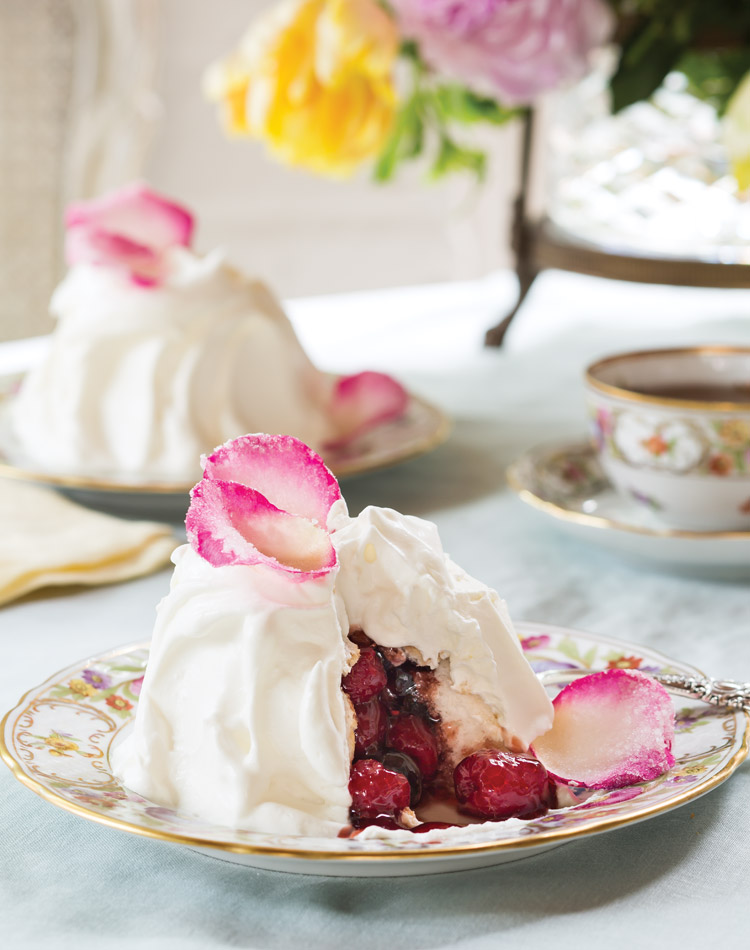
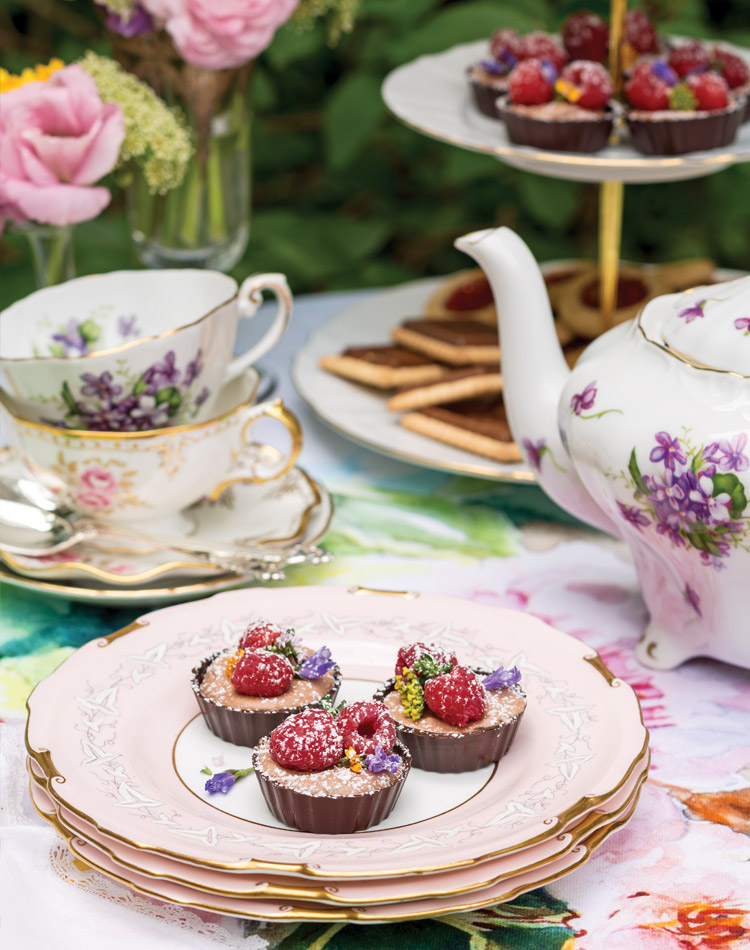
The gentle blush of a sugared rose petal adds the crowning touch to Angel Food Cakes. Beneath a rippling cloud of sweetened whipped cream, delicate sponge cake holds a luscious surprise. The first forkful reveals an abundance of raspberries and jam—the ruby-hued fruit filling a delightful complement to the other components of the dessert. For a variation on England’s chilled dessert of cooked, puréed fruit (typically gooseberries) folded into whipped cream, sample sunny Lemon Shortbread Fool. Crumbled cookies add delightful crunch to tantalizing swirls of citrus and cream. Hibiscus tea, an infusion made from the subtropical roselle bloom, adds tartness to the airy dessert filling in our decadent Chocolate Mousse in Chocolate Cups. Raspberries, edible flowers, and a dusting of confectioners’ sugar draw attention to these artful treats. Our pièce de résistance is a scrumptious pairing featuring fruits swimming in silky-smooth cream. This fresh and fragrant Berries and Cream delight mixes strawberries and raspberries with whipped cream flavored with raspberry liqueur. (Read more.)


From Southern Living:

To longtime Southern Living readers, it might come as no surprise that the most searched cake in the South is the Hummingbird Cake. Any way you slice it, this cake’s classic combination of banana, pineapple, and cinnamon has long made it one of our most popular recipes across all recipe genres. The 45-year-old recipe, first submitted to the magazine in 1978 by Mrs. L.H. Wiggins of Greensboro, North Carolina, has been reinvented into Bundt cakes, pancakes, and even whoopie pies. But the classic three-layer cake enveloped in cream cheese frosting is still our readers’ preferred way to enjoy this dessert. Nationwide, ‘dump cakes’ proved popular for their ease, with no special tools required to make these no-fail cakes. Despite the extra effort needed to assemble the hummingbird cake, Southerners are more than willing to put in the time for the final delicious result. (Read more.)

Share

Wednesday, April 8, 2026

Easter Eggs


Meat, as well as dairy products and eggs, were at one time renounced by all Christians during the Lenten fast. Among Eastern rite Christians, the discipline is still observed. Decorating and exchanging eggs at Easter have long been a sign of rejoicing. According to Wikipedia:
The egg is widely used as a symbol of new life just as a chick might hatch from the egg. The Easter egg tradition may have celebrated the end of the privations of Lent in the West, though this is speculation. Eggs were forbidden during Lent as well as other traditional fast days; since chickens would not stop producing eggs during this time, a larger than usual store tended to be available at the end of the fast, which had to be eaten quickly to prevent spoiling. Likewise, in Eastern Christianity, both meat and dairy are prohibited during the fast, and eggs are seen as "dairy" (a foodstuff that could be taken from an animal without shedding its blood). It was also traditional to use up all of the household's eggs before Lent began, which established the tradition of Pancake Day.

  Basket of Flowers Egg

Among the most famous of Easter eggs are those made by Fabergé for the Russian Imperial Family. More HERE.

 Mosaic Egg Objet

Share

Tuesday, April 7, 2026

Easter Bonnets

Miss Janice explains the etiquette of wearing hats, gloves and corsages.

 Hats are a beautiful accessory and certainly popular to wear on Easter Sunday. You may keep your hat on while indoors, but should remove it at dusk. Gentlemen should remove their hats when entering a building. Hat pins are lovely adornments to a hat and should be pinned on the right side of a lady's hat and on the left side of a gentleman's hat. Make it Southern...A lot of Southern gentlemen still tip their hat to a lady (some men were just raised right)!...All y'all know by now that you may start wearing your white shoes and carrying your white pocketbooks on Easter Sunday...Here's Jacqueline Bouvier Kennedy with Young John Fitzgerald, Jr. on Easter Sunday 1963...

 There is also etiquette to be followed when wearing gloves and corsages. Proper etiquette dictates that gloves are removed when entering a building, whether it is a tearoom or a church. It is not considered proper to shake hands while wearing gloves (only the Queen of England can get away with this) or to eat or drink while wearing gloves. Remove your gloves in a lady like fashion, one finger at a time. Always hold your pocketbook and gloves in your left hand so that you will be ready to shake hands at any time.Remember, only the Queen of England may wear gloves while shaking hands! Corsages are a tradition in the South and may be worn on Easter Sunday. Corsages are pinned to the clothing on the left shoulder. (Read more.)


(Artwork courtesy of Hermes)

Share

The Sacrament of Easter

Making all Sundays holy to the Lord. From Seton Magazine:
If Christians in the midst of the world are to keep alive a Christian culture and the spirit of Easter throughout the year, it is essential to truly live Sunday as “the Day of the Lord.” Man is an image of God, and God is a community of persons (the Blessed Trinity). By gathering as a parish family to celebrate and receive the Holy Eucharist each Sunday and then “resting in the Lord” as a family for the remainder of the day, we become practically what we are in truth, an image of the triune God Who is love.

Certainly there are obstacles in our contemporary culture to living Sunday as a day of worship and rest. Saint John Paul II noted in 1998 that, “Until quite recently, it was easier in Christian countries to keep Sunday holy because it was an almost universal practice and because, even in the organization of civil society, Sunday rest was considered a fixed part of the work schedule…"

Unfortunately, when Sunday loses its fundamental meaning and becomes merely part of a ‘weekend,’ it can happen that people stay locked within a horizon so limited that they can no longer see ‘the heavens.’ Hence, though ready to celebrate, they are really incapable of doing so. The disciples of Christ, however, are asked to avoid any confusion between the celebration of Sunday, which should truly be a way of keeping the Lord’s Day holy, and the ‘weekend,’ understood as a time of simple rest and relaxation” (DD, 4). (Read more.)
Share

Sunday, April 5, 2026

Easter Cakes

 From Country Living:

Easter is a time for dressing up, attending church services, decorating eggs and making Easter crafts. But it's also for planning tasty menus for Easter dinner or Easter brunch. And it isn't an Easter celebration without an over-the-top, fancy spring Easter cake! We've rounded up some of our favorites, from easy recipes that'll feed a crowd to simpler ideas for smaller gatherings. From light and refreshing spring flavors like blueberry, citrus, and coconut to down right decadent and rich chocolate cakes, there's something for everyone. This list has simple cakes, festive cakes, and elegant cakes that make gorgeous Easter centerpieces! (Read more.)

Share

Irish Easter

The old Irish celebrated Easter on a different date from the continental Church for two centuries or more during what is known as the Dark Ages. This has fascinated me ever since I did a book report on the Synod of Whitby (664) in college. It was at Whitby that the conflict between the different customs of Celtic and Roman Christians in the British isles came to a head. Most of the north of Britain had been converted by the zealous Irish monks, led by Saint Colum Cille. The Irish monks wore a tonsure different from the Roman monks; the Irish had their foreheads shaved from ear to ear, with long hair trailing down their back, while the Roman custom was to shave the crown of the head. The Irish claimed that their tonsure came from Saint John the Evangelist whereas the Romans claimed to have inherited their tonsure from Saint Peter. The tonsure, however, did not cause nearly as much problems as the date of Easter. Members of the same family, depending on whether they followed the Celtic or Roman practice, would keep Lent and Easter at different times. This caused no end of inconvenience for those who had to cook the meals.

According to Edmund Curtis in A History of Ireland (1936):
Under the papal authority the Paschal date had been fixed for the Church by Victorius in 457, but the Celtic churches adhered to the Paschal term as fixed by Anatolius in the third century. As a practical result the Irish were found keeping Easter from the fourteenth to the twentieth of the lunar month and the Continental church between the sixteenth and the twenty-second. On this matter of controversy many letters had passed between the Irish leaders and Rome. Popes Honorius and John IV had urged the Irish to conform and had been answered by Cummian and by Columbanus. The latter, writing to Saint Gregory the Great, boldly maintained the Irish position over Easter, but conceded to the Holy See a primacy of honor and a measure of supreme authority, adding, 'it is known to all that our Savior gave Saint Peter the keys of the kingdom of Heaven, and that Rome is the principal seat of the orthodox faith.'

By the middle of the seventh century southern Ireland had accepted the [Roman] Easter and only northern Ireland and Iona, strong in the name and memory of Columba, stood out. (pp.15-16)
Iona finally gave in around 716 and northern Ireland followed suit. After the Synod at Whitby had brought most of northern Britain into the Roman calculation of Easter, the Celtic monks in Scotland and northern England had withdrawn to Iona. What intrigues me about this controversy is that there were great saints who vehemently disagreed with each other on ecclesiastical matters.

Share

How Some Puritans Saw Easter

 From The Earl of Manchester's Foote:

Much like their more famous ‘war on Christmas’, some hardline Puritans of the early 17th Century also had Easter in their sights.

It has been said that the transformation of Easter into a secular festival second only to Christmas has accelerated in recent years. With the long weekend affording many families the chance to come together, commerce has not been slow in sensing an opportunity to capitalise and the profusion of Easter-related paraphernalia – gifts, cards, and confections – only seems to grow. “Easter”, one commentator wryly noted, “is the new Christmas”.

This would have been no surprise in late medieval England, where Easter outranked Christmas as the key festival of the Christian year and was surrounded by a schedule of feast days, public events, and rituals.

But the English Reformation saw much of the Roman Catholic ceremony associated with Easter striped away, in favour of the more austere – and, to the Puritan mind, more fitting – fasting, contemplation, and prayer.

Historian Ronald Hutton traces the downgrading of Easter to the lead-up to the English Reformation led by its chief architect, Archbishop Sir Thomas Cranmer, who energetically pursued a policy of destruction of many of the medieval rituals associated with the festival, such as the dressing of special ‘Easter sepulchres’ – an arched recess generally in a church’s chancel which, from Good Friday to Easter day, would have had a crucifix and sacred elements placed within it – a long standing English tradition that was effectively snuffed out as early as 1548. (Read more.)

Share

Saturday, April 4, 2026

Anastasis and Transfiguration


From Hilary White:

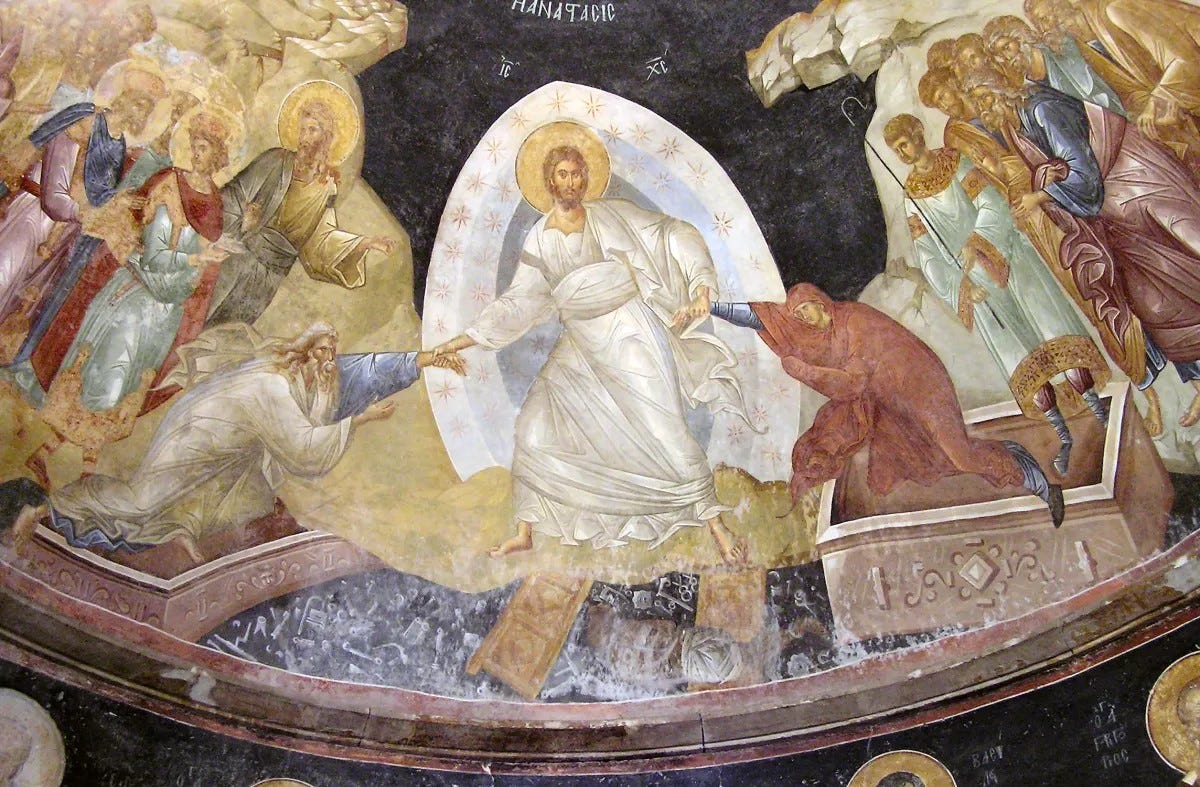
The Anastasis, literally “a rising up” or “standing up again in Greek. It is the icon that shows us what happened beyond the view of living men after the Crucifixion. Christ has descended not as a lifeless corpse but as a radiant figure, full of divine power, bursting with the Uncreated Light, reaching down into death itself to rescue Adam, Eve and all the righteous held captive since the beginning of time. In this image, Holy Saturday is not a pause. It is an explosion.

The Anastasis is one of the most commonly repeated of all iconographic prototypes in the Eastern tradition. It is not merely a depiction of an event but a visual proclamation of victory, a theological image so central that it appears again and again in apses, narthexes, chapels and manuscripts across centuries and empires. (Read more.)


Share

Thursday, January 29, 2026

What Europeans Found on the Most Isolated Island in the World

 From Literary Hub:

Europe came late to Rapa Nui, two centuries after Magellan led a pioneering Spanish expedition across the Pacific in 1521. Many of the statues were probably carved in those eight generations. When ships finally arrived—eight in all between 1722 and 1786, from Holland, Spain, England, and France, bringing a total of around 1,400 men—the visitors saw things they found hard to believe. There was a long tradition in Europe of representing named individuals realistically in stone, whether known persons or mythical beings or gods. The statues on the island were much larger, and far more numerous, than any standing at typical installations in Europe. And they seemed identical, anonymous, stylized, and alien. From the Islanders’ point of view, the visitors were equally strange, as they appeared and vanished overnight, over sixty-four years spending a total of no more than a week ashore. We may imagine that Islanders found it hard to stop talking and thinking about what had happened. But there must have been many who never saw a European.

Such brief and intermittent encounters had profound consequences, for the Islanders and for our understanding of their story, even now. It began on the Easter day when the Africaansche Galey signaled land. The Dutch West India Company had sponsored an expedition to search for a southern continent, which was thought necessary to balance all the land north of the equator. Jacob Roggeveen, a lawyer turned explorer, had wandered about the Pacific with three ships and found nothing. His crews were beginning to lose faith till they spotted a turtle and floating vegetation, and birds overhead. There was great joy, Roggeveen wrote in his log: They were about to discover Southland. But the imagined continent soon revealed itself as no more than a low, flat island. Rising plumes of smoke showed it was inhabited. Weather marked the occasion: They waited at a distance for thunder, lightning, heavy rain, and winds to clear.

The pioneer encounter occurred 3 miles offshore. The Dutch, spotting an old man approaching in a canoe, sent out a sloop to investigate. This unceremonial meeting was the first contact between people whose ancestors had parted tens of millennia ago in Asia, and whose experiences, cultures, and beliefs separately reflected that distance. It was an innocent event played out repeatedly around the world in various forms. A marker of unity. A harbinger of change and loss.

The naked man put up a good fight, but was overpowered and brought to the Arend, Roggeveen’s flagship. Curiosity trounced the Islander’s fears, and he seemed delighted by what he saw, taking a special interest in the ship—how it was made, the masts’ great height, the sails and the thickness of the ropes, and the guns, to which he gave particular attention. The sound of the ship’s bell and the sight of himself in a mirror scared him, and he appeared to be ashamed of his nudity. Offered a glass of liquor, he poured it down his face and tried to rub it out of his eyes. He put his arms and head on the table, and repeatedly raised them toward the sky, shouting loudly as he “addressed his gods.” (Read more.)

Share

Friday, January 9, 2026

Masquerade

A Lady
Masquerades in the past were usually associated with the Carnival season which started at Epiphany and ended on Mardi Gras. From Reading Treasure:
While modern masquerades are usually reserved for Halloween, in the 18th century masquerades were much more frequent occasions. Marie Antoinette's fondness for masquerades was no small thing: her frequent appearances at Paris masquerades at first endeared her to Parisians, who became enchanted with the smiling new dauphine that contrasted too wonderfully with the decrepit Louis XV; but after she became queen, Marie Antoinette's love for donning a mask and dancing the night away began to take a more infamous turn.

After she and her husband ascended to the throne, the propaganda wheels that had previously only caused bumps in the road began to turn in full force. Every little action by the queen, however harmless it may have been, was ripe for gossip and inflation.

Once, the queen and her entourage were on their way--fully masked--to a ball, when the carriage broke down. It was decided that because their faces were well hidden by the masks, they would take a fiacre--otherwise known as a carriage for hire. For the queen of all France to take what amounts to a common taxi was inconceivable in French society, and perhaps nothing would have come of the situation if Marie Antoinette had kept mum. However, the queen gaily brought up the incident to others, thinking nothing of sharing what she perceived as a fun adventure.

To the gossip mill that hounded her, however, that "fun adventure" was surely the sign of more serious transgressions. The 'fiacre' incident sparked rumors that the queen was visiting the private homes of men in secret, and that she frequently disguised herself to take private rides in fiacres with her lovers. As Madame Campan succinctly summarized: "
a single instance of levity gives room for the suspicion of others." (Read more.)
The Aunts
Share

Saturday, April 19, 2025

Irish Easter

St. Columba

 From The Easton Gazette:

The old Irish celebrated Easter on a different date from the continental Church for two centuries or more during what is known as the Dark Ages. This has fascinated me ever since I did a book report on the Synod of Whitby (664) in college. It was at Whitby that the conflict between the different customs of Celtic and Roman Christians in the British isles came to a head. Most of the north of Britain had been converted by the zealous Irish monks, led by Saint Colum Cille.

The Irish monks wore a tonsure different from the Roman monks; the Irish had their foreheads shaved from ear to ear, with long hair trailing down their back, while the Roman custom was to shave the crown of the head. The Irish claimed that their tonsure came from Saint John the Evangelist whereas the Romans claimed to have inherited their tonsure from Saint Peter. The tonsure, however, did not cause nearly as much problems as the date of Easter. From the beginning of Christianity the Church celebrated Easter at the same time the Jews observed Passover, on 14 Nisan, at the first full moon after the Spring Equinox. Following the Council of Nicaea in 325, the Roman church placed the equinox on March 21, while the Celtic churches insisted upon March 25 as the date of the Equinox. And so some years Easter in the two rites coincided but other years it did not. From The Freelance History Writer:

The Celts understood that the tradition they followed was that taught by the apostle John and they calculated Easter day as falling between 14 Nisan and 20 Nisan – i.e. When the 14 Nisan (the Passover) fell on a Sunday, they celebrated it on that day. But if it fell on the day after (on Monday) then the Easter celebration would fall on the following Sunday (20 Nisan), etc. The Rome loyalists claimed the authority of the apostle Peter, and calculated Easter Day as falling between 15 Nisan and 21 Nisan.

So when the date of 15 Nisan through to the 20 Nisan fell on a Sunday, and the full moon had fallen after March 25th, both Celtic and Roman Christians would celebrate Easter on the same day. It was when the Celts celebrated on 14 Nisan itself on Sunday that one main difference came, as the Rome loyalists then celebrated Easter a week later on 21 Nisan instead. This explains the situation described by the Venerable Bede: “Thus it is said to have happened in those times that Easter was twice kept in one year; and that when the king having ended the time of fasting, kept his Easter, the queen and her followers were still fasting, and celebrating Palm Sunday”. In that particular year 14 Nisan had fallen on a Sunday.

 (Read more.)


More HERE.

Share

Wednesday, March 5, 2025

Mercredi des Cendres

From author Catherine Delors:
Ash Wednesday follows Fat Tuesday, and the mood could not be more different. Today, a day of fast and prayer, marks the beginning of Lent. The day of ashes on foreheads, and the admonition Memento, homo, quod pulvis es, et in pulverem reverteris (“Remember that you are dust, and to dust you shall return.”)

No better illustration of the contrast between Carnival and Lent than this work by the 19th century Bavarian artist Carl Spitzweg. Spitzweg, though classified as a Romanticist, admired and emulated the genre paintings of the 17th century Flemish school. His style is often humorous and down-to-earth (two qualities I find somewhat lacking in Romantic art.) (Read more.)
Share

Friday, April 5, 2024

Trump Demands Apology For Easter Blasphemy

 From MxM:

Former President Trump has called for an immediate apology from President Biden for marking March 31st, Easter Sunday, as "Transgender Day of Visibility." Trump's national press secretary, Karoline Leavitt, described the move as an "assault on the Christian faith," stating that the day should be reserved for the celebration of the resurrection of Jesus Christ.

Leavitt's comments reflect the outrage expressed by some Christian groups and individuals over the Biden administration's decision. The controversy follows the White House's decision to ban religious egg designs in its Easter Art Event, a move that has also been criticized by some Christian groups. The art contest is part of the White House's Easter traditions, which include the annual Easter Egg Roll. The flier for the contest states that an Easter egg design submission "must not include any questionable content, religious symbols, overtly religious themes, or partisan political statements." (Read more.)
Share

Sunday, March 31, 2024

Artisan Easter Eggs

From Victoria:

A symbol of new life in many cultures throughout the world, the egg has been incorporated into springtime traditions for thousands of years. Decorating these beloved emblems is a cherished custom associated with childhood, but this rite of Easter can continue on with elegant adornments that capture the beauty and wonder of this season of awakening. Nestled gently into a rustic twig nest, suspended from a willowy bouquet of freshly cut branches, or arranged in similarly festive displays, a bevy of thoughtfully hand-decorated eggs celebrates spring. Along with offering an interlude of crafting, creating these keepsakes with papier-mâché eggs instead of a farm-fresh variety provides a means to preserve the splendor of a landscape in bloom. (Read more.)

Share

Sacrilege at the White House

From Jan Greenhawk at The Easton Gazette:

Of all the days of the Spring, this White House chose to degrade what is considered by many Christians to be the most important religious holy day of the year, Easter Sunday, with this proclamation from a President who claims to be a Catholic.

Are they stupid? Are they tone deaf?

Neither.

This is clearly being pushed by an administration with an agenda that dismisses all people's religious beliefs as secondary to their courtship of the transgender, LGBTQIA Marxist left. We have seen them promote people like Rachel Levine, who thinks he is a woman, male members of the military who think they are women, and other mentally ill people while confusing our children about the truth; men and women are different and one cannot be the other. Worse, they promote mutilating children and addicting them to a lifetime of hormone blocking drugs which have proven to have devastating effects.

The Biden Administration isn't doing this to be caring and inclusive to these sad individuals, they are doing this to give, as Dan Bongino says, the double-barreled middle finger to Christians across this country and the world. And Biden, who is clearly controlled by outside masters, gladly goes along so he can pretend to the leader of the free world.

And, they know that many churches in our country will not fight back against this. Why?

In his book LIVE NOT BY LIES: A MANUAL FOR CHRISTIAN DISSIDENTS, Rod Dreher explains how the Marxist, Progressive Left have to replace traditional religion of any kind with their own religion. They cannot reconcile their own vision of Utopia with the views of Christians, so they set out to first infiltrate them, then change them, then demolish them. He states, " In our time, secular social justice has been shorn of its Christian dimension. Because they defend a particular code of sexual morality and gender categories, Christians are seen by progressives as the enemies of social justice."

In this scenario where a Progressive government/society is in charge, churches have to make a decision. They can either stand their ground and stick to their values and beliefs or concede to the cult of popular insanity that has increasing followers thanks to the constant messaging from media and the internet. If they stick to their values, they may come under fire by a totalitarian culture that promotes silencing and erasing those individuals and organizations that disagree. (Read more.)


Share

Tuesday, May 23, 2023

An All-Too-Moveable Feast

I am saddened with how the American hierarchy has hacked up the Roman calendar. From Charlotte Allen at First Things:

The American bishops—as well as others, mostly in the English-speaking world—had a precedent for this. Starting in the late 1960s, the Feast of the Epiphany, celebrating the Magi’s visit to the infant Jesus—traditionally January 6, “Twelfth Night,” in the Western church—was moved to the Sunday immediately following New Year’s Day. This has meant that the season of Christmastide itself, which traditionally speaking isn’t supposed to end until the eleven pipers pipe and the twelve drummers drum, has regularly been terminated in parish churches as early as January 2. Further gumming up the works is the fact that many Spanish-speaking Catholics in the United States haven’t bought into the bishops’ switch to Sunday and continue to celebrate El Día de los Reyes—a much more important feast for them than for Anglophones—on whatever day of the week January 6 happens to fall.

Postponing Ascension Day—giving Jesus three extra days on earth before being “taken up” until a “cloud received Him”—means compressing the time between the Ascension and Pentecost (the ancient Jewish Feast of Weeks marking the seventh sabbath after Passover and always celebrated by Christians on a Sunday) from ten days to a mere seven. You might say that God now has to send down the Holy Spirit to the Church (the event that the Christian feast of Pentecost commemorates) by express instead of standard delivery. Not only does this change maul the Scriptures (the Acts of the Apostles is very clear about the time period between Ascension Day and Pentecost), but the once-widespread Catholic custom of a nine-day novena between the two feast days—with the Easter candle in the sanctuary extinguished on the intervening Sunday as a symbol of Christ’s absence—is now just a memory in most U.S. dioceses.

And in a further flattening of the post-Easter liturgical calendar, the American bishops (along with bishops in many other Western countries) moved the uniquely Catholic feast of Corpus Christi, which since the Middle Ages has been celebrated on the Thursday ten days after Pentecost. Again, the bishops decided that going to Mass or viewing a procession on a weekday was too much to ask of American Catholics, so Corpus Christi was shuffled off to Sunday as well. So now we’re left with a blurry procession of late-spring Sundays: Ascension Sunday, Pentecost Sunday, Trinity Sunday (a week after Pentecost), and Corpus Christi Sunday. Many Catholics probably have trouble figuring out which one is which.

As for the bishops’ goal of encouraging Mass attendance on major feasts by moving around their days of observance, quite the opposite has happened instead. Fewer Catholics than ever go to church on Sundays these days, even though such convenient scheduling arrangements as evening and vigil Masses have made it easier than ever in history for them to fulfill their weekly worship obligations. A Gallup poll released in April 2018 showed that Sunday Mass attendance, which had stabilized at around 45 percent about a decade ago, has recently resumed a precipitous post-Vatican II decline, down to 39 percent in 2017 from its height of 75 percent during the 1950s. And as the rules about holy-day worship have relaxed, the complaints from Catholics obliged to abide by the few restrictions left have grown. In December 2017, when Christmas fell on a Monday, many Catholics were disappointed to learn that the bishops wouldn’t let them pull a “two-fer” via a Mass on Sunday, December 24, that would cover both days. (Read more.)

Share

Thursday, May 5, 2022

Make Catholicism Penitential Again

 From Crisis:

Jesus’ very first words in the Gospel of Mark are: “Repent, the kingdom of God is at hand!” (1:15). While Matthew and Luke expand upon Jesus’ infancy, His baptism, and the temptations in the desert, they also begin with a repentance motif. After all, John the Baptist is introduced as Christ’s herald, preaching a baptism of repentance. And, after the events listed above, Jesus inaugurates His own public ministry with a call to repentance (Matthew 4:17) and a campaign against evil, characterized by healings and exorcisms.

Repentance, then, is the very leitmotif of Jesus’ ministry. It is also the Church’s, for the Risen Christ commissions His Apostles to “preach repentance for the forgiveness of sins, beginning in Jerusalem” (Luke 24:46-48; see also John 20:21-23). (Read more.)
Share

Sunday, April 17, 2022

Nineteenth-Century Easter Bonnets


From Mimi Matthews:

In the nineteenth century, Easter Sunday was an occasion for ladies of all classes to don their most fashionable bonnets.  Some of these bonnets were specially bought for the holiday.  Others were old bonnets made up with new trimmings.  In either circumstance, Easter bonnets were as essential to celebrating Easter as were eggs and bunnies.  An 1889 edition of the Ladies Home Journal even went so far as to declare that it was “an accepted fact that every woman who can buy or make a dainty bonnet for Easter-day must wear it.”

[...]

Nevertheless, the Globe states that “this, the season of rejoicing through all Christendom, is emphasised by a woman in a bonnet” and that “on Easter Sunday a new bonnet is de reigueur.”  What were these Easter bonnets like?  Addressing the Easter bonnets of 1889, the Ladies Home Journal reports that:

“There are large hats and small ones, though the tendency, as is usual in summer time, is to large hats. There are tiny bonnets, and those a little larger. There are bonnets that affect an air of primness, and there are those that are really frivolous looking.”

 (Read more.)


Easter bonnets and church hats are not a thing of the past. From Southern Living:

In many congregations across the country, statement-making hats are as synonymous with Sunday mornings as robed choristers and gospel readings. For writer Craig Marberry, who grew up in a Chicago congregation of the Church of God in Christ, the spectacular toppers were just part of the sanctuary topography. "In my church, women only wore three types of hats," he says. "Large hats, larger hats, and 'why'd you have to sit in front of me?' hats."

While the pastor's grandson took the tradition for granted as a boy, Marberry gained new appreciation for the fabulous church hats of his youth when he partnered with photographer Michael Cunningham to produce a tome filled with portraits of church-hat-wearing Southern women and their stories—Crowns: Portraits of Black Women in Church Hats, published in October 2000.

"I realized that church hats weren't merely fashion accessories," he says. "They are an expression of faith, as well as a celebration of fashion. Every woman has a different and compelling story about what church hats mean to them."

The tradition of church hats has its roots in scripture—in particular, a passage from one of Paul's letters to the Corinthians declares that women should cover their heads during worship to honor God. "In many religious denominations, women cover their heads for worship as a sign of respect for God and the church hierarchy," says Marberry. "But Black women alone have interpreted that edict with singular flair."

There's an important cultural element at play too, he notes. "African Americans oftentimes think we were severed from our African culture, our heritage because of slavery," says the author. "But there are a lot of things we do without realizing that they're connected to the motherland." Hats are one of them. "Many African societies believe that the soul is housed in the head, not in the heart, and therefore you adorn the head as a way of honoring it," he says.

Perhaps that's part of the reason women leaders of the Civil Rights Movement often marched in their church hats, a symbol of dignity.

 "If you look at the photos of Civil Rights marches from the '60s, you'll see women wearing church hats: Dorothy Height, Coretta Scott King, and countless others," says Marberry. "Even Rosa Parks, the mother of the Civil Rights Movement, had on a hat the day that she refused to give up her seat to a white man."

Church hats, in other words, are a proud declaration of who you are, how you worship, and what you stand for. And the grander the hat, the better. (Read more.)


Share

Saturday, April 16, 2022

The Faith Journey of St. Mary Magdalen

From Monsignor Charles Pope:
Mary Magdalene makes a journey in this passage from fear to faith. Let’s prayerfully examine her journey of faith.

I. Her Fearful Fretting Mary Magdalene is looking for a corpse. She’d come out to the tomb that morning for one purpose: to finish the prescribed burial customs for Jesus. His body had been placed in the tomb hurriedly on Friday evening, for it was almost sundown and the Passover feast was near. Now the Passover and Sabbath were complete; it was time to anoint the body and finish all the usual customs.

On Friday, Mary had been through immense trauma, seeing her beloved Jesus, her Messiah, brutally tortured and slowly killed through crucifixion. It seemed as if things could not possibly get worse, yet they just did. It would appear, according to her, that grave robbers had broken in and stolen the body. Strangely, they had left the expensive linens behind. But never mind that, things were now a total disaster. Now it would seem that she could not even perform a final kindness for Jesus.

Because of her fearful fretting, Mary is not able to look at the information before her properly. Jesus had promised to rise from the dead, on the third day, and this was the third day. The empty tomb does not signify grave robbers; it manifests resurrection! In her fear and fretful grief, though, Mary draws only the most negative of conclusions.

This, of course, is our human condition. So many of us, on account of fear and perhaps past trauma, tend to place the most negative interpretations on the events of our daily life. We are quick to seize on bad news, and we dismiss good news too easily, or barely notice that every day most things go right. Instead, we focus on the few things that go wrong. So easily we are negative and forget that even in painful transitions, as certain doors close, others open. New possibilities often emerge even in painful circumstances. (Read more.)
Share