Showing posts with label Germany. Show all posts

Thursday, May 14, 2026

Is God Using Communism to Punish Us?

 From Mark Judge at Hot Air:

 In his 1948 book Communism and the Conscience of the West, Bishop Fulton Sheen argues that Christianity and communism have similar world views. Christianity contains the truth about our lives, teaching us that love of God and neighbor, respecting the natural law, and the anticipation that we will have to battle real evil in this world. It is bluntly realistic. Communism is a distortion of Christianity. It makes the individual, in Sheen’s phrase, “a robot,” a slave to unstoppable historical and economic forces, which will result in utopia - if only after a lot of violence.

     Yet both Christianity and Communism see the world as the spiritual battleground that it is. Sheen respects Communism more than he does liberalism, which seeks comfort and virtue without any real battle.“Thought utopian and violent,” Sheen wrote, “Marxism reveals a better insight into the historical process than liberalism, which saw peace coming without a struggle and which denied that even a relative Easter of economic order would come without the Good Friday of self-sacrifice and effort.”

 Sheen goes on to argue that “the Gospel for the last Sunday of Pentecost and the Gospel for the first Sunday of Advent are gospels of catastrophe, they proclaim that the final era of peace will not be ushered in until the final conflict between good and evil, when God shall come to judge the living and the dead and the new city of Peace will be descending from the heavens.”

    Sheen also points out that the Russians learned Marxism from German intellectuals:

As many a parent who educated his child in an extremely progressive school, where the child equated freedom with doing what he pleased, is now the parent who wants to know what to do with his recalcitrant, alcoholic, neurotic son, so the Western world that taught Russia some bad ideas may soon want to know how it can be saved from a country which learned is lesson all too well. A Freudian psychoanalyst cannot help the son, so neither politics nor economics can help the Western world, for the fault is deeper; the world is under the judgment of God and needs repentance.    

    Sheen writes that “though Babylon fell because it was very wicked, it was nonetheless God’s instrument for disciplining the people of Judah. Assyria was bestial, but to was the ‘rod and staff’ of God’s anger against the people of Israel.” In the West, “communism may be the instrument for the liquidation of a bourgeois civilization that has forgotten God.” (Read more.)

Share

Monday, May 4, 2026

How the Thirty Years’ War Ravaged Europe

 From The Collector:

The Thirty Years’ War (1618–1648) was one of the most destructive conflicts in European history. What began as a religious struggle in the Holy Roman Empire soon expanded into a continent-wide power struggle involving nearly every major state. Entire regions were depopulated, armies grew to unprecedented size, and the war changed how Europe understood sovereignty and statehood. By the time peace finally arrived in 1648, the war had not only shattered old medieval structures but helped lay the foundations of the modern nation-state.

The Holy Roman Empire in the early seventeenth century was a fragmented and decentralized political entity, composed of hundreds of independent kingdoms, principalities, bishoprics, free cities, and minor lordships. While these territories owed nominal loyalty to the Emperor, real power rested with local rulers, many of whom guarded their autonomy jealously.

This loose structure had endured for centuries, but it was placed under immense strain by the religious divisions unleashed by the Reformation. By 1600, the empire was split between Catholic, Lutheran, and Calvinist states. Although the Peace of Augsburg (1555) had attempted to stabilize relations by allowing rulers to choose between Catholicism and Lutheranism, it excluded Calvinists and failed to resolve underlying tensions.

Religious identity became closely tied to political authority, with rulers using confessional allegiance to assert independence from imperial control. The Habsburg emperors were staunch Catholics and increasingly sought to reverse Protestant gains and strengthen central authority within the empire.

These pressures erupted in Bohemia in 1618. Protestant nobles, alarmed by perceived Habsburg encroachments on their religious and political rights, threw imperial officials out of a castle window in Prague, in the Defenestration of Prague. The initial rebellion was against Habsburg rule rather than a purely religious uprising. Although framed in confessional terms, the conflict centred on resistance to imperial centralization. (Read more.)


Share

Saturday, May 2, 2026

How the Fall of Rome Created the Power of the Medieval Papacy

 From The Collector:

In the Early Middle Ages, after the fall of the Roman Empire left the existing government structures in shambles, the papacy established itself as the preeminent authority in the West. Indeed, in a post-Roman world, where there was no large political structure to ensure stability in Europe, the Roman Church emerged as the only force able to provide some unity. Led by a series of popes functioning as both spiritual and temporal rulers, the papacy came to dominate the intellectual life, political landscape, and culture of the so-called Dark Ages.

In 476, the German chief Odoacer deposed Romulus Augustulus, ending the succession of Roman emperors inaugurated by Augustus. He then proclaimed himself king. The event is traditionally considered the end of the Roman Empire. By then, the so-called “barbarian invasions,” or the migration of Germanic peoples into Roman-controlled Europe, had already significantly altered the social and political composition of the empire.

In 406, the Vandals, Suebi, Alani, Burgundians, and Alemanni, fleeing from the advance of the Huns, crossed the River Rhine, pouring into Gaul. Some years later, they arrived in Spain. Meanwhile, the Visigoths established themselves in Narbonensis and Aquitania (the territories in Gaul). Though partially successful in regaining control of portions of Gaul, Roman general Constantius was unable to expel the “barbarians” from the country.

In 410, Alaric, at the head of the Visigoths, sacked Rome, pillaging the heart of the Roman Empire for three days. Only the churches were spared, as Alaric had converted to Christian Arianism. In the first half of the 5th century, other Germanic peoples began to establish themselves in the Roman territories. In 435, the Vandals conquered Carthage in North Africa. In 450, Attila and his Huns invaded Italy. Only Pope Leo the Great managed to persuade them not to sack Rome. (Read more.)


Share

Tuesday, April 28, 2026

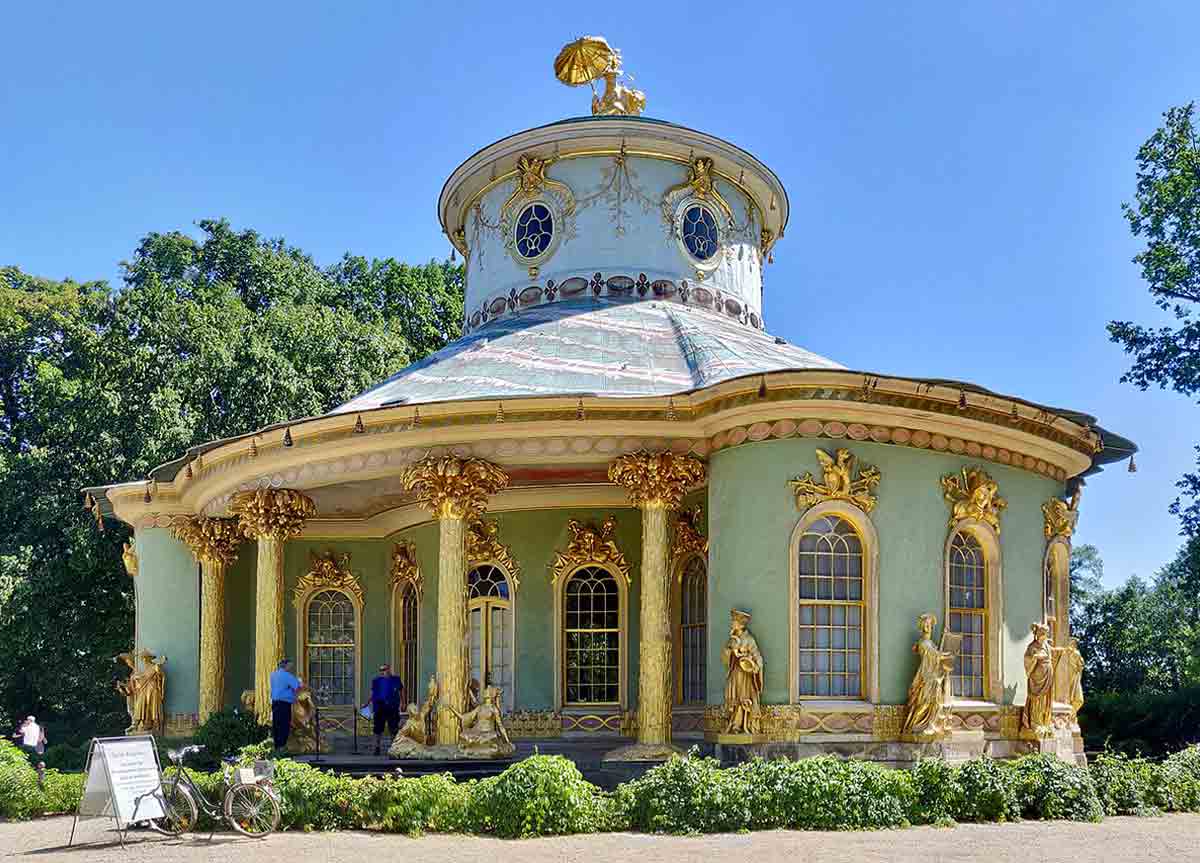
Chinoiserie in Architecture

chinesisches haus chinese house sanssouci park potsdam 2019 

From The Collector:

Located in the Sanssouci Park, the Chinesisches Haus (“Chinese House”) in Potsdam, Germany, was built between 1755 and 1764. Commissioned by Prussian king Frederick the Great, the project was headed by German master builder Johann Gottfried Büring. The Chinese House is characterized by its trefoil shape, which was inspired by the Maison du Trèfle at the Palace of Lunéville in Lorraine. Its exteriors feature four prominent gilded sandstone columns alongside several playful, life-sized gilded sculptures of Chinese musicians and tea drinkers. These were the works of German sculptors Johann Melchior Kambly, Johann Gottlieb Heymüller, and Johann Peter Benckert.

The Chinoiserie style continues in the building’s interiors with a vast collection of 18th-century porcelain and a large fresco depicting a whimsical gathering. It features numerous Chinese men standing behind a balustrade, some glancing around and others engaged in conversation. In the surroundings, there are peacocks, parrots, monkeys, statues of Buddha, and many other Chinoiserie motifs. Frederick the Great, as a fervent admirer of Chinoiserie, would later follow up with two additional Chinese-style structures. One was the Chinese Kitchen, located just a stone’s throw from the Chinese House, and the other was the Drachenhaus (“Dragon House”), located at the northern part of the Sanssouci Park. (Read more.)


Share

Thursday, April 23, 2026

The Second Partition of Poland

 From Charles Coulombe:

THE First Partition of Poland was a dreadful blow, not just to Polish morale, but that of the Lithuanians, Belarusians, and Ukrainians with whom they shared the Commonwealth. The Allied Powers — Russia, Prussia, and Austria — that had undertaken the First Partition were watchful over any signs of independence that the Polish King and government might exert. Russia in particular supervised both the meeting of the Sejm and the Permanent Council made up of pro-Russian nobles and now deputed to carry on most of the business of governing. Stanislaus’ royal prerogative was restricted, so that he lost the right to confer noble titles, and military promotions and to appoint ministers and senators. Provincial Governorships, and Crown lands would be auctioned off. With the King reduced to seeming impotence, and the government firmly in pro-Russian hands, it seemed that the Commonwealth was now a complete puppet.

But King Stanislaus was a wily man. There was strong Conservative opposition to the Council, made up of nobility who feared loss of their own powers to a resurgent central government. The King became adept at playing the two sides off against each other and creating his own King’s party. Moreover, although his own powers had been severely clipped, his ability to influence and cajole became if anything ever stronger. He became very adept at mitigating or frustrating the worst of legislation that the Russians favoured. In secret, with trusted advisers, he created a reform programme. But while the King was able to slow the rate of decay, his opponents in the Sejm were able to block his reforms.

This standoff would continue for almost two decades. But on the wider world, things were happening. In 1781, Austria and Russia allied as a means of countering — and, they hoped, eventually conquering — the Ottomans (Catherine the Great had one of her grandsons named Constantine, in hopes that he would reign over a new Byzantine Empire). Stanislaus attempted to join this alliance, reasoning that it would strengthen Poland-Lithuania, and buy the country some independence. They were unable to agree on terms, but in 1787, the two Christian Empires went to war with the Muslim one. In response, Stanislaus convoked the “Great Sejm” the following year, which would sit for four years. Then in 1789, the revolution in France began, and that country created a constitution. (Read more.)

Share

Wednesday, April 15, 2026

The Rot That Bred the Reich

 From Celina's Substack:

To understand the death of a civilisation, one must first walk through its ruins. The scene is Berlin, sometime in the mid-1920s, beneath the blinding, electric glare of neon and the suffocating, narcotic haze of the Berliner Luft, an atmosphere that locals gleefully described as an amphetamine-like air that made hearts race, pupils dilate, and morals evaporate until dawn.1 In the shadowed, labyrinthine alleys of a shattered empire, the streets of the capital have been entirely surrendered to a bacchanalia of unprecedented depravity. Prostitutes in various stages of undress crowd the cobblestones. They are openly aggressive, their ranks swollen by pregnant mothers, desperate war widows, and adolescents, all selling their flesh for the price of a meal.2 On every street corner, hawkers peddle cocaine, morphine, and opium to passersby, while newsstands prominently display nudist magazines dedicated exclusively to the exhibition of children.3

Push past the heavy, smoke-stained velvet curtains of the subterranean cabarets, and the full, suffocating scope of the abyss reveals itself. Here, glittering shows parade acres of sweaty, perfumed flesh to the applause of an audience intoxicated by a potent mixture of ecstasy, terror, and moral decay. Cross-dressing men perform grotesque pantomimes of traditional womanhood, while tuxedo-clad women mock the remnants of patriarchal authority, puffing cigars and sneering at the ghosts of their fathers.

For the modern, liberal apologists of the era, this explosion of libertinism is often retroactively celebrated as a vibrant, avant-garde renaissance, a brief, shining moment of progressive emancipation before the darkness of fascism fell. It is romanticised in our modern cinema and theatre as a glorious rebellion against the stuffy confines of tradition. But to the ordinary, rooted citizens of the German nation, the truth was far darker and far more evident. (Read more.)

Share

Friday, April 3, 2026

Germany’s Protestant Church and the Seeds of a Religious Backlash

 From The European Conservative:

Germany is not like America. There is no mass evangelical movement blending Christianity with culture war activism, no figure comparable to Charlie Kirk. But this doesn’t mean the country is immune to change. Beneath the surface, a new, quieter religious backlash is stirring—and Germany’s notoriously progressivist Protestant Church may, paradoxically, be helping to fuel it.

The official church is in crisis. The scale of that crisis was thrown into sharp relief once again during this year’s Lenten season, when statistics published in March confirmed the continuing downward trend in membership. In 2025, a further 1.1 million people left the two major churches, with Protestants leading the exodus: their numbers fell by around 580,000 to approximately 17.4 million. Where in 1992, some 36% of Germans were Protestant, that figure has now fallen to 21%.

No one was surprised. The reasons are surely complex in a largely secular society. What is striking, however, is not the decline itself but the leadership’s response to it—a posture of resignation bordering on indifference. When the already-falling figures were presented in 2024, Kirsten Fehrs, chair of the German Protestant Church Council and the institution’s most senior representative, could offer nothing more than, “We will become a smaller and poorer church.”

Rather than campaign to win members, the leadership appears to have made peace with its growing irrelevance. In recent years, anything associated with the church’s former core mission—spreading the faith and engaging non-believers—has been quietly abandoned, even treated with embarrassment. The very word ‘mission’ has become contested. In a recent opinion piece, the editor of the church newspaper evangelisch.de argued that the term rests on a false distinction between “us” and “them,” and that mission should mean only “walking alongside others”—explicitly not “about recruiting members or church growth.” The instruction in John 20:21—”As the Father has sent me, even so I am sending you”—is evidently no longer something the leadership feels obliged to follow. (Read more.)


Share

Wednesday, February 25, 2026

The Suicide of Neanderthals

 From EL PAÍS:

In his latest book, the paleoanthropologist Ludovic Slimak recounts how, as a young man, he spent his time observing people as he played the bagpipes in a kilt on the dirty streets of Marseille. Driven by an unconscious impulse, he had decided to master the instrument, and he succeeded, even leading a famous band in France. Then his first child was born, he found himself traveling from gig to gig, and eventually, he gave it up. But he was able to earn his PhD with the money he made from music.

The French scientist has been able to spend the last 30 years observing and studying one of the most decisive moments in the history of evolution: the encounter between our species and the Neanderthals, our closest human relatives. One of his latest discoveries is Thorin, a Neanderthal who lived around 42,000 years ago, very close to the moment of extinction. From then on, Homo sapiens became the only human species on the planet.

 In his new book The Last Neanderthal: Understanding How Humans Die, Slimak, 52, reflects on the reasons for the disappearance of these human cousins, and what it reveals about ourselves. “It’s a sad book,” he underscores, because despite the latest evidence that Neanderthals controlled fire, created cave art, and had sex and children with our own species — leaving a trace of their DNA in our genome — this scientist from the French National Center for Scientific Research believes they went extinct in isolation and abandonment. Slimak answers EL PAÍS’ questions via videoconference from his beautiful home, where he lives with his wife and two children, halfway between Toulouse and the Pyrenees. (Read more.)


40,000-year-old Stone Age symbols may have paved the way for writing, long before Mesopotamia. From Phys.org:

Over 40,000 years ago, our early ancestors were already carving signs into tools and sculptures. According to a new analysis by linguist Christian Bentz at Saarland University and archaeologist Ewa Dutkiewicz at the Museum für Vor- und Frühgeschichte (Museum of Prehistory and Early History) in Berlin, these sign sequences have the same level of complexity and information density as the earliest proto-cuneiform script that emerged tens of thousands of years later, around 3,000 B.C.E.

Using a computational approach, the team examined over 3,000 signs found on 260 objects to reveal insights into the origins of writing. Their findings, which have been published in the journal PNAS, were clear—and surprised even the researchers.

Paleolithic objects dating back between 34,000 and 45,000 years bear mysterious sign sequences—often repeated lines, notches, dots and crosses. Many of these artifacts were discovered in caves in the Swabian Jura, such as a small mammoth found in the Vogelherd Cave in Lone Valley in southwestern Germany.

A Stone Age human carved the mammoth figurine out of a mammoth tusk and carefully engraved it with rows of crosses and dots. Other artifacts found in the Swabian Jura are also etched with signs. (Read more.)

Share

Tuesday, February 17, 2026

Marco and Munich

 From Tierney's Real News:

Marco Rubio just gave a keynote address at the 62nd Munich Security Conference in Europe, the premier global forum for international security policy.

His speech is one of the best speeches I’ve ever heard against Godless Communism - and it succinctly explains the nightmare and foolishness of Europe (and America) abandoning God and national sovereignty to appease the atheist one-world-order Globalists - in 20 minutes.

If you only listen to one thing this weekend - let it be this. In fact, I think this speech is so powerful of an explanation that it should be played in every Christian church in America on Sunday morning. I’m not kidding.

Rubio said that Europe and U.S. belong together bound by “centuries of shared history, Christian faith, culture, heritage, language, ancestry” and that since WW2 mistakes have been made:

  • Outsourcing “our sovereignty to international institutions”

  • Imposing energy policies that impoverish our people “to appease a climate cult”

  • Opening doors to mass migration “that threatens the cohesion of our societies, the continuity of our culture, and the future of our people.”

Rubio says “We owe it to our people to face those facts and to move forward to rebuild.”

Some highlights:

MARCO RUBIO: “We in America have no interest in being polite and orderly caretakers of the West’s managed decline!

We are prepared to do this alone but it is our preference, and our hope, to do this together with you, our friends in Europe.

America was founded 250 years ago, but the roots began here on this continent long before. The men who settled and built the nation of my birth arrived on our shores carrying the memories, the traditions, and the Christian faith of our ancestors as a sacred inheritance, an unbreakable link between the old world and the new.

We are part of one civilization, Western civilization. We are bound to one another by the deepest bonds that nations could share, forged by centuries of shared history, Christian faith, culture, heritage, language, ancestry, and the sacrifices our forefathers made together for the common civilization to which we have now fallen heir.

And if at times we disagree, our disagreements come from our profound sense of concern about a Europe with which we are connected, not just economically, not just militarily. We are connected spiritually and we are connected culturally. We want Europe to be strong. We believe that Europe and the West must survive.” (Read more.)

Share

Saturday, January 24, 2026

The Triumph of German Industrial Modernism

 From The Palladium Newsletter:

Germany entered the twentieth century as an industrial giant but a cultural latecomer. Its artistic inheritance remained rooted in regional craftsmanship and medieval revivalism. Albeit beautiful in isolation, these traditions offered little guidance for a rapidly growing nation competing with the disciplined cultural machines of France and England. Germany produced enormous quantities of goods, yet lacked the institutions needed to give them a coherent visual or moral character. In the hierarchy of European taste, France still dominated luxury and refinement, while England retained prestige in craftsmanship and the decorative arts. German manufacturers, in contrast, filled markets with imitative ornaments and sentimental novelties. Public taste deteriorated. Reformers feared that industrialization had eroded the very ability to judge quality, creating a visual environment disconnected from any shared cultural purpose.

The German architect and author Hermann Muthesius diagnosed the crisis with clarity: German manufacturers, he argued, had abandoned their cultural responsibilities. Cheap, derivative goods did more than weaken taste. They threatened “the national character through pollution of the visual environment.”] Germany could not rely on imported styles, nor accept a reputation for shoddy production. A new domestic standard was required—one rooted in simplicity, integrity, and an honest expression of industrial reality.

The Werkbund emerged as the institutional answer. Its founders rejected the nostalgic escape into handicraft promoted by the English Arts and Crafts movement. They embraced the machine as a cultural fact. Modern life would not be redeemed by retreat, but by disciplined cooperation between artists and industry. Mechanization could produce beauty, but only if aesthetic judgment shaped its direction.

Central to this project was education. The Werkbund believed that a modern society needed perceptual training as urgently as technical skill. Reformers like Muthesius and Georg Kerschensteiner pushed to overhaul the school system, arguing that aesthetic judgment could not be left to habit or chance. Muthesius had already modernized the Prussian Arts and Crafts Schools, insisting that “art is an indispensable complement to life.” Kerschensteiner championed manual training as a foundation of ethical and civic development. Educators such as Ludwig Pallat, Hermann Obrist, and Franz Cizek used the Werkbund to promote methods that would “stimulate the creativity of the child, preserve his innate imaginative powers, train his eye and hand as well as his brain, and inculcate respect for manual skill.” Their goal was not simply to produce designers, but to produce citizens capable of sustaining a higher national culture. Taste itself was civic infrastructure. (Read more.)

Share

Thursday, January 15, 2026

Jacques-Louis David's Sketchbook

 From ArtNet:

The French media outlet Radio France launched its investigation into the sketchbook after being contacted by a descendant of the original owner. The broadcaster claims that it was able to pull together enough evidence to back the descendant’s claim in “just a few weeks.” The discovery sheds a light on the slow progress of ongoing provenance research into objects that were acquired by French museums after 1933.

France’s ministry of culture issued a response to the evidence gathered by Radio France stating that neither the ministry nor the Palace of Versailles had not been aware that the item was stolen during the war. They promised to “continue their research on this notebook and have discussions with the descendants of the owners.”

The Palace of Versailles declined to comment.

The sketchbook dates from 1790 and is filled with rare drawings and notes, including preparatory materials for one of David’s most famous works, The Tennis Court Oath (1790). The painting, which was never finished, records a foundational event in the French Revolution. It belongs to the Palace of Versailles but is currently on display in the Louvre’s landmark exhibition “Jacques-Louis David,” until January 26. The sketchbook is not featured in the exhibition.

a plain page in a sketchbook that contains pencil sketched images of figures in various expressive gestures

Once stolen by the Nazis, the sketchbook was sent to Germany. It was sold by Munich’s Karl and Faber gallery in 1943. It came into the hands of the German dealer and art historian Otto Wertheimer, who had himself fled Nazi persecution of the Jews in the 1930s. He settled in Paris in 1944 and became known for supplying French museums with important masterpieces at a time when an artwork’s provenance was rarely questioned. He sold the David sketchbook to the Palace of Versailles in 1951. (Read more.)


Share

Wednesday, January 7, 2026

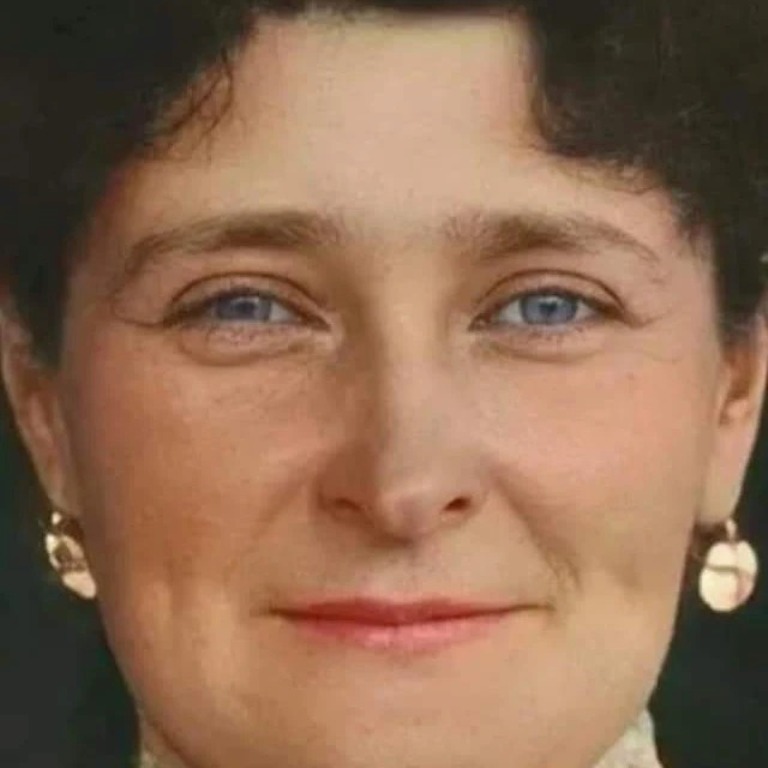
Health of Empress Alexandra

0290b 

judge 

From Nicholas II:

During her life, Alexandra carried much grief, worry and sorrow on her shoulders, all of which began at an early age. She lost her brother Friedrich to haemophilia in May 1873; her sister Marie died of diphtheria in November 1878; and the following month, her beloved mother Princess Alice also died of diphtheria in December 1878.

After her mother and sister’s deaths, Alix became more reserved and withdrawn. She described her childhood before her mother and sister’s death as “unclouded, happy babyhood, of perpetual sunshine, then of a great cloud.”

In March 1892, her father Grand Duke Louis IV, died of a heart attack. According to Baroness Sophie Buxhoeveden, Alix regarded the death of her father as perhaps “the greatest sorrow of her life”. Buxhoeveden recalled in her 1928 biography [The Life and Tragedy of Alexandra Feodorovna] that “for years she could not speak of him, and long after when she was in Russia, anything that reminded her of him would bring her to the verge of tears”. This loss was probably so much greater for Alix because Grand Duke Louis IV had been Alix’s only remaining parent since she was six years of age. (Read more.)


Share

Friday, January 2, 2026

A Warning to the West

 From Diane Montagna:

Europe is undergoing a process of intentional self-annihilation. Its political leaders have sealed the continent’s fate through unchecked mass migration, deliberately choosing to replace the coming generations with Muslims. The Church has aided them in this endeavor with talk of “mercy” towards refugees, while justice for Europeans has been sidelined. And perhaps the bell would not have tolled with such finality, had Europe held fast to its ancient faith. Yet in religion’s stead, each person determines his own morality and subjective truth. Christianity is viewed as superfluous to true ethics and human rights.

One might even argue that the European elite—in politics, media, and beyond—are relentlessly pressing and manipulating the population toward surrender, even self-erasure, thereby igniting the fierce counterfire of a surging populism they themselves provoked. They must explain the reason for such folly. A German economist once remarked on former Chancellor Merkel’s inexplicably destructive migration policies: “Either she has lost her mind, or she pursues some hidden agenda unknown to us.” This is compounded by the tendency of the so-called elite to converse chiefly among their own kind, insulated from the concerns and reflections of ordinary citizens—a detachment that serves to bolster their one-sided dominance.

Wolfgang Kubicki, the former liberal vice president of the German Bundestag, who authored the book Meinungsunfreiheit (Unfreedom of Opinion), observed that whereas people once exchanged arguments to find the truth, they now discredit the people who make arguments so that no one has to address the arguments themselves. This tactic was rightly condemned by US Vice President J.D. Vance in his memorable address in Europe. And this was precisely the point of President Trump’s recent warning: Look at Germany, see what they have done there, and know what awaits us should we fail to alter course — irrespective of whether one agrees with every step he has taken. (Read more.)


Share

Saturday, December 27, 2025

The Man Behind 'The Nutcracker'

 From The Conversation:

So how does The Nutcracker and the Mouse King fit into this strange body of work?

Hoffmann’s original tale is no innocent sugarcoated fantasy. The story was written for his friend Hitzig’s children, Marie and Fritz. It is a veiled critique of the strictures Hitzig and his social class placed on his children’s freedom.

The story is, tellingly, set in a household named Stahlbaum, or “Steel Tree”: a fortress of sorts that is infiltrated by the mysterious Drosselmeier. 

In Hoffmann’s tale, Marie is positioned as the novice who must learn to use and trust her imagination. Only her imaginative vision can animate – literally and metaphysically – the mundane world that surrounds her and fulfil her dreams and desires. Drosselmeier is a figure analogous to Hoffmann, cultivating Marie Hitzig’s imagination within and outside of the story.

This clashing of worlds is not without its trauma. Hoffmann’s story ends on a sombre note, with Marie’s visions being dismissed by her family as nonsense. Mocked into outward submission, she never speaks of these adventures again. Ridiculed as a dreamer, she becomes reserved. But in her mind’s eye, she returns from time to time to “those glorious days”.

Hoffmann’s ending leaves us suspended between sadness at the suppression of Marie’s childhood imagination and triumph at the quiet persistence of her imaginative spirit. (Read more.)

Share

Thursday, December 25, 2025

Christmas Scenes


From East of the Sun, West of the Moon. And Christmas trees, HERE.


And scenes of winter, too. Happy New Year!


Share

Tuesday, December 16, 2025

O Christmas Tree


Kaiser Franz Josef with Empress Sisi and family

The Habsburgs and the Christmas tree. From the World of Habsburgs:

A festively decked tree with candles is today the foremost symbol of Christmas. However, this has not always been the case. It was not least the Habsburgs themselves who were responsible for introducing this custom in the lands of the Habsburg Monarchy.

Christmas trees as we know them today first arrived in Vienna during the Biedermeier, evidently from northern Germany. In Protestant countries Christmas had long been celebrated as a festivity of the middle-class family, as an intimate, emotional experience of the birth of Jesus – in contrast to the publicly celebrated, convivial church festivity of the Catholic tradition. The ‘new’ tranquil Christmas celebration round the Christmas tree came to epitomize a pious sense of family and bourgeois domesticity in the Habsburg monarchy during the Biedermeier era.

This rapid change of emphasis and its ready acceptance in Vienna can be explained by the profound social changes taking place in the capital during the reign of Joseph II and the Biedermeier era: the new economically flourishing patrician class began to assume a leading role during the time of the industrial revolution and was seeking new modes of expression for its sense of family values.

In 1814 reports compiled by Metternich’s state police contain the first mention of a Christmas tree festivity held in the salon of the Arnsteins, a Jewish banking family. Those attending were given lavish gifts, a custom that was not usual on Christmas Eve in Vienna at the time. The mistress of the house, Fanny von Arnstein, was from Berlin and had brought the custom with her from her native city.

However, it was via court circles in Vienna that the Christmas tree spread rapidly to the living rooms of the middle classes. The wife of Archduke Karl, Henriette of Nassau-Weilburg, who came from a Protestant family, brought the custom from her German home. Christmas 1816 saw the first Christmas tree, festively decked with candles, in the Habsburg family. Emperor Franz I attended this celebration and was so taken with the magical aura of the Christmas tree that he ordered a tree to be put up in the Hofburg at Christmas from then on. Subsequently it became the norm in Catholic families to celebrate Christmas round the tree: contemporary accounts record that while it was still almost impossible to procure a Christmas tree in 1821, by 1829 there were already street vendors selling trees at the Schottentor, the city’s north gate, and in 1851 the Am Hof square is said to have resembled a forest in the run-up to Christmas. (Read more.)

Share

Tuesday, November 18, 2025

The Enigmatic “Fairy-Tale” King of Bavaria

undefined 

From The Collector:

When any historical figure is said to have been mad, we have to consider the time and place in which they lived and how this conditioned their diagnosis: what were the norms in their society from which they apparently deviated? Moreover, how did that society treat those it considered mad, and what motivations might there have been for interpreting their behavior as such?

In Ludwig II’s case, the ministers and physicians who produced a report on his madness certainly had a motivation: to remove him from the throne for the good of the state of Bavaria. They contacted various insiders at Ludwig’s court, and then passed this information to four psychiatrists for corroboration.

As a recent study has pointed out, none of these doctors examined Ludwig, and only one of them had even met the king: neurologist Bernhard von Gudden, who wrote in the report that Ludwig was “teetering like a blind man without guidance on the verge of a precipice.”

The evidence was that Ludwig avoided the public, holed up in his study concocting grand architectural plans, rambling through the mountains, or demanding that theatrical performances be put on for his sole enjoyment. His treatment of those around him could be erratic, with occasional outbursts of petulance or anger.

Most importantly for late 19th-century doctors preoccupied with hereditary degeneration, Ludwig’s younger brother, Otto, suffered from bouts of debilitating mental illness. This was sufficient for the government to agree, in June 1886, that Ludwig should vacate the throne. (Read more.)

Share

Is ‘Nuremberg’ About the Wrong Psychiatrist?

 From Forward:

Douglas Kelley, the real-life U.S. Army psychiatrist portrayed by Rami Malek in the recently released motion picture Nuremberg, wrote a book titled 22 Cells in Nuremberg that came out in 1947, a year after he finished his five-month stint at the Nuremberg trials.

Nearly 60 years later, interviews conducted by Leon Goldensohn, a Jewish psychiatrist who replaced Kelley at the historic war crimes trials, were published in The Nuremberg Interviews: An American Psychiatrist’s Conversations with the Defendants and Witnesses. Goldensohn who spent more time with Nazi prisoners than Kelley did, and this book, translated into 16 languages, arguably sheds more light on the Third Reich criminals.

Goldensohn and Kelley were responsible for monitoring both the physical and mental health of the Nazi prisoners, and both their lives ended tragically: Goldensohn died of a heart attack in 1961, five days after his 50th birthday; Kelley died by suicide in front of his family at the age of 45. (Read more.)

Share

Saturday, November 15, 2025

Hitler Was Not a Christian

 From Mark Judge at Splice Today:

Adolf Hitler was not a Christian. The German dictator was a pantheist. That’s the argument put forward by the new book Hitler’s Religion: the Twisted Beliefs That Drove the Third Reich by Richard Weikart, published by Regnery. The book comes along at a good time, offering penetrating research in a milieu where everyone from the alt-right to Black Lives Matter is accused of being Hitler. The Fuhrer is the go-to intellectual comfort food for lazy, virtue-signaling hacks.

“Pantheism is the idea that all of nature is God,” Weikart, a history professor at California State University, explained to me in a recent interview. “Because Hitler thought that nature was God, he thought that following the laws of nature was doing the divine will.”

In the Judeo-Christian tradition, nature is a creation of God, not God himself. According to Weikart, Hitler believed that God was found in the power of nature, particularly the violent Darwinian struggle for survival. “Hitler thought that destroying people he thought as weak or inferior was in perfect accordance with what nature does,” Weikart says. “After all, in nature, animals get killed, and certain species go extinct. Hitler thought the same thing should go on in human society because he thought certain races were inferior to others, so he thought destroying them was a good thing.” This kind of ruthless theology can be found on both extremes of modern politics, from the laissez-faire survival-of-the fittest rants of free market conservatives to the abortion on demand evil of the left (there’s also alt-right maestro Richard Spencer’s sickening pro-abortion musings).

Discerning Hitler’s religion is a complicated task. The German dictator often spoke about what religious beliefs he didn’t believe in, but never clearly stated which ones he did. He rejected Christianity but also atheism, mysticism, occultism, and neo-paganism. Hitler would often publicly claim to be Christian, even saying in 1922, “My feelings as a Christian points me to my Lord and Savior as a fighter.” Yet he also said the following: “The Christian-Jewish pestilence is surely approaching its end now. It is simply dreadful, that a religions even been possible, that literally eats its God in Holy Communion.” (Read more.)


Share

Tuesday, October 28, 2025

At the End of the Postwar World

 From Victor Davis Hanson at Freedom Frequency:

When fighting in Europe ends with the Nazi surrender on May 9, the continent is left in shambles, impoverished, and immediately threatened with both internal and external communist takeovers. Some 70 million to 85 million lives have been lost in this war. Perhaps 35 million died in Europe, on the Eastern Front, and in the Mediterranean. The traditional European economic powerhouse of Germany is flattened, occupied, and divided, with 30 percent of its territory under the control of the Soviet Union.

Many of the borders in Eastern Europe and the Balkans are radically altered, and these vast territorial changes will lead to some 20 million refugees. Perhaps up to 2 million displaced persons will have died of starvation, disease, or exposure by 1950. The vast majority of them are Germans expelled from Silesia, Prussia, and Pomerania to make way for the restoration of Poland. A quarter-million Jews who survived the Holocaust are homeless.

When the war ends, more than half of some 500 Soviet rifle divisions are occupying both Eastern Europe and East Germany—even as a broke Britain and a tired America are planning to collectively demobilize more than 3 million expeditionary troops eager to leave for home as quickly as possible.

The economies and infrastructure of the losing Axis-associated powers of Germany, Italy, Austria, Hungary, Romania, Bulgaria, and Slovakia are ruined. Their political systems are near-nonexistent. Neutrals like Spain, Portugal, Sweden, and Switzerland are still in the economic doldrums. The lands of formerly German-occupied Europe—especially the Netherlands and France—have seen their economies absorbed by Nazi mercantilism and are busy hunting down former internal collaborators.

Yet the ascendant Soviet Union is even more impoverished. Its western territories are ravaged. And it has suffered 26 million civilian and military deaths. (Read more.)

Share