Showing posts with label The Mystery of Iniquity. Show all posts

Monday, July 27, 2026

Catherine Herridge Uncovers Shocking Revelations About The Biden Family

 From Zero Hedge:

Herridge, a veteran Emmy-winning investigative reporter, has previously pursued stories on the Hunter Biden laptop, the Biden family's foreign business dealings, and related corruption allegations - reporting that put her at odds with CBS leadership and the broader media consensus.

In February 2024 she was among those laid off in a round of cuts. CBS then seized her reporting files, including materials involving confidential sources. Testifying before the House Judiciary Committee, Herridge described the seizure in stark terms: "When my records were seized I felt it was a journalistic rape."

She added that "CBS News' decision to seize my reporting records crossed a red line that I believe should never be crossed by any media organization" and that "When the network of Walter Cronkite seizes your reporting files, including confidential source information, that is an attack on investigative journalism."

She has maintained that she simply "reported out the facts of the story. I called balls and strikes." The network eventually returned the files under pressure from the House Judiciary Committee and her union.

Earlier, during the 2020 campaign, the Biden team had already labeled her a "partisan, rightwing hack." Her treatment fits a pattern of institutional pushback against journalists who refused to look away from the Biden family's financial ties.

Those ties have been documented for years. House Oversight Committee investigations, led by Chairman James Comer, obtained bank records and witness accounts showing Chinese Communist Party-linked money flowing to Biden family members.

Comer stated that the documents demonstrated the family had received funds from CCP-connected entities and that family members "attempted to sell access & influence around the world." (Read more.)


Share

Tuesday, July 21, 2026

Gottfried is Right: Wokeness Is Not Communism, It’s Demonic Narcissism

 From Mark Judge at Chronicles:

Gottfried, a former professor of humanities at Elizabethtown College, has authored many outstanding books—particularly on the question of Marxism—so I defer to his judgment on what qualifies and doesn’t qualify for the precise definition of Marxism and Communism. Rather than disagree with him, I’d like to offer a slightly different perspective. The woke, in fact, are clinical narcissists in the sense that term was defined by Christopher Lasch. 

Narcissism, Lasch argued in his 1979 classic The Culture of Narcissism, is not self-love, but the opposite. The narcissist is not full of ego but has no sense of self. Lacking a stable sense of identity, the narcissist hunts for meaning in therapy, self-help, sex, or radical politics. This is the mental illness that is driving the politics of the left.

Lasch argued that human personality and psychology have changed over the course of the last century. Americans have transformed from strong, confident and well-adjusted people to those evincing a “minimal” self. Having cast aside our former understanding of man’s purpose and meaning in this world, American personality has become weak and dependent on government, corporations, radical politics, sex, and bureaucracies for a sense of meaning. 

Central to Lasch’s analysis is an understanding how infants develop. Citing Freud, he argued that to an infant, interactions with the world result in two sets of feelings—either omnipotence or helplessness. In an infant’s fantasy world, that baby is either the king of the world, demanding that his needs get met right now, or he is totally helpless and dependent on others for survival.

To snap out of this infants must encounter limits or “transitional objects” as they grow. Toys, games, siblings, sports, and barriers introduce limits into the world of the child. These objects shrink the scale of fantasies, introduce reality, and allow a healthy transition into adulthood. In the latter part of the 20th century, too much of the raising of children went to television, the helping professions, schools, and bureaucracies. (Read more.)

Share

Monday, July 20, 2026

Spying and Lying

 From Sharyl's Substack:

The news that Special Counsel Jack Smith spied on Congress and then lied about it should be of no surprise.

It’s far from the first time something like that has happened.

And since nobody has been held accountable in the past in any meaningful way, why would anybody expect the behavior to stop? Why wouldn’t the abuses expand?

The same could be said after the forensically proven government spying on me and my family. I was an investigative correspondent at CBS News at the time. The Department of Justice has defended the improper spying against me, in court. under Obama, Trump, and Biden—rather than holding the guilty parties accountable.

Let’s look at an early scandal that left the guilty officials unscathed and foreshadowed more to come.

In March 2013, Director of National Intelligence James Clapper gave false information under oath before the Senate Intelligence Committee.

Senator Ron Wyden (D-OR) asked him directly: “Does the NSA collect any type of data at all on millions or hundreds of millions of Americans?”

Clapper replied: “No, sir… Not wittingly.”

This was untrue. We didn’t know it at the time but the National Security Agency (NSA) was secretly collecting massive amounts of telephone metadata, records of who called whom, when, and for how long, on tens of millions of Americans through the Section 215 program, along with other bulk surveillance programs. (Read more.)

Share

Friday, July 17, 2026

Death of a Family


image

July 17 is a sad anniversary. To quote author and historian Gareth Russell:

It had been a horrible, violent, lawless death - carried out in secret, without a trial or without justice. It was a fate that was to befall millions of ordinary Russians in the years under Communist rule - a system of government which has still, inexplicably, managed to escape the historical condemnation it so richly deserves. The Soviet Union was a depraved and genocidal regime, which even on its best days bore all the qualities of a sociopath. It was devoid of morality or respect for human life. It was infinitely worse than any regime in Russian history. And although it had technically come to power in October 1917, it was the events in Yekaterinburg on 17th July 1918 that should arguably be seen as the Soviet Union's true birth-date. Everything that defined it and everything that it was prepared to resort to was contained in how it executed the Romanovs. As Trotsky so rightly pointed out, with his chilling disinterest in human suffering - it proved that there was no going back. It defined what was to come. (Read entire post.)

 image

Share

Sunday, July 5, 2026

Be Careful Whom You Trust

 From Chronicles:

Rasputin’s arrival in the Russian capital came at a moment of acute vulnerability both for the Russian nation and the Romanov dynasty. Timid, insecure, and stubborn, with an unbending belief in his God-given right to rule, Tsar Nicholas possessed neither the temperament nor the vision to govern a sprawling empire of 175 million subjects at a time when the chancelleries of Europe were sleepwalking towards the cataclysm of world war. His German-born wife, Alexandra, was even more problematic. Not only was she politically naïve, but she became psychologically unbalanced by the hemophilia of the royal couple’s only son, Alexei.

Within days of meeting the family, Rasputin was advising the tsar on family matters, Beevor writes. The mystic’s influence at court took another significant step forward when he appeared to “heal” the young tsarevich after a leg injury caused a life-threatening hemorrhage. The doctors believed that Rasputin’s calm demeanor may simply have relaxed the boy, lowering his blood pressure and thus slowing the bleeding. But to Nicholas and Alexandra, it was proof that the dipsomaniac, sexually profligate traveler in their midst was in fact God’s instrument on earth.

Inevitably, there were rumors that he was the tsarina’s lover, which Rasputin himself never actively discouraged. Such a development would not have been inconsistent with his relations elsewhere in high Russian society. On the other hand, Beevor’s research extends to the discovery that “while Rasputin was content to lie naked with many women, he had sex with very few of them.” The author further doubts that Alexandra, a loyal and devoted wife and mother, whatever her other shortcomings, would have yielded in this way. Nor does he credit the rumor, widespread in the feverish atmosphere surrounding the Romanov court, that there had been anything improper in Rasputin’s relations with the four royal princesses, then aged between nine and 14, even if his late-night conduct in their bedchamber might have raised eyebrows in our own, more morally vigilant times. (Read more.)

Share

Tuesday, June 30, 2026

Nixon Threatened to Reveal the CIA's Involvement in the Kennedy Assassination

 From Stone Cold Truth:

A stunning, long-overlooked Nixon Watergate-era tape shows Richard Nixon warning CIA Director Richard Helms that he knows of CIA involvement in the murder of John F. Kennedy- “I know who shot John.” This shocking new tape depicts Nixon increasingly besieged by Watergate but unaware that at least four of the Watergate burglars were still on the CIA payroll at the time of the break-in, and that the CIA had thus infiltrated the burglary team. Recently declassified documents reveal that Watergate Special Prosecutor Nick Akerman was aware of both the CIA’s advance knowledge and involvement in the break-in — but said and did nothing.

Senator Howard Baker, the Republican Leader on the Senate Watergate Committee and his counsel Fred Thompson himself, a future U.S. Senator from Tennessee, like Baker, stumbled on the CIA's deep advanced knowledge and direct involvement in the Watergate break-in. Baker and Thompson both knew that at least four of the Watergate burglars were on the CIA payroll at the time of the break-in and that through CREEP Security Director James McCord, had infiltrated the burglary team. Senate Watergate Committee Chairman Sam Ervin stoutly refused to allow Baker and the Committee Republicans including Edward J. Gurney of Florida the right to publish a Minority Report which noted this stunning information regarding the CIA.

Nixon deeply distrusted the CIA because he knew that President Eisenhower had ordered the agency to give top secret briefings to both Nixon and Kennedy after both were the certain nominees of their parties. Nixon was sore that Kennedy utilized the information in their debates, attacking Nixon for being "soft" on communist Cuba, knowing full well that Nixon had chaired a working group as Vice President overseeing preparations for the "Bay of Pigs" invasion. Nixon, of course, could not reveal this upcoming attempt to topple Castro in the details. (Read more.)

Share

Sunday, June 28, 2026

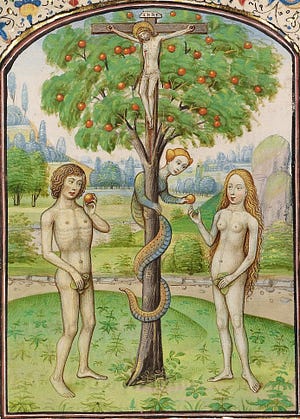
Meditation on the Tree of Knowledge


 From Justi Andreasen at Reclaiming the Biblical Worldview:

What if the fruit in Eden was never meant to remain untouched, and the transgression lay in the manner of its taking?

Most readers approach Genesis 3 as a simple account of disobedience. The command is given, the boundary is crossed, and the punishment follows. Yet this familiar reading leaves one question largely unexplored: What was the Tree of the Knowledge of Good and Evil for? In other words, why would a good God place a forbidden tree in Paradise?

St. Ephrem the Syrian offers a different vision. He describes the Tree as a veil, a living boundary akin to the curtain separating the Holy Place from the Holy of Holies. Its presence did not signal permanent exclusion. It marked a space into which one must be worthy to step. Adam and Eve were not barred forever. They were being formed for a gift.

“He planted the Tree of Knowledge, endowing it with awe, hedging it in with dread, so that it might straight way serve as a boundary to the inner region of Paradise.” -St. Ephrem, Hymn III, 3

A boundary implies not absolute prohibition but ordered approach. The Temple clarifies the pattern. The veil did not exist to enforce distance but to protect what was holy until the priest was ready to enter. Entry required preparation. When King Uzziah (a ruler who unlawfully entered the Temple to perform priestly rites reserved for consecrated priests) forced his way past the boundary, his presumption disfigured him. The Tree functioned in the same way. It stood as a threshold within creation, a sign that maturity unfolds in time. The fruit was to be received when the creature had grown into obedience.

This holds true in ordinary situations as well. Consider claiming a driver’s license without undergoing formation. You would place yourself and others at risk, because you would be exercising responsibility without the formation required to carry it safely. Or consider falsifying your CV to obtain a high position. The title might come quickly, but the strain would follow just as quickly. You would find yourself overwhelmed, and the team around you would feel the instability of leadership that has not been earned. Had the role been the fruit of your labour, had you been promoted through recognition of real competence, the weight of it would rest on something solid, and the order of the group would hold. (Read more.)

Share

Thursday, June 25, 2026

The Red Cap of Hermetics

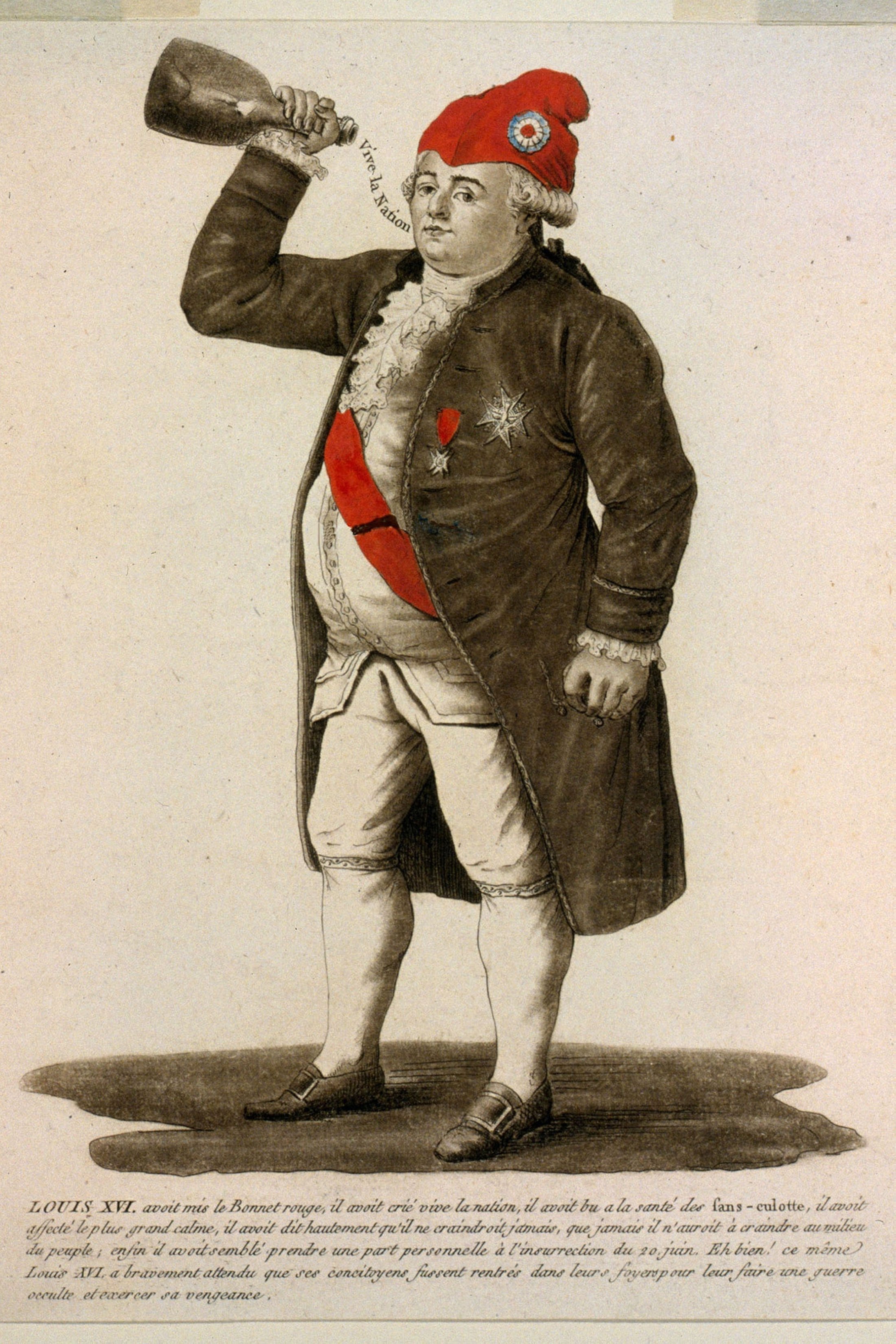
Louis XVI was mocked with the "Red Cap of Liberty" which was recently displayed at the Paris Olympics. From Daily Sabah:

In the aftermath of the French Revolution, Louis XVI, the last king of France, was depicted in many paintings with a "Bonnet Rouge" (Red Cap) on his head. However, what is the story of this red cap with its long apex bent over to the front, and why was it placed the head of the French constitutional monarch before he was executed?

[...]

In ancient Rome, freed slaves were dressed in a white cap called a pileus. Brutus, who betrayed Caesar, chose this cap, which symbolizes freedom, as an expression of Rome's return to the republic, and engraved it on the coin he minted. But this fez, which looks like the white cap worn by Albanians today, actually had nothing to do with the red Phrygian cap.

With the American Revolution, the pileus became an omen of revolutionaries, anarchists, and republicans. It resurfaced with the protests against the Stamp Act of 1765 when Britain imposed a direct stamped paper tax on the British colonies in America.

In particular, a figure of British parliamentarian John Wilkes – nicknamed the "Devil," and known for his support of the American rebels – with this cap became very popular among the rebels known as the "Sons of Liberty."

French anarchists, who inherited this symbol from the American Revolution, preferred the Phrygian cap instead of the pileus. Thus, this red hermetic cap became the symbol of the French revolutionaries and freedom from 1789 onwards. For example, in a sculpture made by French artist Joseph Chinard in 1794, representing the revolution and the republic, a Phrygian cap was placed on the head of a woman in Roman attire. (Read more.)

Share

Monday, June 22, 2026

The Storming of the Tuileries, June 1792

Louis XVI dons the Bonnet Rouge

Madame Royale describes the storming of the Tuileries palace on June 20, 1792 and how her family escaped death:

On the 20th of June, about eleven o'clock in the morning, nearly all the inhabitants of the faubourgs Saint-Antoine and Saint-Marceau, where the populace chiefly lived, marched in a body to the National Assembly, to go from there to the garden and plant the liberty-tree. But as they were all armed, which gave reason to suspect bad intentions, my father ordered the gates of the Tuileries to be closed. The Assembly showed great dissatisfaction, and sent a deputation of four municipals to induce the king to order the gates to be opened. These deputies spoke very insolently; said they exacted the opening of the gates in order that those who had come to plant the tree, the sign of liberty, might return that way, inasmuch as the crowd in the rue Saint-Honoré was too great to allow them to pass. My father, however, persisted in his refusal, and they then went and opened themselves the gates of the garden, which was instantly inundated by the populace; the gates of the courtyards and the château still remained locked. 

An hour later this armed procession began to defile before our windows, and no idea can be formed of the insults they said to us. Among others, they carried a banner on which were these words: 
"Tremble, tyrant; the people have risen;" and they held it before the windows of my father who, though he was not visible himself, could see all and hear their cries of "Down with Veto!" and other horrors. This lasted until three o'clock, when the garden was at last freed. The crowd then passed through the Place du Carrousel to the courtyards of the Tuileries, but quietly, and it was generally thought they were returning to their faubourgs. 

During this time our family were in the rooms on the courtyard side, absolutely alone and observing all that went on; the gentlemen of the suite and the ladies dined on the other side. Suddenly we saw the populace forcing the gates of the courtyard and rushing to the staircase of the château. It was a horrible sight to see, and impossible to describe–that of these people, with fury in their faces, armed with pikes and sabres, and pell-mell with them women half unclothed, resembling Furies. 

Two of the ushers wishing to run the bolts of my father's door, he prevented it and sprang himself into the next room to meet the rioters. My aunt followed him hastily, and hardly had she passed when the door was locked. My mother and I ran after her in vain; we could not pass, and at that moment several persons came to us, and finally, the guard. My mother cried out: "Save my son!" Immediately some one took him in his arms and carried him off. My mother and I, being determined to follow my brother, did all we could against the persons who prevented us from passing; prayers, efforts, all were useless, and we had to remain in our room in mortal anxiety. My mother kept her courage, but it almost abandoned her when, at last, entering my brother's room she could not find him. The persons who, on her own order, had carried him away lost their heads, and in the confusion, took him up higher in the château, where they thought him in greater safety. My mother then sent for him and had him brought back to his room. There we awaited, in the silence of profound anxiety, for news of what had happened to my father. 

Returning to him, I must resume at the moment when he passed through the door which was then locked against us. As soon as he thought the danger passed the king dismissed his suite, so that no one was with him but my Aunt Élisabeth, [Maréchal de Mouchy (who in spite of his 77 years and my father's order persisted in remaining), two old ushers, the brave Acloque, commander of the division of the National Guard, an example of fidelity in the uniform of rebellion], 1 and M. d'Hervilly, lieutenant-colonel of the new King's-Guard, who, seeing the danger, ran to call the Guard and collected about twenty grenadiers, but on reaching the staircase he found only six had followed; the others had abandoned him. My father was therefore almost alone when the door was forced in by one sapeur, axe in hand raised to strike him, but [here] by his coolness and imperturbable courage my father so awed the assassin that the weapon fell from his hand,–an event almost incomprehensible. It is said that some one cried out: "Unhappy man, what are you about to do?" and that those words petrified him; for my part I think that what restrained that wretch was Divine Providence and the ascendancy that virtue always maintains over crime. 

The blow having thus failed, the other accomplices, seeing that their leader had let himself be cowed, dared not execute their evil designs. Of all this mass of the populace, there were certainly very few who knew precisely what they were expected to do. To each had been given twenty sous and a musket; they were sent in drunk with orders to insult us in every imaginable way. Their leader, Santerre, had brought them as far as the courtyard, and there he awaited the success of his enterprise. He was desperate on learning that his stroke had missed, and he came near being killed himself by a man in the château, who aimed for him, and was prevented from shooting only by remonstrances as to the danger to which he exposed my father; for if Santerre were sacrificed the brigands would surely avenge him. 

My father was nevertheless obliged to allow all these wretches to go through the rooms of the château, and, standing himself in a window with my aunt, he watched them pass before him and heard the insults with which they overwhelmed him. It was on this horrible day that my father and my aunt each made a memorable speech. At the moment of the greatest danger a soldier came up to the king and said to him, "Sire, fear nothing." My father took his hand and laid it on his own heart. "Does it beat hard, grenadier?" he said. Shortly before, my Aunt Élisabeth, being mistaken for the queen, saw herself exposed to the utmost fury of the brigands; some one near was about to make her known. "Do not undeceive them," cried my aunt with sublime devotion. 

This dreadful situation lasted from half-past three in the afternoon till eight at night. Pétion, mayor of Paris, arrived, pretending to be much astonished on hearing of the danger the king had run. In haranguing the people he had the impudence to say: "Return to your homes with the same dignity with which you came." The Assembly, seeing that the stroke had missed, changed its tone, pretended to have been ignorant of everything, and sent deputation after deputation to the king expressing the grief it feigned to feel for his danger. 

Meantime my mother, who, as I said, could not rejoin the king, and was in her apartment with my brother and me, was a long time without hearing any news. At last, the minister of war came to tell her that my father was well; he urged her to leave the room where we then were, as it was not safe, and we therefore went into the king's little bed-chamber. We were scarcely there before the rioters entered the apartment we had just left. The room in which we now were had three doors: one by which we had entered, another opening upon a private staircase, a third communicating with the Council Chamber. They were all three locked, but the first two were attacked, one by the wretches who were pursuing us, the other by men who came up the little staircase, where we heard their shouts and the blows of their axes. 

In this close danger my mother was perfectly calm; she placed my brother behind every one and near the door of the Council Chamber, which was still safe, then she placed herself at the head of us all. Soon we heard some one at the door of the Council Chamber begging to enter. It was one of my brother's servants, pale as death, who said only these few words: "Madame, escape! the villains are following me." At the same instant, the other doors were forced in. In this crisis my mother hastily ordered the third door opened and passed into the Council Chamber, where there were, already, a number of the National Guard and a crowd of wretches. 

My mother said to the soldiers that she came to take refuge with her son among them. The soldiers instantly surrounded us; a large table standing in the middle of the Chamber, served my mother to lean upon, my brother was seated on it, and the brigands defiled past it to look at us. We were separated from my father by only two rooms, and yet it was impossible to join him, so great was the crowd. We were therefore obliged to stay there and listen to all the insults that these wretches said to us as they passed. A half clothed woman dared to come to the table with a bonnet rouge in her hand and my mother was forced to let her [Page 236] place it on her son's head; as for us, we were obliged to put cockades on our heads. It was, as I have said, about eight o'clock when this dreadful procession of rioters ceased to pass and we were able to rejoin my father and aunt. No one can imagine our feelings at that reunion; they were such that even the deputies from the Assembly were touched. My brother was overcome with fatigue and they put him to bed. We stayed together for a time, the room being full of deputies. An hour later they went away, and about eleven o'clock, after having passed a most terrible day, we separated to get some rest . . . . 

The next day Pétion came again to play the hypocrite, saying he had heard of more assemblings of the people and he had hastened to defend the king. My father ordered him to be silent; but as he still tried to protest his attachment, my father said: "Be silent, monsieur; I know your thoughts." (Read more.)
 
Marie-Antoinette, her children, and Madame de Tourzel face the mob   
 
Louis XVI was mocked with the "Red Cap of Liberty" which was displayed at the Paris Olympics. From Daily Sabah:

In the aftermath of the French Revolution, Louis XVI, the last king of France, was depicted in many paintings with a "Bonnet Rouge" (Red Cap) on his head. However, what is the story of this red cap with its long apex bent over to the front, and why was it placed the head of the French constitutional monarch before he was executed?

[...]

In ancient Rome, freed slaves were dressed in a white cap called a pileus. Brutus, who betrayed Caesar, chose this cap, which symbolizes freedom, as an expression of Rome's return to the republic, and engraved it on the coin he minted. But this fez, which looks like the white cap worn by Albanians today, actually had nothing to do with the red Phrygian cap.

With the American Revolution, the pileus became an omen of revolutionaries, anarchists, and republicans. It resurfaced with the protests against the Stamp Act of 1765 when Britain imposed a direct stamped paper tax on the British colonies in America.

In particular, a figure of British parliamentarian John Wilkes – nicknamed the "Devil," and known for his support of the American rebels – with this cap became very popular among the rebels known as the "Sons of Liberty."

French anarchists, who inherited this symbol from the American Revolution, preferred the Phrygian cap instead of the pileus. Thus, this red hermetic cap became the symbol of the French revolutionaries and freedom from 1789 onwards. For example, in a sculpture made by French artist Joseph Chinard in 1794, representing the revolution and the republic, a Phrygian cap was placed on the head of a woman in Roman attire. (Read more.)


Share

Friday, June 19, 2026

Scandal ‘Million Times Worse Than Epstein’ Explodes

 From the Daily BS:

For years, Britain’s political and bureaucratic elite insisted critics were exaggerating, stereotyping, or simply stirring up trouble. Now, thanks to a bombshell citizen-funded investigation and a megaphone provided by Elon Musk, one of the darkest scandals in modern British history is back in the spotlight — and the questions are getting harder to ignore.

Musk lit the fuse this week when he blasted Britain’s handling of the grooming-gang scandal and called for consequences not just for the predators, but for the officials who allegedly stood by while vulnerable girls were abused.

“The politicians who turned a blind eye to the Rape of Britain must go to prison,” Musk wrote on X after the release of a sprawling independent report commissioned by Member of Parliament Rupert Lowe. (Read more.)


Share

Wednesday, June 17, 2026

The Karmelo Anthony Trial

 From Culturcidal:

Today, the Karmelo Anthony case is still in the news, and even before the trial, you wouldn’t have thought that it would be a particularly controversial case. Post-trial, where Anthony got 35 years in jail, we have an even fuller picture of what happened.

There was a track meet. Anthony went to another team’s tent, which he almost certainly knew he wasn’t supposed to do. He was asked to leave something like 12-15 times, nicely at first, but more insistently when he refused and became belligerent. Anthony began trying to goad Austin Metcalf into a fight. He dared him to touch him. He called the people in the tent “p*ssies” who couldn’t make him move. He challenged Metcalf to a fistfight, which Metcalf responded to by saying, I’m not going to fight at a track meet.” Eventually, Anthony baited Metcalf into shoving him and immediately stabbed him, which killed him.

In other words, Anthony was somewhere he wasn’t supposed to be, he was asked many times to leave, and instead of doing so, he tried to start a fistfight, and then, when he finally got a reaction, he immediately responded with lethal force.

It all seems very clear-cut, right? Yet, what have we seen in this case?

Karmelo Anthony’s family raised 630k in a GiveSendGo (that was happily pulled after his murder conviction in accordance with their rules). Setting aside the fact that a large number of black Americans pretty clearly chipped in money just because Karmelo Anthony murdered a white guy, what happened to those funds is still a bit of a mystery. Anthony’s family has been staying in a 900k home in a gated community (this was apparently rented), and he had a public defender. (Read more.)

Share

Tuesday, June 9, 2026

Republicans Supported Gay Marriage ‘Rights’ Until They Saw It Destroy Children’s Rights

 From The Federalist:

The reason is simple: Republicans were told that supporting same-sex marriage meant supporting their gay brother, daughter, coworker, or friend. They were told that opposing it meant they hated gay people, and many bought it. If supporting same-sex marriage was simply the price of treating loved ones with dignity and respect, they were willing to pay it.

What they were not told was that same-sex marriage would victimize kids. No sooner had gay marriage been achieved on the grounds that marriage had nothing to do with children than activists, judges, and lawmakers turned around and demanded parenthood too.

Republicans have no interest in persecuting their gay friends and family members. What they reject is the claim that adult equality requires making children lose their mother or father. And after a decade of watching the consequences unfold, it has become obvious that “equal marriage” was never just about adult “rights.” It was about parenthood and children. (Read more.)


Share

Friday, June 5, 2026

A White Teenager Died in the Streets Crying 'I Can't Breathe'

 From Man of Steele:

Yesterday I published my own piece on Henry Nowak, arguing that white guilt has created a racial double standard in Western justice. Daily Mail then asked me to write about the case for a UK audience, and I took the opportunity. The tragedy here for me is that if race had never been woven into policing practices as a form of social justice, we almost certainly would not be in this position. Instead, years of “anti-racism” training and race‑action plans have raised a deeper question: why would anyone want a society in which race shapes how individuals are treated, especially when it is the state doing the treating? The police officers should have listened to Henry, treated him as the individual he was, and used those critical moments to try to save him, not to handcuff him.

Share

Wednesday, June 3, 2026

Is The Democratic Party Too Obsessive About Abortion?

 From Creative Destruction Media:

Over a century ago, Margaret Sanger founded Planned Parenthood, openly stating then that the goals were to “reduce the birth rates of black and brown babies as well as defectives.” Those goals were erased from the organization’s history long ago, but that was the original intent. For decades, abortion was under the jurisdiction of state laws, until it wasn’t.

In the early 1970’s, a case (Roe v Wade) came before the Supreme Court regarding the right of a woman to have an abortion. The court found that a woman had a right to privacy under the Due Process Clause of the 14th amendment, up until fetus viability. The ruling overturned state laws governing abortion and nationalized the issue. The ruling supercharged Planned Parenthood and other resources as abortion services greatly expanded across the country.

In 2022, the Supreme Court issued the Dobbs v Jackson opinion, concluding that the US Constitution does not confer a right to abortion. The ruling found that state governments had the authority to regulate any aspect of abortion not preempted by federal law, as “direct control of medical practice in the states is beyond the power of the federal government.” In effect, the Supreme Court found it had no jurisdiction on the matter of abortion. (Read more.)


Share

Saturday, May 30, 2026

Britain Mourned George Floyd. Why Won't It Mourn Henry Nowak?

 From Amuse on X:

Begin, then, with the deaths a nation could not stop talking about. When George Floyd died under a Minneapolis officer’s knee in May 2020, Britain responded as though the killing had happened in Bristol rather than 4,000 miles away. The Guardian’s own survey of that summer found demonstrations in more than 260 British towns and cities, from Shetland to south Wales, with crowds of 15,000 in Manchester and well over 210,000 marchers nationwide by mid June. The future Prime Minister knelt for the cameras. This is worth dwelling on, because it proves something the British establishment now seems eager to deny about itself. It is fully capable of treating a police death on another continent as a domestic moral emergency. The machinery exists. The will exists. The question is only when it switches on.

Now set against that the case of Henry Nowak. Last December, Nowak, an 18-year-old finance student at the University of Southampton, walked home from an evening out with his football teammates and was stabbed five times by Vickrum Digwa with a 8.5 inch blade, one wound piercing his heart. When officers arrived, Digwa told them what prosecutors would later call a wicked lie, that he was the victim of a racist attack. The gravely wounded teenager told police he had been stabbed. They handcuffed him anyway. They arrested the dying boy on the word of the man who had killed him, and only when Nowak collapsed did they remove the cuffs and begin first aid. He died at the scene. This week a Southampton jury convicted Digwa of murder, rejecting his claims of self defence and racial provocation, and convicted his mother of assisting an offender for hiding the weapon. Hampshire’s Deputy Chief Constable apologized that Henry was handcuffed and arrested in the moments before he lost consciousness, the Independent Office for Police Conduct opened an investigation, and his reported final words, according to trial reporting and the shadow home secretary, were the three that a nation had treated as sacred only six years earlier: I can’t breathe.

Let me anticipate the first and fairest objection, because the strength of this argument depends on conceding it. The two deaths are not medically identical, and no honest observer should pretend otherwise. Floyd was wasn’t killed by the police but from a fatal overdose of fentanyl according the coroner’s report. Nowak was murdered by a private criminal, and Hampshire Police have cited a pathologist’s view that the depth of the chest wound meant officers could not have saved him even had they believed every word he said. If the claim here were that the police killed Henry Nowak in the way Democrats claimed an officer killed George Floyd, that claim would be false. But that was never the comparison worth making. The variable under examination is not the cause of death. It is the response of a society to a death, and on that variable the two cases are almost laboratory clean. (Read more.)

Share

Sunday, May 10, 2026

‘Full of Grace’

 From Mark Judge at Chronicles:

Open up the May issue of Washingtonian magazine, and you find a hagiographic article about Sarah McBride. McBride is the 35-year-old transgender representative from the state of Delaware, who went under the name Timothy Ryan McBride for the first 21 years of “her” life. The title of the Washingtonian profile is “Sarah, Full of Grace.”

The Washingtonian photographed McBride at the top of a lavish stairwell, a golden yellow lamp producing a saintly nimbus. The article summary reads:

The nation’s first openly trans congresswoman, Sarah McBride, believes in kindness, tolerance, and reaching across the aisle. But in the face of vilification from the right—and some disappointment from the left—her faith his being tested.

In other words, the Washingtonian is comparing a person suffering from gender dysphoria, a man who insists on dressing like a woman and using women’s private spaces like bathrooms and showers, to the Blessed Virgin Mary. 

Actually, they may be comparing McBride to Joan of Arc. Writer Sylvie McNamara describes how two weeks after being elected in 2024, McBride discovered that Republicans on Capitol Hill had passed a rule restricting bathroom use in the Capitol to those whose sex at birth matched the restroom they use. McBride complied with the rule, angering left-wing activists. “I think the thing I am proudest of is that in the face of a very concerted effort to try and derail me and turn me into a caricature, I have remained disciplined and focused and try to fight for a politics of grace.”

This is the second time in 2026 that McNamara has written about McBride for the Washingtonian. In January, she got together with McBride to watch Queer Eye for the Straight Guy. “A freshman Democrat from Delaware—and the first out-trans member of Congress—she’s long been a proponent of ‘a politics of grace,’” McNamara then wrote of McBride, “of meeting differences with kindness and curiosity and giving people space to grow.” Then McBride said Republican leader Mike Johnson should be featured on Queer Eye.

The McBride canonization in Washingtonian is noteworthy because it reminds people that the media is not only out to lie, but to wage a spiritual war—and one that promotes evil. Sure, some people, even conservatives, might say, McBride and the bathroom issue are important, but the controversy doesn’t reach the level of, say, the war in Iran.

In fact, it does. As I once explained in an essay about the film The Exorcist, even more than geopolitical conflicts, human sexuality is a target for demonic exploitation. The point of the demonic in The Exorcist was not to levitate bodies or vomit on priests; it was to convince human beings that they are nothing but base, animalistic creatures unworthy of God’s love. To convince us of this, the demon in the film attacks people in vulgar, sexual terms, even to the point raping the victim, a young girl named Regan. The demon makes God’s beautiful design ugly, disfiguring the face of a beautiful young girl. The devil cannot create; it can only imitate and destroy. (Read more.)

Share

Saturday, May 9, 2026

The Left’s History of Violence

 From Mark Judge at Splice Today:

Journalist Noah Rothman has a new book out. Blood and Progress: A Century of Left-Wing Violence in America charts the long and often untold history of the Left’s political violence in America. The book is especially timely in light of the recent, and third, assassination attempt on President Trump, and the mental derangement of the Democrats.

According to Rothman, “It is necessary to bring a gratuitous amount of evidence to bear in support of the observable fact that the American left—too often, fringe and mainstream alike—either refuse to confront or are disconcertingly comfortable with a certain level of domestic political violence. Indeed, its members will heartily protest the allegation that there is a rising tide of left-wing violence to speak of. They are inclined to ignore it, excuse it, explain it away, or marshal their own evidence in support of their belief that the American right is the font from which all political violence springs.”

Blood and Progress reminds readers that in 1995, community activist Barack Obama launched his first run for the Illinois state Senate at the house of Bill Ayers and his wife, Bernadine Dohrn. In 1970 Ayers and Dohrn were indicted for inciting a riot and conspiracy to bomb government buildings. Dohrn was convicted and Ayers wasn’t. Ayers told The New York Times in 2001, “I don’t regret setting bombs. I feel we didn’t do enough.” Ayers and his fellow terrorists bombed the Pentagon as part of his anti-war activities. As journalist Bernie Quigley once put it, “Maybe we should begin to ask ourselves where we are going in our world today when a right-wing terrorist, resolute in his conviction to the very last, like Ayers, gets a quick and short ride to the death chamber and a shallow and forgotten grave, while bombers from the ’60s get tantalizing offers from Harvard, $100 million grants from Ambassador Walter Annenberg and dinner with [celebrity academic professors].”

I wish that Rothman had spent more time on Obama’s mentor, the card-carrying Communist Frank Marshall Davis—or “Old Frank” as Obama called him. There’s also nothing about Hasan Piker, the left’s new Marxist darling. A mix of Lenin, Paul Bunyan and Torquemada, Piker posed in a recent photograph on a train with a copy of What Is To Be Done? by Lenin. As Sam Tanenhaus notes in his biography of Whittaker Chambers, would-be revolutionaries often tout Lenin’s work while ignoring the violence in those same pages.

Lenin’s The Soviets at Work is a book that, as Tanenhaus notes, “is written in a prose of almost unrelieved brutality, a combination of insults (“Let the poodles of bourgeois society scream and bark”) and threats (“everyone who violates the labor discipline in any enterprise and in any business… should be discovered, tried and punished without mercy”).” Lenin’s analogies “are drawn almost exclusively from the battlefield” and “he is thrilled by the spectacle of violence. His favorite adjective is ‘merciless.’ Nor does Lenin conceal the authoritarian character of the government he is assembling. Democracy in the new world can be achieved, he explains, only ‘by subjecting the will of thousands to the will of one.’” (Read more.)


Share

Sunday, May 3, 2026

Raymond Ibrahim's Trilogy

undefined
Baucent of the Templars


 "Not to us, O Lord, not to us; but to thy name give glory." Psalm 113 (Vulgate), motto of the Templars

Once in a discussion with a fellow historical novelist I was informed that the crusades are the earliest examples of genocide. I was surprised that the novelist, being Jewish, seemed unaware of the various ancient persecutions against her own people, including that of the Greeks in the days of the Maccabees, that might be considered genocidal. I reminded her of that, as well as of the fact that there were twelve major crusades, taking place over nearly three hundred years. They were led by different people, with the principle goal of liberating the Holy Land from Muslim rule and thus delivering the Christian population from slavery and oppression. Some were more successful than others. Some, like the Fourth Crusade, were total disasters. In fact, the Fourth Crusade is the one which most people think of when they view the crusades as orgies of mass murder. In that case, those being killed were other Christians. Did other massacres of the innocent occur during the course of the various crusades? Yes. So, did the crusaders journey hundreds of miles to the Middle East, braving fatal diseases, pirates, brigands and an ocean of foes, just for the joy of killing people? That is one of the questions answered by Raymond Ibrahim in his brilliant trilogy about the centuries-long conflict between Christianity and Islam. Ibrahim's books are The Sword and the Scimitar, Defenders of the West, and The Two Swords of Christ. The books present a background to the crusades, containing detailed information of which most contemporary people are unaware, as well as the histories of heroes like El Cid and the rise of the two greatest military orders, the Templars and the Hospitallers.

In the early Church the practice of Christians was, even in the era of persecution, to visit the places where Jesus Christ had been born, lived, died and risen. Pilgrimages were regarded as highly penitential, in which the pilgrim would not only risk life and health, but leave behind property, home, family, occupation and offices. The Romans built pagan shrines over the venerable spots like the stable at Bethlehem and the Holy Sepulcher but those temples only served to remind everyone where the sacred sites were hidden. When Emperor Constantine legalized Christianity in the Fourth Century, his mother Empress St. Helena went on pilgrimage to the Holy Land, where she discovered not only the True Cross, but found and reopened many of the other places sacred to the memory of the Savior. This ignited centuries of pilgrimage to the Middle East. Rich and poor would go, often in parish-sponsored groups as now. Special costumes were worn when on pilgrimage, and one was often regarded as being temporarily in religious life when journeying to a holy site. For Jerusalem was not the only destination; there were shrines throughout Europe, including Rome and Compostela. But the pilgrimage to the Holy Land remained the ultimate of penitential practices, with many indulgences attached. People would go for themselves and for loved ones who were sick or who had died.

All this changed with the rise of Islam in the 7th century, meticulously described by Ibrahim in his book Sword and Scimitar. Founded by Mohammed, an Arabian who claimed to be a prophet of the One True God, Islam combined elements of Nestorian Christianity and Judaism with the prophet's own inspirations, many of which included teachings abhorrent to Judeo-Christian morality. One such teaching permits Muslim men to take a non-Muslim "infidel" woman by force. Mohammed commanded his followers to spread Islam by warfare. Within 200 years, the Christian lands in North Africa, Spain, Arabia, and the Middle East were conquered. Great Christian cities like Antioch and Alexandria, which had been Apostolic sees, fell to Islam, with the churches and basilicas becoming mosques. Christians, especially children, young men and young women, were made into sex slaves and concubines, including monks and nuns. Many boys were castrated to be eunuchs in the harems of the various Muslim elites. Hatred in the form of desecration was lavished upon Christian shrines, churches, monasteries, and cathedrals, with special contempt reserved for icons, church bells and crosses. The latter were dragged upside down through the streets, to be spat and urinated upon by the disciples of the prophet. Altars were sometimes desecrated by the gang-rape a Christian virgin. Those Christians and Jews who were not killed or sold were subject to oppressive laws and taxes in their own lands. This is documented in Muslim sources which repeatedly rejoice when describing the oppression of "infidels" and especially the defilement of Christian women.

A war-like, nomadic people called the Turks embraced Islam; they eventually overran the old Roman province of Anatolia so it became "Turkey." In the late 11th century, Jerusalem, which had fallen into Muslim hands before, was captured by the Seljuk Turks, who tortured, raped, and sold into slavery the Christians of the region. Those who were killed were regarded as lucky. The violence disrupted the flow of pilgrimages from Europe to the Holy Land. The Muslims made a point of harassing and robbing pilgrims, sometimes capturing them to be sold into slavery. Blond and red-haired girls and boys with blue, gray or green eyes were especially favored for the slave markets. Although one beautiful abbess from Germany, traveling with a group of pilgrims to Jerusalem, was waylaid by Muslim bandits and raped to death in front of her fellow Christians, who were also mistreated in various horrific ways. This led Pope Urban II at the Council of Clermont in 1095 to call for a crusade of Christian soldiers to deliver the Christians in the Holy Land. Thus began the era of the crusades. Defenders of the West describes some of the great heroes of Christendom who kept Islam out of Europe, including at least one from Albania whom I had never heard of before. My opinion of Richard I "Lionheart" had suffered in the past but in Defenders he is revealed as among the bravest of the brave. The Two Swords of Christ traces the history of the two great military orders in a deeply inspiring way. For when the weak and innocent are attacked, it is unquestionably the duty of Christians who are able to defend them.

From The Chivalry Guild:

If I had to pick the best way to describe the recent works of Raymond Ibrahim—Sword and Scimitar (2018) and Defenders of the West (2022)—I’d call them no-going-back books. The equally chilling and invigorating experience of his histories cannot be undone and you cannot see the world the same way afterwards—especially since it’s not just history, but a forgotten prelude to what we’re living with today. Reality looks different post-Ibrahim.

Sword and Scimitar takes the reader through fourteen centuries of warfare between Islam and the West, with emphasis on eight great battles within that conflict. Better than any book I know, it dynamites the old public school narrative about the Crusades as a brutal act of Christian aggression against those poor, peaceful, tolerant Muslims. Ibrahim tells a much darker story about our ancient adversaries, documenting the scale of their conquests and the horrors that followed pretty much everywhere the armies of the prophet went. What we call “the West,” he writes, is but “the last and most redoubtable bastion of Christendom not to be conquered by Islam. Simply put, the West is actually the westernmost remnant of what was a much more extensive civilizational block that Islam permanently severed.” Three-quarters of the formerly Christian world was conquered by these people. It is both chilling and invigorating, like I noted, to think about how much danger we were in—and what kind of virtue was required to meet that danger and triumph over it, at least for a time.

Defenders of the West is an even more important book. It’s personal and compelling, and it reverses a long trend of hiding Christian heroes from those of us who need to learn about them. Thanks to Enlightenment propagandists, a vague narrative persists that heroism basically died out after the assassination of Julius Caesar and wasn’t revived again until Napoleon and George Washington walked the earth. The intent is a broadside against the Faith, leaving you with the vague impression that the teachings of Christ and his Church effectively snuff out all martial virtue, as though heroics cannot co-exist with the Gospel. Ibrahim shows this to be absolute nonsense. With his chronicles of Godfrey of Bouillon, El Cid, Richard the Lionheart, Fernando III, Louis IX, John Hunyadi, Scanderbeg, and Vlad Dracula, he brings to life eight legends whose deeds rival or exceed those of any heroes of any age.

These works are, in my humble opinion, on the shortlist for books of the century. So it was with special interest that I anticipated his follow-up effort. The Two Swords of Christ (published November ’25) continues with his major theme but looks at a different aspect of the conflict: the crucial work done by the Templars and the Hospitallers, basically the special forces of Christendom.

Ibrahim’s title comes from Luke 22, in which Jesus tells his disciples to buy a sword. When they reply, “Look, there are two swords here,” Jesus says, “It is enough!” What’s fascinating is his use of the singular pronoun it rather than the plural they. It suggests not the swords, but a way of life that employs “a spiritual sword against spiritual enemies, and a physical sword against physical enemies.” If your religious education was anything like mine, your teachers blithely passed over this and similar passages in favor of all the nicer-sounding directives about loving everybody and just being nice, along with never fighting—because fighting is unchristian. For those looking for simplistic formulas for life, it’s far easier to reduce the character of the Lord to that of a harmless meditation instructor, rather than wrestling with the much more challenging and dynamic truth.

The two swords also work as a metonymy for the knightly orders, filled with men whose particular way of serving God and their neighbors was with weapons. (Read more.)

  All three books are so detailed in citing source material that one comes away with a refreshed world-view, for a deeper understanding of history leads to a more profound comprehension of the present. Plus Raymond Ibrahim is an engaging and descriptive writer so that I often felt I was watching a film of the events he has so richly described. I recommend this excellent trilogy for every home library and every college history class.

Share

Saturday, April 25, 2026

The Hardest Truth about Islam and Christianity

People often cite the fact that the Koran mentions the Virgin Mary with reverence, a fact which never stopped a single Muslim from kidnapping and enslaving millions of Christian women and girls in harems for over a thousand years. And the rape of "infidel" women is not seen as a sin from the Islamic point of view. From Patrick Novecosky:

Relations between the papacy and Islam stretch back more than 1,300 years to the era of Pope Donus in the 7th century, when the rapid expansion of Islam transformed the Christian world. What followed was not primarily dialogue, but conflict. Muslim armies swept through formerly Christian lands in North Africa and the Middle East. Europe responded with the Crusades. Constantinople fell. Naval battles like Lepanto became defining moments of civilizational struggle. For much of history, Christianity and Islam encountered each other not in shared spaces of worship, but on opposing sides of war.

That history does not dictate the future, but ignoring it doesn’t lend clarity to the present.

The Catholic Church’s modern approach to Islam largely dates to the Second Vatican Council in the 1960s. Its declaration, Nostra Aetate, marked a turning point, stating that the Church “has a high regard for the Muslims,” who worship the one, merciful God. It called for both sides to move beyond past hostilities and work together for justice and peace.

The Catechism of the Catholic Church builds on that framework. It teaches that Muslims, “together with us, adore the one, merciful God” and are included in God’s plan of salvation. That’s pretty remarkable language, especially when viewed against centuries of conflict. They reflect the Vatican’s deliberate effort to emphasize common ground and reduce religious hostility.

But they do not erase fundamental differences.

Islam rejects the Christian understanding of God as Trinity, denies the divinity of Jesus, and does not accept the central claim of salvation through the cross and resurrection. These are not minor disagreements. They go to the heart of what each religion believes about God and humanity’s relationship to Him. Any serious discussion of Christian-Muslim relations must grapple with that reality. (Read more.)

Share

Monday, April 20, 2026

That Vulgar Necklace

 Marie-Antoinette was the victim of the entire debacle. From Country Life:

The story begins in 1772, when Louis XV commissioned an enormous diamond necklace for his maîtresse-en-titre, Madame du Barry. For 200,000,000 livres (about £12 million today), the royal jewellers Boehmer and Bassenge were to create a rivière consisting of 647 flawless, perfectly matched diamonds; a necklace so heavy that it would have to have diamond streamers down the back to prevent the wearer from toppling forward.

In 1774, Louis XV died. Undeterred, Boehmer and Bassenge completed the necklace and, in 1778, just after war had been declared on Britain, offered it to Louis XVI and Marie Antoinette. For whatever reason — Thomas Carlyle quotes the queen as saying ‘We have more need of seventy-fours [ships] than necklaces’ — she refused it.

For the next two years, Boehmer and Bassenge hawked the necklace around the royal courts of Europe without success. In 1781, following the birth of the dauphin, they again tried to sell it to Louis XVI — and again were rebuffed. This was the year in which Jeanne de Valois-Saint-Rémy, an impoverished and unscrupulous young woman, began to insinuate herself into royal circles by pretending to be one of Marie Antoinette’s closest confidantes. In 1783, she achieved her greatest social success when she was taken up by Cardinal de Rohan — nearly twice her age, extremely wealthy and, frankly, not that bright.

De Rohan had lost all chance of preferment, having publicly insulted Marie Antoinette’s mother. He yearned to be accepted back at court and de Valois offered to carry a letter of apology to the Queen. The forged response de Valois brought back was, unsurprisingly, encouraging. Further forged letters convinced de Rohan that the Queen was in love with him and that he should give money to de Valois, which he did. Her problem now was that the cardinal kept pressing for a meeting with sa Majesté. How relieved de Valois must have been when she encountered a prostitute, Marie Nicole Leguay d’Oliva, who bore an uncanny resemblance to the Queen and was willing, for a fee, to take part in a practical joke. (Read more.)

Share