Showing posts with label The Holy Father. Show all posts

Sunday, August 23, 2026

The Modesty Fallacy

 Worrying about female modesty has become an obsession among many Christians. Yes, there is more flesh exposed than there was in past times. But there is such cult-like behavior in many Catholic circles, including homeschooling groups, that has nothing to do with Church teaching nor with Sacred Scripture. I knew one group of young mothers where no one could wear cologne. Another group is saying you cannot take Catholic children to the beach because of what they might see. People make up their own rules that have nothing to do with tradition but with their own irks and quirks. They are the new Puritans. And as a historian I can tell you that standards of modesty among Catholics have changed and fluctuated a great deal for 2000+ years. I will  never forget the reaction of a devout lady when she was shown the original edition of my novel Trianon with the beautiful LeBrun portrait of Marie-Antoinette and her children on the cover. "She's wearing a low-cut dress!" was the exclamation. As for immodesty being connected to rape, Muslim women are raped even when they are covered from head to toe. And what about all the nuns raped by Communists? And I have lamented about all the young Catholic women making themselves deliberately unattractive in ugly, shapeless clothes as a badge of piety.

Lindsay T. has an interesting series of articles on her substack.

The virtue of modesty is defined in the Catechism as “a virtue of the heart” which “guides how one looks at others and behaves toward them in conformity with the dignity of persons”.[7] How men and women dress is important, but judgement of one’s degree of modesty is not the responsibility of the on-looker. In fact, the on-looker should employ modesty in how he looks and behaves towards the other person.

Pope John Paul II, in his book Love and Responsibility, also places responsibility of chaste thoughts on the on-looker:

The virtue of chastity is underdeveloped in anyone who is slow to affirm the value of the person and allows the values of sex to reign supreme: these, once they take possession of the will distort one’s whole attitude to a person of the other sex. The essence of Chastity consists in quickness to affirm the value of the person in every situation.[8]

If an onlooker is tempted to lust by a woman wearing yoga pants or spaghetti straps, I would suggest their attitude towards the other sex has been distorted; they have allowed “the values of sex to reign supreme.” The focus should be on affirming “the value of the person in every situation.”

The culture around Franciscan University, though it professes to teach and encourage a Catholic sexual ethic, has proven repeatedly that it does not affirm “the value of the person in every situation” when it comes to cases of harassment and assault. In fact, it has repeatedly favored the perpetrator—which is most often male—and has scapegoated alleged victims—who are most often female. The questions that female students have received upon reporting harassment or assault prove the strength of the prevailing group theory: It can’t be the man’s fault. There must be something the girl did to incite, invite, or welcome that behavior.

[....]

As a Catholic woman and mother, it concerns and affects me when, at the local Catholic high school, a teacher who is also a Franciscan graduate tells a classroom that “rape culture” is a product of feminism (See Krason: “The sexual harassment frenzy… is the latest poison from the Sexual Revolution”) and many men’s lives have been ruined by false accusations. This group theory that women are responsible for men’s purity is a part of their cultural evangelism. The University’s sexual assault misinformation spreads with conviction. As long as this group theory can subsist—that women are responsible for male virtue—then the friars can sidestep accountability. A University that has protected abusers (who are overwhelmingly male) and mishandled (overwhelmingly female) students’ reports of harassment and assault will be seen as not only blameless, but as a conservative institution battling the woke, feminist agenda of “rape culture” (I hope that sounds as crazy to you as it does to me). (Read more.)

NOTE: Yes, there is a jab at Trump for something coarse he said years ago. He was saying how rich and powerful men are often able to get away with grotesque behavior towards women. He was not advocating the bad behavior, which is obvious when one hears the entire conversation.

Share

Wednesday, July 29, 2026

Henrietta Maria: Constructing and Reconstructing Early Modern Royal Motherhood and Confessional Identity

 
From Dr. Amy Saunders:

This article examines representations of Henrietta Maria’s (1609-1669) Catholicism and motherhood in a variety of artistic mediums and analyses how these objects are now reinterpreted within heritage sites and museum spaces in England. Henrietta Maria’s patronage, agency, motherhood, pregnancy, and confessional and foreign identity are often omitted from these heritage reconstructions despite the centrality of these themes within the artworks themselves. Her confessional and foreign identity places her in a liminal position within heritage spaces, where she is situated in opposition to Protestant queen regnants and queen consorts who are represented as more admirable or ‘successful’, due to their politics, identities, and activities. Furthermore, this article suggests that the continuation of a Protestant monarchy in England into the twenty-first century has influenced these representations with Henrietta Maria’s narrative not aligning to retrospectively applied ideals of the later royal family. (Read more.)

My novels on Henrietta Maria, HERE and HERE.

Share

Saturday, July 11, 2026

Vatican Begins Restoration of Raphael Loggias

 From The Art Newspaper:

The restoration follows two pilot projects carried out between 2019 and 2024, in which experts tested the technology that will be applied to the entire cycle.

The restoration is supported by $5.5m from the Legacy of Raphael: The Vatican and Beyond initiative, a World Monuments Fund project for restoration, training, digital documentation and dissemination. That initiative was itself funded with a $14.3m donation by the Stephen A. Schwarzman Foundation, a New York-based philanthropic organisation. The work on the loggias has also been supported by the group Patrons of the Arts in the Vatican Museums.

Jatta adds that the installation of the new windows had been made possible with a donation by The Patrons of the Arts in the Vatican Museums, which also financed the pilot projects.

“The new windows are absolutely essential,” Jatta says. “If the right microclimatic conditions aren’t created in that space, there’s no point in carrying out the restoration, as those areas and the frescoes would certainly deteriorate again.” (Read more.)

Share

Tuesday, June 16, 2026

The Meaning of America’s Consecration to the Sacred Heart

 From NCR:

The first is that June 11 was the date in 1899 when Pope Leo XIII consecrated the world to the Sacred Heart of Jesus. Exactly one century later, on June 11, 1999, St. John Paul II wrote, somewhat astonishingly, “The consecration of the human race in 1899 represents an extraordinarily important step on the Church's journey.”

Few Catholics today are aware of the consecration of the human race to the Sacred Heart 127 years ago. Few would consider that act, as John Paul II did, “an extraordinarily important step on the Church’s journey.” But John Paul II saw something that most historians and journalists, secular and Catholic, miss: the objective significance of an act of consecration.

Our prayer matters. Our entrusting ourselves and the world to God matters — just as Jesus’ consecration to the Father and self-offering on Calvary for our salvation matters, and matters a lot. (Read more.)


Share

Thursday, June 4, 2026

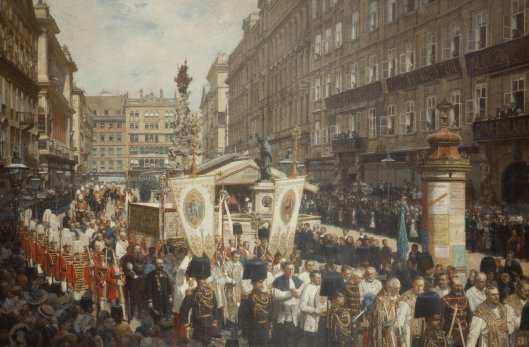
The Great Feast: The Hapsburgs And Corpus Christi

Hapsburgs Corpus Christi 

From The War for Christendom:

 In 1264, Pope Urban IV issued the Papal Bull Transiturus de Hoc Mundo, promulgating to the Latin Rite the Solemn Feast of the Body and Blood of Christ, to be celebrated on the first Thursday after Trinity Sunday. Around this same time, Rudolf the eighth Count of Hapsburg aided and protected a priest bringing the Viaticum to a dying farmer, giving the priest his horse and guiding him across a raging torrent, walking bareheaded. The priest then prophesied that the humble Count and his descendents would receive the Imperium of the Holy Roman Empire.

This veneration of the Holy Eucharist was continued by all the descendants of the Noble House, and the Feast of Corpus Christi in the Hapsburg realms became second only to the Solemn Feasts of Easter and Christmas. The Family indeed owed all to Rudolf’s great devotion to the Holy Eucharist, and the special Eucharist blessing bestowed on him, thus it was most fitting that the Feast of Christ’s Body should become the greatest feast of the Empire. So long as the Family remained devoted to the Cross and the Eucharist, God would bless and protect them (and He still does, even though they have been cast from the throne).

First in the great procession in the Imperial City of Vienna came three priests in splendid vestments like heralds to the city. Then came the Court officials in full Court dress, and the Court Clergy vested in gold and white vestments, followed by dignitaries of every rank. Before the gilded canopy marched the Archdukes of the House, carrying candles, and the acolytes carrying forward the Cross, the golden banners swaying in the wind, the swinging thuribles sending into the air clouds of incense, and the ever ringing bells. The great canopy itself was carried by four noble chamberlains in Imperial livery, upheld over the Hofburg Parish Priest who held up in benediction the golden Monstrance with radiating rays like the sun, in which resided the truly present Most Sacred Body of the Son of God, while the Emperor of Christendom walked behind bareheaded and flanked by the Imperial Guard, humbly worshiping his Divine King. (Read more.)


Share

Saturday, May 23, 2026

What Does St. Paul Say About Veils?

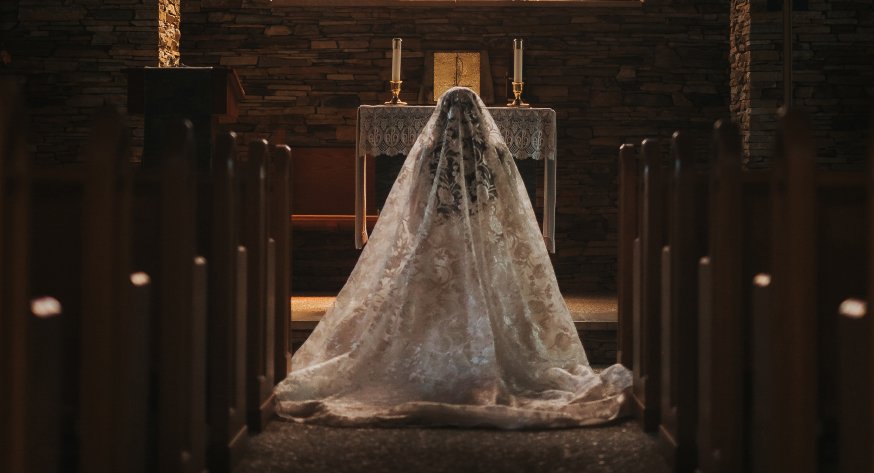
https://fssp.com/wp-content/uploads/Wedding-Veil-Cropped-1.jpg 

Charlene, Princess of Monaco

 I have worn hats or veils in church my entire life, except for a few confused years in the late seventies and early eighties. I have repeatedly had women say to me: "I wish we still did that" or "I wish I was brave enough to do that" or "I would wear one but I don't want to appear holier-than-thou." To the first objection, my response is that no one ever came down from heaven and began ripping women's veils off; if you want to wear a veil or a hat at Mass, then wear one. To the second objection, I say that it requires courage to shed one's blood for the Gospel; it does not require courage to wear a scrap of lace on your head. To the third objection, I can merely shake my head and query: "Holier-than-thou?" In seventh grade, at a Catholic school, I remember going into Mass with a gaggle of twelve-year-old veiled damsels who spoke in such a way that would make Cheech and Chong blush. I grew up seeing femmes fatales such asGrace Kelly, Jackie Kennedy, the Duchess of Alba, and Marlene Dietrich wearing mantillas, which speedily disabused me of the notion that wearing a veil confers automatic holiness. Not to mention the variety of feisty and eccentric characters among my own family and friends, and in my parish, who wore an expansive collection of veils and hats over the years, featuring everything from threadbare polyester lace to Parisian couture. None were angels, except perhaps the little girls and the nuns. I remember when one of my aunts was an unmarried expectant mother, wearing a cute headscarf at Mass over her stylish bob. I loved how her scarf and dress matched and wanted the same look. (I was five.) My overall impression, which led to my own decision to veil, was that it is not a matter of conforming to what people might think, but a matter of devotion to God, according to the teachings of both Scripture and Tradition.

From Father Mike Johns at Word on Fire:

The practice of wearing a veil during Mass has seen a bit of a revival among Catholic women in recent times. Find a Catholic parish at random in which to attend Mass, and odds are that at least some of the women present will be wearing a veil. A quick internet search about veiling during Mass results in many articles and videos from both secular and religious outlets commenting on the practice. Some Catholic outlets even go so far as to recommend the use of the veil as a necessary outward sign of a wife’s submission to her husband.

St. Paul’s words in 1 Corinthians 11:3–16 are often at the center of such discussions. In this chapter of his letter, Paul is concerned to correct numerous liturgical abuses taking place among the Corinthians, and the subject of head coverings is at the top of his list. In the words of one Scripture scholar, “Women in Corinth, at least some of them, had stopped wearing head coverings in worship, and that bothered Paul.” In 1 Cor 11:3–16, Paul tackles this issue.

The Catholic Church, however, clearly teaches that the use of the veil is no longer obligatory for women. Under Pope St. Paul VI, the Church maintains that veils “no longer have a normative value” since in passages such as 1 Cor 11:3–16 Paul is addressing “disciplinary practices of minor importance.” In addition, the current Code of Canon Law has also lifted any obligation concerning the use of the veil for women in church. In classifying the use of the veil as a disciplinary practice of minor importance, the Church sees it as on par with other devotions, or perhaps even as a sacramental. That is, it can perhaps aid in the expression of Catholic piety but is not an essential component of faith.

At the same time, Paul’s arguments in 1 Cor 11:3–16 (and his letter as a whole) ought to be taken seriously. The letters of St. Paul are among the most beautiful and rewarding pages of the New Testament. This is especially true of the First Letter to the Corinthians, which has been called “Paul’s most practical and contemporary letter.” (Read more.)


More discussion from The Missive:

We receive Tradition as a holy gift, treasure it, and pass it on to those who come after us. We realize, in humility, that in the long run, Tradition will judge us and that it is really not for us to pass judgement on Tradition. Traditio sacra sacrorum tuitio. Sacred tradition is a safeguarding of sacred things, and more importantly, of being safeguarded by them. For those who are still being formed by Tradition – a formation that can indeed fill a lifetime – it may be hard to understand why it is so important for women to wear veils in church.

Let me begin with an experience that occurred to me some years ago now. Once, when I stopped for gas at a roadside convenience store, the attendant at the cash register saw me in my cassock and asked, completely at a loss, “What’s with…???” and motioned up and down with her hands to indicate that she was referring to my garb. She didn’t even know what to call it. At that time I was still a seminarian, and I explained to her that I was hoping to become a priest.

When we see a policeman or a soldier or a nurse, for example, we know who they are by the way they are dressed. And I hope that when you get ready to come to church, you dress with church in mind: you realize a distinctiveness in being in church. It is not like going anywhere else.

Proper attire for a woman, according to the Tradition given to us clearly by St. Paul in 1 Corinthians 11 and confirmed by Pope St. Linus, who was the second pope, right after St. Peter, is to wear a veil or head covering while in church. I have noticed that men tend to be good in observing the rule that applies to them, namely, that they should not wear a hat in church. I hope that if you saw someone wearing a baseball cap or a fishing hat in church, you would realize that this is not appropriate and indicate in some way to him that he needs to take it off.

Now, you might be wondering why a priest wears a biretta in church and could wear one even during the sermon. Some Fraternity priests do. The answer is that the biretta is a sign of office; a much more striking sign of a higher office is the bishop’s mitre, which he does wear when he preaches.

Dear faithful who are ladies, what I hope you will find in wearing the veil is that you have a particularly strong awareness of where you are, that you are focused completely on Our Lord and not worried about external appearance. (Read more.)

Tea at Trianon has has several posts on headcoverings, including HERE and HERE. A fabulous post, HERE.

Share

Wednesday, May 13, 2026

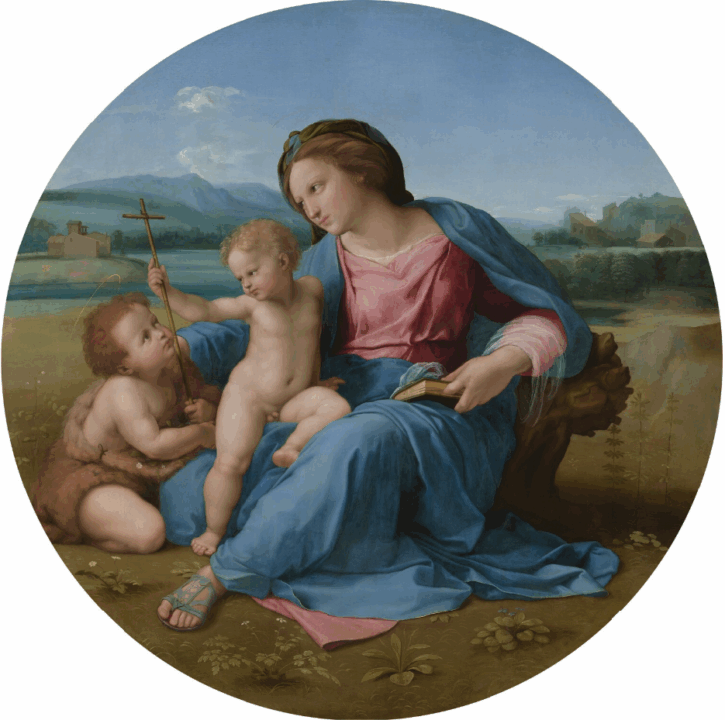
Raphael and the Pursuit of Sublime and Heavenly Beauty

The Alba Madonna 

From Word on Fire:

Raphael’s drawings clearly show that the young artist learned quickly and adapted to the rapid artistic developments occurring during the Renaissance. Leonardo and Michelangelo’s influence becomes apparent in the motion, arrangement, and anatomical accuracy that began to characterize the figures in Raphael’s sketches, which he referenced for his paintings. The progression of his technique reveals that Raphael was a man who strove for perfection—and many would argue that he achieved it to the greatest extent possible within the realm of human capabilities.

Raphael’s continual refinement of his skills in the chase after excellence didn’t stop there. He went to Rome in 1508, becoming the court artist for Pope Julius II (r. 1503–1513) and Pope Leo X (r. 1513–1521). He made drawings of the ancient monuments in the city to learn the ins and outs of classical architecture. This knowledge proved useful for the School of Athens, a fresco that Raphael made for a four-part series in the Stanza della Segnatura in the Apostolic Palace.

We’ll never know how much further Raphael could have gone in his endeavors. Raphael did not enjoy the longer lives of his contemporaries, whose artwork had such a noteworthy impact on him; Michelangelo and Leonardo died at 88 and 67 years of age, respectively. Raphael left this world at 37, making the progression of his artistic career even more remarkable than theirs, at least in regard to time. In 1520, he completed what became his last masterpiece: The Transfiguration, a stunning example of his masterly orchestration of light, color, and human bodies to create a dramatic scene. (Read more.)


Share

Friday, May 8, 2026

All's Not So Quiet on Any Front

 From James Howard Kunstler:

Project Freedom. Cute move! Notice that it’s not Operation Freedom. That would frame it as a military move. The President is tactically framing this as a humanitarian action. Mr. Trump has advised Congress as of May 1 that hostilities with Iran (Operation Epic Fury) are terminated, at the 60-day limit of the War Powers Resolution. Commercial ships from countries not involved in the Iran / US dispute will now get escorted safely through the Strait of Hormuz by US naval vessels. (Later amended by CENTCOM, around 9a.m. Monday as being protected by US Navy vessels “in the vicinity.”)

Any attack on these ships by Iran would prompt a forceful response and trigger a re-wind of the clock on the War Powers Resolution (WPR), meaning, another sixty days to conduct military operations, such as the destruction of key bridges and electric power plants promised earlier. Iran’s leadership — whoever that is — thought it could juke Mr. Trump on the 60-day deadline by stalling negotiations while it reorganized its remaining missile launchers. Tactical fail. Incidentally, the Supreme Court has never directly ruled on the WPR’s constitutionality or enforced the 60-day limit.

Also, by the way, the “neutral and innocent bystanders” designation means that oil tankers from Kuwait, the Emirate states, Qatar, and Saudi Arabia will be given safe escorts out of the Persian Gulf. That will have two effects: 1) avert the “shutting-in” of their productive oil wells (and the prospective geological damage to the oil fields); and 2) alleviate the price pressure on oil generally with new supply reentering the global oil market. (Read more.)


From John Zmirak at Chronicles:

Conflict between popes and secular leaders has been a running theme of Western history since Constantine’s conversion. It’s all too tempting for my fellow Catholics today, surveying such incidents, to thoughtlessly side with the papacy in any conflict. But countless faithful believers over the centuries did not.

The Ghibellines, who backed the Holy Roman Emperors against the grander claims of medieval popes, were equally Catholics in good standing; they simply regarded the pretensions of given popes as excessive, misguided, or wrong. The great theological poet Dante was technically a Guelph (the pro-papal party), but he wrote in De Monarchia that a strong, faithful emperor was equally crucial to the health of Christendom. Going back to the 10th century, it took the Emperor Otto the Great invading Rome and deposing a corrupt pope to free the papacy from what historians call the “Pornocracy,” or “rule by harlots,” the dominion of local nobles who picked the popes, sometimes delegating that power to influential courtesans.

Sometimes God uses Caesar to rebuke or correct sinful heirs to St. Peter. I’d like to see the Trump administration act in that direction, relying on the faithful Catholics in its midst, such as JD Vance and Marco Rubio, to explain to the public that it’s acting on behalf of Catholic laymen against corrupt and politicized clerics. While too many online Catholics are busy complaining about Jeffrey Epstein and his depraved network it’s easy to forget that the U.S. bishops in the past 40 years have enabled far more sex crimes than Epstein could have imagined. (Read more.)


Share

Sunday, May 3, 2026

Raymond Ibrahim's Trilogy

undefined
Baucent of the Templars


 "Not to us, O Lord, not to us; but to thy name give glory." Psalm 113 (Vulgate), motto of the Templars

Once in a discussion with a fellow historical novelist I was informed that the crusades are the earliest examples of genocide. I was surprised that the novelist, being Jewish, seemed unaware of the various ancient persecutions against her own people, including that of the Greeks in the days of the Maccabees, that might be considered genocidal. I reminded her of that, as well as of the fact that there were twelve major crusades, taking place over nearly three hundred years. They were led by different people, with the principle goal of liberating the Holy Land from Muslim rule and thus delivering the Christian population from slavery and oppression. Some were more successful than others. Some, like the Fourth Crusade, were total disasters. In fact, the Fourth Crusade is the one which most people think of when they view the crusades as orgies of mass murder. In that case, those being killed were other Christians. Did other massacres of the innocent occur during the course of the various crusades? Yes. So, did the crusaders journey hundreds of miles to the Middle East, braving fatal diseases, pirates, brigands and an ocean of foes, just for the joy of killing people? That is one of the questions answered by Raymond Ibrahim in his brilliant trilogy about the centuries-long conflict between Christianity and Islam. Ibrahim's books are The Sword and the Scimitar, Defenders of the West, and The Two Swords of Christ. The books present a background to the crusades, containing detailed information of which most contemporary people are unaware, as well as the histories of heroes like El Cid and the rise of the two greatest military orders, the Templars and the Hospitallers.

In the early Church the practice of Christians was, even in the era of persecution, to visit the places where Jesus Christ had been born, lived, died and risen. Pilgrimages were regarded as highly penitential, in which the pilgrim would not only risk life and health, but leave behind property, home, family, occupation and offices. The Romans built pagan shrines over the venerable spots like the stable at Bethlehem and the Holy Sepulcher but those temples only served to remind everyone where the sacred sites were hidden. When Emperor Constantine legalized Christianity in the Fourth Century, his mother Empress St. Helena went on pilgrimage to the Holy Land, where she discovered not only the True Cross, but found and reopened many of the other places sacred to the memory of the Savior. This ignited centuries of pilgrimage to the Middle East. Rich and poor would go, often in parish-sponsored groups as now. Special costumes were worn when on pilgrimage, and one was often regarded as being temporarily in religious life when journeying to a holy site. For Jerusalem was not the only destination; there were shrines throughout Europe, including Rome and Compostela. But the pilgrimage to the Holy Land remained the ultimate of penitential practices, with many indulgences attached. People would go for themselves and for loved ones who were sick or who had died.

All this changed with the rise of Islam in the 7th century, meticulously described by Ibrahim in his book Sword and Scimitar. Founded by Mohammed, an Arabian who claimed to be a prophet of the One True God, Islam combined elements of Nestorian Christianity and Judaism with the prophet's own inspirations, many of which included teachings abhorrent to Judeo-Christian morality. One such teaching permits Muslim men to take a non-Muslim "infidel" woman by force. Mohammed commanded his followers to spread Islam by warfare. Within 200 years, the Christian lands in North Africa, Spain, Arabia, and the Middle East were conquered. Great Christian cities like Antioch and Alexandria, which had been Apostolic sees, fell to Islam, with the churches and basilicas becoming mosques. Christians, especially children, young men and young women, were made into sex slaves and concubines, including monks and nuns. Many boys were castrated to be eunuchs in the harems of the various Muslim elites. Hatred in the form of desecration was lavished upon Christian shrines, churches, monasteries, and cathedrals, with special contempt reserved for icons, church bells and crosses. The latter were dragged upside down through the streets, to be spat and urinated upon by the disciples of the prophet. Altars were sometimes desecrated by the gang-rape a Christian virgin. Those Christians and Jews who were not killed or sold were subject to oppressive laws and taxes in their own lands. This is documented in Muslim sources which repeatedly rejoice when describing the oppression of "infidels" and especially the defilement of Christian women.

A war-like, nomadic people called the Turks embraced Islam; they eventually overran the old Roman province of Anatolia so it became "Turkey." In the late 11th century, Jerusalem, which had fallen into Muslim hands before, was captured by the Seljuk Turks, who tortured, raped, and sold into slavery the Christians of the region. Those who were killed were regarded as lucky. The violence disrupted the flow of pilgrimages from Europe to the Holy Land. The Muslims made a point of harassing and robbing pilgrims, sometimes capturing them to be sold into slavery. Blond and red-haired girls and boys with blue, gray or green eyes were especially favored for the slave markets. Although one beautiful abbess from Germany, traveling with a group of pilgrims to Jerusalem, was waylaid by Muslim bandits and raped to death in front of her fellow Christians, who were also mistreated in various horrific ways. This led Pope Urban II at the Council of Clermont in 1095 to call for a crusade of Christian soldiers to deliver the Christians in the Holy Land. Thus began the era of the crusades. Defenders of the West describes some of the great heroes of Christendom who kept Islam out of Europe, including at least one from Albania whom I had never heard of before. My opinion of Richard I "Lionheart" had suffered in the past but in Defenders he is revealed as among the bravest of the brave. The Two Swords of Christ traces the history of the two great military orders in a deeply inspiring way. For when the weak and innocent are attacked, it is unquestionably the duty of Christians who are able to defend them.

From The Chivalry Guild:

If I had to pick the best way to describe the recent works of Raymond Ibrahim—Sword and Scimitar (2018) and Defenders of the West (2022)—I’d call them no-going-back books. The equally chilling and invigorating experience of his histories cannot be undone and you cannot see the world the same way afterwards—especially since it’s not just history, but a forgotten prelude to what we’re living with today. Reality looks different post-Ibrahim.

Sword and Scimitar takes the reader through fourteen centuries of warfare between Islam and the West, with emphasis on eight great battles within that conflict. Better than any book I know, it dynamites the old public school narrative about the Crusades as a brutal act of Christian aggression against those poor, peaceful, tolerant Muslims. Ibrahim tells a much darker story about our ancient adversaries, documenting the scale of their conquests and the horrors that followed pretty much everywhere the armies of the prophet went. What we call “the West,” he writes, is but “the last and most redoubtable bastion of Christendom not to be conquered by Islam. Simply put, the West is actually the westernmost remnant of what was a much more extensive civilizational block that Islam permanently severed.” Three-quarters of the formerly Christian world was conquered by these people. It is both chilling and invigorating, like I noted, to think about how much danger we were in—and what kind of virtue was required to meet that danger and triumph over it, at least for a time.

Defenders of the West is an even more important book. It’s personal and compelling, and it reverses a long trend of hiding Christian heroes from those of us who need to learn about them. Thanks to Enlightenment propagandists, a vague narrative persists that heroism basically died out after the assassination of Julius Caesar and wasn’t revived again until Napoleon and George Washington walked the earth. The intent is a broadside against the Faith, leaving you with the vague impression that the teachings of Christ and his Church effectively snuff out all martial virtue, as though heroics cannot co-exist with the Gospel. Ibrahim shows this to be absolute nonsense. With his chronicles of Godfrey of Bouillon, El Cid, Richard the Lionheart, Fernando III, Louis IX, John Hunyadi, Scanderbeg, and Vlad Dracula, he brings to life eight legends whose deeds rival or exceed those of any heroes of any age.

These works are, in my humble opinion, on the shortlist for books of the century. So it was with special interest that I anticipated his follow-up effort. The Two Swords of Christ (published November ’25) continues with his major theme but looks at a different aspect of the conflict: the crucial work done by the Templars and the Hospitallers, basically the special forces of Christendom.

Ibrahim’s title comes from Luke 22, in which Jesus tells his disciples to buy a sword. When they reply, “Look, there are two swords here,” Jesus says, “It is enough!” What’s fascinating is his use of the singular pronoun it rather than the plural they. It suggests not the swords, but a way of life that employs “a spiritual sword against spiritual enemies, and a physical sword against physical enemies.” If your religious education was anything like mine, your teachers blithely passed over this and similar passages in favor of all the nicer-sounding directives about loving everybody and just being nice, along with never fighting—because fighting is unchristian. For those looking for simplistic formulas for life, it’s far easier to reduce the character of the Lord to that of a harmless meditation instructor, rather than wrestling with the much more challenging and dynamic truth.

The two swords also work as a metonymy for the knightly orders, filled with men whose particular way of serving God and their neighbors was with weapons. (Read more.)

  All three books are so detailed in citing source material that one comes away with a refreshed world-view, for a deeper understanding of history leads to a more profound comprehension of the present. Plus Raymond Ibrahim is an engaging and descriptive writer so that I often felt I was watching a film of the events he has so richly described. I recommend this excellent trilogy for every home library and every college history class.

Share

Saturday, May 2, 2026

How the Fall of Rome Created the Power of the Medieval Papacy

 From The Collector:

In the Early Middle Ages, after the fall of the Roman Empire left the existing government structures in shambles, the papacy established itself as the preeminent authority in the West. Indeed, in a post-Roman world, where there was no large political structure to ensure stability in Europe, the Roman Church emerged as the only force able to provide some unity. Led by a series of popes functioning as both spiritual and temporal rulers, the papacy came to dominate the intellectual life, political landscape, and culture of the so-called Dark Ages.

In 476, the German chief Odoacer deposed Romulus Augustulus, ending the succession of Roman emperors inaugurated by Augustus. He then proclaimed himself king. The event is traditionally considered the end of the Roman Empire. By then, the so-called “barbarian invasions,” or the migration of Germanic peoples into Roman-controlled Europe, had already significantly altered the social and political composition of the empire.

In 406, the Vandals, Suebi, Alani, Burgundians, and Alemanni, fleeing from the advance of the Huns, crossed the River Rhine, pouring into Gaul. Some years later, they arrived in Spain. Meanwhile, the Visigoths established themselves in Narbonensis and Aquitania (the territories in Gaul). Though partially successful in regaining control of portions of Gaul, Roman general Constantius was unable to expel the “barbarians” from the country.

In 410, Alaric, at the head of the Visigoths, sacked Rome, pillaging the heart of the Roman Empire for three days. Only the churches were spared, as Alaric had converted to Christian Arianism. In the first half of the 5th century, other Germanic peoples began to establish themselves in the Roman territories. In 435, the Vandals conquered Carthage in North Africa. In 450, Attila and his Huns invaded Italy. Only Pope Leo the Great managed to persuade them not to sack Rome. (Read more.)


Share

Saturday, April 25, 2026

The Hardest Truth about Islam and Christianity

People often cite the fact that the Koran mentions the Virgin Mary with reverence, a fact which never stopped a single Muslim from kidnapping and enslaving millions of Christian women and girls in harems for over a thousand years. And the rape of "infidel" women is not seen as a sin from the Islamic point of view. From Patrick Novecosky:

Relations between the papacy and Islam stretch back more than 1,300 years to the era of Pope Donus in the 7th century, when the rapid expansion of Islam transformed the Christian world. What followed was not primarily dialogue, but conflict. Muslim armies swept through formerly Christian lands in North Africa and the Middle East. Europe responded with the Crusades. Constantinople fell. Naval battles like Lepanto became defining moments of civilizational struggle. For much of history, Christianity and Islam encountered each other not in shared spaces of worship, but on opposing sides of war.

That history does not dictate the future, but ignoring it doesn’t lend clarity to the present.

The Catholic Church’s modern approach to Islam largely dates to the Second Vatican Council in the 1960s. Its declaration, Nostra Aetate, marked a turning point, stating that the Church “has a high regard for the Muslims,” who worship the one, merciful God. It called for both sides to move beyond past hostilities and work together for justice and peace.

The Catechism of the Catholic Church builds on that framework. It teaches that Muslims, “together with us, adore the one, merciful God” and are included in God’s plan of salvation. That’s pretty remarkable language, especially when viewed against centuries of conflict. They reflect the Vatican’s deliberate effort to emphasize common ground and reduce religious hostility.

But they do not erase fundamental differences.

Islam rejects the Christian understanding of God as Trinity, denies the divinity of Jesus, and does not accept the central claim of salvation through the cross and resurrection. These are not minor disagreements. They go to the heart of what each religion believes about God and humanity’s relationship to Him. Any serious discussion of Christian-Muslim relations must grapple with that reality. (Read more.)

Share

Thursday, April 16, 2026

Pope Leo XIII and the St. Michael Prayer

From Unveiling the Apocalypse:
I would like to recommend an excellent book by Kevin Symonds, titled Pope Leo XIII and the Prayer to St. Michael.  This recently published book, which examines the history behind the composition of the Prayer to St. Michael, presents a wealth of scholarly evidence which attests to the authenticity of the vision of Pope Leo XIII.  The author has obviously undertaken a painstaking amount of research for this book, and has translated several key documents which were previously unavailable in English.  A fresh batch of information is brought to light here, including additional material emanating from the eyewitness testimony provided by Fr. Pechenino, and a homily on Pope Leo's vision attributed to Cardinal Pedro Segura y Saenz. Among these new findings we find the surprising fact that the earliest accounts of this vision records that Satan had actually requested a period of 50-60 years in which to destroy the Church, rather than 75-100 years. 

While these documents which Symonds has unearthed are undoubtedly the earliest of their kind, and therefore possess the strongest claim to the full truth on this matter, we cannot fail to notice that this contradicts the common perception that Pope Leo's prophetic vision comprised the entirety of the 20th century, rather than just the first half of it.  On the surface, this discovery appears to indicate that the period of Satan's greater power ended around the middle of the 20th century, at the close of the Second World War. Once again, such a scenario appears to contradict the actual sequence of historical events, and it is plainly evident that the true grip of Satan's greater power only seemed to really take hold in the latter half of the 20th century, after the events of the Second World War, when the Sexual Revolution which took place in the 1960's coincided with a massive decline in the Church - paving the way for current apostasy we are still enduring today. (Read more.)
Share

Tuesday, April 14, 2026

Talking Nonsense in the Name of God

Let us remember that the Crusades were initiated by the popes to free the Holy Land from Muslims. Various nations of Islam had committed sacrilege in the Holy Places, raped monks and nuns, destroyed churches or turned them into mosques, while enslaving thousands of Christians. Girls were sold as sex slaves. Boys were often castrated so they could serve as eunuchs in the sultan's palace. This went on for over a thousand years. Various popes called upon Christian warriors to fight the Muslims in order to free the Christians of the Middle East. So while popes encourage peace most have known that sometimes battle is necessary to liberate the persecuted.  

Meanwhile, in the present day, so many Catholics do not know the most basic moral teachings about chastity, contraception, abortion, celibacy outside of marriage, and keeping holy the Lord's Day. Not to mention all the theological teachings about the Holy Eucharist and the Blessed Mother. It is the responsibility of the Shepherds to teach them! And where is the outcry from our Shepherds about the Christians being murdered, raped and enslaved around the world, in Nigeria, Somalia, Syria, China, Indonesia, India! What about the blatant and repeated human rights violations in several Muslim countries against their own women? What about the slave trade which flourishes in Africa? What about the human trafficking in the Americas? There are some major moral issues which require the full attention of the Holy Father and the bishops.

From Andrew Klavan at The New Jerusalem:

If the faithful are nothing else, they ought to be clear-eyed and honest about the way things are. Politicians can deal in virtuous-sounding lies, but not priests. A politician can say, “Poverty is the underlying cause of crime,” in order to sell the public on some useless program that will increase his patronage power and line the pockets of his friends. But God-fearing men should see that the logic doesn’t hold. How, for instance, does such an idea explain well-heeled criminals like Jordan Belfort and Bernie Madoff? A Christian should understand that the sinful human heart, with its greed and cruelty, is crime’s real cause. Poverty merely limits the sorts of crimes one can commit. Once you see that, ideas like defund the police and end incarceration reveal themselves to be works of either ignorance or cynicism. Sin is with us until the end of days. So, therefore, are cops and jails.

Likewise war. In a world where men like Hitler and ideas like Islamism can define the ethos of a people, bullets will sometimes have to fly. I say this without jingoism or belligerence. It is a simple fact of life. We can’t love our spouses, play with our children, do our jobs, read books or stroll through parks unless tough guys with weapons guard our borders and our streets, ready to fight when the need arises. Pacifism, if it is not suicidal, is just straight up wicked. It simply shunts the moral responsibility of waging war onto another man’s shoulders.

“Render unto Caesar the things that are Caesar’s,” Jesus said, “and unto God the things that are God’s.” I take this to mean in part that his preachments, if they are to make any sense, cannot be taken as a political program. “Love your enemy,” is not a foreign policy prescription. “Turn the other cheek,” is not a recommended reform of the justice system. These are formative ways of seeing the world and its inevitable troubles as God sees them: as tragedies that spring from the bottomless fountain of our sin. They will continue to exist as long as we are what we are. One hopes that leaders shaped by the Christian ethos will deal with them as justly as possible.

Each person born is going to find himself in that blood-soaked melodrama known as history. He may have the good luck to live in a rich and secure society governed by the rule of law, or he may get the short end of the stick and find himself dumped into the midst of chaos and oppression. Accepting Christ can teach him humility, grant him peace and lead him to salvation. But it can’t shield him from the truth — because it is only by and in and for the Truth that he is saved. (Read more.)

Share

Tuesday, April 7, 2026

The Sacrament of Easter

Making all Sundays holy to the Lord. From Seton Magazine:
If Christians in the midst of the world are to keep alive a Christian culture and the spirit of Easter throughout the year, it is essential to truly live Sunday as “the Day of the Lord.” Man is an image of God, and God is a community of persons (the Blessed Trinity). By gathering as a parish family to celebrate and receive the Holy Eucharist each Sunday and then “resting in the Lord” as a family for the remainder of the day, we become practically what we are in truth, an image of the triune God Who is love.

Certainly there are obstacles in our contemporary culture to living Sunday as a day of worship and rest. Saint John Paul II noted in 1998 that, “Until quite recently, it was easier in Christian countries to keep Sunday holy because it was an almost universal practice and because, even in the organization of civil society, Sunday rest was considered a fixed part of the work schedule…"

Unfortunately, when Sunday loses its fundamental meaning and becomes merely part of a ‘weekend,’ it can happen that people stay locked within a horizon so limited that they can no longer see ‘the heavens.’ Hence, though ready to celebrate, they are really incapable of doing so. The disciples of Christ, however, are asked to avoid any confusion between the celebration of Sunday, which should truly be a way of keeping the Lord’s Day holy, and the ‘weekend,’ understood as a time of simple rest and relaxation” (DD, 4). (Read more.)
Share

Monday, April 6, 2026

Sacred Art and the Coming of Islam

 From Hilary White at the Sacred Images Project:

And yet, despite the chaos, the sacred arts flourished. In Constantinople, the domes of Hagia Sophia shimmered with gold and glass mosaics that captured the uncreated light of heaven. In Ravenna, Christ gazed out from apse and arch with the serene confidence of divine kingship. Processions of saints in jewel-toned robes crossed the walls of sanctuaries like heavenly courtiers. The image of God made visible, incarnate, and triumphant had become the cornerstone of Christian art.

To the west, Britain and Ireland, far from the imperial centres, were stirring with new creative energy. Missionaries and monks were carving a fresh Christian identity into the raw material of a post-Roman world. The Book of Durrow, the Lindisfarne Gospels, and the carved stone crosses of Iona emerged from this wild frontier of the faith, filled with patterns and symbols that spoke of eternity in knots and spirals.

But across the deserts of Arabia, something was stirring, something that would soon cast a long and complex shadow over the entire Christian world.

Within a single lifetime, Islam would rise from obscurity and sweep across the old heartlands of Eastern Christianity. Antioch, Damascus, Jerusalem, and Alexandria, centres of theology, pilgrimage, monasticism, and sacred art, would fall under a new religious power. The sea that had been a Christian sea, ringed by basilicas and monastic foundations, would become the heart of an Islamic empire.

The world had changed, and Christian culture would never be the same. (Read more.)

Share

Thursday, April 2, 2026

Blessed Karl, Clericalism and Lay Church Governance

 From Charles Coulombe at One Peter 5:

In many ways, Austro-Hungarian Emperor-King Franz Joseph epitomised the traditional relationship between the lay and clerical powers of the Church. As with the other Crowned Heads of Europe, he had inherited a particular style of Catholic devotion peculiar to his own dynasty – the Pietas Austriaca. Bound up with a veneration of the True Cross and the Passion, the Blessed Sacrament and the Sacred Heart, the Blessed Virgin and St. Joseph (the family patron), this religiosity had led to the tremendous collection of relics at the Hofburg, the Imperial Palace in Vienna. The Maundy Thursday Footwashing and the Corpus Christi procession were highlights of court life in Vienna, and in 1898 Franz Joseph led the Imperial Family in observing the Consecration of All Mankind to the Sacred Heart, led by Leo XIII in Rome. In the canon of the Mass, the Good Friday Collects, and the Holy Saturday Exsultet, the Emperor was prayed for by name.

Franz Joseph was crowned and anointed King of Hungary in 1867. As Emperor-King he appointed the Cardinals, Archbishops, and Bishops, subject to Papal approval. Exempt from this were Salzburg and Olomouc, their metropolitans being elected by the cathedral chapters, and the former ‘Salzburg dioceses’ of Seckau, Lavant, and Gurk. The Archbishop of Salzburg had the right of appointment for Seckau and Lavant, the occupation of Gurk was regulated in a mixed manner, that is, the Emperor proposed two candidates, the subsequent nomination was made by the Archbishop of Salzburg. The Nuncio had to be consulted to make sure that the choice was not obnoxious to the Pope – either disapproval would derail the process; the separate Austrian and Hungarian ministries of Worship and Education would do the research, but it was Franz Joseph who had to approve the choices, both for Latin and Eastern Rite Catholic Bishops. Moreover, he had to bear in mind that some of his appointees would sit in one or more legislatures within the Monarchy.

There were three national parliaments. In the Upper House – House of Lords (Herrenhaus) of the Austrian Parliament could be found the prince-archbishops of Vienna, Prague, Salzburg, Görz, and Olmütz, the archbishops of Lemberg and Zara, the Byzantine Catholic archbishop of Lemberg, the Armenian Catholic archbishop of Lemberg, and the Greek Orthodox archbishop of Czernowitz, as well as the prince-bishops of Brixen, Breslau (although located in what was then Germany, for the diocesan territory in Austrian Silesia), Krakau, Seckau, Trient, Laibach, Lavant, and Gurk. In the Hungarian Upper House, the Főrendiház or “House of Magnates,” had an even higher proportion of ecclesiastical members – although it was also more interfaith than Austria’s: forty-two dignitaries of the Catholic and Orthodox Churches, including the Primate, Archbishops, Bishops, Abbots, and various other high officials, and thirteen representatives of the Protestant confessions. The annexation of Bosnia in 1908 presented a challenge in creating representative institutions for a region that had never known them. But while Bosnian diet (Sabor) would only one have one house, it would also have religious representatives appointed by the Monarch. These were, in deference to the Muslim majority, the Reis, who was the principal of Muslims’ granted lands, and the Muslims’ regional leader from Mostar; four Metropolitans and the president of the Orthodox community; the Catholic archbishop and two province members of Franciscan order of Bosnia and Herzegovina; and the Sephardic rabbi of the higher order. The various provincial diets in the Austrian half of the Monarchy also numbered the local Catholic bishops in their number.

Another religious duty that Franz Joseph took very seriously was that of funding missions – even though Austria-Hungary had no colonies. The Catholic Church in Scandinavia, Albania, and Bulgaria (Latin and Byzantine in that case) was heavily funded by the Emperor, as was the Church in the Holy Land and Egypt (the Coptic Catholic Church was funded from its beginning thereby, and Franz Joseph paid for the building of the Latin Catholic Cathedral of St. Catherine in Alexandria, where, ironically, the remains of  his wartime enemy King Victor Emmanuel III would rest until their recent repatriation to Italy). But since 1826, very largely out of funds given by both Franz Joseph and his two immediate predecessors, a large amount of this largesse went to the Church in the United States. Through an organisation called the Leopoldinenstiftung – the “Leopoldine Foundation” – the Habsburgs and many of their subjects poured millions of dollars into the American Church, founding 400 parishes, subsidising wholly or partly 300 missionaries (such as St. John Neumann and Ven. Bishop Baraga), and sending an endless flow of vestments, statues, stained glass, liturgical implements, and the like. A great deal of dynastic money went to Eastern Rite churches in the United States as well. Unfortunately, the outbreak of war in 1914 ended the flow of generosity – which, of course, would be repaid by Woodrow Wilson’s insistence of the deposition of Franz Jospeh’s successor, his exile, and the partition of his domains. (Read more.)

Share

Tuesday, March 24, 2026

The ‘Polar Unity’ of the Two Forms of the Roman Rite

 From The Catholic Thing:

The motu proprio Summorum Pontificum (2007) of Pope Benedict XVI introduced into the contemporary ecclesial vocabulary a distinction that has since become both fruitful and contentious: the “Ordinary Form” and the “Extraordinary Form” of the one Roman Rite. Benedict was at pains to insist that these are not two rites but two usages of the same lex orandi. The Missal promulgated by Pope Paul VI after the Second Vatican Council constitutes the Ordinary Form; the Missal of Pope John XXIII (1962), standing in organic continuity with the Tridentine codification of Pope Pius V, may be celebrated as the Extraordinary Form.

Benedict’s claim was juridical and pastoral, but its deeper import is theological. The coexistence of the two forms within one rite can be understood as a “polar unity” in the sense articulated by Hans Urs von Balthasar: a living tension of complementary principles whose unity is not the flattening of difference but its orchestration.

Benedict himself rejected the hermeneutic of rupture that would pit preconciliar and postconciliar liturgy against one another. In his famous 2005 address to the Roman Curia, he contrasted a “hermeneutic of discontinuity and rupture” with a “hermeneutic of reform in continuity.”

The liturgy, precisely because it is the Church’s most public act of faith, must embody this continuity in a way that is not merely conceptual but sacramental. The two forms of the Roman Rite thus stand as a visible sign that tradition is not a museum piece nor a revolutionary program, but a living stream whose depth and breadth can be perceived only by holding together its historical strata.

To interpret this polarity in a richer theological key, it is helpful to turn to Balthasar’s account of the Marian and Petrine dimensions of the Church. For Balthasar, the Church is first Marian before she is Petrine. Mary, in her fiat and her immaculate receptivity, embodies the Church’s contemplative, bridal, and receptive essence. Peter, in his confession and commission, embodies the Church’s apostolic, juridical, and governing mission.

These two dimensions are inseparable; yet they are not identical. The Marian dimension grounds the Petrine; the Petrine serves the Marian. The Church is not an institution that happens to have a mystical interior; she is a mystery that necessarily assumes institutional form. (Read more.)


Share

Monday, March 16, 2026

Lorrha Stories: Irish Monasticism

 From The Abbey of Misrule:

St Ruadhán was one of the ‘twelve apostles of Ireland’, a collective of significant early Irish saints who studied under the legendary St Finian of Clonard. Ruadhán (whose name is pronounced ‘Rowan’, and means ‘red-haired’) was, like his fellow apostles, a monk of the Celtic tradition, which later came into conflict with Rome over various issues, like the date of Easter, the correct form of tonsure and other such theological details. In reality though, these issues were secondary to the real one, which was how much power Rome should have over monasteries in distant lands.

In early Ireland, Christianity was monastic, and it was Abbots rather than Bishops who called the shots. Irish monasticism had, for around 500 years, developed a specifically ‘Celtic’ character which seems to have been greatly influenced - and, I think, directly seeded - by Egyptian desert monks. This was the age of the round tower, the beehive hut and the small-scale, ascetic Christianity of the Wild Saints. It was the world of Patrick and Kevin, Colmcille and Bridget.

The Pontiff in Rome, however, wanted this scruffy, desert Christianity reined in under a hierarchy of Bishops answerable to him, and in Ireland, as in England a century before, the Normans would be his vessels. In 1066, the Norman king William the Conqueror (William the Bastard to his friends) had invaded England, killing its legitimate (and elected) King, Harold II, at the Battle of Hastings. He had done so under the Papal banner, which he had carried into battle, and on his victory he set about demolishing the old wooden Anglo-Saxon churches and building new, stone ‘Romanesque’ ones in their places. He also gave the green light to the continental monastic orders to move in and replace their indigenous counterparts. (Read more.)

Share

Friday, March 13, 2026

Who is Driving the Campaign Against the Order of Malta?

 From The Catholic Herald:

Somebody has got it in for the Order of Malta, the 900-year-old Catholic order which maintains hospitals and runs charitable activities all over the world. In Italy, a stream of very similar articles has been appearing, beginning with an attack last October in the left-wing newspaper Il Fatto Quotidiano, by a journalist writing as Thomas Mackinson. In recent weeks there has been an accelerating series of articles under different names, all of them repeating the same criticisms. People in the Order’s ambit are beginning to wonder who is putting them up to it and why.

The articles accuse the Order of betraying a reform intended by Pope Francis, who wanted to bring it more into line with the life of a full religious order. The criticisms highlight the role of the professed knights – those who take the traditional religious vows – and assert that these need to be made to live in community so as to be true religious. What the articles do not explain, however, and indeed seriously misrepresent, is how the Order came to be in its present position.

The background is the crisis precipitated among the knights by Pope Francis in January 2017, when he forced the Grand Master, the Englishman Matthew Festing, to resign. The result was effectively putting the Order into the hands of its German branch, under the Grand Chancellor (effectively prime minister of the Order) Albrecht von Boeselager. The German-backed faction consolidated their control in the five-yearly elections to the Order’s government held in 2019. Of the 18 names back by this camp, all but one were elected. (Read more.)

Share

Sunday, February 1, 2026

Pro Ecclesia et Pontifice


In March of 1966
, my great grandfather Dr. Fergus O’Connor received the medal of the Holy Cross Pro Ecclesia et Pontifice from Pope Paul VI in recognition of his contributions to medicine for over sixty years. The papal nuncio came to the house at 193 Earl Street in Kingston, Ontario to bestow the medal, due to the advanced age of the recipient, celebrating Mass there as well. In March of 2008, when my late Aunt Mary's belongings were being distributed among the relatives, I happened to come across the certificate that accompanied the medal from the pope. (See photo above.) According to the Catholic Encyclopedia:
The medal Pro Ecclesia et Pontifice was instituted by Pope Leo XIII (17 July, 1888, "Quod Singulari") in memory of his golden sacerdotal jubilee, and bestowed on those women and men who had merited well by aiding and promoting, and by other excellent ways and means assisted in making the jubilee and the Vatican Exposition successful. This decoration was made a permanent distinction only in October, 1898 (Giobbio, see below). Its object is to reward those who in a general way deserve well of the pope on account of services done for the Church and its head. The medal is of gold, silver or bronze. The decoration is not subject to chancery fees. The medal is a cross made octangular in form by fleurs-de-lis fixed in the angles of the cross in a special manner. The extremities of the cross are of a slightly patonce form. In the centre of the cross is a small medal with an image of its founder, and encircling the image are the words LEO XIII P. M. ANNO X (tenth year of his pontificate). On the obverse side are the papal emblems in the centre, and in the circle surrounding the emblems the motto PRO DEO ET PONTIFICE is stamped. On the obverse surface of the branches of the cross are comets — which with the fleurs-de-lis form the coat of arms of the Pecci family. On the reverse side are stamped the words, PRIDIE (left branch); KAL. (top branch); JANUAR. (right branch); 1888 (at the foot). The ribbon is purple, with delicate lines of white and yellow on each border. The decoration is worn on the right side of breast.
Fergus Joseph O'Connor was the son of Charles and Emily O'Connor of Long Point Farm, born on April 1, 1879, Easter Sunday. As Fergus' second son and namesake wrote of him: "It's hard to describe a man with such integrity of character. He was the perfect son to his parents -- the brother to his only sister and complete support to his family." (Dr. Fergus James O'Connor, Because You asked For It)

Fergus loved horses and wanted to become a jockey, for which he was suited due to his stocky stature. His mother, however, encouraged him to seek as much education as possible. He went to high school in Athens, Ontario, and then went to the “Normal School” for teachers' training in Ottawa. It was around that time that he decided to study medicine. His father had wanted Fergus to help him maintain the homestead, but accepted his decision to become a doctor. He taught school to earn his tuition for medical school at Queen's University in Kingston. In his third year, he missed classes the first term because his funds had run out and he had to teach school again to make more money, but his roommate took notes for him, so he was able to pass anyway. He did not have much recreation, and only went to one football game all the time he was at Queen's.

In the summer of 1902, when Fergus first registered at Queen’s he rode his bicycle the 32 miles into Kingston. After finishing his business at the university, he became lost. He drove past three young ladies playing croquet on the front lawn and asked them for directions. One of them was Frances Keating. Frances Margaret Keating was of Norman-Irish stock on her father’s side; her mother was an O’Neill.
Fergus and Frank were married at the dawn Mass at Saint Mary’s Cathedral in Kingston on September 3, 1907. The Mass was followed by a simple wedding breakfast. The new Dr. and Mrs. O’Connor moved to Gananoque in the Thousand Islands area where Fergus set up a practice and built a house.

Fergus' practice involved house calls, as was the custom in those days. He was often called out at night to deliver a baby, and often had to travel unlit roads into remote areas. It was vital for a country doctor to have a reliable horse so as to get him to his patients; my great grandfather had many stories about horse traders. After tending to a patient in the countryside, he could doze in the buggy or sleigh, since the horse knew the way home.

In December of 1916, Fergus was elected mayor of Gananoque. His election was a tribute to the respect generated by his professional dedication and personal integrity. It was remarkable given the local history of conflict between the few Irish Catholics settlers and the Protestant majority, especially the Irish Protestants, called “Orangeman.” Fergus, without compromising any of his beliefs and principles, was able to overcome a great deal of anti-Catholic prejudice, and became the popular “little mayor.”

In 1918, my great-grandparents moved to 193 Earl Street in Kingston, Ontario, with seven of their soon-to-be eight children. They decided to move into Kingston so that their children could go to the Catholic schools available there. A white rose bush from the original that old Daniel had brought over from Ireland was planted outside the front door. Fergus slowly built up a new practice. He taught medicine at Queen’s University, and continued on the faculty for forty years. His close friend, Monsignor J.G. Hanley said of him:
His concern for his students was not limited to their professional development. Working in an area fraught with deep moral implications, he instilled in future obstetricians sound ethical principles to guide them in making crucial decisions which would crucially affect the lives of their patients. Moreover, he was not merely a professor to his students; they all regarded him as a personal friend, and so he was.
By the late 1930’s he was delivering one third of all the babies in Kingston. He had many poor patients who could not pay, but to Fergus being a doctor was a vocation, not a career. However, he would gratefully accept an offering such as a bag of potatoes in the place of money, so that he could feed his family. He eventually became Chief of Obstetrics at the Hotel Dieu Hospital in Kingston and remained so for almost half a century. He delivered his last baby at age eighty-four.

Fergus was also active in the community and the church. He was o
n the Separate School Board for many year
s, as well as being a city alderman. He belonged to the Knights of Columbus and in 1945 founded the Queen’s chapter of the Newman Club.

Fergus died on April 21, 1971. I am grateful for the few memories I have of this wonderful man, a true patriarch. I recall how approachable he was, how kindly and gentle with small children. A Kingston newspaper article described him in his nineties as being “still active and spry…his eyes twinkling….with short quick steps“ and that is exactly as he appears in my memory. One of the main characters in The Paradise Tree is based upon him.
 

Share