Showing posts with label Poetry. Show all posts

Monday, May 25, 2026

Earliest English Poem

 From Euronews:

A 9th-century manuscript held in Rome has revealed the earliest known Old English poem, Caedmon’s Hymn, hidden within a copy of Bede’s Ecclesiastical History of the English People. In the archives of a Roman library, researchers have made an astonishing discovery: a 9th-century manuscript copy of the oldest known poem in the English language - missing, until now.

The lost copy of the Hymn of Caedmon was uncovered in the archives of the National Central Library of Rome. The author of the nine-line poem is said to be a cowherd from Whitby in North Yorkshire, who was inspired after a divine visitation. The composition praising God for the creation of the world, was composed in the 7th century, and survived thanks to its inclusion in some copies of the Ecclesiastical History of the English People, an 8th century history of England written in Latin by the venerable Bede, a northern English monk and saint. (Read more.)

 
Share

Sunday, May 17, 2026

5 Historical Figures Who May Have Inspired King Arthur

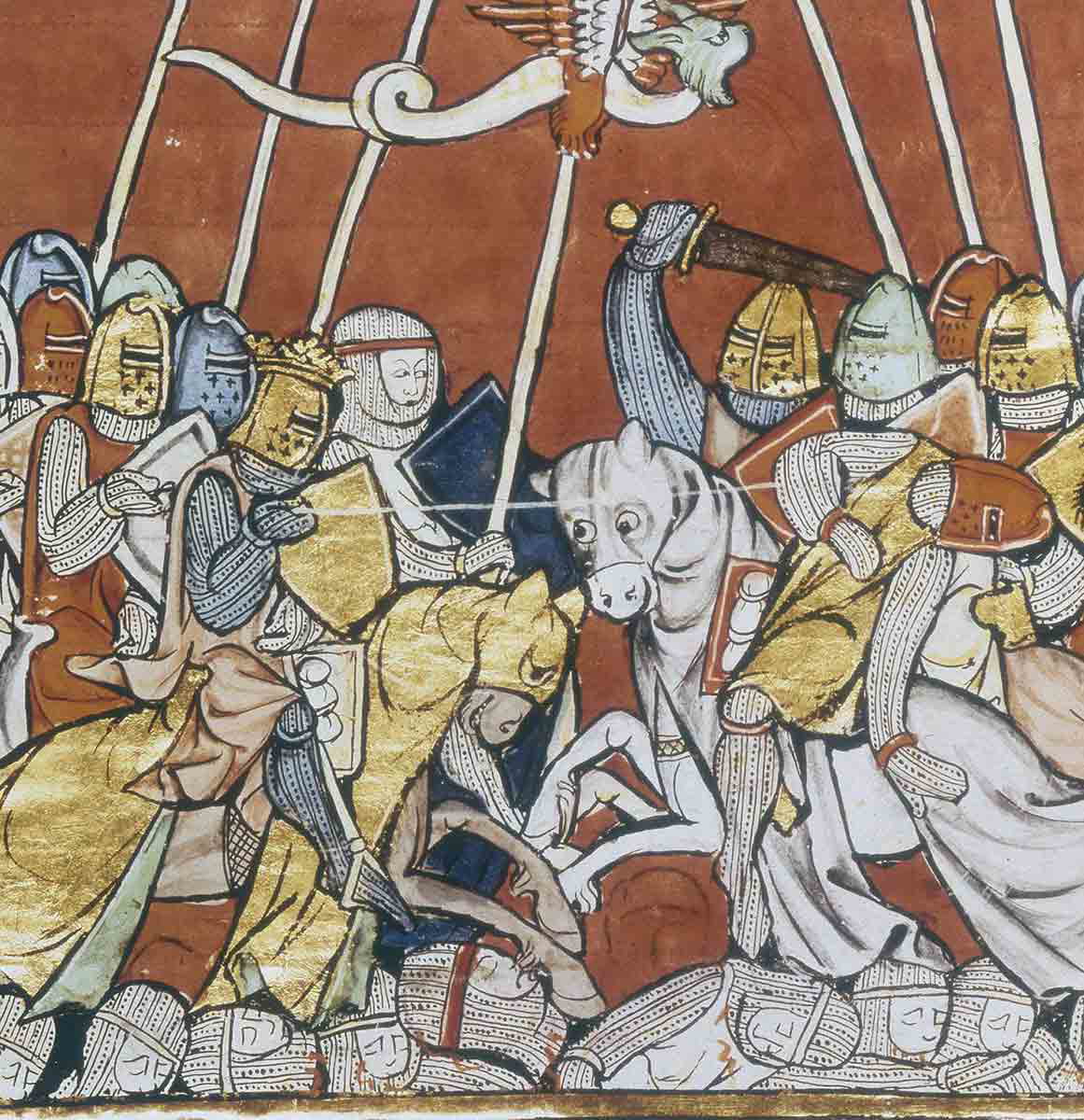
real king arthur battle illustration
Notice the dragon pennant. It went back to the Romano-British legions and was like a small Chinese dragon. It whistled when the wind blew through it. It became the symbol of the Pendragons.

I would happily do nothing all day but study Arthurian legend. One thing to keep in mind is that many of the names are not proper names but titles. "Riothamus," for instance, in the ancient British language means "high king." From The Collector:

Another warlord from Dark Age Britain, who is one of the prime historical candidates for the real King Arthur, is Riothamus. He is known from two Roman sources, one from the 5th century and one from the 6th century. The more important of these two is the account by the 6th-century historian Jordanes.

He described how Riothamus, the king of the Britons, assisted the Romans in a battle against Euric of the Visigoths in the year 470. This idea of a king of the Britons travelling from Britain to Gaul to fight a battle in association with the Romans is fascinating for its similarities to the Arthurian legends. In the account of Arthur’s life by Geoffrey of Monmouth, Arthur is said to have travelled to Gaul with a large army to fight against the Romans.

In addition to this overall similarity, Riothamus is said by Jordanes to have fled to the territory of the Burgundians. It is argued that, given the location of the battle in the territory of the Bituriges, his route while fleeing would have brought him near a town called Avallon. This is then connected to the tradition of Arthur being taken to the Isle of Avalon after being betrayed by his nephew, Mordred. (Read more.)

Share

Friday, May 15, 2026

Helen of Troy


Abduction of Helen by G. Hamilton


The face that launched a thousand ships
And burnt the topless towers of Ilium. 
 —From The Tragical History of Doctor Faustus by Marlowe

 From Ancient History Encyclopedia:

Helen of Troy (sometimes called Helen of Sparta) is a figure from Greek mythology whose elopement with (or abduction by) the Trojan prince Paris sparked off the Trojan War. Helen, considered the most beautiful woman in the world, was the wife of Menelaus, the king of Sparta, and he persuaded his brother Agamemnon, king of Mycenae, to form a great army to besiege the mighty city of Troy in order to recapture Helen. Following the Greek victory in the war, Helen returned home with Menelaus but she became a despised figure in the ancient world, a symbol of moral failure and the perils of placing lust above reason. Despite the poor standing of the literary Helen, she also had a divine form and was the centre of cults at several Greek sites, notably Rhodes, Sparta, and Therapne. 

In Greek mythology, Helen was the daughter of Zeus and Leda, the queen of Sparta and the wife of Tyndareus. Zeus disguised himself as a swan to seduce Leda, and Helen was the result of their amorous engagement. In another version of the myth, Helen's mother is the goddess Nemesis, the personification of retribution. Whoever is the mother, in both versions, Helen is born from an egg in Sparta. Helen's siblings included the hero twins Castor and Pollux (aka Polydeuces) and Clytemnestra, the future wife of King Agamemnon, the king of Mycenae. One day, Tyndareus offered sacrifices to all the gods but forgot Aphrodite and the goddess, angered at the slight, then promised that all of the king's daughters would become infamous for their adultery. (Read more.)


From The New Republic:

Ruby Blondell’s insightful study of ancient Greek representations of Helen of Troy notes the close connections between her subject and the Pandora myth. Both, she argues, spring from cultural anxieties about female beauty and female sexuality, centered on the figure of the parthenos—the girl at marriageable age, a liminal figure who must cross from the world of childhood in her father’s house to the house of her husband. “She must be sufficiently reluctant to suggest that she will not stray once she is married, but she must also actively desire her new husband”—a balance that constantly threatens to tip over. Helen, the most famous adulterous wife in the Western tradition, is figured as a woman who is constantly in this liminal state, and who repeatedly crosses over from one household to another: “many-manned Helen,” as Aeschylus calls her. She was (and is) the locus for exploring the questions of whether beautiful women are always necessarily bad, and whether female sexual desire is always a force of destruction. She is also—unlike modern versions of the promiscuous or adulterous woman—always presented as at least semi-divine, the ever-young, ever-beautiful daughter of Zeus, worshiped at cult centers all over Greece, especially in her native Sparta. Modern versions of misogyny usually do not account for the possibility that “bad” women might also be goddesses.

The best-seller about Helen of Troy by the television presenter Bettany Hughes, from 2007, bizarrely claimed to tell, and to celebrate, “Helen as a real character from history,” while acknowledging that her existence is only “a possibility”—as if the biography of a mythical character from three thousand years ago could possibly be reconstructed. Blondell has almost none of this naïveté: she notes explicitly that her subject is a set of cultural tropes, not a historical person. Helen was a construction of the Greek male imagination, and the myths and literary treatments of Helen can teach us nothing about the lives even of women in classical Greece, let alone women in Sparta in the Bronze Age: she is “a concept, not a person.” But these myths can teach us a great deal about the complex attitudes of ancient Greek men, mostly ancient Athenian men, toward women, female beauty, and male desire.

The story goes that Zeus wanted to reduce the human population, so he arranged for the birth of the two characters who would make the Trojan War inevitable: Achilles and Helen, representing “seductive female beauty and destructive male strength.” They have in common an extraordinary self-awareness and concern for their future reputations in myth and legend. Both were half-human, half-divine, Achilles being the son of the mortal Peleus by the sea-goddess Thetis, and Helen the daughter of Zeus in the form of a swan and of the Spartan queen Leda. Owing to this parentage, she hatched from an egg—the first mark of her unusual, not-quite-human status. Helen is the only female child of Zeus by a mortal woman, an exceptional woman in this as in every other respect. Other versions of the myth suggest that she was the daughter of Nemesis, or “Destruction.”

Helen’s beauty is not subjective. A key premise of the myth is that she is beautiful in some absolute and total way that defies description, and hence can be represented only by entirely conventional means. Helen, like any other beautiful woman in the Greek literary tradition, has lovely cheeks, neat ankles, and pretty accessories. She is equally irresistible to any and every man. As Blondell neatly puts it, “a beauty that is in the eye of the beholder may launch a ship or two, but only a beauty upon which all beholders agree can bind a generation of heroic males under oath and generate an enterprise as cataclysmic as the Trojan War.” 

From a young age, Helen was prone to getting abducted. When she was still a young girl the Athenian hero Theseus swiped her, but she was retrieved by her magical brothers, the twins Castor and Pollux. A little later, suitors from all over Greece began to court her, and took an oath that they would all fight together for her eventual husband. Menelaus of Mycenae, whose main claim to fame was his wealth, won Helen as his wife. But some time afterward, a Trojan prince named Paris was appointed to judge between three goddesses, Hera, Athena, and Aphrodite. He chose Aphrodite, goddess of love, because she promised him Helen as a reward—the only problem being that Helen was married already. The abduction of Helen caused the Trojan War. (Read more.)

The Hatching of Helen

More HERE.

Helen with King Priam watching Menelaus fight Paris

Share

Friday, May 8, 2026

Loverboy Chivalry vs Martial Chivalry


I love Arthurian legend, the basis for "courtly love" which the article refers to as "Arthurian" chivalry or "loverboy" chivalry. Courtly love was essentially invented by Eleanor of Aquitaine, inspired by the troubadour culture of the south of France, cultivated by her grandfather Duke William of Aquitaine. Queen Eleanor founded the "courts of love" in which great ladies would play lawyers and debate the highly romanticized and highly idealized manners and general behavior of their knighted admirers. It allowed women to hold forth upon matters of deportment and courtesy as well as discussing poems,songs and ballads. The bottom line was the respect and reverence which noble men were expected to show to noble ladies. It gave agency to women in an era of arranged marriages, when people did not marry for love. Women of all classes could be beaten by their husbands and mistreated in any number of ways. There was always the danger of both men and women finding love outside of marriage. Courtly culture acknowledged that such forbidden love happened but channeled it into chaste manifestations, because when actual adultery occurred it could lead to war, imprisonment or corporal punishment,  depending upon the rank of the lady and her husband. Not a Christian ideal but then many think it was influenced by the Cathars, as I explore in my novel The Night's Dark Shade. From The Chivalry Guild Letters:

Carolingian chivalry is the essentially French version, and its mythos is the chansons de geste (“songs of great deeds”) involving Charlemagne and his paladins—the most famous of which is The Song of Roland. Carolingianism is about war and God. It is the chivalry, Gautier writes, of the “11th and 12th centuries—that of the crusades, that of our [epic poetry]. It will appear rude and barbarous to some people, but in truth is strong and healthy, and has formed for us the powerful race whose glory has filled the world.” Roland and company don’t have much time for the finer points of etiquette and don’t dedicate themselves to idealized romantic love; they are too busy fighting Saracens and protecting Christian civilization.

As for the more popular Arthurian or English chivalry, Gautier has less fond things to say. He writes:

The romance of the Round Table spread amongst us the taste for a less wild but also a less manly chivalry. The elegancies of love in them occupied the place formally reserved for the brutality of war and the spirit of adventure in them extinguished the spirit of the crusades. One will never know how much harm this cycle of the Round Table inflicted on us. It’s civilized us no doubt; but effeminated us. It took away from us our old aim, which was the tomb of Christ gained by blood in battle. For the austerities of the Supernatural it substituted the tinsel of the Marvelous. It is to this dangerous but charming literature that we owe for theatrical, the boastful, rash chivalry which proves so fatal during the Thirty Years’ War.

This kind of chivalry also gives birth to the satires of Cervantes and company, which aren’t making fun of paladins defending Christendom but instead the errant knights roaming the countryside looking for damsels to rescue. “And we must confess,” Gautier notes, “that some complaints of the great satirist are not without foundation.” (Read more.)


 From Becoming Noble:

Modern discourse offers only impoverished models for women. Feminism dismantled an older understanding of womanhood without replacing it with a sustainable alternative. It treats the household as a prison, motherhood as an obstacle to self-realisation, and the virtues historically cultivated by women as instruments of oppression. Ironically, in so doing, it foreclosed many of the domains by which women wielded substantial influence over civilization.

The reaction is equally impoverished despite its superficial conservatism. The trad-wife thing, to take the obvious example, is a performance of homemaking that lacks any serious theological or historical foundation. It reduces womanhood to a visual display of domestic labour, detached from the actual structures of authority, education, and spiritual responsibility that characterised the aristocratic household. At bottom, it is a reaction to feminism conducted on feminism’s own materialist terms.

The home-schooling mother model is a significant improvement but still shares a visceral and fatal error which precludes its wider adoption. These approaches treat the domestic as something small. None advances the majesty of the Christian aristocratic tradition: that the household is the foundational unit of civilisation, that its proper ordering is a matter of cosmic significance, and that the woman who presides over it wields a form of distinct and profound authority. (Read more.)


Share

Wednesday, April 29, 2026

Who Is Queen Mab?

From Barrie's Peter Pan in Kensington Gardens, illustrated by Arthur Rackham
From The Imaginative Conservative:
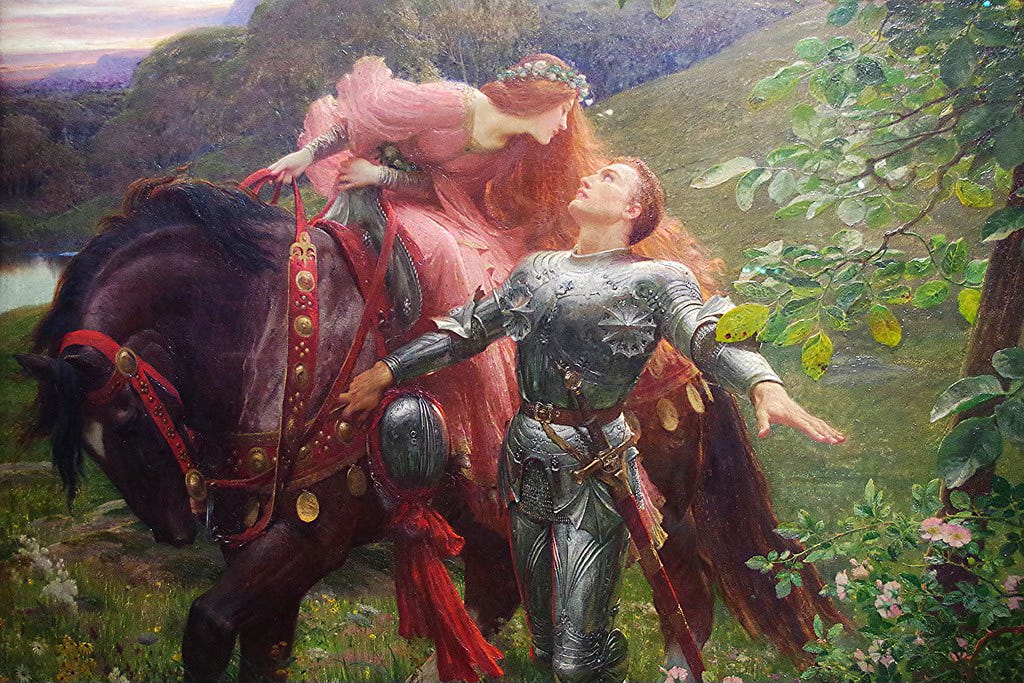
Santayana dedicated some pages to a piece titled “Queen Mab” presumably after the enigmatic faery who is mentioned by Mercutio in Romeo and Juliet.[1] The essay turns into an analysis of British literature, which I take to mean that Santayana saw some form of greater representation in Queen Mab that extended to the wider British psyche. Santayana’s claims regarding British romantic literature, if there is truth in them, add yet another level of genius to Shakespeare, who would have most likely been aware of the duplicity of romance while implementing it in his play. I want first to explain Santayana’s essay—his views regarding British literature—before revisiting the lines where Romeo and Mercutio exchange their thoughts on the meaning of dreams and Queen Mab’s role within them. 
Who is Queen Mab? That is the question this essay will aim to explore. 
Santayana begins his piece by connecting literature to nature. He writes that nature is “far more resourceful than logic,” which is why she has “found a way out the contradiction” that exists between “the human need for expression” and the “British distaste for personal outbursts.” If our inner and outer man oppose each other, then literature is a way to circumvent this contrast. But not all literature is equal. Santayana turns his attention to romantic fiction, which he called a “bypath of expression.” It is a form of literature that is the equivalent of a fleeting phase in our lives, when man plays at “self-revelation” despite being far from it. In Romantic literature man indulges in “day-dreams and romantic transformations” and “imaginary substitutes” for himself as a way to “nurse and develop” his opinions and preferences without stating them directly. Through this form of expression, Santayana writes, man will “dream of what Queen Mab makes other people dream.” 
The sentence needs unpacking. In Santayana’s essay, Queen Mab is England’s literary imagination, but a very specific part of it: the Romantic. And this romantic part of the English literary imagination is a momentary step in our journey towards understanding our hearts. It is, in other words, incomplete. Santayana wrote that a man’s heart, his “ruling motives,” will be revealed “only in long stretches of constant endeavor and faithful habit,” which often comes towards the end of his life. But Queen Mab is still part of the human heart that managed to revolutionize people’s aesthetic sensibilities. British Romanticism elevated man’s self-image. As Santayana wrote, “that which he might have been, and was not, comforts him. Such a form of self-expression, indirect, bashful, and profoundly humorous, being play rather than art, is alone congenial to the British temperament; it is the soul of English literature.” (Read more.)
Share

Monday, April 27, 2026

Song


YOU bound strong sandals on my feet,
You gave me bread and wine,
And sent me under sun and stars,
For all the world was mine.
Oh, take the sandals off my feet,
You know not what you do;
For all my world is in your arms,
My sun and stars are you.
by Sara Teasdale

(Picture by Andrew Wyeth) Share

Sunday, April 26, 2026

The Easter Rising

 From The Abbey of Misrule:

The April weather in the Irish west was astonishing this year, for a while. Two whole weeks of unseasonal heat brought the land out from the finalities of winter. True, the frost still came at night, but by the afternoon I was digging the garden with my top off. Everything on our land awoke. Our field, in which we planted 800 trees nearly a decade ago and which is now becoming a forest, hums with insects heading for the poplar blossom and the whitethorn. The pond is full of frogspawn and the soil is warming. Crocus and cowslip defeat the couch grass in their quest for the light. Sparrows gather moss and straw, the hazel poles are budding. We have set up a beehive in a grove by the hedgerow, and now we wait in the hope that some worker will seek it out and beckon the swarm to follow.

But ask the animals, and they will teach you, or the birds in the sky, and they will tell you; or speak to the earth, and it will teach you, or let the fish in the sea inform you.

As the land has sung itself back into life, it is as if I have awakened too from some numbness that overcame me. It was not simply the numbness of winter. For a while, I have felt closed off from my land; somehow an alien as I walked through it. Maybe I was reading too much theology. I always knew that the Holy Spirit sung itself through bud and blossom, but knowledge is not experience. Back in the day, when I was a pagan and a pantheist, I felt the force of nature as an overwhelming power within me. Then I became a Christian, and something retreated.

What was it?

I wondered this, and I concluded that I had misdirected my worship. I had worshipped the trees rather than their creator. I think that this was a category error; still, I missed the feeling it gave me. I missed the sense that the trees were my sisters and the birds my brothers. Those who have never felt this may call it ‘pagan’, as if that meant anything, but they would be wrong. It is not ‘pagan’ to feel, as Adam did, as Eve did, that this place was created to be our home. That we were intended to be at one with it before we broke away and began instead to worship ourselves.

The heavens declare the glory of God; the sky proclaims the work of his hands. Daily they speak, they never become silent.

Something has happened to me this Easter, though; that old feeling has come back. Now I walk through my growing forest and I feel again that green force that I once felt, and I am overjoyed because I missed it. Is it different now? Yes, and no. I feel the land breathe within me and to me, I see that everything here has its own life, I feel the inscape of it all, but now I feel something beyond it too; something that made it, that sings it every hour, though for this force there is no time. (Read more.)

Share

Tuesday, April 21, 2026

My Lagan Love

https://blogger.googleusercontent.com/img/b/R29vZ2xl/AVvXsEjyEQRMpFkqbMvqB7C7W-i9Ezcc0UxzHNCJo2RLGF3jebVNqCYy0-6WGLEcR4fn0QlwxPIH0_fvSIfBzZl1yHZy_A9XIbVQTKj5q8lEi0wKwMoecYplzUWtkMAGdcnOYFFzntS5_0GBPeE/s1600/My+Lagan+Love.jpg
Where Lagan stream sings lullaby
There blows a lily fair

The twilight gleam is in her eye

The night is on her hair

And like a love-sick
leánan sídhe
She has my heart in thrall

Nor life I own nor liberty

For love is lord of all.


Her father sails a running-barge

'Twixt
Leamh-beag and The Druim;
And on the lonely river-marge

She clears his hearth for him.

When she was only fairy-high

Her gentle mother died;

But dew-Love keeps her memory

Green on the Lagan side.


And often when the beetle's horn

Hath lulled the eve to sleep

I steal unto her shieling lorn

And thru the dooring peep.

There on the cricket's singing stone,

She spares the bogwood fire,

And hums in sad sweet undertone

The songs of heart's desire


Her welcome, like her love for me,

Is from her heart within:

Her warm kiss is felicity

That knows no taint of sin.

And, when I stir my foot to go,
'Tis leaving Love and light

To feel the wind of longing blow
From out the dark of night.


Where Lagan stream sings lullaby

There blows a lily fair

The twilight gleam is in her eye

The night is on her hair

And like a love-sick
leánan sídhe
She has my heart in thrall

Nor life I owe nor liberty

For love is lord of all.


(from an old Irish song)
A beautiful rendition, HERE, HERE and HERE.

To quote from Mary O'Hara's notes on this song, from her book A Song For Ireland:

The leánan sídhe (fairy mistress) mentioned in the song is a malicious figure who frequently crops up in Gaelic love stories. One could call her the femme fatale of Gaelic folklore. She sought the love of men; if they refused, she became their slave, but if they consented, they became her slaves and could only escape by finding another to take their place. She fed off them so her lovers gradually wasted away - a common enough theme in Gaelic medieval poetry, which often saw love as a kind of sickness. Most Gaelic poets in the past had their leanán sídhe to give them inspiration. This malignant fairy was for them a sort of Gaelic muse. On the other hand, the crickets mentioned in the song are a sign of good luck and their sound on the hearth a good omen. It was the custom of newly-married couples about to set up home to bring crickets from the hearths of their parents' house....

undefined
Waterhouse's "Hylas and the Nymphs"


Share

Monday, April 6, 2026

Lilacs

Lilacs by Pierre-Joseph Redouté


Lilacs by Mary Cassatt
 

Our lilacs are blooming in Maryland. Here is an article on the history of lilacs. Lilacs were much loved by Marie-Antoinette. And here is an excerpt from the poem "Lilacs" by Amy Lowell:

Lilacs in dooryards
Holding quiet conversations with an early moon;
Lilacs watching a deserted house
Settling sideways into the grass of an old road;
Lilacs, wind-beaten, staggering under a lopsided shock of bloom
Above a cellar dug into a hill.
You are everywhere.
You were everywhere.
You tapped the window when the preacher preached his sermon,
And ran along the road beside the boy going to school.
You stood by the pasture-bars to give the cows good milking,
You persuaded the housewife that her dishpan was of silver.
And her husband an image of pure gold.
You flaunted the fragrance of your blossoms
Through the wide doors of Custom Houses—
You, and sandal-wood, and tea,
Charging the noses of quill-driving clerks
When a ship was in from China.

 (Read more.)


More lilacs at East of the Sun, West of the Moon

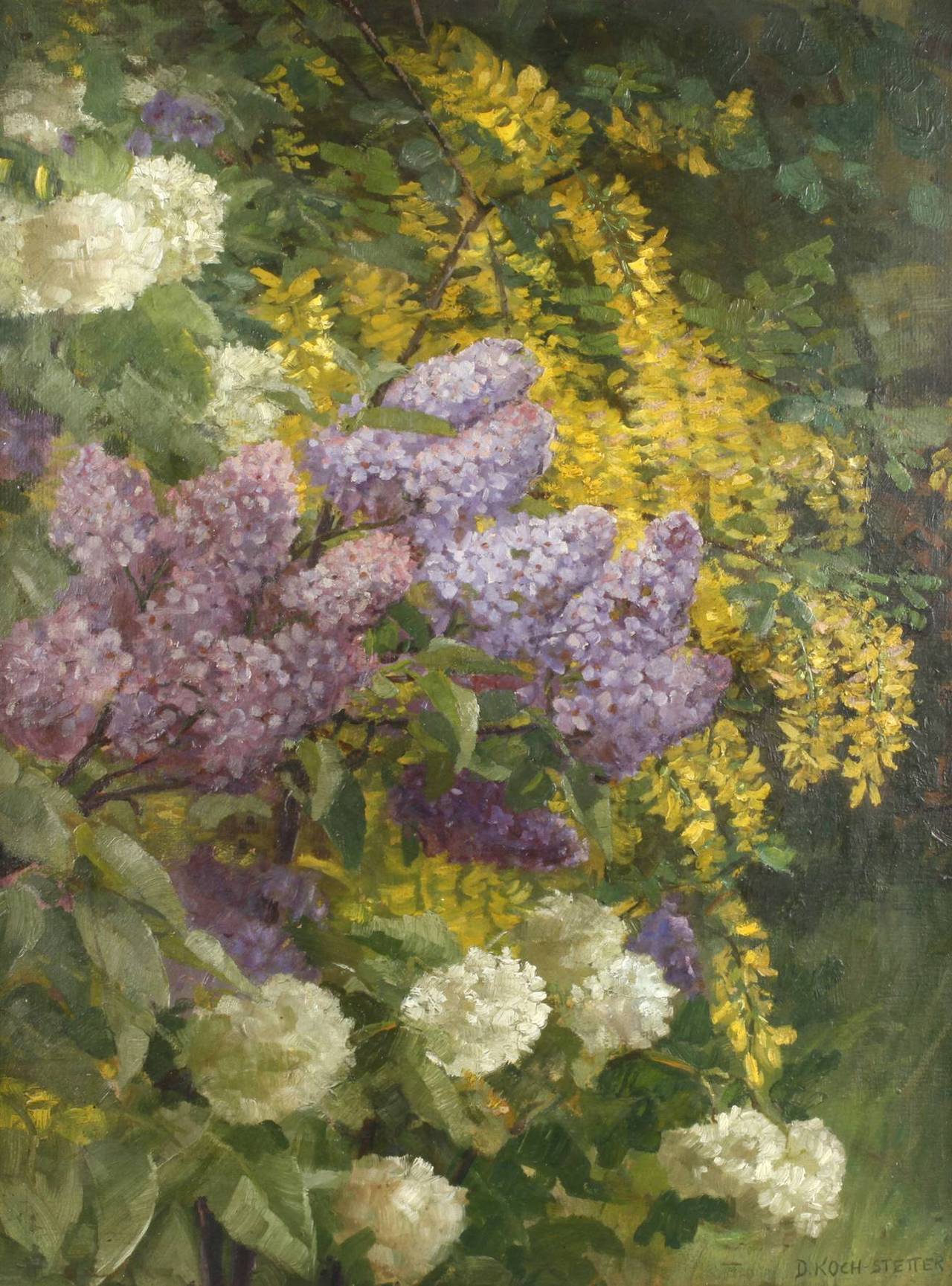
Lilacs by Dora Koch-Stetter

Share

Friday, March 20, 2026

The First Spring Day


I wonder if the sap is stirring yet,
If wintry birds are dreaming of a mate,

If frozen snowdrops feel as yet the sun

And crocus fires are kindling one by one:

Sing, robin, sing!

I still am sore in doubt concerning Spring.
I wonder if the spring-tide of this year
Will bring another Spring both lost and dear;
If heart and spirit will find out their Spring,
Or if the world alone will bud and sing:
Sing, hope, to me!
Sweet notes, my hope, soft notes for memory.
The sap will surely quicken soon or late,
The tardiest bird will twitter to a mate;
So Spring must dawn again with warmth and bloom,
Or in this world, or in the world to come:
Sing, voice of Spring!
Till I too blossom and rejoice and sing.

By Christina Rossetti
(Artwork "The First Buds of Spring" by Lionel Percy Smythe, courtesy of Hermes.) Share

Thursday, March 19, 2026

"The Vision of St. Joseph" by James Tissot

What a wonderful angel! Via East of the Sun, West of the Moon.

"I am poor, and in labors from my youth and being exalted, I was humbled and troubled." Psalm 87:16

Joseph of Nazareth
On a joiner's bench
You ply your trade.
Hands calloused
Fingers nimble.
Wood chips and shavings
At your feet.
Sawdust
In your beard.
You sing
The song of your people
Longing
For the Face
Of Him
Who is to come.

Joseph of Nazareth
Of David's line
You sing
The wedding song.
"My sister, my spouse
Is a garden
Enclosed..."
Virgin husband
Of the Daughter of Sion
You prepare a
Dwelling
For the Stainless One.

Joseph of Nazareth
In sweat of anguish
You ponder
Another Joseph
Thrown in the cistern.
Your song
Becomes sad.
"Save me
O God
For the waters
Are come in
Even unto
My soul..."
You sing
Then fall silent.
Sleep comes
With the breeze
That stirs
The curls of wood...
And then
The voice: 
"Joseph, Son of David,
Fear not...."

By a Carmelite tertiary Share

Tuesday, March 17, 2026

Bards

It has always fascinated me how the telling of stories was held in high regard in Irish culture. Here is a little history:

In medieval Ireland, bards were one of two distinct groups of poets, the other being the fili. According to the Early Irish law text on status, Uraicecht Becc, bards were a lesser class of poets, not eligible for higher poetic roles as described above. However, it has also been argued that the distinction between filid (pl. of fili) and bards was a creation of Christian Ireland, and that the filid are were more associated with the church.[3]

Irish bards formed a professional hereditary caste of highly trained, learned poets. The bards were steeped in the history and traditions of clan and country, as well as in the technical requirements of a verse technique that was syllabic and used assonance, half rhyme and alliteration, among other conventions. As officials of the court of king or chieftain, they performed a number of official roles. They were chroniclers and satirists whose job it was to praise their employers and damn those who crossed them. It was believed that a well-aimed bardic satire, glam dicenn, could raise boils on the face of its target.

The bardic schools were extinct by the mid 17th century in Ireland and by the early 18th century in Scotland.

The bards played an important role in preserving the traditions and legends of the Irish people, as well as their genealogical connections. Stories were passed on through poems, songs, ballads and the loricas. According to one article:

Bards are found in Celtic cultures (Ireland, Scotland, Wales, Manx and Brittany) and a rough equivalent can be found in Norse culture, too, where they were known as "scops."

There is no real equivalent to the Celtic Bard in Anglo-Saxon England, however.

In Ireland and Scotland, the use of the word "Bard" apparently fell into some disrepute, as the records we have show that the Bard was simply a minor poet, while the "filidh" (seer) or the "ollave" (master poet) occupied the former status and functions of the Bard....

The word "Bard," in Wales, denoted a master-poet. In Ireland it meant a poet who was not an Ollave, one who had not taken all the formal training. Apparently even the lower-status Irish Bard was on a level with the Welsh Bard in knowledge and poetic education, however, and these were what I have termed "hedge-bards," above.

In the Celtic cultures, the Bard/Filidh/Ollave was inviolate. He could travel anywhere, say anything, and perform when and where he pleased. The reason for this was, of course, that he was the bearer of news and the carrier of messages, and, if he was harmed, then nobody found out what was happening over the next hill. In addition, he carried the Custom of the country as memorized verses...he could be consulted in cases of Customary (Common) Law. He was, therefore, quite a valuble repository of cultural information, news, and entertainment.

Share

Wednesday, March 11, 2026

Affirmation of Joy

 From Word on Fire:

Such gentle beauty and light stand as a bulwark against final despair. Sam is in a bad spot, and it seems to him that all hope has gone. Nevertheless, he does not despair, “though here at journey’s end I lie / in darkness buried deep.” He thinks he has reached the bitter end of his journey, and he has been unable to save Frodo. Even so, the words that come unbidden to him affirm a power greater than the darkness and evil that surround him. There is something beyond the evil that oppresses and seeks mastery. “Beyond all towers strong and high, / beyond all mountains steep, / above all shadows rides the Sun / and Stars for ever dwell,” he says. The sun and stars are not held captive by the artifacts of instrumentalized reason, for they are beyond and so greater than all such products of war. Indeed, the sun and stars are “above all shadows” whatsoever, and untouched by them. For this reason, although Sam thinks he is going to die, he will not despair: “I will not say the Day is done, / nor bid the Stars farewell.”

Sam’s song affirms a primordial light and beauty that no shadow, no matter how powerful and complete it may seem, can touch. In this way, the sorrow and grief that seem so absolute are relativized against the backdrop of an ever-greater goodness and beauty. Even though it seems certain that he himself will perish, a final despair is not Sam’s decision to make. Miraculously, he does not perish, for Frodo hears him singing, and the two are reunited and able to escape the tower. 

“Dover Beach” and “In Western Lands Beneath the Sun” offer two distinct ways to look upon the world. Arnold looks out upon the beauty of the world and concludes to its irrationality. Sam looks upon the darkness and shadows that surround him and sees beyond them a light and beauty untouched by any passing shadow. In this way, Sam Gamgee affirms what Arnold, in “Dover Beach,” denies. (Read more.)


Share

Tuesday, March 3, 2026

The Magnetic Pull of Wonder

 From C.S. Lewis Substack:

For myself, the medium of wonder has often been poetry. As I recently confessed to my friend Miroslav Volf, “I wouldn’t even be a religious person were it not for poetry, which has not only repeatedly brought me into contact with an other, but has seemed to demand something of me in its wake . . . But poetry remains perpetually open. God moves through art but doesn’t get stuck there. I sometimes think he gets stuck in theology—fixed, frozen, and therefore inevitably falsified.”2

Lewis had a way of letting the transcendent move through his art. And for all his reasoned approaches, he left room for awe. He referred to the spiritual dimension as the distinct feeling of “numinosity,” echoing the term coined by German theologian Rudolf Otto. For Lewis, numinosity meant the singular “Other” quality of the divine. In the face of the divine Other, astonishment is the natural human response.

And Christianity is certainly astonishing. In my letters with Miroslav, published in Glimmerings, I reflected, “I often hear secular people marveling at the sheer preposterousness of Christianity—God walking around the world, zapping water into wine, modern people cheerfully eating his flesh and drinking his blood—but, for me, no small part of Christianity’s appeal is that very preposterousness.”3

It is, as I said earlier, an insult to common sense, which I cherish because I am quite sure that what we call common sense is uncommonly wrong. (Read more.)

Share

Saturday, February 28, 2026

A Review of 'The Heft of Promise' by Frederick Wilbur

 From poetess Maggie Quesenberry Smith:

Frederick Wilbur’s The Heft of Promise explores faith, doubt, and reason by recounting one man’s losses and setbacks, which he tries to endure throughout the labors of farm work, woodworking, and poesy. Many of these poems are meditations on submitting to the discipline of woodworking even though the art’s labor makes unruly clutter no one else understands—a host of tools, profuse wood shavings, deep scars marring his worn work bench. In the end, the poet experiences a watershed moment. He realizes that he will have to let go of his faith in the “dignity of labor” in the end. In “Asylum: Way of Being,” the poet says,


...My hand tools
become mantle shelf antiques,
valuable to collectors in pristine uselessness:
my making made me.

As the poems progress here, the poet’s “latch-bolt / snugs to its keeper.” The poet realizes that a man’s faith solely rooted in Earth cannot sustain him, even though the real world is sometimes all he believes in. In this collection, one man’s story unfolds as he learns from his labor that parables exist there, waiting to emerge as the natural world reveals them through his making.

This collection of poems also explores the pitfalls today in pursuing truth and beauty through poetry rooted in rural, place-based romanticism. This is an age where expeditious consumerism and complex technologies threaten neo-romantic perspectives, well-divorced from Virginia’s rural landscapes, so Wilbur realizes it has become difficult to convince newcomers that homeplaces have enough value for one to invest the work in their husbandry and upkeep. Throughout life’s joys and lamentations, the speaker weighs his worldly blessings and eternal hopes dependent on his earthly possessions and discovers even homeplaces will be too heavy to remember until death. These poems unveil the poet’s slow embrace of simple poverty and the freedom it brings once the poet’s hope and faith are authentic and unfettered by all the substitute “blessings” the materially poor seek in coincidental “finds” throughout the world’s auction houses and salvage yards.

Even the poet’s promises become too heavy to bear, even “empty promises.” While hopeful, people plan and promise, but they are ignorant of their flaws, fragilities, and blind sides. Often, they do not understand the long-term endurance and sacrifices their promises make. Also, the poet shows that the world can “befuddle” our hopes. Sometimes, the world exposes the well-meaning messiness our shortsighted labor and industries engender, much like Wilbur’s hapless cardinal in “Dustwings,” which hits a storm-window and leaves traces from its wings’ prints in the window’s dust. Likewise, Wilbur explores the fact that real world interferences, distractions, and redirections ever thwart our promises, and the guilt of falling short of one’s promises to finish well-laid plans grows too heavy for the poet to bear, driving him to winnow what to keep from what to get rid of—what to get out of his dwellings, out of his memories. What will that engender, though? (Read more.)

Share

Monday, January 5, 2026

The Lord of Misrule

It is the Twelfth Night.

Fisheaters has everything you need to know about Twelfth Night, including a poem by Robert Herrick:
Twelfth Night: Or King and Queen

Now, now the mirth comes
With the cake full of plums,
Where bean's the king of the sport here;
Beside we must know,
The pea also
Must revel, as queen, in the court here.

Begin then to choose,
This night as ye use,
Who shall for the present delight here,
Be a king by the lot,
And who shall not
Be Twelfth-day queen for the night here.
Share

Thursday, January 1, 2026

And the New Sun Rose Bringing the New Year


One of the most stirring passages from Tennyson's Idylls of the King are the last stanzas of "The Passing of Arthur," in which the wounded king is spirited away to the "island-valley" of Avalon. 
And slowly answered Arthur from the barge:
‘The old order changeth, yielding place to new,
And God fulfils himself in many ways,
Lest one good custom should corrupt the world.
Comfort thyself: what comfort is in me?
I have lived my life, and that which I have done
May He within himself make pure! but thou,
If thou shouldst never see my face again,
Pray for my soul. More things are wrought by prayer
Than this world dreams of. Wherefore, let thy voice
Rise like a fountain for me night and day.
For what are men better than sheep or goats
That nourish a blind life within the brain,
If, knowing God, they lift not hands of prayer
Both for themselves and those who call them friend?
For so the whole round earth is every way
Bound by gold chains about the feet of God.
But now farewell. I am going a long way
With these thou seest—if indeed I go
(For all my mind is clouded with a doubt)—
To the island-valley of Avilion;
Where falls not hail, or rain, or any snow,
Nor ever wind blows loudly; but it lies
Deep-meadowed, happy, fair with orchard lawns
And bowery hollows crowned with summer sea,
Where I will heal me of my grievous wound.’
So said he, and the barge with oar and sail
Moved from the brink, like some full-breasted swan
That, fluting a wild carol ere her death,
Ruffles her pure cold plume, and takes the flood
With swarthy webs. Long stood Sir Bedivere
Revolving many memories, till the hull
Looked one black dot against the verge of dawn,
And on the mere the wailing died away.
But when that moan had past for evermore,
The stillness of the dead world’s winter dawn
Amazed him, and he groaned, ‘The King is gone.’
And therewithal came on him the weird rhyme,
‘From the great deep to the great deep he goes.’
Whereat he slowly turned and slowly clomb
The last hard footstep of that iron crag;
Thence marked the black hull moving yet, and cried,
‘He passes to be King among the dead,
And after healing of his grievous wound
He comes again; but—if he come no more—
O me, be yon dark Queens in yon black boat,
Who shrieked and wailed, the three whereat we gazed
On that high day, when, clothed with living light,
They stood before his throne in silence, friends
Of Arthur, who should help him at his need?’
Then from the dawn it seemed there came, but faint
As from beyond the limit of the world,
Like the last echo born of a great cry,
Sounds, as if some fair city were one voice
Around a king returning from his wars.

Thereat once more he moved about, and clomb
Even to the highest he could climb, and saw,
Straining his eyes beneath an arch of hand,
Or thought he saw, the speck that bare the King,
Down that long water opening on the deep
Somewhere far off, pass on and on, and go
From less to less and vanish into light.
And the new sun rose bringing the new year.


Share

Friday, December 26, 2025

How Shakespeare Helped Shape Christmas As We Know It Today

From Daniel McCarthy at The New York Post:

“Hamlet” isn’t altogether a Christmas play, but Christmas is a conspicuous part of it. And there is good reason to think that “Hamlet” was much on the minds of two authors who shaped modern conceptions of Christmas in the 19th century. Clement Clarke Moore’s 1823 poem “A Visit from St. Nicholas” (“’Twas the night before Christmas. . .”) includes the charming line “Not a creature was stirring, not even a mouse” — which echoes the guard at Elsinore who reports “Not a mouse stirring.” Twenty years later in “A Christmas Carol,” Charles Dickens would refer to Hamlet’s ghost in his own tale of yuletide hauntings.

In fact, Dickens observes the rule Marcellus set down in “Hamlet”: The ghosts are gone, their work accomplished, by the dawn of Christmas Day. There’s a faint reminder of “Hamlet” in an earlier Dickens tale set at Christmas as well. As in “Hamlet,” an impudent gravedigger features in a Christmas episode of “The Pickwick Papers,” “The Story of the Goblins Who Stole a Sexton.” Curiously, the goblin who first accosts the gravedigger has a catchphrase — “Ho! Ho! Ho!” — now familiar with a very different Christmas character. Moore and Dickens knew their Shakespeare, and when they set out to create new stories for the season, they didn’t forget the precedents the Bard had provided, few though they were.

“A sad tale’s best for winter: I have one of sprites and goblins,” says Mamillius in “The Winter’s Tale.” In Shakespeare’s day, sprites and goblins — and ghosts — were seasonally appropriate before Christmas. There’s debate about whether Shakespeare invented the “Marcellus rule” that banned such beings from Christmas Day onward, through Twelfth Night on the eve of Epiphany. Yet if there were no ghosts, there were other kinds of spirits. The “Twelve Days of Christmas” were a time of revelry — drinking, singing, putting on plays, and merriment — when not Santa Claus but a “Lord of Misrule” was the mascot of the season.

In Shakespeare’s age Puritans, much like Hamlet, were scandalized by bibulous customs like the wassail. “Hamlet” reminds us that our Christmas troubles and soul-searching are not altogether new. Shakespeare, too, had to ask whether his country had lost its values: Was it Christian or pagan, Catholic or Protestant, stoically philosophical or, like Hamlet in his agony, nihilistic and despairingly materialist? (Read more.)

Share

Saturday, December 13, 2025

A. A. Milne's "King John"

I loved this poem as a child. It still brings tears to my eyes.
King John was not a good man –
He had his little ways.
And sometimes no one spoke to him
For days and days and days.
And men who came across him,
When walking in the town,
Gave him a supercilious stare,
Or passed with noses in the air –
And bad King John stood dumbly there,
Blushing beneath his crown.


King John was not a good man,
And no good friends had he.
He stayed in every afternoon…
But no one came to tea.
And, round about December,
The cards upon his shelf
Which wished him lots of Christmas cheer,
And fortune in the coming year,
Were never from his near and dear,
But only from himself.


King John was not a good man,
Yet had his hopes and fears.
They’d given him no present now
For years and years and years.
But every year at Christmas,
While minstrels stood about,
Collecting tribute from the young
For all the songs they might have sung,
He stole away upstairs and hung
A hopeful stocking out.


King John was not a good man,
He lived his live aloof;
Alone he thought a message out
While climbing up the roof.
He wrote it down and propped it
Against the chimney stack:
“TO ALL AND SUNDRY - NEAR AND FAR -
F. Christmas in particular.”
And signed it not “Johannes R.”
But very humbly, “Jack.”


“I want some crackers,
And I want some candy;
I think a box of chocolates
Would come in handy;
I don’t mind oranges,
I do like nuts!
And I SHOULD like a pocket-knife
That really cuts.
And, oh! Father Christmas, if you love me at all,
Bring me a big, red, india-rubber ball!”


King John was not a good man –
He wrote this message out,
And gat him to this room again,
Descending by the spout.
And all that night he lay there,
A prey to hopes and fears.
“I think that’s him a-coming now!”
(Anxiety bedewed his brow.)

“He’ll bring one present, anyhow –
The first I had for years.”


“Forget about the crackers,
And forget the candy;
I’m sure a box of chocolates
Would never come in handy;
I don’t like oranges,
I don’t want nuts,
And I HAVE got a pocket-knife
That almost cuts.
But, oh! Father Christmas, if you love me at all,
Bring me a big, red, india-rubber ball!”


King John was not a good man,
Next morning when the sun
Rose up to tell a waiting world
That Christmas had begun,
And people seized their stockings,
And opened them with glee,
And crackers, toys and games appeared,
And lips with sticky sweets were smeared,
King John said grimly: “As I feared,
Nothing again for me!”


“I did want crackers,
And I did want candy;
I know a box of chocolates
Would come in handy;
I do love oranges,
I did want nuts!
I haven’t got a pocket-knife —
Not one that cuts.
And, oh! if Father Christmas, had loved me at all,
He would have brought a big, red,
india-rubber ball!”


King John stood by the window,
And frowned to see below
The happy bands of boys and girls
All playing in the snow.
A while he stood there watching,
And envying them all …
When through the window big and red
There hurtled by his royal head,
And bounced and fell upon the bed,
An india-rubber ball!

And oh Father Christmas,
My blessings on you fall
For bringing him a big, red,
India-rubber ball!


(From Now We Are Six)

Share