Showing posts with label Classic Films. Show all posts

Wednesday, June 3, 2026

5 Obsession-Driven Noir Films Adapted from Novels

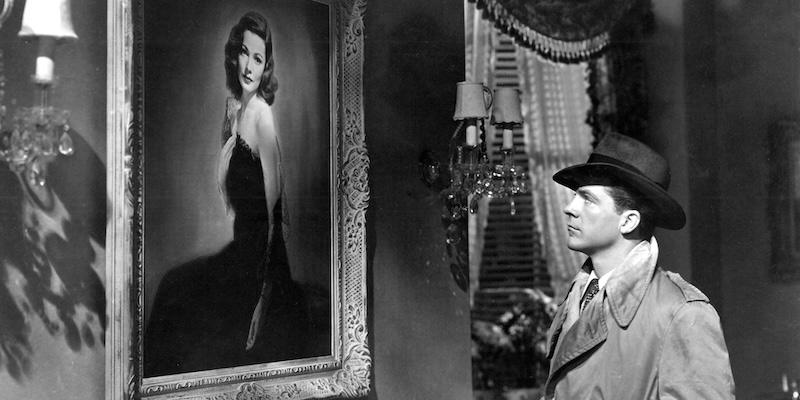
From Laura (1944)

 From CrimeReads:

When I first heard Sting’s lyrics to “Every Breath You Take,” the song’s chilling, threatening tone made me genuinely uneasy. Was someone watching me? Should I be looking over my shoulder? It seemed he had written a definitive stalker’s anthem. And yet, as unsettling as it was, the song was the sole number one hit for The Police and won a Grammy award for Song of the Year in 1984.

Are we obsessed with obsession? Possibly. Obsessive characters abound in creative works, and as I thought about it, several of my favorite films immediately came to mind. Characters with unrelenting fixations drive the disturbing plots of the following classic noir or noir-ish films, all craftily adapted from popular novels.

I recall reading Daphne du Maurier’s suspenseful masterpiece, Rebecca, in high school. I became immediately intrigued by the tangled tale of “the first Mrs. de Winter,” the beautiful and captivating Rebecca. Presumed to have died in a tragic boating accident near Manderley, her husband’s family’s estate on the southern shore of England, she reaches out from her watery grave to extend a forceful hold on the lives of those who loved or hated her. Her former temperamental husband Maxim, the naively insecure “second Mrs. de Winter,” and Manderley’s sinister housekeeper Mrs. Danvers, are all trapped, unable to escape from Rebecca’s manipulative grasp, as if she were stalking and haunting them from the afterlife.

And Mrs. Danvers, a name that has become synonymous with wickedness in film lore, is especially vulnerable. “Danny” professes that she would do anything for her former mistress, and her unrelenting obsession ultimately leads to devastation and her own demise. Hitchcock’s Gothic film noir adaptation, riveting and true to du Maurier’s novel, won Academy Awards for Best Picture and Best Cinemaphotography (Black and White). (Read more.)


Share

Tuesday, June 2, 2026

Make Humans Great Again

 From Chronicles:

One day in the 1960s, in a forest in Tanzania, a 26-year-old British ethologist watched a chimpanzee she had nicknamed “David Greybeard” digging termites out of a mound with a stick. Birds had long been known to use “tools”—Egyptian vultures drop stones onto eggs to crack them open, and Darwin had seen finches on the Galapagos Islands using cactus spines to pry insects out of wood. But Jane Goodall was astounded to see a mammal doing something similar. It strengthened in her mind something that had often been surmised—that chimpanzees were proto-humans, us as we used to be millions of years before we diverged into Australopithecus, Neanderthal, and, finally, Sapiens. 

Humans have always been fascinated by primates. African animists worshipped gorillas as gods, the Dayaks of Borneo saw orangutans as near-kin (“orangutan” means “people of the forest”), and Westerners encountering primates after the 16th century embraced them as pets and circus animals. We would later derive endless entertainment from the likes of King Kong, Tarzan, Planet of the Apes, and 2001: A Space Odyssey. Linnaean taxonomy and Darwinian evolution can even be seen as systematizations of an ancient obsession with the “wild men” of legends—hirsute forest-dwellers both disconcertingly familiar and dangerously fey. 

Goodall had been a student of the paleoanthropologist Louis Leakey, originator of the “out of Africa” theory of human evolution, who was likewise fascinated by the great apes. Other 20th-century influencers famously interested in apes included Robert Yerkes, the once-celebrated psychologist who devised intelligence tests for the U.S. Army, and whose 1925 book Almost Human recounted his delight in the company of Prince Chim, an “intellectual genius” of a bonobo, with whom he shared his New Hampshire home.

Growing liberalization and secularization of thought over the 20th century would encourage new ways of viewing ourselves and animals. By 1965, Goodall was on the cover of National Geographic, celebrating the chimpanzee as an almost-person—no mere bundle of Brownian instincts, but a distant cousin, whose obvious skeletal similarities were mirrored by humanlike behavioral traits. (Goodall herself was careful never to read too much into chimpanzees’ apparent “emotions,” however.) (Read more.)

Share

Friday, May 1, 2026

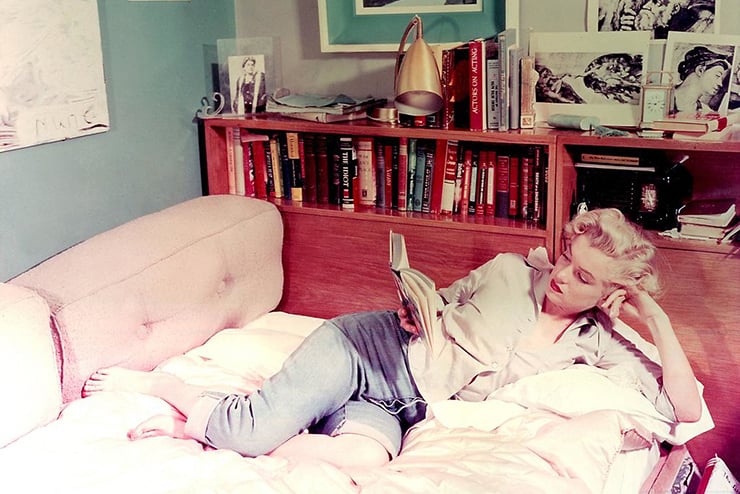
The Lost Literary Life of Marilyn Monroe

The Lost Literary Life of Marilyn Monroe 

Marilyn worked very hard to better herself, as an actress and as a human being. She studied at the Actors Studio with Lee Strasburg and while in New York became friends with journalist Dorothy Kilgallen. She was good with money, too. She lived frugally and invested wisely. She was no spendthrift, as some people might think. From Mark Judge at Chronicles:

Marilyn Monroe read books. A lot of them. That’s the revelation of Marilyn and Her Books: The Literary Life of Marilyn Monroe, a fascinating new volume by Gail Crowther. It isn’t a grasping-at-straws attempt to make Monroe a literary figure based on her love of a few good novels. Crowther has done her research, itemizing the books Monroe owned when she died, finding receipts for books she bought at the Ivy Bookstore in Los Angeles, and going through old letters in which Monroe discussed her favorite books. Monroe was a reader, which may explain why she was drawn to one of her husbands, the playwright Arthur Miller—a man who made his living with words.

When Monroe died in 1962, her collection included more than 400 books. “These books,” Crowther notes, “some dating from her childhood, had followed Marilyn around from one address to another.” Crowther describes the collection: 

The scope of Marilyn’s personal library and the number of genres it contained was impressive. She read literature from all around the world, America, England, France, Germany, but certainly favored Russian novels. She enjoyed poetry, politics, psychology, plays, biographies, science, short stories, cookbooks, horticulture, contemporary novels, children’s books, religion, crime, adventure, art, pets, music, reference, and self-help. She was probably one of the few readers in the world whose personal library contained a biography of herself (Marilyn Monroe “Her Own Story,” 1961, by George Carpozi). 

Monroe loved D. H. Lawrence and owned a poetry collection, the novel Sons and Lovers, a collection of his travel writings, Etruscan Places, and a critical study of Lawrence and his works by Mary Freeman. She also owned copies of The Great Gatsby and Tender is the Night by F. Scott Fitzgerald. She owned a first edition of Ian Fleming’s From Russia, With Love, a book that included a chapter titled “The Mouth of Marilyn Monroe.” Monroe loved Russian literature, bonding with actress, columnist, and writer Sheilah Graham over Dostoevsky, Tolstoy, Chekov, Turgenev, and Pushkin.

Monroe also had “an edgy liking for banned books.” This included The Last Temptation of Christ by Nikos Kazantzakis. Monroe’s copy of the novel sold for $3,220 in a 1999 auction. She also owned a 1934 first edition of Ulysses, published after the ruling that the James Joyce novel was not obscene and could not be banned. (Read more.)

Share

Friday, April 24, 2026

'The Killers': The Only Adaptation That Ernest Hemingway Loved

From Far Out:
A masterful example of the quintessential film noir, The Killers has gone down in history as one of the best works from the immensely popular genre. Based on a story by Ernest Hemingway, this was the film that landed Burt Lancaster and Ava Gardner unprecedented fame and success. However, the greatest achievement of The Killers is that it has firmly retained its cinematic magic even after all these years.

Right from the very beginning, The Killers keeps the audience on its toes and confronts them with quasi-surreal imagery. Presented like the contents of a bizarre dream, two professional assassins casually walk into a small-town diner in order to capture and kill a man known as the Swede (Lancaster). Within minutes, the atmospheric silence ignites into a cloud of chaos. A hostage situation arises out of nowhere and is defused just as quickly. The protagonist is brutally gunned down in the first ten minutes. Everything falls apart.

This initial spiral into beautiful absurdism plays a vital role in the momentum of the film’s subsequent discursive pathways. We follow an insurance investigator (played by Edmond O’Brien) who enters a dangerous world of crime and intrigue while trying his best to pick up the fragmented pieces of the narrative. Unlike many other suspense thrillers whose success hinges on the excitement of the final destination, The Killers is all about the journey and what a journey it is indeed!

Throughout his life, Hemingway was a very vocal critic of the Hollywood factory and often criticised films that were based on his works. However, The Killers is a significant exception to Hemingway’s general disdain for the machinations of the film industry. He famously wrote: “It is a good picture and the only good picture ever made of a story of mine.”

The screenplay, although credited to Anthony Veiller, was also co-written by the likes of John Huston and Richard Brooks. A major reason behind the efficiency of The Killers is the slick screenplay which manages to capture the poetry of Hemingway’s art.

Structured through the flashbacks and recollections of various characters, we are given fleeting visions of the past life of our dead protagonist. Director Robert Siodmak arranges these accounts in the form of poignant puzzle pieces which come together to form a mesmerising gestalt instead of a mere summation. Ranging from ex-lovers to prison inmates, The Killers functions like a fictional documentary that attempts to reconstruct the impenetrable mythology of a film noir mystery.

There are philosophical reflections sprinkled in there as well, most evident in the figure of the Swede’s cellmate in prison who spends his time studying constellations which invoke the memory of Oscar Wilde’s famous quote: “We are all in the gutter, but some of us are looking at the stars.” (Read more.)
Share

Monday, April 13, 2026

Audrey Hepburn’s Pearl Necklace In 'Breakfast At Tiffany’s'

 From British Vogue:

Under the lavender light of dawn in New York City, a yellow taxi stops in front of Tiffany & Co. on Fifth Avenue. A slender figure emerges, dressed in a sleeveless black Givenchy dress, her arms covered by elbow-length gloves. She moves slowly towards the shop window. The camera lingers first on her back: her hair swept into an elegant updo, almond-shaped diamanté clips at her ears, and the open cut of the dress revealing her shoulders. Above the black straps of her dress runs a five-strand pearl necklace, luminescent and striking. As the camera pans, the delicate features of Audrey Hepburn’s face come into view. Her eyes are hidden behind dark sunglasses; a small diamanté coronet crowns her hair. As Holly Golightly, Hepburn elegantly bites into a croissant and sips coffee from a paper cup.

The opening frames of 1961’s Breakfast at Tiffany’s are some of the most memorable – and most stylish – in cinematic history. Lily Collins (taking a break from playing Emily in Paris, Rome and potentially Greece), is set to star as Hepburn in a film about the making of the adaptation of Truman Capote’s novella. While Hepburn’s Hubert de Givenchy gown remains one of the most iconic dresses ever captured on film (she and the French couturier had a 40-year friendship, with him also designing her costumes for 1953’s Funny Face and 1957’s Sabrina), the pearl necklace she wears – which closes at the front with a sparkling clasp – is also one of the most memorable jewellery pieces in film history. Poignantly, the most famous pearl necklace in the history of cinema was not made of pearls at all. Rather it is non-precious costume jewellery, created by the French jewellery designer Roger Scemama.

To begin with, the film faithfully echoes the look described in Capote’s story, in which Golightly is introduced wearing “a slim cool black dress, black sandals, a pearl choker”. The multi-strand pearl necklace complements the architectural simplicity of the dress. On set, a necklace made of real pearls and precious stones would have been an impractical costuming choice: it would have taken longer to produce – and of course cost far more. But most importantly of all, it would not have been right for Holly Golightly – a young woman in the process of inventing her identity and her place in New York society. As her supposed talent agent, OJ Berman, memorably tells Paul Varjak (the “kept man” and struggling writer played by George Peppard): “She is a phoney.” Costume jewellery, therefore, becomes a perfect metaphor for a character whose glamour is largely performative. (Read more.)

Image may contain Person Head Face Smoke Book Publication Clothing and Coat

Share

Saturday, February 28, 2026

The Leopard (2025)

Netflix's 'The Leopard' Teaser Sends the High Society of Sicily Into  Disarray 
It tells us something about how elites seek to retain their power': How  Lampedusa's The Leopard skewered the super-rich 
If we want things to stay as they are, things will have to change. ~The Leopard
The 1963 Visconti film The Leopard (Il Gattapardo), based upon the novel by Giuseppe de Lampedusa about his great grandfather, is an undoubted masterpiece. Both the novel and 1963 film depict the struggles of a princely Sicilian family, under the leadership of their patriarch Don Fabrizio, to navigate the Revolution, called in Italy Il Risorgimento. Il Risorgimento (1848-1870) also labelled the unification of Italy, involved the dominance of the House of Savoy over the other principalities of the Italian peninsula, including the ancient Kingdom of the Two Sicilies, likewise known as the Kingdom of Naples and Sicily. The unification was a violent process led by the masonic revolutionary Giuseppe Garibaldi and his Red Shirts. Don Fabrizio, Prince of Salina, peer of the Sicilian Kingdom, must make some hard decisions in order to protect his wife and children, while salvaging his patrimony and preserving his honor. This is no small task in an era of war and of swiftly changing loyalties amid political upheaval. Luchino Visconti, in spite of being a Communist, crafted an authentic yet transcendent portrayal of a family in crisis, set to a magnificent score by Nino Rota. The 1963 film has become for many the defining depiction of Il Risorgimento. It certainly has been for me, until I recently decided to watch the Netflix series based on Il Gattapardo. The 2025 version is a masterpiece in its own right.
 

The new series is in the grand tradition, with all the cinematic bells and whistles (no matter that I watched it on my laptop). Wikipedia says this:

Principal photography began in April 2023. Filming took place over 105 days and required the use of 5,000 extras; 130 carriages, carts and boats; 100 animals; and 12 animal trainers.

A friend of mine (Italian) said, “The real star of the show is Sicily.” She makes a good point. I’m not sure that Sicily has ever been more beautiful or alluring than in this show. The Netflix Leopard is a feast for the eyes. Almost indecently sumptuous. The flowers, the lemon groves, the palazzos — the food! And, of course, the people: the principal actors and actresses. Gorgeous people, on a gorgeous island, gorgeously shot. That is a commendation already.

The title character — the prince, the Leopard, also known as Don Fabrizio — is portrayed by Kim Rossi Stuart. (One of his grandparents was Scottish. He was named for Kipling’s title character.) Stuart’s prince is suave, worldly, world-weary, charismatic — every inch a prince, really.

Tancredi, that Garibaldian rascal, is played by Saul Nanni, born in 1999. I came to detest the character — not because the actor does anything wrong but because I wanted Tancredi to do right by Concetta and Angelica (and he does right by neither). Do you ever try to “edit” a movie, so as to make it come out right, by your lights? Life can be frustrating, onscreen as off . . .

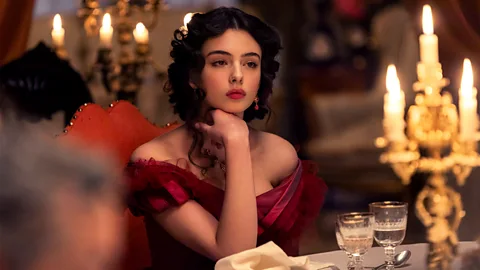
Concetta is Benedetta Porcaroli, who reminds me of Lady Di, as we knew her, before she became a princess. Angelica is Deva Cassel, born in 2004. Signorina, or Mademoiselle, Cassel is the daughter of Vincent Cassel (the French actor) and Monica Bellucci (the Italian model and actress). How ugly can she be, I ask you? Angelica in this series is sex on wheels — a danger to young men, old men, and, you could say, herself.

 Don Calogero is portrayed by Francesco Colella. The character is supposed to be a villain of the piece, and in a way he is: he behaves badly. But many do. And he is a man born poor who is trying to rise in the world: trying to have some of the money, influence, and power that the likes of Don Fabrizio have dropped into their laps at birth. (Read more.)

One would think that a film about Sicilian aristocrats would have nothing to say to American audiences. Yet the story is essentially about family cohesion in a rapidly changing world, to which just about anyone alive today can relate. Dysfunctional dynamics can haunt palaces as well as cottages, with petty jealousies, spousal disagreements, infidelities. But devotion and sacrifice are also there, as well as shared jokes and effervescent joy. Most of all the roles of the father and the mother in keeping the family together, in spite of their personal issues, are inspiring.

At the core of the story is Don Fabrizio's daughter Concetta, a devout and disciplined principessa, convent-bred, who is in love with her cousin Tancredi. In the course of the series, Concetta is faced with painful choices, but in spite of being as passionate and headstrong as the men in the family, chooses the most noble courses of action. Both her suffering and contentment are projected in her jewel-like eyes, even while her modest and dignified bearing attempt to hide her emotions.

Fabrizio himself tries to follow the traditional code of chivalry. His patriarchal duties, especially the duty to protect his family, are second nature to him. When the mayor's daughter, the magnificent Angelica, hints that being his mistress would not be distasteful to her, the Prince lightly dismisses the idea, ignoring his own desire for the girl. He encourages her to marry his nephew, knowing that will be the best thing for everyone. He comes as close as he can to her in a single waltz, in which he maintains a gentlemanly reserve. Meanwhile, the new order has triumphed, as the characters dance in resplendent, frescoed rooms built by the old order.

There is one glimpse of boudoir activity which renders the series unsuitable for children. It would be odd to make a series about Sicily without scenes of religious faith. The Leopard is full of displays of piety, such as when the family prays the rosary together, although in the old film they were kneeling, not sitting. But there is certainly more Catholic imagery than there is sex. The family chaplain is in practically every scene, along with discussions of heaven and hell. The visuals are stunning on a life-changing level; the costumes prove that authenticity and artistry can work side-by-side. It shows what beauty Netflix can produce when willing to do so.

 The Leopard' Netflix Review: Stream It Or Skip It?

 Everything You Need to Know About 'The Leopard,' Netflix's Lush New Italian  Period Drama | Vogue

Share

Monday, February 9, 2026

On the Waterfront (1954)

 On The Waterfront - Hollywood's "Real Contenda" 

From Word on Fire:

The film became the definitive work of “actors’ director” Elia Kazan, inspiring countless artists, including Martin Scorsese and Robert De Niro, who called Kazan “a master of a new kind of psychological and behavioral faith in acting.” Marlon Brando’s powerful, complex, and vulnerable performance as Terry Malloy set the standard for acting in the generations to come, with Kazan concluding, “If there is a better performance by a man in the history of film in America, I don’t know what it is.”

As On the Waterfront was included in the Vatican’s 1995 Alcuni film importanti list, here are some of the Catholic themes woven throughout the film. 

Elia Kazan (1909–2003) was a Greek-American filmmaker, producer, screenwriter, and actor, described by Stanley Kubrick as “without question, the best director we have in America, and capable of performing miracles with the actors he uses.” Kazan started his career in acting and was an early adherent to the new “method acting” school under the direction of Lee Strasberg. From the outset, Kazan had a particular attraction to stories exploring personal and social issues, including racial prejudice, domestic violence, and union corruption: “I don’t move unless I have some empathy with the basic theme.”

He acted in a few films but found acclaim for his directorial work at the helm of classics like Gentlemen’s Agreement, Pinky, A Streetcar Named Desire, East of Eden, and On the Waterfront. Kazan and the young Marlon Brando first worked together on the Broadway adaptation—and subsequent film adaptation—of Tennessee Williams’s play A Streetcar Named Desire, the story of Blanche DuBois who leaves her wealth to live in the working-class apartment of sister Stella and brother-in-law Stanley (Marlon Brando).

Brando later wrote: 

I have worked with many movie directors. . . . Kazan was the best actors’ director by far of any I’ve worked for . . . the only one who ever really stimulated me, got into a part with me and virtually acted it with me. . . . He was an arch-manipulator of actors’ feelings, and he was extraordinarily talented; perhaps we will never see his like again. 

After the success of Streetcar, Kazan and Brando collaborated again on Viva Zapata! before embarking on their most ambitious project to date, On the Waterfront. The film was inspired by the 1948 New York Sun article series “Crime on the Waterfront” by Malcolm Johnson, which outlined corruption on the New Jersey waterfront. (Read more.)

Amazon.com: On The Waterfront [DVD] : Movies & TV

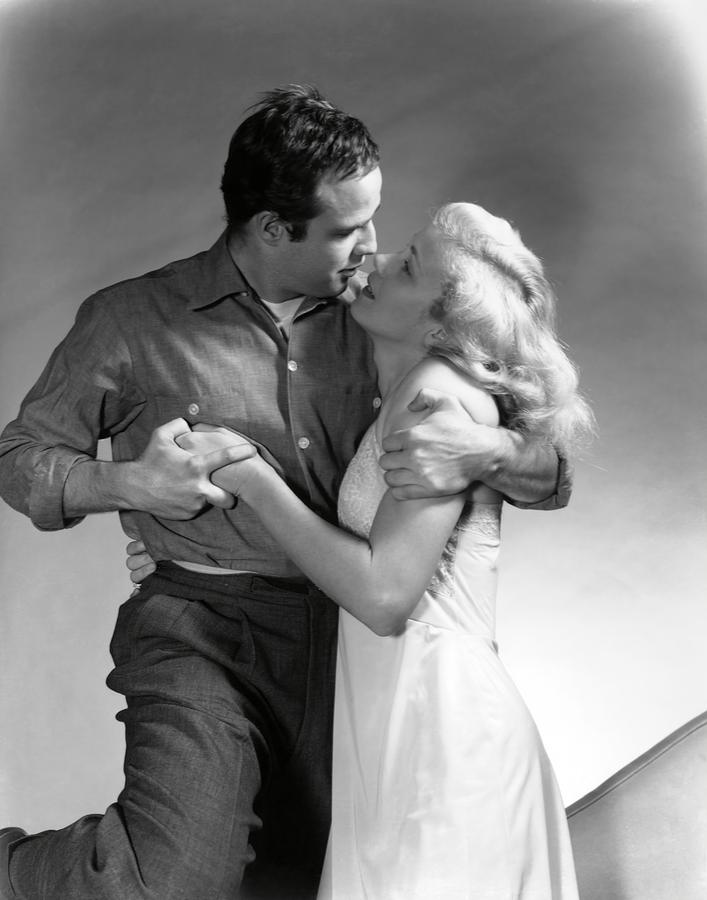
 Marlon Brando and Eva Marie Saint Embrace Photograph - MARLON BRANDO and EVA MARIE SAINT in ON THE WATERFRONT -1954-. by Album

Share

Saturday, February 7, 2026

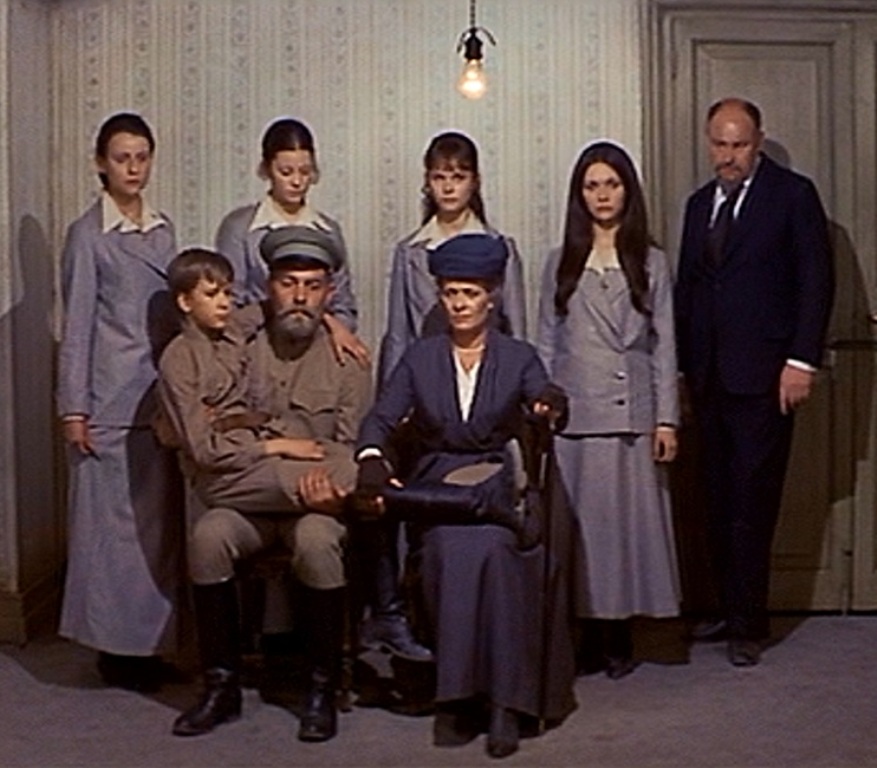
Nicholas and Alexandra (1971)

 Nothing is Written: Nicholas and Alexandra 

The portrayal of the chief murderer of the Imperial Family, Yakov Yurovsky, as a reluctant and humane executioner, has always disgusted me. From Paul Gilbert:

The year 2021 marked the 50th anniversary of the release of the film adaptation of Robert K. Massie’s (1929-2019) classic book Nicholas and Alexandra. Published in 1967, it remained on the New York Times Bestseller List for 46 weeks, and has never gone out of print! Selling more than 4.5 million copies, it is regarded as one of the most popular historical studies ever published. Praised in The New York Times as a “long-needed and balanced account” of the last tsar and his family. In Massie’s study, Nicholas comes across not as the “stupid, weak or bloodthirsty” monarch, as he is often been portrayed by his Western counterparts.

The film version was released on 13th December 1971, and nominated for numerous awards. At the 44th Academy Awards (1972), Nicholas and Alexandra won two awards of six nominations; at the 25th British Academy Film Awards (1972), Nicholas and Alexandra received three nominations; at the 29th Golden Globe Awards (1972), Nicholas and Alexandra received three nominations; and at the 15th Annual Grammy Awards (1973), Richard Rodney Bennett was nominated for Best Original Score Written for a Motion Picture or a Television Special.

The film featured a star-studded cast of notable British actors and actresses: Michael Jayston (1935-2024) as Nicholas II; Janet Suzman [b. 1939] as Alexandra Feodorovna; Irene Worth [1916-2022] as the Dowager Empress Maria Feodorovna; Tom Baker [b. 1934] as Grigori Rasputin; Jack Hawkins [1910-1973] as Count Vladimir Frederiks, the Minister of the Imperial Court; Timothy West [1934-2024] as Dr. Botkin, the court physician; Jean-Claude Drouot [b. 1938] as Pierre Gilliard, the children’s Swiss tutor; Laurence Olivier [1907-1989] as Count Witte, the Prime Minister; Michael Redgrave [1908-1985] as Sazonov, the Foreign Minister; Eric Porter [1928-1995] as Pyotr Stolypin, the Prime Minister after Witte; John McEnery [1943-2019] as Kerensky, leader of the Russian Provisional Government; Michael Bryant [1928-2002] as Lenin; Martin Potter [b. 1944] as Prince Felix Yusupov; Richard Warwick [1945-1997] as Grand Duke Dmitri Pavlovich; among many others.

Personally, I greatly disliked this film for a number of reasons. It is due to the popularity and cult-like status of this film which compelled me to address some of the many factual errors of this film, and that it will serve as a resource for those who have viewed it for the first time. (Read more.)


Share

Friday, February 6, 2026

AFI Theater Declines Journalist Mark Judge’s Anti-Communist Film Festival Without Explanation

 From Breitbart:

The AFI Silver Theatre and Cultural Center in Silver Spring, Maryland, has declined journalist Mark Judge’s upcoming Anti-Communist Film Festival without explanation.

As Breitbart News reported last year, Mark Judge, whose book The Devil’s Triangle chronicled his life’s derailment during the Brett Kavanaugh confirmation hearing, launched the anti-communist film festival in Washington, D.C., to commemorate the 20th anniversary of The Lives of Others – winner of the 2006 Oscar for Best Foreign Language Film. After generating significant grassroots support with his GoFundMe and even some interested sponsors, Judge set his sights on the AFI Silver as a potential venue due to its reputation for being a curator of high quality cinematic arts as well as for its mission statement to educate and enrich the community as a 501C3 non-profit.

Starting in October of last year, emails shared with Breitbart News showed that Judge’s correspondence with the AFI had been amicable and professional, with little to no pushback from the event manager about his desired event. In one email, dated in November 2025, the AFI proposed hosting the festival in August due to September being a relatively busy month.

“September is definitely busier for us than August, so the change to August is a good idea, especially if you are considering expanding the scope of the event,” the event manager said. “Are you interested in Silver I, the 400-seat theater, for both days, or would you like to explore renting multiple theaters? This can be challenging for us at any time of the year, but I am happy to find out what’s possible.”

“For every rental, regardless of the scope, we offer technical support and a dedicated stage manager who will be on site throughout your event, so staffing should not be an issue,” the event manager later added.

As the months unfolded, Judge worked on securing sponsorships while correspondence with the AFI remained amicable. However, in January, when Judge informed the AFI that he stood on the verge of securing the Victims of Communism Memorial (VOC) Foundation as a potential sponsor, the event manager suddenly informed him that prices had increased – the first since it opened in 2003.

“I look forward to learning more about what you and VOC are planning for the Silver. I want to ensure we’re all aligned and confirm what’s feasible on our end before your internal planning progresses too much further. I haven’t yet asked our Programming Director for availability, as I’m waiting for more details from you,” the event manager said.

“Additionally, I’ve just learned that our rental rates will increase for events booked after May, marking our first increase since we opened in 2003,” the manager added. “In September, I quoted you $3,900 for a 2.5-hour event in Silver I, and this will now be $4,400. I apologize for the bad news, but I wanted to give you a heads-up so you can notify VOC if needed.”

That correspondence occurred in early January of this year; nearly three weeks later, after Judge secured the VOC as an official sponsor, the AFI informed Judge it would not be able to host his event. (Read more.)


Share

Tuesday, January 13, 2026

Grace Kelly's Wedding Invitation

grace kelly's wedding invitation 

They call it a "royal" wedding but it was a "princely" wedding, as Monaco is not a kingdom but a principality. From Town and Country:

[GraceKelly's] lavish April 1956 wedding to the Prince of Monaco was filled with the allure and public speculation you'd expect—but there were also quieter, intimate moments under all the glitz and glam. From the first sketch of her handcrafted, lace-embroidered gown to sweet shots of the couple on their honeymoon, get a rare glimpse into what the wedding festivities were really like. (Read more.)
grace kelly stamp

Share

Wednesday, December 31, 2025

Happy New Year!

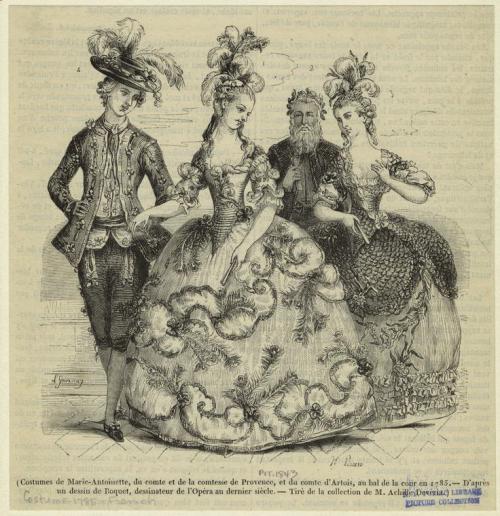
Marie-Antoinette (center) accompanied to a costume ball by Artois, Monsieur and Madame.


Wishing all the readers of Tea at Trianon a New Year of blessings and joy! Share

Wednesday, December 17, 2025

The Lion in Winter (1968)

My life, when it is written, will read better than it lived. Henry Fitz-Empress, first Plantagenet, a king at twenty-one, the ablest soldier of an able time. He led men well, he cared for justice when he could and ruled, for thirty years, a state as great as Charlemagne's. He married out of love, a woman out of legend. Not in Alexandria, or Rome, or Camelot has there been such a queen....
~ The Lion in Winter (1968)

Eleanor of Aquitaine (1122-1204) is one of those historical personages about whom there are many wild stories. In Eleanor's case, most of the stories are probably true, although it is highly unlikely that she poisoned her husband's mistress, Fair Rosamund. Fair Rosamund was idealized at Eleanor's expense by later generations, especially the Victorians, for reasons surpassing comprehension. No doubt Rosamund was sweet and lovely, but Eleanor is immensely more interesting, or at least modern people have found her so.

Perhaps part of the contemporary fascination with Eleanor is that she is seen as being a feminist before her time. I doubt that Eleanor saw her actions in terms of being a liberated woman, asserting herself on behalf of the freedom and dignity of women everywhere. Eleanor's motives were usually part of a larger political maneuver which as a queen, a mother and a duchess she found necessary for retaining her power and influence. For a lady of rank, especially rank as exalted as Eleanor's, the loss of power and influence could mean imprisonment or death. Scheming was a matter of expediency; there is no question that she played the game well.

The film The Lion in Winter captures the spirit of the tempestuous relationship between Eleanor and her unfaithful husband, Henry II of England, and their perpetual attempts to outwit each other. Alison Weir's biography of Eleanor sifts through the legends and plumbs the truths. One of the opening lines of the film in which Henry carelessly admits to pederasty is not based on the known historical record. Henry was known for the sins of the flesh but not for sodomy. Eleanor left Henry after many years and many children, the murder of St. Thomas Becket being the last straw. She returned to France and became the catalyst for the development of the courts of love. Courtly love was not so much about sex as it was about music, Arthurian legend, chivalry, charming repartee, and showing respect for ladies.

Eleanor eventually found herself imprisoned by her husband for making war against him. He would let her rejoin the family at Christmas and Easter. Their daughters were accomplished and lovely; their sons were mostly wretches, and caused no end of trouble. Eleanor was a generous benefactress of the Church and the poor. She retired at last to the abbey of Fontevrault where she made religious vows before she died. A wonderful book for young readers about Queen Eleanor is E.L. Konigsburg's A Proud Taste for Scarlet and Miniver

Below is the scene of Queen Eleanor's arrival for the Christmas court at Chinon in France.

Share

Thursday, December 11, 2025

The Bells of St. Mary's (1945)


The Bells of St. Mary's is often referred to as the film which most exemplifies the mythological Church of pre-Vatican II days, the Church That Never Was, so to say. It is seen as idealizing priests and nuns and parish life when in reality, as we are continually being told, priests were abusive monsters and nuns were shrewish old hags. However, every time I see The Bells of St. Mary's I am struck by how many things about the film resonate with my own experience of Catholicism over six decades. The nun friends that I have had laughed together just like those in the film, especially in the scene when the cat got inside Fr. O'Malley's hat on the mantelpiece. And the striving of the parish to keep the school open is not unreal either.

It is always surprising how familiar some of the characters in the film are to me. Yes, when I went to parochial school there were some cranky old nuns. My former spouse has stories of his school days and encounters with grouchy teaching sisters that make one's hair stand on end. All the same, over the years I have known several nuns like Sr. Benedict, energetic, cheerful, and beautiful in every way. I have certainly encountered priests of the Fr. O'Malley variety, full of blarney at times, but able to connect with people from all walks of life. And what rectory does not have the occasional eccentric characters associated with it, such as the St. Mary's housekeeper Mrs. Breen, played to the hilt by the pixillated Una O'Connor. "You don't know what it's like to be up to your neck in nuns," she warns Fr. O'Malley, as he readies himself to embark on one of the most famous power struggles in filmdom.

Bing Crosby is not half so annoying as he was in Going My Way, the prequel of Bells. The fact that Ingrid Bergman was not a raised a Catholic and was not an especially devout person is testimony to her superb acting ability. Her composed deportment is right on target, restrained without being stiff. Sr. Benedict is able to gently impose a sense of discipline and order on the children while at the same time letting them know that they are loved unconditionally. I have known nuns just like her. She is based upon director Leo McCarey's aunt, a nun who helped to build Hollywood's Immaculate Heart Convent before dying of typhoid fever.

Sr. Benedict and Fr. O'Malley, like so many dedicated religious and clergy with whom I have been acquainted, interact with a variety of people with a plethora of problems, from the troubled young girl to the cranky old Bogardus. The story is fictional, meant to be entertaining and light-hearted but it touches upon very real quandaries. Sr. Benedict, who after overcoming many obstacles saves the school, has to lose it by going away. She is heartbroken and finds it hard to give up her own will, thinking that Fr. O'Malley has arranged her transfer on purpose. Discovering the truth at last helps her to accept everything that has happened in a spirit of faith. The look she gives Fr. O'Malley before walking away, eyes full of tears but radiant with peace, contains in it an ocean of sacrifice. In that sense, The Bells of St. Mary's is not only about the Church that was, it is about the Church that is, and that ever will be. Share

Friday, December 5, 2025

It's A Wonderful Life (1946)


It's a Wonderful Life, originally a box office flop, has now been part of the American Christmas movie repertoire for decades. My former spouse owned a VHS copy when I first met him and after we were married it became our custom to watch it at least once during the Christmas season. We are always struck by the emphasis on the preciousness of a single human life. George Bailey, who thinks himself a failure, is granted the gift of seeing what the world would be like if he had never been born; it is not a pretty sight. One life touches so many others, even in a backwater town like Bedford Falls. Although most of the characters appear to be Protestant, there are many Catholic elements in the secular film. The power of intercessory prayer, the mediation of the angels and saints, are central themes. Yes, I know that departed souls never become "angels." Clarence calls himself one and is trying to "win his wings;" we always saw him as one of the Holy Souls on the brink of Paradise. He is sent to earth through the mediation of "Joseph" who I always assume is St. Joseph, patron of fathers. Frank Capra was an Italian Catholic, after all. According to an article in the Los Angeles Times:
In media interviews at the time, Capra did not portray it as a holiday film. In fact, he said he saw it as a cinematic remedy to combat what he feared was a growing trend toward atheism and to provide hope to the human spirit. In a moment of possible revisionism decades later, Capra said that he also realized that with the holiday season comes an inherent vulnerability in all humans, and that this uplifting tale might just ride on that sentiment.
The town of "Bedford Falls" where the film takes place could be any number of towns in Pennsylvania that we have known, and James Stewart, who played George Bailey, thought so, too, saying:
Two months had been spent creating the town of Bedford Falls, New York. For the winter scenes, the special effects department invented a new kind of realistic snow instead of using the traditional white cornflakes. As one of largest American movie sets ever made until then, Bedford Falls had 75 stores and buildings on four acres with a three block main street lined with 20 full grown oak trees.
Bedford Falls, New York as shown in 'It's a Wonderful Life'
As I walked down that shady street the morning we started work, it reminded me of my hometown, Indiana, Pennsylvania.

The very ordinariness of the town, all the mundane, everyday actions, the hidden tears and disappointments and heartbreaks, as well as the joys, and even the petals from a small girl's rose, are shown as being the elements which go into making a "wonderful life," rather than great deeds and worldly successes. George Bailey had to give up all his youthful dreams of setting the world on fire in order to save the family business. Because he is man who loves justice and hates iniquity, he must stand up to the local tyrant on behalf of the poor of the town. An unfortunate turn of events leaves him frustrated and despairing. He is about to take his own life but is stopped by an act of Divine intervention.

Donna Reed is radiant as Mary, George's wife and his saving grace, who asks her children to pray for their father. She is an ordinary girl who becomes an ordinary wife; in spite of hardships she never loses her dignity or her hope. As for the other characters, they are what make it a most enjoyable film; it is bursting with unsophisticated but colorful personalities, just as in certain small towns I have known. As James Stewart himself would later say:
Today I've heard the filmed called 'an American cultural phenomenon.' Well, maybe so, but it seems to me there is nothing phenomenal about the movie itself. It's simply about an ordinary man who discovers that living each ordinary day honorably, with faith in God and selfless concern for others, can make for a truly wonderful life.
Share

Saturday, November 22, 2025

Pope Leo and the Illiteracy of Modern Movies

 From Mark Judge at Chronicles:

One of the best books of film criticism I’ve read in years is Cocktails with George and Martha by Philip Gefter. It examines Who’s Afraid of Virginia Woolf?, the 1966 movie starring Richard Burton and Elizabeth Taylor. The story, based on the 1962 award-winning play, dramatizes a married couple who have grown bitter and exhausted with each other. George and Martha, bickering, backbiting, verbally torturing each other, then ultimately understanding that, for all they have suffered, they still love each other.

According to Gefter, it was  “an entertaining alchemy of talent, vision, tension, drama, ego, rigor and drama that brought Virginia Woolf to the big screen.” He goes on: “No matter how tempered, decorous, or respectful the daily comportment of any couple, their underlying feelings of attachment dwell in a private, unpredictable universe subject to its own solar flares of displeasure, shooting meteors of pain, and exploding stars of rage.” The film “remains today an existential provocation that serves up a range of fundamental truths about marital attachments … necessarily lurking, safely hidden, beneath the rituals of everyday life.” (Read more.)

Share

Tuesday, November 11, 2025

Lilith (1964)


Lilith (1964) | Cinema Sojourns

I met a lady in the meads
Full beautiful-- a faery's child.
Her hair was long, her foot was light,
And her eyes were wild.

~from "La Belle Dame Sans Merci" by John Keats

One July, when I lived in Pennsylvania, Turner Classic Movies ran Lilith, oddly coinciding with our parish summer festival. Not that our summer festival was anything like the one shown in Lilith. Based upon the novel by J.R. Salamanca, Lilith depicts a young woman afflicted with schizophrenia and the dangerous spell she casts on those around her. Keats' poem about the "beautiful lady without pity" figures prominently in the book, which explores the mystery of mental illness in far greater depth than does the film. The film is also heavy with nihilism as opposed to the pure tragedy of the novel. Although I must say that Jean Seberg was perfectly cast as the dangerous and beguiling Lilith, possessing the right balance of spritely charm and flaky malevolence needed for such a role.

Both book and film take place in Rockville, Maryland, just down the road from where I grew up. The movie was filmed on location in Rockville; it is fascinating to see what the town looked like before it became a parking lot for Washington, D.C. commuters. The festival scene was shot at an actual parish picnic, that of St. Mary's Catholic Church in Barnesville, Maryland, which is also the site for the drama of the novel. I used to attend that particular picnic in the early 80's and once helped with serving the chicken dinner. There is still a "Fair" there every summer, according to the parish bulletin.

When Lilith was last on, I watched for the glimpse of my friend Joanie's mother, who was caught on film, standing under a tree watching the jousting tournament with some other local people. Jousting is the official state sport of Maryland and figures prominently in the plot of Lilith. It is amid the wholesomeness of the picnic that Lilith's depravity is first exposed, but Vincent, the protagonist played by Warren Beatty, is too smitten to notice, and soon after falls under her thrall.

Most of action of book and film takes place at Chestnut Lodge, a famous clinic for the mentally ill and a landmark in Rockville. The character Vincent is a young Korean War veteran who goes to work as an aid at the clinic. Although he has no formal training, Vincent sincerely wants to help the patients, and his concern and empathy win him the trust of the doctors. He is permitted to take the seriously ill Lilith on outings, and she appears at first to be making progress in his care.

Unfortunately, the doctors and Vincent himself underestimate Lilith's bewitching and seductive charm. They are disarmed by her childlike and innocent manner. So is the viewer/reader likewise deceived, even to the extent that one begins to question if she is really insane at all. Lilith, however, is genuinely psychotic. Vincent betrays his trust and becomes sexually involved with her. Once Vincent becomes her lover, he also becomes her slave, which means playing into her derangement rather than foiling it. The more she indulges her whims, the more divorced she becomes from reality, dragging others along with her into the pit.

What is remarkable about the story is that Lilith's various aberrant behaviors, which in 1964 were considered quite shocking and indicative of her madness, are things which now certain segments of society are trying to convince us are normal. Her narcissism, her self-deification, her lack of boundaries (especially where sexuality is concerned) are traits which, when combined, once put someone in the mental hospital. Today such conduct is regarded by some as part of having a free spirit. It raises the question as to whether an entire society can degenerate into psychosis. If so, then increased self-indulgence is clearly not the path to healing.... Share

Saturday, November 8, 2025

The Secrets of Vera Caspary

 From The New Yorker:

Caspary was invested in the character because she’d modeled Laura’s personality on her own. She was a “career girl” avant la lettre and never seems to have pictured or wished herself otherwise. Born to bourgeois Jewish parents in Chicago in 1899, she went out to work almost as soon as she turned eighteen and rarely stopped churning out copy from that day until she died. There was no college and no finishing school, no slow courtship of traditional critical respect. She had to make a living, so she wrote.

Her first jobs had her writing the materials for scam correspondence courses on everything from ballet to salesmanship to screenplay writing. She did a little journalism, of the “RAT BITES SLEEPING CHILD!” sort, but credited a job at the Trianon ballroom in Chicago with opening her mind to experiences not her own. “I became both editor and staff of Trianon Topics,” she explained, “an eight-page tabloid-sized weekly devoted to clean dancing.” She worked the way most journalists once did: she hung around, talking to every sort of person who came through the place. And though she could not print scandals, she found that “through the gathering of inane and trivial news I was educated and profoundly changed.”

[...]

For all that, something seems to have gotten lost when the author tried to channel her own spirit into Laura. The fictional character is less direct and less charismatic than her creator. The genius of the novel, the thing that hooked Preminger and had studio executives begging Caspary, for the rest of her life, to write another like it, was another character: Waldo Lydecker, Laura’s sometime mentor and friend.

Lydecker is the sort of man who refers casually to “Roberto, my Filipino manservant.” A newspaper columnist by trade, he is corpulent and arrogant. He is not afraid to tell his readers that he hates mystery stories, finds them flat and unappealing. “I offer the narrative,” he declares, “not so much as a detective yarn as a love story.” That, right there, is the siren song of the unreliable narrator, and also of a type: the predatory, cosmopolitan, maybe gay (but maybe not) villain.

In the film, Lydecker is played by Clifton Webb, who was not obese, but otherwise fit the bill nicely. (Webb was also fairly openly gay, at least to those in the know in Hollywood.) Preminger claimed that the character was truly authored not by Caspary but by the last screenwriter on the project, Samuel Hoffenstein, who had the actor in mind: “Hoffenstein practically created the character of Waldo Lydecker for Clifton Webb,” he said.

Actually, the recipe was not so simple. It is generally assumed that Lydecker was based on Alexander Woollcott, the theatre critic who wrote “Shouts and Murmurs” for The New Yorker and started the Algonquin Round Table. Woollcott was quite large and gay and could have been described as pretentious (he allegedly described himself as such on one occasion). Caspary undoubtedly knew of him, as she knew other members of his set. Her name sometimes appeared in Franklin Pierce Adams’s gossip columns; she wrote some light items for this magazine.

But there is another source for the character. The writing of “Laura” was a kind of accident, done for money. Caspary did not like murder mysteries herself, and she saw in them a structural flaw. “The murderer, the most interesting character,” she wrote, “has always to be on the periphery of action lest he give away the secret that can be revealed only in the final pages.” If she was going to write one, she decided she needed to do it differently.

A friend suggested she read Wilkie Collins’s “The Woman in White” and try out his manner of using the voices of several characters to weave the story. It worked, not least because she found inspiration for Lydecker’s type in Collins’s villainous, obese Count Fosco. “Crime is in this country what crime is in other countries—a good friend to a man and to those about him, as often as it is his enemy,” Fosco declares in that book.

Lydecker’s genealogy is of more than academic interest. Caspary and Preminger can be seen to occupy the roles of the characters she created. There she was, a capable woman of few artistic pretensions, trying to get ahead in the world. There he was, physically imposing and convinced of his own gifts, wanting to possess her story in order to claim a certain amount of its authorship for himself. And, in a way, unlike Lydecker, Preminger succeeded: far more people know his film now than have read her novel. Perhaps that is the one way in which Vera Caspary can be called a victim. (Read more.)


A review of Laura is HERE


Share

Thursday, October 30, 2025

Soviet Propaganda Cartoons

 From Mark Judge at Hot Air:

 Most of the cartoons criticize America for racism and greed. The Politburo called America oppressive while ignoring our constitution, civil rights movement, and freedom of speech. They mocked Western wealth while censoring our charity and basic decency. Like the Nazis, they rejected jazz in favor of "traditional" songs. Many of these cartoons are inspired works of art  - not surprisingly, some of the best were made not by true believers but by animators who feared for their family’s safety if they didn’t toe the line. 1972's anti-war "Ave Maria” is like the darkest parts of Fantasia and Guernica - although it should be said that some of the other films are pure Disney or Warner Brothers. 

Yet even a society as closed as the former Soviet Union couldn’t keep all Western influence at bay. In 1979's trippy, anti-gun "Shooting Gallery," artist-director Vladimir Tarasov gave the main character a red hat with a huge front brim. Tarasov had gotten the idea from a character named Holden Caulfield, who wore a hunting cap in a book called The Catcher in the Rye.

    It is striking how much the modern Western left has come to reflect old Soviet ideology. The essay by Igor Kokarev that accompanies the DVD set has 8 points that characterize the Soviet system. Many of them, like restricting travel and prizing modesty to the point of violence towards those who dress differently, are common among Islamic immigrants to the West, and are being adopted by their leftist defenders, who are self-admitted Marxists. (Read more.)


Share

Wednesday, October 29, 2025

Juarez (1939)


 Juarez (1939)

The 1939 film Juarez depicts the debacle of the French attempt to establish hegemony in Mexico under the auspices of Maximilian von Habsburg. The unlikely combination of characters involved in the fiasco shows that once again truth is stranger than fiction. Louis-Napoleon Bonaparte, styling himself as Emperor of the French, was the master manipulator of the affair which sent the Austrian Archduke Maximilian to his doom. Maximilian's consort was the intelligent and mercurial Charlotte (Carlota) of Belgium, a granddaughter of Louis-Philippe, the Citizen-King. Although Juarez is a simplification of an extremely complicated series of events, it brings to life the historical reality of such fascinating personalities coming together.


I personally think that the film was misnamed; it should have been called Carlota, since Bette Davis turned her supporting role as the Empress of Mexico into the heart and soul of the drama. In typical Bette fashion, she upstages everyone else, including the great Paul Muni as Benito Juarez. Brian Aherne is perfection as the noble, charming and romantic Maximilian, the most hapless of Habsburgs, and one of the most liberal, too. The film does not show his marital infidelities, but it does play up the irony that Maximilian's reforms were similar to those proposed by Juarez. This did not endear the Emperor to the wealthy landowners and he lost their support. The real struggles of Maximilian and Carlota with their childlessness is poignantly portrayed, as is their genuine horror when they realize that they have been duped by Napoleon III. Maximilian perceives that the imperial Mexico of his dreams is nothing but a cruel charade, and that the original plebiscite that brought him there had been rigged. Nevertheless, he and Carlota have fallen in love with their new country and have come to identify so deeply with Mexico's agonies that there is no turning back.

The gradual disintegration of Carlota's sanity is perhaps one of Bette's greatest achievements as an actress. Carlota's breakdown at the Tuileries is a heartrending scene, with Bette authentically capturing the mannerisms of a person descending into mental illness. In actuality, Carlota's complete psychological collapse occurred not at the Tuileries but in Rome, where Pope Pius IX sighed:
Nothing is spared me in this life, now a woman has to go mad in the Vatican." The Empress never saw her husband again; he was shot by order of Juarez, while Carlota spent the next sixty years secluded in a Belgian castle. As for Mexico, in years to come the Church would be persecuted there; many of the faithful would be martyred.

The scene of the most stunning beauty is one earlier in Juarez where Carlota in black is praying at the foot of the statue of Our Lady. The prostrate Empress begs to have a child, and for the success of the Mexican enterprise, surrounded by the votive candles, with darkness hovering beyond the small sphere of light. Her faith in the face of insurmountable difficulties is all the more radiant if the viewer knows that her prayers will not be answered according to her heart's desires. Her posture of supplication communicates a total oblation of self to the will of God. Once again it is demonstrated that sometimes God chooses not to save a people or a nation through political means. Rather, He intends to sanctify in the crucible of sacrifice.
 
Share

Monday, October 27, 2025

Hellbrew of Hate

From Mark Judge at Hot Air:

In his book The Red and the Black: American Film Noir in the 1950s, Ohio University professor Robert Miklitsch argues that some of the criticism of anti-communist films is not about quality, but politics. Films like I Was a Communist for the F.B.I. (1951), The Whip Hand (1951), Big Jim McLain (1952), and Walk East on Beacon! (1952) “tended to be made ‘on the cheap,’ [and] have been derogated by critics for their aesthetic quality. Since they appeared to promote a right-wing agenda unlike left, progressive pre-1948 noir, they have also been excoriated for their politics. In a word, these anticommunist films are—to invoke Daniel Leab’s verdict on I Married a Communist— ‘awful.’” Miklitsch notes that critic Arthur Lev was quite savage towards I Married a Communist. Miklitsch posits this: “Question: is it possible that Lev’s categorical judgment of I Married a Communist is an alibi for his real criticism—that the film is visually ‘undistinguished’ because it is politically reprehensible?”

 Of course it is. Many of these great pro-freedom films were blacklisted because they argued against “the new world coming” of communism. It’s still going on. Look how hard the media has been promoting  Paul Thomas Anderson’s One Battle After Another, about a leftist “revolutionary” who wages a guerrilla war against conservatives. The film will lose $100 million, but don't tell Hollywood that.

    The best book about communism in Hollywood is still Hollywood Traitors: Blacklisted Screenwriters—Agents of Stalin, Allies of Hitler, by Allan H. Riskind. Riskind reveals how many communists were in Hollywood in the postwar years. One of them was director Abraham Polonsky, who once described a meeting for the founding of the Committee for the First Amendment (CFA) this way: “You could not get into the place. The excitement was intense. Every star was there.” He went on: “We Communists had not created the organization, but we believed in its usefulness and helped to organize its activities.” (Read more.)


Share