Showing posts with label The Persecuted Church. Show all posts

Wednesday, August 5, 2026

The Private Life of James II

 I have posted about Justine Brown's biography of James II, HERE and HERE; I am happy to say that I have at last been able to read it for myself. It really is the best book I have ever read about James. For one thing it does not trash everyone else in his family as some biographies do. And it explores the walking contradiction that was James II, second son of Charles I and Henrietta Maria, whose very real virtues were overshadowed by his principal vice, that of lust, leading to several torrid extramarital love affairs and a handful of illegitimate offspring. I have often wondered if the obvious sex addictions which ruled Charles II and James II were a result of the traumas suffered when they were young and witnessed the bloodshed of war, resulting in the judicial murder of one beloved parent with long separations from the other beloved parent. Or maybe it was just that they took after their grandfather Henri IV, le vert galant. Their first cousin Louis XIV resembled le bon roi Henri as well, when it came to women, without the excuse of having witnessed the horrors of war as a child, although he came close enough. While James was handsomer than his brother Charles, he possessed neither his earthy charm nor his uncanny ability for double-dealing. James, a military man, was forthright and blunt, seeing the world in black and white, which some have characterized as bigotry, although his ideas of freedom of conscience as applied to the law were revolutionary for his time. Ironically, James is seen as a tyrant and absolutist, when all he wanted was for Catholics and non-conformist Protestants to enjoy the same religious liberties as Anglicans. He had the makings of a great king but was betrayed by his own flesh and blood, changing the course of history and plunging Ireland and Scotland into another century of persecution.

People have mocked James for throwing the Great Seal of England into the Thames before fleeing his kingdom. However, after reading Justine's book it becomes clear why he did so. He was emotionally devastated by the betrayal of his beloved daughters, as well as by his sons-in-law, one of whom was also his nephew, only child of his beloved sister Mary, the Princess Royal. In all the upheavals of the English Civil Wars, James' immediate family had always remained loyal to his father Charles I and to each other. While they had been sundered by miles, illness, imprisonment and death, they never betrayed each other. For James to have his throne stolen by his own children, with the help of the Churchills, to whom he had given everything, was like a knife in the heart. I think he also knew that the ancient monarchy was over and that kings and queens would no longer rule but merely reign.

Perhaps James' main mistake was, other than underestimating the ruthlessness of his daughters Mary and Anne, was underestimating the hatred of Catholicism that the Whig party was intent upon keeping alive in England. During his exile and army career, James had visited Catholic countries; he was married to an Italian and his sister-in-law was Portuguese. He thought that seeing the open practice of Catholicism would wean the populace from their worn-out prejudices. But the fear of popery that erupted into violence, forcing his Queen and his newborn son to escape to France, showed him that he had miscalculated.

James II emerges from the book as a tragic but fascinating personality. He was one of the last Kings of England to have had personal experience of warfare. As Duke of York he built up the British navy, preparing it to be the mega-force which was to rule the seas in the next century. He was a patron of the lively Restoration theater and of all the arts. He was a patron of Catholic shrines, reopening defunct Catholic places of pilgrimage during his short reign. He possessed basic familiarity with his Celtic realms, having lived for several years in Scotland as Duke of Albany. He is patriarch of a European dynasty, the Fitz-James Stuarts, and also has many descendants in the United Kingdom to this day, including the current Prince of Wales. In his last years, exiled in France, the founder of the Trappists, Abbot Armand Jean le Bouthillier de Rancé was his father-confessor. For anyone interested in English history The Private Life of James II by Justine Brown is a must-read.

The biography may be purchased, HERE. An interview with the author is HERE. My novel about James' mother, Queen Henrietta Maria, is HERE.

Share

Tuesday, July 21, 2026

History of 'The Friars'

Where the Carmelite Order began in England. From The Friars website:
Nestled by the tree-lined River Medway near Aylesford is the principal house of the Carmelite religious order that came to Kent in 1242. A compelling story of the Friars and the Carmelites of Aylesford who were forced from their priory in 1538 only to return 400 years later in 1949, is told in the artworks and buildings discovered on a short walk through the grounds. Here you’ll come across one of the finest intact medieval courtyards in England, 17th-century thatched barns and a hostelry for pilgrims dating to the late 1200s. 
In its 750-year history, this venerable oasis has changed use many times. In the centuries after the Reformation, the monastic was converted into an opulent stately home. Merchant bankers, Royalists during the Civil War, Second World War servicemen and even the leader of a Scout group have all left their mark.

When the Carmelite family returned in the mid-20th century, they restored the tranquil gardens, built chapels and adorned them with distinguished ceramic artworks. Father Malachy Lynch who spearheaded the reconstruction, memorably described the Friars as a “prayer in stone”. (Read more.)
Share

Monday, June 22, 2026

The Storming of the Tuileries, June 1792

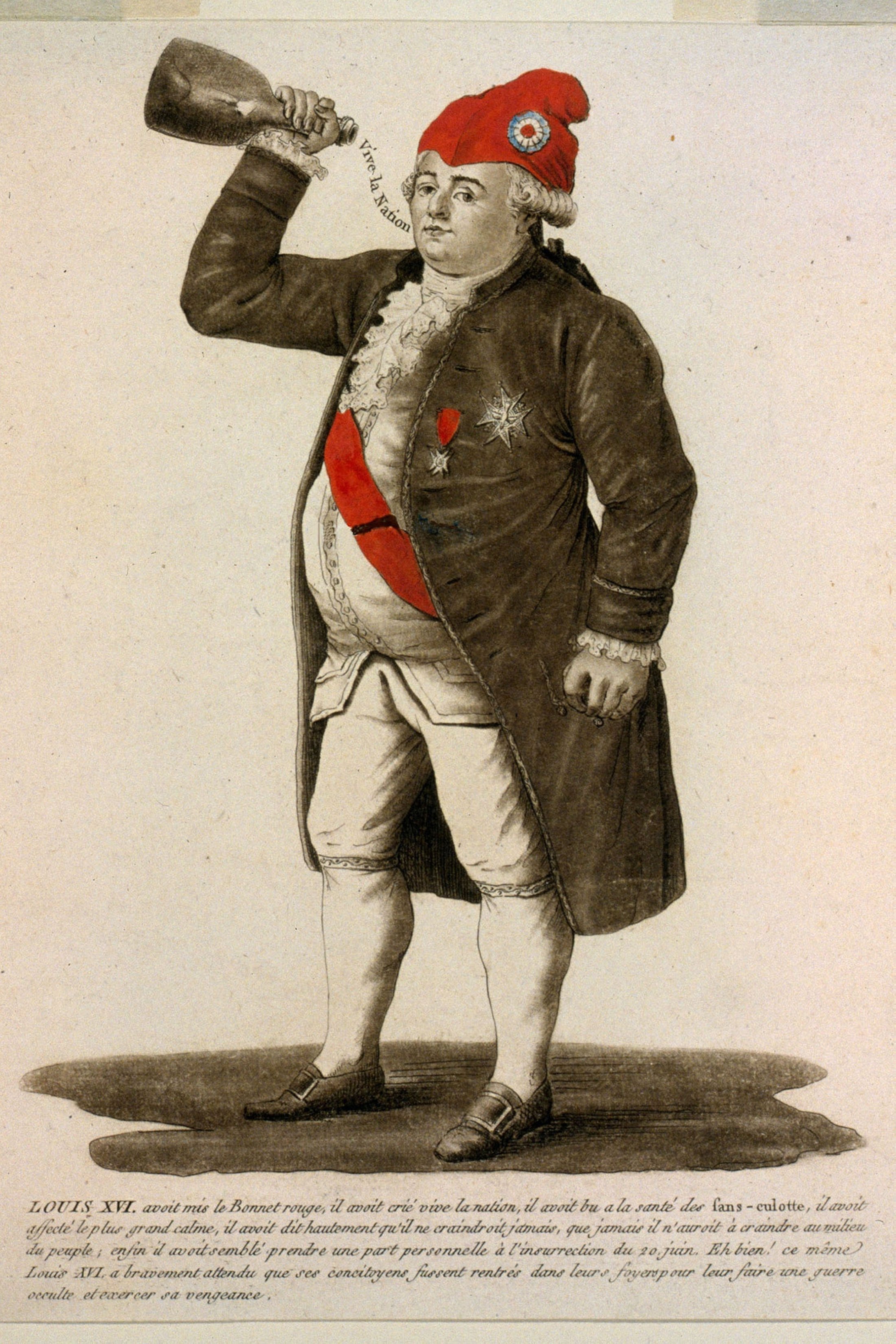
Louis XVI dons the Bonnet Rouge

Madame Royale describes the storming of the Tuileries palace on June 20, 1792 and how her family escaped death:

On the 20th of June, about eleven o'clock in the morning, nearly all the inhabitants of the faubourgs Saint-Antoine and Saint-Marceau, where the populace chiefly lived, marched in a body to the National Assembly, to go from there to the garden and plant the liberty-tree. But as they were all armed, which gave reason to suspect bad intentions, my father ordered the gates of the Tuileries to be closed. The Assembly showed great dissatisfaction, and sent a deputation of four municipals to induce the king to order the gates to be opened. These deputies spoke very insolently; said they exacted the opening of the gates in order that those who had come to plant the tree, the sign of liberty, might return that way, inasmuch as the crowd in the rue Saint-Honoré was too great to allow them to pass. My father, however, persisted in his refusal, and they then went and opened themselves the gates of the garden, which was instantly inundated by the populace; the gates of the courtyards and the château still remained locked. 

An hour later this armed procession began to defile before our windows, and no idea can be formed of the insults they said to us. Among others, they carried a banner on which were these words: 
"Tremble, tyrant; the people have risen;" and they held it before the windows of my father who, though he was not visible himself, could see all and hear their cries of "Down with Veto!" and other horrors. This lasted until three o'clock, when the garden was at last freed. The crowd then passed through the Place du Carrousel to the courtyards of the Tuileries, but quietly, and it was generally thought they were returning to their faubourgs. 

During this time our family were in the rooms on the courtyard side, absolutely alone and observing all that went on; the gentlemen of the suite and the ladies dined on the other side. Suddenly we saw the populace forcing the gates of the courtyard and rushing to the staircase of the château. It was a horrible sight to see, and impossible to describe–that of these people, with fury in their faces, armed with pikes and sabres, and pell-mell with them women half unclothed, resembling Furies. 

Two of the ushers wishing to run the bolts of my father's door, he prevented it and sprang himself into the next room to meet the rioters. My aunt followed him hastily, and hardly had she passed when the door was locked. My mother and I ran after her in vain; we could not pass, and at that moment several persons came to us, and finally, the guard. My mother cried out: "Save my son!" Immediately some one took him in his arms and carried him off. My mother and I, being determined to follow my brother, did all we could against the persons who prevented us from passing; prayers, efforts, all were useless, and we had to remain in our room in mortal anxiety. My mother kept her courage, but it almost abandoned her when, at last, entering my brother's room she could not find him. The persons who, on her own order, had carried him away lost their heads, and in the confusion, took him up higher in the château, where they thought him in greater safety. My mother then sent for him and had him brought back to his room. There we awaited, in the silence of profound anxiety, for news of what had happened to my father. 

Returning to him, I must resume at the moment when he passed through the door which was then locked against us. As soon as he thought the danger passed the king dismissed his suite, so that no one was with him but my Aunt Élisabeth, [Maréchal de Mouchy (who in spite of his 77 years and my father's order persisted in remaining), two old ushers, the brave Acloque, commander of the division of the National Guard, an example of fidelity in the uniform of rebellion], 1 and M. d'Hervilly, lieutenant-colonel of the new King's-Guard, who, seeing the danger, ran to call the Guard and collected about twenty grenadiers, but on reaching the staircase he found only six had followed; the others had abandoned him. My father was therefore almost alone when the door was forced in by one sapeur, axe in hand raised to strike him, but [here] by his coolness and imperturbable courage my father so awed the assassin that the weapon fell from his hand,–an event almost incomprehensible. It is said that some one cried out: "Unhappy man, what are you about to do?" and that those words petrified him; for my part I think that what restrained that wretch was Divine Providence and the ascendancy that virtue always maintains over crime. 

The blow having thus failed, the other accomplices, seeing that their leader had let himself be cowed, dared not execute their evil designs. Of all this mass of the populace, there were certainly very few who knew precisely what they were expected to do. To each had been given twenty sous and a musket; they were sent in drunk with orders to insult us in every imaginable way. Their leader, Santerre, had brought them as far as the courtyard, and there he awaited the success of his enterprise. He was desperate on learning that his stroke had missed, and he came near being killed himself by a man in the château, who aimed for him, and was prevented from shooting only by remonstrances as to the danger to which he exposed my father; for if Santerre were sacrificed the brigands would surely avenge him. 

My father was nevertheless obliged to allow all these wretches to go through the rooms of the château, and, standing himself in a window with my aunt, he watched them pass before him and heard the insults with which they overwhelmed him. It was on this horrible day that my father and my aunt each made a memorable speech. At the moment of the greatest danger a soldier came up to the king and said to him, "Sire, fear nothing." My father took his hand and laid it on his own heart. "Does it beat hard, grenadier?" he said. Shortly before, my Aunt Élisabeth, being mistaken for the queen, saw herself exposed to the utmost fury of the brigands; some one near was about to make her known. "Do not undeceive them," cried my aunt with sublime devotion. 

This dreadful situation lasted from half-past three in the afternoon till eight at night. Pétion, mayor of Paris, arrived, pretending to be much astonished on hearing of the danger the king had run. In haranguing the people he had the impudence to say: "Return to your homes with the same dignity with which you came." The Assembly, seeing that the stroke had missed, changed its tone, pretended to have been ignorant of everything, and sent deputation after deputation to the king expressing the grief it feigned to feel for his danger. 

Meantime my mother, who, as I said, could not rejoin the king, and was in her apartment with my brother and me, was a long time without hearing any news. At last, the minister of war came to tell her that my father was well; he urged her to leave the room where we then were, as it was not safe, and we therefore went into the king's little bed-chamber. We were scarcely there before the rioters entered the apartment we had just left. The room in which we now were had three doors: one by which we had entered, another opening upon a private staircase, a third communicating with the Council Chamber. They were all three locked, but the first two were attacked, one by the wretches who were pursuing us, the other by men who came up the little staircase, where we heard their shouts and the blows of their axes. 

In this close danger my mother was perfectly calm; she placed my brother behind every one and near the door of the Council Chamber, which was still safe, then she placed herself at the head of us all. Soon we heard some one at the door of the Council Chamber begging to enter. It was one of my brother's servants, pale as death, who said only these few words: "Madame, escape! the villains are following me." At the same instant, the other doors were forced in. In this crisis my mother hastily ordered the third door opened and passed into the Council Chamber, where there were, already, a number of the National Guard and a crowd of wretches. 

My mother said to the soldiers that she came to take refuge with her son among them. The soldiers instantly surrounded us; a large table standing in the middle of the Chamber, served my mother to lean upon, my brother was seated on it, and the brigands defiled past it to look at us. We were separated from my father by only two rooms, and yet it was impossible to join him, so great was the crowd. We were therefore obliged to stay there and listen to all the insults that these wretches said to us as they passed. A half clothed woman dared to come to the table with a bonnet rouge in her hand and my mother was forced to let her [Page 236] place it on her son's head; as for us, we were obliged to put cockades on our heads. It was, as I have said, about eight o'clock when this dreadful procession of rioters ceased to pass and we were able to rejoin my father and aunt. No one can imagine our feelings at that reunion; they were such that even the deputies from the Assembly were touched. My brother was overcome with fatigue and they put him to bed. We stayed together for a time, the room being full of deputies. An hour later they went away, and about eleven o'clock, after having passed a most terrible day, we separated to get some rest . . . . 

The next day Pétion came again to play the hypocrite, saying he had heard of more assemblings of the people and he had hastened to defend the king. My father ordered him to be silent; but as he still tried to protest his attachment, my father said: "Be silent, monsieur; I know your thoughts." (Read more.)
 
Marie-Antoinette, her children, and Madame de Tourzel face the mob   
 
Louis XVI was mocked with the "Red Cap of Liberty" which was displayed at the Paris Olympics. From Daily Sabah:

In the aftermath of the French Revolution, Louis XVI, the last king of France, was depicted in many paintings with a "Bonnet Rouge" (Red Cap) on his head. However, what is the story of this red cap with its long apex bent over to the front, and why was it placed the head of the French constitutional monarch before he was executed?

[...]

In ancient Rome, freed slaves were dressed in a white cap called a pileus. Brutus, who betrayed Caesar, chose this cap, which symbolizes freedom, as an expression of Rome's return to the republic, and engraved it on the coin he minted. But this fez, which looks like the white cap worn by Albanians today, actually had nothing to do with the red Phrygian cap.

With the American Revolution, the pileus became an omen of revolutionaries, anarchists, and republicans. It resurfaced with the protests against the Stamp Act of 1765 when Britain imposed a direct stamped paper tax on the British colonies in America.

In particular, a figure of British parliamentarian John Wilkes – nicknamed the "Devil," and known for his support of the American rebels – with this cap became very popular among the rebels known as the "Sons of Liberty."

French anarchists, who inherited this symbol from the American Revolution, preferred the Phrygian cap instead of the pileus. Thus, this red hermetic cap became the symbol of the French revolutionaries and freedom from 1789 onwards. For example, in a sculpture made by French artist Joseph Chinard in 1794, representing the revolution and the republic, a Phrygian cap was placed on the head of a woman in Roman attire. (Read more.)


Share

Friday, June 12, 2026

Vow of Louis XVI

Here is an English translation of the Vow of Louis XVI made in the Tuileries palace in the spring of 1791:
Well dost Thou see, O my God, the great sadness that oppresses my heart, the grief that wounds it and the depth of the abyss into which I have been cast. I am assailed by countless evils from all sides. To the oppression of my soul, the horrible tragedies that have befallen me and my family add up to those that cover the whole extension of the realm. The clamoring of all the misfortunate and the moans of our oppressed religion reaches my ears, and an inner voice suggests to me that perhaps Thy justice holds me accountable for all these calamities for not having restrained, during the days of my power, their main causes, which are the people’s licentiousness and the spirit of irreligion, and for supplied heresy, now triumphant, its weapons by favoring it by laws that gave it redoubled strength and enough boldness to dare anything.
 
O Jesus-Christ! Divine Redeemer of all our iniquities, today I come to find relief for my soul in Thy Adorable Heart. I call to my aid the tender Heart of Mary, my august protectress and Mother, and the assistance of Saint Louis, my advocate and the most illustrious of my ancestors. Open Thyself, adorable Heart, through the most pure hands of my powerful intercessors, receive benignantly the vows of which confidence inspires me and that I offer Thee as the frank expression of my sentiments. If, as a consequence of Divine goodness, I were to recover my liberty, my crown and royal power, I solemnly promise:

1. To revoke at once all the laws that will be indicated to me by the Pope, or a Council, or by four of the more learned and virtuous bishops of my realm, as contrary to the purity and the integrity of the Faith, and contrary to the discipline and the special jurisdiction of the Holy, Roman, Catholic, and Apostolic Church; and especially to revoke the Civil Constitution of the Clergy.

2. To take, within a year, all the necessary measures to establish, with the approval of the Pope and the episcopate of my realm, and in accordance with canonical standards, a solemn feast in honor of the Sacred Heart of Jesus to be celebrated forevermore throughout all France on the first Friday immediately after the eight days following the Feast of Corpus Christi and to be always followed by a general procession. This feast will be celebrated in reparation for the outrages and desecrations perpetrated in our holy temples by schismatics, heretics and the bad Christians in these times of so great turmoil.

3. To go in person on a Sunday or a holy day within three months of the day of my deliverance to the Church of Notre Dame of Paris, or to any other principal church in the place where I will be at that time, to pronounce a solemn act of consecration of my person, my family and my realm to the Sacred Heart of Jesus next to the main altar after the Offertory of the Mass and through the hands of the priest, promising to give to all my vassals an example of the worship and the devotion due that adorable Heart.
4. To erect and adorn within a year of my release and at my own expense, in the church that I will choose, a chapel or an altar to be dedicated to the Sacred Heart, which will stand as a lasting monument of my recognition and limitless confidence in the infinite merits and inexhaustible treasures of grace that this Divine Heart contains. 

5. Finally, to renew every year, wherever I might be on the Feast of the Sacred Heart, the act of consecration stated in the third point and to participate in the general procession that will take place right after that day’s Mass.

 Now I cannot pronounce this pact except in secret, but I would sign it with my own blood if necessary; and the most beautiful day of my life will be when I will be able to proclaim it aloud in the Temple.

  O Adorable Heart of my Savior, may I neglect my right hand and my own being if I were to ignore Thy benefits these my promises, if I were to cease to love Thee and place all my trust and comfort in Thee! Amen.”
  
Louis XVI, King of France

 (Read more,)
 The original French version is HERE. In the spring of 1791, after signing the Civil Constitution of the Clergy a few months earlier, King Louis XVI fell ill at the Tuileries, where the royal family were living under house arrest. His illness was undoubtedly the result of the stress of the upheavals which he had tried to prevent, as well as the fact that his conscience was troubling him about signing the Catholic Church in France over to the revolutionary government, severing the ties with Rome. Louis had signed it under duress but deeply regretted his decision immediately.

According to biographer Bernard Fay, Louis made the Vow under the guidance of his non-juring confessor, a Eudist priest Fr. Hebert. In the 1600's a Visitation nun, Saint Margaret Mary, had claimed that Jesus had requested that the King of France consecrate France to His Sacred Heart. The consecration had never been performed. So, with the help of Fr. Hebert, Louis drafted the following Vow, which he sealed in the walls of his apartments.

The Vow was not found until the palace had been partially burned by the Commune and was being torn down in 1871. It was discovered still sealed in the wall of the king's room. Louis was a locksmith and was fascinated with construction, so building a hiding place for his papers would not have been beyond him. He was known for his penchant for secrecy and his hiding of private papers from prying eyes. The fact that the Vow was not discovered until the 1870's demolishes the claim of some that it was merely a product of pious forgery during the 1814-1830 Restoration. The methodical legality of the document is typical of Louis XVI, who as an amateur cartographer was characterized by his precision and attention to detail.
Share

Thursday, June 4, 2026

Canada’s Mass-graves Scam

 From Daniel McCarthy at the New York Post:

A hoax costs taxpayers hundreds of millions of dollars and incites arson attacks against dozens of churches. This time, however, it’s not the latest headline out of Minnesota — look a little further north. In 2021, at a time when media throughout the western world were still in a state of high agitation after the killing of George Floyd, Canadian outlets picked up on a story too sensational not to be true:

Hundreds of indigenous First Nations children had been buried in unmarked graves at residential schools run by the Catholic Church in British Columbia. The Kamloops Indian Band sent around a press release that “confirmed” it. The statement claimed the remains of 215 children had been found with the help of an expert using ground-penetrating radar.

“We had a knowing in our community that we were able to verify,” said the band’s chief, Rosanne Casimir.

“Some were as young as three years old,” she continued, asserting that “the final resting place of these children” was in the Kamloops Indian Residential School.

Only it wasn’t — no human remains have been found at Kamloops.

And the media that fanned the flames of the story is finally admitting it.

Even now Canada’s biggest daily paper, The Globe and Mail, phrases its retraction in cagey terms.

“There has been no public confirmation of the discovery of any human remains,” the paper conceded on Saturday.

Yet that funny phrasing leaves one wondering, is there private confirmation of human remains — another “knowing,” perhaps?

The Globe and Mail editorial, titled “There is no reconciliation without truth,” is a masterpiece of embarrassed equivocation, lamenting conditions at Canada’s residential schools of First Nations children and even insisting that the absence of bodies “does not mean children did not die there” before finally, eight paragraphs into the story, taking a smidgen of responsibility.

“The media, including the The Globe and Mail, did not initially scrutinize, much less challenge” the story.

“The initial headlines and stories in the media simply stated as fact that the remains of 215 children had been found. Many of those early stories, including in this newspaper, made references to ‘mass graves’,” a phrase that went beyond even Chief Casimir’s claims.

Yet right after the admission of its failures, the paper’s editorialists wistfully speculate, “Perhaps it will be proven, some day, that there are hundreds of unmarked graves at Kamloops” — as if the error here was just in being a little too hasty to declare what will sooner or later turn out to be true. (Read more.)

Share

Thursday, May 21, 2026

How Religious Toleration for the Irish Helped America Win Independence

 From Providence:

In July Fourth 1779, Congress went to Mass. One newspaper reported that on “the day which gave freedom to the vast republic of America, the Congress, the president and councils of state, with other civil and military officers” attended “Roman chapel” at the invitation of “His Most Christian Majesty” Louis XVI’s emissary. “A Te Deum was performed,” giving “great satisfaction to all present.” Protestant American rebels worshipping with Catholic French monarchists elicited cross-confessional interest in another country: Ireland. 

The above report comes from the Presbyterian Londonderry Journal in the north of Ireland. Writing for the Anglican Freeman’s Journal in Dublin, Catholic polemicist Father Arthur O’Leary wondered how “banishment and proscription, on account of religious systems” still prevailed in Ireland when “Presbyterians and Catholics chant the Te Deum in the same chapel in America?” Irish interest in Franco-American worship suggests that the American Revolution was a war with not only global implications but religious ones too. Irishmen and Irish-Americans—Anglican, Presbyterian, Catholic—provided essential manpower for both rebels and royalists alike. How Crown and Congress respectively managed religious tensions in mobilizing Irish troops helped decide the war’s outcome. The Continental Army overcame sectarian tensions to become a multiconfessional force. In contrast, King George’s army saw religious animosities hamper recruitment, strain soldier-officer relations, and polarize the war in Ireland.      

Nearly half a million Irish immigrated to British North America in the eighteenth century. Outside New England, one in six white Americans were of Irish descent. Two-thirds were “Scotch-Irish” Presbyterians, the rest mostly Catholics. The American colonies appealed to Irishmen because they lacked the religious hierarchy that restricted liberty and opportunity in Ireland. Sectarian and dynastic wars in seventeenth-century Ireland produced a “Protestant Ascendancy” that prescribed privileges for Anglicans but led to dispossession for Catholics and discrimination against Presbyterians. While Catholics owned two-thirds of Irish land in 1640, they retained only a tenth of it sixty years later. “Penal laws” deprived Catholics of civil rights. Largely of Scottish descent, Presbyterians provided invaluable settlers and soldiers to the Ascendancy, yet remained second-class subjects. The Sacramental Test Act excluded most Presbyterians from politics. The linen industry, lifeblood of Presbyterian Ulster, suffered trade fluctuations exacerbated by British commercial rules. Presbyterians resented Anglican attempts in the 1710s to nullify their marriages and collect tithes. New Light minister John Abernathy’s call for “every man” to “enjoy the freedom of following the Light of his Conscience” resonated with Presbyterians. Unavailable in Ireland, economic and religious liberty proved plentiful in America.  

“The Irish in America, with a few exceptions, were attached to independence,” observed a South Carolina patriot.. Irish Presbyterians constituted a fifth of Pennsylvanians and a quarter of South Carolinians and Georgians.. Frontier fights against the French and their Native American allies reinforced Presbyterian attachment to ideals of liberty and property. Many Irish Presbyterians had preferred to emigrate than to pay tithes supporting an exclusionary Ascendancy.  Their descendants preferred to fight than to pay taxes imposed by a remote Parliament. If the first shot at Concord was likely discharged by a New England Puritan, many future volleys fired in freedom’s name came from Irish Presbyterians. (Read more.)


Share

Monday, May 11, 2026

Madame Elisabeth on the Way to Execution

This is Versailles: Execution of Madame Élisabeth

Madame Élisabeth of France and her companions leave the Conciergerie for the final journey to the guillotine on May 10, 1794. Madame Élisabeth was the last to die, which means she had to watch all the others decapitated before her. They each begged for her blessing before approaching the scaffold. From This is Versailles:

Once the condemned were removed, Madame Élisabeth once again exerted herself to the comfort of her fellow-condemned. She had always been a fervently religious woman and now she encouraged those who were to die with her. She chose to rejoice in the fact that the Tribunal had not asked them to renounce their faith "only their miserable lives".

There appears to be some conjecture about when Madame Élisabeth was definitely informed of the death of Marie Antoinette. Later, Marie Thérèse would recall that they had heard her mother's sentence being cried out from the people walking beneath their windows but that they had refused to believe it. One account claims that Élisabeth had asked to see her sister-in-law after her sentencing only to be told that she had suffered the same fate. Another claims that it was only at the foot of the guillotine that she overheard a callous remark. Once it was noticed that the condemned bowed to her before their deaths, a spectator allegedly remarked that that they could "make their salaams to her all they wanted, she will share the fate of the Austrian". (Read more.)


From European Royal History:

She reportedly successfully comforted and strengthened the morale of her fellow prisoners before their impending execution with religious arguments, and by her own example of calmness.

Élisabeth was executed along with the 23 men and women who had been tried and condemned at the same time as she, and reportedly conversed with Mme de Senozan and Mme de Crussol on the way. In the cart taking them to their execution, and while waiting her turn, she helped several of them through the ordeal, encouraging them and reciting the De profundis until her time came. Near the Pont Neuf, the white kerchief which covered her head was blown off, and thus being the only person with bare head, she attracted special attention by the spectators, and witnesses attested that she was calm during the whole process.

 At the foot of the guillotine, there was a bench for the condemned who were to depart the cart and wait on the bench before their execution. Élisabeth departed the cart first, refusing the help of the executioner, but was to be the last to be called upon, which resulted in her witnessing the death of all the others.

Reportedly, she considerably strengthened the morale of her fellow prisoners, who all behaved with courage. When the last person before her, a man, gave her his bow, she said, “courage, and faith in the mercy of God!” and then rose to be ready for her own turn. While she was being strapped to the board, her fichu (a sort of shawl) fell off, exposing her shoulders, and she cried to the executioner “Au nom de votre mère, monsieur, couvrez-moi. (In the name of your mother, sir, cover me)”

Reportedly, her execution caused some emotion by the bystanders, who did not cry “Vive la Republique” at this occasion, which was otherwise common. The respect Élisabeth had enjoyed among the public caused concern with Robespierre, who had never wished to have her executed and who “dreaded the effect” of her death.

Her body was buried in a common grave at the Errancis Cemetery in Paris. At the time of the Restoration, her brother, Louis-Stanislas, Comte de Provence, now King Louis XVIII of France and Navarre, searched for her remains, only to discover that the bodies interred there had decomposed to a state where they could no longer be identified. Élisabeth’s remains, with that of other victims of the guillotine (including Robespierre, also buried at the Errancis Cemetery) were later placed in the Catacombs of Paris. A medallion represents her at the Basilica of Saint Denis.

Beatification

The Cause of Beatification of Élisabeth was introduced in 1924, but has not yet been completed. In 1953, she was declared a Servant of God, and in 2016, her Cause was re-opened. (Read more.)

Share

Thursday, April 16, 2026

Pope Leo XIII and the St. Michael Prayer

From Unveiling the Apocalypse:
I would like to recommend an excellent book by Kevin Symonds, titled Pope Leo XIII and the Prayer to St. Michael.  This recently published book, which examines the history behind the composition of the Prayer to St. Michael, presents a wealth of scholarly evidence which attests to the authenticity of the vision of Pope Leo XIII.  The author has obviously undertaken a painstaking amount of research for this book, and has translated several key documents which were previously unavailable in English.  A fresh batch of information is brought to light here, including additional material emanating from the eyewitness testimony provided by Fr. Pechenino, and a homily on Pope Leo's vision attributed to Cardinal Pedro Segura y Saenz. Among these new findings we find the surprising fact that the earliest accounts of this vision records that Satan had actually requested a period of 50-60 years in which to destroy the Church, rather than 75-100 years. 

While these documents which Symonds has unearthed are undoubtedly the earliest of their kind, and therefore possess the strongest claim to the full truth on this matter, we cannot fail to notice that this contradicts the common perception that Pope Leo's prophetic vision comprised the entirety of the 20th century, rather than just the first half of it.  On the surface, this discovery appears to indicate that the period of Satan's greater power ended around the middle of the 20th century, at the close of the Second World War. Once again, such a scenario appears to contradict the actual sequence of historical events, and it is plainly evident that the true grip of Satan's greater power only seemed to really take hold in the latter half of the 20th century, after the events of the Second World War, when the Sexual Revolution which took place in the 1960's coincided with a massive decline in the Church - paving the way for current apostasy we are still enduring today. (Read more.)
Share

Friday, February 27, 2026

Gone for a Soldier

 
If you don a scarlet coat at the price of your conscience, the color will only remind you of the wound in your own soul! If you sign away the faith of your fathers, all lesser goods will be forfeited too! ~from Gone for a Soldier by Avellina Balestri

From Amazon:

Young Edmund Southworth could not have foreseen the path his life would take upon befriending Gentleman Johnny Burgoyne, British military veteran and parliamentarian. As Catholic recusants from the north of England, Edmund’s once noble family has struggled to survive for centuries in the shadow of the Anglican ascendancy. But General Burgoyne offers him the chance to put past humiliations behind him by joining the Church of England and donning a scarlet coat as an officer of King George III. Although his conscience is uneasy, Edmund embarks upon Burgoyne’s March to subdue the American revolutionaries by splitting the colonies in two. He finds unexpected love in the arms of Abby Vanderkamp, a supporter of American independence, who will do anything to free her father from a British prison hulk or, failing that, strike a blow for the hard-pressed rebel cause. As the British advance through the New York wilderness devolves into increasing brutality and instability, Edmund will have his already divided loyalties tested to the breaking point under the influence of this hostile land which presents him with new challenges and opportunities alike.


Gone for a Soldier is the first volume of a trilogy called All Ye That Pass By about the War for American Independence from the point of view of the young British soldier, Edmund Southworth. Edmund is from a devout Catholic recusant family in England, "recusant" being the name given to those who paid the exorbitant fines levied on all who refused participation in the Church of England. His father having died, Edmund is the head of his household, comprised of his bitter mother, his saintly sister and a few servants. Forbidden because of his Faith from any profession but that of country gentleman, Edmund's family struggles with poverty, while valiantly determined to fulfill their duties to their tenants and to the poor. Miss Balestri quite authentically depicts the hardships Catholics faced in eighteenth-century England, weaving into the narrative stories of saints, martyrs, Jacobites and highwaymen, so that the reader receives a glimpse of the larger picture.

Then the vibrant, unforgettable character of "Gentleman Johnny" Burgoyne sweeps into the story, taking Edmund under his wing. A womanizer and bon vivant, Burgoyne is nevertheless a loyal friend and a brave general. With a dollop of bullying and an ocean of charm, Burgoyne convinces Edmund that he needs to join Burgoyne in North America in the fight against the colonists by becoming a soldier. The problem is that military careers are only available to Protestants, so Burgoyne talks Edmund into renouncing his Catholic Faith and receiving the bread and wine in a midnight act of apostasy. Burgoyne dismisses it is as a small matter but Edmund is tormented by his betrayal of the Faith of his fathers, The author explores the anguish of violating one's conscience, making the reader pray and hope  never to be in Edmund's circumstances. It is, however, but the beginning of his adventures in America, where he and Burgoyne are joined by quite the colorful cast of characters. Miss Balestri once again proves her mastery of history, and her ability to bring it alive in intriguing storytelling.

About the author:

Avellina Balestri is a Catholic author and editor based in the historic borderlands of Maryland and Pennsylvania. Her stories, poems, and essays have been featured in over thirty print and online publications. She has published two books: "Saplings of Sherwood", the first book in a Robin Hood retelling series, and "Pendragon's Shield", a collection of poetry. She is the Editor-in-Chief of Fellowship & Fairydust, a magazine inspiring faith & creativity and exploring the arts through a spiritual lens. Under its auspices, she hosted a literary conference at Lady Margaret Hall in Oxford, England, commemorating the legacy of J.R.R. Tolkien. She also has the honor of representing the state of Maryland at The Sons of the American Revolution National Orations Contest. Avellina believes that the Trinitarian divine dance and Incarnational indwelling mystery are reflected in all things good, true, and beautiful, and that the image of God is wondrously woven into every human heart. These themes are at the forefront of the stories she chooses to tell.

For more information about the author and her various projects, please visit the following websites:

www.fellowshipandfairydust.com 

www.avellinabalestri.com

Share

Tuesday, January 27, 2026

When Was Catherine Howard Born?

 From Gareth Russell:

Henry’s fifth wife Catherine Howard had, at one point, a date of birth that was almost as imprecise as Anne Boleyn’s. In Catherine’s case, the traditional date was c. 1522, but this was contested by later generations of historians until, by the twentieth century, there was a nine-year window between 1518 and 1527.[3] This would have made her in her early twenties or twelve-thirteen at the time of her marriage to Henry VIII in 1540 and about twenty-three or fourteen when she was executed in February 1542. An argument will be made here that the traditional date of birth for Catherine is almost certainly the correct one and that she was born in c. 1522-1523, making her about seventeen at the time of her marriage and about nineteen when she was executed.

The mystery of Catherine’s age is, to some degree, perplexing, in that, unlike Henry’s other three English wives, we do have a specific statement on the subject from a contemporary, who met Catherine on numerous occasions. Charles de Marillac, who served as the French ambassador to England throughout Catherine’s time as queen, wrote that Catherine was eighteen.[4] The letter’s utility is admittedly complicated by the fact that de Marillac was referring to an incident earlier in Catherine’s life, before he knew her. We know that the referenced incident occurred in late 1539, but de Marillac, writing in 1541, seemed to think it had happened in 1540. This places Catherine’s birth to 1521, if de Marillac was correct about the timing of the incident, but to 1522 if, as seems likely, he had misdated the incident to a few months later.

The incident in question – Catherine’s alleged betrothal to Francis Dereham – was something about which de Marillac heard for the first time in late 1541. While it is understandable that the rumours he was hearing were incorrect in their details, it is not credible that de Marillac would have stated that Catherine was eighteen when it happened, if she was in fact several years younger. De Marillac had spent weekends as Catherine and Henry’s guest in 1540 and 1541, he knew her personally, and it stretches credulity that he could have gotten wrong such a basic fact as the Queen’s age, particularly by such a margin.

​Another specific complicated by context are the details of Catherine’s debut at the Tudor court in late 1539. She joined the royal household as a maid of honour to Henry’s fourth wife Anne of Cleves, whose arrival in London was anticipated in late 1539, only to be delayed to January by the weather. Maids of honour were a queen’s unmarried ladies-in-waiting and fourteen was too young to serve. Even young women from prominent and well-connected families were not permitted to take their oath as a maid of honour until they were sixteen.[5] When the household was reconvened in 1539 for Anne of Cleves, we know that it stuck rigorously to the rules about composition.[6] This would date Catherine’s year of birth to 1523, likely in the second half of the year. (Read more.)


 My review of Gareth's book on Queen Katherine, HERE.

Share

Thursday, December 25, 2025

Last Will and Testament of Louis XVI

The last Will and Testament of Louis XVI, King of France and Navarre, given on Christmas day, 1792.
In the name of the Very holy Trinity, Father, Son and Holy Ghost.
To-day, the 25th day of December, 1792, I, Louis XVI King of France, being for more than four months imprisoned with my family in the tower of the Temple at Paris, by those who were my subjects, and deprived of all communication whatsoever, even with my family, since the eleventh instant; moreover, involved in a trial the end of which it is impossible to foresee, on account of the passions of men, and for which one can find neither pretext nor means in any existing law, and having no other witnesses, for my thoughts than God to whom I can address myself, I hereby declare, in His presence, my last wishes and feelings.
I leave my soul to God, my creator; I pray Him to receive it in His mercy, not to judge it according to its merits but according to those of Our Lord Jesus Christ who has offered Himself as a sacrifice to God His Father for us other men, no matter how hardened, and for me first.
I die in communion with our Holy Mother, the Catholic, Apostolic, Roman Church, which holds authority by an uninterrupted succession, from St. Peter, to whom Jesus Christ entrusted it; I believe firmly and I confess all that is contained in the creed and the commandments of God and the Church, the sacraments and the mysteries, those which the Catholic Church teaches and has always taught. I never pretend to set myself up as a judge of the various way of expounding the dogma which rend the church of Jesus Christ, but I agree and will always agree, if God grant me life the decisions which the ecclesiastical superiors of the Holy Catholic Church give and will always give, in conformity with the disciplines which the Church has followed since Jesus Christ.
I pity with all my heart our brothers who may be in error but I do not claim to judge them, and I do not love them less in Christ, as our Christian charity teaches us, and I pray to God to pardon all my sins. I have sought scrupulously to know them, to detest them and to humiliate myself in His presence. Not being able to obtain the ministration of a Catholic priest, I pray God to receive the confession which I feel in having put my name (although this was against my will) to acts which might be contrary to the discipline and the belief of the Catholic church, to which I have always remained sincerely attached. I pray God to receive my firm resolution, if He grants me life, to have the ministrations of a Catholic priest, as soon as I can, in order to confess my sins and to receive the sacrament of penance.

I beg all those whom I might have offended inadvertently (for I do not recall having knowingly offended any one), or those whom I may have given bad examples or scandals, to pardon the evil which they believe I could have done them.

I beseech those who have the kindness to join their prayers to mine, to obtain pardon from God for my sins.
I pardon with all my heart those who made themselves my enemies, without my have given them any cause, and I pray God to pardon them, as well as those who, through false or misunderstood zeal, did me much harm.

I commend to God my wife and my children, my sister, my aunts, my brothers, and all those who are attached to me by ties of blood or by whatever other means. I pray God particularly to cast eyes of compassion upon my wife, my children, and my sister, who suffered with me for so long a time, to sustain them with His mercy if they shall lose me, and as long as they remain in his mortal world.
I commend my children to my wife; I have never doubted her maternal tenderness for them. I enjoin her above all to make them good Christians and honest individuals; to make them view the grandeurs of this world (if they are condemned to experience them) as very dangerous and transient goods, and turn their attention towards the one solid and enduring glory, eternity. I beseech my sister to kindly continue her tenderness for my children and to take the place of a mother, should they have the misfortune of losing theirs.

I beg my wife to forgive all the pain which she suffered for me, and the sorrows which I may have caused her in the course of our union; and she may feel sure that I hold nothing against her, if she has anything with which to reproach herself.

I most warmly enjoin my children that, after what they owe to God, which should come first, they should remain forever united among themselves, submissive and obedient to their mother, and grateful for all the care and trouble which she has taken with them, as well as in memory of me. I beg them to regard my sister as their second mother.

I exhort my son, should he have the misfortune of becoming king, to remember he owes himself wholly to the happiness of his fellow citizens; that he should forget all hates and all grudges, particularly those connected with the misfortunes and sorrows which I am experiencing; that he can make the people happy only by ruling according to laws: but at the same time to remember that a king cannot make himself respected and do the good that is in his heart unless he has the necessary authority, and that otherwise, being tangled up in his activities and not inspiring respect, he is more harmful than useful.

I exhort my son to care for all the persons who are attached to me, as much as his circumstances will allow, to remember that it is a sacred debt which I have contracted towards the children and relatives of those who have perished for me and also those who are wretched for my sake. I know that there are many persons, among those who were near me, who did not conduct themselves towards me as they should have and who have even shown ingratitude, but I pardon them (often in moments of trouble and turmoil one is not master of oneself), and I beg my son that, if he finds an occasion, he should think only of their misfortunes.

I should have wanted here to show my gratitude to those who have given me a true and disinterested affection; if, on the one hand, I was keenly hurt by the ingratitude and disloyalty of those to whom I have always shown kindness, as well as to their relatives and friends, on the other hand I have had the consolation of seeing the affection and voluntary interest which many persons have shown me. I beg them to receive my thanks.

In the situation in which matters still are, I fear to compromise them if I should speak more explicitly, but I especially enjoin my son to seek occasion to recognize them.

I should, nevertheless, consider it a calumny on the nation if I did not openly recommend to my son MM. De Chamilly and Hue, whose genuine attachment for me led them to imprison themselves with me in this sad abode. I also recommend Clery, for whose attentiveness I have nothing but praise ever since he has been with me. Since it is he who has remained with me until the end, I beg the gentlemen of the commune to hand over to him my clothes, my books, my watch, my purse, and all other small effects which have been deposited with the council of the commune.

I pardon again very readily those who guard me, the ill treatment and the vexations which they thought it necessary to impose upon me. I found a few sensitive and compassionate souls among them – may they in their hearts enjoy the tranquillity which their way of thinking gives them.

I beg MM. De Malesherbes, Tronchet and De Seze to receive all my thanks and the expressions of my feelings for all the cares and troubles they took for me.

I finish by declaring before God, and ready to appear before Him, that I do not reproach myself with any of the crimes with which I am charged.

Made in duplicate in the Tower of the Temple, the 25th of December 1792.

LOUIS

Share

Tuesday, October 14, 2025

Echoes of the Great Famine in the Covid Era

 From Brownstone Institute:

In Spring 2020, supposedly “civilized” nations of the world tackled the prospects of how best to subjugate their domestic populations. At this time I was struck by seemingly obvious parallels to another sad chapter in the history of human misery: the Irish Potato Famine. There are many core similarities marking the two calamities.

Both evolved from real biological threats that did actually exist (a potato blight in Ireland and a novel coronavirus globally); yet government choices (rooted more in ideology and control) amplified the suffering far beyond anything naturally inflicted. British policies during the famine prioritized exports and landlord profit over human lives (Irish landlords at this time were a gentry class called the “Protestant Ascendancy” that exercised social, political, and economic domination over the subject population). Likewise, lockdown mandates favored top-down edicts over personal choice and community resilience, which only favored the social elite who could afford to sequester. Both eras saw freedoms trampled: the Irish lost access to their own food and land, while Covid restrictions silenced dissent, shuttered churches, and confined people to their homes, all under the guise of public safety.

The Irish catastrophe of 1845-1852 killed over a million and forced another million to emigrate, but it stemmed from more than crop failure. British governance enforced a system where Irish tenant farmers grew cash crops for export, leaving potatoes as their sole staple. When the blight hit, food ships sailed out of Irish ports laden with grain and livestock, bound for England, while locals starved. Relief came too late and too stingy, burdened on absentee landlords who evicted families to cut costs. This was no act of God, but rather policy as punishment and tied to centuries of colonial disdain.  

Fast-forward to 2020, and a similar script unfolded. The virus was indeed deadly for the vulnerable, but the response (in the form of indefinite shutdowns, mask mandates, and travel bans) created a cascade of harms far worse than the thing it was trying to mitigate. Economies ground to a halt, mental health crises surged, and children lost years of schooling, all while leaders preached “Follow the science” from their insulated bubbles. Freedom of speech crumbled under censorship of dissenting doctors, religious gatherings faced police raids, and personal autonomy yielded to tracking apps and vaccine passports. These toxic measures (sold as temporary) corrosively lingered, forever eroding trust in institutions. (Read more.)


Share

Saturday, October 11, 2025

120th Anniversary of R.H. Benson's "The King's Achievement"

 From Stephanie Mann:

The King's Achievement, Monsignor Robert Hugh Benson's historical novel about the Dissolution of the Monasteries, was published in 1905, 120 years ago. It was one of those books I read years before I started studying the English Reformation in depth before writing my book, so I've selected it for our next Son Rise Morning Show 2025 anniversary on Monday, October 13, Columbus Day! I'll be on the air at my usual time, 7:50 a.m. Eastern/6:50 a.m. Central to discuss this anniversary and its importance. Please listen live here or catch the podcast later here.

Like its sequel, By What Authority?, which was published in 1904, The King's Achievement is a family drama, as Benson shows the divisions caused in two families by the English Reformation during the reigns of Henry VIII and Elizabeth I. One link between the two novels, for example, is the former nun, Margaret Torridon, taken from her convent by her own brother in The King's Achievement, living years later in the Catholic household of her brother-in-law and sister Mary in By What Authority?

Monsignor Robert Hugh Benson was a convert to Catholicism, the youngest son of Edward White Benson, the Archbishop of Canterbury from 1883 to 1896, and his wife, Mary. Robert's older brothers, E.F. (Edward Frederick) and A.C. (Arthur Christopher) were also authors: E.F. wrote the "Mapp and Lucia" novels and A.C. contributed to Elgar's Coronation Ode written for Edward VII in 1902 and "Land of Hope and Glory"; he was also Master of Magdalene College, Cambridge. Their sister Margaret was an Egyptologist.

After his conversion to Catholicism in 1903, Robert Hugh Benson was ordained a priest the next year. 

He wrote several novels, historical and contemporary, and consulted with Don Bede Camm, another Catholic convert, who studied the English Reformation martyrs, on his historical novels. He acknowledges Dom Bede Camm's assistance in both By What Authority? and The King's Achievement

Dom Bede Camm was inspired by the stories of the English Catholic martyrs beatified by Pope Leo XIII and published a two-volume book about them in 1904, Lives of the English Martyrs. He also helped the Benedictine Adorers of the Sacred Heart of Montmartre who had established a convent near the former site of Tyburn Tree, where many martyrs suffered.

So Camm was a good resource for Benson, but the characters and the dramas Benson created are fictional--although Thomas More, Thomas Cromwell, and other historical people appear in The King's Achievement. (Read more.)
Share

Tuesday, October 7, 2025

The Question of Thomas More

 From The Acton Institute:

The book opens with a description of a citywide Candlemas procession in 1478 in London. “When seen from above,” she writes, “the thousands of small flickering flames, as they met and merged through the streets of London, might appear as a single unwavering light.” Add in the chapter’s epigraph from More’s Four Last Things—“For as the flame is next to the smoke, so is death next to an incurable sickness, and such is all our life”—and the book immediately has the atmosphere of 15th-century London. I was impressed by this imagery from the outset, but when the book unostentatiously returned to the symbol of a candle flame at the end, this opening took on new meaning. Paul is not simply a historian; she is also a storyteller.

The book is pleasingly arranged, moving easily from detailed descriptions of More’s daily life to deep dives into cultural and political intricacies. Paul consistently makes good choices about how to organize her material. For example, early in the book she moves from a description of More’s young childhood days (before he started grammar school) into an account of the chaotic time after King Edward IV’s death. She closes the section about Thomas’s childhood with the sentence, “While Thomas slept next to his siblings, the rest of the city was meant to join him, but much business could occur in the darkness of the London streets.” The next section begins, “Dodging the night watch, William Mistlebrook rushed through the parish of St. Giles without Cripplegate…” This is simply a good transition, and a smart way to embed the details of her subject’s life in its historical setting.

Individual sentences themselves, however, leave something to be desired: “the rest of the city was meant to join him” is an unpleasant construction. There are a number of moments like this where a small syntactical flaw interrupts the flow of the story, which made me wish Paul’s editor had been more rigorous.

Paul’s facility with her material is clear from her apparent delight in interweaving quotations, historical records, and her own descriptive prose. Though the biography is about St. Thomas More, it also gives detailed portraits of characters like John More (Thomas’s father), Margaret (More) Gibbs (his daughter), Erasmus, Germain de Brie, Edward IV, Cardinal Wolsey, Francis I of France, and scores of others. (Read more.)

Share

Thursday, August 14, 2025

Islamic State’s War on Christianity in Africa—and Beyond

 From It Can Always Get Worse:

The one attack report in Al-Naba 507 that was not from Africa was from Syria (Wilayat al-Sham). It documented a series of attacks on “the PKK militia”, the PKK being the Kurdistan Workers’ Party, which operates under the banner of the “Syrian Democratic Forces” (SDF) on Syrian territory. IS’s anti-PKK attacks were reported from “Al-Khayr” (Deir Ezzor), the eastern desert province where IS has its deepest roots thanks to the cynical actions of the fallen regime of Bashar al-Asad. IS claims to have killed seventeen PKK militiamen over the preceding week by assaulting village checkpoints with machine guns, and ambushing two PKK vehicles, one on the road between villages and one in a village using an IED. This is, says Al-Naba, part of the “continuing escalation of the mujahideen’s operations against the militia in the area.”

IS’s Sahel Province (Wilayat al-Sahel) claims to have killed thirty soldiers in an ambush in the Kalamba area of Burkina Faso, and to have repelled an attack by the army of Niger near the village of Kallagui that killed sixteen. “Local sources confirmed that the apostate militias are suffering heavy losses in terms of men and equipment, despite receiving support from French and American forces in the region”, Al-Naba claims.

IS’s West Africa Province (Wilayat Gharb Ifriqiya) “burned a military site of the apostate Nigerian army, killed three of them, and wounded at least two others, and destroyed one of their vehicles, in two separate attacks in Borno State in northern Nigeria”, according to Al-Naba. ISWAP allegedly also seized “weapons and other equipment” in the raid.

In Wilayat Mozambique, “the soldiers of the caliphate” abducted four Christians from a village in Cabo Delgado and then “slaughtered them”, says Al-Naba 507. A fifth Christian was murdered in another village in the same area of Mozambique.

IS’s Central African Province (Wilayat Wasat Ifriqiya) murdered four Christians in the Ituri area in the east of the Democratic Republic of the Congo, according to Al-Naba. Three Congolese Christians were shot to death by IS in a village and two days later another Christian was “slaughtered” on a road between two towns. Al-Naba boasts that his comes after ISCAP murdered fifty-three Christians in the Congo the week before, and “seized dozens of homes and possessions belonging to them”. (Read more.)

Share

Monday, August 4, 2025

Dictator Judge Sanctioned and Other News


From Tierney's Real News: 

Hamas thinks it can starve and torture Jewish hostages — like Evyatar David — for nearly two years…and record him digging his own grave and the suckers will reward Hamas terrorists with their own state. The problem isn't only Hamas - it’s other Islamo-Communist terrorist groups - and the Deep State, cartels and countries who fund them. It's also the brainwashed world allowing and empowering them. This is what intentional starvation (by Hamas) in Gaza looks like. (Read more.)


Trump delivered but the Dems want to cancel his accomplishments. From Amuse on X:

The decision by the US Court of International Trade to strike down President Trump’s use of tariffs as a tool of negotiation is not only deeply flawed in its legal reasoning, it is a case study in judicial myopia. That is a strong charge, and I do not level it lightly. But when a court disregards explicit statutory delegation, ignores Congress’s own votes to preserve executive flexibility, and, in doing so, threatens the gains of successful international negotiations, one is left wondering what, exactly, the judiciary imagines its role to be.

We begin with what is uncontested: the Constitution grants Congress the power to regulate foreign commerce. Yet it is equally well established that Congress may delegate aspects of that power to the executive, especially in domains that involve foreign policy, national security, and economic diplomacy. Tariffs, in the Trump administration’s hands, were not a protectionist reflex, but a tool of negotiation, calibrated to pressure allies and rivals into fairer trade arrangements.

The Court claimed that the International Emergency Economic Powers Act (IEEPA) was an insufficient basis for the President’s actions, despite the statute’s sweeping language. Congress gave the executive authority to deal with “unusual and extraordinary threats” to the US economy, and did so with the knowledge that the modern global economy is interconnected, adversarial, and subject to persistent manipulation by state and non-state actors alike. Trump’s identification of the trade deficit and industrial hollowing as national security threats is not merely plausible, it is prescient.

What makes the Court’s ruling especially troubling is its disregard for the practical outcomes of the policy it nullified. In the wake of Trump’s so-called Liberation Day tariffs, the United States successfully concluded trade negotiations with Mexico, Canada, China, Japan, and the European Union. These were not symbolic overtures, they were quantifiable wins. China committed to $200 billion in purchases of US goods. The EU pledged $750 billion in energy contracts and $600 billion in industrial investments. The USMCA replaced NAFTA with a more balanced, labor-protective framework. If this is not the proper fruit of diplomatic leverage, what is? (Read more.)

Share

Friday, July 25, 2025

Recusant Queen: The White Martyrdom of Henrietta Maria

Queen Henrietta Maria wearing the diamond cross given her by Pope Urban VIII
 

Kristen Van Uden Theriault wrote a most insightful and poignant review of My Queen, My Love at Catholic Exchange:

After the Anglican revolution of Henry VIII, the English royal house was divided. Protestant Elizabeth I died with no issue. Despite Mary Queen of Scots’ heroic witness unto death for the true Faith, her son James was effectively hijacked by her enemies and groomed into a Tudor heir. By the time James’ son Charles ascended the throne, the Stuart dynasty was strongly within the Protestant camp, though his potential conversion remained a hoped-for (or dreaded) eventuality.The long line of English Catholic martyrs marched forward even during the “tolerant” reign of the Stuarts....Anti-Catholic sentiment reigned supreme.  The “ringing island” rang no longer, instead clamoring dissonant peals of error.

Into this hostile territory entered a young Catholic princess, Henrietta Maria of France. The daughter of Henry IV, a French Huguenot, and Catholic Marie de’Medici, Henrietta was sent not only as a political envoy, as was the routine purpose of royal marriages, but also as a religious ambassador. Her parents’ marriage, by which the Church partially attempted to heal the French Huguenot schism, provided a model, albeit a rocky one.

The marriage of Henrietta and Charles required a dispensation from the pope, as Catholics were forbidden to marry non-Catholics except in extreme or unusual circumstances. The dispensation came with a weighty caveat: that Henrietta would endeavor to convert her husband, and consequently his country, back to the true Faith. Henrietta was instructed to imitate saint Berthe, who had converted her pagan husband, and sent into the spiritual war zone.

Henrietta arrived in England at the tender age of fifteen, with this outsized supernatural mission to complete. (Read more.)


Book available, HERE.

Share

Sunday, June 29, 2025

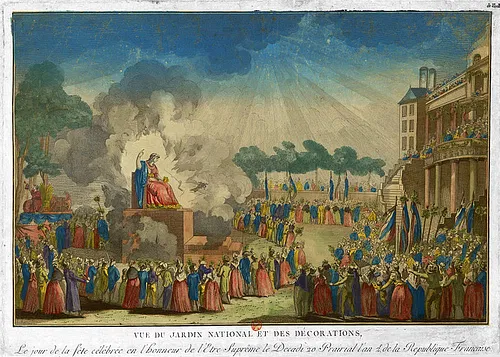
Cult of the Supreme Being


 Many Catholics, particularly priests, monks and nuns, were murdered by the revolutionary government for refusing to renounce the papal sovereignty. From World History:

The Cult of the Supreme Being was a deistic cult established by Maximilien Robespierre (1758-1794) during the French Revolution (1789-1799). Its purpose was to replace Roman Catholicism as the state religion of France and to undermine the atheistic Cult of Reason which had recently gained popularity. It represented the peak of Robespierre's power and went unsupported after his downfall.

In establishing the Cult of the Supreme Being, Robespierre intended to shepherd the French Republic toward a state of absolute virtue, or moral excellence. He meant to use the idea of an abstract godhead, or Supreme Being, to educate the French people on the relationship between virtue and republican government, thereby creating a perfectly just society. According to the decree of 18 Floréal (7 May), the cult acknowledged the existence of a Supreme Being as well as the immortality of the human soul. Worship of the Supreme Being was to be done through acts of civic duty.

On 8 June 1794, a Festival of the Supreme Being was held on the Champ de Mars. Robespierre, who was then at the apex of his dictatorial powers, took on a central role in the festivities, giving him the appearance of pontiff to the new religion. It is thought that distaste for the cult, and for Robespierre's central position in it, helped lead to his downfall a little over a month later. According to historian Mona Ozouf, the Festival represented a certain revolutionary stiffness that foreshadowed the "sclerosis of the Revolution" (Ozouf, 24).

The French Revolution had been at odds with the Catholic Church since its beginning. A fundamental pillar of the oppressive Ancien Régime, the institution of the Church seemed to stand for corruption, superstition, and backwardness, all contrary to revolutionary values. In November 1789, Church lands were seized and nationalized to bolster France's withering economy, while the Civil Constitution of the Clergy forced all practicing clergymen to swear oaths to the new constitution and pledge that their loyalty to the French state would supersede their loyalty to the Pope in Rome.  
Yet in this early phase of the Revolution, it was the institution of the church that was under attack rather than Christianity itself. Many citizens would still consider themselves Catholic, and many even sought to reconcile the Gallican Church with the Revolution; most early revolutionary festivals included sermons from constitutional priests, who made sure to draw parallels between revolutionary values and the Gospels and to refer to Jesus Christ as the ideal sans-culotte. Infants would be baptized with a tri-color cockade pinned to their diapers, being simultaneously given over to both Christ and the fatherland. 
But before long, the differences between the Church and the Revolution became too vast to ignore. The Pope condemned the Revolution and excommunicated certain clergymen who had supported the new constitution. King Louis XVI of France (r. 1774-1792), after his failed flight to Varennes, made clear his disgust at the Revolution's treatment of the Church, further helping to associate it with corrupt aristocracy. In late 1791, the French Legislative Assembly declared that all clergymen who had not yet sworn oaths to the constitution were guilty of conspiracy and sentenced to deportation. The Assembly also legalized divorce and declared that all records of births, deaths, and marriages would henceforth be handled by secular officials only, removing an important function from the Church. (Read more.)


Share

Thursday, June 12, 2025

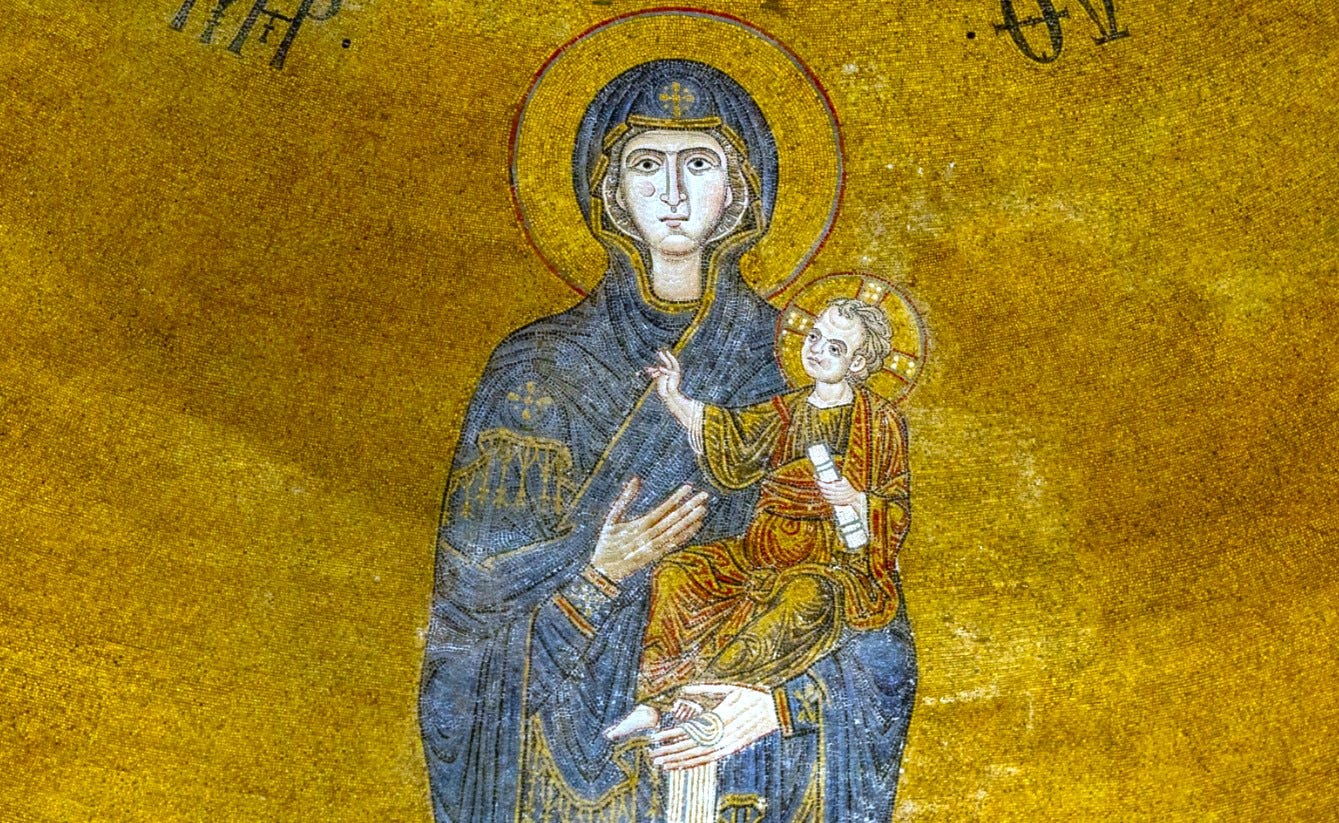
The Changing Face of Byzantine Sacred Art


From Hilary White at The Sacred Images Project

Many western Christians who are not regularly exposed to them have an idea that all Byzantine or “eastern” iconography looks the same.

It’s easy to see why: after 500+ years of adulating the illusionistic naturalism of the Renaissance, the stylized, formal and symbolic aesthetic of Byzantine icons can seem like a foreign world. And I think these stylistic differences are a big part of what keeps the two sides separated.

We westerners, used to our naturalism, tend to not think much about them, and assume that they’re all more or less the same. And it’s true that the forms have a visual stylistic consistency; we know what “Byzantine icons” means. But once you start looking more closely, we see there is a much more complex and historically nuanced development, as there is in western art. Over the centuries, Byzantine iconography changed and developed dramatically, shaped by theological debates, political upheavals and cultural influences.

Our timeframe of iconography stretches across vast temporal and spatial distances, from the earliest frescoes of the catacombs in old Rome to the deeply symbolic, highly stylized icons of post-Byzantine (Constantinopolitan) Orthodox traditions. And it was carried out to the outer corners of the Christian world; we can see the same motifs, the same language spoken, from Ireland, Scotland and Lindisfarne, to Cappadocia to Ethiopia. (Read more.)

Share