


 |
| A young Marie-Antoinette in formal court dress, which she disliked. |
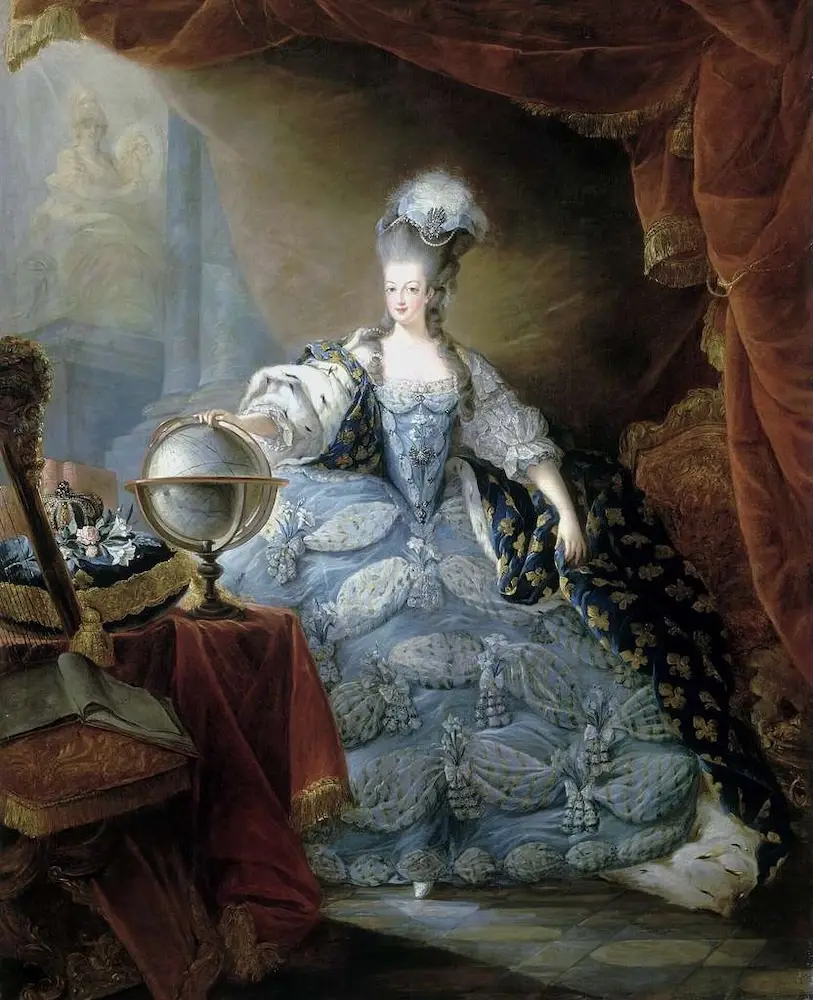 |
| Marie-Antoinette at 19 in a formal court gown for a state occasion, corseted with panniers (side hoops), jewels, rouge, and very elaborate hair. Some people think this gown was what she wore to her husband's coronation. |
 |
The Queen with her two oldest children in the less formal attire she preferred.
|
“Court fashion was highly prescribed. Marie Antoinette wanted to break free of that and express herself,” says Jeffrey Mayer, professor of fashion history at Syracuse University. Her style signaled a departure from the Baroque era (17th–18th century), which was defined by lavish ornamentation. Instead, she embraced "an elegant, fresh, feminine style, made provocatively modern,” says Cox.
Inspired by Enlightenment thinkers like Jean-Jacques Rousseau, the queen embraced all things pastoral. She regularly used printed cottons such as toile de Jouy, a fabric depicting monochromatic pastoral scenes. Her playful style drew from the Rococo movement, an 18th-century decorative trend that featured curved lines, pastels, wooden marquetry, ribbons and florals. Marie Antoinette's embrace of these motifs helped popularize the style and laid the groundwork for the “French country” aesthetic. At the Petit Trianon, the queen’s personal retreat in Versailles, she harmonized interior design with fashion. Motifs like her beloved cornflowers adorned everything from her custom tea set to her gowns. Although earlier royals used monograms, she emblazoned “M.A.” on everything from banisters to cosmetics, creating a lasting association between monograms and luxury, says Cox.
[...]
The palace of Versailles was open to the public (as long as you met the dress code), and visitors could tour the queen’s closet. They could also visit the Parisian shop of Rose Bertin, Antoinette’s stylist and unofficial “Minister of Fashion.” They could even commission a copy of her latest look…as long as they waited the mandated two weeks after the queen debuted it.
Bertin’s Paris shop, Le Grand Mogol (The Grand Mogul) “functioned as an early couture salon, showing new collections each season and maintaining a fully staffed workroom. This was the blueprint for the modern 'fashion house' or maison de couture,” says Mayer. (Read more.)
 |
| The young Queen with flowers replacing jewels. |
 |
| At a costume ball, escorted by her brother-in-law, the Comte d'Artois (Charles X) |
 |
| In simple attire, no jewels, hair unpowdered. |
 |
| Marie-Antoinette in simple attire, hair unpowdered, no jewels. But the portrait was seen as being disrespectful to her queenly status. |








No comments:
Post a Comment