A place for friends to meet... with reflections on politics, history, art, music, books, morals, manners, and matters of faith.
A blog by Elena Maria Vidal.
"She was not a guilty woman, neither was she a saint; she was an upright, charming woman, a little frivolous, somewhat impulsive, but always pure; she was a queen, at times ardent in her fancies for her favourites and thoughtless in her policy, but proud and full of energy; a thorough woman in her winsome ways and tenderness of heart, until she became a martyr."
"We have followed the history of Marie Antoinette with the greatest diligence and scrupulosity. We have lived in those times. We have talked with some of her friends and some of her enemies; we have read, certainly not all, but hundreds of the libels written against her; and we have, in short, examined her life with– if we may be allowed to say so of ourselves– something of the accuracy of contemporaries, the diligence of inquirers, and the impartiality of historians, all combined; and we feel it our duty to declare, in as a solemn a manner as literature admits of, our well-matured opinion that every reproach against the morals of the queen was a gross calumny– that she was, as we have said, one of the purest of human beings."
"It is now sixteen or seventeen years since I saw the queen of France, then dauphiness, at Versailles; and surely there never lighted on this orb, which she hardly seemed to touch, a more delightful vision. I saw her just above the horizon, decorating and cheering the elevated sphere she had just begun to move in, glittering like a morning star full of life and splendor and joy. Oh, what a revolution....Little did I dream that I should have lived to see such disasters fall upon her, in a nation of gallant men, in a nation of men of honor and of cavaliers! I thought ten thousand swords must have leaped from their scabbards, to avenge even a look which threatened her with insult. But the age of chivalry is gone; that of sophisters, economists, and calculators has succeeded...."
~Edmund Burke, October 1790
A Note on Reviews
Unless otherwise noted, any books I review on this blog I have either purchased or borrowed from the library, and I do not receive any compensation (monetary or in-kind) for the reviews.
I remember visiting the Hessian Barracks in Frederick, MD as a child. From Smithsonian:
On August 15, 1776, a flotilla of British ships arrived on Staten
Island, New York, just south of Manhattan. On board the vessels were
more than 8,600 foreign soldiers, the first major contingent of German
troops to reach the American Colonies. (Another group had set up camp in
Quebec several months earlier to reinforce British forces in Canada.)
There was no mistaking the new arrivals. Unlike their British allies, who were famously known as the redcoats, the Hessians usually wore blue or green coats, sometimes accompanied by tall, pointy brass headgear called miter caps.
For more than a year, the British Army had been battling rebellious
colonists intent on establishing an independent nation. In October 1775,
a fed-up George IIIannounced
his intention to “put a speedy end to these disorders by the most
decisive exertions.” The British king added that he had “received the
most friendly offers of foreign assistance.” Despite vigorous objections
from some lawmakers, Parliament backed George in taking up those offers, expecting that the added manpower would soon crush the rebellion once and for all.
“Paris in the Dark Ages,” wrote Belloc, gave way to an
‘awakening Europe’ in which “the Normans show first how true a kingdom,
with peace and order and unity, may be established” and how “Rome did
not die; it was transformed” and how “the philosophy of the Empire had
been touched with mysticism” and “the shrine, the miracle, the unseen
had replaced the clear and positive attitude, the speculative and cold
intelligence, which had distinguished the philosophy of Rome.”
In
its place was “medieval religion, its legends, its marvels . . . the
one good counterbalance that ultimately saved the world from barbarism.”
Hemingway absorbed it all and gave it back to us, brilliantly, in The Sun Also Rises.
While many think this, his debut novel, is just about drinking and
debauchery, underlying that decadence is an iceberg of spiritual
healing.
Its protagonist, “Jake” Barnes, is inspired
by St. James—whom Mary, i.e., Our Lady of Pilar, appeared to shortly
after her Assumption into Heaven. On the eve of his trip to Pamplona,
Jake refers to the Paris street named for St. James as “the rigid north
and south of the rue saint-Jacques.” A curious description, Stoneback
thought, since there’s nothing rigid about it, unless the underlying
spirituality along this medieval main street is, in fact, the whole
point of the literary device.
Le long de la rue,
there’s the famous Church of the Val-de-Grâce, meaning “vale of
grace”—an architectural splendor King Louis XIII’s wife, Queen Anne of
Austria, built to celebrate the birth of their son Louis XIV (“The Sun
King”); and the adjoining monastery, later converted into a hospital for
wounded soldiers, imaging Jake’s war wounds—Hemingway’s, too. Then
there’s that plaque dedicated to Pamplona, a town along the Chemins
Pèlerinage—the Way of St. James. (Read more.)
A hoax costs taxpayers hundreds of millions of dollars and incites arson attacks against dozens of churches. This time, however, it’s not the latest headline out of Minnesota — look a little further north. In 2021, at a time when media throughout the western world were still
in a state of high agitation after the killing of George Floyd,
Canadian outlets picked up on a story too sensational not to be true:
Hundreds of indigenous First Nations children had been buried in unmarked graves at residential schools run by the Catholic Church in British Columbia. The Kamloops Indian Band sent around a press release that “confirmed” it. The statement claimed the remains of 215 children had been found with the help of an expert using ground-penetrating radar.
“We had a knowing in our community that we were able to verify,” said the band’s chief, Rosanne Casimir.
“Some were as young as three years old,” she continued, asserting
that “the final resting place of these children” was in the Kamloops
Indian Residential School.
And the media that fanned the flames of the story is finally admitting it.
Even now Canada’s biggest daily paper, The Globe and Mail, phrases its retraction in cagey terms.
“There has been no public confirmation of the discovery of any human remains,” the paper conceded on Saturday.
Yet that funny phrasing leaves one wondering, is there private confirmation of human remains — another “knowing,” perhaps?
The Globe and Mail editorial, titled “There is no reconciliation
without truth,” is a masterpiece of embarrassed equivocation, lamenting
conditions at Canada’s residential schools of First Nations children and
even insisting that the absence of bodies “does not mean children did
not die there” before finally, eight paragraphs into the story, taking a
smidgen of responsibility.
“The media, including the The Globe and Mail, did not initially scrutinize, much less challenge” the story.
“The initial headlines and stories in the media simply stated as fact
that the remains of 215 children had been found. Many of those early
stories, including in this newspaper, made references to ‘mass graves’,”
a phrase that went beyond even Chief Casimir’s claims.
Yet right after the admission of its failures, the paper’s
editorialists wistfully speculate, “Perhaps it will be proven, some day,
that there are hundreds of unmarked graves at Kamloops” — as if the
error here was just in being a little too hasty to declare what will
sooner or later turn out to be true. (Read more.)
Those of us who hold to a Catholic understanding of the human person — seeing each life as sacred because it is made in the image of God — have, for decades now, found ourselves resisting a growing secular pressure to legalise euthanasia.
The arguments are by now familiar. On the one hand, we hear appeals to autonomy, freedom of choice, and the understandable desire to avoid suffering. On the other, there remains a deep moral conviction that life and death are not ours to dispose of at will — and that once the boundary is crossed, the consequences are neither contained nor benign.
Experience bears this out. In Canada, there are now documented cases of disabled individuals being offered euthanasia because it is cheaper than providing basic support such as accessible housing. In the Netherlands, even teenagers suffering from depression have been granted euthanasia. What were once presented as tightly safeguarded exceptions have, in practice, expanded in ways that place the most vulnerable at risk.
The argument, therefore, is no longer theoretical. It is grounded in real examples of systems in which safeguards have failed, and where the logic of euthanasia has begun to erode the dignity it was supposed to protect.
In this conversation, I speak with Professor David Jones, Professor of Bioethics at St Mary’s University, London, and one of the central figures in the campaign against euthanasia in the United Kingdom.
Together we explore what has just taken place in the Scottish Parliament, why the proposed legislation was defeated, and what this may mean for the future of similar efforts at Westminster — where time is running short and the outcome remains finely balanced, both procedurally and in the court of public opinion. (Read more.)
In March of 1966, my great grandfather Dr. Fergus O’Connor received the medal of the Holy Cross Pro Ecclesia et Pontifice from Pope Paul VI in recognition of his contributions to medicine for over sixty years. The papal nuncio came to the house at 193 Earl Street in Kingston, Ontario to bestow the medal, due to the advanced age of the recipient, celebrating Mass there as well. In March of 2008, when my late Aunt Mary's belongings were being distributed among the relatives, I happened to come across the certificate that accompanied the medal from the pope. (See photo above.) According to the Catholic Encyclopedia:
The medal Pro Ecclesia et Pontifice was instituted by Pope Leo XIII (17 July, 1888, "Quod Singulari") in memory of his golden sacerdotal jubilee, and bestowed on those women and men who had merited well by aiding and promoting, and by other excellent ways and means assisted in making the jubilee and the Vatican Exposition successful. This decoration was made a permanent distinction only in October, 1898 (Giobbio, see below). Its object is to reward those who in a general way deserve well of the pope on account of services done for the Church and its head. The medal is of gold, silver or bronze. The decoration is not subject to chancery fees. The medal is a cross made octangular in form by fleurs-de-lis fixed in the angles of the cross in a special manner. The extremities of the cross are of a slightly patonce form. In the centre of the cross is a small medal with an image of its founder, and encircling the image are the words LEO XIII P. M. ANNO X (tenth year of his pontificate). On the obverse side are the papal emblems in the centre, and in the circle surrounding the emblems the motto PRO DEO ET PONTIFICE is stamped. On the obverse surface of the branches of the cross are comets — which with the fleurs-de-lis form the coat of arms of the Pecci family. On the reverse side are stamped the words, PRIDIE (left branch); KAL. (top branch); JANUAR. (right branch); 1888 (at the foot). The ribbon is purple, with delicate lines of white and yellow on each border. The decoration is worn on the right side of breast.
Fergus Joseph O'Connor was the son of Charles and Emily O'Connor of Long Point Farm, born on April 1, 1879, Easter Sunday. As Fergus' second son and namesake wrote of him: "It's hard to describe a man with such integrity of character. He was the perfect son to his parents -- the brother to his only sister and complete support to his family." (Dr. Fergus James O'Connor, Because You asked For It) Fergus loved horses and wanted to become a jockey, for which he was suited due to his stocky stature. His mother, however, encouraged him to seek as much education as possible. He went to high school in Athens, Ontario, and then went to the “Normal School” for teachers' training in Ottawa. It was around that time that he decided to study medicine. His father had wanted Fergus to help him maintain the homestead, but accepted his decision to become a doctor. He taught school to earn his tuition for medical school at Queen's University in Kingston. In his third year, he missed classes the first term because his funds had run out and he had to teach school again to make more money, but his roommate took notes for him, so he was able to pass anyway. He did not have much recreation, and only went to one football game all the time he was at Queen's.
In the summer of 1902, when Fergus first registered at Queen’s he rode his bicycle the 32 miles into Kingston. After finishing his business at the university, he became lost. He drove past three young ladies playing croquet on the front lawn and asked them for directions. One of them was Frances Keating. Frances Margaret Keating was of Norman-Irish stock on her father’s side; her mother was an O’Neill. Fergus and Frank were married at the dawn Mass at Saint Mary’s Cathedral in Kingston on September 3, 1907. The Mass was followed by a simple wedding breakfast. The new Dr. and Mrs. O’Connor moved to Gananoque in the Thousand Islands area where Fergus set up a practice and built a house.
Fergus' practice involved house calls, as was the custom in those days. He was often called out at night to deliver a baby, and often had to travel unlit roads into remote areas. It was vital for a country doctor to have a reliable horse so as to get him to his patients; my great grandfather had many stories about horse traders. After tending to a patient in the countryside, he could doze in the buggy or sleigh, since the horse knew the way home.
In December of 1916, Fergus was elected mayor of Gananoque. His election was a tribute to the respect generated by his professional dedication and personal integrity. It was remarkable given the local history of conflict between the few Irish Catholics settlers and the Protestant majority, especially the Irish Protestants, called “Orangeman.” Fergus, without compromising any of his beliefs and principles, was able to overcome a great deal of anti-Catholic prejudice, and became the popular “little mayor.”
In 1918, my great-grandparents moved to 193 Earl Street in Kingston, Ontario, with seven of their soon-to-be eight children. They decided to move into Kingston so that their children could go to the Catholic schools available there. A white rose bush from the original that old Daniel had brought over from Ireland was planted outside the front door. Fergus slowly built up a new practice. He taught medicine at Queen’s University, and continued on the faculty for forty years. His close friend, Monsignor J.G. Hanley said of him:
His concern for his students was not limited to their professional development. Working in an area fraught with deep moral implications, he instilled in future obstetricians sound ethical principles to guide them in making crucial decisions which would crucially affect the lives of their patients. Moreover, he was not merely a professor to his students; they all regarded him as a personal friend, and so he was.
By the late 1930’s he was delivering one third of all the babies in Kingston. He had many poor patients who could not pay, but to Fergus being a doctor was a vocation, not a career. However, he would gratefully accept an offering such as a bag of potatoes in the place of money, so that he could feed his family. He eventually became Chief of Obstetrics at the Hotel Dieu Hospital in Kingston and remained so for almost half a century. He delivered his last baby at age eighty-four.
Fergus was also active in the community and the church. He was on the Separate School Board for many years, as well as being a city alderman. He belonged to the Knights of Columbus and in 1945 founded the Queen’s chapter of the Newman Club.
Fergus died on April 21, 1971. I am grateful for the few memories I have of this wonderful man, a true patriarch. I recall how approachable he was, how kindly and gentle with small children. A Kingston newspaper article described him in his nineties as being “still active and spry…his eyes twinkling….with short quick steps“ and that is exactly as he appears in my memory. One of the main characters in The Paradise Tree is based upon him.
It isn’t regime change. It’s a surgical strike against the British
Empire’s irregular warfare and a key component of that, which we have
long called “Dope Inc.”, the nexus of narcotics trafficking, terrorism,
and the City of London-centered banking system. And today, we’re going
to break that down.
I’m Susan Kokinda. I’ve been tracking this
since the 1970s, watching how the offshore banking operation was set up
to sidestep regulation, sovereignty, and law enforcement. And I’m here
to tell you that for the first time, someone is taking that on, and it’s
Donald Trump.
So if this sounds like your kind of fight, please
hit those like, share, and subscribe buttons so we can reach more
people. Here’s what we’re going to cover today.
First, it’s not
regime change – and the Empire knows it. Second, how the Empire’s
operations of dirty money is now in the crosshair – and the Russians
know it, and how Trump is deploying to defeat all of these imperial
operations.
So let’s clear up the biggest misconception, right
now. Many former MAGA allies, Candace Owens, Marjorie Taylor Greene, are
screaming that this is “Neocon regime change 2.0”. They’re just looking
at the surface or outright lying.
But listen to Secretary of State Marco Rubio. He told us exactly what this is. (Read more.)
The coastal Colony of Avalon in Ferryland was chartered by the British statesman George Calvert in 1623. Today, it’s considered
one of the best-preserved early English colonial sites in North
America. Archaeologists have been conducting major excavations at the
site since the 1990s, and they typically find about 3,000 artifacts every week during dig seasons.
This summer, Calum Brydon, an archaeologist at Memorial University, was investigating the ruins of an Avalon storage room when he saw the wampum.
“When I first found it, I wasn’t entirely sure what it was,” Brydon tells CBC News’ Henrike Wilhelm. “There was part of me that realized it’s a shell bead, and it just didn’t quite click.”
“Wampum” is an English word derived from an eastern Algonquian term that means “strings of white.” Indigenous groups of northeastern North America carved the beads from shells of quahog (clams) and whelk
(sea snails). They incorporated the beads into belts and necklaces,
which were sometimes used to mark important events. Later, they may have
used the beads to trade with European settlers.
“The wampum [were] likely brought to Ferryland through trade or
exchange with Dutch or New England merchants who had previously traded
or exchanged wampum with Indigenous peoples,” Memorial University
archaeologist Barry Gaulton, the director of the excavations, tells Live Science’s Tom Metcalfe. (Read more.)
Quebec has approved its first adoption by a polyamorous trio — a
"throuple" — granting three men legal recognition as parents of a
3-year-old girl, according to Visegrad24. The groundbreaking case follows a Superior Court ruling earlier this
year that affirmed children can have more than two legal parents. Two men are officially registered as the girl's parents, while the
third is seeking full recognition under Quebec's revised Civil Code,
which now accommodates multiparent families.
The adoption, finalized after a full home study and court review,
marks a significant shift in Canadian family law, expanding parental
rights beyond traditional norms. The decision follows a landmark April 25 ruling by the Quebec
Superior Court that declared the province's rules tying filiation to a
maximum of two parents unconstitutional and gave Quebec 12 months to
amend its Civil Code so that children in "multiparent" families enjoy
the same rights and protections as those in two-parent households. The ruling was brought by La Coalition des familles LGBT+ and several
families that had been unable to list more than two parents on birth
records. (Read more.)
This is strange, like something from a Fannie Flagg novel. From The Travel:
Canada boasts an incredible 879,800 lakes, ranking it among the top countries globally with the most lakes.
Not only are many of them stunning and visited by thousands of
Canadians every year, but some also have a special history hidden
underneath the surface. In fact, in Lake Minnewanka at Banff National
Park, a 1928 Hudson Essex Saloon was located. It sat 55 meters below the surface for 85 years.
Another eerie discovery was made back in May. However, this time, it
wasn't a car beneath the surface; it was the complete drainage of an
entire beloved lake. Locals had developed an attachment to the
lake, especially for hunting and fishing purposes. Suddenly, the lake
had disappeared, and the future of its surrounding areas has also raised
uncertainty about what lies ahead. Here's a closer look at what happened to Lake Rouge, and how locals have reacted to its sudden disappearance. (Read more.)
In May 2025, residents living around Lac Rouge discovered a
washed-out road near the lake, triggering investigations that revealed
the lake had completely emptied almost overnight, an extremely rare and
puzzling event for the area.
Using both ground and air searches, experts found that the land around the lake had collapsed on itself, causing the lake to drain. Lac Rouge is a small lake, only about a 0.86 square miles (1.4 square kilometers) around. According to the European Southern Observatory, it was used by the Cree First Nation based in the nearby community of Waswanipi for fishing, hunting, and trapping. (Read more.)
The
conservative tradition has always accepted hierarchy as a fact of life —
and often a necessary good. There will always be leaders and followers,
the cultivated and the crude, the strong and the weak. The question is
not whether hierarchies exist, but whether they are just and capable.
Since
the French Revolution, the West has been haunted by the spectre of
egalitarianism elevated to a fanatic creed. The guillotine didn’t merely
decapitate a king — it aimed to destroy the very concept of natural
order. In its place came Jean-Jacques Rousseau’s naive worship of the
“general will,” a cult of popular sovereignty that mistook numbers for
wisdom and emotion for truth.
But
crowds do not think. They react. They surge, scream and stampede. As
the crowd grows, the mind shrinks. That is the enduring lesson of the
revolution: when the mob is sovereign, civilization burns.
The
conservative does not idolize the mob. He fears it. He respects the
people but insists they deserve more than flattery. They deserve
leadership. Real leadership — wise, learned, prudent and
self-restrained. The kind that builds cathedrals rather than chasing
hashtags. The kind that governs with duty rather than ruling for
applause. (Read more.)
Trump began the meeting by congratulating Carney on his election
victory and offering warm praise that helped ease some of the tension in
the room. It was classic Trump: build rapport first, then move the
pieces.
But what happened next caught everyone off guard.
Carney, who had built his entire campaign around posturing against Trump, suddenly flipped the script.
“Thank
you for your hospitality, and, and above all, for your for your
leadership,” Carney said. “You're, you're a transformational president.”
He
then echoed Trump’s policy priorities—focusing on the economy, the
border, and the fight against fentanyl—and presented them as his own
vision for Canada. (Read more.)
To say that Canada is militarily helpless is not to indulge in
hyperbole, but to confront a reality long obscured by diplomatic
euphemism. The Canadian Armed Forces are not merely under-resourced;
they are structurally incapacitated. The nation lacks the manpower,
equipment, logistical depth, and political seriousness to defend its own
vast territory, much less contribute meaningfully to the defense of
NATO allies or embattled democracies like Ukraine. The Canadian military
is, to borrow Hobbes, nasty, brutish, and short—in staffing, in
supplies, and in strategic thinking.
Begin with manpower. The
Canadian Armed Forces are authorized to field around 101,500 personnel.
As of 2025, they are short by at least 16,000. This is not a minor
discrepancy; it is a hemorrhage. Nearly 15% of the force exists only on
paper. And even among those still wearing the uniform, a distressing
number are functionally undeployable: overweight, undertrained, or
shackled by bureaucratic delays that make a military posting resemble a
Kafkaesque waiting room.
In some vital specialties—aviation
technicians, naval crews, combat medics—the effective manning levels
have dropped to less than half of what operational requirements demand.
Training pipelines are slowed to a crawl. The few who do enlist find
themselves waiting upwards of a year and a half for security clearances
and medical screenings. And when they finally report for duty, the story
turns tragicomic: in one recent deployment to Europe, Canadian troops
reportedly had to borrow basic equipment—including helmets—from their
American counterparts. Others bought their own kit from civilian
retailers.
This is not merely inconvenient. It is existential. A
military without the ability to equip and train its soldiers is not a
military but a costume party at the edge of a battlefield. (Read more.)
Understand what JD Vance is saying. Notice how key Greenland is
(geographically and strategically) to America for all the major arctic
shipping routes for the world. It is also a strategic location for air
and submarine surveillance in the northern hemisphere. If the US lets
Russia & China control that - America is doomed. We will lose
control of imports and exports, to our enemies, and also give them a
military advantage - TO INVADE US - off our shores.
VP VANCE: "Our message is very simple. Yes, the people of Greenland
are going to have self-determination. We hope that they choose to
partner with the United States because we're the only nation on earth
that will respect their sovereignty and respect their security - because
their security is very much our security."
"We can't just bury
our head in the sand — or, in Greenland, bury our head in the snow — and
pretend that the Chinese are not interested in this very large
landmass. We know that they are."
“Our message to Denmark (which
currently rules over Greenland) is very simple: You have not done a good
job by the people of Greenland. You have under invested in the people
of Greenland and you have under invested in the security architecture of
this incredible, beautiful landmass."
"We want to have good
relationships with everybody... but part of having good relations is
showing your strength when you have to. And unfortunately, the story of
Greenland over the past 20 years when it comes to security is that we've
underinvested... that has to change." (Read more.)
U.S. Aspirations to Buy Greenland Date Back Nearly 160 Years
President
Andrew Johnson sought to purchase Greenland in 1867. Johnson’s
Secretary of State William Seward explored buying Greenland alongside
Alaska, per the U.S. State Department’s historical records. Only the
Alaska deal went through.
Truman Tried to Buy Greenland In
1946, President Harry Truman proposed buying Greenland for $100 million
in gold. The idea stemmed from Cold War fears about Soviet influence.
Denmark rejected the offer.
Trump Talked About Greenland Takeover in First Term, Too During
his first term, Donald Trump also floated the idea of the U.S. buying
Greenland, sparking global headlines in August 2019. He called it a
“large real estate deal” for national security. Denmark quickly
dismissed the notion, with Greenland’s leaders asserting their autonomy.
A Cold Connection Dates Back to WWII The U.S. military first set foot in Greenland during World War II to prevent Nazi Germany from gaining a foothold.
Norway Used to Own Greenland
Denmark owns Greenland as a constituent country within the Kingdom of Denmark.In
1814, after the Napoleonic Wars, Norway was forced to relinquish
several territories when its alliance with Napoleonic France crumbled,
according to the Norwegian Historical Association. Denmark, aligned with
the victorious powers, gained Greenland and other territories. (Norway
was transferred from Danish to Swedish control.) This wasn’t a voluntary
handover but a consequence of wartime negotiations and territorial
realignment dictated by the treaty’s terms. (Read more.)
Elena Maria Vidal’s The Paradise Tree is the haunting saga
of the O’Connor family. The reader follows the life of blacksmith Daniel
O’Connor, an Irish catholic who migrates to Canada in pursuit of
economic and religious freedom. O’Connor flees Ireland with a rosebush
and the “Paradise Tree,” a wooden crucifix. He begins a new life in
Ontario, where he cultivates his home and raises a family in a new world
fraught with its own sets problems—some old, some new.
A sprawling historical novel, told from multiple perspectives, The
Paradise Tree takes us into the lives of the O’Connor family in a voice
that is thorough and rich. Vidal’s writing is sensory and visceral. The
reader feels as if she is a member of the O’Connor family, slunk in the
corner watching, rooting for the characters, feeling for the characters,
and taking on their conflicts, joys, and burdens. We are told the
harrowing tale of the O’Connor family in scenes that we feel we are a
part of, and when necessary, a narrative voice that moves the story to
it’s bittersweet conclusion as we leap along in time with the family.
Vidal’s meticulous research brings the O’Connor’s’ world to life.
Lush provocative details enrich the novel instead of distracting from
it: “Time for the ceilidh!”…Patrick brought out his bodhran, a wide
drum…The general idea of the ceilidh was that each member of the company
would contribute to the entertainment of the others with a song, story,
a dance, or recitation.” Vidal’s novel is rich with history. She
manages to enlighten the reader of the customs, traditions, and folklore
of the O’Connor family through factual anecdotes and observations, as
well as poetry and song, while moving the story forward instead of
bogging us down in showy, didactic details. Whether we are discovering
the “shillelagh” wielding “Orangemen,” or sitting down to a goose
roasted over a spit and smelling the simmering parsnips on Christmas
Eve, we are given a thorough history lesson without the lectures, the
notes, and—thank goodness—the exams.
The Paradise Tree does what good novels should. It tells us a
story, it shows us what it means to be human—replete with the triumphs,
sadness, and conflicts entailed in being human—while whisking us away
to another world that is not our own. For 232 pages we are extracted
from our lives and into the lives of the O’Connor family. We root for
them. We feel their hardships. We feel their connection and
disconnection as a family while we are shown a distant time and place,
filled with potentially unfamiliar folkways. In the end we are
pleasantly reminded that the O’Connors’ story is just as much ours as we
traverse the familiar territory of faith, family, and love, and how we
still find ourselves dancing in the face of seemingly insurmountable
odds.
(Read more.)
Whoever you are, wherever your people came
from, and whatever you enjoy doing with your free time, I don’t hesitate
for a moment to recommend purchasing Elena Maria Vidal’s latest
historical fiction novel The Paradise Tree.
The book begins in mid-19th century Ireland
around the time of the Great Famine, a time in Ireland when Irish
Catholics were discriminated against and persecuted by British
landowners and occupiers. Main character Daniel O’Connor (who is based
upon the stories and descriptions of Vidal’s own
great-great-great-grandfather) strikes off for a new and better life in
the New World.
And, it is better — well, at least, Daniel
O’Connor and his bride, Brigit, don’t ever again know in Ontario,
Canada, the pains of starvation they knew too well in Ireland. But,
no new home one may find for one’s self and one’s family is ever exactly
Eden, of course. And, no one’s family life is perfect and without
strain, loss, or seasons of deep sadness. No man’s work is free
of difficulty in this hard, fallen world. And, it seems, no culture or
society is without its own forms of bigotry.
Despite their tribulations throughout the
years, the O’Connors’ family (a vibrant, large family of 11 children) is
one which is primarily shaped and formed by deep and abiding religious
faith, married love, family tenderness and fidelity. As well as a good
deal of enjoyable Irish wit and wisdom, with a touch of fascinating
“mystical” Irish folklore. Vidal’s description of Irish immigrant life
brings deeper understanding of the background and experiences of my
countless delightful and much-loved friends of Irish heritage.
For me the quality of a book depends a great deal upon having likable, relatable characters. The Paradise Tree is
filled with deeply likable characters about whom the reader comes to
care very much, and desires to know better…and personally. It also has a
few richly described dastardly characters.
I can say from a personal perspective that this book is an inspiring
read for those beginning their own families who desire to know just how
Catholic families in generations past kept and handed down the Faith to
their children and their children’s children.
Above all, the O’Connor story is of re-birth, carrying on and going forward in hope for the future with a faith that sustains. (Read more.)
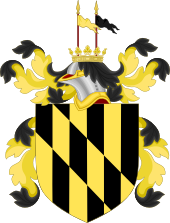
Notice the lion of the Talbots behind her. The lion was the heraldic symbol of the English Talbots as well as of the Irish Talbots, and there were many branches of the Irish Talbots. There appear to be no pictures of Lady Grace online. Perhaps in some old castle or mansion in County Kildare there is a portrait of her. (If anyone can find one, please let me know.) There is little available about her life and nothing about why her brother Cecil Calvert named Talbot County after her. Cecil had eleven brothers and sisters and Grace was not close to him in age. Some sources say she came to Mary's Land and died there but others say she died and was buried in London.
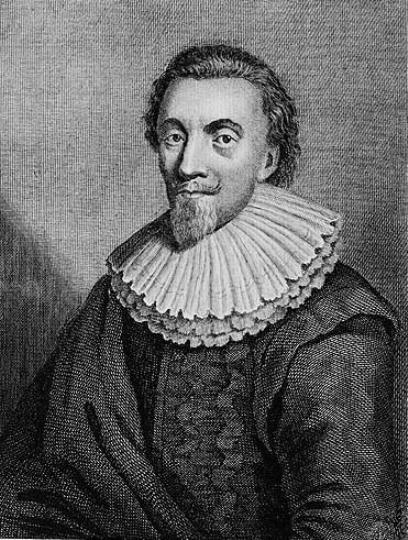
At any rate, someone should make a movie about the Calverts and their adventures in the New World. The adventures began with George Calvert (1580-1632) of Kiplin Hall in Yorkshire, the future 1st Lord Baltimore. Born into a devout Catholic family, the Calverts were so devout they were often in trouble with the law, which prohibited the practice of the Catholic Faith. His mother had been from the ancient family of Crosland, whose heraldic symbol was the cross. The Calverts later combined both coats of arms when they became the Lords Baltimore.
In 1604 George Calvert married Anne Mynne. By this time he had studied law and languages at Oxford. In order to study at Oxford one had to conform to the state religion of Anglicanism and George did so, although it is thought he may have secretly continued to be a Catholic. At any rate, he was married in the Anglican church and all his children were baptized Anglican. George traveled abroad as a young man and with his knowledge of law and languages he was sent on diplomatic missions by the new Stuart King James I. King James was known to favor handsome young men but in George Calvert's case his genuine diplomatic finesse earned him the royal trust and royal regard. (Read more.)
As discussed in Part 1, Lady Grace Calvert Talbot is the lady for whom Talbot County is named, the red lion being the heraldic symbol of the Talbots, the family of her husband, Robert Talbot, Baronet of Carton in County Kildare.
There are no pictures of Lady Grace Calvert Talbot online that I can find. It may be because the Carton Talbots lost their lands and property in the 1650's when Sir Robert fought against Oliver Cromwell during the latter's Irish invasion which was infamous for its brutality. The Irish were defeated; portraits could have been lost or destroyed, especially when all the furniture was confiscated by the English.
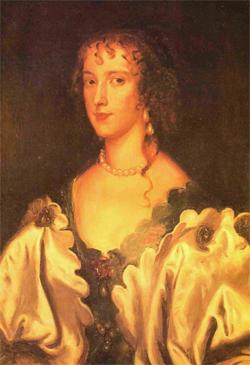
The above portrait is of Lady Grace's sister-in-law, Anne Lady Baltimore, wife of Cecil Calvert, for whom Anne Arundel County is named. Lady Grace was about the same age and would have worn similar costume and hairstyle. Why Cecil named a county after her I am still wondering. He had other sisters for whom nothing was named. Perhaps Cecil was particularly fond of Grace, I do not know; I will keep searching. It may have been more to honor her husband than to honor her since Robert Talbot was a brave man who lost everything fighting for his king and for his faith. Perhaps Cecil knew that Grace would want her husband honored in such a manner. And of course, what her husband suffered, she suffered as well. Likewise, to honor him was to honor her, and vice versa.
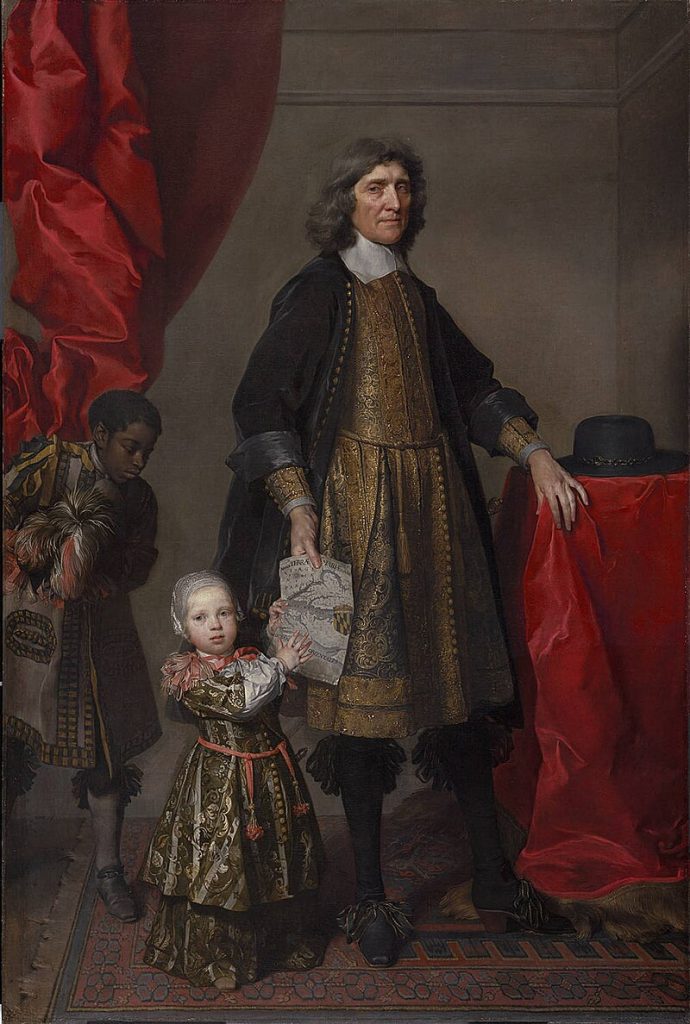
We left off with Cecil Calvert receiving the charter in June of 1632 from King Charles I for the new colony of Mary's Land, named for Charles' consort Queen Henrietta Maria, called "Queen Mary" by the English people. As the Avalon colony was foundering, George Calvert sent his children back to Ireland and England. It was then, in 1628, that Cecil contracted a marriage with Anne Arundell, also from a devout Catholic family, a family who, like the Talbots, eventually had their property confiscated by Oliver Cromwell. Since the bride was only about 12 or 13, it is likely that the marriage was not solemnized and consummated until later; at any rate, their first child, Charles Calvert, 3rd Lord Baltimore, was born in 1637. They had nine children, four of whom lived to adulthood. Anne was said to be a great beauty, educated and accomplished. Cecil, being a Catholic, could not study at Oxford, so instead he prepared at Gray's Inn to become a lawyer while Anne's father gave them a manor house in the country. Anne Arundell, Lady Baltimore, died in her early 30's in 1649.
Charles, by the Grace of God, of England, Scotland, France, and Ireland, king, Defender of the Faith, &c. To all to whom these Presents come, Greeting.
Whereas our well beloved and right trusty Subject Caecilius Calvert, Baron of Baltimore, in our Kingdom of Ireland, Son and Heir of George Calvert, Knight, late Baron of Baltimore, in our said Kingdom of Ireland, treading in the steps of his Father, being animated with a laudable, and pious Zeal for extending the Christian Religion, and also the Territories of our Empire, hath humbly besought Leave of us, that he may transport, by his own Industry, and Expense, a numerous Colony of the English Nation, to a certain Region, herein after described, in a Country hitherto uncultivated, in the Parts of America, and partly occupied by Savages, having no knowledge of the Divine Being, and that all that Region, with some certain Privileges, and Jurisdiction, appertaining unto the wholesome Government, and State of his Colony and Region aforesaid, may by our Royal Highness be given, granted and confirmed unto him, and his Heirs.
Cecil sent his younger brother Leonard Calvert to establish the new "county palatinate" of Mary's Land. Accompanied by the Jesuit Father Andrew White, Leonard and two hundred and twenty other settlers sailed from England in the two ships, the Ark and the Dove, which had belonged to Cecil and Leonard's father, in which he had fought off the French in Newfoundland. The ships landed at St. Clement's Island in southern Maryland on March 25, 1634, the feast of the Annunciation. The first Catholic Mass in the original colonies was offered there. (Read more.)
Our Film of the Week, The 49th Parallel, was intended as a plea for help, from one friend to another. That is, the English, who of course had all the nations of the Commonwealth on their side, including that grand and unique nation of Canada, wanted the Americans to enter the war against the Nazi regime. Goebbels, misunderstanding quite badly both American feelings and American affection for our cousins across the ocean, thought that he could win the United States over to the German side.
By the time The 49th Parallel had made its way to the screen, however, the Japanese had bombed Pearl Harbor, and the United States was in the war on both fronts. So the immediate political use to which the director, Michael Powell, and the screenplay writer Emeric Pressburger wished to put the film had already been accomplished. And yet the film is quite moving and powerful as a tribute to the kind of nation that the Canadians wanted to be, at their best, and also as a gesture of gratitude and appreciation for their southern neighbor. For, as the voice-over says at the beginning of the film, the forty-ninth parallel is unique in the world. It is merely a line on the map, well over a thousand miles long. It marks no river or mountain range. It is undefended. It requires no defense. And my family and I speak now from over twenty years of experience: we love Canada, and though we see that the people of each nation think they know more about their neighbors than they really do, we are always struck by the welcome we receive there, and the good cheer of the people, especially of the common folk who live far from the cosmopolitan cities. (Read more.)
“I could spend the night writing to you. I would not find space to sign. I am your forever faithful wife. Good night, my dear friend. It is midnight. I think it is time for me to rest.”
These words of 32-year-old Marie Dubosc were written to her husband, Louis Chambrelan, the first lieutenant of the French warship Galetée in 1758, during the Seven Years’ War. He never received the letter, which is one of over 100 sent to the crew and now read for the first time after they were discovered by a historian in Britain’s National Archives.
Galatée, a frigate of 200 tons, was escorting troop ships from Bordeaux to Quebec when it was captured by the British ship Essex in the Bay of Biscay on April 8, 1758, and sent to Portsmouth. Marie and Louis, who had a young daughter, would not meet again. Marie died the following year in Le Havre, before her husband’s release. In 1761, safely back in France, he remarried.
The journey of the letters to storage in Kew, southwest London, was circuitous. After they were penned, the French postal administration attempted to deliver them to Galatée, sending them to multiple ports in France where they always arrived too late. Once the ship was reported captured, the letters were sent to England, where they were handed to the Admiralty and apparently forgotten.
“It’s agonising how close they got,” said Professor Renaud Morieux, from Cambridge University’s history faculty and Pembroke College, who discovered the box of 104 letters. He believes officials opened two letters to see if they contained anything of military value and intended to check others before sending them on to the prisoners. “In my opinion they were waiting for an opportunity to open more, but they didn’t take the time or just forgot.” (Read more.)
Sister Frances Margaret (Fanny) Allen of the Religious Hospitallers
of St. Joseph died on Sept. 10, 1819, in Montreal at the Hotel-Dieu, the
hospital and convent founded by Venerable Jerome Le Royer, Venerable
Marie de la Ferre, and Jeanne Mance. She was a Vermonter in Canada, the first woman from New England to
become a Catholic religious, and the daughter of deist, rationalist and
American Revolutionary hero, Ethan Allen.
Fanny Allen was born on Nov. 13, 1784. Her father died when she was 4
years old and her mother, also named Fanny, remarried (to Dr. Jabez
Penniman). Neither the Allen nor the Penniman household was particularly
religious. In the midst of the great religious revivals in the British
colonies and the post-revolutionary period, Ethan Allen had written and
self-published Reason: The Only Oracle of Man (1785). So few
copies sold that the printer demanded more money to cover his losses.
Fanny laughed through her baptism ceremony when she was an adult. Her
mother insisted she be baptized by an Episcopalian minister in 1805
before she went to Catholic Montreal to study French. The minister,
Daniel Barber, did not appreciate her mirth. (Read more.)
During the last ice age, humans ventured into two vast and completely
unknown continents: North and South America. For nearly a century,
researchers thought they knew how this wild journey occurred: The first
people to cross the Bering Land Bridge, a massive swath of land that
connected Asia with North America when sea levels were lower, were the
Clovis, who made the journey shortly before 13,000 years ago. According
to the Clovis First theory, every Indigenous person in the Americas
could be traced to this single, inland migration, said Loren Davis, a professor of anthropology at Oregon State University. But
in recent decades, several discoveries have revealed that humans first
reached the so-called New World thousands of years before we initially
thought and probably didn't get there by an inland route.
So who were the first Americans, and how and when did they arrive?
Genetic studies
suggest that the first people to arrive in the Americas descend from an
ancestral group of Ancient North Siberians and East Asians that mingled
around 20,000 to 23,000 years ago. They crossed the Bering Land Bridge
sometime between then and 15,500 years ago, said David Meltzer,
an archaeologist and professor of prehistory in the Department of
Anthropology at Southern Methodist University in Dallas and author of
the book "First Peoples in a New World, 2nd Edition" (Cambridge University Press, 2021). But some archaeological sites hint that people may have reached the Americas far earlier than that.
For instance, there are fossilized human footprints in White Sands National Park in New Mexico that may date to 21,000 to 23,000 years ago.
That would mean humans arrived in North America during the Last Glacial
Maximum (LGM), which occurred between about 26,500 to 19,000 years ago,
when ice sheets covered much of what is now Alaska, Canada and the
northern U.S. Other, more equivocal data suggest the first people arrived in the Western Hemisphere by 25,000 or even 31,500,
years ago. If these dates can be confirmed, they would paint a much
more complex picture of how and when humans reached the Americas. (Read more.)
Marie-Antoinette "en gaulle" by Elisabeth Vigée-Lebrun
Generalissima: A Novel of Henrietta Maria
Book Two in the "Henrietta of France Trilogy"
#1 in Kindle Biographies of Royalty!
Marie-Antoinette, Daughter of the Caesars: Her Life, Her Times, Her Legacy
An Audible Bestseller
Marie-Antoinette, Daughter of the Caesars: Her Life, Her Times, Her Legacy
An Amazon Bestseller
Trianon: A Novel of Royal France
My Queen, My Love: A Novel of Henrietta Maria
Available from Amazon
The Saga of Marie-Antoinette's daughter, Marie-Thérèse of France
A Novel of the Restoration
In Kirkus Top 20 for 2014! And #1 in Kindle Historical Mystery, Thriller & Suspense Fiction
"In every Eden, there dwells a serpent . . . ."
#1 in Kindle History of France!
The Night's Dark Shade: A Novel of the Cathars
Join me on Facebook!
Elena Maria Vidal Author Page
Join me on X!
@emvidal
Visit My Tumblr!
East of the Sun, West of the Moon
St. Teresa of Avila, pray for us!
"...Bud forth as the rose planted by the brooks of waters. Give ye a sweet odor as frankincense. Send forth flowers, as the lily...and bring forth leaves in grace, and praise with canticles, and bless the Lord in his works." —Ecclesiasticus 39:17-19
The fact that a link is provided here in no way constitutes an endorsement of everything on the other end of the link.
Comments Policy
Comments are moderated. If a comment is not published, it may be due to a technical error. At any rate, do not take offense; it is nothing personal. Slanderous comments will not be published. Anonymity may be tolerated, but politeness is required.
I would like to respond to every comment but my schedule renders it impossible to do so. Please know that I appreciate those who take the time to share their thoughts.














_School_-_Lady_Grace_Talbot_(1562%E2%80%93after_1625),_Mrs_Henry_Cavendish_-_1129101_-_National_Trust.jpg)