


Thomas Merton on Noise
22 hours ago


From AMAC:
A groundbreaking report has demolished a favorite rhetorical tactic used by transgender activists to argue in favor of harmful procedures for gender-confused minors.
For years, the left has emotionally blackmailed the parents of gender-confused kids, insisting that families must sign off on dangerous, irreversible drug regimens or even surgeries, or else their child will surely commit suicide. But independent researchers recently confirmed there is no proof that restricting minors from this so-called “gender-affirming care” leads to more suicides.
A favorite line of transgender activists and their allies in the medical establishment is this: “Would you rather have a dead son or a live daughter?”
Medical professionals and social workers will frighten parents with some form of this bad-faith argument, claiming that “treatments” like cross-sex hormones, puberty blockers, or surgeries that leave kids permanently disfigured are “life-saving.” A compliant liberal media has willfully repeated this lie in their own biased coverage of debates about transgender drugs and surgeries.
But a comprehensive study from Do No Harm looked at Centers for Disease Control and Prevention data across 23 states that have banned transgender drugs and surgeries for minors. Their conclusion? There is “no evidence that these bans have increased suicide rates.”
Do No Harm is an advocacy group which “represents physicians, nurses, medical students, patients, and policymakers focused on keeping identity politics out of medical education, research, and clinical practice.” It was founded in 2022 and opposes transgender drugs and surgeries for minors.
“The alarmist prediction that restricting medicalization of gender-distressed minors would produce a spike in youth suicides is not supported by the data,” Do No Harm scholars Jay Greene and Ian Kingsbury write in their new report. (Read more.)
From The Abbey of Misrule:
Long before the digital age, artists have pondered both the promise and peril of artificial intelligence. Homer’s Iliad described automaton tripods made by Hephaistos that might be confused with Elon Musk’s dream of putting an Optimus robot in every home. Ovid’s Metamorphoses tells of Pygmalion, disappointed in his marital prospects, carving his perfect woman and bringing her to life with the help of Venus. She was the first romantic chatbot, a reflection of Pygmalion’s self-love. Mary Shelley’s Frankenstein warns us what can happen when scientific hubris puts the creation of life and intelligence in its crosshairs. More recently, we have Frank Herbert’s Dune, with the maxim “thou shall not make a machine in the likeness of a human mind.”
Yet we are here, crafting such a machine. Many, perhaps the majority of us, have deep reservations about AI, yet struggle to explain why. We think it could create trouble but also see the great benefits. As a result, nearly all the arguments have been around the outcomes of AI. This is the modern approach - judging something by what it can do, rather than what it is.
If artificial intelligence were a tree, then nearly every discussion we are currently seeing concerns its fruits. An AI optimist predicts a cure for cancer, where a pessimist sees the elimination of the doctor-patient relationship. Mass prosperity! Or is it mass layoffs? For every rotten apple I spot, another sees a juicy golden delicious. How can we make sense of it all?
Arguing about the fruits is problematic. First, predictions are tricky business. Remember when social media was supposed to bring people together? Second, Christianity focuses on the means, not the ends. We care more about whether eggs are getting cracked than how tasty the future omelette may be. (Read more.)

Here are some of the reforms of Louis XVI, made of his own free will beginning from the moment he ascended the throne. He was considered quite the Liberal.
1774 Louis XVI placed Turgot in charge of finances and introduced free circulation of grain. Founded School of Medicine in Paris.
1775 Droits d'octroi were reduced, prison reform begun, and the death penalty for deserters was abolished.
1776 The king signed the six edicts of Turgot comprising the abolition of the corvée. The parlements resisted the edicts, preventing them from becoming law. In the same year he reduced his household.
1778 More taxes reduced.
1779 The king abolished servitude and other reforms were made.
1780 Further reductions in the Royal household were made, hospital reform was begun, prison reform continued, most torture was abolished.
1784 Relief given to Jews.
1786 More hospital reform, aid to the deaf, and provisions made for lost children.
1787 Steps taken towards the total abolition of the corvée, more reductions in royal household, civil rights accorded to Jews and Protestants.
1788 All forms of torture were abolished, greater freedom given to press, steps towards abolition of lettres de cachet.
All of the above is taken from Nesta Webster's Louis XVI and Marie-Antoinette during the Revolution, but it is a matter of public record as well. There are also discussions on the king's reforms in Simon Schama's Citizens and Vincent Cronin's Louis and Antoinette. Anyone who thinks Louis XVI was a lazy, sluggish, do-nothing king need only examine the six volumes of laws passed during his reign. He wanted to reform the feudal tax system, which is why he called the Estates-General. If all the nobles and wealthy clergy had been minimally taxed, there would have been no deficit. The enemies of the king were determined his plans were not to succeed. They had been planning for years. As Marie-Antoinette wrote to her brother Leopold II in August 1790 about the society she had once thought to be innocuous:
Be well on your guard where you are with regard to all associations of Freemasons. You must already have been warned that it is by this means that all the monsters here count on attaining the same end in every country. Oh, God, preserve my fatherland and you from such misfortunes.(Image: Louis XVI rendant la liberté aux serfs de son royaume. Dessin de Charles de Wailly, 1783.) Share
From Hilary White at The Sacred Images Project:
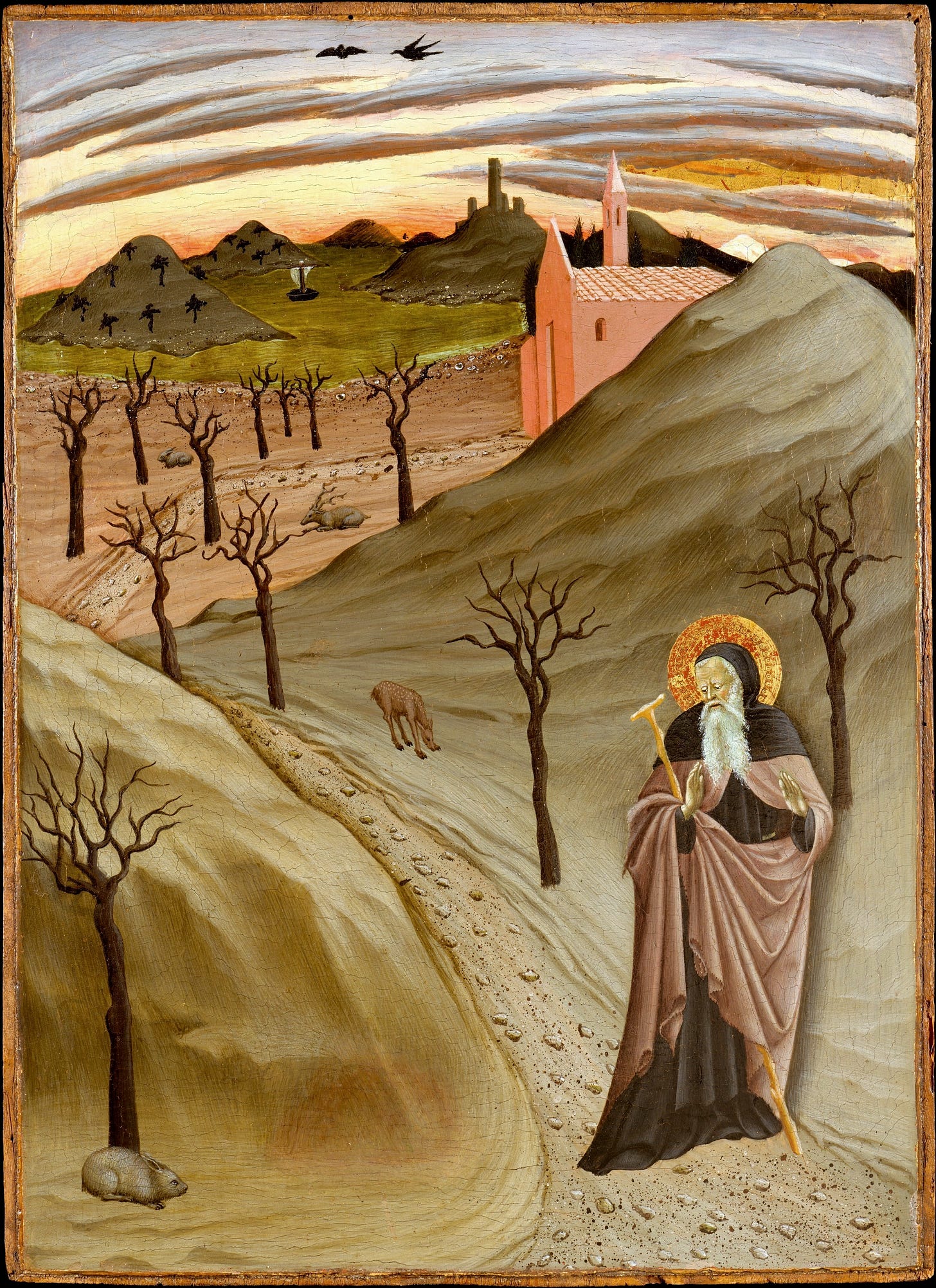
ShareWhen reading the New Testament through our usual theological lens of a grand cosmic drama, it’s easy to miss the significance of the kind of work done by most of the named protagonists. The first Apostles, Peter, Andrew, James and John are all fishermen. And Thomas, Bartholomew and Philip probably were too. Paul of Tarsus - a highly educated Pharisee and Roman citizen - is described as a tentmaker, though the Greek skēnopoios may mean something closer to a general leatherworker or maker of canvas goods, and his friends Aquila and Priscilla practised the same trade. Tabitha (also called Dorcas) was a seamstress.
There were a few representatives of what we might today call the “middle class”1. Lydia was a successful cloth merchant who specialised in the famous purple cloth of the region. Luke was a physician (and painter), Matthew and Zaccheus were both publicans (tax collectors for the Romans) a profession despised by the Jews, of course, though lucrative. Cornelius and Julius were centurions in the Roman army. Zenas (Titus 3:13) is identified as a lawyer.
Later the movement attracted members of the upper echelons, including Erastus, who is identified by Paul as the city of Corinth’s director of public works2. The wealthy, slave-owning convert Philemon was an upper-class patrician, probably a Romanised Greek and landowning civic politician in the city of Colossae. Very interestingly, Paul refers to Philemon3 as a “dear friend and fellow worker” in his letter about the escaped slave Onesimus.
But we get the general tone from Paul of how deeply work, and often manual work, was morally incorporated into early Christian thinking. “We labour, working with our own hands, (1 Corinthians). “We worked night and day,” ( 1st Thessalonians) and “if anyone will not work, neither shall he eat,” (2 Thessalonians).
In fact it would never have occurred to any person of that time that work - an occupation of some kind, whether manual or domestic labour, artisan craft or mercantile trade, or even senatorial-rank political involvement - was something embarrassing to be escaped in favour of a life of pure leisure and entertainment. On the contrary, Christians taught that whatever work you did it should be ordered to the Christian goals of salvation. (Obviously this meant there were some trades and professions you could not enter, like prostitution, gladiatorial combat, making idols for the temples, etc.) (Read more.)
From Chronicles:
Share“Resolved, That the House of Representatives condemns and denounces socialism in all its forms, including the Democratic Socialists of America, and opposes the implementation of socialist policies in the United States,” a congressional resolution passed on Sept. 1 boldly declares. The resolution further states that the House recommits itself to upholding the Constitution, supports “fair, free, and secure elections” in which participation is reserved for “American citizens only,” and calls for Congress to pass the SAVE Act “to ensure election security, increase public confidence in America’s voting system, and close loopholes in order to prevent noncitizens from voting in elections.”
In a healthy democracy—or even in an ailing democracy run by a complacent and self-serving uniparty—one might expect that none of the elements of this resolution would be controversial. Who, after all, would oppose upholding the Constitution, object to elections that are fair, free, and secure, favor allowing noncitizens to vote, and actively want to worsen public confidence in our nation’s voting system?
In our current climate, one would expect opposition to come primarily from the radical left and its leading official organization, the Democratic Socialists of America (DSA). Indeed, the resolution recognizes this, opening with “the condemnation and denouncement of socialism in all its forms” and continuing its preamble stating that “the DSA’s ideology and socialism, in any form, are incompatible with American values and the United States Constitution.” The DSA appears to agree with that assessment, as it has claimed (as the resolution’s preamble further observes) that “the United States never was a democracy.”
But DSA members are not the only or even the primary votes in opposition to this resolution. The resolution passed by a relatively narrow margin of 220 votes to 192, with all Republicans and only eight Democrats voting in favor of it. That is to say that 192 Democrats—the vast majority of the congressional delegation of that party—voted against it. (Read more.)
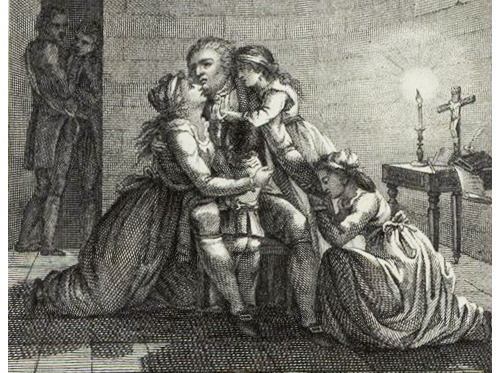
At half-past eight the door opened; the queen appeared first, holding her son by the hand; then Madame Royale and Madame Élisabeth; they ran to the arms of the king. A gloomy silence reigned for several minutes, interrupted only by sobs.
… The king sat down, the queen on his left, Madame Élisabeth on his right, Madame Royale nearly opposite to him, and the little prince between his knees.
All were bending towards him and held him half embraced. This scene of sorrow lasted seven quarters of an hour, during which it was impossible to hear anything; we could see only that after each sentence of the king the sobs of the princesses redoubled, lasting some minutes; then the king would resume what he was saying.—the journal of Jean-Baptiste Cléry
From The Logres Institute:
ShareThursday 9/17 Empire Magazine released their exclusive first look at Greta Gerwig’s Magician’s Nephew film, confirming early rumors that Meryl Streep will indeed voice Aslan, the Great Lion of Narnia. Moreover, Gerwig’s "rock'n'roll" Aslan has “heterochromatic eyes” inspired by David Bowie, feathered eyes, dragon-like skin, a lipstick red nose, and rainbow whiskers. Everything about Gerwig's visualization of Aslan speaks to breaking the gender binary and the celebration of transgressive identities. Though the move to queer Aslan is hardly surprising given Gerwig's politics and history of feminist filmmaking, the idea of a queerily feminine Aslan is important to address. By casting a woman as the voice of Aslan, Gerwig twists an icon of Christ into a different form.
We love our favorite stories because they provide a frame through which we can understand who we are and the world we live in. We love C.S. Lewis and his Chronicles of Narnia for the cosmic vision they give us—a re-enchanted way to imagine the world as filled with divine presence, crammed with meaning, and bursting with goodness, truth, and beauty. Lewis could write such a world because his imagination was deeply sacramental. He understood that created things like wardrobes, lamp posts, and lions are formed with intrinsic meaning. (Read more.)
From The Maistre Institute:
ShareThe charter of the modern state was signed at Westphalia in 1648 by exhausted men who wanted the killing to stop and were prepared to pay almost anything for it. What they agreed was that the religion of a territory would follow the conscience of its prince, and that no authority whatsoever stood above the sovereign to adjudicate the question. We remember this as the birth of toleration. It was also, and more consequentially, the moment the universal Church was subordinated to the territorial ruler as a matter of public law. Innocent X saw exactly what had been done and declared the settlement null and void insofar as it prejudiced the Catholic religion. Nobody listened. A pope proposing terms of peace would be disregarded again in 1917, on the same reasoning and by the same sort of men, though by then the disregard was so habitual that hardly anyone thought to remark on it.
After Westphalia the sovereign state acknowledged no superior on earth. Christendom, which had always meant something standing above the princes rather than beside them, survived mainly as a family inheritance maintained by one dynasty out of stubbornness and piety in roughly equal measure.
The Revolution then took what Westphalia had built and knocked out the last support. Sovereignty no longer descended from God to the prince. It rose from below, from the people, and it needed no warrant from heaven at all. Napoleon abolished the Holy Roman Empire outright in 1806, the title simply lapsing after eight hundred years, and the Habsburgs withdrew to the merely Austrian crown. Then came the nationalisms, lyrical in their poetry and homicidal in their politics, each teaching a people that its destiny required a state of its own. Then 1848. By the time Princip fired in Sarajevo the intellectual demolition was finished and had been for some while. Only the building was still standing, and buildings come down fast once the footings are gone. (Read more.)
From The War on Beauty:
ShareFrance has been in a process of de-Christianization since the Revolution in 1789 when Catholicism was outlawed and replaced with a new atheistic cult called ‘The Cult of Reason.’ A lot of people were surprised by the recent mockery of the Last Supper at the Olympic Games, but this isn’t the first time there has been an outright assault on the Catholic Church in France, nor is this the worst instance (shockingly).
After the Catholic monarchs and Ancien Régime were violently couped in 1789, a new anti-religious, and clearly satanic totalitarian government came to power and immediately severed all ties with the Church. Along with the persecution of the aristocracy, normal French people/ peasants, including thousands of clergy were martyred for not renouncing their Catholic beliefs.
This was the first big move in shifting France away from a faith-based society to one that worships reason, science, and man’s own ‘intelligence’ as the new God. The new regime went so far as to remove all crosses and religious symbols in the country including from graveyards, ceased all Catholic schooling, and not only closed all churches but forcibly confiscated them from the diocese to fund the new government. (Read more.)

Aglaé Louise Françoise Gabrielle de Polignac (7 May 1768 - 30 March 1803) was the first child and only daughter of Yolande Martine Gabrielle de Polastron and Jules de Polignac. In 1780, she was married to the Antoine Louis Marie de Gramont, duc de Guiche. They had three children.Share
In 1784, the talented Elisabeth Vigee-Lebrun painted the 16 year old Aglaé in a simple, pastoral dress that was popularized in the 1780s by the rise of country and hamlet inspired fashions. (Read more.)
From Unlicensed Punditry:
It is 2026 and the Ottoman Empire is still at the gates, only now, there are people who don’t care because they have no concept of what living in an Ottoman civilization (or under the Taliban’s interpretation of sharia law) looks like.
We should not believe it wasn’t this way before 9/11 because there have always been haters of this nation, not because it didn’t give them of its bounty, but because, in their opinion, it didn’t give them enough.
9/11 changed that – albeit temporarily.
For a while, the bitchers, whiners and anti-Americans were too afraid to be exposed as making common cause with 7th Century savages who figured out how to use the very freedoms against us that the anti-Americans take for granted. They saw the anger that average Americans rightly focused on Islamic terrorists – and they also saw the fear in those who were not confident enough in America’s goodness to stand up.
That soon faded and America’s ADHD returned. Not only did the anger wane, it became tiresome, but the fear subsided as well. Twenty-five years ago, there were no marches to “free Palestine”, a state and a people who do not exist and protest featuring open hatred of Israel, a state and people who do exist.
Over the span of just a few years, we not only forgot who the enemy was, we hold seminars to protect Muslims from “Islamophobia” and openly import them while actively denying Islam’s role in the murder of thousands of people here in America and abroad. We even elect the radical among them to office.
The tolerance we have for Mamdani, Omar, El Sayed, Rashida Tlaib, and other agitators has eclipsed our outrage that we were attacked on our home soil on 9/11, that outrage has become performative. (Read more.)

Called a "consoling angel," the sister of King Louis XVI decided to stay on the side of her family even when death was imminent for doing so in the midst of the horrors of the French Revolution. On the 230th anniversary of her death under the guillotine on May 10, 1794, "Madame Elisabeth" is one step closer to beatification as the historical commission for her sainthood cause wrapped up its work May 2. The diocesan phase of her sainthood cause was reopened in 2017. Since then, Fr. Xavier Snoëk, the postulator, has spared no effort to raise awareness of the noble lady.
She was "an original and very modern young woman … pious and exuberant at the same time," Father Snoëk told OSV News. "She read a lot while being passionate about science and mathematics. She was also very athletic. She loved the outdoors and was an excellent horseback rider." (Read more.)
I always disliked the changes Disney made to the delightful fairy-tale The Snow Queen by Hans Christian Andersen. From Classical Ideals:
ShareThe story of The Snow Queen (1844) by Hans Christian Andersen begins with an evil mirror, crafted by the devil himself. Its deviousness lies in the fact that it shows things the opposite of what they are. Good looks evil, beauty looks ugly and conversely, evil looks virtuous and ugliness looks good.
At the beginning of the story, while the devils carry this mirror up and up to heaven in order to laugh at God Himself by inverting His reflection, they drop it and it breaks into a trillions of pieces. Some of these pieces land on earth and pierce the eyes of people to invert their vision, and into their hearts to invert their sense of morality. Though this story was written nearly two hundred years ago, well before the internet and its devices captured society so profoundly, its message feels urgently relevant. So many of society’s ideas about morality, heroism and virtue seem not merely wrong, but completely inverted.
One of the most egregious examples of this, ironically, is in Disney’s retelling of the Snow Queen, Frozen (2013). The villain of the Snow Queen becomes the heroine in Frozen as Elsa, a misunderstood princess with superpowers she “just hasn’t learned to control yet”. Frozen shows selfishness as freedom, permissiveness as love.
(Read more.)

Among the thousands murdered during the French Revolution, one of the most notorious cases was that of the death of the Princesse de Lamballe, friend of Queen Marie-Antoinette. The fury of the new order of Liberty, Equality, and Fraternity vented itself upon her frail form in a manner of extreme violence. This was as strange as it was hideous, because other than being a confidante of the queen's, Madame de Lamballe could be counted among the more liberal, "enlightened" aristocrats, devoted to works of charity and civil improvements.
 Contrary to the standard depiction of Lamballe as a lovely but simpering idiot, the princess was intelligent as well as cultured. She was the Grande Maitresse of all the French masonic ladies' lodges, for she saw freemasonry as a tool for creating a better world, as did many of her contemporaries. Her liberal politics were one of the reasons, according to scholar Bernard Fay, that King Louis XVI encouraged his wife towards the Polignacs, and away from Lamballe and her Orleanist salon. Madame de Lamballe discovered before the end that utopian politics that seek to create an earthly paradise inevitably lead to social chaos.
It was at the time of the sleighing-parties that the Queen became intimately acquainted with the Princesse de Lamballe, who made her appearance in them wrapped in fur, with all the brilliancy and freshness of the age of twenty,–the emblem of spring, peeping from under sable and ermine. Her situation, moreover, rendered her peculiarly interesting; married, when she was scarcely past childhood, to a young prince, who ruined himself by the contagious example of the Duc d’Orleans, she had had nothing to do from the time of her arrival in France but to weep. A widow at eighteen, and childless, she lived with the Duc de Penthievre as an adopted daughter. She had the tenderest respect and attachment for that venerable Prince; but the Queen, though doing justice to his virtues, saw that the Duc de Penthievre’s way of life, whether at Paris or at his country-seat, could neither afford his young daughter-in-law the amusements suited to her time of life, nor ensure her in the future an establishment such as she was deprived of by her widowhood.Marie-Antoinette made Madame de Lamballe, known for her virtue and kindness, the Superintendent of her household, which was controversial at the time since there were other courtiers who felt the position was due to them. The two women became good friends. The queen was always trying to recapture the home she had left in Austria, where she had been inseparable from her older sister Maria Carolina, who had mothered her a great deal. Madame de Lamballe and Madame de Polignac were both roughly the same age as Carolina. However, Lamballe was a bit too intellectual for Antoinette and so the queen, with Louis' approval, eventually became closer to the Polignacs. She always remained friends with Lamballe, however.
We were hardly seated before a head at the end of a pike was presented at the window. Tison's wife screamed loudly; the murderers thought it was the queen's voice, and we heard the frantic laughs of those barbarians. Thinking that Her Majesty was still at table, they had raised the victim's head so that it could not escape her sight; it was that of the Princesse de Lamballe. Though bloody, it was not disfigured; her blond hair, still curling, floated around the pike.Such excesses became typical of the French Revolution, stirred up by propaganda which played upon the fears of many. The Princesse de Lamballe was a bit misguided but ultimately heroic and loyal, and the grisly death to which she was subjected exemplified not only the misogyny of the new order but a hatred of all that was beautiful and good.

From History Today:
The Directory, the regime which ruled France during the closing years of the revolutionary decade, took its name from the five-man executive body that was elected by a two-chamber legislature, according to the Constitution of 1795. It has been disparaged as an uninspiring, corrupt, and chaotic interlude between two far more dramatic periods, that of the Terror, which preceded it, and the Bonapartist dictatorship that followed. In the past, most historians simply ignored it, concluding their accounts of the Revolution in 1794, with the fall of Robespierre, but that is no longer the case. The Directory remained true to the founding principles of 1789, and is now rightly regarded as an integral part of a greater project to replace the ancien régime in France. Although this experiment failed to end the Revolution by restoring political stability as its leaders intended, they made an invaluable contribution to that protracted process. Their achievements have often been credited to Napoleon, who did bring the upheaval to a close, while many of the individuals who served the Directory would continue to do so under his Consulate and Empire.
Biancamaria Fontana has chosen to approach the Directory from a biographical point of view, devoting the substantive chapters of this book to seven of its leaders, six of whom (from a total of 13) held the post of director for varying lengths of time between 1795 and 1799, while the other was a minister of justice. Their appellation as ‘desk revolutionaries’ might have been more convincingly addressed, though the majority of these mostly lesser-known individuals worked diligently to organise a French Republic which had barely survived its unexpected inception in 1792. This perspective offers significant insight into the regime’s operation, as well as the solid, if unspectacular, measures that were adopted under the Directory, most notably in the realms of finance and taxation. Success on the battlefield was also secured with the annexation of additional territory to the Republic, yet continuing warfare was hardly conducive to orderly progress, and deep-rooted political divisions persisted. The recourse to purges of the legislature, in 1797 and 1798, so as to preserve the system only served to demonstrate its fragility.
The personnel examined here were all seasoned national deputies who had voted for Louis XVI’s execution in 1793 and were thus committed to creating a lasting Republic. Three of them, the directors Reubell, Merlin de Douai, and François de Neufchâteau, were lawyers and had acquired considerable experience of office-holding before the Revolution. The task of legal codification progressed, government finances were much improved, and the bureaucracy was streamlined. Another director, Carnot, an army engineer, pursued the task of military reform by integrating conscripts into the regular army, while the dissolute ex-noble Barras, whose personal conduct gave the Directory such a poor reputation, alone served in the post from beginning to end, when he colluded in its downfall in Brumaire (November 1799). This famous coup d’état was orchestrated by his short-lived fellow director, the abbé Sieyès, who, having played a major role in the events of 1789, now joined the executive with the aim of extending its powers. This could only be done by overthrowing the regime. Outmanoeuvred by Bonaparte, who supplied military support for the coup, Sieyès would collaborate with the subsequent Napoleonic regime, to which Merlin de Douai and Cambacérès in particular made outstanding contributions. (Read more.)
From The Enterprise:
ShareLast week, Judge Noël Wise of the Northern District of California entered judgment in Stanford Daily Publishing Corp. v. Rubio. The plaintiffs were the university’s student newspaper and a Jane Doe holding an F-1 visa. The opinion runs some 90 pages and collapses two legal statuses that the Constitution and the Immigration and Nationality Act keep apart. An American citizen and a foreign student may stand at the same rally and chant the same slogans for Hamas, the same organization that murdered, raped, and kidnapped Israeli civilians on October 7. The First Amendment forbids the government from jailing, fining, or prosecuting either of them for those words alone. That protection is real. It is also not the question this case decides.
The question is whether a foreign student, admitted for a limited purpose on conditions attached by Congress, may retain the invitation after the Secretary of State concludes that his presence carries potentially serious adverse foreign policy consequences. Judge Wise held, in effect, that once the guest begins speaking, the invitation hardens into something the Secretary cannot touch. She treated a permission as if it were a right. The citizen holds this country the way an owner holds a house. The visa student is a guest. Nothing in the First Amendment converts the second position into the first.
Section 221(i) of the Immigration and Nationality Act, codified at 8 USC 1201(i), is written for guests. After a visa is issued, the Secretary of State “may at any time, in his discretion, revoke” it. The power does not expire when the student clears customs. The judgment belongs to the Secretary, not to a jury, a prosecutor, or a district judge in San Jose. A companion provision, 8 USC 1227(a)(4)(C), makes an alien deportable when the Secretary has reasonable ground to believe that his presence or activities would have potentially serious adverse foreign policy consequences. Congress then added the sentence that should have stopped this lawsuit at the courthouse door. There shall be no means of judicial review of a 221(i) revocation, except in the narrow case where the revocation is the sole ground for removal. Congress knows how to open the courthouse. It does so constantly. Here it closed the door on purpose, because visa decisions sit where foreign policy, intelligence, and diplomacy meet, and because courts have the least competence in that arena. (Read more.)
From Carl Trueman at First Things:
ShareIn retrospect, I see that I grew up at a breaking point in English culture. I was (perhaps symbolically) the last person at my school to study Latin and the last not to take computer science. The ancient disciplines were already on life support, and the technocrats were waiting in the wings. My copy of Lewis and Short, the classic Latin dictionary, is an ever-present symbol of this; it was the school’s copy, given to me when I left as it was of no further use to the institution.
Earlier this year, I had a strange premonition of how different England has become. A young Dutch politician, Eva Vlaardingerbroek, was barred from entering the U.K. One of my sisters had never heard of her and therefore did an AI Google search to find out what had made her so dangerous. To her surprise, the chatbot told her that this politician was known, among other things, to refer to my work in public lectures, and that we were both outspoken opponents of transgenderism. The same government, of course, has allowed thousands of anonymous young men to enter the country, providing them with accommodation while only last week finding it necessary to advise them of some quaint aspects of British culture, such as the fact that women are allowed to work, that “if you have sex with someone without their consent, this is called rape,” and that if you indulge in such behavior, “it will affect your asylum claim.” Dutch conservatives who think that women cannot have penises are not welcome, while men from countries that consider rape something of a gray area are entering in droves. Well, I suppose the situation could be worse: They could be fans of J. K. Rowling or retweet posts by Graham Linehan.
England exemplifies the political shape a country takes when expressive individualism grips the imagination of its ruling class. It is impossible for any culture to allow everyone to be who they want to be, from transgender activists to traditional Christians. Somebody therefore has to bring order to the potential chaos, and as expressive individualism tends strongly toward the transgressive, with its core notion that personal authenticity lies in breaking with the herd (that is, the social expectations of the past), the culture-makers will typically favor those who want to demolish received ideas and traditions deemed stumbling blocks to self-realization. This turns morality on its head. Yesterday’s virtues have become today’s oppressive vices, as the moral register has shifted in a psychological direction—most notably in the trivialization of trauma, which in some cases has come to mean little more than “somebody somewhere said something hurtful about me.” Sadly, the Church has often proved little different. (Read more.)
From Chronicles:
The other day, while I was trying to enjoy myself on a short vacation in a beach town, the ethnographer in me could not help but notice a disconcerting phenomenon.
Three or four times in a brief span of perhaps an hour, I saw a young woman and a young man walking together, clearly couples. All of the women were strikingly beautiful. “Well done, lad!” I thought each time. And then, in each case, I noted that the man was not holding the woman’s hand, and he was not talking to her or even looking at her.
What was he doing?
You know exactly what he was doing, don’t you? He was looking at the little machine in his hand as he walked beside this lovely young woman.
And no, it’s not just a quick “What’s the address of the restaurant we’re going to?” kind of looking that he was engaged in. No, these young men were ignoring the humans in their lives in order to attend instead to machines. These men who were walking alongside attractive women—a situation every normal man has devoted backbreaking work and great risks to achieve throughout the long history of humanity—are now too distracted by a handheld machine displaying ghostly images from nowhere and speaking to them in a disembodied robot voice to even notice the beautiful women before them.
In my head, as I see these men doing what they are doing, I am having the same conversation with each of them:You can stop talking to me about how tough things are for your generation. I’ll hear none of it. You deserve every serving of ordure you might get from the world, and you will get none of my pity. For here is a real human female right beside you, longing to have you take her hand and make her feel loved, and you’re more interested in the little soul-sucking metal box with the screen on it. What has gone so dreadfully and totally wrong with you, you strange creatures? What even are you? I do not see my species in you.
But it is not just the young men. I can’t count the number of young women also fervently clinging to their phones—taking endless pouty-faced selfies, gazing into them as at a lover, and holding them at that ostentatious and ridiculous angle in front of their faces while blathering vapidities to someone somewhere else holding her little machine in just the same ludicrous posture. Absorption by the spirit of the robotic is a binary experience, spread across the sexual divide. (Read more.)











