Showing posts with label Africa. Show all posts

Sunday, September 13, 2026

How Iran-Backed Pirates in Yemen Are Raising Your Gas Price

 From Tierney's Real News:

Yemen’s Iran-backed Houthis just seized the strategic port of Mocha (Mokha), pushed into the coastal town of Dhubab, and took Perim Island (also known as Mayyun) in the heart of the Bab el-Mandeb Strait. Multiple reports confirm the group now effectively controls Yemen’s entire Red Sea coastline and the critical island that splits the narrow strait’s shipping lanes.

The stretch between Perim and Ras Siyyan in Djibouti is the most narrow point of strait, measuring just 20 km. This will give the Houthis excellent opportunities to block this maritime trade route leading up to the Suez Canal. If the Houthis decide to expand their naval blockade from just Saudi ships to all international cargo vessels, then all maritime trade will have to be rerouted around Africa again.

Bab el-Mandeb is the southern gateway connecting the Red Sea to the Gulf of Aden—the “other” strait that has become Saudi Arabia’s primary remaining outlet for crude. It normally carries about 10–12% of global seaborne trade and, pre-crisis, 8–9+ million barrels per day of oil and products. India, China, Japan, South Korea and others depend on it for Middle Eastern and Russian crude.

The Houthi forces have publicly stated that their blockade explicitly targets Saudi-linked shipping. Despite their public assurances that wider international commercial traffic is safe, energy markets react to the geographic proximity of heavy weapons to a channel that is only 18 miles wide. (Read more.)

Share

Monday, July 13, 2026

The 400,000 USAID Deaths

 From DataRepublican:

South Sudan’s independence was the product of a twenty-year American political project that united four constituencies who agreed on nothing else. Evangelicals found Christians enslaved by an Islamist government; Francis Bok, captured at age seven, became the first formerly enslaved person to testify before the Senate Foreign Relations Committee. The Congressional Black Caucus found Arab militias enslaving Black Africans; the apartheid divestment playbook was redeployed against Talisman Energy, the last major Western oil company in Sudan. Neoconservatives found a state sponsor of terrorism that had hosted bin Laden. Liberal interventionists found a genocide in Darfur; the Save Darfur rally on the National Mall in 2006 drew tens of thousands of people.

The Darfur Peace and Accountability Act passed the House 416 to 3. All four constituencies arrived at the same policy: pressure Khartoum, support the south, self-determination. The Save Darfur Coalition merged in 2011 — referendum year — into “United to End Genocide”. The momentum from one crisis was redirected to engineer the independence of a different part of the country.

Meanwhile, Operation Lifeline Sudan had been running since 1989 — sixteen years of airstrips, supply chains, and NGO networks that USAID inherited. OLS was the first time the UN negotiated directly with a non-state armed group, implicitly legitimizing the SPLA (Sudan People’s Liberation Army) as a governing authority before it governed anything. (Read more.)

Share

Saturday, June 27, 2026

How the Phoenician Spoken and Written Language Shaped the Mediterranean

 From The Collector:

The Phoenicians were prolific merchants and explorers who traveled from their home in the Levant across the ancient Near East and Mediterranean, planting colonies and trading outposts around the ancient world. Wherever the Phoenicians went, they took their language with them, and they were pioneers in this area too. They developed the first true alphabetic script. The useful tool was adopted by other cultures, including the ancient Greeks, who in turn influenced the ancient Latin alphabet, which is the basis of most modern Indo-European languages, including English.

The Phoenicians were Semitic-speaking people who primarily inhabited several coastal cities in the Levant, including Byblos, Tyre, Arvad, Berytus (Beirut), and Sidon. There was no Phoenician empire or unified state. Each city was an independent city-state. The Phoenicians never referred to themselves as “Phoenicians” in their own written texts but as members of their respective city-states.

The earliest recorded references to the Phoenicians date from the Late Bronze Age Egypt (c. 1500-1200 BC). The “Annals of Thutmose III” (c. 1479-1425 BC) mention Byblos extensively as a vassal of New Kingdom Egypt. The Egyptians called them “Asiatics.” Byblos was also mentioned in the “Amarna Letters” (1360-1332 BC) as an important city that was a source of contention between the Egyptians and Hittites. (Read more.)


Share

Sunday, June 21, 2026

An Irishman Against American Slavery

From A Catholic Bard:

Daniel O’Connell  (August 6, 1775 – 15 May 15, 1847) hailed in his time as The Liberator, was the acknowledged political leader of Ireland’s Roman Catholic majority in the first half of the 19th century. His mobilisation of Catholic Ireland, down to the poorest class of tenant farmers, secured the final installment of Catholic emancipation in 1829 and allowed him to take a seat in the United Kingdom Parliament to which he had been twice elected. –Wikipedia

Gentlemen:

We have read, with the deepest affliction, not unmixed with some surprise and much indignation, your detailed and anxious vindication of the most hideous crime that has ever stained humanity—the slavery of men of color in the United States of America.

We are lost in utter amazement at the perversion of mind and depravity of heart which your address evinces.
How can the generous, the charitable, the humane, the noble emotions of the Irish heart, have become extinct among you? How can
your nature be so totally changed as that you should become the apologists and advocates of that execrable system which makes man the property of his fellow-man destroying the foundation of all moral and social virtues—condemns to ignorance, immorality, and irreligion, millions of our fellow-creatures—renders the slave hopeless of relief, and perpetuates oppression by law ; and, in the name of what you call a Constitution!

It was not in Ireland you learned this cruelty and inhumane.
Your mothers were gentle, kind, Their bosoms overflowed with the honey of human charity. Your sisters are, probably, many of them still among us, and participate in all that is good and benevolent in sentiment and action.
How, then, can you be so depraved?
(Read more.)


Another Communist invention? From Tierney's Real News:

Portugal and Britain were the biggest slave-trading countries in the world - providing about 70% of all Africans transported to the colonies to work. Britain sent some 3 million African slaves to its colonies in the Caribbean, North America and South America from 1610-1807. How did they get them? They paid African leaders to “capture” and enslave their own brothers and sisters and sell them to British slave traders.

Black Muslims, who sold their own, were the WORST and most prolific slavers in history. They enslaved MILLIONS and still traffic and enslave their own in Africa TODAY in open slave markets on the streets.

Among the first documented Africans in British North America were approximately 20 men and women who arrived at Jamestown, Virginia, in 1619. They were seized by private slave traders from a slave ship bound for Mexico and traded in Virginia. The Africans worked the tobacco fields in Jamestown along with white indentured servants. Early Africans were also held as slaves by Native Americans, the original slave traders in North America, who enslaved other tribes as well.

The British were aided by loyal Native American tribes, slaves from Africa and Hessian troops from Germany to fight AGAINST American patriots.

IN OTHER WORDS, BLACK SLAVES WERE EXPORTED TO AMERICA BY THE BRITISH AND THEN BLACK SLAVES FOUGHT WITH AMERICAN INDIANS AND THE BRITISH AGAINST AMERICAN PATRIOTS.

In other words, black slaves and American Indians in America tried to STOP America from becoming a free and independent nation! They fought with their masters (the British) to try to defeat American patriots! That’s the truth that they refuse to tell us!

Therefore, the historical reality of the Revolutionary War directly challenges the idea that Juneteenth represents a more unifying national independence story than July 4th. IT DOES NOT.

During the Revolutionary war, thousands of enslaved individuals defected to the British military following Lord Dunmore’s Proclamation, taking up arms against the American Patriots. By fighting alongside the British Crown, these individuals actively worked to defeat the American revolution and preserve British colonial rule over the continent.

Juneteenth should be celebrated as a milestone of freedom, but it cannot replace the holiday that marks the birth of the very Republic that made that freedom legally possible. (Read more.)

Share

Wednesday, June 10, 2026

The UN, Slavery, and History’s Selective Amnesia

 From The European Conservative:

In March 25th, the United Nations General Assembly adopted a resolution describing the transatlantic slave trade and the enslavement of Africans as “the gravest crime against humanity.” The text was adopted by 123 votes to 3, with 52 states abstaining, including France, Portugal, Spain, the United Kingdom, and most European countries. The United States, Israel, and Argentina voted against.

The symbolic significance of this resolution is considerable. No one would dispute that the transatlantic slave trade constitutes one of the greatest tragedies in human history. For several centuries, millions of Africans were deported to the Americas under appalling conditions, reduced to the status of commodities, and integrated into an economic system based on their dehumanisation. The memory of this crime deserves to be acknowledged and passed on.

But it is precisely because the history of slavery is too grave to be exploited that we must question the ideological assumptions underlying this resolution. For the controversial nature of the text does not lie in its condemnation of the transatlantic slave trade but in what it omits.

By designating the transatlantic slave trade as ‘the gravest’ of crimes against humanity, the UN appears to be establishing a moral hierarchy among historical atrocities—as if certain sufferings could be considered superior to others and as if one could objectively measure the horror and declare that one crime surpasses all others. This wording partly explains the numerous European abstentions, for whom, for many years, the Holocaust has been held up as the ultimate benchmark of human barbarity. Regardless of the comparison with the Second World War, the motivations for which may be suspicious, several states argued that it was not for the UN to establish a hierarchy among crimes against humanity. Should we place Auschwitz and Kolyma, the Armenian genocide and the genocide of the Tutsis in Rwanda on a graduated scale, as if ranking the competitors in a macabre contest?

But the main difficulty lies elsewhere. This resolution completely ignores the existence of other slave systems which have nevertheless shaped the history of Africa and the world for over a millennium. (Read more.)


Share

Friday, May 29, 2026

Islam’s Sexual Enslavement: A History in Paintings

 From Raymond Ibrahim:

Objectively speaking, the painting in question portrays a reality that has played out countless times over the centuries: African, Asiatic, and Middle Eastern Muslims have long targeted European women—so much so as to have enslaved millions of them over the centuries (see Sword and Scimitar for documentation).

Not only do elements of this phenomenon continue to this day—right smack in Europe—but there is something else, another medium besides writing, that documents this long history: countless more such paintings that feature the abduction, trafficking, and sexual enslavement of European women. Altogether they further underscore the ubiquity and notoriety of this phenomenon.

Indeed, this was such a well-known theme that many nineteenth and early twentieth century artists and painters specialized in it, often based on their own eye-witness accounts. (As one art gallery puts it, “Many … of the most important painters did travel [to the Muslim world] themselves, and what they painted was based on the sketches they had made while they were there…”)

Below are just 20 such paintings (there are many more). Aside from noting the artist’s name, year of painting, and, where possible, title—information which is often difficult to ascertain—I’ve limited my remarks to important asides and clarifications, mostly in the first few paintings, leaving the rest to speak for themselves. (Read more.)

Share

Monday, May 18, 2026

The Discovery at Oxyrhynchus

 From The Sunday Times:

The Egyptian archaeological site of Oxyrhynchus, 120 miles south of Cairo, might not have the glamour and renown of the hallowed Valley of the Kings. But a team from the University of Barcelona working at the site has made one of the most significant discoveries in decades.

A mummy from the late Roman period, about 1,600 years old, was discovered buried with a verse of Homer’s The Iliad, the original of which dates back 2,800 years. The text was found in clay with an embalmer’s seal on the outside of the mummy’s wrapping. It is the first time a Greek literary text has been found directly incorporated into the Egyptian mummification process. The discovery, at the ancient city of El-Bahnasa, started as a relatively unexceptional find, said Ignasi-Xavier Adiego, a professor at the University of Barcelona who directs the Oxyrhynchus project. (Read more.)


From The Conversation:

Archaeologists have found something unexpected inside a 1,600-year-old Roman-era Egyptian mummy: a fragment of Homer’s Iliad. It wasn’t placed beside the body, but inside the mummy’s abdomen. But the real surprise isn’t just where the fragment was found. It’s how it got there. To understand, we must go back – to the Iliad itself, and to what it became in the Roman world.

In The Iliad, a poem shaped in the 8th century BC and attributed to Homer, the Trojan war does not end in triumph or renewal. It ends in devastation. The poem closes at the edge of collapse, with Troy reduced to a landscape of heroic ruin. And yet, this is not where the story ends.

According to later Roman tradition, one Trojan escaped. Aeneas – son of Anchises and the goddess Aphrodite – fled the burning city carrying his father on his shoulders and the household gods in his hands. He moved west, across the Mediterranean, towards Italy, where he became the ancestor of Rome.

This continuation did not come from the Iliad itself. It was shaped centuries later, most famously in Virgil’s Aeneid. But it changed the meaning of the Trojan war entirely. The past, in other words, was actively reorganised – through stories that could be reworked, extended and connected across time and space. (Read more.)

Share

Monday, May 11, 2026

Centuries-old Christian Nubian Murals

 From Live Science:

Lavish clothes worn by royalty and clergy in medieval Christian Nubia have been re-created based on 1,200-year-old murals of these elite people painted in a cathedral. These costumes were made using only fabrics and dyes that were available in medieval, northeastern Africa; Nubia was located in what are now parts of Egypt and Sudan. The clothing then donned by models and presented in performances that brought onlookers to tears.

The live portrayals of these elite individuals — two kings, two royal mothers and one bishop — are a "powerful means of communication," Karel Innemée, an archaeologist at the University of Warsaw who co-authored a study about the re-created Nubian costumes, told Live Science in an email. The work was published March 30 in the journal Antiquity. He recalled how, at a photo shoot at a church in The Hague, Netherlands, Sudanese models "assumed an aristocratic demeanour when they put on the costumes, while we, the audience, were literally moved to tears when we saw them. The reactions of the audiences of the shows in Paris, Berlin, and London only confirmed this result."

 Researchers learned about the Nubian murals decades ago and by happy accident. In 1960, when construction of the Aswan High Dam started in Egypt, UNESCO launched an international campaign to find and rescue archaeological works that would soon be under the waters of the new artificial Lake Nasser. (Read more.)

Share

Monday, April 20, 2026

Mystery of a 17th-Century Portrait

a painting of two very finely dressed boys, one is white and one is Black, the portrait is full-length and clearly old fashioned in its styling 

 From ArtNet:

It is not known when the painting entered the collection of the Sidney family, which has lived at Penshurst Place since Tudor times. However, it was first recorded at the family home in 1743 and has been on public display since 1947.

The NPG’s senior curator for research, Charlotte Bolland, has described the painting as “an incredibly early” full-length depiction of a person of African heritage in England. She told ITV that portraits were typically reserved for elite subjects “who were interested in conveying messages about themselves.” She described the portrait as particularly “ambitious and unusual” in its presentation of two young boys side-by-side.

Conservators have lifted layers of discolored varnish from the canvas, allowing the work to “really come to life,” said Bolland.

A deeper investigation into the portrait has so far included both a technical analysis, including examining pigments and using radiography to look beneath the surface, and extensive archival research to try and find hints about who the two boys might be. Speaking to the BBC, Bolland described the work as “a real collaborative effort.” Dress historians, hunting historians, and genealogists are among the experts who will weigh in. (Read more.)


Share

Saturday, April 4, 2026

The Pirates Of The Red Sea

 From AND Magazine:

The Houthis are Yemeni rebels and allies of the Iranian regime. They recently entered the war with the United States and Israel and began to fire missiles at Israel. To date, however, they have refrained from shooting at shipping in the Red Sea. Right now, tankers filling up with oil at Yanbu, the Saudi port on the Red Sea, are in many ways the world’s lifeline. Thirty tankers at a time are docked there, taking on oil brought across Saudi Arabia in a pipeline. This allows oil to flow out of Saudi Arabia and bypass the Iranian stranglehold on the Straits of Hormuz.

Why? Why have these Iranian allies not closed the Red Sea to shipping? The answer tells you a great deal about how the Middle East works and what the word “ally” really means in the region.

In 2023, Saudi Arabia and Yemen entered into a Road Map deal to end fighting between the Houthis and Riyadh. Saudi Arabia now sends tens of millions of dollars to Yemen every few months. Ostensibly, this is support for the Yemeni government, but a big chunk of this money goes to the Houthis directly. The Saudis pay the salaries of the Houthi fighters.

We call this protection money.

The Houthis don’t make any serious effort to disguise it as anything else. Earlier this year, the Saudis were behind on their payments to the Houthis. Houthi fighters were not being paid. There were reports of famine in some Houthi-controlled areas. Acting de facto Prime Minister Mohammed Ahmed Muftaf, speaking in place of Houthi de facto President Mahdi Al Mashat, then delivered a strongly worded warning to Saudi Arabia. He urged Riyadh to release funds to pay Houthi salaries as a “basic right” and said that “time is running out and patience has limits.” (Read more.)

Share

Wednesday, January 28, 2026

The Lost Tomb of Thutmose II

 From Earth:

Archaeologists from Egypt and Britain are credited with identifying the tomb of King Thutmose II, the last Eighteenth Dynasty ruler whose burial place had never been located. Crews traced an entrance marked Tomb C4 into a valley 1.5 miles (2.4 kilometers) west of the Valley of the Kings. Survey maps from the University of Cambridge helped guide the mission across Luxor’s west bank. Fieldwork was led by Piers Litherland, an honorary research associate whose excavations track early royal burials outside the main valleys. Careful digging mattered because the first cleared corridor ended in collapse, giving no quick name for the owner. Location near tombs of royal women made the burial look like another consort’s chamber, not a king’s. Archaeologists treat the landscape as evidence, since builders often grouped wives, children, and officials in separate parts of the cliffs.Nearby openings include burials linked to wives of Thutmose III and an intended resting place for Queen Hatshepsut. That context shaped early expectations and delayed a royal claim until later fragments provided a clearer signature. (Read more.)

Share

Wednesday, December 31, 2025

The Lighthouse of Alexandria

From The Greek Reporter:

The Lighthouse of Alexandria, the last standing of the Seven Wonders of the Ancient World, was an engineering marvel that served to guide ships to the port city.

It was completed in the 3rd century BC during the reign of Ptolemy II Philadelphus, the son of Ptolemy I, the Macedonian Greek general of Alexander the Great, on the island of Pharos off the coast of the city of Alexandria in Egypt.

The Lighthouse of Alexandria was a beacon, safely guiding seamen sailing the Mediterranean to Egypt for fifteen centuries.

It was one of the greatest architectural feats of antiquity, serving as a symbol of power of the Ptolemaic Dynasty, the successors of Alexander the Great, who was the founder of the city of Alexandria.

An important landmark of the Hellenistic period, the Lighthouse of Alexandria had travelers from all over the world who were encouraged to visit the port city to admire the tower. (Read more.)

Share

Monday, December 29, 2025

“Ghost” Daycare Centers in Minnesota

 From Sharyl's Substack:

A series of social media videos released in recent days by independent journalist Nick Shirley has focused scrutiny on Minnesota’s taxpayer funded child care assistance programs.

The videos allege widespread fraud involving empty child care facilities that have collectively received tens of millions in taxpayer dollars.

But potential fraud surrounding Somali-owned day care centers dates back years.

In the new videos, Shirley is accompanied by a longtime local investigator identified as David – who says he has monitored these sites for years noticing no children (but sometimes adults outside smoking).

Shirley and David visit several Minneapolis daycare centers during business hours, finding locked doors, blacked-out windows, and no signs of children despite licenses for dozens or even hundreds of kids.

The investigation comes as federal prosecutors describe “industrial-scale” fraud across Minnesota’s social services, potentially exceeding $1 billion, much of it linked to the state’s large Somali community. (Read more.)

Share

Sunday, December 7, 2025

How Ken Burns Turned The American Revolution Into Woke Propaganda

 From Amuse on X:

Ken Burns’ new six part, twelve hour PBS series The American Revolution arrives with the familiar promises. It will be definitive. It will scrape away myth. It will finally tell “everyone’s” story. At the level of production values, it delivers exactly what viewers expect. The maps are elegant, the voice over is confident, the selection of anecdotes is often moving. Roughly 80% of the factual scaffolding is solid. Yet precisely because the scaffolding is solid, the remaining 20% matters. Burns uses the trust he earns with competent narrative history to smuggle in a present day ideological project, one that quietly teaches viewers to be embarrassed by the American founding and to transfer moral credit for its achievements away from the people who actually built it.

The core problem is not that Burns includes Native Americans, enslaved Africans, women, and dissenters in his story. Any honest account should. The problem is how he includes them, and how he frames everyone else. Again and again, the series moves from careful description into unargued assertion, from history into catechism. The pattern is simple. First, offer a conventional fact. Second, attach to it a tendentious gloss. Third, omit the evidence that would let a viewer test that gloss. A well produced documentary becomes a vehicle for a subtle but thorough rewriting of the American Revolution along contemporary ideological lines.

Consider the very first move the series makes. Before the colonies are even on screen, we are told that the six nations of the Iroquois Confederacy had a thriving democracy and that later the Founders would create a similar union. The unmistakable implication is that we owe our constitutional order, in significant part, to the Haudenosaunee. This is presented in the magisterial tone that Burns has perfected over decades, as if it were a settled finding of the historical profession rather than a contested, fringe thesis. No primary source is quoted on screen, no debate acknowledged, no footnote even hinted at. The viewer simply absorbs that American self government is derivative of indigenous models.

This suggestion collides with the documentary record. If the Iroquois design played a real role in the creation of American federalism, one would expect it to surface in the immense paper trail of the founding. Yet the Journals of the Continental Congress, the records of the Constitutional Convention, the ratification debates, and the public essays of the period are silent on any Iroquois template. The authors of the Federalist Papers explain their influences in great detail. They cite Montesquieu, Polybius, the Dutch Republic, the Swiss cantons, and of course the English constitution. They do not cite the Great Law of Peace. Individual colonists knew the Iroquois well and sometimes admired their discipline, but admiration is not intellectual dependency.

Burns’ one concrete hook is a line from a 1751 letter, in which Benjamin Franklin notes the practical fact that six nations of what he calls “ignorant savages” had managed to form a union, and remarks that it would be strange if the colonies could not do the same. The letter is an admonition, not a citation. Franklin’s point is that if even people he regards as backward can coordinate, then Englishmen with parliaments and printing presses have no excuse for their disunity. To treat this as proof of direct borrowing from Iroquois constitutional theory is to misread a scolding remark as a philosophical footnote. Burns never explains this, because explanation would reveal how thin the evidence really is.

Equally misleading is the description of the Iroquois system as a “thriving democracy.” The confederacy had no written constitution, relied on hereditary clan structures, and vested decision making in a small council of sachems selected by clan mothers. Ordinary Iroquois did not cast votes in anything like our sense. It was an impressive indigenous polity, but calling it democratic in the modern sense stretches the term past usefulness. Here again, the series chooses the vocabulary of contemporary legitimacy rather than the vocabulary that best fits the 18th century reality.

Why does this matter? Because the opening move sets a tone. If the American founders merely borrowed their institutional imagination from the Iroquois, then the uniqueness of the American experiment is diminished, and so is the moral credit we extend to the founding generation. The point is not to honor the Iroquois as such, who deserve study on their own terms, but to recenter the story away from the people who actually wrote the Declaration, fought the war, and built the Constitution. It is a redistribution of prestige, and it is accomplished by selective quotation and silence rather than by argument.

The treatment of slavery reveals the same habits in a more serious register. When Burns turns to the Atlantic slave trade, he speaks in the passive voice. Tens of thousands of Africans, we are told, were captured and put in chains. The obvious question, captured by whom, is left unanswered. The effect is not accidental. A viewer who has not studied the trade will naturally imagine European raiding parties sweeping through African villages. Burns knows this. He also knows that in the overwhelming majority of cases, the first act of enslavement was carried out by Africans themselves. (Read more.)

Share

Saturday, December 6, 2025

"Politically incorrect"

 From Tierney's Real News:

Many so-called ‘influencers’ and the fake news are finally reporting about the Somali community in Minnesota as if it’s ‘breaking news’ and all this just started yesterday.

NOPE, it started around 20 years ago and has gotten increasingly out of control every year! I was one of the FIRST to cover it in Minnesota in 2018 and I couldn’t get ANY of the local news outlets to cover my reporting. They were all afraid to be called racists.

You can thank President Trump for being “politically incorrect” enough to get the fake news to cover it now!

8 years ago, in 2018, I reported a conversation on Facebook that I had with two local Somali men in Minneapolis as well as with their “handlers” in the Minnesota Koch Libertarian party.

Here’s my personal experience talking to Somalis in Minnesota from 2018:

TIERNEY: “Yesterday, I had long social media conversations with two Somali Muslim gentlemen from Minneapolis, Minnesota. I asked them about their goals for improving Minnesota and how they feel about being an American. I also asked them about the million dollar upgrade at Cedar Riverside public housing that Mayor Jacob Frey promised its majority Somali residents this week. After I was called a racist, a fascist, a bigot, stupid and old, here’s what else they shared with me. Nearly verbatim.

SOMALI MEN: “Get with the program, miss. We are here to stay. We never left our Somali heritage or culture. That’s what America is missing. Please stop forcing us to your ways. You’re old and have very old ideas. Get with the program. I’m trying to have my son to be the first Muslim black governor of the state of Minnesota in next 20 years. He’s gonna run as a Democrat.

Oh, and on those upgrades at Cedar Riverside. They better give us those upgrades and changes if the Mayor wants to earn our votes. Or else we can always get another Mayor next time around. You see how being an American works? I told you lady please get with the program because Somalis are the latest addition to black folks.

Why should we assimilate? Do you know how stupid you sound? Guess what? We’re here to stay and will transform America for the better. Get that through your thick, ignorant skull. You need to see a doctor. It’s inevitable that Somalis will be taking over and there isn’t anything you can do about it.

Again, what’s wrong with Somalis taking over? It is inevitable! This land doesn’t belong to either of us. It is our time to populate it and rule it. Go back to Europe or wherever you’re from if you don’t like it.”

Then I was contacted by two Somali leaders working with a Libertarian organization (the Koch Libertarians were helping the Somali leaders behind the scenes - contrary to what they said publicly) who asked me to support security at Cedar Riverside because the Somali elders feared their own Somali youth! (Read more.)


From Overton News:

That’s when Secretary Kristi Noem dropped a bombshell that shook the Cabinet Room.

She revealed that President Trump asked her to investigate billions in taxpayer fraud in Tim Walz’s Minnesota, and what she uncovered is shocking.

Then she took aim at Walz directly and TORCHED him in front of everyone.

“You know, you told me to look into Minnesota and their fraud on visas and their programs.”

“50% of them are fraudulent, which means that that wacko Governor Walz either is an idiot or he did it on purpose…and I think he’s both, sir.”

“He brought people in there illegally that never should have been in this country. Said they were somebody that they’re not. They said they were married to somebody who was their brother or somebody else.”

“Fraudulent visa applications signed up for government programs took hundreds of billions of dollars from the taxpayers.”


“And we’re going to remove them and we’re going to get our money back, and we’re going to this next year, make sure that we only put people in leadership positions in this country that love this country and have its back.”

Noem’s remarks landed like a political thunderclap. (Read more.)

Share

Anne Arundel’s Historic Belvoir Manor

There is some really intriguing archaeological work going on about slavery in Maryland. From WYPR:

An Anne Arundel County home’s ties to enslavement can be found beneath its soil and in the historic record.

But descendants of those enslaved believe their history is threatened.

When you enter the Belvoir Manor house from the basement and climb the stairs to the first floor you encounter history.

Julie Schablitsky, the chief archaeologist for the Maryland Department of Transportation, said the original stone house was built by Francis Scott Key’s grandparents in 1736. Then a brick addition was built in the 1780s by the owner and enslaver, Dr. Upton Scott.

“He was kind of banned from Annapolis a bit because people thought he was a British sympathizer,” Schablitsky said. “And so he was here living away from his Annapolis home and in doing that I think he was building, and then I also think that’s about the same time when a quarter for enslaved people was built too when they were firing all of these bricks up.”

Schablitsy found evidence of the building where enslaved people once lived while looking to no avail for something else at Belvoir. The French commander Comte de Rochambeau and his 4,500 troops camped there on their way to Yorktown in 1781.

“And instead of finding France we ended up finding Africa,” Schablitsky said.

A short walk from the home is a 32 by 32 foot site that was loaded with evidence and artifacts like stone walls and a brick floor, pieces of ceramic, and what Schablitsy calls the smoking pipe, a clay pipe with DNA that proved its user was a woman of African ancestry.

Wanda Watts has her fourth great grandmother’s manumission papers which prove she was enslaved at Belvoir.

“We know her husband, who was a free man, who was a glass maker in Annapolis and Baltimore, he purchased her and her daughter from here,” Watts said.

Pam and Larry Brogden, who are cousins, believe their family was at Belvoir too. There was a woman, Cinderella Brogden, who was enslaved there in the 19th century. Cinderella and her husband Abraham, a freedman, ran away to Baltimore but were captured.

“Abraham went to prison for three years,” Pam Brogden said. “They don’t know what happened to Cinderella.”

“Cinderella and Abraham, there’s a little gap between that and my great grandfather who came from slavery but we don’t know where,” said Larry Brogden.

On a recent tour of Belvoir the Brogdens, Watts and Schablitsky were taken aback by its condition.

“This is sad that we’re losing the main house,” Schablitsy said.

They had not been there for several years.

Watts said, “It’s really dilapidated and overgrown.”

Windows are broken. Fences are overrun by weeds. Watts said they have reached out to the owners.

“We’d like to see the manor preserved as well as the slave quarters and the area that we believe is the burial ground,” Watts said. “Preserved in some manner, not to disappear.”

Schablitsky said, “This is a very very significant site in Maryland and it is threatened. It is actually threatened. It’s not preserved. There’s nothing to keep it from being developed and lost forever.”

The property is owned by Luminis Health, which owns Anne Arundel Medical Center.

In a statement, Justin McLeod, Luminis’s media strategist, said Belvoir was donated to the company.

He said, “We appreciate its historical significance to its ancestors and our community. The Belvoir House remains in the same condition as when it was gifted to us, and we have engaged a professional property management company to maintain it.”

McLeod added there are no specific future plans for the property.

Gabby Reed, the director of communications for Anne Arundel County, said in a statement that the county has no plans to purchase the property.

On Nov. 22, Anne Arundel County Executive Steuart Pittman gave a formal apology for the government’s role in the institution of slavery and its lasting impact on the Black community.

Pittman said, “As County Executive, and as a direct descendant of Anne Arundel County enslavers, we collectively offer our inadequate and long-delayed, but deeply felt apology, and pledge to never allow this history to be forgotten as we work together toward atonement.”

Schablitsky has written a book, Belvoir: An Archaeology of Maryland Slavery. She offers clues on how the enslaved lived their lives. (Read more.)

Share

Tuesday, December 2, 2025

Murder & Mayhem in Minnesota

 From Tierney's Real News:

Almost 500 employees of the Minnesota Department of Human Services (DHS) publicly accused Democrat Governor Tim Walz on X of being responsible for facilitating and covering up the massive fraud in Minnesota committed by Somalis. I was one of the first to report on this fraud long ago!

Tim Walz (referred to by MAGA as Tampon Tim) is a proud member of TEAM ILHAN in Minnesota - along with AG Keith Ellison, Senator Amy Klobuchar and Senator Tina Smith - and a card-carrying Communist aligned with the CCP.

Trust me, it’s not just Walz - it’s ALL of Team Ilhan and their co-conspirators in the Koch Libertarian party in Minnesota!  

A statement was posted from an account called “Minnesota Department of Human Service Employees” on X, which claimed to represent more than 480 current DHS staff members.

The post claimed that Governor Tim Walz was “100% responsible for massive fraud in Minnesota,” asserting that employees repeatedly raised concerns about fraudulent activity within DHS programs but were met with “monitoring, threats, repression,” and efforts to discredit internal reports.

That account was created in 2023 and had nearly 17,000 followers. (Read more.)

Share

Tuesday, November 25, 2025

Darker Shade of Pale

 From The Conversation:

When I started writing this book I was so ignorant about Jewish history. I often asked myself: why, as a Jewish scholar of South Africa, had I paid absolutely no attention to Jews? Why had my intellectual peers also not done so? I had never considered questions about how you write Jews into South African history.

So I had a steep learning curve too, reading as much as I could find, and spending lots of time in South African archives, to produce a social history intertwined with my grandfather’s story. I tried to make sense of him, and his individual Jewishness, as made and unmade by his wider society.

It started with life in the shtetl (the name for a small town with a predominantly Jewish population in eastern Europe). I deliberately started there because most migration stories start when people get off the ship, as day one of the new life. But what did they come with? What was the headspace? What were the psyches that landed, and how well equipped or not were they psychologically to cope?

And I must say that I found the world of the shtetl staggeringly unexpected. Even the smallest shtetl was status-obsessed; failure was deeply shameful, even there. (Read more.)


Share

Thursday, November 13, 2025

For the Glory of France

 From The Claremont Review of Books:

This pattern suggests that the West has a capacity for self-criticism and self-correction that sets it apart from other present and past civilizations. Bartolomé de las Casas’s remonstrances with the Spanish Crown, Edmund Burke’s prosecution of Warren Hastings for the offenses of the East India Company, William Wilberforce’s abolitionist oratory in Parliament, and Abraham Lincoln’s Socratic refutation of Stephen Douglas on the American Great Plains reflect the same spirit. The highest virtues of the West do not stem from self-satisfaction but from an aspiration to meet an objective standard of natural right. Even two serious and uniquely Western contemporary vices—postcolonial self-loathing and exoticized multiculturalism—are recognizably corruptions of this aspiration.

Here, A Counter-History of French Colonization lacks depth on the subject of the spiritual and philosophical dimensions that define a civilization. The book’s meticulous middle section on colonial governance (“A Raw Deal (1905-54)”) deploys a great deal of economic and institutional data to evaluate the record of the empire in material terms, but says little about its religious legacy. The merits of French rule as Ghali describes it largely equate to the exports of secular, republican France: the end of slavery (which had crippled human capital development), education for women, protection for religious minorities, and the medical knowledge to begin to overcome tropical scourges like malaria, tsetse fly, and leprosy. This last success was won by brave doctors working in the Indigenous Medical Assistance system, often at the cost of their own lives. But even these real victories for human dignity are like flowers cut from their roots. Equating the West with “modernity” or “technological superiority” is a dangerous simplification. Exporting powerful tools without Christianity, which both bolsters reason and restrains it with mercy, can lead to horrors. (Read more.)

Share

Monday, November 10, 2025

Legendary Foundress of Carthage

Queen Dido 

From All That's Interesting:

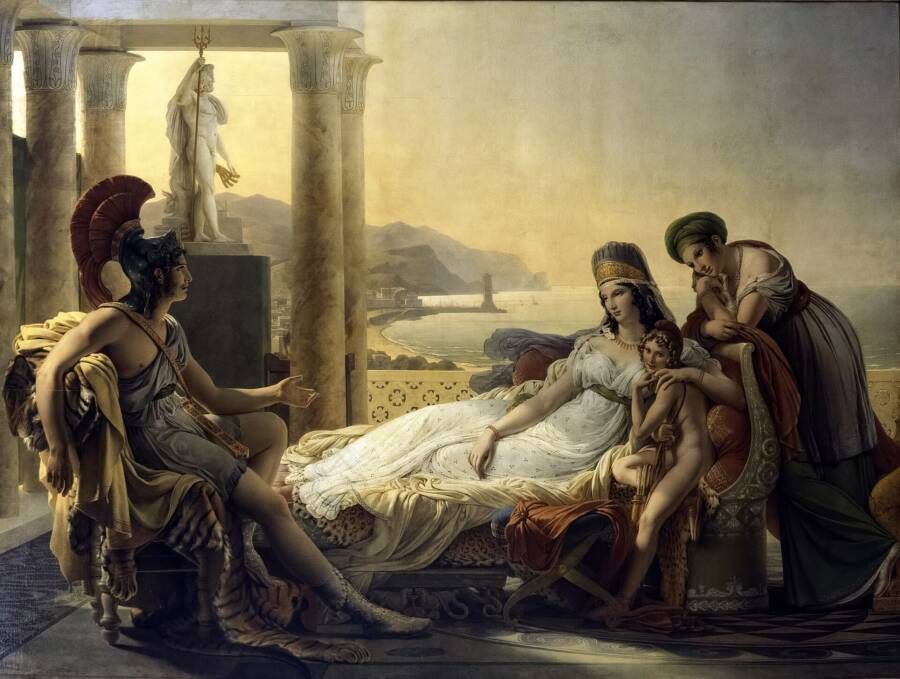
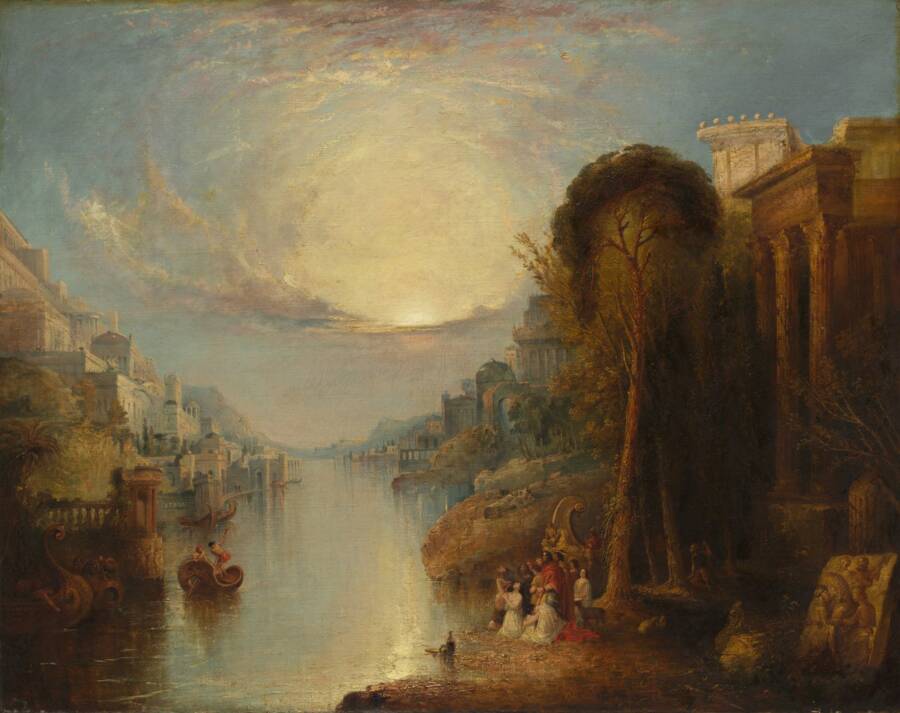
According to Greco-Roman legend, Dido founded the ancient city of Carthage in modern-day Tunisia by requesting a seemingly small amount of land from a local chieftain — only as much as an ox-hide could cover. Dido then cleverly cut that ox-hide into tiny strips and laid them out in a circle, claiming a much larger space than expected.

Encompassing an entire hillside, Carthage quickly transformed into a bustling metropolis, and Dido became famous not only as the founder of the city, but also its first queen. However, as ancient myths tell it, her power and influence couldn’t protect her from meeting a tragic fate.

In Virgil’s Aeneid, Queen Dido fell in love with the Trojan hero Aeneas after he landed in North Africa. Though it initially seemed like Aeneas returned her feelings, Aeneas was soon commanded by the gods to continue on his planned journey. He then abandoned Dido, leading her to die by suicide.

The mists of time have forever clouded the story of this fabled queen, and it’s still unclear whether she was inspired by a real historical figure. Despite this, Dido’s legends have captivated countless people for millennia. (Read more.)

Painting Of Carthage


Share