Showing posts with label Gareth Russell. Show all posts

Saturday, July 12, 2025

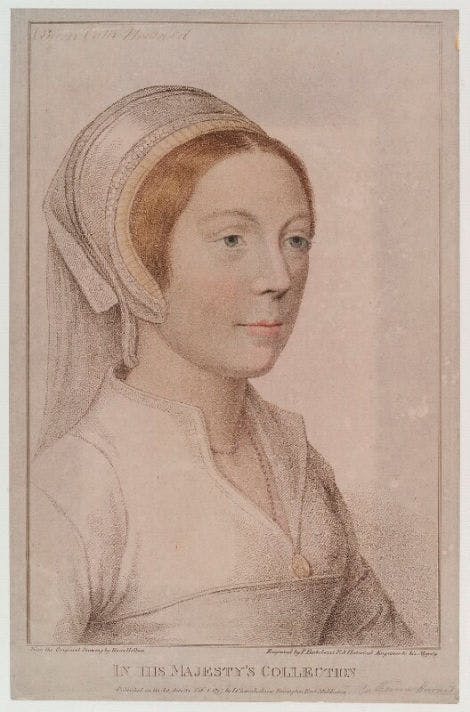
Catherine Howard's Proclamation as Queen at Hampton Court, 1541

 From Gareth Russell at Historic Royal Palaces:

Hampton Court was where the business of Catherine’s queenship truly began. As Queen, Catherine was head of the largest female-run establishment in England, with a substantial income and a large number of staff. 

On 8 August 1540 – the same day as Catherine reached Hampton Court – the government announced that Catherine was the lawful Queen of England. According to the contemporary chronicler Edward Hall, Catherine was also ‘showed openly as Queen at Hampton Court.’ This meant that she was presented to the entire court with the honours and titles of a queen. Hall does not specify but, very likely, there would also have been a quasi-public component to this, whereby Catherine walked in procession from the Queen’s Apartments to hear Mass in the Chapel Royal.

With protocol satisfied, Queen Catherine and King Henry left Hampton Court for an extended hunting trip that would last until October. Moving through the sweltering countryside, they stayed at smaller royal homes at Reading, Grafton (where Henry’s grandparents Edward IV and Elizabeth Woodville had married), Ampthill, Dunstable, and St Albans. (Read more.)

Share

Saturday, June 14, 2025

New Biography of James I

 Heritage Images/Getty Images 

From Seventeenth Century Lady:

The book contains many, many different historical figures, and there is a handy ‘Dramatis Personae’ at the end, which can help those less well-acquainted with these to get back on track. The two sections of colour images are well-chosen and vibrant. There are maps, family trees, notes, a bibliography, and an index. The Epilogue contained a concise yet surprisingly full summary of the history of the rest of the Stuart dynasty, at least as far as Queen Anne is concerned. It was also a thrill and honour to have my reference book, Sex and Sexuality in Stuart Britain, cited and listed in the bibliography.

Although eminently readable and gripping, Queen James is a hefty tome, and it certainly gave me much to consider. I often reflect upon how one can have preconceived notions about historical figures based on peripheral reading and whatnot and then have these notions tested and sometimes altered by more exposure to primary sources. In my case, I didn’t have a favourable view of James, especially with his dealings with witch-hunting and some aspects of his personality (even his sons, Henry and Charles, thought him rather vulgar, etc); but I pitied him particularly for his lamentably sad childhood and the paranoia he developed about being assassinated (with good reason).

I liked how Russell didn’t just launch straight into James’s sexuality, but spent a considerable time on his backstory – the tragic lives of his parents, the formidable (and terrifying!) impact of his time under the tutelage of George Buchanan, whom I now despise, and the various political complexities, horrors, and intrigues which plagued his life. (Read more.)


Gareth Russell's new biography of James I is available HERE.

Share

Friday, February 28, 2025

New Biography of James I


 There is a new biography of James I by Gareth Russell, reviewed by Andrea Zuvich at The Seventeenth Century Lady:

The book contains many, many different historical figures, and there is a handy ‘Dramatis Personae’ at the end, which can help those less well-acquainted with these to get back on track. The two sections of colour images are well-chosen and vibrant. There are maps, family trees, notes, a bibliography, and an index. The Epilogue contained a concise yet surprisingly full summary of the history of the rest of the Stuart dynasty, at least as far as Queen Anne is concerned. It was also a thrill and honour to have my reference book, Sex and Sexuality in Stuart Britain, cited and listed in the bibliography.

Although eminently readable and gripping, Queen James is a hefty tome, and it certainly gave me much to consider. I often reflect upon how one can have preconceived notions about historical figures based on peripheral reading and whatnot and then have these notions tested and sometimes altered by more exposure to primary sources. In my case, I didn’t have a favourable view of James, especially with his dealings with witch-hunting and some aspects of his personality (even his sons, Henry and Charles, thought him rather vulgar, etc); but I pitied him particularly for his lamentably sad childhood and the paranoia he developed about being assassinated (with good reason).

I liked how Russell didn’t just launch straight into James’s sexuality, but spent a considerable time on his backstory – the tragic lives of his parents, the formidable (and terrifying!) impact of his time under the tutelage of George Buchanan, whom I now despise, and the various political complexities, horrors, and intrigues which plagued his life. (Read more.)


The American edition, called The Six Loves of James I, will be released in December but is currently available for pre-order on Amazon.

Share

Friday, September 6, 2024

V&A Exhibition About Marie-Antoinette


They interviewed my friend Gareth. From British Vogue:

The drivers of the French Revolution, in particular, used Marie Antoinette as a pawn, caricaturing her as a figure of dubious morals. “Critics of the monarchy accused her of multiple affairs, paedophilia, espionage, even bestiality,” explains royal historian Gareth Russell, who is working on a book about the fall of the French monarchy. “They attempted to attack and undermine the monarchy by presenting the queen as a figure of pornographic excess,” a depiction proliferated via pamphlets shared on the streets of Paris.

 In the years following the French Revolution, there was a collective need to defend its principles (and the violence they precipitated), particularly among left-wing thinkers and writers, meaning that the conception of Marie Antoinette as an out-of-touch monarch was only burnished after her beheading. “Those who wanted to justify the revolution in later decades needed to render understandable the execution of a widowed mother, which is what Marie Antoinette was,” explains Russell. “When you depict Marie Antoinette as saying ‘let them eat cake’, you render her completely unsympathetic.” In the 20th century, meanwhile, she’s become an emblem of the dangers of abject consumerism. “As you enter the 1900s, Marie Antoinette as an icon of materialism starts to serve another purpose, almost in the same way as the sinking of The Titanic did,” explains Russell. (Read more.)


From Tatler:

The exhibition will also explore Marie Antoinette's influence on popular culture and style. Her clothes have had a lasting impact on design and fashion and, in 2006, Sofia Coppola's famous homage starring Kirsten Dunst won an Oscar for costume design. To this day, more than 230 years after her execution, Marie Antoinette remains a regular figure on designers' mood boards for her love of pastels, ribbons and flowers. Past collections by Jean Paul Gaultier, Dior and Vivienne Westwood all owe more than a hint of their inspiration to the French fashion plate. (Read more.)

Share

Sunday, May 2, 2021

The True Age of Catherine Howard

From Royal History Geeks:

According to historian Gareth Russell, Catherine’s most recent biographer, there is more to this debate than meets the eye.

“The idea that Catherine was born in 1525 is based on a misreading of her grandparents’ wills,” Gareth explains. “It’s an understandable mistake. But it is unambiguously a mistake.”

“The most compelling evidence for Catherine’s year of birth comes from Charles de Marillac, French ambassador to Henry VIII’s court. He knew Catherine well. They went on long hunting trips in the summers of 1540 and 1541. And he was paid to make these kinds of things his business.

“de Marillac reported that Catherine was 18 when she debuted at court at the tail end of 1539. While he may have been basing this on her appearance, four years is too big a mistake to make.

“Some argue that de Marillac had poor form when it came to age guessing. They point out that he estimated 24-year-old Anne of Cleves’s age at 30. But this is a misunderstanding. He doesn’t get Anne’s age wrong. He says that if you saw her, you would guess her age at 30, meaning that she looked older than she was. He’s making an unchivalrous comment, not – at least from a biographical point of view – an inaccurate one.

“There’s also a widely-held view that 14 was deemed an acceptable age to marry in Tudor England. But it’s a bit more nuanced than that. Many believed that a 14-year-old would struggle to bring a child to term. Given the primary role of a Queen was to bear heirs, if Henry had taken a wife as young as that, it would have been more widely remarked upon.

“Given this evidence, a birthdate of circa 1521/22 emerges as the most likely.” (Read more.)


More HERE

My review of Gareth Russell's bio of Catherine Howard, HERE.

Share

Thursday, February 15, 2018

Marie-Antoinette at Oxford

A discussion on Amazon has been brought to my attention, HERE. It is about whether or not my books Trianon and Madame Royale are truly at the Bodleian and whether or not any academics have ever "examined" my books. I must respectfully cite my friend, author and historian Gareth Russell, who shared with me that he referred to my novel Trianon in his dissertation at Oxford University a few years ago. Gareth is the author of several books and plays, including the recent acclaimed biography of Catherine Howard, Young and Damned and Fair. Gareth also is the one who told me that both Trianon and Madame Royale are to be found at Bodleian Libraries at Oxford. HERE are excerpts from his dissertation which he gave me permission to publish.

I was also more surprised than anyone else to find Trianon mentioned in a work about mother and daughter relationships, HERE. I have no idea why but I am glad the book was found useful. I discovered Madame Royale mentioned in Russia and Europe in the Nineteenth Century by Roy Bolton and Grigory Goldovsky, HERE, which is an honor indeed. So I just wanted to clarify the matter for those who think my novels belong with the Harlequins that there exist scholars who have thought otherwise. But honestly, I know of few other historical fiction novels that have undergone such scrutiny and treated as if they were post-graduate theses. Share

Monday, July 10, 2017

Young and Damned and Fair: The Life of Catherine Howard, Fifth Wife of King Henry VIII

Of all the royalty that have ever lived, it seems to me that the Tudor dynasty of England is among the most popular, particularly Henry VIII and his wives. Each year sees new works of biography and fiction about one of Henry's wives or children. One of the best current writers on the Tudors is Gareth Russell. A playwright and a novelist as well as an Oxford-educated historian, Gareth brings  his gifts of description and of character analysis, in addition to a scrupulous historicity, into what I think is the best Tudor biography I have yet read. The author visited the main sites where Catherine's tragedy was played out, giving rich details in addition to discussing the extant sources and art works. Like all of Gareth's books and plays, Young and Damned and Fair is a most entertaining read for its color and wit but most of all for the way Catherine Howard and her world are brought to life.

Catherine tends to be overshadowed by Henry's other wives, except for Anne of Cleves, of course, whom she supplanted. Her marriage and queenship were short and relatively uneventful, until the disastrous ending. Gareth shows that many of the common beliefs about Catherine are untrue. Although she was the impoverished daughter of a ne'er-do-well younger son of the great Howard family, she was by no means an unsophisticated waif. Brought up by her step-grandmother, the Dowager Duchess of Norfolk, Catherine lived in one of the grandest households in England, where she learned outward decorum and polished manners. In fact, throughout her brief time as a royal consort, Catherine's conduct in her royal duties was admirable, characterized by charm, charity, and regal grace. The defect in her upbringing was that in the large household, and among the many young ladies with whom she was being brought up, Catherine was not guarded carefully enough. A petite striking beauty whose vivacity heightened her allure, she was preyed upon by at least two household retainers that we know of, one of whom, Francis Dereham, she promised to marry. But it is a myth that Catherine's uncle, the Duke of Norfolk, connived to obtain Catherine a place at court. Norfolk himself had relatively little to do with Catherine's rise or her fall, contrary to popular rumor.

Catherine caught the king's eye when she was chosen to be a lady-in-waiting to his fourth queen, Anne of Cleves. She was chosen because she was a Howard and therefore had connections, not because the Howards saw her as a potential bride of Henry. In fact, when it became clear that the King had his eye upon her it brought panic, and Catherine's grandmother and her aunt tried their best to cover up all evidence of her dalliance with Francis Dereham. For Catherine herself, winning the love of Henry VIII brought clothes, jewels and material benefits which she has often been deprived of. She nevertheless lived in constant dread of disappointing a known tyrant, who had executed her cousin, the glamorous and clever Anne Boleyn. In her undisciplined youth, Catherine sought an outlet for her anxiety by doing what she knew how to do best, which was flirt with young men. Her flirtation with the courtier Thomas Culpepper would be her doom.

Catherine was not executed for adultery, however. There was no evidence that actual adultery had ever occurred. The queen was accused of merely contemplating adultery; hers was a thought crime rather than an actual deed. What really spelled her demise was Catherine's previous promise to marry Francis Dereham, which according to church law would invalidate her marriage to the king. Catherine insisted the promise was a joke and that she had never been formally betrothed to Dereham. But knowledge of her past dalliances combined with her current flirtation made Henry determined that she would die for humiliating him. That Catherine had appeared to be the perfect spouse in the eyes of the ailing and crazed monarch perhaps accentuated his rage towards her. When she was publicly beheaded on February 13, 1542, Catherine displayed courage and calm. She was probably not yet twenty years old. Most of the portraits thought to be of her are not; thus she left the world with hardly a trace of herself, for one raised so high. In spite of the sad finale, I hated for the book to end. I hope Gareth writes books about the other five queens of Henry VIII, too.

(The book was sent to me by the publisher in exchange for my honest opinion.)

Share

Thursday, July 7, 2016

A History of the English Monarchy


 Gareth Russell's A History of the English Monarchy: From Boudicea to Elizabeth I gives a fresh perspective on the overall history of Great Britain, with a focus on the kings and queens. The author is able to consolidate over a thousand years of history into one volume in a lively and engaging manner. Each monarch is presented in an original way. Russell meticulously explodes many myths while often introducing little known facts about the various royals. He also includes information about what was going on in Ireland, which is left out of most books on English history, except as a footnote. On several occasions I found myself laughing out loud, or else being moved to tears. Being an Irish Protestant, Russell's view of the papacy tends to be quite pragmatic although some of the most beautiful passages in the book describe the martyrdom of St. Thomas Becket.

The book begins with a discussion of the mystique of monarchy, going back to the Egyptians through their long history which ended with Cleopatra. To quote:
So ancient was the Egyptian royal system that Cleopatra is still closer to Elizabeth II than she was to the first pharaoh, who had unified Egypt nearly three millennia before her. The kingdom of the pharaohs was the ancient Mediterranean's monarchy par excellence, in which the power of royalty was underpinned by the belief that kings and queens stood far closer to the gods than they did to the rest of humanity. (p.8)
The unity and prosperity of the nation was seen to flow from a strong central monarchy in ancient Egypt. Russell show how as Britain evolved the monarchy became more and more important in bringing stability to the people, although bad kings (and queens) created discord and chaos. It all officially did not begin until the Norman Conquest. In the author's own words:
Duke William went down in history as King William the Conqueror, which is appropriate because the Norman invasion of England amounted to little more than a full and savage conquest of native English culture. The new king's Norman followers were rewarded with land that was taken off the English aristocracy. Native architecture, names, language, church services and art were obliterated and replaced by the culture and values of Normandy. Rebellions were brutally crushed by William's unstoppable, unmerciful armies. Some historians would say that the reasons for the economic differences between the south and north of England actually arose in the eleventh century, when William the Conqueror decided to punish the north for rebelling against him by burning half the north, including its fields and agricultural land. Arguably, the region's economy and population has never fully recovered.
For the next two hundred years, the English monarchy was essentially an absolute one. Backed up by the full force of Norman militarism, William's successors were able to expand their empire and terrify their opponents. By the time William's great-grandson came to the throne as Henry II in 1154, the English crown ruled more of France than the French. Henry had an empire which stretched from England's border with Scotland to France's border with Spain. He had married the flamboyant Eleanor of Aquitaine (below), the greatest heiress of the century and all-round diva; through her he had gained control of the Aquitaine, the most economically prosperous and culturally advanced region in southern Europe. With such wealth and power, it was almost inevitable that England's crown would soon become the dominant power in the British Isles, too. And that expansion started when Henry II became involved in a squabble between the Irish kings of Connaught and Leinster, resulting in King Dermot of Leinster switching allegiance to England and making Henry II the new Lord of Ireland. To say that it was a controversial moment in British history is something of an understatement. (Read more.)
 Anyone who loves history will enjoy the book immensely. I certainly plan on reading it again and referring to it as a reference in the coming years.

More on this fabulous book, HERE. Share

Saturday, August 29, 2015

Lady Cecily Stonor

Gareth Russell hosts Stephanie Mann. To quote:
Lady Cecily Stonor (nee Chamberlain) and her late husband Sir Francis Stonor (+1564) had two sons, Francis and John, and three daughters. They were recusants and because they would not attend Sunday services in the Church of England, they had to pay huge fines, selling land and estates as necessary. In 1577, according to the Stonor Park website, the family paid the modern equivalent of £50,000 in fines.

Cecily Stonor was elderly when she was brought to trial in Oxford for her recusancy. Her home, Stonor Park, Henley-on-Thames, Oxfordshire was a refuge for Catholic priests. The Jesuit Edmund Campion stayed at Stonor and his “Decem Rationes” was printed there and then boldly distributed in the Church of St. Mary the Virgin in Oxford, copies laid out carefully on the benches for Commencement on 27 June 1581. The authorities hunted Campion down on his way to Norfolk and captured him at Lyford Grange in Berkshire on 15 July. Then authorities came to Stonor Park on 4 August, finding the press, another Jesuit priest, William Hartley, and the printer—they also arrested Cecily, her son John, and four servants.

Questioned about her recusancy, Lady Stonor proclaimed that she had remained true to her Catholic faith even though the monarchs and government of England had changed religious policy several times. She referred particularly to her devotion to the Catholic Mass in her statement:
I was born in such a time when holy mass was in great reverence, and brought up in the same faith. In King Edward’s time this reverence was neglected and reproved by such as governed. In Queen Mary’s time, it was restored with much applause; and now in this time it pleaseth the state to question them, as now they do me, who continue in this Catholic profession. The state would have these several changes, which I have seen with mine eyes, good and laudable. Whether it can be so, I refer to your Lordships’ consideration. I hold me still to that wherein I was born and bred; and so by the grace of God I will live and die in it.
Cecily Stonor had experienced the Tudor dynasty, seeing the religious changes made once Henry VIII had proclaimed himself Supreme Head and Government of the Ecclesiae Anglicanae, while she had remained unchanged in her profession of religion. (Read more.)
Share

Thursday, August 27, 2015

A History of the English Monarchy

Welcome to the Blog Tour for Gareth Russell's new book A History of the English Monarchy: From Boadicea to Elizabeth I. Gareth has long been a friend of this blog, although we have not always seen eye-to-eye on everything, and a personal friend of mine as well. Along with being one of the most brilliant and prolific young authors I know of, he also edits the magazine Tudor Life. Visit Gareth at his blog Confessions of a Ci-Devant. I am honored to be part of Gareth's blog tour. To be included in the giveaway, please leave a comment with an email address so we can contact you if you win.

Here is a description from the publisher of the new book:
In A History of the English Monarchy, historian Gareth Russell traces the story of the English monarchy and the interactions between popular belief, religious faith and brutal political reality that helped shape the extraordinary journey of one of history’s most important institutions.
From the birth of the nation to the dazzling court of Elizabeth I, A History of the English Monarchy charts the fascinating path of the English monarchy from the uprising of ‘Warrior Queen’ Boadicea in AD60 through each king and queen up to the ‘Golden Age’ of Elizabeth I. Russell offers a fresh take on a fascinating subject as old as the nation itself. Legends, tales and, above all, hard facts tell an incredible story… a history of the English Monarchy.
I will be reviewing the book soon. In the meantime, the following is an article by Gareth, exclusive to Tea at Trianon.


A whitewashed church: A visit to the burial ground of the early Plantagenets

by Gareth Russell

While researching my last book A History of the English Monarchy: From Boadicea to Elizabeth I, I visited France to see the tombs of Henry II, Eleanor of Aquitaine, Richard I and Henry III’s mother, Isabelle. The family feuds between Henry II, his wife and their sons had formed the basis for my third chapter, ‘From Scotland to Spain: The empire of the Plantagenets’ and their story fascinated me.

They lie today in effigy in the vast whitewashed knave of what was once the abbey church of the Fontevraud nunnery, a magnificent convent founded and expanded by Queen Eleanor’s family, where she chose to construct the early Plantagenets’ necropolis at the centre of what was then an empire that straddled both sides of the English Channel. The bright artwork, clouds of fragrant incense and kaleidoscope of splendid colour designed to tremble the knee and swell the heart is long gone. In the centuries after the region was claimed by the kings of France, Fontevraud retained its association with royalty and nobility, in what ultimately proved a costly friendship. In the seventeenth century, its abbess was a favourite of Louis XIV and ties to Versailles lasted until 1792, when the French Revolution’s hurtling mania towards enforced secularisation saw the last of the nuns, led by Abbess Julie-Gilette de Pardaillan d’Antin, take flight as the abbey was ransacked within weeks of the French monarchy itself imploding in a hail of blood, bullets and fire on the cobblestones of the Tuileries Palace courtyard.

The bright new world of de-Christianised republican France had no use for places like Fontevraud and the damage done was so extensive that even after Louis XVIII and Charles X were restored to the thrones of their forebears, the broken abbey retained the purpose assigned to it by the revolution, a prison, until 1963. To amuse themselves, the souls trapped in terrible conditions within its walls, some poor and victimised, others criminal and malign, vandalised what was left of Fontevraud’s once-splendid interiors. The misérables hacked off the nose of Richard the Lionheart’s effigy and whittled away in boredom at his carved joints.

Today his tomb is a small splash of colour alongside his mother’s, father’s and sister-in-law’s in the vast white emptiness of the disused chapel, where the grave of the abbey’s saintly founder, Robert of Arbrissel, is covered by nothing more than glass so that people can glibly walk across it. The sounds of tourists have replaced the pilgrims and the knights, the faintly discordant notes of their conversations and even their whistling echoes of the walls in place of hymns, chants and prayers. The bodies of Richard I and his relatives have long since vanished, torn from their tombs with every other set of royal bones in revolutionary France, no matter how antique. The outward shell of the tombs is all that remains. Whether it was the result of her design or vandalism after the 1790s is hard to tell, but it is amusing that the fiery Eleanor of Aquitaine’s effigy today rests a few slight but very definite inches higher than her estranged husband’s.

Emerging up the steps and into the light of the museum’s gardens, my mind fluttered to one of medieval Christianity’s sternest enjoinders – ‘Sic Gloria Transit Mundi’. (‘Thus passes all the glories of the world’.) In the end, all that remains of Queen Eleanor’s ambitions for her improbable family’s eternal memorial are four fading effigies in a defunct church. And, of course, the very faint possibility that her grave is deliberately a little higher than everybody else’s. Perhaps it is just the failed poeticism of the place, but it encourages the happy thought that through vanished magnificence a kernel of humanity, a reminder of our eternal foibles, endures.
About the Author:
Gareth Russell is an historian and writer from Belfast, Northern Ireland. He studied Modern History at the University of Oxford and completed a postgraduate in medieval history at Queen’s University, Belfast. He is the author of two novels and three non-fiction books, including his most recent book, A History of the English Monarchy: From Boadicea to Elizabeth I. He is currently writing a biography of Queen Catherine Howard.
Share