


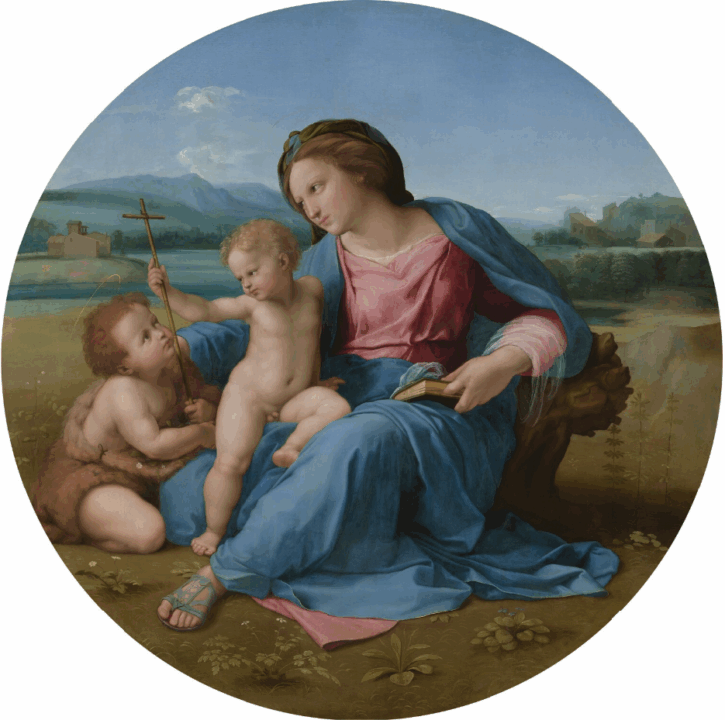
From Word on Fire:
Raphael’s drawings clearly show that the young artist learned quickly and adapted to the rapid artistic developments occurring during the Renaissance. Leonardo and Michelangelo’s influence becomes apparent in the motion, arrangement, and anatomical accuracy that began to characterize the figures in Raphael’s sketches, which he referenced for his paintings. The progression of his technique reveals that Raphael was a man who strove for perfection—and many would argue that he achieved it to the greatest extent possible within the realm of human capabilities.
Raphael’s continual refinement of his skills in the chase after excellence didn’t stop there. He went to Rome in 1508, becoming the court artist for Pope Julius II (r. 1503–1513) and Pope Leo X (r. 1513–1521). He made drawings of the ancient monuments in the city to learn the ins and outs of classical architecture. This knowledge proved useful for the School of Athens, a fresco that Raphael made for a four-part series in the Stanza della Segnatura in the Apostolic Palace.
We’ll never know how much further Raphael could have gone in his endeavors. Raphael did not enjoy the longer lives of his contemporaries, whose artwork had such a noteworthy impact on him; Michelangelo and Leonardo died at 88 and 67 years of age, respectively. Raphael left this world at 37, making the progression of his artistic career even more remarkable than theirs, at least in regard to time. In 1520, he completed what became his last masterpiece: The Transfiguration, a stunning example of his masterly orchestration of light, color, and human bodies to create a dramatic scene. (Read more.)








No comments:
Post a Comment