Showing posts with label Holy Week. Show all posts

Friday, April 3, 2026

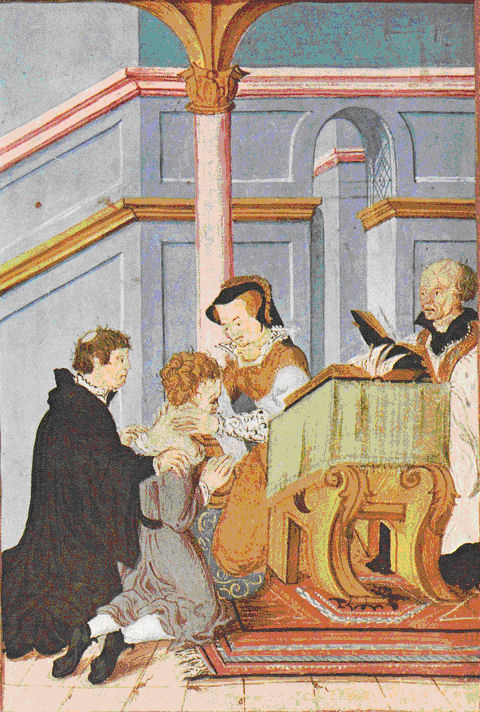
Queen Mary Prays over the Sick on Good Friday

From Nobility. It is always bittersweet for me to read about how much potential for being a great ruler Mary Tudor had. To quote from a contemporary report:
On [Good] Friday morning the offertory was performed according to custom in the Church of the Franciscan Friars, which is contiguous to the palace. After the Passion, the Queen came down from her oratory for the adoration of the Cross, accompanied by my lord the right reverend Legate, and kneeling at a short distance from the Cross moved towards It on her knees, praying before It thrice, and then she drew nigh and kissed It, performing this act with such devotion as greatly to edify all those who were present.
Her Majesty next gave her benediction to the rings, the mode of doing so being as follows: An inclosure (un riparo) was formed for her Majesty to the right of the high altar by means of four benches placed so as to form a square, into the center of which she again came down from her oratory, and placing herself on her knees within this inclosure, two large covered basins were brought to her, filled with rings of gold and silver, one of these basins containing rings of her own, whilst the other held those of private individuals (particolari), labelled with their owners’ names. On their being uncovered she commenced reciting a certain prayer and psalms, and then taking them in her two hands (pigliandoli a mano per mano), she passed them again and again from one hand to the other, saying another prayer, which commenced thus:—
Sanctifica, Domine, annulos istos.”

This being terminated, her Majesty went to bless the scrofulous, but she chose to perform this act privately in a gallery, where there were not above 20 persons; and an altar being raised there she knelt and recited the confession, on the conclusion of which her Majesty turned towards my Right Reverend Lord the Legate, who gave her absolution; whereupon a priest read from the Gospel according to St. Mark, and on his coming to the words— “Super ægros manus imponet et bene habebunt,” she caused one of those infirm women to be brought to her, and kneeling the whole time she commenced pressing, with her hands in the form of a cross, on the spot where the sore was, with such compassion and devotion as to be a marvel, and whilst she continued doing this to a man and to three women, the priest kept ever repeating these words:
Super ægros manus imponet et bene habebunt.”
Then on terminating the Gospel, after the words—
In principio erat verbum,”
and on coming to the following, namely,—
Erat lux vera quæ illuminat omnem hominem in hunc mundum,”
then the Queen made the sick people again approach her, and taking a golden coin called an angel, she touched the place where the evil showed itself, and signed it with this coin in the form of the cross; and having done this, she passed a ribbon through a hole which had been pierced in the coin, and placed one of these round the neck of each of the patients, making them promise never to part with that coin, which was hallowed, save in case of extreme need; and then, having washed her hands, the towel being presented to her by my Lord the Right Reverend the Legate, she returned to her oratory. (Read entire article.)
Share

Thursday, April 2, 2026

Franz Joseph Washing the Feet of the Poor

In accord with the ancient custom.
In 1850, Franz Joseph participated for the first time as emperor in the second of the traditional Habsburg expressions of dynastic piety: the Holy Thursday foot-washing ceremony, part of the four-day court observance of Easter. The master of the staff and the court prelates chose twelve poor elderly men, transported them to the Hofburg, and positioned them in the ceremonial hall on a raised dais. There, before an invited audience observing the scene from tribunes, the emperor served the men a symbolic meal and archdukes cleared the dishes. As a priest read aloud in Latin the words of the New Testament (John 3:15), “And he began to wash the feet of the disciples,” Franz Joseph knelt and, without rising from his knees, washed the feet of the twelve old men in imitation of Christ. Finally, the emperor placed a bag of twenty silver coins around the necks of each before the men were led away and returned to their homes in imperial coaches.(Read more.)
Share

Sunday, March 30, 2025

The Holy Week Breviary Used by Marie-Antoinette in Prison

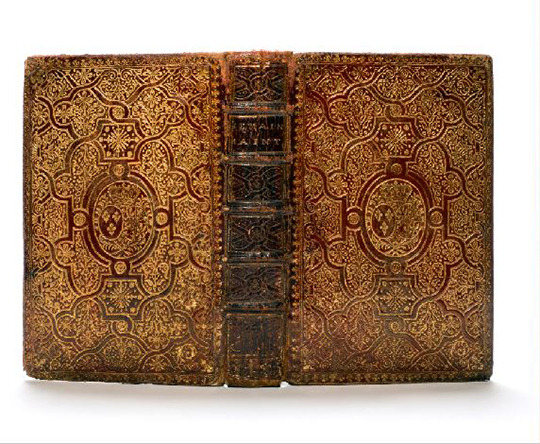
Even as people continue to scrutinize old letters under a microscope, searching for the least word or phrase that would indicate a love affair between Marie-Antoinette and Count von Fersen, evidence of the Queen's fervent Catholic faith continues to surface. Recently auctioned in Paris was the Office de la Semaine Sainte en Latin et en François à l'usage de Rome et de Paris. Dédié à la Reine pour l'usage de sa Maison. Paris, Veuve Mazières et J. B. Garnier, 1728. In English, it is translated as follows: Office of Holy Week in Latin and French According to the Usage of Rome and Paris. Dedicated to the Queen for Use in Her Household. La Reine mentioned in the title was Marie Leszczynska, the grandmother of Louis XVI and Madame Elisabeth; the volume bears her coat-of-arms. The book was bequeathed to Madame Elisabeth, whose cause for beatification has been introduced, when the old Queen died. The princess brought it with her to the Tuileries when the Royal Family were taken to Paris by force in October of 1789. Madame Elisabeth left it behind when fleeing from the palace in August of 1792 but later sent a secret communication to her lady-in-waiting, Madame de Sérent, to smuggle books to her in the Temple prison, including the Holy Week Office. The Royal Family made use of the book not only during Holy Week but throughout the year, reading aloud the words of the Mass every day. According to Beauchesne's biography of Madame Elisabeth, the Queen and Madame Elisabeth were sewing and listening to the fifteen-year-old Madame Royale read to them from the Office of Holy Week, when the guards came to take away the eight year-old Louis XVII. Later, when the Queen was taken to the Conciergerie for her final ordeals, the prayer book went with her. To this day the book opens easily to certain pages, including p. 310, which has the passage:
Scarcely is he [Jesus] raised to the sight of all these people, that he is insulted, and charged on all sides with curses and reproaches. In the end, he makes one last effort to raise his eyes to Heaven: My Father, he exclaims, forgive them, I pray you, because they know not what they do.
A guard at the Temple gained possession of the book after the Queen's death, and it later came to the great nephew of Louis XVI, Henri d'Artois, the Comte de Chambord. Read more, HERE.


Share

Thursday, March 28, 2024

Holy Thursday

Let us prepare for the Last Supper with Our Lord. Dom Gueranger writes of the Mass of the Lord's Supper in The Liturgical Year, Vol. VI:
The Mass of Maundy Thursday is one of the most solemn of the year; and although the feast of Corpus Christi is the day for solemnly honouring the mystery of the holy Eucharist, still, the Church would have the anniversary of the last Supper to be celebrated with all possible splendour. The colour of the vestments is white, as it is for Christmas day and Easter Sunday; the decorations of the altar and sanctuary all bespeak joy, and yet, there are several ceremonies during this Mass; which show that the holy bride of Christ has not forgotten the Passion of her Jesus, and that this joy is but transient. The priest entones the angelic hymn, Glory be to God in the highest! and the bells ring forth a joyous peal, which continues during the whole of the heavenly canticle: but from that moment they remain silent, and their long silence produces, in every heart, a sentiment of holy mournfulness. But why does the Church deprive us, for so many hours of the grand melody of these sweet bells, whose voices cheer us during the rest of the year? It is to show us that this world lost all its melody and joy when its Saviour suffered and was crucified. Moreover, she would hereby remind us, how the apostles (who were the heralds of Christ, and are figured by the bells, whose ringing summons the faithful to the house of God), fled from their divine Master and left Him a prey to His enemies.


"And there appeared to Him an angel from Heaven, strengthening Him. And being in an agony, he prayed the longer." Luke 22:43
Share

Friday, April 7, 2023

Suspicion

Suspicion...is an opinion, not too well-grounded, or grounded in false assumptions, that another has an evil purpose in a certain line of conduct. A suspicious person somehow adopts the general assumption that everybody must be deemed guilty of evil until he has proved himself to be innocent. Worst of all, he must always give expression to his suspicions in the hope of making others share them with him....

An unjustifiable lack of trust hurts deeply. If you set a low value on moral worth of another, misjudge his dispositions, drag down his character, misinterpret his intentions, or torture his innocence by false suspicions and accusations, you inflict upon him one of life's bitterest trials. A trial like this caused the heart of the Lamb of God to be wrung with anguish in the garden of Gethsemane. The whole story of Good Friday is summed up in false suspicion.

Mistrust leads astray. Not only unjustifiable mistrust, but at times even well-founded mistrust is a force that drags one down into the depths. When a man is aware that he is being suspected of a sin, he sometimes experiences a desire to commit that very sin and so to take another step on the downward path.
(from Father Lawrence Lovasik's The Hidden Power of Kindness, Sophia Institute Press, 1999, p.98) Share

Saturday, April 16, 2022

Holy Saturday

From Fish Eaters: 
It was to the Limbo of the Fathers that Christ descended, a place of the dead that was emptied through His Passion, Resurrection and Ascension, and no longer exists. By this "Harrowing of Hell," as His Descent is sometimes called, the doors to Heaven were swung open so that those who die in a state of grace may enter in, alleluia! Adam, Eve, Noe, Abraham, Moses, the good thief on the cross -- all the righteous were illuminated by the Presence of Christ in the place of death, making Sheol itself a paradise. They remained there with Him until His Bodily Resurrection when the the "bars of Hell" were broken down and they were later able to enter into Heaven itself with His glorious Ascension.
 Today a great silence reigns on earth, a great silence and a great stillness. A great silence because the King is asleep. The earth trembled and is still because God has fallen asleep in the flesh and he has raised up all who have slept ever since the world began....He has gone to search for Adam, our first father, as for a lost sheep. Greatly desiring to visit those who live in darkness and in the shadow of death, he has gone to free from sorrow Adam in his bonds and Eve, captive with him -- He who is both their God and the son of Eve.. "I am your God, who for your sake have become your son....I order you, O sleeper, to awake. I did not create you to be a prisoner in hell. Rise from the dead, for I am the life of the dead." [Ancient Homily for Holy Saturday: PG 43, 440A, 452C; LH, Holy Saturday, OR]
 Because of this great silence, today there will be no Mass (until the Vigil Mass tonight, which technically is Easter); instead, there is a solemn service. Today is traditionally a day of abstinence in addition to being a day of fasting, until the Vigil Mass, when the Lenten Fast ends. Though this fasting requirement was abolished in the new Code of Canon Law, traditional Catholics follow the traditional practice. In some churches today, priests will bless Easter baskets containing the foods eaten tomorrow (in other places, the baskets will be blessed after the liturgy tomorrow). Baskets bearing Easter bread, Easter eggs, meats, butter, horseradish, and salt are brought to church, blessed, and taken home to await the great feast tomorrow.
Share

Friday, April 2, 2021

Good Friday

"My people, what have I done to you? How have I offended you? Answer me!...I gave you a royal scepter, but you gave me a crown of thorns." ~from the Improperia.
Share

Thursday, April 1, 2021

Strength and Solace in ‘The Sadness of Christ’

 From Tod Worner:

No matter how many Holy Weeks I am blessed to live through, I will never fully understand it. How God could endure so much torment for so great a gain on behalf of so little a man as me defies rational explanation. The cosmic reconciliation of justice and mercy in a broken man on a cross utterly boggles my mind. But God’s grace is not dependent upon my comprehension. It simply is. It is of God. And I am in awe of it.

As I write this, it is late at night. Playing on the television screen across the room is Robert Bolt’s brilliant play-made-movie A Man for All Seasons.I can’t tell you how often I have watched this brilliant story of the courage and martyrdom of St. Thomas More, but Holy Week is the perfect time to watch it again. In the name of Christ and his Church, St. Thomas saw himself stripped of his home, his family, his freedom and ultimately his life.

The last book that St. Thomas wrote during his imprisonment was The Sadness of Christ, a searing reflection on the Agony of Christ in the Garden of Gethsemane. It wrestles with the anxiety, fear and despair that can come out of martyrdom. Surely, this reflection provided some degree of comfort and sense to the horrors that St. Thomas was enduring. But it also speaks to you and me in our modern daily worries, uncertainties and imperfections. It is an extraordinary thing that, while achieving such great ends for the kingdom of God, for you and for me, Christ’s Passion and St. Thomas’ martyrdom would tragically fully consume them. (Read more.)

Share

Sunday, April 12, 2020

Christ is Risen! Alleluia, Alleluia!


I like the idea that beauty and holiness are the apologia for Christianity. The beauty of Christianity needs to shine out more; this is where the celebration of the liturgy becomes central. And the goodness of Christianity, i.e. the holiness of self-giving love (the witness of charity) and of prayer, needs to be sustained and developed. And this too, certainly: that the one thing Christianity has to offer is Easter. Simply: Christ is risen!
— Dom Hugh Gilbert (from A Conservative Blog for Peace)

The Regina caeli is said in place of the Angelus during Eastertide. It is chanted, HERE.

Queen of Heaven
V. Queen of Heaven, rejoice, alleluia.
R. For He whom you did merit to bear, alleluia.
V. Has risen, as he said, alleluia.
R. Pray for us to God, alleluia.
V. Rejoice and be glad, O Virgin Mary, alleluia.
R. For the Lord has truly risen, alleluia.
Let us pray. O God, who gave joy to the world through the resurrection of Thy Son, our Lord Jesus Christ, grant we beseech Thee, that through the intercession of the Virgin Mary, His Mother, we may obtain the joys of everlasting life. Through the same Christ our Lord. Amen.
Regina caeli
V. Regina caeli, laetare, alleluia.
R. Quia quem meruisti portare, alleluia.
V. Resurrexit, sicut dixit, alleluia.
R. Ora pro nobis Deum, alleluia.
V. Gaude et laetare, Virgo Maria, alleluia.
R. Quia surrexit Dominus vere, alleluia.
Oremus. Deus, qui per resurrectionem Filii tui, Domini nostri Iesu Christi, mundum laetificare dignatus es: praesta, quaesumus; ut per eius Genetricem Virginem Mariam, perpetuae capiamus gaudia vitae. Per eundem Christum Dominum nostrum. Amen.


Here is the Easter Sequence, to be sung before the Gospel during the Easter Octave:

Victimae Paschali laudes immolent Christiani.
Agnus redemit oves: Christus innocens Patri reconciliavit peccatores.
Mors et vita duello conflixere mirando: dux vitae mortuus, regnat vivus.
Dic nobis Maria, Quid vidisti in via?
Sepulcrum Christi viventis, et gloriam vidi resurgentis.
Angelicos testes, sudarium et vestes.
Surrexit Christus spes mea: praecedet suos in Galilaeam.
Scimus Christum surrexisse a mortuis vere: Tu nobis, victor Rex miserere.
Amen. Alleluia.

++++++++++

Christians, to the Paschal victim offer sacrifice and praise.
The sheep are ransomed by the Lamb; and Christ, the undefiled,
hath sinners to his Father reconciled.
Death with life contended: combat strangely ended!
Life's own Champion, slain, yet lives to reign.
Tell us, Mary: say what thou didst see upon the way.
The tomb the Living did enclose; I saw Christ's glory as He rose!
The angels there attesting; shroud with grave-clothes resting.
Christ, my hope, has risen: He goes before you into Galilee.
That Christ is truly risen from the dead we know.
Victorious King, Thy mercy show!
Amen. Alleluia Share

Saturday, April 11, 2020

The Exultet


The Easter Proclamation or Exultet from the Holy Saturday liturgy is one of the most sublime chants in the Roman rite, although it has gone through some changes over the years. Listen to it, HERE. Here is the authorized English translation from the 1970 Missale Romanum:
Rejoice, heavenly powers! Sing, choirs of angels!
Exult, all creation around God's throne!
Jesus Christ, our King, is risen!
Sound the trumpet of salvation!
Rejoice, O earth, in shining splendor,
radiant in the brightness of your King!
Christ has conquered! Glory fills you!
Darkness vanishes for ever!
Rejoice, O Mother Church! Exult in glory!
The risen Savior shines upon you!
Let this place resound with joy,
echoing the mighty song of all God's people!
My dearest friends,
standing with me in this holy light,
join me in asking God for mercy,
that he may give his unworthy minister
grace to sing his Easter praises.
Deacon: The Lord be with you.
People: And also with you.
Deacon: Lift up your hearts.
People: We lift them up to the Lord.
Deacon: Let us give thanks to the Lord our God.
People: It is right to give him thanks and praise.
It is truly right
that with full hearts and minds and voices
we should praise the unseen God, the all-powerful Father,
and his only Son, our Lord Jesus Christ.
For Christ has ransomed us with his blood,
and paid for us the price of Adam's sin to our eternal Father!
This is our passover feast,
when Christ, the true Lamb, is slain,
whose blood consecrates the homes of all believers.
This is the night
when first you saved our fathers:
you freed the people of Israel from their slavery
and led them dry-shod through the sea.
This is the night
when the pillar of fire destroyed the darkness of sin!
This is the night
when Christians everywhere,
washed clean of sin and freed from all defilement,
are restored to grace and grow together in holiness.
This is the night
when Jesus Christ broke the chains of death
and rose triumphant from the grave.
What good would life have been to us,
had Christ not come as our Redeemer?
Father, how wonderful your care for us!
How boundless your merciful love!
To ransom a slave you gave away your Son.
O happy fault,
O necessary sin of Adam,
which gained for us so great a Redeemer!
Most blessed of all nights,
chosen by God to see Christ rising from the dead!
Of this night scripture says:
"The night will be as clear as day:
it will become my light, my joy."
The power of this holy night dispels all evil,
washes guilt away, restores lost innocence,
brings mourners joy;
it casts out hatred, brings us peace,
and humbles earthly pride.
Night truly blessed when heaven is wedded to earth
and man is reconciled with God!
Therefore, heavenly Father,
in the joy of this night,
receive our evening sacrifice of praise,
your Church's solemn offering.
Accept this Easter candle,
a flame divided but undimmed,
a pillar of fire that glows to the honor of God.
(For it is fed by the melting wax,
which the mother bee brought forth
to make this precious candle.)
Let it mingle with the lights of heaven
and continue bravely burning
to dispel the darkness of this night!
May the Morning Star which never sets
find this flame still burning:
Christ, that Morning Star,
who came back from the dead,
and shed his peaceful light on all mankind,
your Son, who lives and reigns for ever and ever.
Amen.


Share

Friday, April 10, 2020

Relics and Blood Type

From UCatholic:
The earliest recorded event of a consecrated Host miraculously turning into physical flesh and blood dates back to the 8th century in the city of Lanciano, Italy. Called the Miracle of Lanciano, a monk was skeptical about the Real Presence and transubstantiation. When he celebrated Mass and said the Words of Consecration with doubt in his soul and heart, before the monks eyes he saw the the Host changed into living flesh and the wine change into coagulated blood. 
In 1971, scientists performed a study on these relics which had been perfectly preserved throughout the ages. The Host was human heart tissue with the blood typeAB+, the rarest of all. The blood was found to have no preservatives, and also was blood type AB+.
Another miraculous occurrence took place in 1996, when a women in Buenos Aires found a desecrated Host in a candle holder in her parish church. She turned the Host into her priest who went to dissolve it into water per Canon Law. When the priest went to do so, the Host turned into flesh and blood. 3 years later, the Bishop of Buenos Aires sent the host to the US for testing. The results came back the same – human heart tissue with blood type AB+. At the time, the Bishop of Buenos Aires was Jorge Bergoglio – Pope Francis. 
Additional tests of trace amounts of blood on the Shroud of Turin along with traces from the Shroud of Oviedo (the cloth wrapped around Christs face shortly after his death) also were shown to be of blood type AB, lending credence to the evidence that Christs blood type was AB, and Hosts literally turn into His flesh and blood when consecrated.
Amazing coincidence or proof? Blood type AB+ is the universal recipient for blood transfusions, and all tested Hosts were found to be heart tissue. As we know, Christ will receive anyone into His heart who is willing.  (Read more.)
Share

Friday, April 19, 2019

The Family and the Cross

From Finer Feminity:
Each of us is condemned to death. Let’s face it. There is no use in being afraid of facts. We may turn our backs, but the facts won’t go away. The sensible thing, the honest thing, and in the long run by far the pleasantest thing, is to see life clearly as it really is, to accept its conditions, and then to make the most of it.

Every parent, it seems to me, ought to make the effort of profoundly realizing that the moment a child is born, the child starts to grow away from its father and mother. The child, indeed, begins to die, even in the instant that it begins to live. By honest facing of such realities, we can make realities serve us, make them stimulate us rather than terrifying us into inaction-or wrong action.

It is simply a fact of family life that children are made to serve God, not to serve parents. And parents are made to serve God, not to serve children. These are happy facts; not unhappy facts. And understand, I am only trying to get the emphasis right, because it is the emphasis that is at the root of all happiness, and all true success.

Much of every child’s service of God will consist in being good to his parents. And much of each parent’s service of God will consist in being good to the children. But as I said, the emphasis must be right, because if it isn’t, we will all harm one another instead of helping one another.

Dreadful damage is done to children by parents who act on the unspoken assumption that children exist to serve parental comfort or parental ambitions. And dreadful damage is done to children who are allowed to grow up supposing that their parents exist to serve them. Corrosive family unhappiness is rooted in such errors.

We must get clear in our heads and hearts, from the beginning, that if God sends us a child, he sends us someone who is made to serve Him- to take up his cross and follow Christ. We ought not to shy away from that word…cross. God sends no cross that we cannot carry; and most of our crosses are small ones. The point is to trust Christ and follow Him; He will not let our backs be broken. (Read more.)
Share

Sunday, April 1, 2018

The Eighth Day


Let, then, the week with its Sabbath pass by; what we Christians want is the eighth day, the day that is beyond the measure of time, the day of eternity, the day whose light is not intermittent or partial, but endless and unlimited. Thus speak the holy Fathers, when explaining the substitution of the Sunday for the Saturday. It was, indeed, right that man should keep, as the day of his weekly and spiritual repose, that on which the Creator of the visible world had taken his divine rest; but it was a commemoration of the material creation only. The Eternal Word comes down in the world that he has created; he comes with the rays of his divinity clouded beneath the humble veil of our flesh; he comes to fullfil the figures of the first Covenant. Before abrogating the Sabbath, he would observe it as he did every tittle of the Law; he would spend it as the day of rest, after the work of his Passion, in the silence of the sepulchre: but, early on the eighth day, he rises to life, and the life is one of glory.

Share

Tuesday, March 27, 2018

The Spirituality of Fasting

From The USCCB:
In the early Church and, to a lesser extent still today, there were two fasts. There was the "total fast" that preceded all major feasts or sacramental events.  The ancient name for this fast was "statio" from the verb "sto, stare" to stand watch, on guard or in vigil.  The second fast was a fast of abstinence from certain foods, e.g., meats or fats.  This was more an act of self-discipline and self-control.  The statio fast was total and a means of watching and waiting…i.e. for something.  The fast of abstinence was more general and personal, to help oneself be more disciplined or self-controlled.  The total fast is still kept today prior to reception of Holy Communion.  Following Holy Communion, the total fast ceases because Jesus had explicitly stated that we don't fast when the bridegroom is here, in other words, what we're keeping vigil for has arrived, the wait is over.  On the other hand, the fast of abstinence was allowed on Sundays because the continuity of abstinence can be important for it to be effective.
These initial observations, then, teach us that the Eucharist is always the end of a preparation.  It is always the fulfillment of an expectation. In the Orthodox Church during Lent, they have Eucharist only on Saturday and Sunday. But because Wednesdays and Fridays are total fast days, those two days are also days for the Communion service (Liturgy of the PreSanctified) which are held in the evening, i.e., after the day of preparation.  Fasting is always preparatory. (Read more.)
Share

Friday, October 6, 2017

Mozart at the Vatican

From The Imaginative Conservative:
The fourteen-year-old Mozart didn’t see himself as being a music pirate, mind you. He was just doing the thing he so excelled at, with his musical genius and photographic memory, back in the spring of 1770. He and his father Leopold were in Rome, working their way through Italy for the month as the young Wolfgang performed and studied and learned. Their timing was perfect: Rome during Holy Week. This was the only time and place you could hear Allegri’s famous “Miserere mei Deus” being sung. In the Vatican’s Sistine Chapel, to be more exact, as part of the exclusive Tenebrae service on Wednesday and Friday of Holy Week. It was a big tradition; since 1514, a total of twelve Misereres had been chanted/sung at this service. This twelfth one, a setting of Psalm 51, composed by Gregorio Allegri in the late 1630’s for Pope Urban VIII, had become the mainstay, far and away the most popular Miserere. To attend this service and hear this music was a big deal. Visitors, musicians, and travelers would arrange their schedules well in advance to be sure and catch a performance.

Why the big deal? Mystery and inaccessibility have a way of adding cachet to any piece of music, particularly one so strikingly gorgeous, at once austere and lushly inviting. The Vatican knew it had a winner on its hands with Allegri’s Miserere and, wanting to preserve its aura of mystery and exclusivity, forbade replication, threatening anyone who attempted to copy or publish it with excommunication.

But the teen Mozart was hungry for a challenge, and, well, you know Mozart. He was… spirited. Free-thinking. Not prone to doing exactly as he’d been instructed if he didn’t see the rationale behind it. So, as he and his father attended the Wednesday Tenebrae service, he listened to the incredible choral music, and after the performance, his brain set to work. Late into the night, he wrote it out from memory, note for note. And we’re talking twelve minutes of choral, contrapuntal music. There are two chorus parts, divided at times by two, to create four groups of singers. On top of that are four solo voices that create their own quartet voice. All this stuff going on, a cappella, and Mozart got it all. He went back on Friday night to give it a double-check. All it needed was a few minor tweaks. (Read more.)
Share

Thursday, July 20, 2017

Cristo Velato

From Aleteia:
Although Corradini was in fact commissioned with the job in the first place, he died having only produced a clay model for what would later be a definitive piece sculpted in marble. It was Giuseppe Sammartino, then, who ended up producing the astonishing sculpture of a dead Jesus, covered by a transparent shroud carved out of the very same marble block shared with the rest of the statue. Sammartino’s mastery – the veil covering the figure of Jesus being in fact “transparent” — didn’t only gain him a well-deserved place in the history of Western art, but also turned his artwork into the stuff of legend.

Some stories claim Sammartino covered his sculpture with a linen veil he managed to transform into marble by means of complex chemical-alchemical processes. Those very same legends would also claim that Raimondo di Sangro, the commissioner of the sculpture, was himself an alchemist who taught Sammartino the mysteries of his pseudo-science. Of course, these are but legends. (Read more.)
Share

Sunday, April 16, 2017

The Eighth Day


Let, then, the week with its Sabbath pass by; what we Christians want is the eighth day, the day that is beyond the measure of time, the day of eternity, the day whose light is not intermittent or partial, but endless and unlimited. Thus speak the holy Fathers, when explaining the substitution of the Sunday for the Saturday. It was, indeed, right that man should keep, as the day of his weekly and spiritual repose, that on which the Creator of the visible world had taken his divine rest; but it was a commemoration of the material creation only. The Eternal Word comes down in the world that he has created; he comes with the rays of his divinity clouded beneath the humble veil of our flesh; he comes to fullfil the figures of the first Covenant. Before abrogating the Sabbath, he would observe it as he did every tittle of the Law; he would spend it as the day of rest, after the work of his Passion, in the silence of the sepulchre: but, early on the eighth day, he rises to life, and the life is one of glory.
Share

Friday, April 14, 2017

"We Have No King but Caesar"

From These Stone Walls:
Getting to the story beneath the one on the surface is important to understand something as profound as the events of the Passion of the Christ. You may remember from my post, “De Profundis,” that Jesus said something perplexing when he learned of the illness of Lazarus:
“This illness is not unto death; it is for the glory of God, so that the Son of God may be glorified by means of it.” (John 11:4)
The irony of this is clearer when you see that it was the raising of Lazarus that condemned Jesus to death. The High Priests were deeply offended, and the insult was an irony of Biblical proportions (no pun intended). Immediately following upon the raising of Lazarus, “the chief priests and the Pharisees gathered the council” (the Sanhedrin). They were in a panic over the signs performed by Jesus. “If he goes on like this,” they complained, “the Romans will come and destroy both our holy place (the Jerusalem Temple) and our nation” (John 11 47-48).

The two major religious schools of thought in Judaism in the time of Jesus were the Pharisees and the Sadducees. Both arose in Judaism in the Second Century B.C. and faded from history in the First Century A.D. At the time of Jesus, there were about 6,000 Pharisees. The name, “Pharisees” – Hebrew for “Separated Ones” – came as a result of their strict observance of ritual piety, and their determination to keep Judaism from being contaminated by foreign religious practices. Their hostile reaction to the raising of Lazarus had nothing to do with the raising of Lazarus, but rather with the fact that it occurred on the Sabbath which was considered a crime.

Jesus actually had some common ground with the Pharisees. They believed in angels and demons. They believed in the human soul and upheld the doctrine of resurrection from the dead and future life. Theologically, they were hostile to the Sadducees, an aristocratic priestly class that denied resurrection, the soul, angels, and any authority beyond the Torah. (Read more.)
Share

Thursday, April 13, 2017

Music for Holy Week and Easter

From The Imaginative Conservative:
Rossini’s setting of the scene of the Stabat Mater—whose text comes from a thrirteenth-century hymn possibly written by Pope Innocent III—comes a century and a quarter after the realization by his compatriot Vivaldi, and it is worlds apart in style as well as time. Drawing on the tradition of bel canto (“beautiful singing”) that he helped to make famous, Rossini’s effort is operatic in many sections, never more so than in the second movement, “Cuius animam gementem” (“Through her weeping soul”), in which the tenor sings, to a breezy tune, words of the utmost pathos. (Read more.)
Share

Wednesday, April 12, 2017

The New-Martyrs of Egypt

From The Catholic Gentleman:
As the smoke cleared, the devastation became apparent. Blood and body parts covered the floor, pews, and walls. Palm branches that were moments ago held aloft in joyful celebration were now scattered on the ground. Wails and cries erupted as survivors identified the dead as their loved ones and friends. Passion week had truly begun for these Egyptian Christians, entered into and sealed with sorrow.

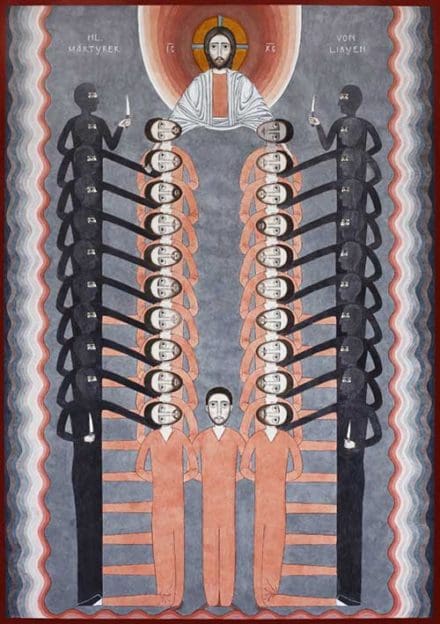
I shed tears with a broken heart for these dear Christian brothers and sisters in Egypt. They have suffered so much for being faithful to the name of Jesus. In my home, I have a copy of the original icon created by a Coptic Christian after 21 Copts were kidnapped and beheaded on a beach in Libya. They died repeating the name of Jesus. “The people of the Cross,” their killers called them with spite and hatred in their voice. And so they were, though their killers knew not that it was the sign of their triumph and not their defeat.

The word martyr comes from the Greek word meaning witness. In the early church, the martyrs were the most cherished treasures of the ekklesia. Their mangled bodies were recovered from the places of their executions and buried with great love and honor. Prayers were offered at their graves and many of their names are still remembered and venerated today. (Read more.)
More HERE. Share