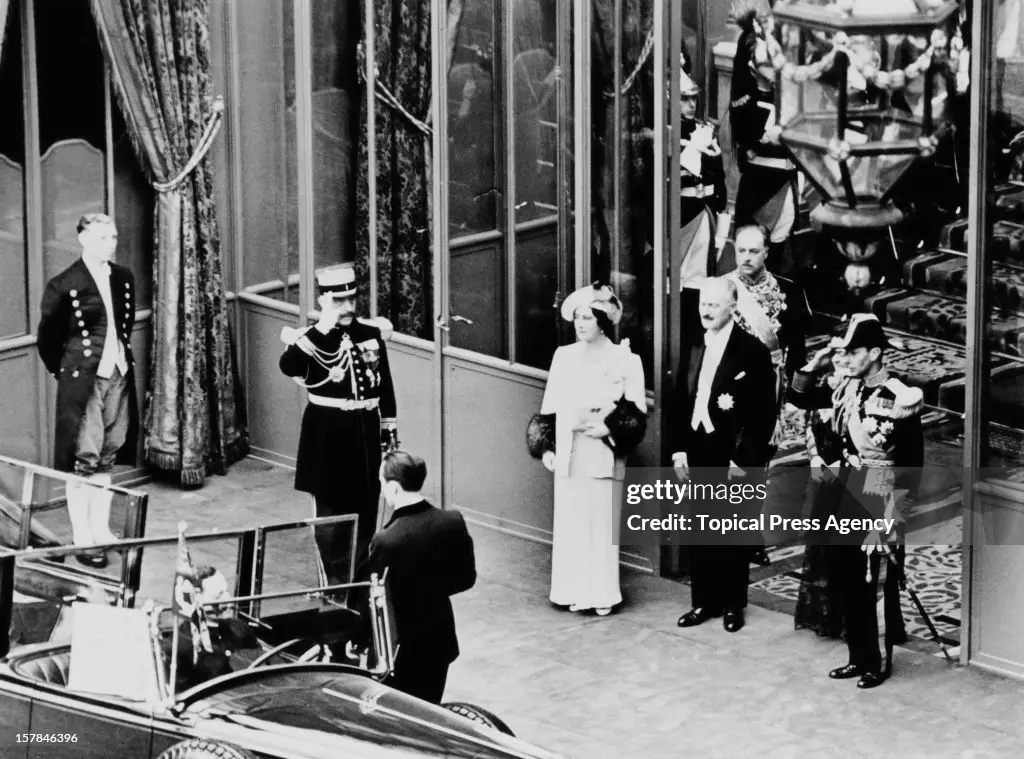
The latest work of one of my favorite authors, Oxford-educated historian Gareth Russell, is a delightful literary portrait of Queen Elizabeth the Queen Mother entitled Do Let's Have Another Drink! As Mr. Russell makes clear from the beginning of the book, it is not a full biography, covering every aspect and incident of the late Queen Mother's life. It is rather a collection of anecdotes, arranged in chronological order, which nevertheless create a vibrant depiction of the Queen whom Hitler called "the most dangerous woman in Europe." While the book is laugh-out-loud amusing it also has many poignant moments as befits the life of a royal consort who endured two world wars, accompanied by apocalyptic global changes, including the rise of Communism and the decline of the British Empire. Elizabeth suffered many personal losses throughout, such as the deaths of family members, and the scandals which haunt most royal families, including the relatively staid House of Windsor. The lady whom the more elegant and stylish set liked to ridicule for her love of cocktails, good food, and country life could also be the life of any party when she chose to be, taking Paris by storm in her white wardrobe. The Queen Mother became most known for her bright smile and spine of steel as she picked her way through the rubble left by German bombs in order to comfort the citizens of London. Her refusal to flee London with her children during the worst of the blitz made her a beloved figure, a larger-than-life legend in her own time, and in times to come.
I thoroughly enjoyed the account of the visit to Paris of King George VI and Queen Elizabeth. The Queen had just lost her mother the Countess of Strathmore and so she was in mourning. Black was not considered suitable for so important a state visit, so the Queen's designer Norman Hartnell designed a white wardrobe, since in France white was the color of mourning for queens. I have no doubt Marie-Antoinette would have approved. In the words of The Court Jeweller:
In the spring of 1938, Buckingham Palace was hard at work planning King George VI and Queen Elizabeth’s first state visit.
They were due to arrive in France for the visit in June, but the death
of the Queen’s mother, the Countess of Strathmore, meant that plans had
to be changed. So did the Queen’s state visit wardrobe, which was in the
process of being made by Norman Hartnell.
Instead of remaking the tour wardrobe in black mourning colors,
Hartnell suggested that the Queen’s clothes for the visit should be
white instead, pointing to Queen Victoria’s all-white funeral as a royal
precedent. The fittings for the outfits were finished in a hurried
rush; Elizabeth wrote to her mother-in-law, Queen Mary, that she was
“nearly demented with rushing up and down and trying to order and try on
all my white things for Paris!” With the white wardrobe, naturally, the
Queen packed lots of royal pearls in her bags, too. (Read more.)
According to The Royal Order of Sartorial Splendor:
When the trip arrived, Queen Elizabeth left England in black and arrived
in France in dazzling white. Dressed like a cloud, she was an ethereal
sight to behold. There are several accounts of her presence inspiring
gasps from the crowds, from the moment she stepped off the train to the
flutter when she opened her parasol (in fact, she temporarily revived
parasol production in Paris and London). The white color proved to be
the perfect thing to make her easily seen in the crowd, as did her
seemingly outdated style. Her romantic image was the opposite of what
many French women were striving for with their sleek up looks and raised
skirt heights; and as is the case more often than not, timeless
elegance and working with what suits you before anything else easily
surpassed the trends. (Read more.)
From The Enchanted Manor:
Normally not known as a fashion icon, especially in her later years, the
famous “White Wardrobe” worn by the Queen in Paris during the Royal
Tour of France in 1938 caused an international fashion sensation.
Hartnell had designed romantic day and evening dresses made of beautiful
white fabrics such as the finest silks, chiffons, lace and tulle which
were embellished with sequin and pearls. Inspired by a Winterhalter
portrait of Queen Victoria, Hartnell incorporated crinoline into the
dress designs and the Queen also revived a past fashion trend by
accessorizing her outfits with lovely parasols to match each dress.
With the great press coverage and wonderful reviews of her clothing, the
Queen wanted to commemorate the success of the Paris visit by
commissioning her favorite royal photographer, Cecil Beaton, to document
the beautiful Hartnell dresses in a series of portraits taken in the
State Rooms and gardens of Buckingham Palace. (If you are interested in
finding out more information about the life of Queen Elizabeth, the Queen Mother, please clink on the link) (Read more.)

I cannot recommend Gareth Russell's book highly enough. He is one of the best history writers in the English language, due to the thoroughness of his research and his marvelous expressiveness, as he is a novelist and playwright as well.

 Share
Share


 Marie-Antoinette is frequently associated with shopping, but how did she shop? It is often forgotten that Versailles, being open to the public, was a place of commerce; vendors set up their stalls in the courtyards and galleries of the palace. As for the Queen, she would usually receive tradesmen in the morning while her hair was being dressed. However, she always sought ways to celebrate the life of the ordinary French people, particularly the peasants whose industry fed the nation. In September, 1777 Marie-Antoinette had a farmers' market in the park at Trianon to inaugurate the opening of her new gardens. The Queen wore peasant attire and served at an outdoor "tavern." Pierre de Nolhac describes the market thus:









:max_bytes(150000):strip_icc():format(webp)/southern-living-White_Christmas_Mimosa_009-905867a816c042859acd522b7cb39871.jpg)