Showing posts with label Crown Jewels. Show all posts

Saturday, June 20, 2026

The Jewels of Marie-Antoinette

It is well-known that Marie-Antoinette had a fondness for diamonds, although she never even thought of purchasing Boehmer's necklace of the scandal; she preferred the money to be spent on ships for the French navy. The diamond necklace was not to her taste, anyway, which tended towards light, aerial creations. 

In the famous ensemble painting by Elisabeth Vigée-Lebrun, the queen is shown wearing only a few pearls, while sitting near the jewel cabinet. The symbolism of this has been discussed by J.M. Charles-Roux and by some art historians. It was to emphasize that for Marie-Antoinette her children were her true jewels. When the painting was begun in 1786, the queen was expecting baby Sophie; the gown she is wearing is a maternity gown, as can be seen by the open and adjustable front. The emphasis of the painting was supposed to be the other children getting the cradle ready for the new baby. However, by the time the picture was completed in 1788, little Sophie had been born and had died. Hence, the cradle is shrouded in mourning cloth.

After the death of her oldest son Louis-Joseph, Marie-Antoinette had the image hidden away; she could not bear the sight of it. Nevertheless, it was considered a highly accurate likeness of her. Louis XVI declared to the artist when first gazing at the portrait of his wife and children: "I do not understand much about painting, but you make me love it."

Share

Wednesday, June 17, 2026

The Bolshevik Sale of the Romanov Jewels

 From Nicholas II:

There is no greater example of such a large-scale criminal sale in history, than that of the jewels of the Russian Imperial Court – perhaps, the finest collection in the world. The Bolsheviks inherited an impressive legacy, and wasted little time in profiting from the sale of many pieces to eager buyers in the West during the 1920s.

Interesting testimonies have survived to this day about how the jewels were sorted and catalogued, and how the fate of these historically important treasures was determined. They are today preserved in the RGASPI (Russian State Archive of Social and Political History) in Moscow.

The Bolsheviks made their first attempt to sell the Romanov jewels in May 1918. Then, in New York, customs officers detained two visitors with jewels (worth 350 thousand rubles) that belonged to Grand Duchess Olga Alexandrovna (1882-1960), the youngest daughter of Emperor Alexander III.

The following year, the founding congress of the Third Communist International was held in Moscow. From that time, the agents of the Communist International (Comintern) regularly exported gold jewellery and precious stones from Moscow. At first, there was practically no control over the agents, so many items were stolen rather than helping to “finance a world revolution”. (Read more.)


Share

Tuesday, June 2, 2026

Legendary Crown Jewels

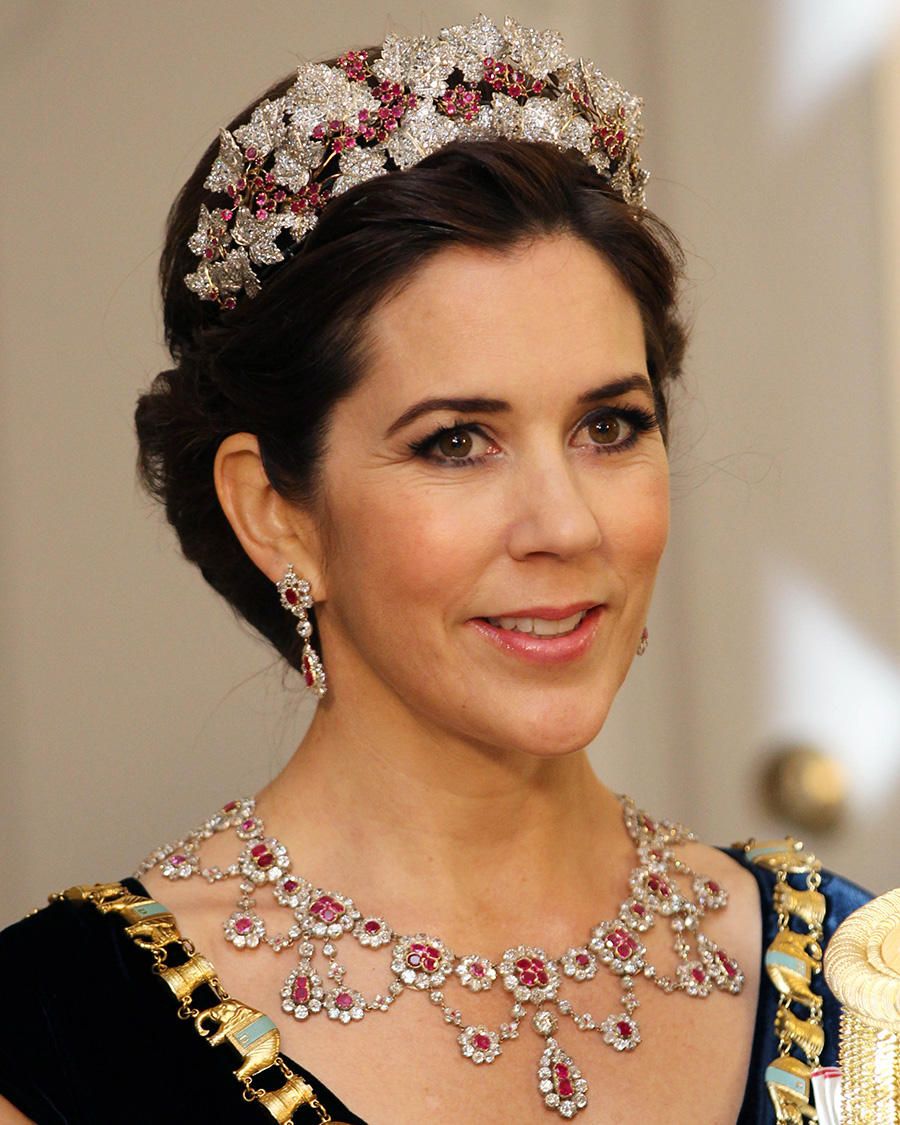
Princess Mary of Denmark attends a Gala Dinner to celebrate Queen Margrethe II of Denmark’s 40 years on the throne at Christiansborg Palace Chapel on January 15, 2012 in Copenhagen, Denmark. (Photo by Chris Jackson/WireImage)
 

From Only Natural Diamonds:

According to Daughters, the Danish Crown Jewels came very close to taking the top spot because they are among the clearest examples of uninterrupted monarchical continuity in Europe. The collection remains remarkably intact and exceptionally well preserved, offering a rare glimpse into how royal regalia can survive centuries of political and cultural change while remaining deeply tied to national identity.

Daughters notes that the Danish Crown Jewels are especially significant because of their extraordinary continuity and preservation. “The British and Danish crown jewels are perhaps the strongest examples of monarchical continuity in Europe,” he says. While Britain’s regalia reflects both continuity and reinvention following the destruction of the original Crown Jewels during the English Civil War, Denmark’s collection “has remained almost entirely intact,” creating what he describes as “a rare sense of unbroken cultural identity.”

He also explained that Denmark’s regalia functions differently than many other royal collections in Europe. “In Denmark, the regalia feels more closely tied to national heritage and cultural continuity, serving as an enduring public symbol of Danish history,” he says. That connection between the monarchy and national identity has helped transform the jewels from historical treasures into living cultural artefacts still woven into modern royal life. (Read more.)

Share

Saturday, May 2, 2026

State Dinner at the White House, April 2026

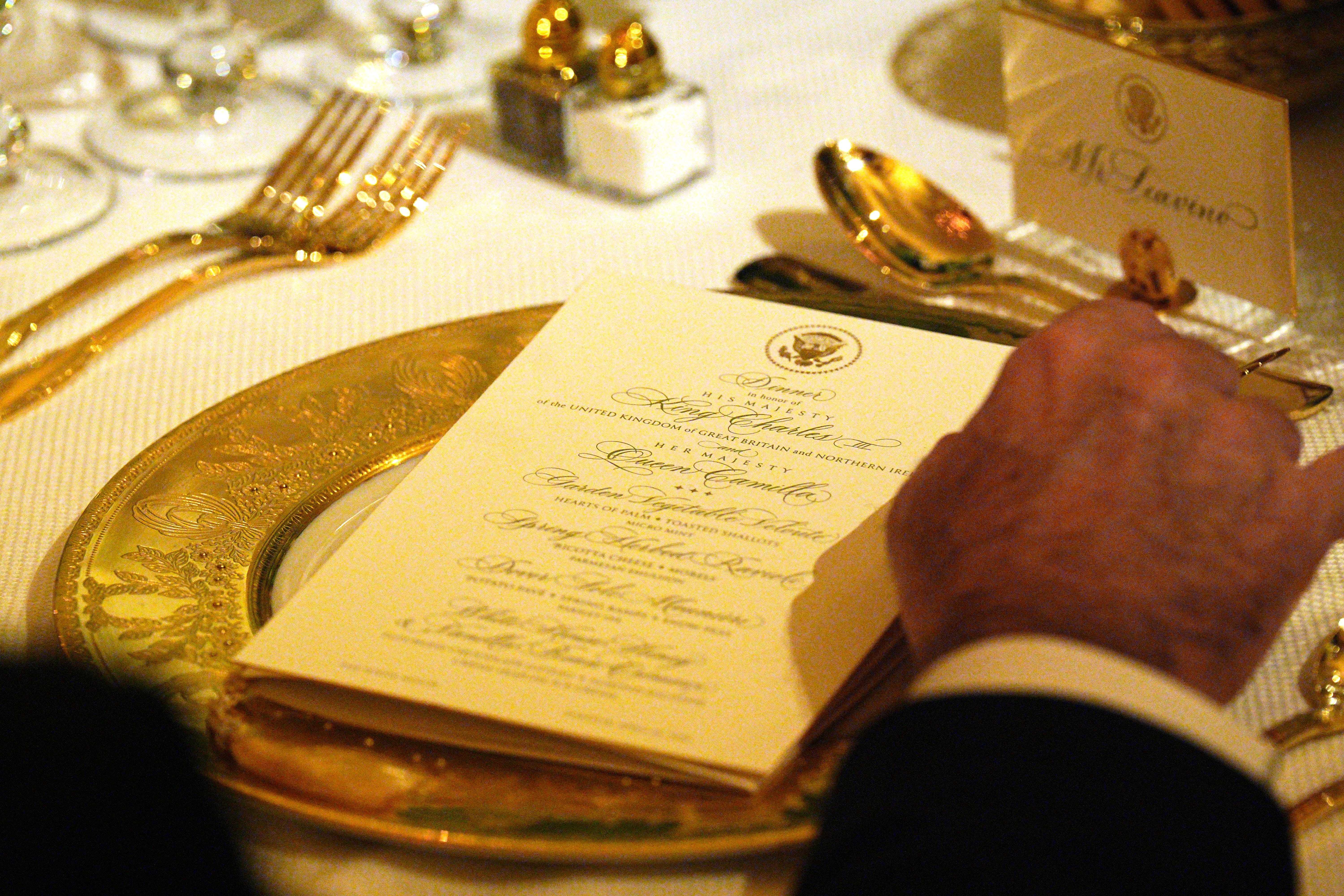
<p>The menu at the state dinner for the King and Queen at the White House in Washington DC, on day two of the state visit to the US (Aaron Chown/PA)</p> 

From The Independent:

The full menu for the has been revealed as President Donald Trump and Melania Trump welcomed King Charles and Queen Camilla as part of their state visit on Tuesday evening.

The dinner celebrated the relationship and came alongside the King’s speech, which thanked Mr Trump for a “wonderful dinner” and touched on the two countries’ “moments of difficulty”.

The menu contained many classic French dishes, including a Dover sole meuniere and potatoes pave, and elements of the banquet presentation were chosen to reflect “the long and enduring friendship” between the UK and the US. A spring theme was also echoed throughout the dinner, with fresh seasonal flowers on the table that were said by a White House spokesman to have been “inspired by the beauty of English gardens”. First course: garden vegetable veloute, hearts of palm salad, toasted shallots, micro mint.

Second course: spring herb ravioli, ricotta cheese, morel mushrooms, light parmesan emulsion.

Third course: Dover sole meuniere, spring ramps, snow peas, potatoes pave, parsley oil.

Fourth course: White House honey and vanilla bean cremeux, flourless chocolate gateau, almond jaconde, creme fraiche ice cream....(Read more.)

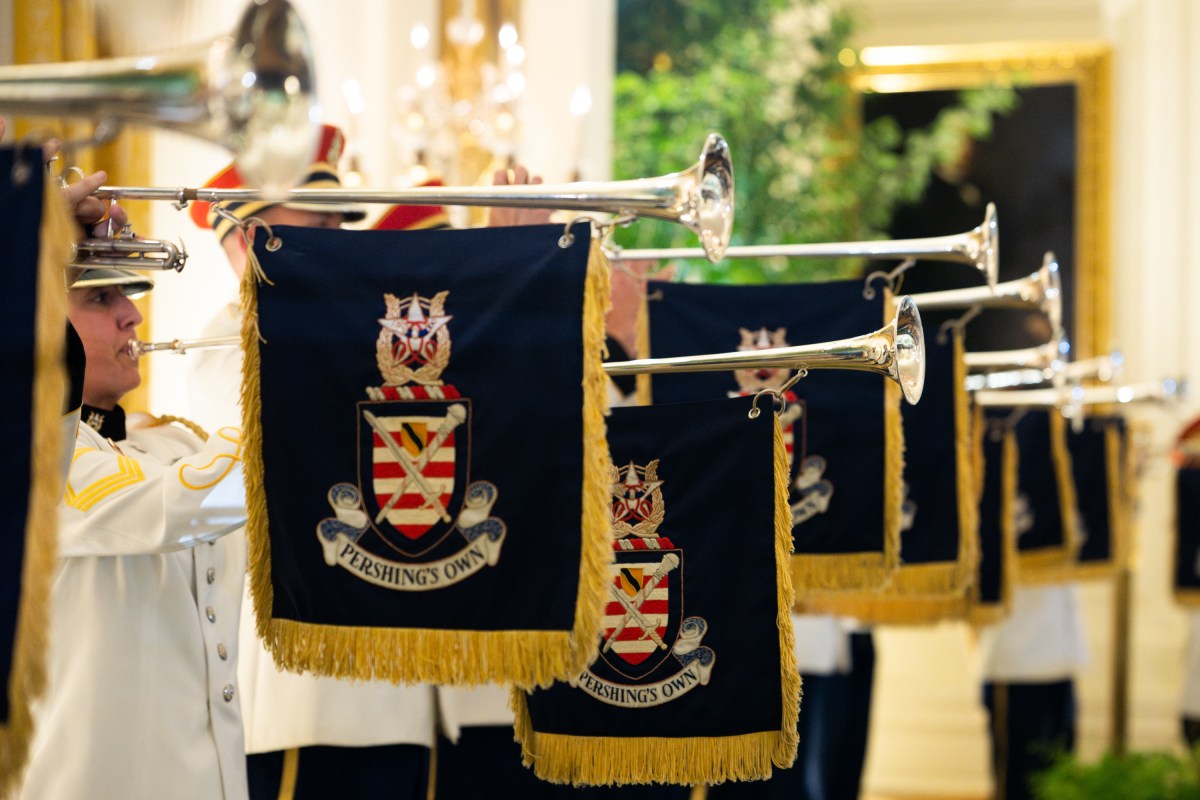
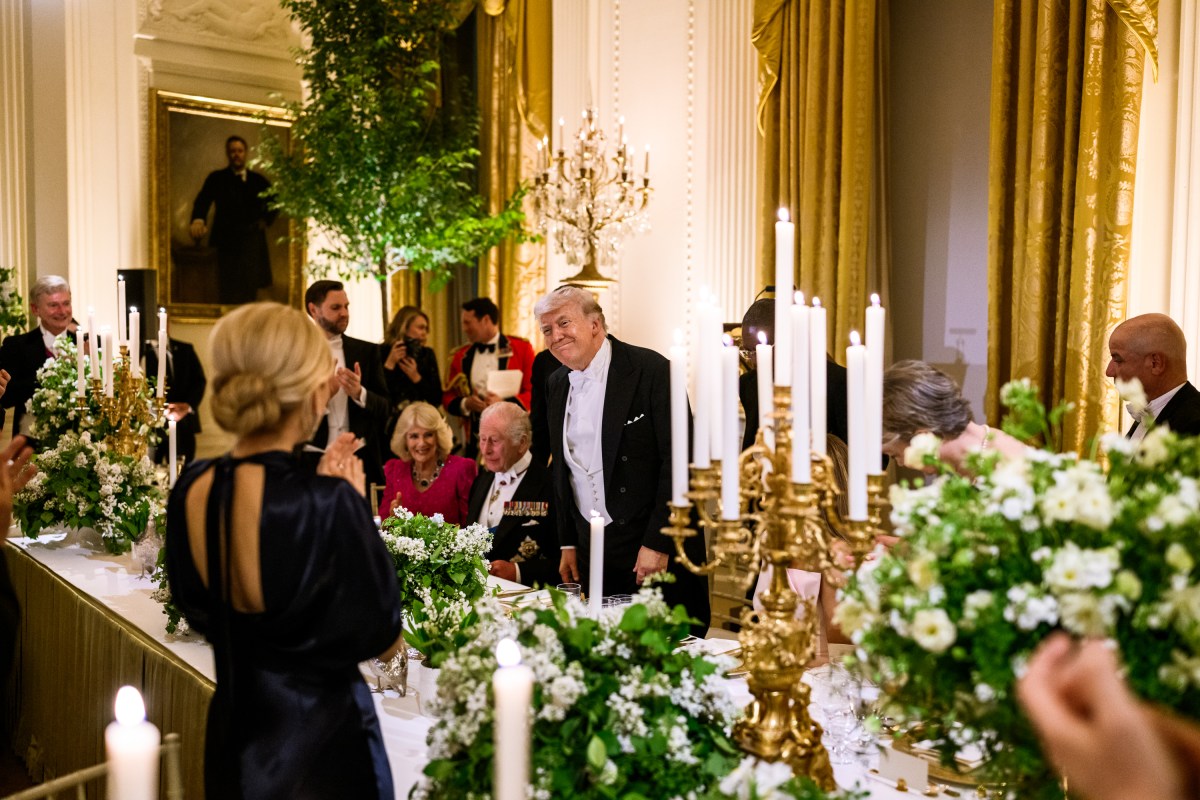
 President Donald J. Trump and First Lady Melania Trump host a State Dinner for King Charles III and Queen Camilla of the United Kingdom, Tuesday, April 28, 2026, in the East Room of the White House. (Official White House Photo by Andrea Hanks)

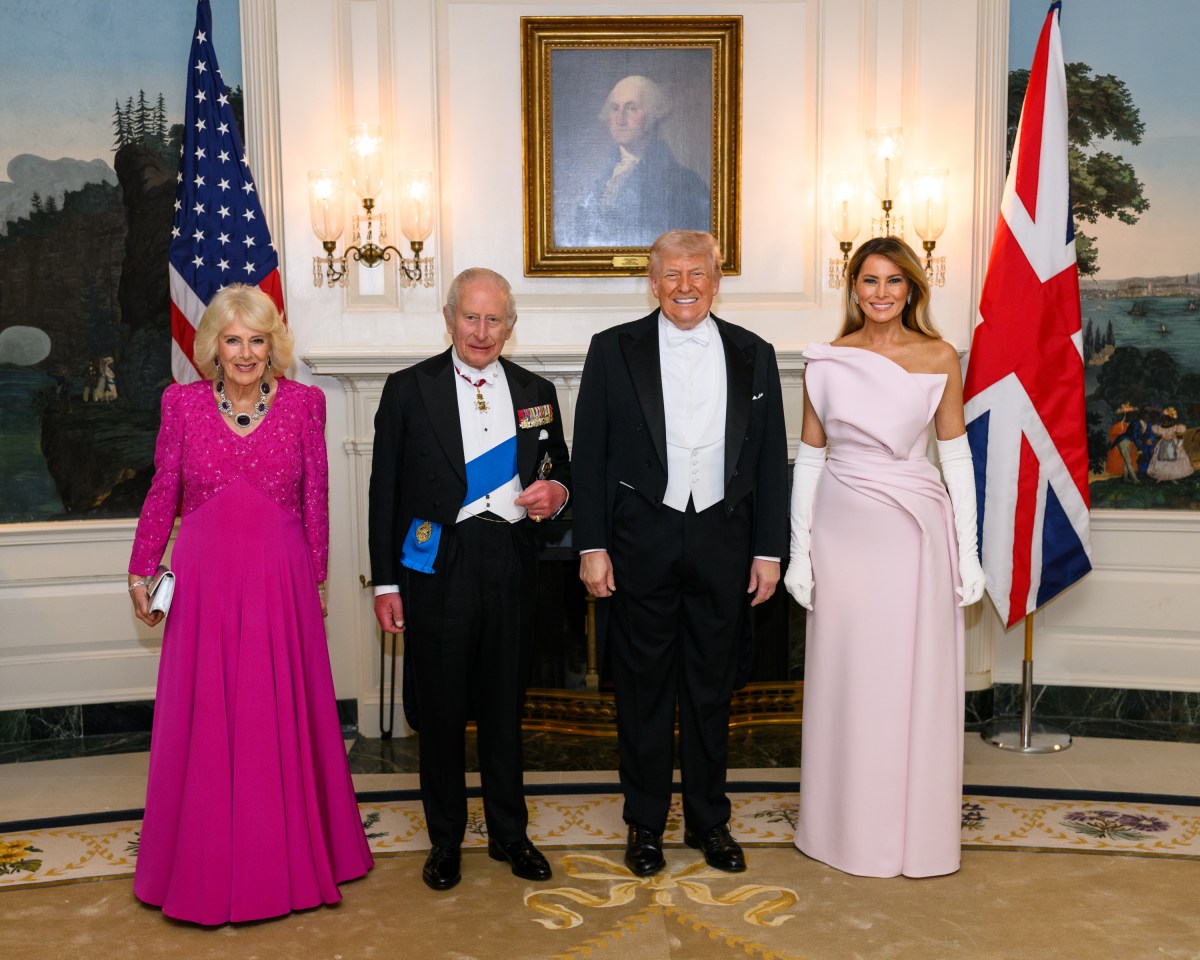
 President Donald J. Trump and First Lady Melania Trump pose for photos with King Charles III and Queen Camilla of the United Kingdom in the Diplomatic Reception Room of the White House before a State Dinner, Tuesday, April 28, 2026. (Official White House Photo by Daniel Torok)

 President Donald J. Trump and First Lady Melania Trump host a State Dinner for King Charles III and Queen Camilla of the United Kingdom, Tuesday, April 28, 2026, in the East Room of the White House. (Official White House Photo by Daniel Torok)

Photos from The White House.

More photos from USA Today.

Image may contain Person Adult Accessories Jewelry and Necklace

 From Tatler:

Queen Camilla is no stranger to delivering all-out glamour when the dress code calls for it, and the White House state dinner on Tuesday night was one such occasion.

Share

Thursday, April 23, 2026

Saint George and King Charles I

But the knight, turning him about, bade her remain where she was, and went out to meet the dragon.
When it observed him approach, the beast was struck with amazement, and, having paused for but a moment, it ran toward the knight with a great swiftness, and beating its dark wings upon the ground as it ran.
 
When it drew near to him, it puffed out from its nostrils a smoke so dense that the knight was enveloped in it as in a cloud; and darted hot flames from its eyes. Rearing its horrid body, it beat against the knight, dealing him fearful blows; but he, bending, thrust his spear against it, and caught the blows upon his shield. 
~ Legend of St. George and the Dragon

St. George's Day is on April 23. St. George is the patron saint of England as well as the patron of the Royal Order of the Garter, the order of chivalry cherished by King Charles I. The legend of St. George and the dragon was one of the most popular stories in the Middle Ages. St. George is generally believed to have lived in Asia Minor and to have suffered under the Emperor Diocletian. Ascalon, the sword of St. George, was celebrated by knights who took the martyred warrior as the patron of chivalry. While his name became the battle-cry of Merry Old England, St. George  was universally venerated in both the East and the West; in the Roman Church he was one of the Fourteen Holy Helpers.

While we know there was indeed a martyr named George, how true is the account of his battle with the dragon? According to New Advent:
This episode of the dragon is in fact a very late development, which cannot be traced further back than the twelfth or thirteenth century. It is found in the Golden Legend (Historia Lombardic of James de Voragine and to this circumstance it probably owes its wide diffusion. It may have been derived from an allegorization of the tyrant Diocletian or Dadianus, who is sometimes called a dragon (ho bythios drakon) in the older text, but despite the researches of Vetter (Reinbot von Durne, pp.lxxv-cix) the origin of the dragon story remains very obscure. In any case the late occurrence of this development refutes the attempts made to derive it from pagan sources....

The best known form of the legend of St. George and the Dragon is that made popular by the "Legenda Aurea", and translated into English by Caxton. According to this, a terrible dragon had ravaged all the country round a city of Libya, called Selena, making its lair in a marshy swamp. Its breath caused pestilence whenever it approached the town, so the people gave the monster two sheep every day to satisfy its hunger, but, when the sheep failed, a human victim was necessary and lots were drawn to determine the victim.

On one occasion the lot fell to the king's little daughter. The king offered all his wealth to purchase a substitute, but the people had pledged themselves that no substitutes should be allowed, and so the maiden, dressed as a bride, was led to the marsh. There St. George chanced to ride by, and asked the maiden what she did, but she bade him leave her lest he also might perish. The good knight stayed, however, and, when the dragon appeared, St. George, making the sign of the cross, bravely attacked it and transfixed it with his lance. Then asking the maiden for her girdle (an incident in the story which may possibly have something to do with St. George's selection as patron of the Order of the Garter), he bound it round the neck of the monster, and thereupon the princess was able to lead it like a lamb.

They then returned to the city, where St. George bade the people have no fear but only be baptized, after which he cut off the dragon's head and the townsfolk were all converted. The king would have given George half his kingdom, but the saint replied that he must ride on, bidding the king meanwhile take good care of God's churches, honour the clergy, and have pity on the poor. The earliest reference to any such episode in art is probably to be found in an old Roman tombstone at Conisborough in Yorkshire, considered to belong to the first half of the twelfth century. Here the princess is depicted as already in the dragon's clutches, while an abbot stands by and blesses the rescuer.
The key to the legend of St. George is that it epitomizes the spiritual combat in which all Christians are engaged, on one level or another. As Fr. Blake explains:
I love saints like St George, whose true story is lost in myth. In both stories George becomes a Christian "everyman". The first legend reminds us that despite every attempt to overcome him by God's grace George endures and survives all, and even in death is victorious.
The second story draws on apocalyptic imagery, the dragon is the symbol of evil, the power of sin, but here it is to be contrasted with the pure virgin. I am reminded of St Athanasius' struggle for twenty years in the tomb against demons. In all of us there is the pure virgin and the dragon. George, here takes on the attributes of St Michael (Michael means "Who is like God"), in his struggle he overcomes evil which then becomes subject to purity.
King Charles I was greatly devoted to the chivalric mission of the English Order of the Garter, founded by Edward III on Saint George's Day, 1348. Charles I had the Garter Star embroidered on the cloaks of all the knights, as a "testimony to the World." From The Victoria and Albert:
This form of the Order of the Garter (the highest order of English knighthood) as a star was introduced by Charles I (ruled 1625-1649) in 1627. It was to be worn by Knights of the Garter 'upon the left part of their cloaks, coats and riding cassocks, at all times when they shall not wear their robes, and in all places and assemblies...a testimony to the World, of the honour they hold...the Order Instituted and Ordained for persons of the highest honour and greatest worth'. (Read more.)
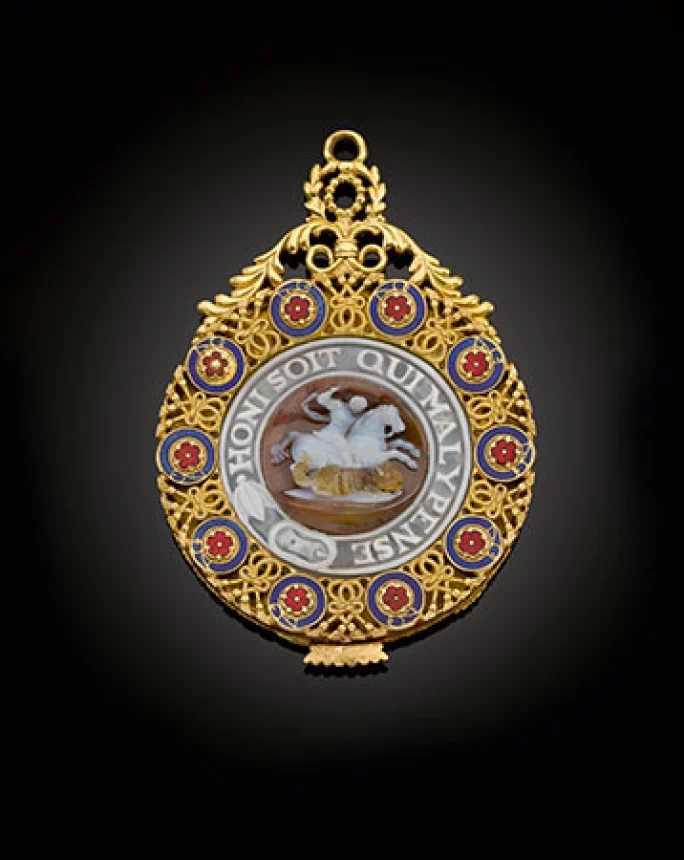
A pendant of Saint George slaying the dragon was also worn. From Sotheby's:

By the end of the fifteenth century a collar had been added to the regalia, possibly as a result of the influence of foreign Orders where a collar was worn to form a badge. The collar design has changed very little since its introduction being composed of a series of gold heraldic knots and roses encircled by the Garter, with a hanging pendant of St George slaying a dragon, known as the Great George.  As for other British chivalric orders, the collar is worn on ceremonial occasions and designated Collar Days throughout the year.

Over time the collar came to be regarded as an encumbrance during ordinary activities and by the early sixteenth century the first reference can be found to the Lesser George [Lots 24; 28], an image of St George encircled with the Garter worn as a separate badge. Lesser Georges were originally hung from a blue ribbon around the neck so as to be worn upon the breast. But by the late seventeenth century it had become practice to sling the Lesser George under the right arm, a contemporary chronicler explaining that this was for ‘conveniency of riding and action’. (Read more.)
From the Royal Collection Trust:

A length of blue silk attached to a book in the Royal Collection may in fact be the Garter ribbon worn by Charles I as he sat for Sir Anthony van Dyck’s famous triple portrait, scientific analysis has revealed. The portrait and the ribbon will be brought together for the first time for In Fine Style: The Art of Tudor and Stuart Fashion, which opens on 10 May, 2013, at The Queen’s Gallery, Buckingham Palace.  The exhibition explores the changing fashions of the rich and powerful of the Tudor and Stuart era through paintings, drawings and prints, as well as rare surviving examples of clothing and accessories.

Charles I placed great importance on the Order of the Garter, the oldest and highest order of chivalry in England – even wearing a Garter badge to his execution in 1649.  Fourteen years earlier, in Van Dyck’s portrait, the monarch is shown wearing a pale blue Garter ribbon around his neck. 

The inclusion of Van Dyck’s painting in the exhibition prompted Royal Collection Trust curators to take a closer look at four lengths of blue silk ribbon attached to the binding of a copy of the Eikon Basilike (‘The Royal Portrait’), now in the Royal Library, Windsor Castle.  The book was first published just ten days after the monarch’s execution on 30 January 1649 and quickly became one of the biggest-selling books of the 17th century, fuelling the image of Charles I as a martyr. (Read more.)

Charles I never converted to Catholicism, in spite of his wife Queen Henrietta Maria's efforts and prayers. He continued to collect recusancy fines from practicing Catholics throughout his personal rule. However, he frequently showed  leniency to Catholics who had been arrested. Charles insisted that the Church of England be hierarchical and appointed bishops who were in favor of a majestic and dignified liturgy. His mentor and Archbishop of Canterbury, William Laud, upset the Puritans when he said that the Church of Rome was not the "Whore of Babylon." (In spite of that, Henrietta Maria never liked him.) From The Amish Catholic on the life and death of Charles I:

A few years ago, Fr. Hunwicke produced a very good argument as to why, canonically and liturgically, a soul who died in schism could be recognized as a saint (taking the precedent of various Eastern saints like Palamas and Gregory of Narek). He has argued for a favorable reading of Charles’s Catholicizing tendencies before.

I would add my voice to Fr. Hunwicke’s. Charles was, on the whole, a boon to the Catholic Church. Charles’s marriage to a formidable Catholic princess, Henrietta Maria of France, saw the arrival at court of Roman Catholic priests, a first since the days of Mary Tudor. He allowed the ambassadors of foreign courts to hold their own chaplains, notably at St. James’s, Spanish Place. Charles even opened up diplomatic talks with the Pope for the first time in decades, receiving more than one papal legate during his personal reign. High-level talks about reunion between the two churches were carried on in secret. He wrote to the Pope, in a letter of 1623 preserved and collected for publication by Sir Charles Petrie (1935),

Be your holiness persuaded that I am, and ever shall be, of such moderation as to keep aloof, as far as possible, from every undertaking which may testify any hatred towards the Roman Catholic religion. Nay, rather I will seize all opportunities, by a gentle and generous mode of conduct, to remove all sinister suspicions entirely; so that, as we all confess one undivided Trinity and one Christ crucified, we may be banded together unanimously into one faith. (See Petrie, The Letters…of King Charles I, pg. 16).

Of course, Charles was inconstant in these measures of good will. He was harsher on Recusants when it came to fines, but significantly lowered priest-hunting efforts. I believe I will not err in saying that, among the many martyrs of the English Reformation, none came during the King’s personal reign in the 1630’s. I only count four overall, of which we can probably acquit Charles from the burden of guilt. The two Catholics executed in 1628 – St. Edmund Arrowsmith, a Jesuit, and Blessed Richard Herst, a layman – seem to have fallen victim to the prejudices of lower officials rather than to any especially anti-Catholic venom emanating from the Crown. And once trouble with the Scots and Parliament began, Charles attempted to hold the situation together by, among other things, clamping down on priests. But even those martyrs which followed in the wake of these efforts owe their deaths more to the actions of local and middling anti-Papist forces than to the intentions of a harried crown. Only two seem to have died in 1641, the last year the King had any discernible control over what was going on in London. Realistically, it would be more appropriate to blame parliament for those deaths. In his church appointments, Charles always preferred those clerics who showed a marked sympathy to the doctrine of Rome. William Laud is only one among several examples that could be cited. (Read more.)

This triple portrait by Van Dyck was for the purpose of making a sculpture of the King
 
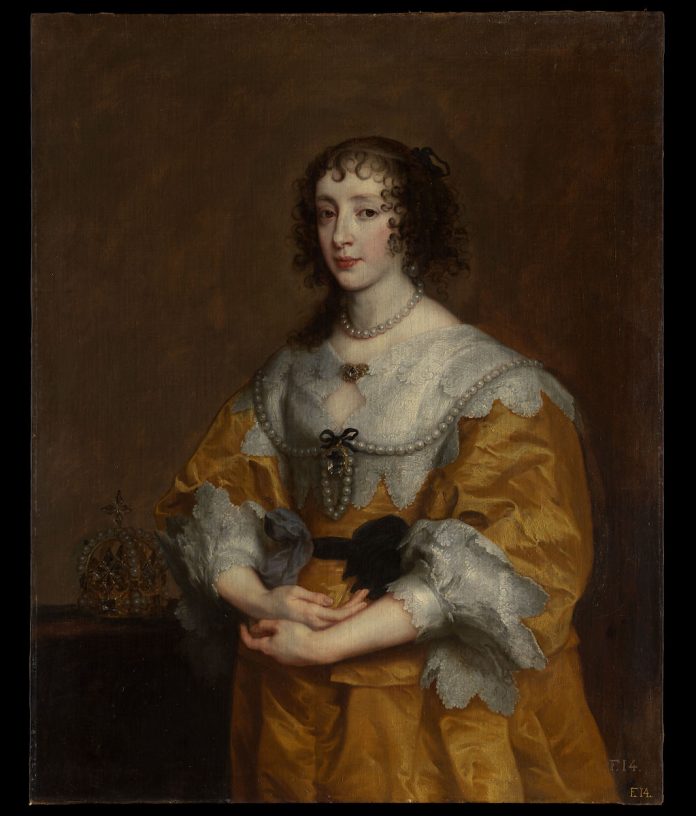
Henrietta Maria holding a butterfly


Share

Sunday, March 29, 2026

Jewels of Queen Marie-Amélie

undefined 

 Niece of Marie-Antoinette. From The Royal Watcher:

After the July Revolution of 1830, the Duke was made the King of the French, and despite being loyal to the Bourbon Monarchy, the new Queen Marie-Amélie resigned herself to her new role, saying: “Since by God’s will this Crown of Thorns has been placed upon our heads, we must accept it and the duties it entails.” After a subdued reign marked by religious duties and charitable work, when the King was forced to abdicate after the 1848 Revolution, Queen Marie-Amélie said to the presiding minster “Ah Monsieur, you were not worthy of such a good king!”. The family went into exile in England and lived a private life at Claremont House, where the now widowed Queen Marie-Amélie supported her grandson’s reconciliation with the Count of Chambord, the head of the senior Bourbon line, who made him his Heir. When she died in 1866, the Queen asked to be buried as the Duchess of Orléans at the Chapelle Royale de Dreux. As she still supported the senior branch of the House of Bourbon, Queen Marie-Amélie famously refused to wear the French Crown Jewels but had a magnificent personal Jewellery Collection which was documented even in her day! (Read more.)

Share

Tuesday, February 24, 2026

The Spell of Posey Rings

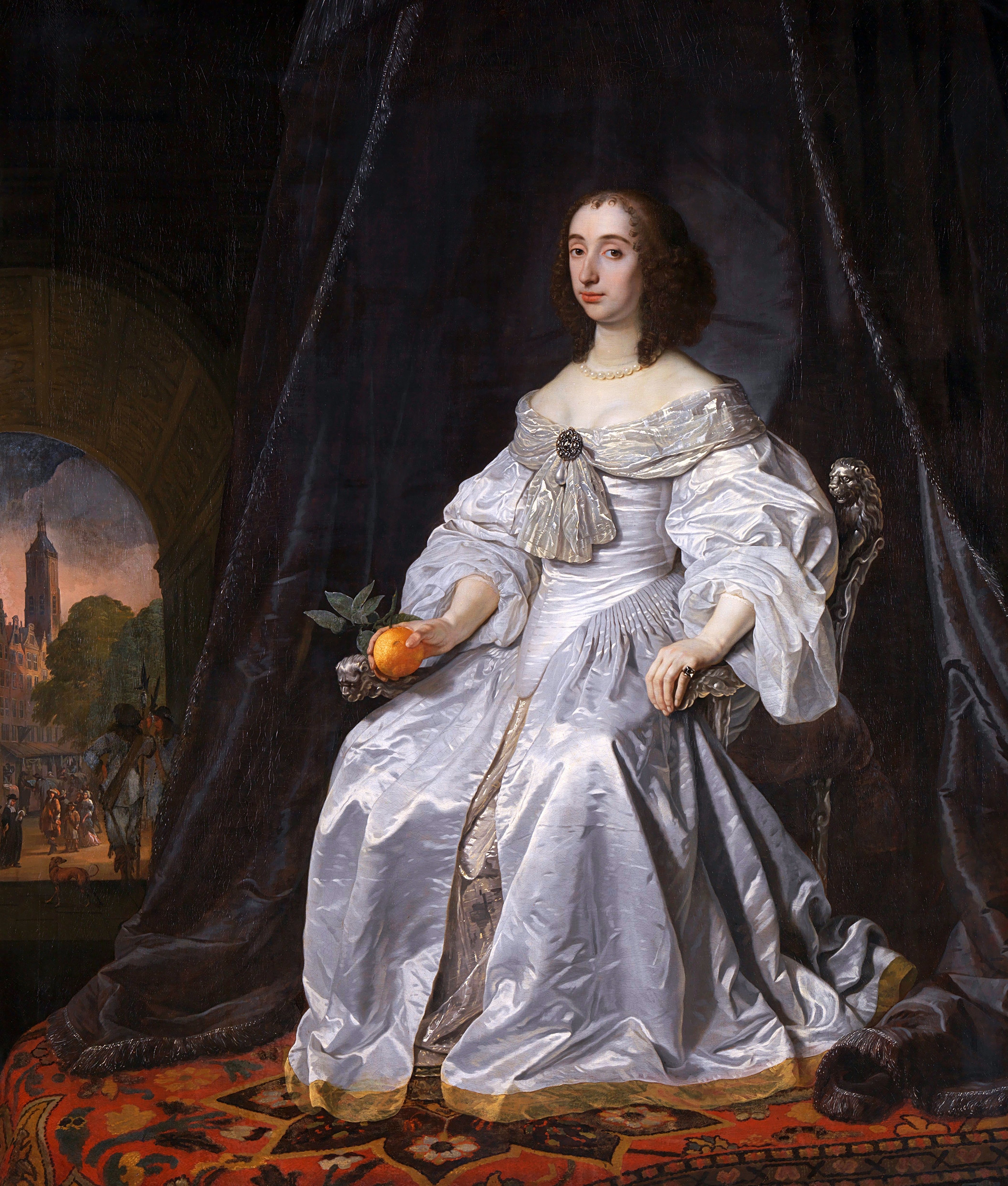
Painting of Princess Mary holding an orange
Mary of Great Britain and Ireland

From Country Life:

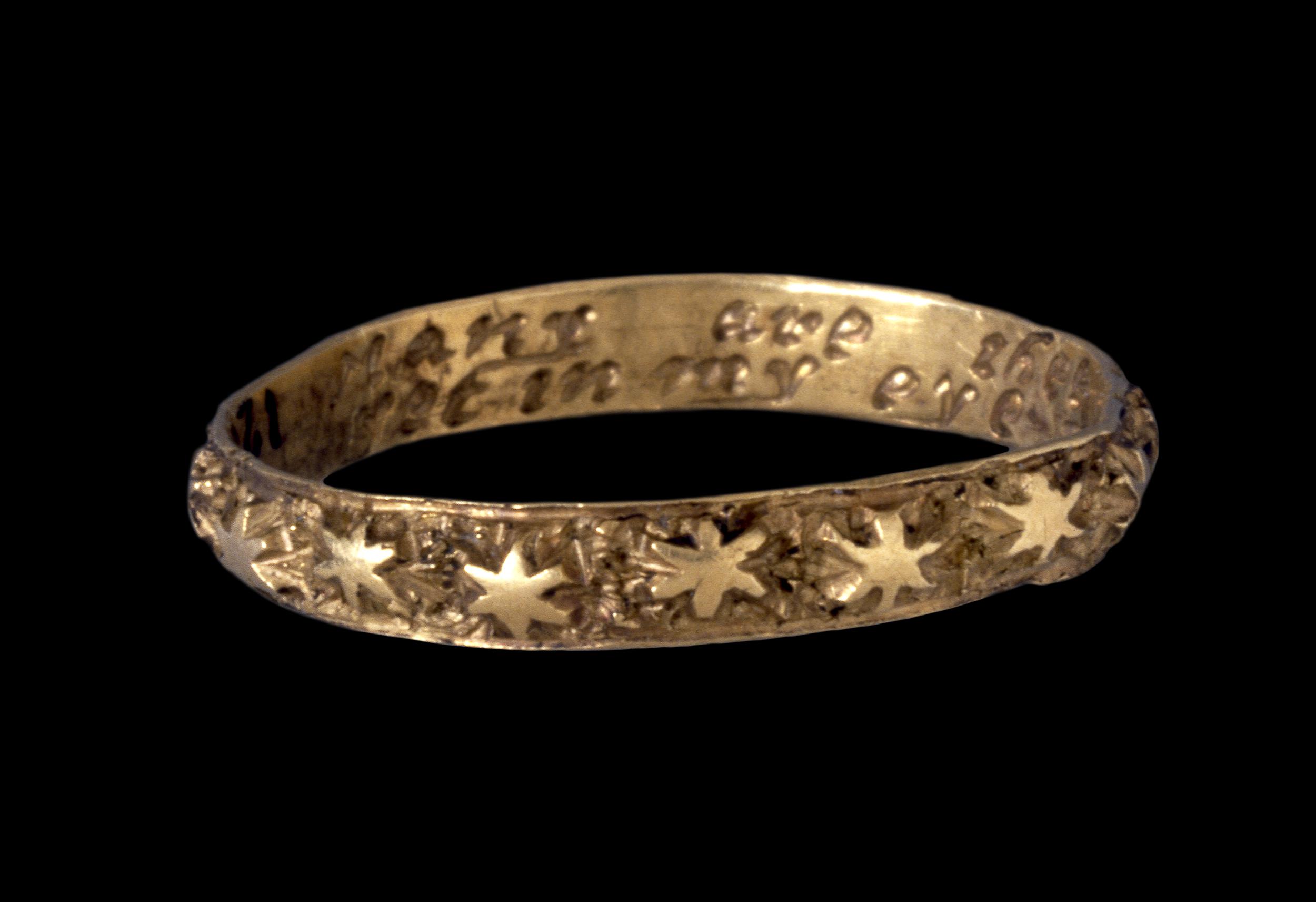
Gold rings with poesies (‘little poems’) — poésie being the Old French for ‘poetry’ — quickly became the single most popular type of jewellery in the country. They were exchanged by lovers, would-be lovers, family members and best friends, but their most common use was as a betrothal or wedding ring. Henry VIII gave a posy ring to Anne of Cleves inscribed: ‘God send me well to kepe.’ William of Orange gave one to Princess Mary inscribed: ‘I’le win and wear you if I can.’ Jewellers used to keep a stock of blank rings, and booksellers promoted inspirational handbooks, such as Loves Garland or Poſies for Rings, which was published in 1624.

I was still in my teens when a friend of my mother’s showed me his collection of posy rings. I was transfixed by their beauty — the soft, almost pure yellow gold, the finely wrought decoration (flowers, leaves, hearts and other symbols) and the elegant script, but what really fascinated me were the inscriptions. ‘I like my choyce.’ ‘True love appears/In midst of tears.’ ‘God has brought to pass that which unlikely was.’ It was as if I were listening to the voices of the long-dead givers and receivers. 

The physical appearance of posy rings changed over time. Lombardic script was replaced by Gothic script, which, in turn, gave way to Roman capitals and then italics. Earlier rings carried much more decoration, too. Niello — a hard black paste — was used to fill in the letters and the costlier rings were enamelled in bright colours. The language of courtly love was, of course, Norman French (‘sans de partier’ or ‘without parting’) although some poesies were in Latin (‘Non Auri Sed Amor’ or ‘not gold but love’) and others in a sort of proto-franglais (‘Autre ne wile and evere you best’, which hardly needs translating). Later, they were almost all in English. (Read more.)

Gold posey ring engraved with stars on a black background

Share

Thursday, December 25, 2025

Coronation of Charlemagne


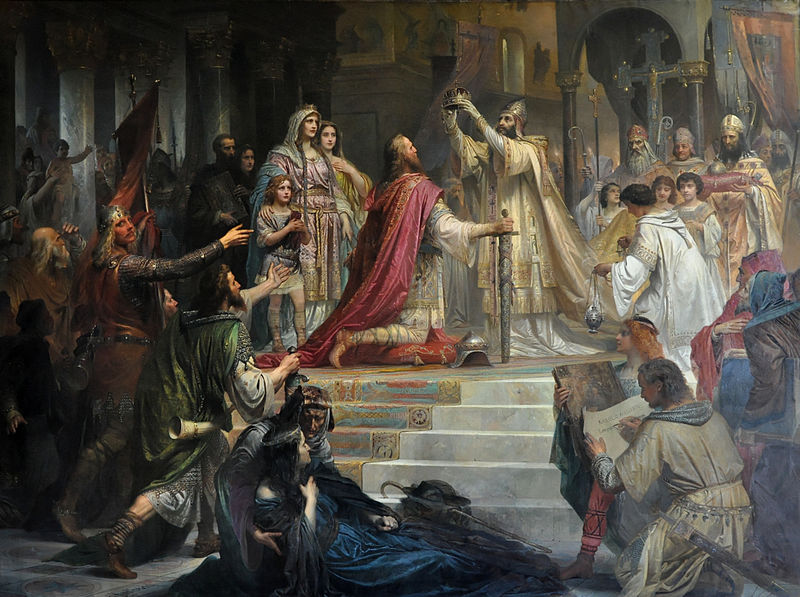
On Christmas Day, 800, Charles the Great, King of the Franks, was crowned Emperor of the Romans by Pope Leo III at St. Peter's Basilica. According to one account:
On the day of the Nativity of our Lord Jesus Christ all [who had been present at the council] came together again in the same basilica of blessed Peter the apostle. And then the venerable and holy pontiff, with his own hands, crowned [Charles] with a most precious crown. Then all the faithful Romans, seeing how he loved the holy Roman church and its vicar and how he defended them, cried out with one voice by the will of God and of St. Peter, the key-bearer of the kingdom of heaven, "To Charles, most pious Augustus, crowned by God, great and peace-loving emperor, life and victory."(Salus et victoria) This was said three times before the sacred tomb of blessed Peter the apostle, with the invocation of many saints, and he was instituted by all as emperor of the Romans. Thereupon, on that same day of the nativity of our Lord Jesus Christ, the most holy bishop and pontiff anointed his most excellent son Charles as king with holy oil.
Share

Thursday, December 4, 2025

Le Bal des Débutantes 2025

Image may contain Hana Hayes Marija OmaljevGrbić Chandelier Lamp Clothing Dress Fashion Formal Wear and Gown 

 Image may contain Chandelier Lamp Clothing Dress Fashion Formal Wear Gown Wedding Wedding Gown and Person

In which the daughters of celebrities mix with aristocrats and princesses at a traditional event. From Vogue:

Read more HERE and HERE.

Share

Saturday, November 1, 2025

A Stolen String of Pearls

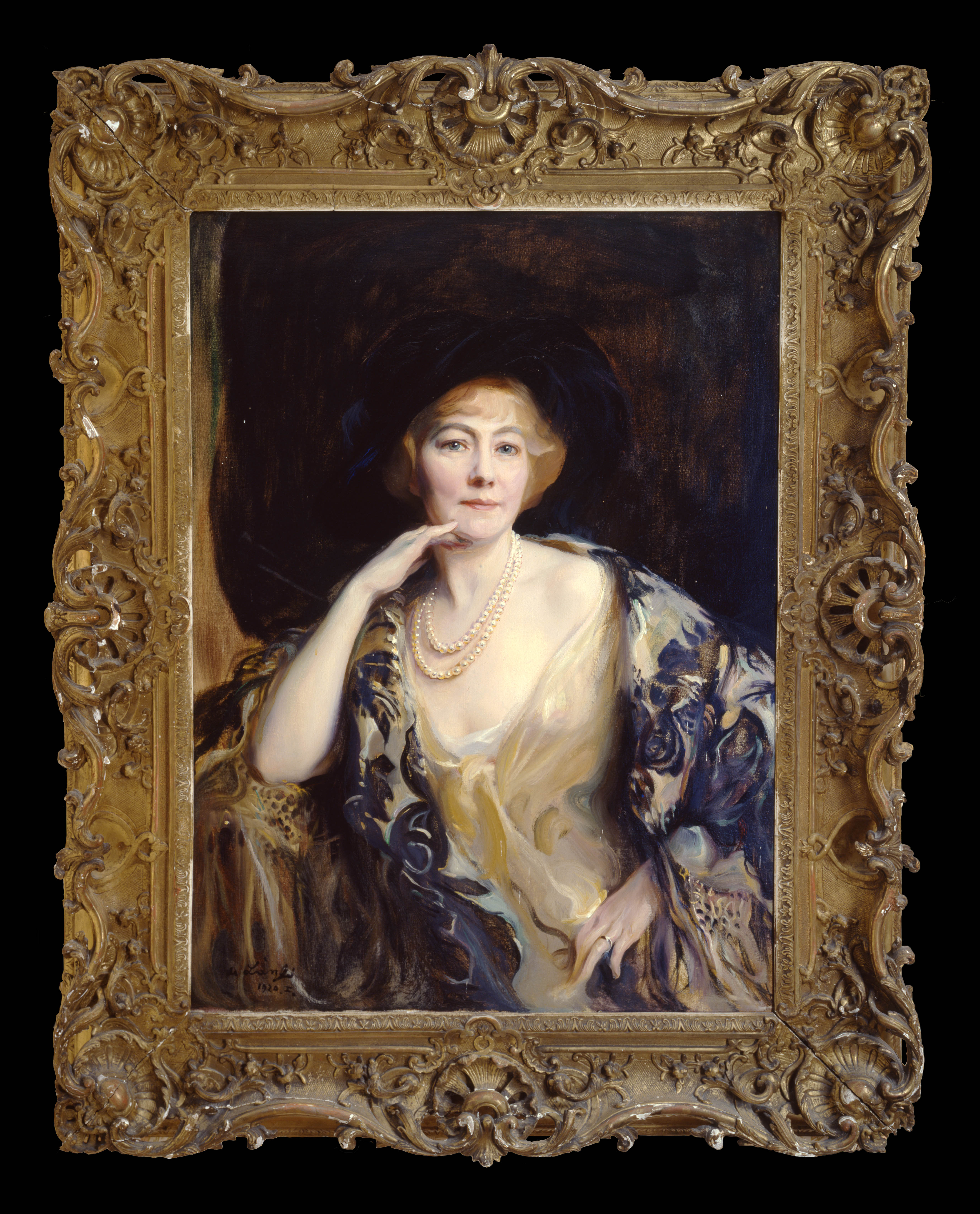
 A portrait of Mrs Harold Nickols wearing a two-string of blush-pink pearls

From Country Life:

De László’s most mysterious pearls are double string blush-pink ones which, in January 1921, were worn for a portrait sitting by Mrs Harold Nickols — the wife of a wealthy English businessman and philanthropist. Born Isabel ‘Bella’ MacConnell in Dublin, in 1878, she wed Harold in July 1908 and lived a lavish lifestyle of couture-filled wardrobes and finely decorated rooms. Her flawless pearls — gifted to her by her husband — included a central gem rumoured to have once been part of the Portuguese crown jewels.

Before they ringed the neck of Bella, the precious pearls had made headlines for their starring role in a jewellery heist. Their original owner was Max Meyer, one of Hatton Garden’s most respected gem dealers, who, in 1913, sent the necklace (then on a single strand and nicknamed the ‘Mona Lisa of necklaces’) to a colleague in Paris, France for appraisal. The jewels were valued at £135,000 (about £20 million in today’s money), but the sale fell through and so they were returned to London by registered post. ‘This was fairly common practice at the time,’ says Vivian Watson, author and third-generation Hatton Garden jeweller. ‘Even the priceless Cullinan diamond was sent to England from South Africa this way, with a security firm acting as a decoy to lure would-be criminals away from the mail.’ (Read more.)

Share

Thursday, October 30, 2025

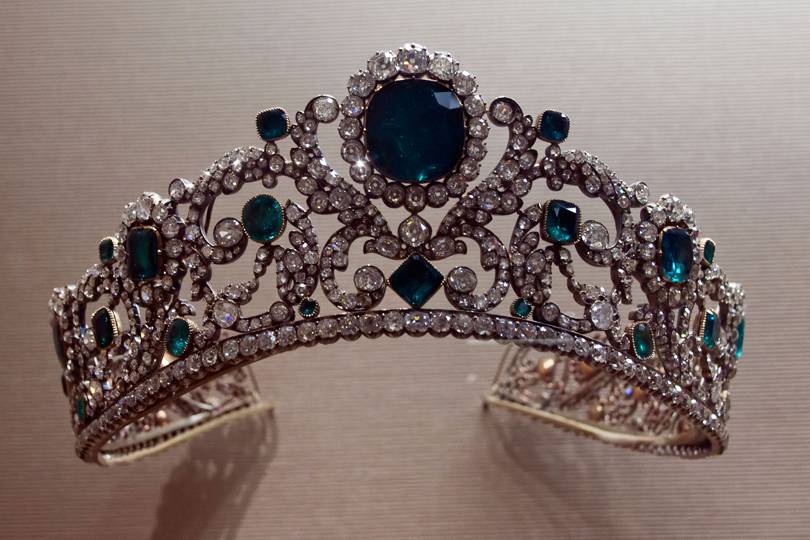
The Angoulême Emerald Tiara


Duchesse d'Angoulême

The tiara that was not stolen. The legitimate line of the French Monarchy was abolished in 1830, not 1848. From Tatler:
The French king and queen at the time, Louis XVI and his wife, Marie Antoinette, had attempted to escape Versailles during the uprising but were captured, imprisoned and eventually guillotined. When they had married in 1770 Louis and Marie-Antoinette were 15 and 14 years old respectively, and it was eight years later that their long-awaited first child, Princess Marie-Thérèse, was born. Despite having three more biological children, Marie-Thérèse was the only surviving family member of the Revolution and was imprisoned until she was nearly 17.

Upon her release, she was surrounded by throne enthusiasts keen to use her to regain monarchic power, and was quickly married off to her first cousin Louis Antoine, Duke of Angoulême in 1799, who was living in the Baltics while Napoleon held power back in France. Napoleon’s defeat at the Battle of Waterloo in 1815, however, finally saw King Louis XVIII and the House of Bourbon reinstated – with the added bonus of allowing Marie-Thérèse full access to the state jewels. In 1819, crown jeweller Maison Bapst was commissioned by the duke to use 14 emeralds from the royal collection, along with over 1,000 additional emeralds and diamonds, to make the Angoulême Emerald Tiara for his wife. However, Marie-Thérèse faced upheaval once again with the outright abolishment of the monarchy in 1848, theoretically becoming `Queen of France’ for about 20 minutes (which was the time between her father-in-law and husband signing their abdication papers). She left France and her beloved tiara for the final time and sought exile once more. (Read more.)
Share

Friday, October 24, 2025

The Glittering Royal History Behind the Louvre’s Stolen Jewels

Marie-Louise poses beside an imperial crown, wearing an embroidered white gown with swan-carved throne behind.
Marie-Louise of Lorraine-Austria

  From Artnet:

When Napoleon married his second wife, the Austrian Archduchess Marie Louise, in 1811, he ordered two dazzling sets of jewelry from Etienne Nitot and sons, his favored jeweler. One was made in opals and diamonds, and the other in emeralds and diamonds, with both intended to remain part of the empress’s personal jewel case. This would become significant amid the political turbulence of the 1810s, when she would be forced to hand over the crown diamonds to the Bourbons, but not her personal sets.

The eldest daughter of Francis II, the Holy Roman emperor, and Maria Theresa of Naples-Sicily, Marie Louise provided Napoleon with the royal pedigree he desired and, in time, an heir. The emerald and diamond set was made by second-generation jeweler François-Régnault Nitot, with the necklace and earrings including 32 intricately cut emeralds and more than 1,000 diamonds. When Marie Louise bequeathed the set to her cousin Leopold II of Habsburg, it included a tiara, but after being sold by his descendants to the jeweler Van Cleef & Arpels more than a century later, its emerald stones were gradually sold off and replaced with turquoise ones (it’s now in the Smithsonian collection). The Louvre acquired the necklace and earring in 2004 for an estimated $4 million. (Read more.)


A secret history. From Town and Country:

 It began life as a suite created by a husband for his new wife. Napoleon commissioned the emerald and diamond crown, necklace, and earrings for his second wife Marie Louise. Some believe they were a wedding gift, others a push present to the woman who bore him his long awaited heir. The necklace and earrings are among the eight pieces stolen from the Louvre in a brazen heist that took place the morning of Sunday, October 19. They had been on display in the Galerie d’Apollon, a testament to the efforts of the Friends of the Louvre society to reassemble the collection that had been sold at auction in 1887 in an attempt by the third republic to rid the country of any evidence of its imperial past. These particular pieces had, for many years, stayed within Marie Louise’s family. She had been spared Naopoleon’s exile and by treaty was allowed to keep the jewels deemed to be part of her personal collection, including these emeralds. Documentation becomes difficult to trace accurately, but at some point the emerald necklace and earrings become part of the collection of Liliane de Rothschild, a woman known for her penchant for passion for 18th century history and Marie Antoinette memorabilia. When she died in 2003, the obituary in Le Figaro lauded her taste and generosity: “She was a patron as generous as she was discreet,” said Maurice Druon, an academic and member of the Académie Française.

“How many national collections have benefited from her donations, how many important works did she put in our most beautiful galleries, how many institutions did she support with an active and constant attention,” Druon said. The New York Times obituary also noted her deep knowledge of Rothschild family history, her wit and composure, and a friendship with Greta Garbo. (Read more.)


Share

Wednesday, October 15, 2025

Marie-Antoinette's Jewels

SWITZERLAND-FRANCE-AUCTION-LUXURY-HISTORY 

Ironically, most of the jewels featured at the exhibition did not belong to Marie-Antoinette or, if they did, have been reset. For one thing, anyone can notice from portraits that the Queen wore jewelry sparingly. Marie-Antoinette's daughter inherited the jewels that were smuggled out of France during the Revolution, and she left them to her niece, the Duchess of Parma, who had many children. And so the remaining jewels were scattered, sold, resold, and reset. The famous pink diamond was probably Marie-Antoinette's as well as the matching diamond bracelets. Marie-Antoinette did have tear-drop pearl earrings and so some of the pearls may have been hers. But the heavy, gaudy pieces, that may be what is left of the monstrosity originally intended for Madame du Barry by Boehmer, never belonged to Marie-Antoinette. The Queen despised anything so vulgar. From The Times:

Jewellery is not only a beautiful luxury but also a form of ready currency. Aristocrats fleeing the Revolution slipped their jewels out of France to finance their new lives in exile. The royal family were no exception to this. Although their attempt to escape ended in disaster, Marie Antoinette’s jewels fared better. Smuggled out via the Austrian ambassador, they passed to her daughter Marie-Thérèse, the only survivor of the family. A pearl pendant with a diamond bow formerly hung from Marie Antoinette’s three-strand pearl necklace and, alongside other French royal jewels, survived in the Bourbon Parma family collections, reappearing to huge excitement in a 2018 Sotheby’s auction.

Splendid jewellery decorated Marie Antoinette as Dauphine and Queen, was stripped from her in her last moments, but remained as a memento for her daughter and a reminder of the doomed glamour of the ancien régime. (Read more.)


More HERE.

Share

Saturday, October 4, 2025

The Accession of Grand Duke Guillaume and Grand Duchess Stéphanie

 Luxembourg's Grand Duke Guillaume  and Grand Duchess Stephanie  flanked by Grand Duke Henri  and Grand Duchess Maria...

 Grand Duke Guillaume of Luxembourg was joined by his wife Grand Duchess Stphanie at the gala dinner celebrating his...

In Luxembourg. From Tatler:

 The day began with the abdication: Grand Duke Henri, 69, formally stepped down from his role at the Grand Ducal Palace. It followed a precedent set by his father, the late Grand Duke Jean, who abdicated in 2000 after 36 years on the throne.

Grand Duke Henri of Luxembourg announced his intention to abdicate in December 2024, during his annual Christmas broadcast. During his speech, he said, ‘It has been a period during which Luxembourg has undergone great changes, and I am proud to have been able to, together with the Grand Duchess, walk this path with you.’

He went on to say that whilst 'the Grand Duke is above political parties and does not interfere in political debates, nothing prevents me from speaking out when the fundamental interests of the country and its citizens are at stake.' He added, ‘This is what I have strived to do over the past 25 years, paying particular attention from the outset to the diversity of our population, the need for coexistence, and sustainability in all areas of our society, so that we can leave our children a healthier country.’

Today, Henri made way for Guillaume, the eldest of five children he shares with Maria Teresa. Princess Alexandra, Prince Louis, Prince Félix and Prince Sébastien were also in attendance. The outgoing Grand Duke signed a document officially ending his 25-year reign at an intimate ceremony, before proceeding to lower his monogrammed flag outside. (Read more.)


Also from Tatler:

A true Renaissance man, he supports a plethora of causes in his home country, from Luxembourg’s Chamber Orchestra to its Cycling Federation. Especially close to his heart is the Scouting Movement. Hereditary Grand Duke of Luxembourg spent a Summer in Nepal on a humanitarian camp with the Scouts, and in 2017 was named on the board of directors for World Scout Foundation. Fluent in Luxembourgish, French, German, Spanish and English, the future Grand Duke is known to play piano and enjoy football, swimming, and volleyball.

 Amid all the scouting and the cycling, the soon to be Grand Duke Guillaume of Luxembourg found time to fall in love. On his 30th birthday, he announced that he was in a relationship with a ‘dear miss’ ('yes,' he said, ‘I have a girlfriend’) but kept the press guessing as to the identity of Luxembourg’s could-be Grand Duchess. A year later, on 27 April 2012, he finally declared that he would be marrying Belgian Countess Stéphanie de Lannoy. A royal wedding followed, with the great and the gilded of Europe making their way to Luxembourg to celebrate. Prince Edward and Sophie, then Countess of Wessex; Princess Caroline of Hanover; King Felipe VI and Queen Letizia of Spain – all watched on as Countess Stéphanie walked down the aisle at the Luxembourg City Town Hall, wearing an Elie Saab dress with a 13-foot long train teamed with the Lannoy tiara, which belonged to her family rather than the Prince’s. The tiara features 300 diamonds in a delicate floral design, with a large pear shaped gem at the top. (Read more.)


Share

Monday, September 22, 2025

State Banquet at Windsor Castle with President Trump

Trump delivers his speech, where he spoke in awe of how King Charles knew the names of all of the guests, including those with 'bad names like XYZ-Q3' 

 Britain's King Charles III (C) glances while standing beside US President Donald Trump during a State Banquet

 From Hello!:

President Trump said of the special relationship, “seen from American eyes, the word special does not begin to do it justice.” 

The US leader also heaped praise on the King describing his as a “very, very special man”, listing a catalogue of his passions from the environment to architecture during a banquet staged in his honour to mark Mr Trump’s second historic state visit.
The President, whose speechwriter Ross Worthington was among guests at the banquet, added: “We're joined by history and faith, by love and language and by transcendent times of culture, tradition, ancestry and destiny. We're like two notes in one chord or two verses of a poem. Pieces of the same part, each beautiful on its own, but really meant to be played together.

“The bond of kinship and identity between America and the United Kingdom is priceless, eternal. It's irreplaceable and unbreakable.”

In his own toast, the King paid tribute to the “special relationship” saying the UK and US are now the “closest of kin”. (Read more.)

 Prince William arrives wearing a Windsor tail coat, with Princess Kate sporting a couture gown by British designer Phillipa Lepley. Trump's daughter, Tiffany, is seen behind with her husband Michael Boulos

 From The Daily Mail:

The Princess of Wales was a vision in a couture gown by British designer Phillipa Lepley, over which she sported a full-length, hand-embroidered gold chantilly lace evening coat. She also wore earrings belonging to the late Queen and her favourite Lover’s Knot tiara.

Queen Camilla sported sapphire, from her tiara to the colour of her embroidered Fiona Clare dress.

Meanwhile, First Lady Melania Trump struck a note of modern style in an off-shoulder yellow dress with a clashing purple belt.  

As the King stood to give his speech, he toasted Britain's 'remarkable bond' with the US.

In a warm and witty speech the monarch welcomed the Trumps to Windsor Castle, highlighting the two countries' 'unparalleled partnership'.  (Read more.)


Share

Tuesday, July 15, 2025

Tiara Collection of Queen Mary

 Queen Mary official portrait photograph of 1935 in sash and tiara holding fan. Illustrated London News Silver Jubilee... 

From Tatler:

A formidable character who became the matriarch of the Royal Family, Princess Victoria Mary of Teck was born at Kensington Palace on 26 May 1867 in the same room where Queen Victoria (who was a distant cousin) had been born 40 years prior.

In 1891, aged 24, Mary was betrothed to her second cousin once removed, Prince Albert, eldest son of the then Prince of Wales (future King Edward VII). However, six weeks after the announcement of the engagement, Prince Albert died unexpectedly during an influenza pandemic. The following year, Mary became engaged to his only surviving brother, Prince George (future King George V), marrying him in 1893. When he became Prince of Wales in 1901, she became Princess of Wales.

In 1910, following the death of his father, King Edward VII, King George V acceded to the throne and Mary became Queen. In 1936, her husband died, and was succeeded by her son, Edward VIII, until he abdicated in favour of his brother, George VI, in order to marry Wallis Simpson. When Queen Mary’s granddaughters, Princess Elizabeth and Princess Margaret, were born, she took an active interest in their lives, taking them to London to visit art galleries and museums. She died on 24 March 1953 at the age of 85, 10 weeks before her granddaughter Queen Elizabeth II’s coronation. (Read more.)

Share