Showing posts with label Our Lady. Show all posts

Friday, April 3, 2026

Good Friday


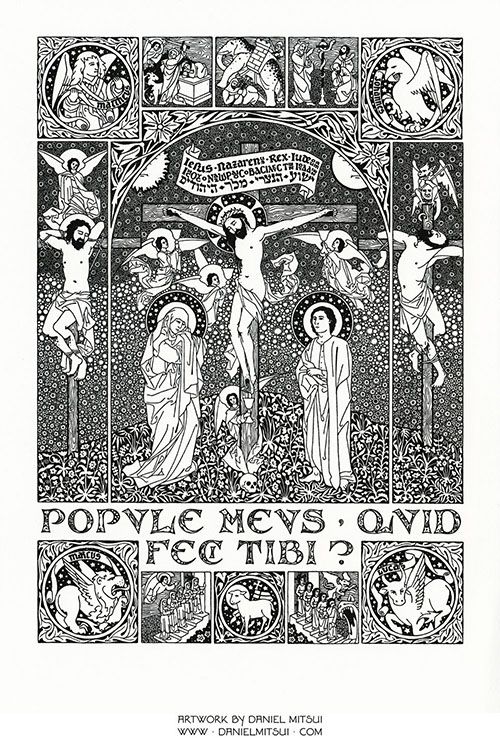
From Daniel Mitsui.

The Reproaches (Improperia)
I.
1 and 2: My people, what have I done to you
How have I offended you? Answer me!
1: I led you out of Egypt,
from slavery to freedom,
but you led your Savior to the cross.
2: My people, what have I done to you?
How have I offended you? Answer me!

1: Holy is God!
2: Holy and strong!
1: Holy immortal One, have mercy on us!
1 and 2: For forty years I led you
safely through the desert.
I fed you with manna from heaven,
and brought you to a land of plenty; but you led your Savior to the cross.
Repeat "Holy is God..."
1 and 2: What more could I have done for you.
I planted you as my fairest vine,
but you yielded only bitterness:
when I was thirsty you gave me vinegar to drink,
and you pierced your Savior with a lance.
Repeat "Holy is God..." 
II.
1: For your sake I scourged your captors
and their firstborn sons,
but you brought your scourges down on me.
(Repeated throughout by Choir 2)
2: My people, what have I done to you?
How have I offended you? Answer me!
1: I led you from slavery to freedom
and drowned your captors in the sea,
but you handed me over to your high priests.
2: "My people...."
1: I opened the sea before you,
but you opened my side with a spear.
2: "My people...."
1: I led you on your way in a pillar of cloud,
but you led me to Pilate's court.
2: "My people...."
1: I bore you up with manna in the desert,
but you struck me down and scourged me.
2: "My people...."
1: I gave you saving water from the rock,
but you gave me gall and vinegar to drink.
2: "My people...."
1: For you I struck down the kings of Canaan.
but you struck my head with a reed.
2: "My people...."
1: I gave you a royal scepter,
but you gave me a crown of thorns.
2: "My people...."
1: I raised you to the height of majesty,
but you have raised me high on a cross.
2: "My people...."
Share

Thursday, April 2, 2026

Blessed Karl, Clericalism and Lay Church Governance

 From Charles Coulombe at One Peter 5:

In many ways, Austro-Hungarian Emperor-King Franz Joseph epitomised the traditional relationship between the lay and clerical powers of the Church. As with the other Crowned Heads of Europe, he had inherited a particular style of Catholic devotion peculiar to his own dynasty – the Pietas Austriaca. Bound up with a veneration of the True Cross and the Passion, the Blessed Sacrament and the Sacred Heart, the Blessed Virgin and St. Joseph (the family patron), this religiosity had led to the tremendous collection of relics at the Hofburg, the Imperial Palace in Vienna. The Maundy Thursday Footwashing and the Corpus Christi procession were highlights of court life in Vienna, and in 1898 Franz Joseph led the Imperial Family in observing the Consecration of All Mankind to the Sacred Heart, led by Leo XIII in Rome. In the canon of the Mass, the Good Friday Collects, and the Holy Saturday Exsultet, the Emperor was prayed for by name.

Franz Joseph was crowned and anointed King of Hungary in 1867. As Emperor-King he appointed the Cardinals, Archbishops, and Bishops, subject to Papal approval. Exempt from this were Salzburg and Olomouc, their metropolitans being elected by the cathedral chapters, and the former ‘Salzburg dioceses’ of Seckau, Lavant, and Gurk. The Archbishop of Salzburg had the right of appointment for Seckau and Lavant, the occupation of Gurk was regulated in a mixed manner, that is, the Emperor proposed two candidates, the subsequent nomination was made by the Archbishop of Salzburg. The Nuncio had to be consulted to make sure that the choice was not obnoxious to the Pope – either disapproval would derail the process; the separate Austrian and Hungarian ministries of Worship and Education would do the research, but it was Franz Joseph who had to approve the choices, both for Latin and Eastern Rite Catholic Bishops. Moreover, he had to bear in mind that some of his appointees would sit in one or more legislatures within the Monarchy.

There were three national parliaments. In the Upper House – House of Lords (Herrenhaus) of the Austrian Parliament could be found the prince-archbishops of Vienna, Prague, Salzburg, Görz, and Olmütz, the archbishops of Lemberg and Zara, the Byzantine Catholic archbishop of Lemberg, the Armenian Catholic archbishop of Lemberg, and the Greek Orthodox archbishop of Czernowitz, as well as the prince-bishops of Brixen, Breslau (although located in what was then Germany, for the diocesan territory in Austrian Silesia), Krakau, Seckau, Trient, Laibach, Lavant, and Gurk. In the Hungarian Upper House, the Főrendiház or “House of Magnates,” had an even higher proportion of ecclesiastical members – although it was also more interfaith than Austria’s: forty-two dignitaries of the Catholic and Orthodox Churches, including the Primate, Archbishops, Bishops, Abbots, and various other high officials, and thirteen representatives of the Protestant confessions. The annexation of Bosnia in 1908 presented a challenge in creating representative institutions for a region that had never known them. But while Bosnian diet (Sabor) would only one have one house, it would also have religious representatives appointed by the Monarch. These were, in deference to the Muslim majority, the Reis, who was the principal of Muslims’ granted lands, and the Muslims’ regional leader from Mostar; four Metropolitans and the president of the Orthodox community; the Catholic archbishop and two province members of Franciscan order of Bosnia and Herzegovina; and the Sephardic rabbi of the higher order. The various provincial diets in the Austrian half of the Monarchy also numbered the local Catholic bishops in their number.

Another religious duty that Franz Joseph took very seriously was that of funding missions – even though Austria-Hungary had no colonies. The Catholic Church in Scandinavia, Albania, and Bulgaria (Latin and Byzantine in that case) was heavily funded by the Emperor, as was the Church in the Holy Land and Egypt (the Coptic Catholic Church was funded from its beginning thereby, and Franz Joseph paid for the building of the Latin Catholic Cathedral of St. Catherine in Alexandria, where, ironically, the remains of  his wartime enemy King Victor Emmanuel III would rest until their recent repatriation to Italy). But since 1826, very largely out of funds given by both Franz Joseph and his two immediate predecessors, a large amount of this largesse went to the Church in the United States. Through an organisation called the Leopoldinenstiftung – the “Leopoldine Foundation” – the Habsburgs and many of their subjects poured millions of dollars into the American Church, founding 400 parishes, subsidising wholly or partly 300 missionaries (such as St. John Neumann and Ven. Bishop Baraga), and sending an endless flow of vestments, statues, stained glass, liturgical implements, and the like. A great deal of dynastic money went to Eastern Rite churches in the United States as well. Unfortunately, the outbreak of war in 1914 ended the flow of generosity – which, of course, would be repaid by Woodrow Wilson’s insistence of the deposition of Franz Jospeh’s successor, his exile, and the partition of his domains. (Read more.)

Share

Wednesday, March 25, 2026

Lady Day


 From A Clerk of Oxford:
Today is the feast of the Annunciation, 'Lady Day'. As I explored last year, the medieval church considered 25 March to be the single most important date in history, at once the beginning and the end of Christ's life on earth: it was the date of the Annunciation, the Crucifixion, the eighth day of Creation, the crossing of the Red Sea, and the sacrifice of Isaac, all profoundly meaningful events in the carefully-crafted divine story of salvation history. Its resonances reached even unto Middle Earth, as Tolkien aligned the downfall of the Ring to this most auspicious of dates. (Read more.)
Share

Thursday, March 19, 2026

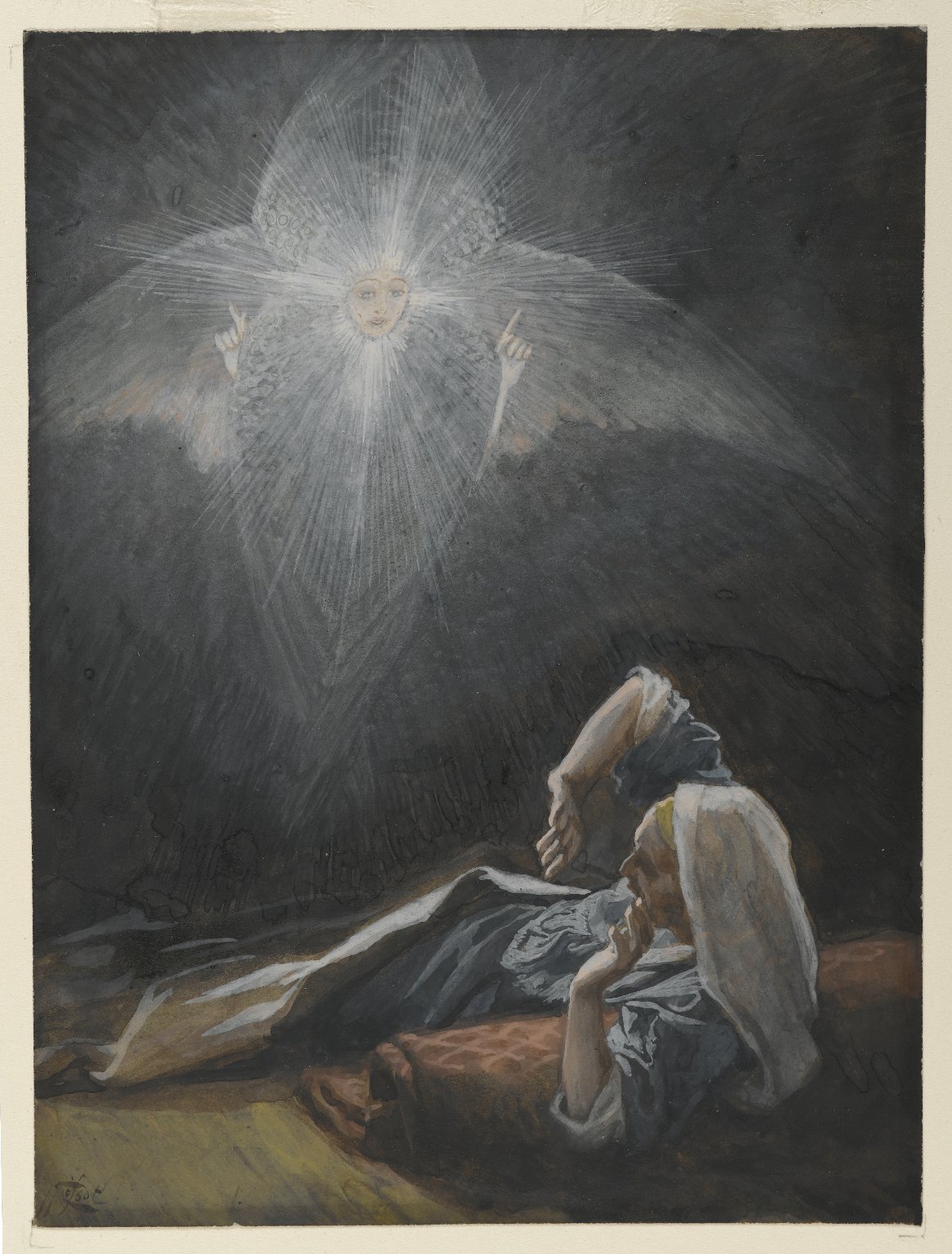
"The Vision of St. Joseph" by James Tissot

What a wonderful angel! Via East of the Sun, West of the Moon.

"I am poor, and in labors from my youth and being exalted, I was humbled and troubled." Psalm 87:16

Joseph of Nazareth
On a joiner's bench
You ply your trade.
Hands calloused
Fingers nimble.
Wood chips and shavings
At your feet.
Sawdust
In your beard.
You sing
The song of your people
Longing
For the Face
Of Him
Who is to come.

Joseph of Nazareth
Of David's line
You sing
The wedding song.
"My sister, my spouse
Is a garden
Enclosed..."
Virgin husband
Of the Daughter of Sion
You prepare a
Dwelling
For the Stainless One.

Joseph of Nazareth
In sweat of anguish
You ponder
Another Joseph
Thrown in the cistern.
Your song
Becomes sad.
"Save me
O God
For the waters
Are come in
Even unto
My soul..."
You sing
Then fall silent.
Sleep comes
With the breeze
That stirs
The curls of wood...
And then
The voice: 
"Joseph, Son of David,
Fear not...."

By a Carmelite tertiary Share

Saturday, March 7, 2026

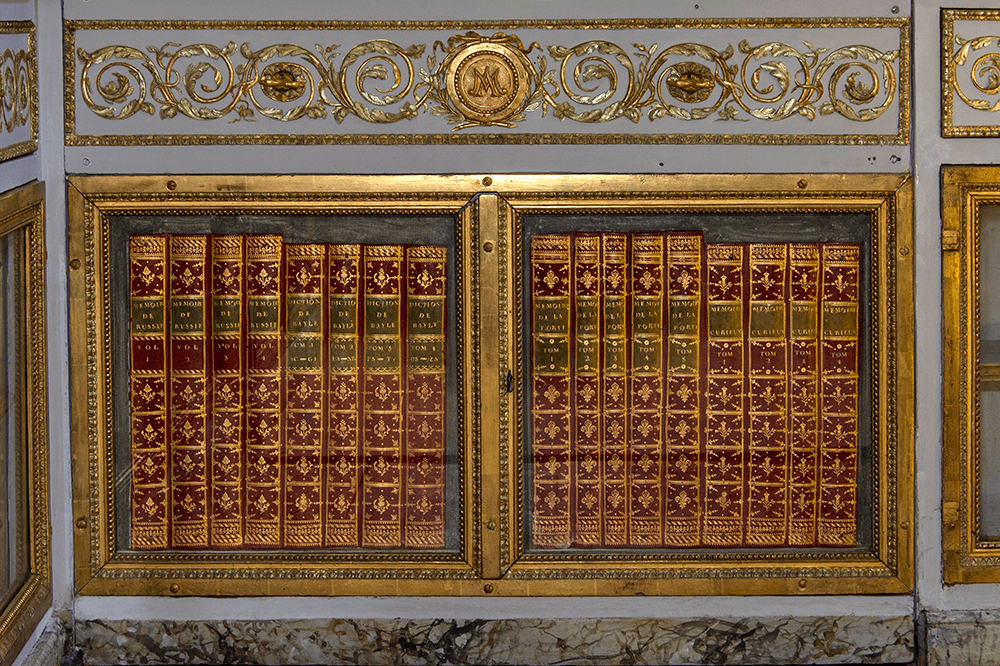
Marie-Antoinette's Library at Versailles

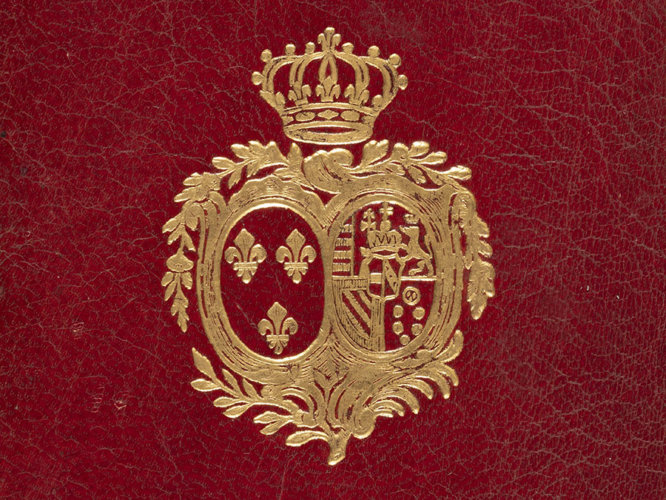
All of the Queen's books were bound in red Moroccan leather and stamped in gold with her coat-of-arms

From Les Carnets de Versailles [translated by Tea at Trianon]:
Several handwritten catalogs, written between 1781 and 1792, list the Queen's books: nearly 500 titles, for a set of around 1,800 volumes. We find on the shelves of Versailles all the great authors, Latin and Greek classics as well as French and foreign writers. The ancients...but also La Fontaine, Boileau, Corneille, Molière, Racine, Regnard, Crébillon, Destouches, Madame de Sévigné, Madame de La Fayette, Lesage rub shoulders with the contemporaries - Voltaire, Rousseau, Beaumarchais , Goldoni, Defoe, Mme Riccoboni, Fielding, Richardson…
Marie-Antoinette had a certain predilection for romantic literature, entertaining works, theater and music. It also has a large music library (scores and booklets) supplied by the Menus Plaisirs. The more austere books, less appreciated by the sovereign, are not overlooked: theology (Pascal, Bossuet, Fénelon, Bourdaloue, Massillon, Nicole), history (Mézeray, Montfaucon…), science (Buffon, Nollet, Duhamel du Monceau …) are present on the shelves. There are also large volumes of travel and archeology, illustrated with magnificent engravings.... 
Like many of the Château's collections, the books formerly stored in the Queen's library have been scattered. The shelves today hold a deposit from the National Library of France, composed of 18th century works, of royal origin, selected for their binding in red morocco. Some books with the arms of Queen Marie-Antoinette were nevertheless able to return to the site, in particular the two acquisitions made in 2019: an Office of the Virgin, printed in 1771 by Michel Lambert, and Les Lacunes de la philosophie, by François Louis d ' Escherny, published in 1783. (Read more.)
Faux bookshelf disguising a door panel
More on the Queen's library, HERE. Marie-Antoinette also had a library at Petit Trianon, HERE and HERE.
Share

Monday, March 2, 2026

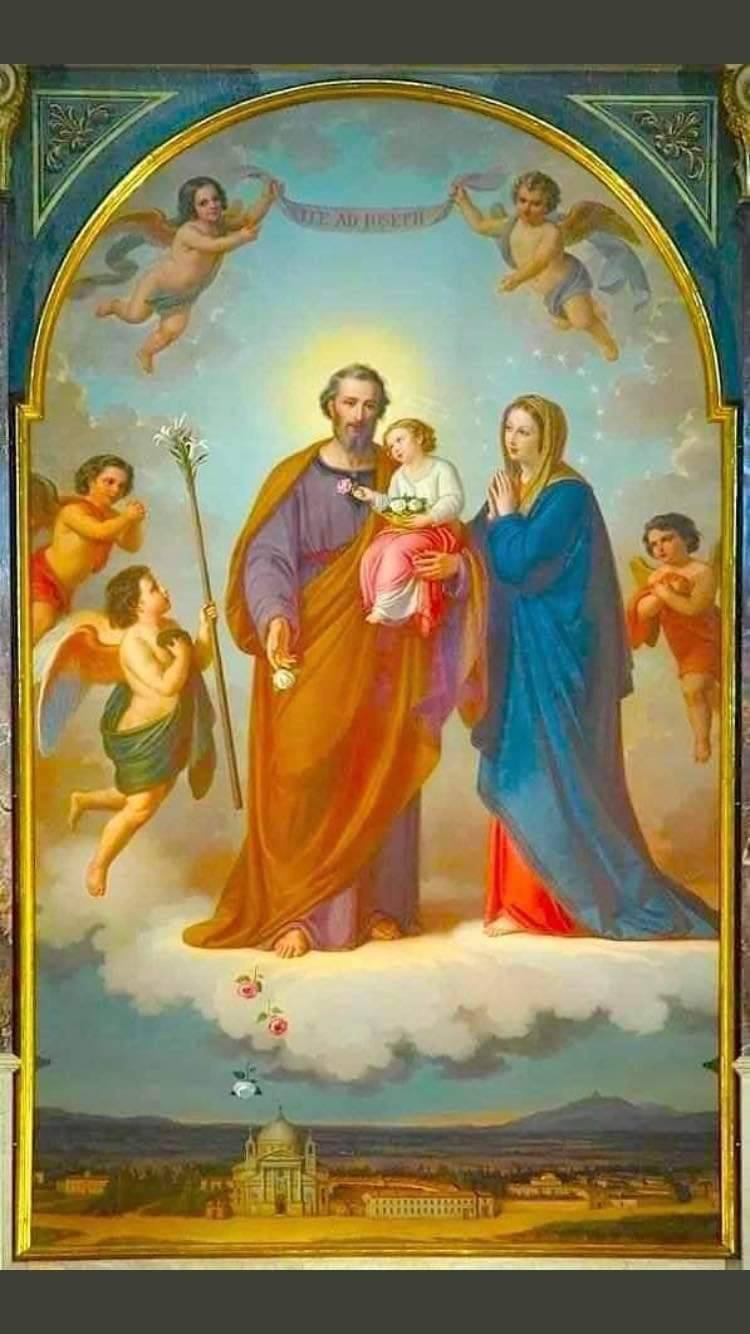
St. Joseph: The Model of Manhood

March is the month of St. Joseph. From The Catholic Gentleman:

Why did God choose St. Joseph? Of all the thousands of Jewish men, many of whom no doubt were righteous, why was a humble carpenter chosen for the task of being the earthly father of the Savior? The answer is simple: God knew St. Joseph would immediately do anything that was asked of him, no matter how difficult.

The saints agree that conformity to the will of God through prompt obedience is one of the surest paths to holiness. St. Joseph exemplified this virtue, and a perfect example is the flight into Egypt. The angel of the Lord appeared to St. Joseph in a dream, warning him of the danger that was coming. Scripture then tells us that, “When he arose, he took the young Child and His mother by night and departed for Egypt.” Did you catch that? The minute he woke up, he obeyed. He didn’t let fear of uncertainty paralyze him, he didn’t spend weeks planning, and he didn’t save up some money first. He took Jesus and Mary and left for Egypt, entrusting his family to the providence of God. That is prompt obedience, and that is why  St. Joseph was entrusted with the greatest responsibility ever given to a man. (Read more.)

Share

Monday, February 2, 2026

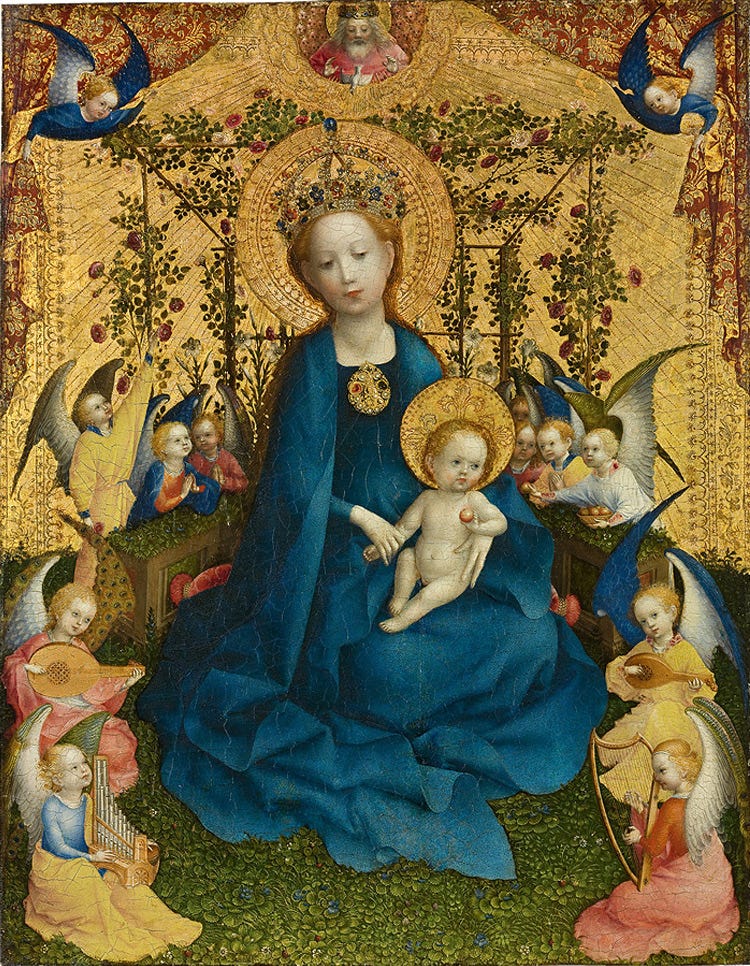
Virgin of the Rose Bower

The enclosed garden: “Thou art all fair, O my love, and there is not a spot in thee.”

 From Hilary White at The Sacred Images Project:

The painting by Stefan Lochner is among the most concentrated visual expressions of the western iconographic prototype we call the “hortus conclusus”. The phrase is drawn from the Bible’s Song of Songs that begins, “A garden enclosed is my sister, my spouse…” It has always functioned in Christian spiritual theology as a Marian title, signifying virginity, purity and the inviolate womb in which the Incarnation took place.

In the later Middle Ages, the hortus conclusus prototype was increasingly visualised using the forms of fashionable private pleasure gardens familiar to the aristocracy and urban elite. This convergence allowed Marian images to appropriate the language of cultivated leisure: enclosure, refinement, ordered nature, while reorienting it toward chastity, contemplation and sacred presence.

Our word “paradise” derives from the Old Persian pairidaeza, meaning an enclosed garden or walled park, a term that entered Greek as paradeisos and then Latin as paradisus. Originally denoting royal pleasure gardens, the word was adopted in the Septuagint to translate the Garden of Eden, permanently linking enclosure, order, and cultivated beauty with the biblical vision of divine dwelling. (Read more.)


Share

Sunday, January 11, 2026

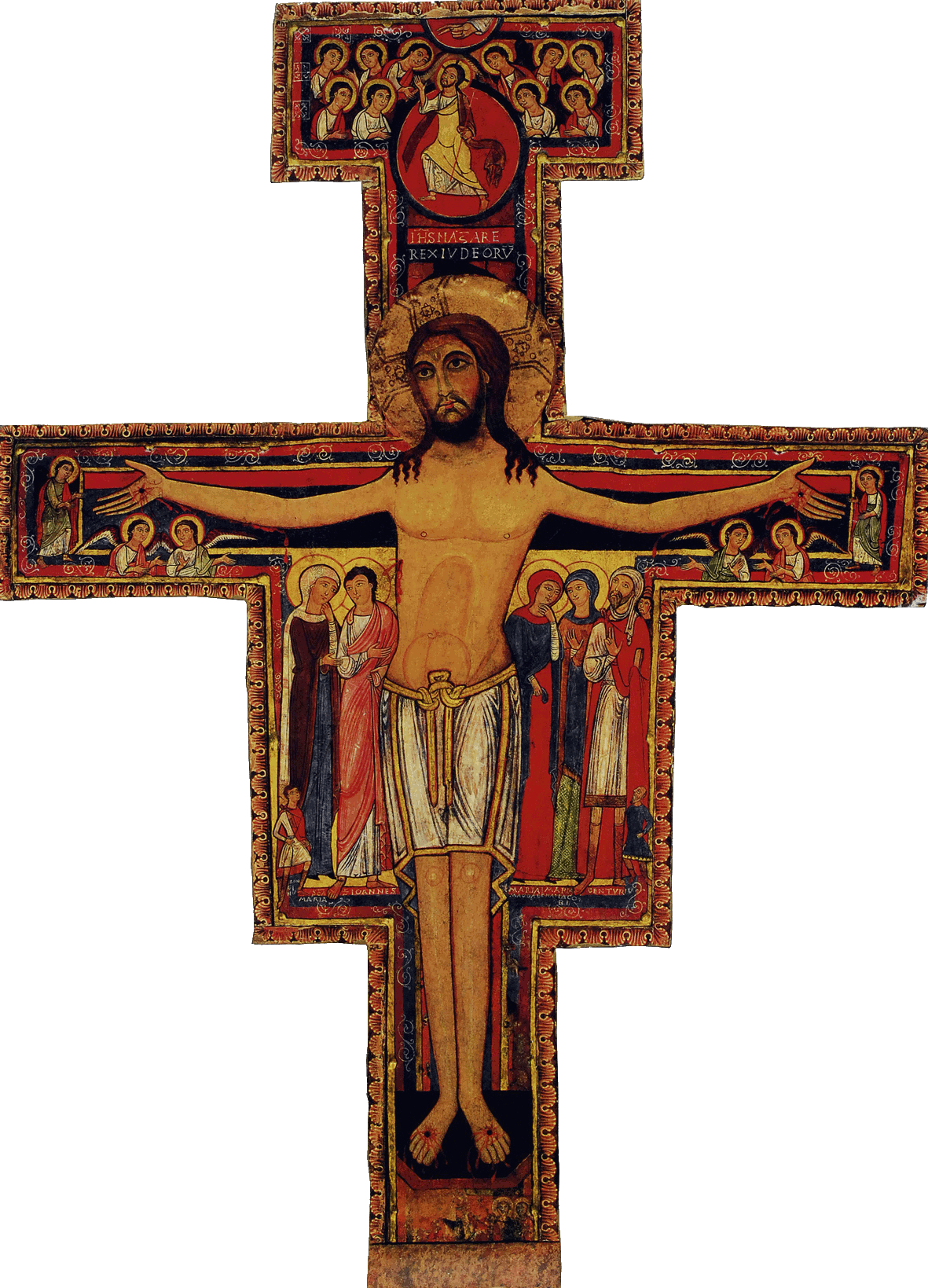
Ecce Agnus Dei


The Franciscan answer to the Catharist heresy. From Hilary White at The Sacred Images Project:

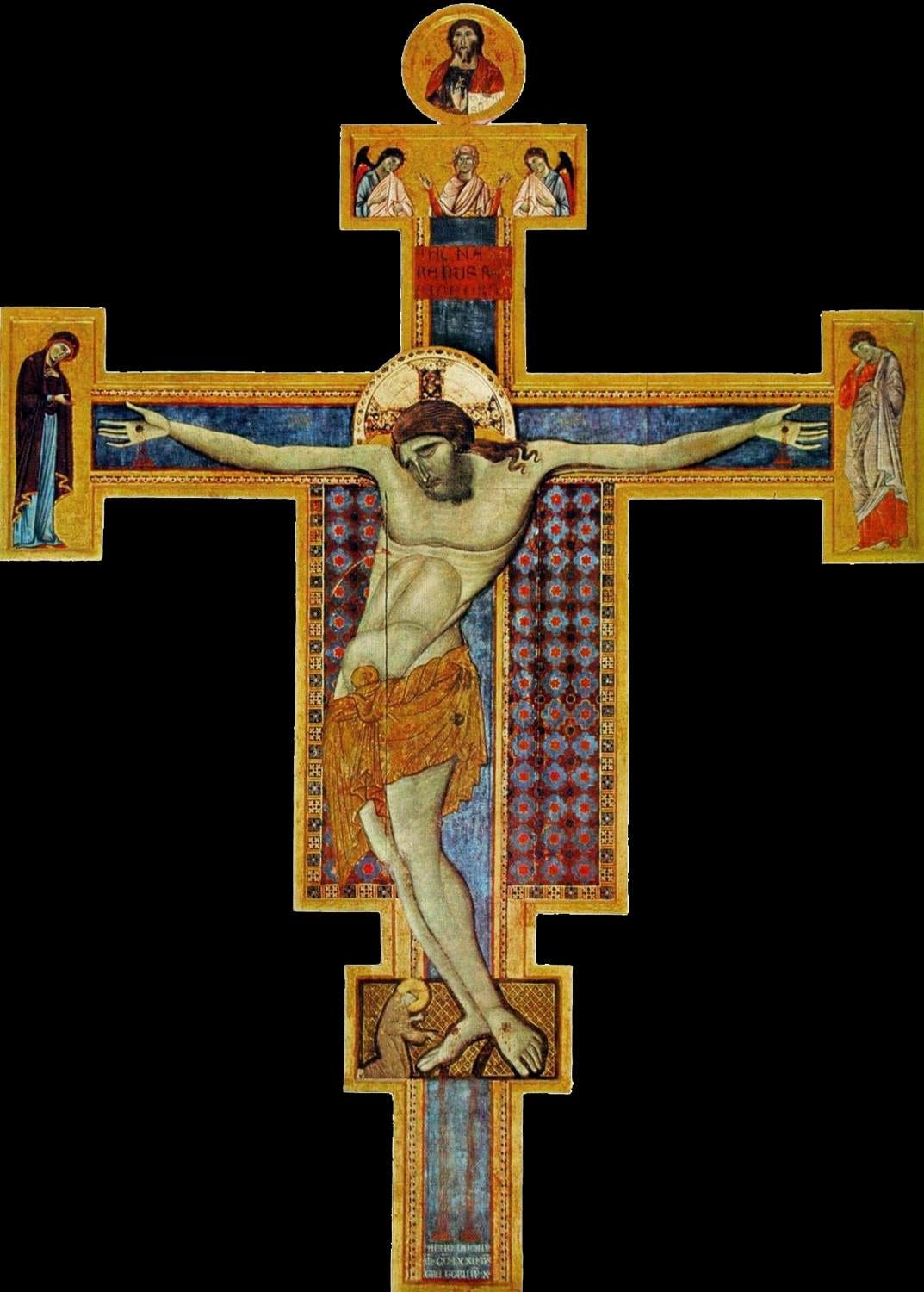
These icons were in the line of a movement that started in the 12th century of showing the physical and real suffering and death of Christ on the cross that led to the naturalistic depictions of the crucifixion we’re familiar with today. The intention is to generate an emotional response of pity, empathy, sorrow and repentance in the viewer. And this is part of a greater spiritual movement that was later to be popularised by the new mendicant orders, Franciscans and Dominicans, who emphasized the importance of Christ's human and physical suffering and our own ability to “enter into” and participate in it through our affections. Of course, the creation of sacred art is a key component of this kind of evangelisation.

 [...]

As such, the artistic development of these paintings over the following 200 years would be part of a larger and permanent change in the way Christians thought about Christ, their ideas of having a genuine affective relationship with a real person, who knew pain and understood them at a visceral level. The Italo-Byzantine and Duecento panel paintings showing Christ in agony only intensified as more natural looking figures were created.

Master of St. Francis. Perugia National Gallery. It’s impossible for a photo to do justice to it. It smacks you in the head when you walk into the very large room it’s housed in. At least 12 feet tall. You have to stand on the other side of the room to take the whole thing in.

And this movement, in both spirituality and art, is thought by some scholars as a response to the materialist ideas of the Cathar heresy1 that was spreading in Northern Italy and southern France at the time. In the early 12th century the idea that Christ was just a man and His death was of no redemptive significance, were growing.

The Cathars adopted the ancient Manichaean dualistic ideas of two gods; an evil god who created material reality and a good god who created spiritual beings like angels and human souls. The soul was entrapped in the material body and had to be released by a process of spiritual purification and ultimately death. Catharism rejected Catholic sacraments and authority, including the Bible, and its popularity ultimately threatened the political and economic stability of Europe.

Of course this all meant that the Cathars also rejected the redemptive value of the crucifixion, holding that Jesus was just a human being, perhaps inspired by the Holy Ghost, and that the only way to be “saved” was to free the soul from the evil material world. (Read more.)


My novel on the Cathars, HERE.

Share

Saturday, January 10, 2026

A Road Trip to Avalon


Some young knights on a quest. From The Saxon Cross:

Glastonbury is a weird town. For two thousand years it has been the spiritual center of England. For a long time this was because Glastonbury Abbey was the largest and most powerful monastery on the island. But while the monastery has long lain in ruin, the town is still very much a spiritual center. The town is chockfull of New Age shops, druids, neo-pagans, witches and occultists. Something very real draws this sort of person to the town, and I think some of them are genuine seekers. Of course, they’re looking in all the wrong places, but the power they feel is real. Glastonbury is a Christian holy place and that power still pervades the ground.

First we walked the ruins of the great abbey. This island is littered with the ruin of the work of the Protestant Reformation and King Henry VIII. During King Henry’s dissolution of the monasteries the abbey fell into disrepair, and its last abbot was draw, quartered, and hanged on Glastonbury Tor in 1539. Glastonbury then ceased to be the center of Christianity in the isle, and the blood soaked into the ground has been crying out ever since. The ruins of the monastery are hauntingly beautiful. It is also the purported site of Arthur and Guinevere’s graves, although this is one legend that I think may have been fabricated in the Middle Ages. On the abbey grounds still live the last of the Holy Thorns, the sacred trees that bloom on Christmas Day, that are said to have been brought to the isle of Avalon by St. Joseph of Arimathea.

 On our way up to the Tor we stopped to drink from the Chalice Well, also known as the Red Spring. There are two versions of the legend of this holy well. One claims that St. Joseph buried the Holy Grail inside the Tor, and from it sprang the well. The other claims that he buried two vials, one filled with Christ’s blood and the other with His tears, and from these sprang the Red and White Springs respectively, the White Spring being another holy well just across the street from the Chalice Well garden. Whatever the truth is, the water is full of iron and indeed tastes like blood. Inside the chalice well garden at the foot of the Tor we were met by another one of our companions, Jake, which seemed like a fitting and symbolic place to meet on a spiritual quest. Together we prayed and drank from the well, and then ascended the Tor together. As we began our ascent a rainbow broke out across the sky, crowning St. Michael’s Tower. (Read more.)

Share

Tuesday, December 30, 2025

The Tortured Soul of Léon Bloy

 From Angelus:

Although he is considered the father of the “Catholic” novel, Bloy is more famous for quotations extracted from them and from his brilliant and controversial journals published during his lifetime.

One journal was titled “Pilgrim of the Absolute,” which also became Bloy’s honorary title. Another, called “Bloy Before the Swine,” included a harsh depiction of his life in a Paris suburb. Those whom he’d turned to in his abject poverty and helped him probably agreed with another honorific, “The Ungrateful Beggar,” which was the title of another volume. His thought was that he could not compromise his writing or vocation, and expected others to support him in what publishers and the public refused to do.

It is a cliché that a prophet’s mission is to comfort the afflicted and afflict the comfortable. But that seems to have been Bloy’s modus operandi.

France had responded with enthusiasm to the 1846 apparition of the Blessed Virgin Mary to two young visionaries in the hamlet of La Salette. Its message of repentance was embraced by many but became controversial, even though the local bishop and the Vatican supported the claims.

But one of the visionaries, Melanie Calvat, felt that the message of Our Lady was not being correctly reflected and prophesied a coming disaster for the French Church. Her ideas resonated with Bloy, who became Calvat’s advocate and challenged the French hierarchy and the congregations who served as chaplains on the mountain where pilgrims visited the shrine built to mark the apparition. In his typical absolutist style, he said what had started with the charism of repentance associated with La Salette was now a matter of “hoteliers and merchants of soup,” because of the guesthouses run by the congregation on the “holy mountain.”

His identification with the cause of Calvat was a reflection of Bloy’s sympathy with those who were on the losing side of life. He also published defenses of Columbus and Napoleon, both of whom he judged maligned by historians.

Perhaps most quixotically, he believed, or wanted to believe, that the son of King Louis XVI and Marie Antoinette, known to history as Louis XVII, had somehow survived imprisonment by Jacobin revolutionaries and lived in the Netherlands, missing all the action of the Napoleonic regime and the Bourbon Restoration. Bloy was fascinated with the idea that the powers of Europe knew the true heir to the French throne was alive and feared his possible restoration. (Read more.)


My novel about Louis XVII, HERE.

Share

Sunday, December 28, 2025

The Coventry Carol

Christmas is tinged with sorrow. From A Clerk at Oxford:
Lullay, lullay, thou little tiny Child,
By, by, lully, lullay.
Lullay, lullay, thou little tiny child.
By, by, lully, lullay.

O sisters too, how may we do,
For to preserve this day
This poor youngling for whom we sing,
By, by, lully, lullay.

Herod the King, in his raging,
Charged he hath this day
His men of might, in his own sight,
All young children to slay.

Then woe is me, poor child, for thee,
And ever mourn and may,
For thy parting, nor say nor sing,
By, by, lully, lullay.
The Coventry Carol is among the medieval carols most often heard today, and I find the popularity of this profoundly sad song at Christmastime intriguing. As John of Grimestone's lullaby suggests, there are actually a considerable number of medieval lullabies which share the mood of the Coventry Carol: somewhere between lullaby and lament, full of melancholy and pity for the child being comforted, whether it's Herod's victims, the Christ-child, or any human baby born into a weeping world. (Here's another beautiful example.) I wonder if the popularity of the Coventry Carol today indicates that it expresses something people don't find in the usual run of joyful Christmas carols - this song of grief, of innocence cruelly destroyed. Holy Innocents is not an easy feast for a modern audience to understand, and I'll confess I find the medieval manuscript images of children impaled on spears just horrible - but then, they are meant to be, and they're horrible because they're all too close to the reality of the world we live in. The idea that this is incongruous with the Christmas season (as you often hear people say) is largely a modern scruple, I think. It's our modern idea that Christmas is primarily a cheery festival for happy children and families - our images of Christmas joy, both secular and sacred, are all childlike wonder and picture-perfect families gathered round the tree. This is very nice, of course, for those who have (or are) children, or happy families, but for those who don't - those who have lost children or parents, who face loneliness or exclusion, who want but don't have children, family, or home - it can be deeply painful. (Read more.)
Share

A Renowned Medievalist, Poet, and Fencer

Professor Rachel Fulton Brown from the University of Chicago. From The European Conservative:

Conservatives need to stop letting the Adversary define the terms of the debate, starting with the concept of sin. The very concept of sin is anathema to modern feminism, convinced as it is that men are to blame for all the woes of human existence. I exaggerate, but only slightly. The gender debate, such as it is, is a debate about where to place blame for the differences between the sexes, with women claiming that they should be able to behave like men sexually while at the same time blaming men for behaving like men. The upshot is that everyone is unhappy, blaming each other for not being empathetic enough to anticipate each other’s every need. There is no antidote because nobody is willing to acknowledge his or her role in creating the situation, famously encapsulated in that moment in a certain garden when, convinced it would give them power to overcome their own nature, the first woman and the first man ate of the fruit they had been forbidden to eat thinking it would make them “as Gods” (Gen. 3:5). This original sin of disobedience has, according to Christian teaching following the Apostle Paul, defined human nature ever since: women being persuaded that God lied to them about who they are, and men going along with the women like so many Macbeths.

And yet, into this tale of sorrow comes the Virgin Mary, our second Eve, who rather than fighting God’s will for her, consents to become the Mother of God. Mary’s obedience presents modern feminism with an insurmountable challenge. Was this not rape, as so many have argued; after all, how could Mary have possibly said, “No”? Everything hinges on this question. In the 12th century, Mary’s consent would become axiomatic for the sacramental definition of marriage: just as God would not have taken flesh from the Virgin without her consent, so both the bride and the bridegroom must make verbal consent (“I do”) to their marriage. Ironically (our story is filled with irony), from a Christian perspective, the feminist rejection of patriarchal marriage is a rejection of the one institution founded on a woman’s God-given right to say, “No,” precisely because God did not rape the Virgin Mary, but rather sent his messenger to obtain her consent (“Fiat mihi secundum verbum tuum,” “Let it be to me according to your word,” Luke 1:38).

But why did Mary say, ‘Yes’? ‘She was special, alone of all her sex; nobody could be as perfect as she,’ reply her feminist sisters. ‘She sets an impossible ideal.’ To me, as a daughter of Eve, this has always sounded like envy: ‘I wish I could be as beautiful and beloved as she.’ Modern women will deny it, but their taste in romance literature suggests otherwise; likewise, the sorrow they express at not being able to find the man of their dreams who will treat them like the queen they know (and tell each other) they are. As I have tried to show in my scholarship, what they fail to appreciate is how much their fantasies depend on stories told about the Virgin Mary, specifically, stories told about the Virgin Mary through commentaries on the Song of Songs in which stories Mary is given the role of the bride pursued by the bridegroom to become his beloved queen. “You are all beautiful, O my love, and there is no spot in thee,” the bridegroom tells her (Song 4:7). “My soul melted when he spoke,” she tells her companions (Song 5:6). “One is my dove, my perfect one is but one, she is the only one of her mother, the chosen of her that bore her,” he tells his associates (Song 6:8). Every modern romance novel that casts the hero as elusive, strangely powerful, ancient and brooding draws on this tradition; every woman who imagines herself pursued by a loving God-man is heiress to the medieval tradition of mystical longing. (Read more.)

Share

Saturday, December 27, 2025

Jesus Christ the Apple Tree


It is St. John's day, which is the name-day of my late father. This early American carol was one of his favorites. It invokes images of Eden and the lost earthly paradise, while bringing to mind the Tree of Life which is the Cross. From Hymns and Carols of Christmas:
1. The tree of life my soul hath seen,
Laden with fruit and always green:
The trees of nature fruitless be
Compared with Christ the apple tree.

2. His beauty doth all things excel:
By faith I know, but ne'er can tell
The glory which I now can see
In Jesus Christ the apple tree.

3. For happiness I long have sought,
And pleasure dearly I have bought:
I missed of all; but now I see
'Tis found in Christ the apple tree.

4. I'm weary with my former toil,
Here I will sit and rest awhile:
Under the shadow I will be,
Of Jesus Christ the apple tree.

5. This fruit doth make my soul to thrive,
It keeps my dying faith alive;
Which makes my soul in haste to be
With Jesus Christ the apple tree.
From The Thinking Housewife: "The lyrics were written by an unknown poet in the 18th century and call to mind the tradition in the Middle Ages of decorating Christmas trees with apples, symbolic of the Tree of Knowledge." (Read more.)

The Tree of Life and Death


Share

Friday, December 26, 2025

The Sacred Earthiness of Christmas

 From George Weigel at First Things:

Christianity begins in a real place, at a specific point in time in which real men and women met an itinerant rabbi named Jesus of Nazareth—and after what they had thought to be the utter catastrophe of his degrading and violent death, met him anew as the Risen Lord Jesus. The lives of those real men and women were so transformed by these encounters that they, in turn, went out and got to work on the task the Risen One gave them: to “make disciples of all nations” (Matt. 28:19). 

The earthiness of the Christmas story—the manger, the stable, the “swaddling clothes,” the stolid oxen and lowing cows, the bewildered but kindly shepherds, the exotic Magi from the East and their gifts of gold, frankincense, and myrrh, the child’s circumcision—underscores this core Christian conviction: The Second Person of the Most Holy Trinity, the “Word” through whom “all things were made” (John 1:1, 3), entered history through the cooperation of a Jewish girl and her overshadowing by the Holy Spirit, and was born at a precise moment in time at a precise place. Whether “the first cuttings of His infant hair” really are in Rome’s Basilica of the Holy Cross in Jerusalem may be beyond historical verification; the real point being made in such claims is that the incarnate Son of God really was at one point in his life among us, an infant who had an infant’s hair and all the other attributes of a weak and defenseless child. 

Ditto for what is really being proposed by the “napkins,” the cradle, St. Joseph’s blanket-cloak, and all the rest: He whom Christianity proclaims as Lord and Savior, the One who fully reveals both the truth about God and the truth about our humanity’s dignity and destiny, was not a character in some virtual reality “metaverse” constructed by Mark Zuckerberg. He was here, on this third planet of the solar system. And he is still with us: in the Scriptures proclaimed, and above all in the holy bread broken and shared. (Read more.)


Share

Thursday, December 25, 2025

Merry Christmas!

The Nativity by Giotto
And a Happy New Year! Thanks to everyone who has visited this blog in 2025~ I will pray for you all this Christmas Day in the morning. Please pray for me.
Welcome, all wonders in one sight!

       Eternity shut in a span;

Summer in winter; day in night;

       Heaven in earth, and God in man.

Great little one, whose all-embracing birth

Lifts earth to heaven, stoops heav’n to earth.
 ~  from "In the Holy Nativity of Our Lord" by Richard Crashaw

Share

Christmas Scenes


From East of the Sun, West of the Moon. And Christmas trees, HERE.


And scenes of winter, too. Happy New Year!


Share

Last Will and Testament of Louis XVI

The last Will and Testament of Louis XVI, King of France and Navarre, given on Christmas day, 1792.
In the name of the Very holy Trinity, Father, Son and Holy Ghost.
To-day, the 25th day of December, 1792, I, Louis XVI King of France, being for more than four months imprisoned with my family in the tower of the Temple at Paris, by those who were my subjects, and deprived of all communication whatsoever, even with my family, since the eleventh instant; moreover, involved in a trial the end of which it is impossible to foresee, on account of the passions of men, and for which one can find neither pretext nor means in any existing law, and having no other witnesses, for my thoughts than God to whom I can address myself, I hereby declare, in His presence, my last wishes and feelings.
I leave my soul to God, my creator; I pray Him to receive it in His mercy, not to judge it according to its merits but according to those of Our Lord Jesus Christ who has offered Himself as a sacrifice to God His Father for us other men, no matter how hardened, and for me first.
I die in communion with our Holy Mother, the Catholic, Apostolic, Roman Church, which holds authority by an uninterrupted succession, from St. Peter, to whom Jesus Christ entrusted it; I believe firmly and I confess all that is contained in the creed and the commandments of God and the Church, the sacraments and the mysteries, those which the Catholic Church teaches and has always taught. I never pretend to set myself up as a judge of the various way of expounding the dogma which rend the church of Jesus Christ, but I agree and will always agree, if God grant me life the decisions which the ecclesiastical superiors of the Holy Catholic Church give and will always give, in conformity with the disciplines which the Church has followed since Jesus Christ.
I pity with all my heart our brothers who may be in error but I do not claim to judge them, and I do not love them less in Christ, as our Christian charity teaches us, and I pray to God to pardon all my sins. I have sought scrupulously to know them, to detest them and to humiliate myself in His presence. Not being able to obtain the ministration of a Catholic priest, I pray God to receive the confession which I feel in having put my name (although this was against my will) to acts which might be contrary to the discipline and the belief of the Catholic church, to which I have always remained sincerely attached. I pray God to receive my firm resolution, if He grants me life, to have the ministrations of a Catholic priest, as soon as I can, in order to confess my sins and to receive the sacrament of penance.

I beg all those whom I might have offended inadvertently (for I do not recall having knowingly offended any one), or those whom I may have given bad examples or scandals, to pardon the evil which they believe I could have done them.

I beseech those who have the kindness to join their prayers to mine, to obtain pardon from God for my sins.
I pardon with all my heart those who made themselves my enemies, without my have given them any cause, and I pray God to pardon them, as well as those who, through false or misunderstood zeal, did me much harm.

I commend to God my wife and my children, my sister, my aunts, my brothers, and all those who are attached to me by ties of blood or by whatever other means. I pray God particularly to cast eyes of compassion upon my wife, my children, and my sister, who suffered with me for so long a time, to sustain them with His mercy if they shall lose me, and as long as they remain in his mortal world.
I commend my children to my wife; I have never doubted her maternal tenderness for them. I enjoin her above all to make them good Christians and honest individuals; to make them view the grandeurs of this world (if they are condemned to experience them) as very dangerous and transient goods, and turn their attention towards the one solid and enduring glory, eternity. I beseech my sister to kindly continue her tenderness for my children and to take the place of a mother, should they have the misfortune of losing theirs.

I beg my wife to forgive all the pain which she suffered for me, and the sorrows which I may have caused her in the course of our union; and she may feel sure that I hold nothing against her, if she has anything with which to reproach herself.

I most warmly enjoin my children that, after what they owe to God, which should come first, they should remain forever united among themselves, submissive and obedient to their mother, and grateful for all the care and trouble which she has taken with them, as well as in memory of me. I beg them to regard my sister as their second mother.

I exhort my son, should he have the misfortune of becoming king, to remember he owes himself wholly to the happiness of his fellow citizens; that he should forget all hates and all grudges, particularly those connected with the misfortunes and sorrows which I am experiencing; that he can make the people happy only by ruling according to laws: but at the same time to remember that a king cannot make himself respected and do the good that is in his heart unless he has the necessary authority, and that otherwise, being tangled up in his activities and not inspiring respect, he is more harmful than useful.

I exhort my son to care for all the persons who are attached to me, as much as his circumstances will allow, to remember that it is a sacred debt which I have contracted towards the children and relatives of those who have perished for me and also those who are wretched for my sake. I know that there are many persons, among those who were near me, who did not conduct themselves towards me as they should have and who have even shown ingratitude, but I pardon them (often in moments of trouble and turmoil one is not master of oneself), and I beg my son that, if he finds an occasion, he should think only of their misfortunes.

I should have wanted here to show my gratitude to those who have given me a true and disinterested affection; if, on the one hand, I was keenly hurt by the ingratitude and disloyalty of those to whom I have always shown kindness, as well as to their relatives and friends, on the other hand I have had the consolation of seeing the affection and voluntary interest which many persons have shown me. I beg them to receive my thanks.

In the situation in which matters still are, I fear to compromise them if I should speak more explicitly, but I especially enjoin my son to seek occasion to recognize them.

I should, nevertheless, consider it a calumny on the nation if I did not openly recommend to my son MM. De Chamilly and Hue, whose genuine attachment for me led them to imprison themselves with me in this sad abode. I also recommend Clery, for whose attentiveness I have nothing but praise ever since he has been with me. Since it is he who has remained with me until the end, I beg the gentlemen of the commune to hand over to him my clothes, my books, my watch, my purse, and all other small effects which have been deposited with the council of the commune.

I pardon again very readily those who guard me, the ill treatment and the vexations which they thought it necessary to impose upon me. I found a few sensitive and compassionate souls among them – may they in their hearts enjoy the tranquillity which their way of thinking gives them.

I beg MM. De Malesherbes, Tronchet and De Seze to receive all my thanks and the expressions of my feelings for all the cares and troubles they took for me.

I finish by declaring before God, and ready to appear before Him, that I do not reproach myself with any of the crimes with which I am charged.

Made in duplicate in the Tower of the Temple, the 25th of December 1792.

LOUIS

Share

Wednesday, December 24, 2025

“Tomorrow Shall Be My Dancing Day”

 From The Imaginative Conservative:

William Sandys (1792-1874) was an antiquarian by hobby—a “person who collects or studies old things” or “a student of the past,” according to Webster’s. The things Sandys happened to collect were Christmas songs. His 1833 publication Christmas Carols Ancient and Modern helped to launch the Victorian revival of the holiday, a revival that followed centuries of puritan neglect.[*] Sandys claimed in his book to have unearthed English yuletide songs dating back four centuries. Making their first appearance in print were many carols we now take for granted, such as “The First Noel,” “God Rest Ye Merry, Gentlemen,” and “Hark, the Herald Angels Sing.”

Although it hasn’t soared to those heights of popularity, “Tomorrow Shall Be My Dancing Day” is richly fascinating nonetheless. The text has turns of phrase redolent of the Middle Ages or Renaissance, yet no source for the song prior to Sandys has been found. What is most remarkable about “Dancing Day” is that it narrates the entire story of Christ’s life in Christ’s own voice, and that it describes the story of salvation with the image of a dance:

Tomorrow shall be my dancing day;
I would my true love did so chance
To see the legend of my play,
To call my true love to the dance.

Refrain:

Sing, oh! My love, oh! My love, my love, my love,
This have I done for my true love.

Most scholars agree that the text goes back far earlier than 1833, with the phrase “legend of my play” a possible clue that the carol was connected to the medieval mystery plays. Musicologists Hugh Keyte and Andrew Parrott write:

It seems possible that ‘Tomorrow shall be’ was devised to be sung and danced at the conclusion of the first day of a three-day drama . . . The actor portraying Christ would have sung the verses and the whole company and audience the repeats of the refrains.

Hymn texts in which Christ himself speaks—a device one commentator refers to as vox Christi—are rare, making a theatrical origin for “Dancing Day” even more likely.

Mystery plays were one of the three distinctive medieval forms of theater, the other two being miracle plays and morality plays. All three types evolved out of short scenes performed in church by the clergy as an adjunct to the liturgy and depicting biblical subjects such as the Creation, Adam, and Eve, or the Last Judgment. Mystery plays eventually moved out of church premises into the village square, often traveled from town to town on wagons, and became increasingly elaborate.

As the plays traveled to various locales, they were often advertised by the players in a song called a “banns.” If our carol originally formed part of a mystery play about the life of Christ, the “dancing day” on the “morrow” might refer to the subsequent part of the play, treating the Redemption.

Most striking is the relationship between Christ and humanity being likened to that of a lover and his “true love,” with the refrain’s expressive repetitions of “my love.” This motif hearkens back to the love poetry of the Song of Songs, in which the lover and beloved are traditionally interpreted as representing Christ and the church or Christ and the soul. The idea of Christ and humanity being united as bridegroom and bride is a classic Christian motif, but we are surprised to find it in a popular Christmas carol, and even more to find the image extended to depict Christ as our dancing partner. There is a good amount of theology and scripture in “Dancing Day,” such as the treatment of the Incarnation:

Then was I born of a virgin pure;
Of her I took fleshly substance.
Thus was I knit to man’s nature
To call my true love to the dance.

In a manger laid and wrapped I was,
So very poor; this was my chance,
Betwixt an ox and a silly poor ass,
To call my true love to my dance.

(Read more.)


Share

Saturday, December 20, 2025

Defense of the Traditional Date of Christmas

From Dr. Taylor Marshall:
Now we move on to establishing the birthday of Christ from Sacred Scripture in two steps. The first step is to use Scripture to determine the birthday of Saint John the Baptist. The next step is using Saint John the Baptist’s birthday as the key for finding Christ’s birthday. We can discover that Christ was born in late December by observing first the time of year in which Saint Luke describes Saint Zacharias in the temple. This provides us with the approximate conception date of Saint John the Baptist. From there we can follow the chronology that Saint Luke gives, and that lands us at the end of December. 
Saint Luke reports that Zacharias served in the “course of Abias” (Lk 1:5) which Scripture records as the eighth course among the twenty-four priestly courses (Neh 12:17). Each shift of priests served one week in the temple for two times each year. The course of Abias served during the eighth week and the thirty-second week in the annual cycle.[ii]However, when did the cycle of courses begin?
Josef Heinrich Friedlieb has convincingly established that the first priestly course of Jojarib was on duty during the destruction of Jerusalem on the ninth day of the Jewish month of Av.[iii]Thus the priestly course of Jojarib was on duty during the second week of Av. Consequently, the priestly course of Abias (the course of Saint Zacharias) was undoubtedly serving during the second week of the Jewish month of Tishri—the very week of the Day of Atonement on the tenth day of Tishri. In our calendar, the Day of Atonement would land anywhere from September 22 to October 8.
Zacharias and Elizabeth conceived John the Baptist immediately after Zacharias served his course. This entails that Saint John the Baptist would have been conceived somewhere around the end of September, placing John’s birth at the end of June, confirming the Catholic Church’s celebration of the Nativity of Saint John the Baptist on June 24.
The second-century Protoevangelium of Saint James also confirms a late September conception of the Baptist since the work depicts Saint Zacharias as High Priest and as entering the Holy of Holies—not merely the holy place with the altar of incense. This is a factual mistake because Zacharias was not the high priest, but one of the chief priests.[iv]Still, the Protoevangelium regards Zacharias as a high priest and this associates him with the Day of Atonement, which lands on the tenth day of the Hebrew month of Tishri (roughly the end of our September). Immediately after this entry into the temple and message of the Archangel Gabriel, Zacharias and Elizabeth conceive John the Baptist. Allowing for forty weeks of gestation, this places the birth of John the Baptist at the end of June—once again confirming the Catholic date for the Nativity of Saint John the Baptist on June 24.
The rest of the dating is rather simple. We read that just after the Immaculate Virgin Mary conceived Christ, she went to visit her cousin Elizabeth who was six months pregnant with John the Baptist. This means that John the Baptist was six months older that our Lord Jesus Christ (Lk 1:24-27, 36). If you add six months to June 24 you get December 24-25 as the birthday of Christ. Then, if you subtract nine months from December 25 you get that the Annunciation was March 25. All the dates match up perfectly. So then, if John the Baptist was conceived shortly after the Jewish Day of the Atonement, then the traditional Catholic dates are essentially correct. The birth of Christ would be about or on December 25.
Sacred Tradition also confirms December 25 as the birthday of the Son of God. The source of this ancient tradition is the Blessed Virgin Mary herself. Ask any mother about the birth of her children. She will not only give you the date of the birth, but she will be able to rattle off the time, the location, the weather, the weight of the baby, the length of the baby, and a number of other details. I’m the father of six blessed children, and while I sometimes forget these details—mea maxima culpa—my wife never does. You see, mothers never forget the details surrounding the births of their babies. (Read more.)


More HERE.

Share

Wednesday, December 17, 2025

The Nativity: Reason and Reality

 From the late Fr. Schall at Catholic World Report:

The Nativity of the Lord follows the Incarnation of the same Lord. The latter, in its turn, recalls the announcement nine months previously to Mary, if she accepted it, that a Son was to be born of her. She would call Him Emmanuel, “God with us”. And before the Incarnation, we read of prophets and kings who longed for a Savior, who longed to see God, and who expected Him to come to them in some fashion.

In many ways, we do everything possible to celebrate Christmas except to acknowledge why it is worth celebrating. It is almost as if we celebrate Christmas in order to avoid celebrating what it is in the history of the world. Indeed, we insist on celebrating just to be celebrating, an aberration if there ever was one. But in no case will we acknowledge that some event of the past is still present among us and is the foundation of our celebrating. We stubbornly refuse to acknowledge that what happened did happen. We suspect that if were we to do so it would make demands on us that we would not like to follow.

Something odd and curious surrounds this careful and systematic effort to avert our eyes and minds from the central fact of the Nativity. The Nativity is more difficult to explain away than the Incarnation. When a child is born in this world, we cannot deny it is there. We can ask, with the carol, “What Child is this?” It is a question that requires an answer. What is claimed for this Child transcends even the world itself. “In the beginning was the Word”—this was the Word that took flesh and dwelt amongst us, at least for a time. But  He was with us long enough for us to be certain that He actually did exist in places in this world: Bethlehem, Nazareth, Galilee, and Jerusalem. (Read more.)

Share