Showing posts with label Fairy-tales. Show all posts

Thursday, July 30, 2026

The Sword in the Stone: A Medieval Latin Account


From Medievalists:

At the Abbey of Saint Denis-en-France, the Benedictine monk and chronicler Guillaume de Nangis (d. 1300) wrote a Latin World Chronicle from Creation to AD 1300. The text contains an account of the reign of King Arthur of Britain that includes the celebrated Sword in the Stone Episode. This iconic scene was not traditionally part of the ‘historical’ account of King Arthur’s biography.

The pseudo-historical Brut chronicle story of King Arthur, which originates with Geoffrey of Monmouth’s Historia regum Britanniae [History of the Kings of Britain] (c. 1136), has Arthur, aged fifteen, succeed to the throne of Britain without contest. Geoffrey’s Historia implies that Arthur was widely known to have been King Uther Pendragon’s son and heir apparent. The prose redaction of the Estoire de Merlin [Story of Merlin] (c. 1210), an Old French romance attributed to Robert de Boron (fl. 1191–1212), contains the earliest known attestation of the Sword in the Stone Episode, and it is built around an alternative history of Arthur’s childhood. According to it, Merlin compels King Uther Pendragon and Queen Ygraine to give up their son (Arthur) as a newborn. The enchanter sees to it that the child is baptized ‘Arthur’ and adopted by the worthy knight Sir Antor and his wife. The couple raise Arthur as their own alongside their biological son Kay. (Read more.)

Share

Tuesday, July 21, 2026

The Silk Road and Myths of Dragons

 From The Collector:

The Silk Road is one of the world’s most famous trade routes, connecting distant eastern civilizations with Eurasia. It stretched from China through Central Asia and Persia to the Mediterranean. But it was much more than just a trade route. While silk, spices, and jewels were transported, so were customs, myths, religions, and legends. One important myth that traveled along the Silk Road was about dragons. This is how Chinese ideas about dragons influenced European dragon lore, along the Silk Road.

The Silk Road was not a single road that led from China to Europe. It was a network of interconnected trade routes that meandered between the two continents until a standard route was established. The people who used this network did not call it the Silk Road, a term that was coined in the 19th century by the German geographer Ferdinand von Richthofen. Historians believe that the beginnings of the Silk Road can be traced back to the 2nd century BC during China’s Han dynasty, when the diplomat Zhang Qian was sent to establish alliances with western lands and bring his knowledge and observations back to China. During his journey, he saw great trading potential for China, which primarily exported silk.

The Silk Road stretched for thousands and thousands of kilometers, beginning in northern China and passing through important oasis cities such as Dunhuang and Kashgar before reaching the desert regions and mountains of Central Asia. From there, caravans would travel west to Samarkand and Bukhara, continue into Persia, and eventually reach the Mediterranean through cities such as Antioch. Along this route, one of the biggest challenges was navigating complicated terrains such as the Taklamakan Desert and the Pamir Mountains. If there were signposts at all, there were not many of them. Along the way, merchants often founded smaller trading towns and colonies that served travelers.

The Silk Road was most commonly used for transporting Chinese silk, Central Asian horses, spices from South Asia, and precious metals, glass, and ceramics. However, the Silk Road was not used only by merchants but also by pilgrims, diplomats, poets, artists, and adventurers. It was often these travelers who transported ideas, including myths about dragons. (Read more.)


Share

Tuesday, July 7, 2026

The Meadows of Medieval Summer


 From Eleanor Parker at History Today:

A 15th-century calendar poem, turning these labours into rhyming verse, has its speaker say in July, ‘With my scythe my mede I mowe’, and in August, ‘And here I shere my corne full lowe’. This work may even have given July one of its names in English: in some sources it is called ‘Mead-month’, which may go back to a lost Old English name, Mædmonað.

A mead and a meadow are the same thing, though the words now have different connotations. Both go back to Old English forms of the same word, mæd and mædwe. They are related to the Germanic base of the verb mow, just as hay is related to the verb hew, i.e. ‘cut down’. A meadow is land that’s ‘mown’, just as hay is grass that’s ‘hewn’.

These days meadow is the usual term in modern English, while mead has become archaic – not quite obsolete, but certainly carrying an old-fashioned and poetic air. It calls to mind literary landscapes more than real ones, such as the place where Keats’ woebegone knight in La Belle Dame Sans Merci ‘met a lady in the meads, full beautiful, a faery’s child’.

Such romantic, medievalising associations of mead, compared to the more ordinary meadow, probably owe something to the way the word is used by Middle English poets, especially Chaucer. Chaucer writes often of meads and their beauties, praising their colourful flowers and fragrant scents and the enchantments that might be met there. At the beginning of ‘The Wife of Bath’s Tale’, for instance, the wife nostalgically describes the good old days of King Arthur when Britain was full of fairy magic and ‘The elf-queene, with hir joly compaignye, daunced ful ofte in many a grene mede’. (Read more.)

Share

Sunday, May 17, 2026

5 Historical Figures Who May Have Inspired King Arthur

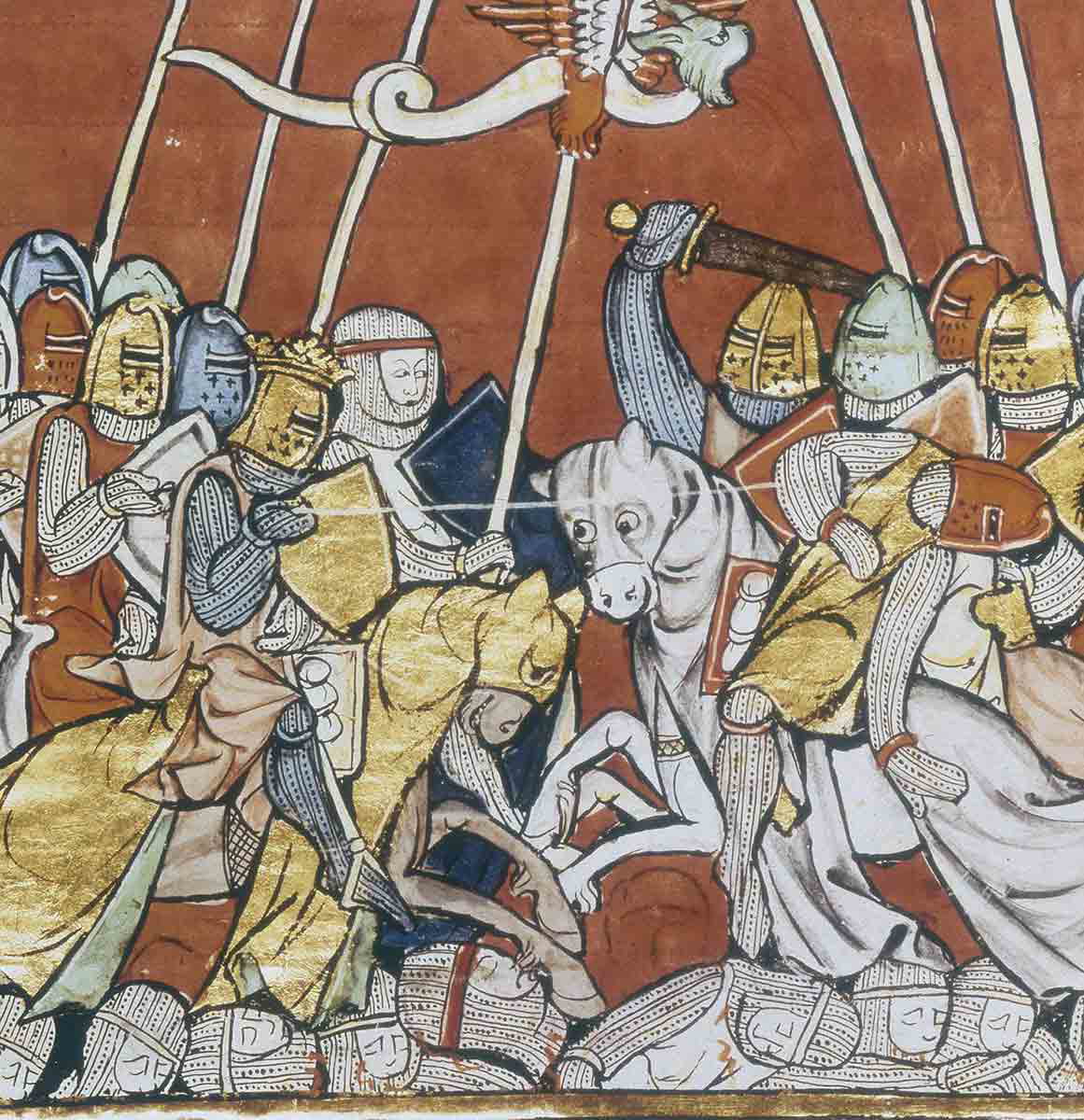
real king arthur battle illustration
Notice the dragon pennant. It went back to the Romano-British legions and was like a small Chinese dragon. It whistled when the wind blew through it. It became the symbol of the Pendragons.

I would happily do nothing all day but study Arthurian legend. One thing to keep in mind is that many of the names are not proper names but titles. "Riothamus," for instance, in the ancient British language means "high king." From The Collector:

Another warlord from Dark Age Britain, who is one of the prime historical candidates for the real King Arthur, is Riothamus. He is known from two Roman sources, one from the 5th century and one from the 6th century. The more important of these two is the account by the 6th-century historian Jordanes.

He described how Riothamus, the king of the Britons, assisted the Romans in a battle against Euric of the Visigoths in the year 470. This idea of a king of the Britons travelling from Britain to Gaul to fight a battle in association with the Romans is fascinating for its similarities to the Arthurian legends. In the account of Arthur’s life by Geoffrey of Monmouth, Arthur is said to have travelled to Gaul with a large army to fight against the Romans.

In addition to this overall similarity, Riothamus is said by Jordanes to have fled to the territory of the Burgundians. It is argued that, given the location of the battle in the territory of the Bituriges, his route while fleeing would have brought him near a town called Avallon. This is then connected to the tradition of Arthur being taken to the Isle of Avalon after being betrayed by his nephew, Mordred. (Read more.)

Share

Wednesday, May 6, 2026

Wonderland

In Victorian days, an infraction of etiquette could alienate people from each other. It did not need to be something unspeakable. Also, Prince Leopold was not Prince of Wales. But it is still an interesting account. From Marlene Wagman-Geller:

One of the strangest creatures that Alice encountered in Wonderland was the Caterpillar who inquired who she was. Her response: “I-I hardly know, sir, at present-at least I know who I was when I got up this morning, but I think I must have changed several times since then.” Alice’s nonfictional counterpart was literary muse Alice Liddell.

A classic had its genesis when Alice’s father, Henry George Liddell, the dean of Christ’s Church, Oxford, invited Charles Dodgson to his home. The lonely bachelor, who only lost his stutter around children, became an adored surrogate uncle to Henry’s three daughters, Lorina, Edith, and Alice. An avid photographer, Charles captured the image of the eight-year-old Alice in numerous portraits; his most well-known work showcased her as the scantily clad girl from Alfred, Lord Tennyson’s poem “The Beggar Maid” that contained the quotation, “This beggar maid shall be my queen!”

On July 4, 1862, Charles, along with the Reverend Robinson Duckworth, took the Liddell sisters for a rowboat ride along the Thames River. To entertain the youngsters, Charles made up a tale of the adventures and misadventures of a girl named Alice. Thrilled with her inclusion, Alice begged Charles to write it down as a proper book. For Christmas, he presented the ten-year-old girl with his handwritten manuscript, along with illustrations, entitled Alice’s Adventures Under Ground. All the members of the boating party made an appearance: Alice, the protagonist, Dodgson, the dodo, the Reverend Duckworth, the duck, Lorina, the lorry, Edith, the eaglet.

Three years later, under the pen name Lewis Carroll, Charles published Alice’s Adventures in Wonderland. Queen Victoria was so taken with the book she asked him to include her name in any future’s book’s dedication. A century later, The Beatles placed Charles’ image on the cover of their Sgt. Pepper album between Marlene Dietrich and T. E. Lawrence. Captain Robert Falcon Scott took the novel along on his Antarctic expedition.

The demise of wonderland arrived when Mrs. Liddell, an enraged Red Queen, gave her variation of, “Off with his head!” Something upset her to such an extent that she forbid Charles to have any contact with her family. She consigned all his letters to Alice to her fireplace. The end of their relationship was enough to wipe the grin off the Cheshire Cat. What the mama saw has never been made public—the Liddells remained mum. After Charles’ death, his family destroyed the pages of his diary concerning his banishment. The enigma surrounding Charles: was he a Nabokov who did more with Alice than talk about cabbages and kings? Was he merely an odd man who only felt comfortable in the world of childhood innocence? The truth lay in Charles’ own looking glass. (Read more.)

Share

Wednesday, April 29, 2026

Who Is Queen Mab?

From Barrie's Peter Pan in Kensington Gardens, illustrated by Arthur Rackham
From The Imaginative Conservative:
Santayana dedicated some pages to a piece titled “Queen Mab” presumably after the enigmatic faery who is mentioned by Mercutio in Romeo and Juliet.[1] The essay turns into an analysis of British literature, which I take to mean that Santayana saw some form of greater representation in Queen Mab that extended to the wider British psyche. Santayana’s claims regarding British romantic literature, if there is truth in them, add yet another level of genius to Shakespeare, who would have most likely been aware of the duplicity of romance while implementing it in his play. I want first to explain Santayana’s essay—his views regarding British literature—before revisiting the lines where Romeo and Mercutio exchange their thoughts on the meaning of dreams and Queen Mab’s role within them. 
Who is Queen Mab? That is the question this essay will aim to explore. 
Santayana begins his piece by connecting literature to nature. He writes that nature is “far more resourceful than logic,” which is why she has “found a way out the contradiction” that exists between “the human need for expression” and the “British distaste for personal outbursts.” If our inner and outer man oppose each other, then literature is a way to circumvent this contrast. But not all literature is equal. Santayana turns his attention to romantic fiction, which he called a “bypath of expression.” It is a form of literature that is the equivalent of a fleeting phase in our lives, when man plays at “self-revelation” despite being far from it. In Romantic literature man indulges in “day-dreams and romantic transformations” and “imaginary substitutes” for himself as a way to “nurse and develop” his opinions and preferences without stating them directly. Through this form of expression, Santayana writes, man will “dream of what Queen Mab makes other people dream.” 
The sentence needs unpacking. In Santayana’s essay, Queen Mab is England’s literary imagination, but a very specific part of it: the Romantic. And this romantic part of the English literary imagination is a momentary step in our journey towards understanding our hearts. It is, in other words, incomplete. Santayana wrote that a man’s heart, his “ruling motives,” will be revealed “only in long stretches of constant endeavor and faithful habit,” which often comes towards the end of his life. But Queen Mab is still part of the human heart that managed to revolutionize people’s aesthetic sensibilities. British Romanticism elevated man’s self-image. As Santayana wrote, “that which he might have been, and was not, comforts him. Such a form of self-expression, indirect, bashful, and profoundly humorous, being play rather than art, is alone congenial to the British temperament; it is the soul of English literature.” (Read more.)
Share

Tuesday, April 21, 2026

My Lagan Love

https://blogger.googleusercontent.com/img/b/R29vZ2xl/AVvXsEjyEQRMpFkqbMvqB7C7W-i9Ezcc0UxzHNCJo2RLGF3jebVNqCYy0-6WGLEcR4fn0QlwxPIH0_fvSIfBzZl1yHZy_A9XIbVQTKj5q8lEi0wKwMoecYplzUWtkMAGdcnOYFFzntS5_0GBPeE/s1600/My+Lagan+Love.jpg
Where Lagan stream sings lullaby
There blows a lily fair

The twilight gleam is in her eye

The night is on her hair

And like a love-sick
leánan sídhe
She has my heart in thrall

Nor life I own nor liberty

For love is lord of all.


Her father sails a running-barge

'Twixt
Leamh-beag and The Druim;
And on the lonely river-marge

She clears his hearth for him.

When she was only fairy-high

Her gentle mother died;

But dew-Love keeps her memory

Green on the Lagan side.


And often when the beetle's horn

Hath lulled the eve to sleep

I steal unto her shieling lorn

And thru the dooring peep.

There on the cricket's singing stone,

She spares the bogwood fire,

And hums in sad sweet undertone

The songs of heart's desire


Her welcome, like her love for me,

Is from her heart within:

Her warm kiss is felicity

That knows no taint of sin.

And, when I stir my foot to go,
'Tis leaving Love and light

To feel the wind of longing blow
From out the dark of night.


Where Lagan stream sings lullaby

There blows a lily fair

The twilight gleam is in her eye

The night is on her hair

And like a love-sick
leánan sídhe
She has my heart in thrall

Nor life I owe nor liberty

For love is lord of all.


(from an old Irish song)
A beautiful rendition, HERE, HERE and HERE.

To quote from Mary O'Hara's notes on this song, from her book A Song For Ireland:

The leánan sídhe (fairy mistress) mentioned in the song is a malicious figure who frequently crops up in Gaelic love stories. One could call her the femme fatale of Gaelic folklore. She sought the love of men; if they refused, she became their slave, but if they consented, they became her slaves and could only escape by finding another to take their place. She fed off them so her lovers gradually wasted away - a common enough theme in Gaelic medieval poetry, which often saw love as a kind of sickness. Most Gaelic poets in the past had their leanán sídhe to give them inspiration. This malignant fairy was for them a sort of Gaelic muse. On the other hand, the crickets mentioned in the song are a sign of good luck and their sound on the hearth a good omen. It was the custom of newly-married couples about to set up home to bring crickets from the hearths of their parents' house....

undefined
Waterhouse's "Hylas and the Nymphs"


Share

Monday, April 13, 2026

Rohmer at Camelot

 From Charlotte Allen at Quillette:

Rohmer was crazy about Chrétien de Troyes and especially about Perceval, which he made his adolescent students read during the decade he spent in his twenties teaching literature at a lycée before he could support himself in the film world. In 1964, he had made a 23-minute short film for French educational television titled Perceval ou le Conte du Graal (Perceval, or the Story of the Grail). For this project, he used illustrations from a 13th-century manuscript housed at the Bibliothèque Nationale de France in Paris. In an interview for L’Avant-Scène Cinéma, Rohmer described the text of Perceval as “one of the most beautiful in French literature.”

He was right. Chrétien de Troyes was not only a literary master in his own right but the inventor of “Arthurian” literature as a literary genre: stories about King Arthur and his court that have kept poets, novelists, playwrights, moviemakers, illustrators, and comic-book writers busy for more than 800 years. He didn’t invent King Arthur himself. Chroniclers in England and Wales had already taken note of Arthur—who might have been a real 5th- or 6th-century warlord, or might have simply been an invented folk-hero—as a majestic Celtic-British ruler who defended his country against the invading Angles and Saxons after the Romans deserted Britain. By the mid-12th century, thanks to the imaginative energy of chroniclers and bards, the canonical saga of Arthur’s life was well-established: the sword Excalibur, Merlin the magician, Queen Guinevere, the isle of Avalon.

But it was Chrétien who shifted the focus of the Arthurian stories away from King Arthur himself to his court and its individual knights. He likely invented Sir Lancelot as Guinevere’s secret lover in one of his narrative poems (five of them survive, and there may have been more), as well as Camelot as the site of one of Arthur’s castles. Perceval was another of his inventions, and he probably invented the Grail as well. His stories are so full-blown that generations of academic researchers and amateur scholars have searched for their possible sources in Welsh and Irish myths and legends, as well as in the oral lore of medieval Brittany, to which many Celtic Britons had fled after the Anglo-Saxon invasions. (Read more.)


Share

Thursday, April 9, 2026

The Ancient Greek Myth That Inspired Tolkien

 From The Greek Reporter:

In Tolkien’s writings, Númenor is described as an ancient kingdom located on a large island to the west of Middle Earth. It is inhabited by the greatest human civilization to have existed and is essentially an idyllic utopia ruled by wise kings. The island itself was a gift presented by the Valar – angelic godlike figures – to the ancestors of the Númenóreans as a reward for facing the Dark Lord Morgoth in battle.

However, over time, the Númenórean civilization is corrupted. The trouble started when the last king of Númenor, Ar-Pharazôn, defeated Sauron, the lieutenant of Morgoth, and brought him back as a prisoner to the island kingdom. Sauron, who was remarkably deceitful, managed to convince the Númenórean king that he could live eternally if only he worshiped Morgoth as a god.

Consequently, the Númenóreans ceased their worship of Eru Ilúvatar, the One God in Tolkien’s mythos, and disaster ensues. For their hubris and corruption, they were punished with the sinking of their island. Only a few of the virtuous Númenóreans escaped to Middle Earth, where they founded the kingdoms of Gondor and Arnor. (Read more.)

Share

Thursday, March 5, 2026

Banshees

"The Banshee Appears"

The Irish people have a colorful folklore, rich with stories of creatures from the Otherworld. In spite of the obviously pagan origins, many legends have endured to modern times. One legend is that of the banshee (bean-sidhe), a spirit which is supposed to haunt certain Irish families when a member is about to die. According to Ireland's Eye:
The bean-sidhe (woman of the fairy) may be an ancestral spirit appointed to forewarn members of certain ancient Irish families of their time of death. According to tradition, the banshee can only cry for five major Irish families: the O'Neills, the O'Briens, the O'Connors, the O'Gradys and the Kavanaughs. Intermarriage has since extended this select list.
Here is a more detailed description from Irish Culture and Customs:
The Bean Sidhe or Banshee makes her appearance when someone in the household is about to die. She haunts only the families of the "high Milesian race" - those whose names have an "O", "Mac" or other prefix. One exception to this rule has been granted by virtue of the Irish poets who have given her to some of the Norman-Irish families - the FitzGerald's for example. In any event, she heralds the demise of only those who are of authentic noble stock and it is with great dread when her piercing "caoine" or keening is heard. In many respects, this mysterious creature resembles traditional Irish keeners or mourners of old; as with her mortal counterparts, those who have seen her describe her as drawing a comb through her hair, similar to tearing the hair out in anguish, which the ancient mourners used to do. Incidentally, or maybe not, while the Banshee is considered benign, she supposedly has a sister force who isn't; this force is called the Lianhan Sidhe and her sole purpose is to seek the love of mortal men. Their desire for her ultimately destroys them.
The banshee, according to legend, is usually heard at night, but sometimes in the morning, and at noon. An old Irish poem refers to the appearance of the Banshee in the morning:

Hast thou heard the Banshee at morn,
Passing by the silent lake,

Or walking the fields by the orchard?

Alas! that I do not rather behold

White garlands in the hall of my fathers.
There were a few banshee stories among some of my older relatives. (I suppose being descended from the Kavanaughs and the O'Neills as well as the O'Connors made them especially worthy of hauntings!) Irish lore is full of tales of the preternatural; the banshee is definitely one of the most interesting.

My Irish novel is HERE.
Share

Sunday, March 1, 2026

The Merlin Mound

 From the BBC:

Demolition work will start in April at the site of a neolithic monument where – legend has it – the bones of King Arthur's magician Merlin are buried. In November, Wiltshire Council gave Marlborough College permission to knock down 20th-century buildings cut into the side of the 4,000-year-old man-made hill. A carpentry workshop, toilets, plant room, water meter and pump will all be demolished. The works will enable archaeologists to investigate a cross-section of the Marlborough Mound, which sits in the grounds of Marlborough College.

According to legend, Merlin's connection to the town gave Marlborough its motto – "'ubi nunc sapientis ossa Merlini" or "where now are the bones of the wise Merlin". Following the Norman conquest, William the Conqueror ordered a castle to be built on the site. The 62ft (19m) tall hill is the second tallest of its kind, with nearby Silbury Hill taking the top spot. The buildings will be "taken down slowly, with an archaeologist present", according to the Marlborough Mound Trust, which is working with the college on the project.

Although it is unlikely anything significant will be found under the buildings, traces of medieval waterways could be uncovered which could give a more "visually pleasing" setting for the monument, according to an archaeological assessment. The mound is not open to the public, although an annual open day is held each summer, for which tickets are issued. (Read more.)

Share

Monday, February 16, 2026

C.S. Lewis and the Greatest Arthurian Epic

 From The Library of Lewis and Tolkien:

Violent, lewd, celebrating deception and sexual immorality on the one hand; gracious, sensitive, revering mercy and humility and rejecting all that is crude, ugly, and obscene on the other — it would be natural to conclude that Ascham and Lewis were talking about two different books, two different portrayals of the Arthurian legend. Lewis must be demonstrating the way such stories could appear in a noble and Christian light, contrary to the book lambasted by Ascham.

The only problem is that Ascham and Lewis were not discussing two different books. They were both describing — or claiming to describe — the same book: Sir Thomas Malory’s 15th-century Arthurian epic, Le Morte d’Arthur.

Malory’s Le Morte d’Arthur is a massive, sprawling narrative that chronicles the rise, decline, and eventual downfall of Camelot — the adventures, and later the breaking, of the fellowship of the Round Table. All of what we regard today as the classic, quintessential features of the Arthurian story are there (and then some): Arthur’s sword Excalibur; the wizard Merlin; the Lady — really Ladies — of the Lake; the quest of the Holy Grail, the healing of the Maimed King and restoration of the Waste Land; Lancelot and Guinevere’s love affair; the rebellion of Arthur’s ill-begotten son, Mordred; Arthur’s final departure over the waves into the distant isle of Avalon. More than any other single work, Le Morte d’Arthur is the one that later storytellers have most drawn upon, whether Tennyson’s cycle of blank-verse poems Idylls of the King, T.H. White’s novel The Once and Future King, or John Boorman’s 1981 film Excalibur. (Read more.)

Share

Wednesday, February 4, 2026

Petrushka


Stravinky's 0riginal costume design for Petrushka


Original 1911 set design for Petrushka

When I was a child my grandmother gave us a record with stories from famous ballets, including musical excerpts from Petrushka. We were entranced by it; my sister and I tried dancing to Petrushka when we were very small; from what I have read since, we were not alone in being swept up into the drama. Composed by Igor Stravinsky (1882-1971) for Sergei Diaghilev's Ballets Russes, Petrushka debuted in 1911 at the Théâtre du Chatelet in Paris. The mysterious, magical tale of love and revenge unfolds at a Russian Shrovetide fair, centering around a puppet called "Petrushka," who in Pinocchio-style comes to life. To summarize:
Petrushka ("Petey") is the story of three puppets - the forlorn and homely Petrushka, a beautiful ballerina, and a mysterious and gaudily dressed Moor - brought to life by their showman master at a Russian Shrovetide fair. Petrushka tries to express his love for the ballerina, but she has eyes only for the Moor. The frustrated Petrushka is subdued by the scimitar-wielding Moor, but the puppet's ghost has the last laugh by thumbing his nose at everyone. All this takes place within the context of the fair, full of dances by nannies, coachmen, masqueraders, crowds and even a dancing bear.
In Russian culture, the puppet character of "Petrushka" was rather like "Punch," a rude, comic Everyman, the butt of every joke. Stravinsky endows him with human feelings; as Petrushka attempts to rise from his baseness, his strivings lead to his destruction, only to gain immortality in the end.
Stravinsky's music captures the carnival atmosphere of Maslenitsa, the Russian version of Mardi Gras, with all its color and passion. As one commentator describes:
Subject and music appear to reflect the Russian nature. Gogol and Mussorgsky are there. Everything is reflected in the score with a sure and reckless mastery —the movement and tumult of the crowd; the gait and aspect of each leading figure; and the grotesque agonies of the helpless one. A shriek of...trumpets in different keys is the motto of Petrouchka's protest. The composition is permeated with Russian folk-melodies and also street songs marvelously treated.
"Fair"
In his day, Stravinsky was considered avant-garde since his music was a bit different from what had gone before. His work was part of the explosion of creativity that brightened the last days of imperial Russia, called the "Silver Age." On one level, Petrushka is an echo of a time that is gone; on another, it conveys the spirit of the Russian people which Communism was not able to destroy. I enjoy listening to Petrushka more than ever, especially during Shrovetide. 

Listen HERE.

Share

Sunday, January 18, 2026

Sir Galahad: The Greatest of the Round Table

 Image 

From The Medieval Scholar:

Galahad’s role in the Arthurian legend, particularly his quest for the Holy Grail, is a later addition to the mythos. His character first emerges in the 13th century within the “Lancelot-Grail” (Vulgate) Cycle, a series of Arthurian romances that expanded the legend and positioned Galahad as central to the Grail quest. The name Galahad is thought to derive from the Welsh Gwalchaved, meaning “Falcon of Summer,” linking him to Celtic origins and mythological traditions.

The original portrayal of Galahad may have been influenced by the mystical ideals of the Cistercian Order and figures like St. Bernard of Clairvaux, whose vision of ascetic, spiritualized knighthood echoed through Galahad’s character. This is reflected in Galahad’s celibate and otherworldly nature, his white shield bearing a vermilion cross, and his embodiment of Catholic warrior asceticism, mirroring the ideals outlined in St. Bernard’s Liber ad milites templi de laude novae militiae for the Knights Templar. (Read more.)


Share

Saturday, January 17, 2026

How 'Wicked' Is Deeply Tied Into Feminism’s Occult Origin Story

 And it's not even part of the original Baum stories, which are weird enough. From The Federalist:

Gage worked alongside Elizabeth Cady Stanton and Susan B. Anthony in the early days, when they founded the National Women Suffrage Association (NWSA), and she coauthored with them the six-volume work The History of Women’s Suffrage (1881–1922). In 1893, Gage wrote her own book, Woman, Church, and State: The Original Exposé of Male Collaboration Against the Female Sex. She worked ardently to publicly discredit Christianity, engaging in public confrontation for her radical view, such as her 1886 publicity stunt at the unveiling of the Statue of Liberty. “She showed up,” as the Smithsonian reports, “on a cattle barge with a megaphone, shouting that it was ‘a gigantic lie, a travesty and a mockery’ to portray liberty as a woman when actual American women had so few rights.”

Gage eventually broke ranks with Stanton and Anthony, who joined forces with the Women’s Christian Temperance Movement, a move that Gage found disagreeable because of the group’s openly Christian principles. Stanton and Anthony were, however, more pragmatic, believing that aligning themselves with the much larger temperance movement was good for their effort.

Despite the break, Gage’s influence did not end there. Like most of her first-wave comrades, Gage was involved in various occult activities, including theosophy, seances, manifesting, and a firm belief in both good and bad witchcraft. She spent years researching witchcraft, even moving to Salem, Massachusetts, to investigate the Salem Witch Trials. “Those condemned as sorcerers and witches, as ‘heretics,’ were in reality the most advanced thinkers of the christian [sic] ages,” Gage wrote. (Read more.)

Share

Friday, January 16, 2026

When the Gods War for the Soul


Review of the series Rise of the Merlin. From Bree A. Dail:

I appreciate ambitious book-to-screen adaptations—The Lord of the Rings, The Wheel of Time, The Witcher, Game of Thrones—even while criticizing their excesses and missteps. When they work, they remind us that epic storytelling can still be done with seriousness, scale, and intention.

Setting aside the issue of gratuitous sex—which always unnecessarily lowers the artistic value of these epics—most original series today (along with many book-to-film or television adaptations) operate at an astonishingly low bar. They suffer from a lack of creative writing talent, a disregard for beauty and mystery, and an indifference to language itself.

From The Rings of Power, to Bridgerton, to the seemingly endless Star Wars spinoffs, and the glut of witch and vampire series, the pattern is the same: dreadful dialogue, thin character development, hollow spectacle, and stories that mistake volume for meaning. Enormous budgets cannot compensate for the absence of imagination, reverence, or craft.

Which is why it is worth noting—explicitly—the astonishing impact Spencer Klavan had in developing, and then teaching, the Atlantean language for this series. That kind of philological seriousness is vanishingly rare in modern television. J. R. R. Tolkien would have been impressed. It is also worth noting Jeremy Boreing not only produced, but directed and wrote these episodes. This has been a major undertaking, which must be lauded. (Read more.)

Share

Lost Lands of Arda

 From The Saxon Cross:

My first entry in this series detailed how Tolkien’s Middle-Earth, when correctly scaled, perfectly matches the landscape of Ice-Age Europe. Tolkien’s placement of mythic locations such as Mirkwood also matches their attested locations in ancient Europe.

My theory is that J.R.R. Tolkien meant for his Middle-Earth legendarium to be a literal mythology of ancient Europe. While the professor made vague allusions to his mythology being a telling of our ancient past, I believe he took this more seriously than he ever publicly admitted. I do not believe he meant it only as a frame story.

[...]

Keep in mind that when I talk about my map projection of Middle-Earth onto Europe, I am consistently referring to the map projection from the first article, not picking and choosing different scales to make things work.

Today, I want to expand by going into deeper detail on more locations within Tolkien’s mythology and their real-world counterparts.

I also want to examine some of the issues with the map from my first post. I will examine the issue of the Black Sea, and also explain why I believe the south of Middle-Earth looks so unlike the real Mediterranean. (Read more.)

Share

Saturday, January 10, 2026

A Road Trip to Avalon


Some young knights on a quest. From The Saxon Cross:

Glastonbury is a weird town. For two thousand years it has been the spiritual center of England. For a long time this was because Glastonbury Abbey was the largest and most powerful monastery on the island. But while the monastery has long lain in ruin, the town is still very much a spiritual center. The town is chockfull of New Age shops, druids, neo-pagans, witches and occultists. Something very real draws this sort of person to the town, and I think some of them are genuine seekers. Of course, they’re looking in all the wrong places, but the power they feel is real. Glastonbury is a Christian holy place and that power still pervades the ground.

First we walked the ruins of the great abbey. This island is littered with the ruin of the work of the Protestant Reformation and King Henry VIII. During King Henry’s dissolution of the monasteries the abbey fell into disrepair, and its last abbot was draw, quartered, and hanged on Glastonbury Tor in 1539. Glastonbury then ceased to be the center of Christianity in the isle, and the blood soaked into the ground has been crying out ever since. The ruins of the monastery are hauntingly beautiful. It is also the purported site of Arthur and Guinevere’s graves, although this is one legend that I think may have been fabricated in the Middle Ages. On the abbey grounds still live the last of the Holy Thorns, the sacred trees that bloom on Christmas Day, that are said to have been brought to the isle of Avalon by St. Joseph of Arimathea.

 On our way up to the Tor we stopped to drink from the Chalice Well, also known as the Red Spring. There are two versions of the legend of this holy well. One claims that St. Joseph buried the Holy Grail inside the Tor, and from it sprang the well. The other claims that he buried two vials, one filled with Christ’s blood and the other with His tears, and from these sprang the Red and White Springs respectively, the White Spring being another holy well just across the street from the Chalice Well garden. Whatever the truth is, the water is full of iron and indeed tastes like blood. Inside the chalice well garden at the foot of the Tor we were met by another one of our companions, Jake, which seemed like a fitting and symbolic place to meet on a spiritual quest. Together we prayed and drank from the well, and then ascended the Tor together. As we began our ascent a rainbow broke out across the sky, crowning St. Michael’s Tower. (Read more.)

Share

Saturday, January 3, 2026

Return to Narnia

 From The Catholic Herald:

The story came about because Lewis felt, he said, he had to write a children’s story or burst, and there are some things that can only be said in a children’s book. And what he wrote about in The Lion, the Witch and the Wardrobe (no other title could have worked so well) was nothing less than the doctrine of the Atonement. That medieval formula, that the death of Christ was necessary “to give the devil his due” as a result of the sin of Adam, has never been so perfectly expressed. But the theology is worn lightly; it is possible for a godless child to read the book without taking it on board. Not in my case; I was scandalised as a child reading the story because I could see instantly (I was educated by nuns) what the Stone Table meant as an altar of sacrifice.

Aslan the lion (emblematic of Christ) summed up the Atonement when he told the girls of the story: “Though the Witch knew the Deep Magic, there is a magic deeper still which she did not know. Her knowledge goes back only to the dawn of time. But if she could have looked a little further back... she would have known that when a willing victim who had committed no treachery was killed in a traitor’s stead, the Table would crack and Death itself would start working backwards...”

C. S. Lewis argued that one never really grows out of children’s books, not good ones. He observed that he liked lemon squash as a child and, as an adult, he liked port, but he still also liked lemon squash. Our growth does not mean discarding our previous self; it means adding to it. Reading the book later on, you note other things: when Aslan jumps into the Witch’s castle to breathe on the creatures she had turned to stone to bring them, flickering, back to life, we have nothing less than the Harrowing of Hell, when Christ descended to the underworld to release all those held by the sin of Adam, except in this case they include a dim but nice giant, a conceited lion and centaurs. (Read more.)


On living as a Narnian in exile. From Hilary White:

I keep seeing people unsure of what to do, caught between awareness of the world’s increasing disorder and the sense that everything happening is far beyond our reach, controlled by forces far above our heads. The weight of it can be paralysing. So, I’d like to suggest something we can do: live in the Real, no matter what spell the world is trying to cast.

I was talking with a friend about that pivotal moment in The Silver Chair. The Green Witch doesn’t simply lie, she does something worse, that lives at the heart of the Modernian proposal: she tries to reshape reality, to lull her victims into accepting a smaller, duller, and false version of the world - but one that seems safe, easy and comforting. She offers them comfort in exchange for surrender.

Puddleglum’s defiance is a heroic refusal to accept the world on false terms, however tempting. (Read more.)


Share