Showing posts with label Egypt. Show all posts

Thursday, August 27, 2026

Elizabeth I and Cleopatra

 Elizabeth I is here portrayed among the goddesses
I think Cleopatra had more similarities with Mary Stuart than Elizabeth Tudor, but the article makes some interesting points. From the University College of London:
Perhaps second only to Tutankhamun in the who’s-who of Ancient Egypt Cleopatra VII is colloquially known as the Last Queen of Egypt. This is a very debatable epithet, whilst she is the last pharaoh of Egypt, she is also the last of Ptolemaic dynasty, a Greek family who ruled Egypt following Alexander’s conquest in 332 BC. Her death, 12th August 30 BC, is chronicled by Plutarch, mentioned by Virgil and exonerated by Horace[1],  she is so renowned her death is sometimes used to denote the end of the Hellenistic era.

Queen Elizabeth, who died 3 years prior to this play’s performance, is quite a similar character. With a slightly dubious claim to the throne, her death in 1603 heralded the end of the Tudor rule.  Following the establishment of the Church of England in the 1530’s and the sweeping massacres of Catholics and Protestants alike England had a Catholic Scottish King, James I. For years England had been at war with both Scots and Catholics, and now had that exact ilk on their throne.

Cleopatra faced similar regency problems;  she may have been an originally Greek Queen, but she was barring the advancing Roman Empire from Romanising her country and herself. Here the Queens differ, Elizabeth went on the offence, striking out at Catholic enemies, such as Spain with her famous victory in 1588. Cleopatra had nowhere near the allies nor resources to defeat her foe (indeed she lost her major naval incursion at Actium), so she had to make them [allies].

Allying herself to Caesar and then Mark Anthony she coerced armies and treaties out of them to protect her beloved Egypt. Plutarch, writing in the 1st century AD, describes Mark and Cleopatra’s first encounter as:
“Venus was come to revel with Bacchus for the good of Asia” (Lives III.XXVI.3)
Cleopatra is represented as the Roman goddess of love and founder of Rome, great praise for an Egyptian Queen who defied them. (Read more.)
Share

Saturday, June 27, 2026

How the Phoenician Spoken and Written Language Shaped the Mediterranean

 From The Collector:

The Phoenicians were prolific merchants and explorers who traveled from their home in the Levant across the ancient Near East and Mediterranean, planting colonies and trading outposts around the ancient world. Wherever the Phoenicians went, they took their language with them, and they were pioneers in this area too. They developed the first true alphabetic script. The useful tool was adopted by other cultures, including the ancient Greeks, who in turn influenced the ancient Latin alphabet, which is the basis of most modern Indo-European languages, including English.

The Phoenicians were Semitic-speaking people who primarily inhabited several coastal cities in the Levant, including Byblos, Tyre, Arvad, Berytus (Beirut), and Sidon. There was no Phoenician empire or unified state. Each city was an independent city-state. The Phoenicians never referred to themselves as “Phoenicians” in their own written texts but as members of their respective city-states.

The earliest recorded references to the Phoenicians date from the Late Bronze Age Egypt (c. 1500-1200 BC). The “Annals of Thutmose III” (c. 1479-1425 BC) mention Byblos extensively as a vassal of New Kingdom Egypt. The Egyptians called them “Asiatics.” Byblos was also mentioned in the “Amarna Letters” (1360-1332 BC) as an important city that was a source of contention between the Egyptians and Hittites. (Read more.)


Share

Thursday, June 25, 2026

The Red Cap of Hermetics

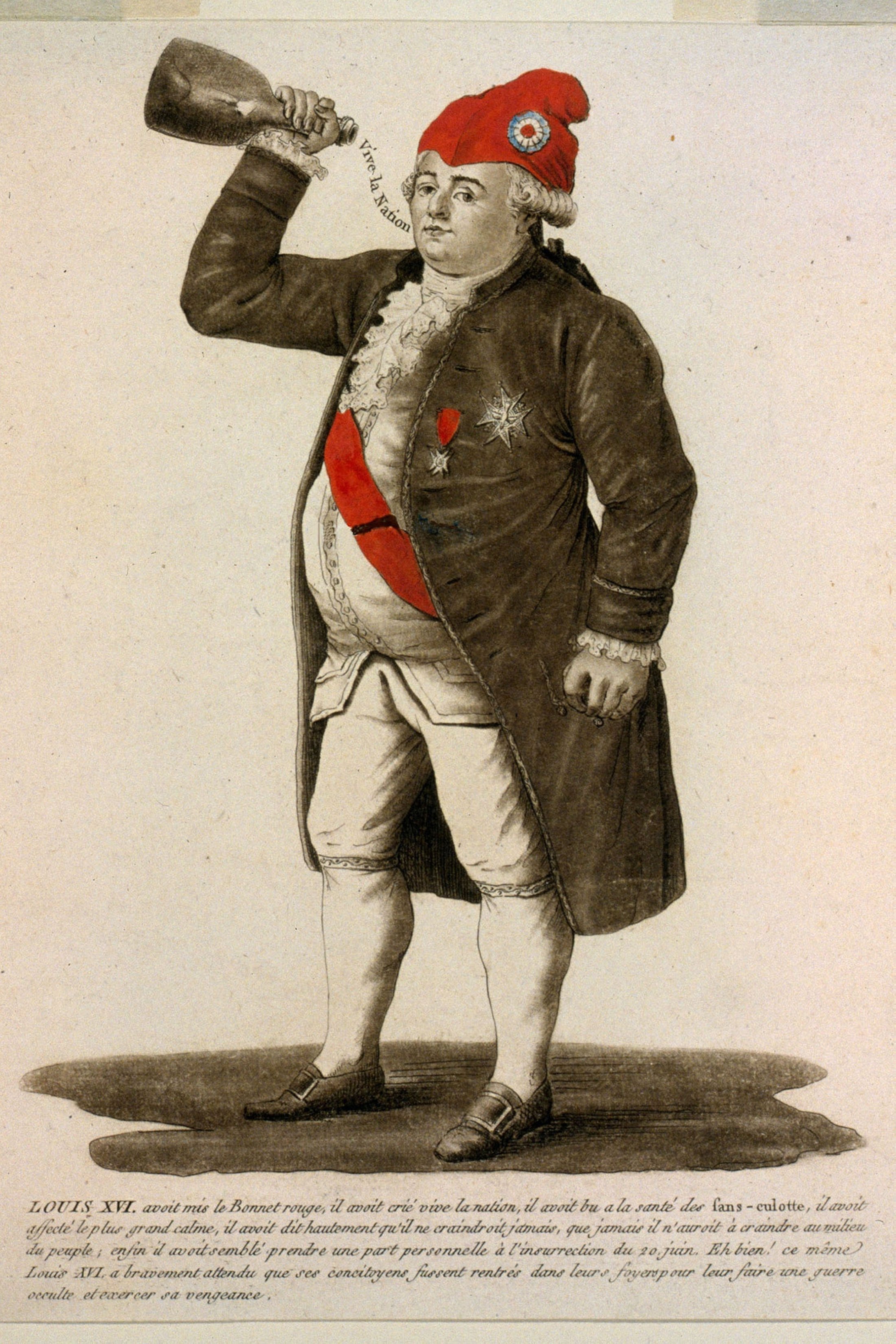
Louis XVI was mocked with the "Red Cap of Liberty" which was recently displayed at the Paris Olympics. From Daily Sabah:

In the aftermath of the French Revolution, Louis XVI, the last king of France, was depicted in many paintings with a "Bonnet Rouge" (Red Cap) on his head. However, what is the story of this red cap with its long apex bent over to the front, and why was it placed the head of the French constitutional monarch before he was executed?

[...]

In ancient Rome, freed slaves were dressed in a white cap called a pileus. Brutus, who betrayed Caesar, chose this cap, which symbolizes freedom, as an expression of Rome's return to the republic, and engraved it on the coin he minted. But this fez, which looks like the white cap worn by Albanians today, actually had nothing to do with the red Phrygian cap.

With the American Revolution, the pileus became an omen of revolutionaries, anarchists, and republicans. It resurfaced with the protests against the Stamp Act of 1765 when Britain imposed a direct stamped paper tax on the British colonies in America.

In particular, a figure of British parliamentarian John Wilkes – nicknamed the "Devil," and known for his support of the American rebels – with this cap became very popular among the rebels known as the "Sons of Liberty."

French anarchists, who inherited this symbol from the American Revolution, preferred the Phrygian cap instead of the pileus. Thus, this red hermetic cap became the symbol of the French revolutionaries and freedom from 1789 onwards. For example, in a sculpture made by French artist Joseph Chinard in 1794, representing the revolution and the republic, a Phrygian cap was placed on the head of a woman in Roman attire. (Read more.)

Share

Monday, May 18, 2026

The Discovery at Oxyrhynchus

 From The Sunday Times:

The Egyptian archaeological site of Oxyrhynchus, 120 miles south of Cairo, might not have the glamour and renown of the hallowed Valley of the Kings. But a team from the University of Barcelona working at the site has made one of the most significant discoveries in decades.

A mummy from the late Roman period, about 1,600 years old, was discovered buried with a verse of Homer’s The Iliad, the original of which dates back 2,800 years. The text was found in clay with an embalmer’s seal on the outside of the mummy’s wrapping. It is the first time a Greek literary text has been found directly incorporated into the Egyptian mummification process. The discovery, at the ancient city of El-Bahnasa, started as a relatively unexceptional find, said Ignasi-Xavier Adiego, a professor at the University of Barcelona who directs the Oxyrhynchus project. (Read more.)


From The Conversation:

Archaeologists have found something unexpected inside a 1,600-year-old Roman-era Egyptian mummy: a fragment of Homer’s Iliad. It wasn’t placed beside the body, but inside the mummy’s abdomen. But the real surprise isn’t just where the fragment was found. It’s how it got there. To understand, we must go back – to the Iliad itself, and to what it became in the Roman world.

In The Iliad, a poem shaped in the 8th century BC and attributed to Homer, the Trojan war does not end in triumph or renewal. It ends in devastation. The poem closes at the edge of collapse, with Troy reduced to a landscape of heroic ruin. And yet, this is not where the story ends.

According to later Roman tradition, one Trojan escaped. Aeneas – son of Anchises and the goddess Aphrodite – fled the burning city carrying his father on his shoulders and the household gods in his hands. He moved west, across the Mediterranean, towards Italy, where he became the ancestor of Rome.

This continuation did not come from the Iliad itself. It was shaped centuries later, most famously in Virgil’s Aeneid. But it changed the meaning of the Trojan war entirely. The past, in other words, was actively reorganised – through stories that could be reworked, extended and connected across time and space. (Read more.)

Share

Sunday, May 3, 2026

Raymond Ibrahim's Trilogy

undefined
Baucent of the Templars


 "Not to us, O Lord, not to us; but to thy name give glory." Psalm 113 (Vulgate), motto of the Templars

Once in a discussion with a fellow historical novelist I was informed that the crusades are the earliest examples of genocide. I was surprised that the novelist, being Jewish, seemed unaware of the various ancient persecutions against her own people, including that of the Greeks in the days of the Maccabees, that might be considered genocidal. I reminded her of that, as well as of the fact that there were twelve major crusades, taking place over nearly three hundred years. They were led by different people, with the principle goal of liberating the Holy Land from Muslim rule and thus delivering the Christian population from slavery and oppression. Some were more successful than others. Some, like the Fourth Crusade, were total disasters. In fact, the Fourth Crusade is the one which most people think of when they view the crusades as orgies of mass murder. In that case, those being killed were other Christians. Did other massacres of the innocent occur during the course of the various crusades? Yes. So, did the crusaders journey hundreds of miles to the Middle East, braving fatal diseases, pirates, brigands and an ocean of foes, just for the joy of killing people? That is one of the questions answered by Raymond Ibrahim in his brilliant trilogy about the centuries-long conflict between Christianity and Islam. Ibrahim's books are The Sword and the Scimitar, Defenders of the West, and The Two Swords of Christ. The books present a background to the crusades, containing detailed information of which most contemporary people are unaware, as well as the histories of heroes like El Cid and the rise of the two greatest military orders, the Templars and the Hospitallers.

In the early Church the practice of Christians was, even in the era of persecution, to visit the places where Jesus Christ had been born, lived, died and risen. Pilgrimages were regarded as highly penitential, in which the pilgrim would not only risk life and health, but leave behind property, home, family, occupation and offices. The Romans built pagan shrines over the venerable spots like the stable at Bethlehem and the Holy Sepulcher but those temples only served to remind everyone where the sacred sites were hidden. When Emperor Constantine legalized Christianity in the Fourth Century, his mother Empress St. Helena went on pilgrimage to the Holy Land, where she discovered not only the True Cross, but found and reopened many of the other places sacred to the memory of the Savior. This ignited centuries of pilgrimage to the Middle East. Rich and poor would go, often in parish-sponsored groups as now. Special costumes were worn when on pilgrimage, and one was often regarded as being temporarily in religious life when journeying to a holy site. For Jerusalem was not the only destination; there were shrines throughout Europe, including Rome and Compostela. But the pilgrimage to the Holy Land remained the ultimate of penitential practices, with many indulgences attached. People would go for themselves and for loved ones who were sick or who had died.

All this changed with the rise of Islam in the 7th century, meticulously described by Ibrahim in his book Sword and Scimitar. Founded by Mohammed, an Arabian who claimed to be a prophet of the One True God, Islam combined elements of Nestorian Christianity and Judaism with the prophet's own inspirations, many of which included teachings abhorrent to Judeo-Christian morality. One such teaching permits Muslim men to take a non-Muslim "infidel" woman by force. Mohammed commanded his followers to spread Islam by warfare. Within 200 years, the Christian lands in North Africa, Spain, Arabia, and the Middle East were conquered. Great Christian cities like Antioch and Alexandria, which had been Apostolic sees, fell to Islam, with the churches and basilicas becoming mosques. Christians, especially children, young men and young women, were made into sex slaves and concubines, including monks and nuns. Many boys were castrated to be eunuchs in the harems of the various Muslim elites. Hatred in the form of desecration was lavished upon Christian shrines, churches, monasteries, and cathedrals, with special contempt reserved for icons, church bells and crosses. The latter were dragged upside down through the streets, to be spat and urinated upon by the disciples of the prophet. Altars were sometimes desecrated by the gang-rape a Christian virgin. Those Christians and Jews who were not killed or sold were subject to oppressive laws and taxes in their own lands. This is documented in Muslim sources which repeatedly rejoice when describing the oppression of "infidels" and especially the defilement of Christian women.

A war-like, nomadic people called the Turks embraced Islam; they eventually overran the old Roman province of Anatolia so it became "Turkey." In the late 11th century, Jerusalem, which had fallen into Muslim hands before, was captured by the Seljuk Turks, who tortured, raped, and sold into slavery the Christians of the region. Those who were killed were regarded as lucky. The violence disrupted the flow of pilgrimages from Europe to the Holy Land. The Muslims made a point of harassing and robbing pilgrims, sometimes capturing them to be sold into slavery. Blond and red-haired girls and boys with blue, gray or green eyes were especially favored for the slave markets. Although one beautiful abbess from Germany, traveling with a group of pilgrims to Jerusalem, was waylaid by Muslim bandits and raped to death in front of her fellow Christians, who were also mistreated in various horrific ways. This led Pope Urban II at the Council of Clermont in 1095 to call for a crusade of Christian soldiers to deliver the Christians in the Holy Land. Thus began the era of the crusades. Defenders of the West describes some of the great heroes of Christendom who kept Islam out of Europe, including at least one from Albania whom I had never heard of before. My opinion of Richard I "Lionheart" had suffered in the past but in Defenders he is revealed as among the bravest of the brave. The Two Swords of Christ traces the history of the two great military orders in a deeply inspiring way. For when the weak and innocent are attacked, it is unquestionably the duty of Christians who are able to defend them.

From The Chivalry Guild:

If I had to pick the best way to describe the recent works of Raymond Ibrahim—Sword and Scimitar (2018) and Defenders of the West (2022)—I’d call them no-going-back books. The equally chilling and invigorating experience of his histories cannot be undone and you cannot see the world the same way afterwards—especially since it’s not just history, but a forgotten prelude to what we’re living with today. Reality looks different post-Ibrahim.

Sword and Scimitar takes the reader through fourteen centuries of warfare between Islam and the West, with emphasis on eight great battles within that conflict. Better than any book I know, it dynamites the old public school narrative about the Crusades as a brutal act of Christian aggression against those poor, peaceful, tolerant Muslims. Ibrahim tells a much darker story about our ancient adversaries, documenting the scale of their conquests and the horrors that followed pretty much everywhere the armies of the prophet went. What we call “the West,” he writes, is but “the last and most redoubtable bastion of Christendom not to be conquered by Islam. Simply put, the West is actually the westernmost remnant of what was a much more extensive civilizational block that Islam permanently severed.” Three-quarters of the formerly Christian world was conquered by these people. It is both chilling and invigorating, like I noted, to think about how much danger we were in—and what kind of virtue was required to meet that danger and triumph over it, at least for a time.

Defenders of the West is an even more important book. It’s personal and compelling, and it reverses a long trend of hiding Christian heroes from those of us who need to learn about them. Thanks to Enlightenment propagandists, a vague narrative persists that heroism basically died out after the assassination of Julius Caesar and wasn’t revived again until Napoleon and George Washington walked the earth. The intent is a broadside against the Faith, leaving you with the vague impression that the teachings of Christ and his Church effectively snuff out all martial virtue, as though heroics cannot co-exist with the Gospel. Ibrahim shows this to be absolute nonsense. With his chronicles of Godfrey of Bouillon, El Cid, Richard the Lionheart, Fernando III, Louis IX, John Hunyadi, Scanderbeg, and Vlad Dracula, he brings to life eight legends whose deeds rival or exceed those of any heroes of any age.

These works are, in my humble opinion, on the shortlist for books of the century. So it was with special interest that I anticipated his follow-up effort. The Two Swords of Christ (published November ’25) continues with his major theme but looks at a different aspect of the conflict: the crucial work done by the Templars and the Hospitallers, basically the special forces of Christendom.

Ibrahim’s title comes from Luke 22, in which Jesus tells his disciples to buy a sword. When they reply, “Look, there are two swords here,” Jesus says, “It is enough!” What’s fascinating is his use of the singular pronoun it rather than the plural they. It suggests not the swords, but a way of life that employs “a spiritual sword against spiritual enemies, and a physical sword against physical enemies.” If your religious education was anything like mine, your teachers blithely passed over this and similar passages in favor of all the nicer-sounding directives about loving everybody and just being nice, along with never fighting—because fighting is unchristian. For those looking for simplistic formulas for life, it’s far easier to reduce the character of the Lord to that of a harmless meditation instructor, rather than wrestling with the much more challenging and dynamic truth.

The two swords also work as a metonymy for the knightly orders, filled with men whose particular way of serving God and their neighbors was with weapons. (Read more.)

  All three books are so detailed in citing source material that one comes away with a refreshed world-view, for a deeper understanding of history leads to a more profound comprehension of the present. Plus Raymond Ibrahim is an engaging and descriptive writer so that I often felt I was watching a film of the events he has so richly described. I recommend this excellent trilogy for every home library and every college history class.

Share

Wednesday, January 28, 2026

The Lost Tomb of Thutmose II

 From Earth:

Archaeologists from Egypt and Britain are credited with identifying the tomb of King Thutmose II, the last Eighteenth Dynasty ruler whose burial place had never been located. Crews traced an entrance marked Tomb C4 into a valley 1.5 miles (2.4 kilometers) west of the Valley of the Kings. Survey maps from the University of Cambridge helped guide the mission across Luxor’s west bank. Fieldwork was led by Piers Litherland, an honorary research associate whose excavations track early royal burials outside the main valleys. Careful digging mattered because the first cleared corridor ended in collapse, giving no quick name for the owner. Location near tombs of royal women made the burial look like another consort’s chamber, not a king’s. Archaeologists treat the landscape as evidence, since builders often grouped wives, children, and officials in separate parts of the cliffs.Nearby openings include burials linked to wives of Thutmose III and an intended resting place for Queen Hatshepsut. That context shaped early expectations and delayed a royal claim until later fragments provided a clearer signature. (Read more.)

Share

Friday, January 23, 2026

Is Alexander the Great’s Tomb Hidden in Venice?

They think Alexander is buried in San Marco instead of St. Mark. It is an interesting theory but I doubt it because of the care the Early Christians took with the bodies of saints like St. Mark. From The Greek Reporter:

The true location of Alexander the Great’s tomb is considered to be one of the great mysteries of the ancient world. After going missing in antiquity, researchers are still trying hard to find it. One modern theory asserts that Alexander the Great’s real tomb is actually in Venice, at St Mark’s Basilica. Why is the tomb of Alexander the Great a mystery in the first place? After he died in 323 BCE, Ptolemy stole his body and took it to Memphis, Egypt. That was the site of Alexander’s first burial. However, Ptolemy’s son then moved Alexander’s body to a different location in Egypt. He had the body buried in Alexandria, which was a fitting location as that city was named after the king himself.

There are several records of important historical figures visiting Alexander the Great’s tomb over the centuries. For a long time, its location was certainly no mystery. However, the last reliable mention of his tomb being visible and recognised in Alexandria comes from the Sophist teacher Libanius, writing in 390. After this, in about the year 400, John Chrysostom visited Alexandria with the intention of visiting Alexander’s tomb. However, by that time, the tomb was lost. (Read more.)

Share

Wednesday, December 31, 2025

The Lighthouse of Alexandria

From The Greek Reporter:

The Lighthouse of Alexandria, the last standing of the Seven Wonders of the Ancient World, was an engineering marvel that served to guide ships to the port city.

It was completed in the 3rd century BC during the reign of Ptolemy II Philadelphus, the son of Ptolemy I, the Macedonian Greek general of Alexander the Great, on the island of Pharos off the coast of the city of Alexandria in Egypt.

The Lighthouse of Alexandria was a beacon, safely guiding seamen sailing the Mediterranean to Egypt for fifteen centuries.

It was one of the greatest architectural feats of antiquity, serving as a symbol of power of the Ptolemaic Dynasty, the successors of Alexander the Great, who was the founder of the city of Alexandria.

An important landmark of the Hellenistic period, the Lighthouse of Alexandria had travelers from all over the world who were encouraged to visit the port city to admire the tower. (Read more.)

Share

Thursday, October 23, 2025

New Research Rewrites the Origins of Egypt’s Greatest Temple

 From SciTechDaily:

An international team of researchers led by Uppsala University has completed the most extensive geoarchaeological investigation of Egypt’s Karnak Temple complex to date. Situated within modern Luxor, Karnak is among the largest religious sites of the ancient world and forms part of a UNESCO World Heritage area.

Published in Antiquity, the study provides new evidence about the temple’s origins, its possible connections to ancient Egyptian creation myths, and how its surrounding river landscape shaped the site’s establishment, occupation, and growth over three millennia.

“Our research presents the clearest understanding of the landscape upon which the ancient Egyptians founded their temple at Karnak approximately 4000 years ago,” says Dr. Angus Graham, Uppsala University, who led the team. (Read more.)

Share

Tuesday, September 23, 2025

Cleopatra's Elusive Tomb

 From Archaeology News:

Archaeologists have unearthed the remains of a massive submerged port off Egypt’s northern coast, a discovery that could shed light on one of history’s most enduring mysteries—Queen Cleopatra’s final resting place. The find is located near Taposiris Magna, an ancient temple complex about 30 miles west of Alexandria, long thought by some scholars to be linked to Egypt’s last pharaoh.

The ancient harbor, approximately 40 feet below the Mediterranean Sea, consists of stone buildings that rise more than six meters high, with shiny floors, columns, cement blocks, anchors, and scattered Ptolemaic amphorae. The port, previously connected to Taposiris Magna, suggests that the complex was far more than a religious site. It also served as a thriving trade center, linking overland routes and Lake Mareotis to Alexandria.

This breakthrough comes from two decades of work by Dominican archaeologist Kathleen Martínez, who has dedicated her career to tracing Cleopatra’s elusive tomb. While most Egyptologists maintain that the queen was buried in Alexandria, Martínez argues that evidence points to Taposiris Magna. The temple was dedicated to Osiris, a god associated with death and resurrection, and its name—“Great Tomb of Osiris”—may hold symbolic significance.

Martínez’s theory was strengthened in 2022, when her team discovered a 4,300-foot tunnel beneath the temple ruins. Carved deep into the rock, partially submerged, and heading seaward, it contained jars and ceramics dating to the time of Cleopatra. The newly discovered offshore harbor appears to be aligned directly with this tunnel, indicating an integrated network that could have been utilized in the queen’s burial. (Read more.)


Share

Tuesday, September 9, 2025

Where Is the Tomb of Alexander the Great?

 From The Collector:

When Ptolemy stole Alexander’s body, Alexandria was still being constructed, and Ptolemy was ruling from Memphis, where Alexander was placed inside a temporary tomb. In the 19th century, archaeologists located a temple of the Pharaoh Nectanebo II near the Serapeum of Saqqara. He was the last native pharaoh of Egypt, who vanished after the Persian invasion in 340 BCE. Archaeologists have proposed that this temple of Nectanebo was repurposed as Alexander’s temporary tomb.

Located near Ptolemy’s seat of power, the temple would only have been a few decades old when Ptolemy was searching for a burial place, and it was probably the most recent major non-Persian monument in Egypt. There was also an unused royal sarcophagus prepared for Nectanebo II, perfect for a king. The discovery of statues dating from Ptolemy I’s reign in the vicinity of the temple confirms that some royal attention was paid to this site at this time.

Interestingly, an apocryphal ancient story claimed that Nectanebo fled to Macedon and was Alexander’s true father. Alexander was already born before Nectanebo fled Egypt, but the story might have emerged because of Alexander’s burial in the former’s tomb. (Read more.)

Share

Monday, May 5, 2025

Taking the Waters: How Natural Springs Can Have Healing Benefits

 From Discover:

For the stressed and overworked, there might be nothing more relaxing than a spa. Beyond the cucumber slices and hot towels, these leisurely destinations carry a fascinating legacy that extends back to ancient times. Bathing in mineral springs — a feature of many historic spas — has been considered a medical and therapeutic treatment throughout the ages, spawning the proverbial phrase “taking the waters”. Today, this practice is known as balneotherapy. 

Some cities have made the most of mineral springs, building reputations as illustrious centers for spas. Though spas are often viewed as recreational spots and nothing more, their various incarnations around the world have developed significant cultural roles, thriving as staples of history and health tourism.

In antiquity, the link between bathing and health usually carried a religious undercurrent. Egyptians submerged themselves in the Nile River, Israelites in the Jordan River, and Hindus in the Ganges River; all of these waters have a sacred history as places of spiritual healing.

Baths continued to have religious and therapeutic meaning in ancient Greece, where the concept of health was first tied to the deity Apollo because he represented the Sun, which was believed to have healing power. Apollo’s divine progeny inherited this bond with health. His son, Asclepius, became known as a god of medicine, and among Asclepius’ offspring was Hygeia, a goddess of health who gave rise to the word “hygiene”. 

Archaeologists found the fragments of six sculptures representing Asclepius and his family at the Great Baths of Dion, part of a complex that was home to thermal baths in the 2nd and 3rd centuries C.E. before an earthquake destroyed them. (Read more.)

Share

Friday, April 25, 2025

The Tomb of Alexander the Great: New Clues

 From The Collector:

Few historical figures have captured the imagination as much as Alexander the Great, the conqueror of Persia who never lost a battle and whose empire stretched from Greece to India. Yet, despite his legacy, the location of his tomb and body remains one great unsolved mystery. In a fascinating interview with Dr. Christian de Vartavan*, an Egyptologist and author of “Locating the Tomb and Body of Alexander the Great”, we explore new theories about Alexander’s tomb and body

*Dr. Christian de Vartavan (FLS FRSA CMLJ) was educated at University College London’s Institute of Archaeology, where he earned his BA, MSc, and PhD degrees. While still a student, Dr de Vartavan gained world fame in Egyptology by discovering part of the forgotten plant material from King Tutankhamun’s tomb in the Royal Botanical Gardens, Kew in 1988. Dr de Vartavan’s Egyptology research has earned him the rare honor of being part of the UK’s National Archive in his lifetime and is kept by the University of Oxford’s Griffith Institute (Sackler Library). His family lived in Alexandria between 1903 and 1992, where he spent part of his youth. (Read more.)


Share

Wednesday, April 16, 2025

Life Under Pharaoh Akhenaten

 From The Greek Reporter:

Recent archaeological discoveries in Egypt are revealing new details about life under Pharaoh Akhenaten, offering a rare glimpse into a city frozen in time. More than 3,000 years ago, Pharaoh Akhenaten made a decision that uprooted an entire population. The ruler of ancient Egypt ordered citizens of So’oud Aten to seal their homes and move, leaving their belongings and everyday lives behind. The move was part of his effort to replace Egypt’s long-standing polytheism (worship of many gods) with monotheism, the worship of a single deity—Aten, the sun god.

“This is the pharaoh,” Egyptologist Zahi Hawass said in an interview with NBC News, “When the king makes a decision, everyone has to obey the decision.” (Read more.)

Share

Tuesday, March 25, 2025

A ‘Vast Underground City’

 From Gateway Pundit:

Archaeologists believe they have uncovered evidence of a massive underground city lying beneath Egypt’s famous Giza pyramids. Researchers from Italy and Scotland used advanced radar technology to produce detailed images from deep below the surface, revealing possible hidden structures 10 times the size of the pyramids themselves. The report highlights eight distinct vertical, cylinder-shaped formations stretching over 2,100 feet beneath the pyramids, along with a series of additional unidentified structures located another 4,000 feet further down. However, some experts remain skeptical of the claim, insisting that such a feat would be structurally impossible. (Read more.)

Share

Wednesday, February 26, 2025

Alexander the Great’s Most Pivotal Battlefield

 From Artnet:

Alexander the Great was crowned king of Macedon in October 336 B.C.E.. Over the following decade, he conquered an unparalleled territory that grew to span from Greece to northwestern India. In the millennia since, experts have grasped at literal scraps just to get a taste of Alexander the Great’s actual lived experience.

Now, ancient Greek aficionados can gaze at the very scenery that Alexander himself encountered amidst the Battle of Granicus.

The 90,000-man clash happened in May 334 B.C.E. near the Granicus River, now known as Biga Stream, which runs through northwestern Turkey—formerly home to the Troy. Even though he was outnumbered, Alexander managed to achieve his first of three triumphs here over the imposing Achaemenid Persian Empire, clearing the way for eastward Hellenization. (Read more.)


From The Greek Reporter:

Alexander the Great, born in 356 BC, became one of history’s most renowned figures. He built an empire that stretched from Greece to India, uniting diverse cultures under his rule. The name Alexander, meaning “defender of the people” in Greek, carries a sense of power and responsibility. This name evokes images of conquest, unity, and strength.

As  his empire expanded, his name’s influence spread, transcending languages and borders. Cities were named in his honor, with Alexandria in Egypt being the most famous. These cities became centers of learning and culture, spreading the name Alexander far and wide. His legacy was not just in the lands he conquered but in the cultural and intellectual seeds he planted. (Read more.)


Share

Sunday, December 15, 2024

Cleopatra’s Sole Surviving Handwriting

 From The Greek Reporter:

The sole surviving sample of Queen Cleopatra’s handwriting, found on an ancient papyrus, reveals a single Greek word, “ginesthoi” (Greek: γίνεσθοι), meaning “make it happen” or ” so be it”.

This remarkable document is a royal decree dated back to 33 BC. It granted tax exemption to Publius Canidius, a Roman officer closely associated with Mark Antony. According to the papyrus, Canidius was permitted to annually export ten thousand bags of wheat and import five thousand amphorae of wine without taxation. However, what captured the imagination was a Greek postscript, which could be translated as “make it so.” Believed to be Cleopatra’s handwriting, it hinted at her direct involvement.

Notably, this paper was signed two years before the Battle of Actium in 31 BC. In that prominent fight, Mark Antony and Cleopatra faced defeat against Roman Emperor Octavian Augustus. (Read more.)

Share

Wednesday, December 11, 2024

One of Archaeology’s Most Controversial Discoveries

 From Smithsonian:

“Life-sized painted bust of the queen, 47 cm high. With the flat-cut blue wig, which also has a ribbon wrapped around it halfway up,” Egyptologist Ludwig Borchardt wrote in his diary on December 6, 1912. “Work absolutely exceptional. Description is useless, must be seen.”

The discovery that the German Egyptologist believed was exceptional beyond words was the iconic limestone and stucco bust of Nefertiti, one-time queen of Egypt and wife of Pharaoh Akhenaten, who ruled in the 14th century B.C.E.

But what began as a profound appreciation of the 18-inch-high sculpture’s beauty in Borchardt’s diary 112 years ago quickly became an archaeological scandal for the ages, prompting questions of ownership and repatriation even in modern times.

The controversy started at an excavation of an ancient city on the Nile. Tell el-Amarna, also known as Akhetaton, captured the imaginations of Borchardt and the European archaeological community around the turn of the century as the capital city built under Akhenaten after he focused the spiritual life of his kingdom on a single god, Aten. (Read more.)
Share

Saturday, November 30, 2024

One Of Italy's Most Underrated Cities

 Turin. From Islands:

One special northern Italian city feels more like Paris than Rome, with wide cobbled boulevards, decadent Baroque and Art Nouveau architecture, and a riverside promenade. Turin, located in the northwestern Italian region of Piedmont halfway between Milan and the French border, has a rich and unique history. Following centuries of occupation by the French Savoy family, Turin was named the first capital of united Italy from 1861 until 1865. Since then, the city has gained many other accolades, from being the birthplace of Fiat and vermouth to housing the second-largest Egyptian museum in the world, Museo Egizio.

The city is known for its food and architecture, with a smattering of Michelin-starred restaurants, as well as landmarks like the Mole Antonelliana, whose pyramidal base and spindly tower can be seen across Turin, and Piazza San Carlo, a Baroque square at the heart of the city. With proximity to Milan and Gran Paradiso National Park, the oldest national park in Italy, Turin is a great jumping-off point for exploring northern Italy. Tour royal palaces, stroll beside the tranquil Po River, or sink your teeth into hearty Piedmontese dishes in one of Italy's most underrated cities. (Read more.)

Share

Thursday, November 28, 2024

Ancient Egyptians, Modern Catholics, and Cremation

 From The Catholic World Report:

The museum has a small but rich collection of ancient Egyptian artifacts whose main attraction, obviously, is mummies. But the exhibition also contains canopic jars. In case you’re wondering what canopic jars are, they are the vessels in which Egyptian embalmers preserved certain organs (the viscera and lungs) they extracted from a body during mummification.

It struck me that, in one sense, the pagan ancient Egyptians in one respect had a greater respect for human embodiment and incarnation than many modern semi-gnostic “Christians”.

Surveys indicate that Catholic acceptance of cremation largely mirrors that of the general population. This should be surprising because, as French philosopher Damien Le Guay has pointed out, burial was for the longest time the funerary practice of Christians while cremation was the hallmark of pagans.

Why did Boston’s canopic jars trigger that association for me? Because they show that it’s not just the taxidermized shell of a body that mattered to the Egyptians. What the embalmers removed wasn’t just “junk,” “medical waste,” or “clumps of cells” to be discarded. Even those elements not put into the mummy case were honored.

This, of course, is not alien to Catholicism. On October 24th, Pope Francis issued his encyclical Dilexit Nos, on the Sacred Heart of Jesus. Our Savior’s Heart is a symbol–but not “just” a symbol–of the center of Jesus’s Love. This is far removed from disincarnate modern thought. (The ancient Egyptian mummifiers also left the heart intact.)

But, you object, the Church permits cremation today. That’s true. Since rescinding its outright ban on cremation in 1963, the Vatican permits cremation today. But much depends on what “permits” means.

The Church “permits”–in the sense of “tolerates”–cremation. But the Church also “prefers” earth burial, in imitation of Jesus who lay in a tomb. It is like Friday abstinence in the United States: the Church in this country “permits” the eating of meat on non-Lenten Fridays provided Catholics perform some other penitential act. But we all also know the dirty little secret: people heard the permission but ignored the condition. The same is true with cremation.

The Church’s preference for earth burial is connected to her preference for bodily integrity, which is why the Church objects to some practices that cremation has otherwise made commonplace. Examples include the scattering of ashes, denying the deceased a final resting place (which is not an urn resting on the mantel over your fireplace), and the commodification of cremains (e.g., crystallizing human ashes into jewelry). It is why the Church generally sought the burial of bodies intact. Something of that same sentiment found echoes in Egyptian burial treatment of body parts, which mirrored something of their concept of life-after-death. (In the Christian West, parcelization of bodies was usually a punishment for serious malefactors, e.g., traitors whose drawn-and-quartered limbs and torso were publicly displayed at various city gates as part of deterrent punishment.)

I find it striking that the pagan Egyptians appear to have a respect for the body similar to what would be later developed more fully by Christians. It was also striking that many Christians seem to be backtracking on their own heritage. (Read more.)

Share