Showing posts with label Art. Show all posts

Sunday, August 2, 2026

Fra Angelico’s First Major Altarpiece Gets a Groundbreaking Repair

a group of angels stand looking at the Virgin who is out of the picture in this part of the Fra Angelico altarpiece 

From Artnet:

Antonella Ranaldi, director of Florence and Prato’s cultural heritage office, called the restoration “a case study of the greatest interest that will serve as a model for restorers in the years to come.”

The work is considered Fra Angelico’s first major large-scale work. In the early 1420s, the budding painter-friar, née Guido di Pietro, entered the convent of San Domenico in Fiesole, a complex just north of Florence, where he was tasked with creating an altarpiece for the newly built monastery. In keeping with the fashions of the age, Fra Angelico created a late Gothic style triptych with a liberal use of gold, centering a serene depiction of the Virgin and Child alongside adoring angels and four haloed saints.

Time has not been kind to the San Domenico altarpiece. By 1501, 50 years after the artist’s death, the painter Lorenzo di Credi was commissioned with updating the work to contemporary tastes. He removed the partitions, downsized the Virgin’s throne, and replaced the gold grounding with a naturalistic landscape. Over the coming centuries, the altarpiece was broken up, its parts looted or sold on the antiques market—the original predella, for instance, now belongs to London’s National Gallery. Fra Angelico’s central panel remained at the convent, albeit damaged by haphazard restorations and eaten by wood-boring insects. (Read more.)
Share

Saturday, August 1, 2026

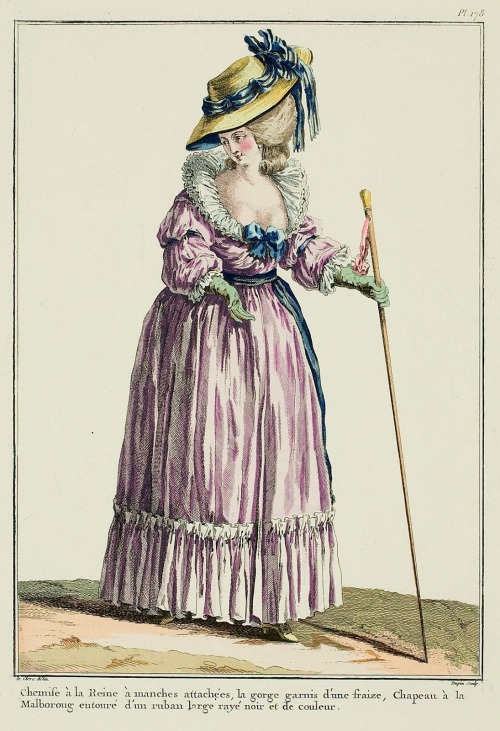
Chemise à la Reine vs. Grande Robe Française

This simple style was introduced by Marie-Antoinette and, although she did not wear such a low neckline as shown in the fashion plate above, it still upset many people. The Queen intended the dress for quiet times at Trianon. Via Tiny Librarian:
Chemise à la Reine with bound sleeves, the neckline trimmed with a frill, Marlborough Hat wrapped with a wide ribbon striped in black and colour. (1784)
“Chemises” belonged to the category of simple and comfortable dress which was in vogue from about 1781 overall due to Marie Antoinette.

At the time, one said that an upper-body garment was made en chemise when “the beginning of the sleeves ended in two pieces which were added” (Dictionary of the abbé Jaubert, 1778).  One frequently finds in the notes of Mlle Bertin mentions such as “a piece en chemise of Italian gauze”, “a fichu-chemise* of Italian gauze”, etc.  On the date of the appearance of the “chemises à la reine”, Bachaumont fixes it for us in writing about the portraits of the Queen and Madame, by Vigée-Lebrun, shown in 1783: “The two princesses are en chemise, a costume invented recently for women.”

And he added, “Many people have found it inappropriate that these august personages are offered to the public in a garment reserved for the interior of their palace.”
(Read entire post.)

This gown is an example of the most formal attire possible, which the Queen was trying to get away from. However, people were more displeased by her simple attire than by her grand formal costume. More HERE. Share

Sacred Geometry and Gothic Rose Windows

 From  Laboratorio Fiore Scriptorium via Hilary White at The Sacred Images Project:

Geometry in the Middle Ages was not just calculation and measurement, but a sacred language capable of uniting heaven and earth, the visible and the invisible. Every line and proportion thus brought to life a prayer in stone, a tangible testimony of faith carved in numbers.

"Sacred Geometry and Gothic Rose Windows, from Architecture to Miniature": a course designed for those more comfortable with technical drawing than with hand-drawn. Originally offered a few years ago, it is now available again—upon request—for small groups of at least three people. (Read more.)

Share

Wednesday, July 29, 2026

Henrietta Maria: Constructing and Reconstructing Early Modern Royal Motherhood and Confessional Identity

 
From Dr. Amy Saunders:

This article examines representations of Henrietta Maria’s (1609-1669) Catholicism and motherhood in a variety of artistic mediums and analyses how these objects are now reinterpreted within heritage sites and museum spaces in England. Henrietta Maria’s patronage, agency, motherhood, pregnancy, and confessional and foreign identity are often omitted from these heritage reconstructions despite the centrality of these themes within the artworks themselves. Her confessional and foreign identity places her in a liminal position within heritage spaces, where she is situated in opposition to Protestant queen regnants and queen consorts who are represented as more admirable or ‘successful’, due to their politics, identities, and activities. Furthermore, this article suggests that the continuation of a Protestant monarchy in England into the twenty-first century has influenced these representations with Henrietta Maria’s narrative not aligning to retrospectively applied ideals of the later royal family. (Read more.)
My novels on Henrietta Maria, HERE and HERE.

Share

Sunday, July 26, 2026

Narrative Icons


From Hilary White at The Sacred Images Project:

One of the most useful distinctions made by people who analyse art is between an image that simply presents something, and an image that tells a story. A portrait of a king, a still life of a bowl of fruit, a simple landscape, or an icon of Christ Pantocrator asks us to contemplate a single subject. They are essentially static images, like a single object in a dark room under a spotlight. Nothing is happening, and nothing is about to happen. It’s just Him and you.

But iconography is about making a visual statement about some eternal reality, even when the image itself is a story being told. We are all familiar with the single-figure icons of course, but there are narrative icons as well. The Nativity icon is a good example of this, where a single image will have several elements of a story presented as if they’re all happening at the same visual “time”1. The format here is to have the most important thing - the Nativity itself - in the centre, with all the side adventures going on around it.

This is called “continuous narrative,” in which the same characters appear multiple times within a single image to depict successive moments in a story. Time is compressed into one pictorial space. But instead of reading left-to-right like a comic strip, the viewer follows the action throughout the composition.

This technique goes back to classical Roman art (for example, Trajan’s Column) and was taken east by Byzantine artists, where it became especially common in manuscript illumination, fresco cycles, and some icons. (Read more.)

Share

Monday, July 20, 2026

The 9 Most Beautiful Historical Movie Theaters in the US

Image may contain Indoors Theater Auditorium Hall Cinema Architecture and Building 

From Architectural Digest:

“Theaters help bring people together to learn and laugh and just be in community,” says Benita VanWinkle, a photographer and associate professor of visual arts at High Point University in High Point, North Carolina. Theaters are also treasure troves of architectural brilliance, as evidenced in VanWinkle’s soon-to-be-released book America’s Hometown Movie Theaters: Please Remain Standing (Bauer & Dean Publishers, September 2026). The book features 395 theaters, all built before 1965, that VanWinkle has photographed while traveling the country for more than 40 years. In the process, VanWinkle also captured tales of resilience as communities have come together over the decades to preserve historical theaters. Her hope is that they remain, not just for design lovers, but as essential community gathering places. “Theaters have always been these places where we get to see a different version of ourselves and have a place together that doesn’t have judgment,” she says. “Most theaters have places to have discussions, share conversations, be educated, and be entertained.”

Here, we’ve pulled our nine favorite historical movie theaters featured in the book. The date listed alongside each theater name and location is the year it was photographed by VanWinkle. Looking for even more movie house magic? There are literally hundreds more movie retro theaters and drive-ins to be admired in her book. (Read more.)

Share

Sunday, July 19, 2026

My Guest Post for Tony Riches


 My thanks to Tony for such a wonderful opportunity! From The Writing Desk:

Wife of the ill-fated Charles I, the colony named for her was intended to be a refuge for Roman Catholics, the Catholic religion being forbidden in the Three Kingdoms. In my room as a teenager there was a print of the Van Dyck portrait of Henrietta Maria, the original of which is in the National Gallery of Art in Washington, D.C. Called “Mary” by her subjects, the second Stuart queen of England peers down from the portrait with her black eyes, which contemporaries described as large, sparkling and beautiful. Her dark curls with auburn highlights contrast against the deep marine blue shimmer of a silk dress, with the salmon-pink bows and elaborate white cuffs and high starched collar. A wide-brimmed plumed black hat was of the type made famous by the cavaliers who later fought for her husband in the English Civil Wars. 

The white plumes are reminiscent of the one made famous by her father Henri IV of France, which he wore into battle so that his men could always find him. Like her father, Henrietta Maria was not afraid to stand out, remaining a devoted Catholic in a land where her faith was banned, becoming the number one lawbreaker, while also striving to be a traditionally obedient wife, as was expected. But the expectations placed upon her made her life a tightrope walk which almost broke her.

The life of Henrietta Maria of France (1609-1669) was turbulent from the beginning. Half-Bourbon and half-Medici, her father, the famous Henri IV, was assassinated when she was an infant. Brought up by her mother, the Queen Regent Marie de’ Medici, to be a devout Catholic, she also mastered ballet, singing, and acting, skills which she would use in masques to entertain the Bourbon Court and later the Stuart Court. At fifteen she was sent to marry Charles Stuart, grandson of Mary Queen of Scots, who had just succeeded his father James I to the throne of the Three Kingdoms. 

While Charles I never converted to Catholicism, as had been hoped by many, his relationship with his wife was profoundly spiritual, enhancing the intense physical passion between them. After the initial clashing of cultures and personalities, theirs became one of the most devoted in the history of royal marriages, and was blessed with nine children. During the troubles which led to the English Civil War, Henrietta Maria became a liability to Charles because of her religion and her meddling, both perceived and actual. But her courage and her devotion fuelled the royalist cause, as she sold her jewels to raise money for arms and led soldiers to aid her husband. 

The challenges the royal couple faced in their early years of marriage are told in Book 1 of the Henrietta of France trilogy, My Queen, My Love. Book 2 will deal with the Civil Wars and Book 3 will be about the Queen’s widowhood as well as the adventures of her surviving children.

My view of historical fiction is that the author attempts to paint a portrait of the past with words. A historical novel is like a portrait come to life, allowing the reader to step into the past. Authenticity is vital, and that comes only from thorough research. While it is not always possible to visit the historical places that play a part in the novel, it helps. 

The internet has been a gift to historical fiction writers, making accessible old documents, manuscripts, pictures and books that one once had to travel far to find. I found the original program of the 1623 masque performed by Anne of Austria and Henrietta of France at the Louvre during Shrovetide. It was at the rehearsal of the masque that Charles Stuart first saw Henrietta during his incognito visit to Paris. Such primary sources, like the Queen’s letters, are indispensable for creating a living portrait.

So much of what people think they know about Henrietta Maria has been filtered secondhand through multiple writers, some of whom view her as a frothy but tiresome fanatic who led her husband into ruin. This is often accompanied by the perception of the Queen as a dangerous seductress, who used her French wiles in the boudoir to subject Charles to her will. 

And others decide that Charles was not enough for her but she had lovers such as Henry Jermyn who actually told her what to do, while fathering her children. Just as her enemies called her the “popish brat of France,” she has been portrayed erroneously either as a sex fiend soaked with crazed religiosity, or as a shy, pious pawn. (Read more.)

Novel available HERE.

Share

Saturday, July 11, 2026

Vatican Begins Restoration of Raphael Loggias

 From The Art Newspaper:

The restoration follows two pilot projects carried out between 2019 and 2024, in which experts tested the technology that will be applied to the entire cycle.

The restoration is supported by $5.5m from the Legacy of Raphael: The Vatican and Beyond initiative, a World Monuments Fund project for restoration, training, digital documentation and dissemination. That initiative was itself funded with a $14.3m donation by the Stephen A. Schwarzman Foundation, a New York-based philanthropic organisation. The work on the loggias has also been supported by the group Patrons of the Arts in the Vatican Museums.

Jatta adds that the installation of the new windows had been made possible with a donation by The Patrons of the Arts in the Vatican Museums, which also financed the pilot projects.

“The new windows are absolutely essential,” Jatta says. “If the right microclimatic conditions aren’t created in that space, there’s no point in carrying out the restoration, as those areas and the frescoes would certainly deteriorate again.” (Read more.)

Share

Thursday, July 9, 2026

“Animalia"

 From Galerie:

When Sheikh Hamad Bin Abdullah Al Thani sold off the Hotel Lambert in Paris and its extraordinary contents in 2022, the depth and extent of his collecting became a thing of legend. A soup tureen gifted to Catherine the Great by Count Orloff; a gilded candelabra commissioned by Marie Antoinette; a hand-painted screen of the Bay of Naples that had belonged to Coco Chanel… it took five distinctive lots to deliver this unparalleled treasure trove of decorative arts to the market. The sale made $76.56 million, and the house—an early baroque palace by architect Louis Le Vau with interiors by Charles le Brun and Eustache Le Sueur—sold for $226 million to the French businessman and art collector Xavier Niel. Actually not bad for a mini-Versailles: the same design team went on to make the most famous palace in the world.

But Sheikh Hamad, a key member of the Qatari royal family who is now in his mid-40s, has not stopped collecting. Since 2021, carefully curated exhibitions at the Hôtel de la Marine in Paris have shown highlights from The Al Thani Collection, which now contains over 5,000 works of art, including very contemporary paintings by artists including Issy Wood and Adrian Ghenie. The latest exhibition, called “Animalia,” offers a look at man’s relationship to animals through the medium of finely crafted objects, from Neolithic times to 1900.

“Sheik Hamad has the mind and the eyes of a falcon,” Giambatista Valli, the couturier who is a friend of the prince, told me at the time of the Hotel Lambert sale. “He is passionate about beauty first and foremost. He is driven by a curiosity which is backed up by incredible knowledge.” (Read more.)


Share

Wednesday, July 8, 2026

The Mysterious Frescoes of Castelseprio


 From Hilary White at The Sacred Images Project:

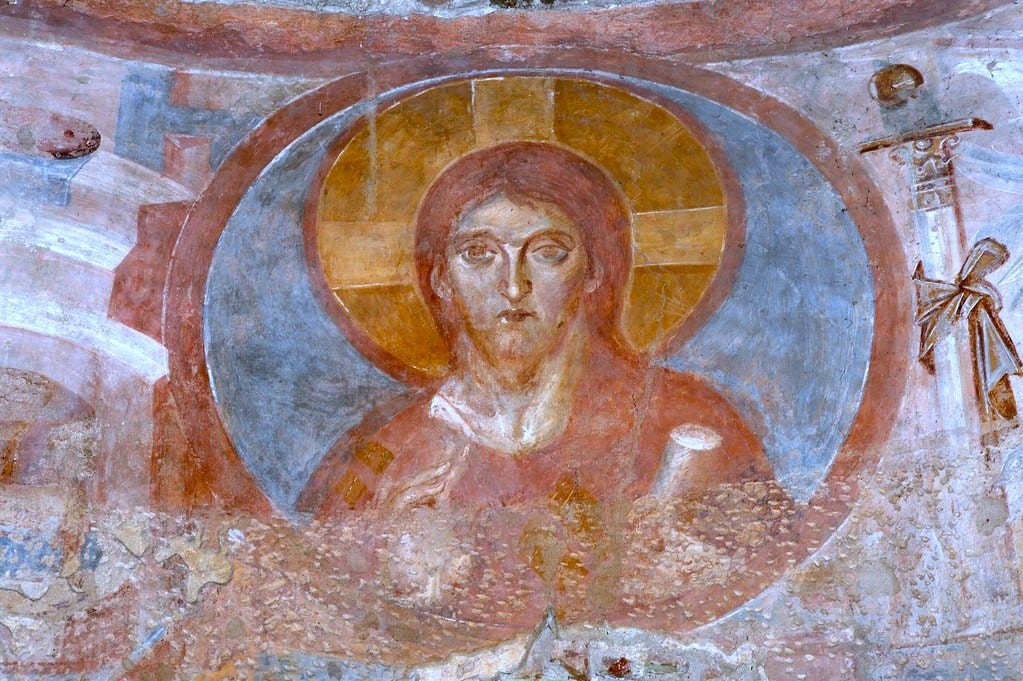
It might seem surprising that this fresco of Christ Pantocrator, discovered in the apse of a small obscure church in the north of Italy, is so unusual that it caused a major re-write of the art-history timeline. It looks like any early Byzantine image that we’ve seen hundreds of times: serene, otherworldly, with the face symmetrical with classical proportions, modelled with lights and darks to give the impression of lifelike three-dimensionality. But at the same time, we can see it is stylistically different: the softness of the facial modelling, the natural fall of the hair, the subtly rendered shadow beneath the chin, the piercing gaze and human expression.

In fact, it immediately reminds me in its naturalism of the frescos discovered at Pompei and Herculaneum. It might not be surprising to find that it dates to the earliest paleo-Christian period, when Roman standards were still in use.

But that would be the wrong guess. 

In today’s post for all subscribers, we will explore the treasure left forgotten in a tiny church in the forests of Lombardy. Hidden for centuries beneath layers of plaster, the exceptionally beautiful and lively Byzantine frescoes of Castelseprio challenge everything scholars thought they knew about Western art of the early middle ages - the time of the Lombard Kingdom, Carolingian and Ottonian empires.

Were they painted by a wandering Byzantine master, or do they reveal a local tradition that quietly preserved the grace and theology of late antique sacred art? (Read more.)

Share

Tuesday, July 7, 2026

The Meadows of Medieval Summer


 From Eleanor Parker at History Today:

A 15th-century calendar poem, turning these labours into rhyming verse, has its speaker say in July, ‘With my scythe my mede I mowe’, and in August, ‘And here I shere my corne full lowe’. This work may even have given July one of its names in English: in some sources it is called ‘Mead-month’, which may go back to a lost Old English name, Mædmonað.

A mead and a meadow are the same thing, though the words now have different connotations. Both go back to Old English forms of the same word, mæd and mædwe. They are related to the Germanic base of the verb mow, just as hay is related to the verb hew, i.e. ‘cut down’. A meadow is land that’s ‘mown’, just as hay is grass that’s ‘hewn’.

These days meadow is the usual term in modern English, while mead has become archaic – not quite obsolete, but certainly carrying an old-fashioned and poetic air. It calls to mind literary landscapes more than real ones, such as the place where Keats’ woebegone knight in La Belle Dame Sans Merci ‘met a lady in the meads, full beautiful, a faery’s child’.

Such romantic, medievalising associations of mead, compared to the more ordinary meadow, probably owe something to the way the word is used by Middle English poets, especially Chaucer. Chaucer writes often of meads and their beauties, praising their colourful flowers and fragrant scents and the enchantments that might be met there. At the beginning of ‘The Wife of Bath’s Tale’, for instance, the wife nostalgically describes the good old days of King Arthur when Britain was full of fairy magic and ‘The elf-queene, with hir joly compaignye, daunced ful ofte in many a grene mede’. (Read more.)

Share

Friday, July 3, 2026

"Jeweled" Sèvres Vases

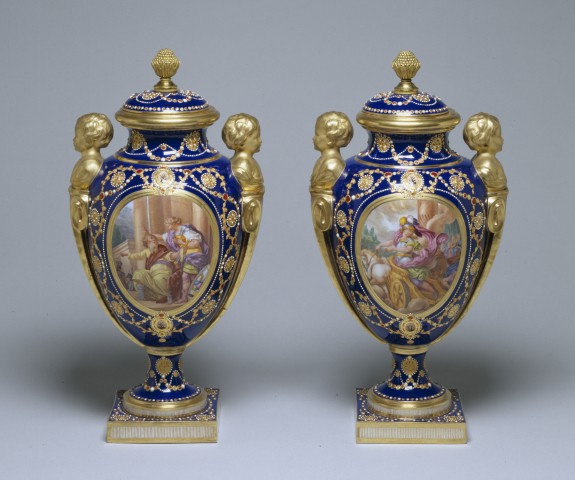
During a recent visit to the Walter's Art Museum in Baltimore, Maryland I saw the vases above, part of the famous "jeweled" Sèvres collection ordered by Louis XVI.  According to the Walter's website:
Between 1778 and 1782, Sèvres manufactured for Louis XVI a series of vases with handles shaped as busts of infants, young women, and old men, hence the name "vases des âges." The Walters' examples, with the infants and a "bleu nouveau" ground color, bear classical scenes and an additional decoration of "jewels" composed of enamel drops over gold foil.

The classical scenes are derived from an illustrated edition of Télémaque, a romance set in antiquity written by Fénélon in 1699. These vases show Telemachus, the son of Ulysses, winning a chariot race and Minerva, disguised as an old man, persuading Telemachus to participate in a war against the Dauniens. These vases were designed by Jacques-François Deparis. The painting was by Antoine Caton, the gilding by Etienne-Henry Le Guay, and the jewels by Philippe Parpette.
Share

Monday, June 29, 2026

Petit Trianon and the Hamlet Revisited


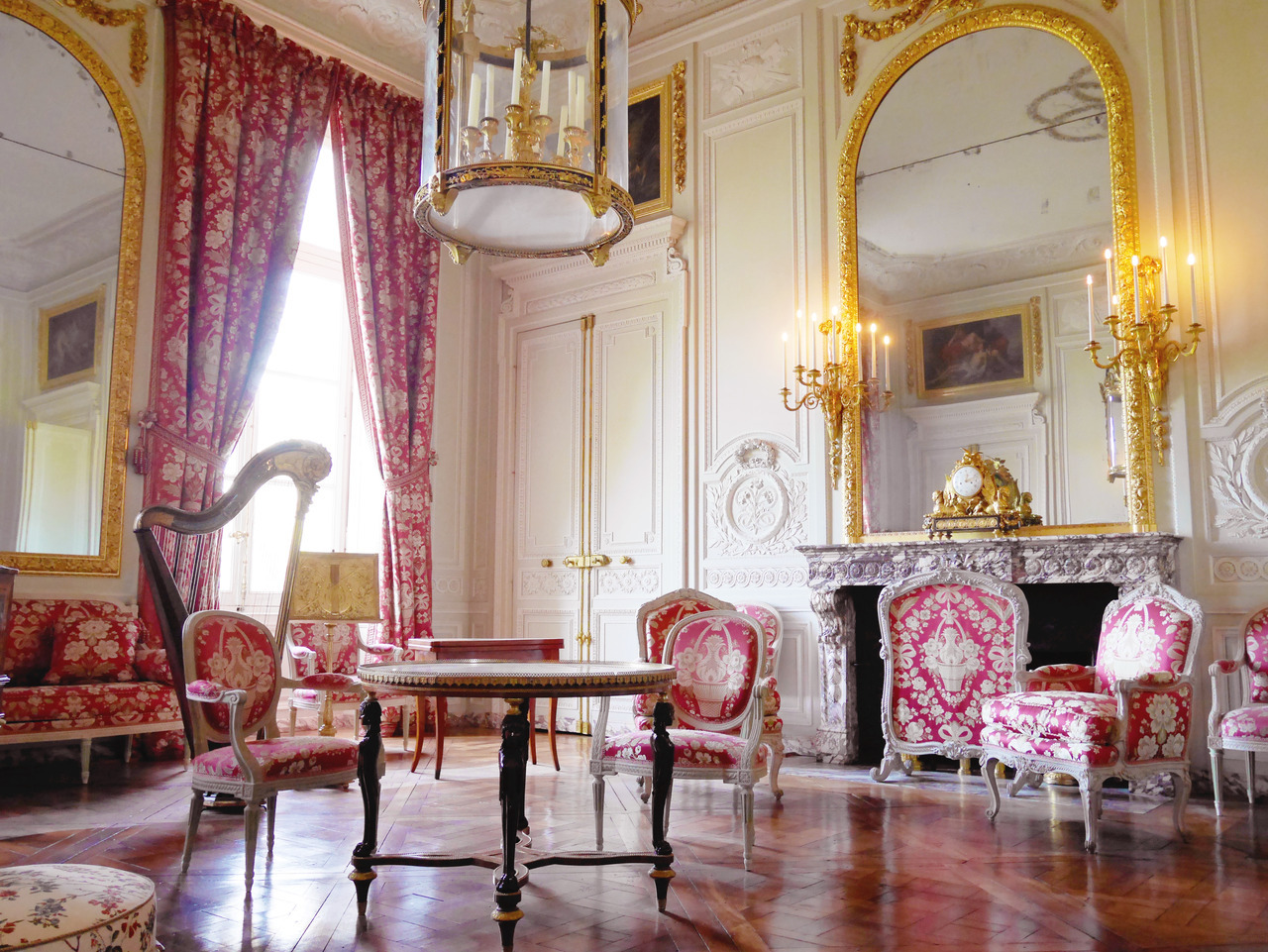
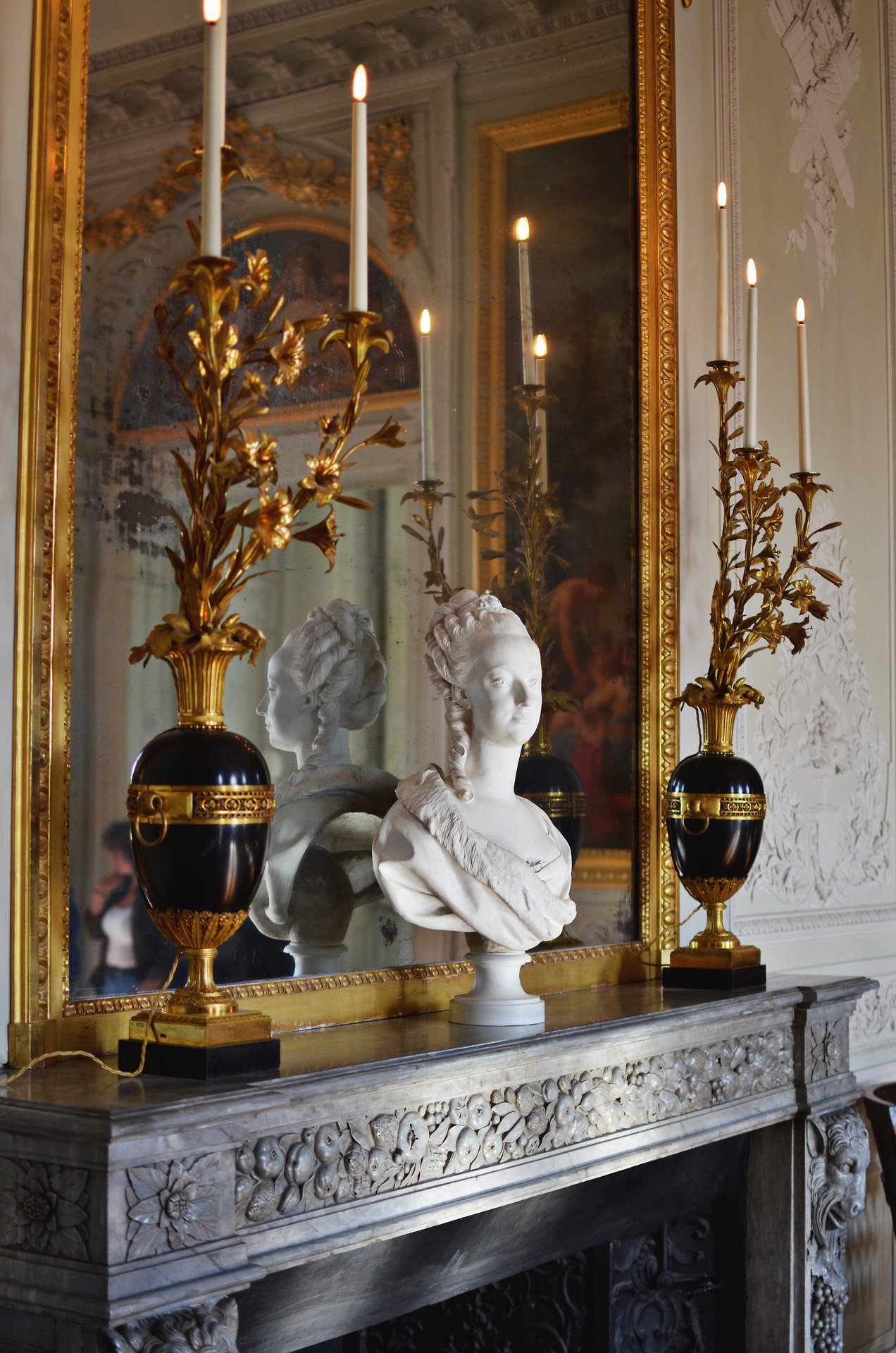
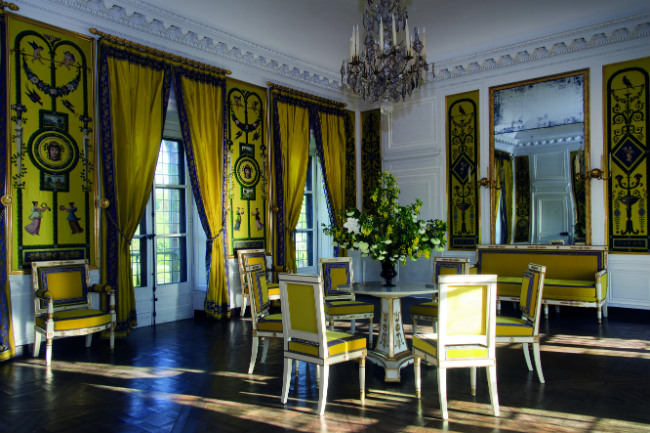
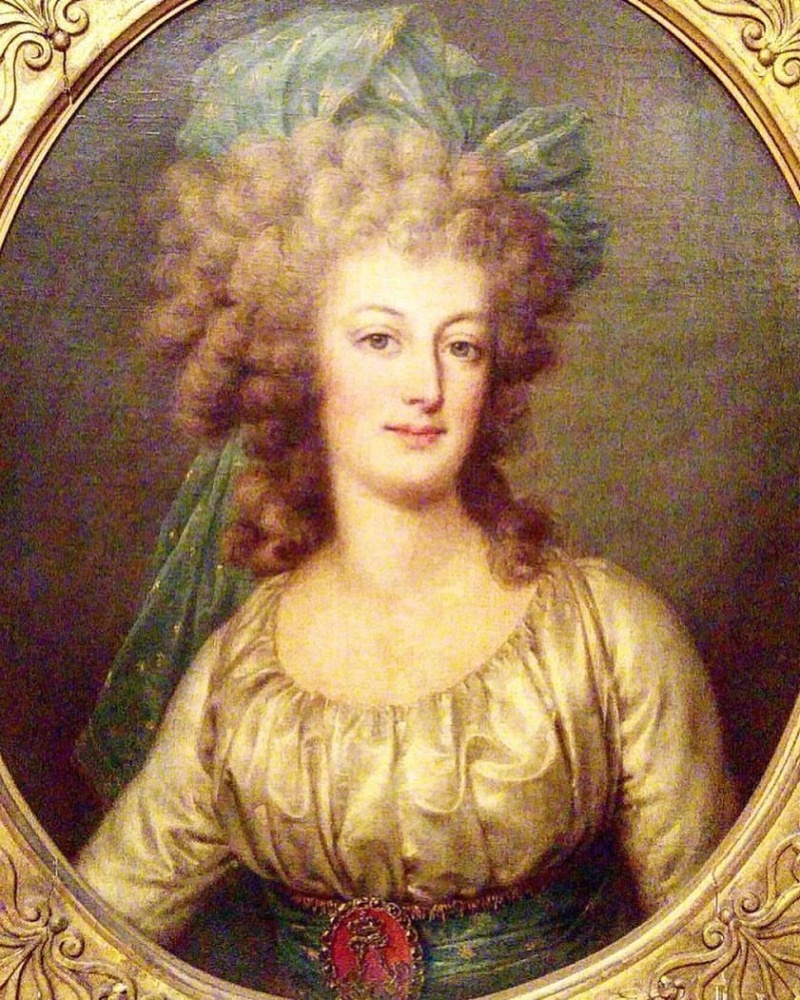
 The grand salon at Petit Trianon from East of the Sun, West of the Moon.

 More pictures, HERE.

From the dining room at Petit Trianon
 The Queen's house at the hameau has been restored. It is interesting to me that Napoleon gave the hamlet to his second wife Marie-Louise, who was the Queen's great niece. He was really unabashed in his fascination with Marie-Antoinette. From France Today:
Left to rack and ruin for the best part of two centuries, the Maison de la Reine, Marie Antoinette’s country retreat on the fringes of the Château de Versailles, has finally been restored to its former glory, thanks to a major £326 million renovation. Built between 1783 and 1787 as the extravagant centrepiece of the Hameau de la Reine, a model ‘village’ and folly of epic scale complete with a (decorative) windmill, sheep trussed up in silk ribbons, a cluster of farmers’ cottages and working farm, the Queen’s House had lain empty since 1848 when the Dior Foundation stepped in three years ago intent on rescuing it from certain ruin and giving it the regal makeover it so begged for.

Secreted in the sprawling gardens of the Petit Trianon, away from fawning courtiers’ prying eyes, the Hameau was Marie Antoinette’s refuge from Versailles’s folderol – for the two short years she got to enjoy it – and only a handful of her closest confidantes were allowed in its inner sanctum, the Maison de la Reine. Conceived with little thought for longevity, the hamlet fared poorly in the post-Revolution years and was all but a crumbling heap when Napoleon ordered a full restoration in 1810. Never one for sentimentalism, the emperor had the most ramshackle structures summarily torn down. Another renovation followed in the 1930s, courtesy of John Rockefeller. Part of the complex was refurbished in the late 20th century and the farm rebuilt in 2006. (Read more.)
From the Queen's house at the hameau
  Share

Friday, June 26, 2026

The Textile Designers Behind Some of Jacqueline Kennedy Onassis’s Most Memorable Interiors

 From Elle Decor:

Jacqueline Kennedy Onassis is remembered not only for her enduring influence on American style, but also for the homes she carefully shaped throughout her life. From the White House and the Kennedy compound in Hyannis Port to her Fifth Avenue apartment and homes she shared with Aristotle Onassis in Greece, Kennedy approached interiors with the same elegance that defined her public image.

Newly surfaced, never-before-published letters exchanged between Kennedy and textile designers D.D. and Leslie Tillett reveal the depth of that involvement. While Kennedy worked with celebrated decorators including Sister Parish, Stéphane Boudin, and Albert Hadley, the Tilletts became her trusted collaborators whose textiles appeared over and over again. Together, the letters offer a rare glimpse into the creative partnership behind some of Kennedy’s most significant interiors.

By the time Kennedy arrived at the White House in 1961, D.D. and Leslie Tillett were already fixtures in American decorating circles. Founded in the 1940s, Tillett Textiles built its reputation on hand-screened fabrics and a customized approach to design, attracting decorators such as Sister Parish and Albert Hadley, as well as clients like Bunny Mellon. It was through Parish and her White House renovation that the Tillets connected with Kennedy. (Read more.)


Share

Saturday, June 20, 2026

The Jewels of Marie-Antoinette

It is well-known that Marie-Antoinette had a fondness for diamonds, although she never even thought of purchasing Boehmer's necklace of the scandal; she preferred the money to be spent on ships for the French navy. The diamond necklace was not to her taste, anyway, which tended towards light, aerial creations. 

In the famous ensemble painting by Elisabeth Vigée-Lebrun, the queen is shown wearing only a few pearls, while sitting near the jewel cabinet. The symbolism of this has been discussed by J.M. Charles-Roux and by some art historians. It was to emphasize that for Marie-Antoinette her children were her true jewels. When the painting was begun in 1786, the queen was expecting baby Sophie; the gown she is wearing is a maternity gown, as can be seen by the open and adjustable front. The emphasis of the painting was supposed to be the other children getting the cradle ready for the new baby. However, by the time the picture was completed in 1788, little Sophie had been born and had died. Hence, the cradle is shrouded in mourning cloth.

After the death of her oldest son Louis-Joseph, Marie-Antoinette had the image hidden away; she could not bear the sight of it. Nevertheless, it was considered a highly accurate likeness of her. Louis XVI declared to the artist when first gazing at the portrait of his wife and children: "I do not understand much about painting, but you make me love it."

Share

The Christology of the Stairs: Medieval Raised Sanctuaries vs. Modern "Worship Spaces"

 From Hilary White at The Sacred Images Project:

Visitors to the medieval churches of Umbria and Tuscany are often surprised by an architectural feature that is found surviving in great abundance in our area; raised or elevated sanctuaries in our most ancient churches. That is, the place where the liturgical actions happen, that we are used to seeing conducted right in front of us, is set on a high platform, sometimes as much as 15 feet above the level of the nave, and mostly impossible to see.

We’re used to the sanctuary part of the church being raised at least a few feet above the level of the nave, often with the altar raised again on a stepped platform, but several meters? So high the congregation can’t see anything?

Architecture always catechizes. We all know that Catholic church architecture is used to express particular beliefs about the nature of reality, Christology, man’s relationship with God and his proper place in creation. Most Catholic churches, until the middle of the twentieth century, were built on a cruciform floor plan. The church itself is the image of the crucified Christ; the faithful literally enter into the symbol. Medieval builders extended this symbolic language far beyond the floor plan. Every aspect of the building could be made to communicate theological truths. These ancient stone churches emerge from a worldview that understands reality itself as hierarchical, which the designers of the elevated sanctuaries took very literally.

 Why are so many ancient churches in Umbria and Tuscany built with sanctuaries raised high above the congregation, sometimes so high that much of the liturgy would have been difficult to see? It has very little to do with practicality and a great deal to do with how medieval Christians understood Christ, the Mass, heaven, earth and the structure of reality itself. (Read more.)


Share

Thursday, June 18, 2026

Marie-Antoinette à la Rose


From the time I first started to write about Queen Marie-Antoinette, I have received comments from devout people about the low-cut gowns that she wore. Let me explain once again that, in the decadent old world, it was etiquette in most of the courts of Europe for ladies' formal attire to include a plunging décolletage. It was considered perfectly correct as long as the proper corset was worn.

The gown which evoked some disapproval for Marie-Antoinette was not one of the low-cut court gowns (shown above) but the simple white linen dress which she favored for her leisure time at Petit Trianon. The portrait in which she is shown thus had to be withdrawn from the public gaze because people took offense at seeing their Queen painted in casual attire. Now to us, the white dress is perfectly modest, but to people of the eighteenth century, it looked as if she were in her chemise, without the stiff corset prescribed for ladies of the royal family. Furthermore, it was interpreted as being a pro-Austrian picture, since linen came from Flanders, one of the Habsburg territories, and the rose the Queen held was seen as a symbol of the House of Austria.

In order to quell the outrage, Madame Vigée-Lebrun had to quickly come up with another painting. In 1783 the artist completed the portrait above, called "Marie-Antoinette à la rose" showing the Queen appropriately garbed in a silk court gown and headdress, trimmed with lace, ribbons and plumes. She is wearing pearls, as befits a Queen, with hair powdered and face rouged, in accord with court etiquette. She looks as if she has just stepped into her garden on a summer evening, bathed in moonlight. The nocturnal quality of the portrait softens the formality of her attire, alluding to Marie-Antoinette's love of nature, and the fact that she was much more at ease in her gardens than she was in the Hall of Mirrors.
Share

Wednesday, June 17, 2026

Rare Portraits of Marie-Antoinette


From Le Boudoir de Marie-Antoinette, HERE, HERE, and HERE

The Dauphine painted by Duplessis in 1773, for her mother the Empress.

And from around the web, it seems that one of the the popular "diary" novels written in the last twenty years was mistaken for a genuine diary of Marie-Antoinette by a researcher. From Anna Gibson:

Reminder to check the sources of your sources!

So an article by a fashion historian in a peer-reviewed journal thought that Kathryn Lasky’s The Royal Diaries novel was real and cited the information in it for an article about the evolution of the chemise dress. (Marie Antoinette had no diary, and she certainly didn’t somehow write in 1769 about dresses that start showing up in fashion journals in the late 1770s; nor did Rose Bertin time travel to meet Marie Antoinette when she was just an archduchess, or design her wedding dress, etc.)

So far I’ve uncovered two articles that cited this historian’s article while repeating the false information regarding Marie Antoinette’s diary and the robes à la créole. Completely understandable that these second writers would take this historian at their word because one would assume they know their stuff, but not understandable that the historian behind the original article found Lasky’s book, read the page in question, and then cited it as fact.(Read more.)

Share

Thursday, June 11, 2026

Coronation Robes

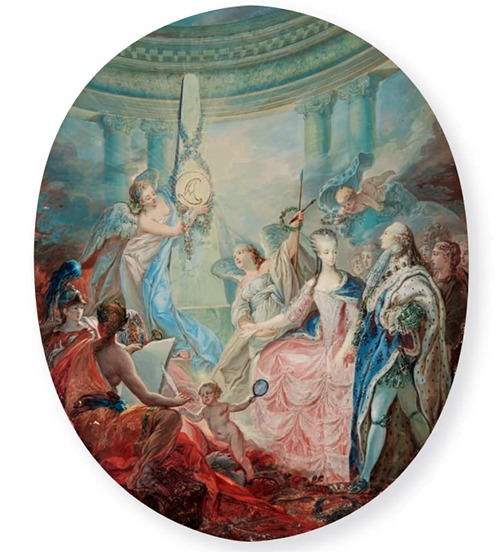
June 11, 1775. Louis XVI and Marie-Antoinette in their coronation robes in an allegorical setting. Notice the monogram "LA" for "Louis and Antoinette." Via Vive la Reine.

 Vive la Reine quotes a contemporary account:
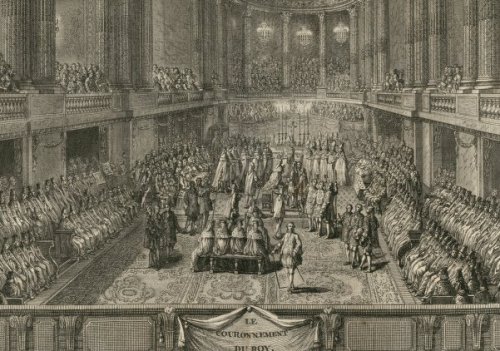
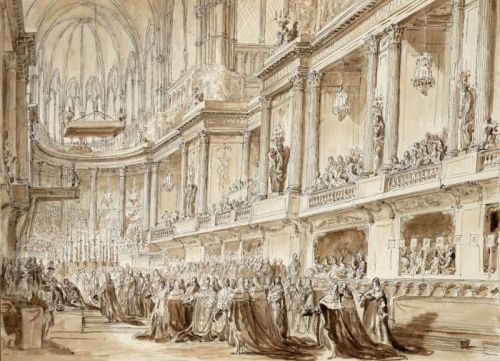
His Majesty entered the metropolitan church, where he was greeted by the Archbishop-Duke of Reims—who was at the head of his Chapter—and listened to the Te Deum. After the Benediction, the King withdrew to the archbishop’s palace where all the Nobles complimented Him. The next day, the King listened to the first Vespers in the Cathedral, and on Sunday, June 11th, around seven o’clock, His Majesty—with the greatest pomp—went back to the same Church and was crowned in the usual ways. (Read entire post.)

A post on the music for the coronation mass and the religious devotions that followed, HERE.

From Vive la Reine: "Detail from The Coronation of Louis XVI by Jean-Michel Moreau, 1775."


Share

Tuesday, June 9, 2026

1,300 Years of History Preserved in Ancient Parchments

From Archaeology News:

The study appeared in the journal Manuscript Studies. Researchers examined 91 parchment manuscripts preserved at Duke University’s David M. Rubenstein Rare Book & Manuscript Library. The collection included religious texts, scrolls, legal records, fragments, and manuscripts written in several languages. The documents came from England, different parts of Europe, the Middle East, and northeastern Africa.

For more than a thousand years, parchment served as the main writing material across Europe and much of the Mediterranean region. Unlike paper, parchment came from animal hides, usually sheep, goats, or cattle. Millions of parchment documents still survive in libraries and museums today. Researchers involved in the study describe those collections as a large biological archive preserved across centuries.

Scientists faced a major obstacle for years. Traditional ancient DNA studies often require researchers to cut, scrape, or drill into material samples. Archivists and conservation experts rarely allow such methods on rare manuscripts because even small damage matters when dealing with cultural heritage objects.

The team used a different technique. Researchers gently rubbed the parchment with small cytology brushes, the same type often used in medical testing. The brushes collected tiny traces of cells from the surface without leaving visible damage.

After sampling, scientists extracted DNA from the brushes and analyzed the material with next-generation sequencing technology. These sequencing methods work well with old and fragmented DNA, which often survives in poor condition inside ancient material. (Read more.)


Share