Showing posts with label Virgins. Show all posts

Friday, June 5, 2026

'Sacré Coeur'


From OSV

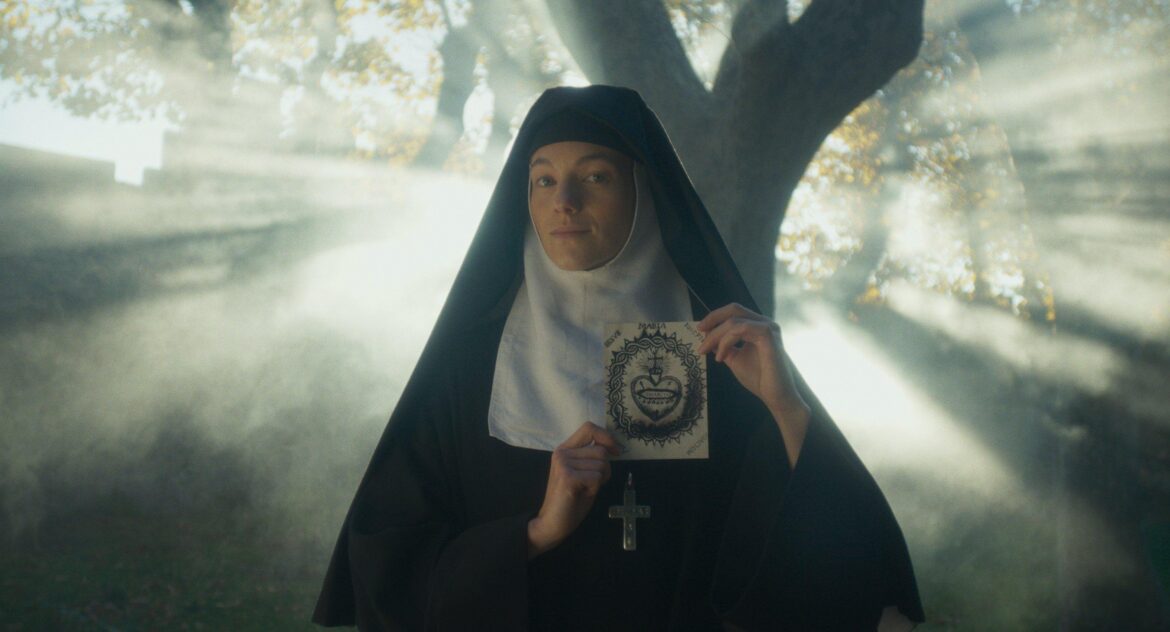
 A French blockbuster is coming to theatres in the U.S. just in time for the consecration of the nation to the Sacred Heart of Jesus and premieres for U.S. audiences in June.

Released in France on Oct. 1, 2025, the docudrama “Sacré Coeur,” subtitled “His Reign Will Have No End” focuses on the apparitions of Jesus Christ to a French Visitation religious sister, St. Margaret Mary Alacoque, showing his heart to her between 1673 and 1675, in Paray-le-Monial, in the French region of Burgundy.

“Sacré Coeur” will be shown in theaters June 9-11 and June 14 via KREA Film-Makers, Saje Distribution and Fathom Entertainment. Tickets and theater information is at sacredheartfilm.us. (Read more.)

Share

Saturday, May 23, 2026

What Does St. Paul Say About Veils?

https://fssp.com/wp-content/uploads/Wedding-Veil-Cropped-1.jpg 

Charlene, Princess of Monaco

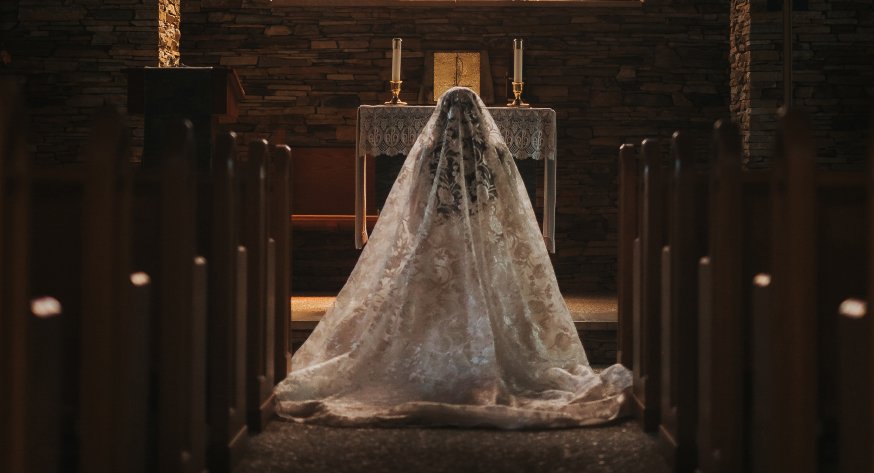
 I have worn hats or veils in church my entire life, except for a few confused years in the late seventies and early eighties. I have repeatedly had women say to me: "I wish we still did that" or "I wish I was brave enough to do that" or "I would wear one but I don't want to appear holier-than-thou." To the first objection, my response is that no one ever came down from heaven and began ripping women's veils off; if you want to wear a veil or a hat at Mass, then wear one. To the second objection, I say that it requires courage to shed one's blood for the Gospel; it does not require courage to wear a scrap of lace on your head. To the third objection, I can merely shake my head and query: "Holier-than-thou?" In seventh grade, at a Catholic school, I remember going into Mass with a gaggle of twelve-year-old veiled damsels who spoke in such a way that would make Cheech and Chong blush. I grew up seeing femmes fatales such asGrace Kelly, Jackie Kennedy, the Duchess of Alba, and Marlene Dietrich wearing mantillas, which speedily disabused me of the notion that wearing a veil confers automatic holiness. Not to mention the variety of feisty and eccentric characters among my own family and friends, and in my parish, who wore an expansive collection of veils and hats over the years, featuring everything from threadbare polyester lace to Parisian couture. None were angels, except perhaps the little girls and the nuns. I remember when one of my aunts was an unmarried expectant mother, wearing a cute headscarf at Mass over her stylish bob. I loved how her scarf and dress matched and wanted the same look. (I was five.) My overall impression, which led to my own decision to veil, was that it is not a matter of conforming to what people might think, but a matter of devotion to God, according to the teachings of both Scripture and Tradition.

From Father Mike Johns at Word on Fire:

The practice of wearing a veil during Mass has seen a bit of a revival among Catholic women in recent times. Find a Catholic parish at random in which to attend Mass, and odds are that at least some of the women present will be wearing a veil. A quick internet search about veiling during Mass results in many articles and videos from both secular and religious outlets commenting on the practice. Some Catholic outlets even go so far as to recommend the use of the veil as a necessary outward sign of a wife’s submission to her husband.

St. Paul’s words in 1 Corinthians 11:3–16 are often at the center of such discussions. In this chapter of his letter, Paul is concerned to correct numerous liturgical abuses taking place among the Corinthians, and the subject of head coverings is at the top of his list. In the words of one Scripture scholar, “Women in Corinth, at least some of them, had stopped wearing head coverings in worship, and that bothered Paul.” In 1 Cor 11:3–16, Paul tackles this issue.

The Catholic Church, however, clearly teaches that the use of the veil is no longer obligatory for women. Under Pope St. Paul VI, the Church maintains that veils “no longer have a normative value” since in passages such as 1 Cor 11:3–16 Paul is addressing “disciplinary practices of minor importance.” In addition, the current Code of Canon Law has also lifted any obligation concerning the use of the veil for women in church. In classifying the use of the veil as a disciplinary practice of minor importance, the Church sees it as on par with other devotions, or perhaps even as a sacramental. That is, it can perhaps aid in the expression of Catholic piety but is not an essential component of faith.

At the same time, Paul’s arguments in 1 Cor 11:3–16 (and his letter as a whole) ought to be taken seriously. The letters of St. Paul are among the most beautiful and rewarding pages of the New Testament. This is especially true of the First Letter to the Corinthians, which has been called “Paul’s most practical and contemporary letter.” (Read more.)


More discussion from The Missive:

We receive Tradition as a holy gift, treasure it, and pass it on to those who come after us. We realize, in humility, that in the long run, Tradition will judge us and that it is really not for us to pass judgement on Tradition. Traditio sacra sacrorum tuitio. Sacred tradition is a safeguarding of sacred things, and more importantly, of being safeguarded by them. For those who are still being formed by Tradition – a formation that can indeed fill a lifetime – it may be hard to understand why it is so important for women to wear veils in church.

Let me begin with an experience that occurred to me some years ago now. Once, when I stopped for gas at a roadside convenience store, the attendant at the cash register saw me in my cassock and asked, completely at a loss, “What’s with…???” and motioned up and down with her hands to indicate that she was referring to my garb. She didn’t even know what to call it. At that time I was still a seminarian, and I explained to her that I was hoping to become a priest.

When we see a policeman or a soldier or a nurse, for example, we know who they are by the way they are dressed. And I hope that when you get ready to come to church, you dress with church in mind: you realize a distinctiveness in being in church. It is not like going anywhere else.

Proper attire for a woman, according to the Tradition given to us clearly by St. Paul in 1 Corinthians 11 and confirmed by Pope St. Linus, who was the second pope, right after St. Peter, is to wear a veil or head covering while in church. I have noticed that men tend to be good in observing the rule that applies to them, namely, that they should not wear a hat in church. I hope that if you saw someone wearing a baseball cap or a fishing hat in church, you would realize that this is not appropriate and indicate in some way to him that he needs to take it off.

Now, you might be wondering why a priest wears a biretta in church and could wear one even during the sermon. Some Fraternity priests do. The answer is that the biretta is a sign of office; a much more striking sign of a higher office is the bishop’s mitre, which he does wear when he preaches.

Dear faithful who are ladies, what I hope you will find in wearing the veil is that you have a particularly strong awareness of where you are, that you are focused completely on Our Lord and not worried about external appearance. (Read more.)

Tea at Trianon has has several posts on headcoverings, including HERE and HERE. A fabulous post, HERE.

Share

Monday, March 16, 2026

Lorrha Stories: Irish Monasticism

 From The Abbey of Misrule:

St Ruadhán was one of the ‘twelve apostles of Ireland’, a collective of significant early Irish saints who studied under the legendary St Finian of Clonard. Ruadhán (whose name is pronounced ‘Rowan’, and means ‘red-haired’) was, like his fellow apostles, a monk of the Celtic tradition, which later came into conflict with Rome over various issues, like the date of Easter, the correct form of tonsure and other such theological details. In reality though, these issues were secondary to the real one, which was how much power Rome should have over monasteries in distant lands.

In early Ireland, Christianity was monastic, and it was Abbots rather than Bishops who called the shots. Irish monasticism had, for around 500 years, developed a specifically ‘Celtic’ character which seems to have been greatly influenced - and, I think, directly seeded - by Egyptian desert monks. This was the age of the round tower, the beehive hut and the small-scale, ascetic Christianity of the Wild Saints. It was the world of Patrick and Kevin, Colmcille and Bridget.

The Pontiff in Rome, however, wanted this scruffy, desert Christianity reined in under a hierarchy of Bishops answerable to him, and in Ireland, as in England a century before, the Normans would be his vessels. In 1066, the Norman king William the Conqueror (William the Bastard to his friends) had invaded England, killing its legitimate (and elected) King, Harold II, at the Battle of Hastings. He had done so under the Papal banner, which he had carried into battle, and on his victory he set about demolishing the old wooden Anglo-Saxon churches and building new, stone ‘Romanesque’ ones in their places. He also gave the green light to the continental monastic orders to move in and replace their indigenous counterparts. (Read more.)

Share

Thursday, December 11, 2025

The Bells of St. Mary's (1945)


The Bells of St. Mary's is often referred to as the film which most exemplifies the mythological Church of pre-Vatican II days, the Church That Never Was, so to say. It is seen as idealizing priests and nuns and parish life when in reality, as we are continually being told, priests were abusive monsters and nuns were shrewish old hags. However, every time I see The Bells of St. Mary's I am struck by how many things about the film resonate with my own experience of Catholicism over six decades. The nun friends that I have had laughed together just like those in the film, especially in the scene when the cat got inside Fr. O'Malley's hat on the mantelpiece. And the striving of the parish to keep the school open is not unreal either.

It is always surprising how familiar some of the characters in the film are to me. Yes, when I went to parochial school there were some cranky old nuns. My former spouse has stories of his school days and encounters with grouchy teaching sisters that make one's hair stand on end. All the same, over the years I have known several nuns like Sr. Benedict, energetic, cheerful, and beautiful in every way. I have certainly encountered priests of the Fr. O'Malley variety, full of blarney at times, but able to connect with people from all walks of life. And what rectory does not have the occasional eccentric characters associated with it, such as the St. Mary's housekeeper Mrs. Breen, played to the hilt by the pixillated Una O'Connor. "You don't know what it's like to be up to your neck in nuns," she warns Fr. O'Malley, as he readies himself to embark on one of the most famous power struggles in filmdom.

Bing Crosby is not half so annoying as he was in Going My Way, the prequel of Bells. The fact that Ingrid Bergman was not a raised a Catholic and was not an especially devout person is testimony to her superb acting ability. Her composed deportment is right on target, restrained without being stiff. Sr. Benedict is able to gently impose a sense of discipline and order on the children while at the same time letting them know that they are loved unconditionally. I have known nuns just like her. She is based upon director Leo McCarey's aunt, a nun who helped to build Hollywood's Immaculate Heart Convent before dying of typhoid fever.

Sr. Benedict and Fr. O'Malley, like so many dedicated religious and clergy with whom I have been acquainted, interact with a variety of people with a plethora of problems, from the troubled young girl to the cranky old Bogardus. The story is fictional, meant to be entertaining and light-hearted but it touches upon very real quandaries. Sr. Benedict, who after overcoming many obstacles saves the school, has to lose it by going away. She is heartbroken and finds it hard to give up her own will, thinking that Fr. O'Malley has arranged her transfer on purpose. Discovering the truth at last helps her to accept everything that has happened in a spirit of faith. The look she gives Fr. O'Malley before walking away, eyes full of tears but radiant with peace, contains in it an ocean of sacrifice. In that sense, The Bells of St. Mary's is not only about the Church that was, it is about the Church that is, and that ever will be. Share

Tuesday, October 21, 2025

St. Hildegard’s Divine Visions

 From US Catholic:

Hildegard of Bingen was a prolific figure, active throughout her long life as an influential church leader, theologian, mystic, visionary, poet, composer, and scientist. She was born the tenth child of a family in Germany, and her parents dedicated their daughter to the church. At age fourteen, she lived in a small room with a religious hermit named Jutta, who was six years her senior. Jutta became a confidant and mentor to Hildegard, and it was with Jutta that Hildegard shared one of her greatest secrets—that since a very young age, Hildegard had been receiving divine visions from heaven.

Hildegard kept this secret very private until, at the age of forty-two, she received a vision in which God unveiled understanding and wisdom about creation and the spiritual life. “The heavens were opened and a blinding light of exceptional brilliance flowed through my entire brain. And so it kindled my whole heart and breast like a flame, not burning but warming” (Joe Staines, Th­e Rough Guide to Classical Music [London: Rough Guides LTD, 2010], 256). The vision instructed Hildegard to begin writing down what God had told her over the course of her life.

Hildegard began writing down all that had been revealed to her over a lifetime of visions. Her writings were extensive and covered a wide range of subjects, including botany, medicine, theology, and music. Her musical compositions are considered one of the origins of Western classical music. Hildegard believed that making music brought one closer to God. “Words symbolize the humanity of the son of God,” Hildegard wrote, “but music symbolizes his divinity” (“The Life and Works of Hildegard von Bingen [1098-1179],” Kenyon College). Hildegard collected her musical compositions into a large compendium, which she called the Symphonic Harmony of Celestial Revelations. (Read more.)

Share

Tuesday, September 2, 2025

Mother Vera

 From The Conversation:

Mother Vera is an immersive work of art and the beauty of the cinematography is almost hypnotic. Countryside, animals and people move across the screen and pull observers into a different time and place. On occasion it is so vivid that it is almost possible to catch the scent of the candles in a darkened church, or the smell of cattle in the yard.

Yet while it is highly evocative, Mother Vera is a demanding watch. The audience is permitted to enter into the life of the nun and her order, and given an infinitesimal, but powerful, taste of the silence and stillness of that domain. Engaging with it is radically different from seeing a film propelled forward by constant dialogue, or framed in a way that leads viewers inexorably towards a prescribed moral conclusion or emotional response. Mother Vera not only gives those watching space to react and reflect individually, it almost compels them to do so. (Read more.)

Share

Monday, July 28, 2025

The Most Controversial Religious Artwork of All Time

Personally, I never saw anything controversial about it. From ArtNet News:

Made by Bernini, arguably the greatest artist of the Baroque era, between 1647 and 1652 the sculpture depicts Saint Teresa of Àvila, also known as Teresa de Jesús (1515–1582), a Spanish Carmelite nun, who was canonized in 1622, merely 25 years before the sculpture’s creation.

Born to an aristocratic Spanish family, Saint Teresa was a religious reformer who founded the Discalced Carmelites order. She experienced mystic visions, which she described in penetrating detail in her influential vernacular writings, most famously in her autobiography The Life of St. Teresa of Jesus.  

The sculpture was commissioned by Venetian Cardinal Federico Cornaro (1579–1653), who had chosen the church, which was home to an order of Discalced Carmelites, for his burial chapel, making Saint Teresa a fitting subject matter. (Read more.)

Share

Wednesday, July 16, 2025

The Power of Francis Poulenc’s “Dialogues of the Carmelites”

The nuns were martyred on July 17, 1794. From The Voegelin View:

The 1957 opera is based on the true story of the Martyrs of Compiègne, a community of sixteen Carmelite nuns who were guillotined during the French Revolution’s Reign of Terror. The libretto is the work of Georges Bernanos, the French Catholic author best known for his novel The Diary of a Country Priest.
Dialogues balances the sweep of historical events with the inner spiritual journey of Blanche de la Force, a young woman from an aristocratic family who fears the oncoming Revolution. Blanche’s fear impels her to join the Carmelite order, but in doing so she goes straight into the target of the revolutionary mob. Arrested and cast out of their convent, the nuns take a vow of martyrdom rather than renounce their vocation. Blanche initially panics and runs away, but at the last moment she finds her courage, steps out from the crowd, and joins her sisters at the guillotine. Many hold Dialogues in high esteem as one of the twentieth century’s greatest operas, even for its subject alone. The intolerant repression of religion by the architects of the French Revolution—ironically carried out in the name of “liberty,” “fraternity,” and “equality”—is a story that must be told, with heroic themes befitting grand opera.
If I have reservations about the piece, it is largely because its first half is filled with abstract spiritual discussions that are poorly suited to musical treatment. This portion of the opera feels static and verbose—not to mention overlong—with Poulenc having little to do but spin exquisite filigree around the text, between increasingly powerful orchestral interludes. The opera’s second half livens up considerably, though, as the revolutionary forces close in on the convent and the nuns take their vow of martyrdom. This is a spiritual, even intellectual opera, one that examines themes of fear and grace—particularly what Poulenc termed “transfer of grace” by which one human death can redeem another. (Read more.)
Share

Tuesday, July 8, 2025

Vestments Made by Saint Thérèse


From Liturgical Arts Journal:

Thérèse had great devotion to the Holy Face of Tours and this is reflected in the image on the chasuble. The decoration is full of symbolism. Thérèse chose two white roses to honor her parents, Sts. Louis and Zélie. She also chose to depict white lilies to symbolize the nine children born into her family. Four died in infancy and so they are the flowers that have not bloomed. The five siblings who survived into adulthood all became fully professes sisters, depicted as the flowers in full bloom. Thérèse identified with the lily half hidden behind the Holy Face. (Read more.)

Share

Friday, May 30, 2025

The Trial of St. Joan


Here is link to the first interrogation of St. Joan's trial, with the other sessions following. She was tormented and betrayed by those who should have been her spiritual fathers. She answered firmly and boldly, even as had her beloved St. Catherine of Alexandria before her. As another excellent article says:
The story of her prison life is a record of shame to her goalers. Chained, mocked at, threatened, and insulted, her serenity never failed. She was in God's hand, and she bowed to His will.

Months of suffering and anxiety passed over her before her captors made up their minds as to the course they would take to bring about her death under the semblance of legal execution. If she could be convicted by an ecclesiastical court of crimes against the faith, her condemnation would redound to the fair fame of England and of the pious House of Lancaster, while covering the French and their sovereign with confusion as the allies and associates of a minister of hell. (3).... ( The House of Lancaster was fervently orthodox. Persecution of heretics begins with Henry IV. The "Cardinal of England" (Beaufort Bishop of Winchester) was the malicious attacker of heretics at home and abroad. He spoke against the Hussites at the Council of Basle, and he planned Crusades against both heretics and "Saracens.")

Pliant churchmen were at hand to give countenance and help in this undertaking bishops full of zeal and loyalty for our sovereign lord Henry VI, by the grace of God King of France and England.

The worst of these servile churchmen was the wretched Bishop of Beauvais, Pierre Cauchon. Many other prelates were Caesar's friends, but he sits exalted in solitary infamy. He came to the Burgundian camp and claimed his victim in the name of Bedford, Regent of France for the English King. Had Jeanne been detained by the Burgundians, it is impossible to believe that Charles VII would not have procured her release. Had she been held as a prisoner of war by the English, it is very likely that the shame of holding a woman captive in their hands would have made it possible to arrange for her ransom. But once charged with heresy and taken out of the hands of the Burgundians such hopes and chances were closed. Still, as an ecclesiastical prisoner she would have been entitled to counsel and guidance by religious persons, the Church offering admonition before preferring grave charges of rebellion against any of her children. But this would render her punishment uncertain. Grave doctors of the law and eminent churchmen had at Poitiers, after long inquiry, declared her worthy of trust and they might do so again.

Therefore it was determined that she should be held in a lay prison though charged with an ecclesiastical offense. Cut off in this way from all spiritual help and instruction, she was to be brought, when the process was ripe, before a well-chosen court bent on her destruction, and ready to entangle her in questions which might entrap her into erroneous or heretical statements.

And once more we are confronted, if we try to rationalize her life and put away all belief in inspiration, with the amazing problem as to where and how this untutored girl drew her stores of logic, law, and theology.

Hallowed Ground has some rare images of St. Joan and her beatification.


Share

Monday, April 14, 2025

Dear Woke Left: Hands Off Jeanne d’Arc!

 From The European Conservative:

She suffered from a destiny that Heaven had asked of her. Her young and tender heart made her shed tears when she saw one of her enemies wounded near her, or when she felt the full weight of the injustice of her judges. She did not consider for a second carrying an iron and preferred to go into battle carrying a banner bearing the names of Jesus and Mary.

The Church that condemned her to the stake was not the brutally patriarchal force feminists like to depict. While Bishop Cauchon wanted her dead, other priests assisted her, confessed her, brought her communion, and bowed to the grace and strength that emanated from the courageous girl of Lorraine.

Even today, some feminists are up in arms and defending their Jeanne d’Arc because they don’t get their own back in the travesty—dare we say the word—of the young woman as a queer activist. Jeanne d’Arc also has a message for women, as a fully-fledged woman: “pursue your ideal, don’t let yourself be intimidated by those who want to stand in your way.” It’s a fact: Jeanne is an inspiring woman, even for a progressive feminist.

For seven hundred years, Jeanne’s case has been a source of questioning and turmoil. In her time, she knew how to win the hearts of the soldiers who began to march in her wake, without really understanding what was happening to them. With her candour and strength, she disarmed the judges who wanted her dead.

We therefore ask our English friends to leave Jeanne in peace and to follow the example of those soldiers who, during the First World War, when she was still just a blessed, prayed to her to give them the strength to defeat the enemy. (Read more.)

Share

Tuesday, March 25, 2025

“O Jewel Resplendent”

O jewel resplendent
and bright, clear beauty of the sun
that’s flooded into you—
the fountain leaping from the Father’s heart, which is his single
Word, by which he did create the primal matter of the world, which Eve disturbed.
This Word the Father made for you
into a man, and this is why you are that shining
matter, through which that Word has breathed forth all
the virtues, just as he brought forth all creation in primal matter.
– St. Hildegard of Bingen

From MDPI:

 The image of sunlight refracting through and reflecting off a gemstone becomes a lens through which Hildegard glimpses the entire sway of salvation history, stretching from the prima materia, the primordial material at the beginning of creation, through the disturbance of that matter in the Fall, and finally to the Virgin’s integral role in renewing that material as she bore the Son of God. Scripturally, the image aligns the Virgin with the twelve precious stones that adorn the walls of the heavenly Jerusalem in Revelation 21, identifying her with the end of salvation history, the new heaven and new earth. In the context of Scivias, meanwhile, the gemstone takes us back to the beginning of the human journey and the anthropological vision of Scivias 1.4 (Figure 1), where the unfallen human body is described as a bejeweled tabernacle. This vision tells the story of a representative “human form,” the soul of an “Everyperson,” whose voice declares the ups and downs of its struggle against the temptations of the material world. It begins with the Everyperson’s conception, as their soul is quickened in the womb of their mother by the flow of divine energy, a “splendor like the dawn” from a golden quadrilateral allegorically identified as scientia Dei, “the Knowledge of God” (Scivias 1.4.9, p. 116). The iconography of this image in the Rupertsberg manuscript draws from common tropes for illustrating the nativity of Christ, with the recumbent mother in the same pose commonly used for the Virgin Mary in childbirth (Saurma-Jeltsch 1998, p. 66). The use of gold to illustrate the divine ensoulment adds further dimensions to the image, for the manuscript intentionally used gold to mark irruptions of divine activity into creation—we will see this gold return below in Scivias 2.1, aligned as here with the light of the dawn.8

 [...]

St. Hildegard of Bingen (1098–1179) comes down to us as one of the most dynamic intellectual figures of the twelfth century. As a leader of religious women in the Rhineland, she authored extensive volumes of visionary theology; designed visual images for at least one of those; composed the largest corpus of liturgical music ascribed to a single author of the Middle Ages; wrote works in natural science and medicine; preached to religious communities throughout her region; and engaged in an extensive correspondence with people from all ranks of society, from popes and kings down to local monks and nuns. This extraordinary, interconnected body of work offers us a unique entry point into medieval intellectual life, at once rooted in tradition and recasting that tradition in startlingly innovative ways. Hildegard’s Mariology exemplifies this creative range.
 
The best overview of Hildegard’s “theology of the feminine” remains the foundational work of Newman (1997). She demonstrated that for Hildegard, the feminine can be understood at a cosmic level as the matrix for the manifestation of divinity into time. The Virgin Mary is the most concentrated focal point of a dynamic that stretches from the figure of eternal Wisdom ordering creation, through the fertile but fallen mother Eve, and then on to the Virgin Mother Church. Essential elements in this Mariology include the predestination of the Virgin (i.e., that God preordained from eternity that the Virgin would bear his Son); Mary’s restoration of Eve’s fallenness through the power of virginity; and the Virgin’s exemplarity for Ecclesia, the Church, who is a Mother to the faithful in baptism and bears for them the Body of Christ in the Eucharist.1
Most studies of Hildegard’s Mariology find their richest sources in her lyrics. She composed more liturgical music for the Virgin Mary than she did for any other single subject: sixteen pieces that survive with musical notation (including antiphons, responsories, a sequence, a song, an Alleluia verse, and a hymn), as well as several others that survive only in a textual miscellany (Hildegard of Bingen 1998). There is good reason for this: Hildegard’s thought reaches its densest and most sublime in her liturgical poetry, which summarizes her larger theological project. Hildegard’s music thus provides an entry point for exploring the deeper roots of her Mariology, not only through manifest images of the Virgin but also through what Denk (2021) has called “Mariological allusion.” Essentially, we can learn even more about Hildegard’s views on the Virgin Mary by tracing allusions, analogues, and motifs that make the Virgin present even in the absence of explicit invocations. Denk (2021) has done this principally through musicological allusions to the wider chant repertoire, a valuable line of inquiry pioneered in recent years by Bain (2021).
 [...] 
Previous studies of the Virgin Mary’s place in Scivias have focused on the contrast with Eve (Garber 1998) and the place of the Annunciation as a model for authorizing female inspiration (Wain 2017). Wain (2017) offers a valuable critique of the ways in which many discussions of medieval Mariology rely too simplistically on the “Eva/Ave” trope to set up an oppositional parallel between Eve and Mary. She suggests that Hildegard instead sees the Virgin Mary as a model for her own intellectual fertility, positing the opening illustration of the Rupertsberg Scivias (which accompanies Hildegard’s preliminary Protestificatio) as an adapted Annunciation scene, with Hildegard gestating and giving birth to the work. Garber (1998), meanwhile, draws together the architectural metaphors found in several of Hildegard’s Marian lyrics with the imagery of the edifice of salvation in Part 3 of Scivias to suggest that Hildegard and her nuns shared with the Virgin a role as builders, not only of the physical monastery that they renewed at the Rupertsberg, but also of the life of monastic virtue. She contrasts the symbolic abstraction of Eve and Mary in much of Scivias with the more physically concrete personifications of the Virtues, who thus offer more relatable role models for Hildegard’s nuns.
The salient historiographical issue is the extent to which the Virgin Mary could serve as a viable role model for medieval women. It is sometimes suggested that she could displace the gross misogyny that often resulted from the identification of women as “daughters of Eve.” But how realistic would that displacement be if we recognize that the Virgin Mary was in many ways “an inaccessible paragon” (Wain 2017, p. 164)? In Hildegard’s hands especially, the Virgin takes on cosmic proportions. We do not find Hildegard meditating on the humanly relatable aspects of the Virgin’s life, such as her compassion or sorrow for her Son, that would become powerful models in later medieval spirituality. Instead, as we will see in this study, Mary appears as “majestic and impersonal” (Newman 1997, p. 166), a radiant light shining distantly, blinding in its brilliance like the sun. But this study will also show that Hildegard mediated the Virgin’s light through analogues of traditional Marian imagery. Building on the insights of Garber (1998) and Fassler (2022), it will reveal how the Virgin exemplifies the life of the virtues and through them could indeed serve as a model for Hildegard and the virgin nuns under her care. Again, in contrast to later medieval spiritual practices that encouraged interior meditation on details of the Virgin’s life—even when those details, such as her reading at the Annunciation,6 could authorize women’s learning and intellectual life—Hildegard’s focus for her nuns was on actively developing virtues that for her imitate the Virgin’s key role in salvation history. When her nuns would join their voices in the music of the liturgy, in particular, they would be transformed into resplendent gems, “living stones” to build up the heavenly Jerusalem and take their place as the perfected work of the Church. (Read more.)
Share

Wednesday, January 29, 2025

A Former Monastery in Sussex


It would make a great hotel. But is it haunted? From House and Garden:

In 2012 Adele, the grammy-award winning singer/songwriter, rented a large Edwardian house called Lock House in West Sussex for six months. During her tenure, Adele found the house unsettling, telling Anderson Cooper during an interview with American broadcaster CBS that it gave her ‘the creeps’. A flyaway comment it might have been, but the consequences for the house's owner, Nicholas Sutton, have been catastrophic: in an interview with The Times, he accused Adele's remarks of ‘negatively impacted future marketing’, rendering the house 'unsellable'. It is currently on the market with House Partnership for £5,995, 000.

 The house has been on the market since 2010 - notably before Adele's tenancy - though it appears that Nicholas is giving up hope of renting it in its current state, and has applied for planning permission to convert the 10 bedroom mansion into three houses and a cottage. The hope, presumably, is that in splitting up the property any evil spirits will be forced to relocate.

It is easy to see what attracted Adele to the Grade II-listed house. Set within the rolling hills of the South Downs National Park, there is a sense of peace to be found here, though with a charming village, Partridge Green, just down the road and larger towns and cities, namely Horsham, Brighton and Guildford, within driving distance, you are never too far from popping to the shops, pub or beach. The house itself is set on 32 acres of land, and includes the main building, two garages and a guest cottage. (Read more.)


Share

Monday, July 15, 2024

Who Was Mary Ward?

 
Mary Ward plays a part in my upcoming novel about the English Civil War. From Mary Ward: Dangerous Visionary:

While 17th century theologians were still wondering whether women had souls capable of apprehending God, scores of young women were risking everything to join Mary Ward’s Institute, drawn by her charismatic personality and deep faith.

Three centuries later, one of her followers, Mother Teresa of Calcutta said she was “God’s gift to the Church and society”, while Pope Pius XII described her as “that incomparable woman, whom England, in her darkest and most sanguinary hour, gave to the Church” and Pope John Paul II praised her in his encyclical on women, Mulieris Dignitatem.

She was one of the great female travellers of the 17th century, journeying on foot over the Alps a number of times amid the Thirty Years War to meet Pope Gregory XV and Urban VIII in Rome and answer the Church’s criticisms of her Institute.

As one of her followers, Sr MM Littlehales, CJ, wrote in her book, ‘Mary Ward: Pilgrim and Mystic’:

In the Elizabethan era – that age of outstanding personalities – she was exceptional. She was among the great 17th century travellers. Indefatigable, she went on foot from Liege to Rome, thence to Naples and Perugia more than once, twice from Rome to Munich and back, to Vienna and to Bohemia – the very borders of Islam. Besides other journeys, she crossed the sea ten times between England and Flanders. Her last and most remarkable journey, from Rome to England, ended in Yorkshire. All these travels were undertaken with the scantiest resources and in poor health – 6 times over the Alps in the depth of winter, through the occupying armies of the Thirty Years War and usually on foot except on two occasions when she was carried in a litter, apparently dying.”

Mary Ward and her companions, who came to be known as ‘the English Ladies’, founded religious communities and schools throughout Europe from St Omer and Liège in Flanders, via Cologne, Trier, Munich, Bratislava and Vienna to Perugia, Rome and Naples.

She strove to educate in and for society, not apart from it, and to educate young women in the Christian virtues and liberal arts so that they would be able to undertake more fruitfully their vocations in life. In her view, education was an advantage not a danger. (Read more.)

Share

Monday, May 27, 2024

Carved in the Ground

 Holy wells in Ireland. From The Abbey of Misrule:

There are at least a hundred wells dedicated to St Brigid, Ireland’s second, and increasingly most popular, patron saint. We’ve visited a few on this pilgrimage already (this is one of my favourites) and there are more to come. This week, we’re in the Irish midlands. With apologies to the good citizens of Westmeath, I’d have to say that the Irish midlands are not the most exciting part of the world. Or even of the country. Ireland is shaped like a bowl: around the edges are mountains, hills and cliffs, and often long white beaches. In the west and north of the country especially these are spectacular, wild, Atlantic landscapes. The middle, though, is flat as a pancake. It’s bog for the most part, and agricultural lowlands. With the decline of farming, there are a fair number of depressed, half-empty towns strewn about. Despite the efforts of various local authorities, this is not much of a tourist draw. But this is not necessarily a bad thing. A lack of coach parties and green leprechaun hats is a plus, of course. And when you find a hidden gem in humdrum places, it feels like a special treat. (Read more.)

Share

Wednesday, May 15, 2024

Madame Elisabeth: A Consoling Angel

From Detroit Catholic:

Called a "consoling angel," the sister of King Louis XVI decided to stay on the side of her family even when death was imminent for doing so in the midst of the horrors of the French Revolution. On the 230th anniversary of her death under the guillotine on May 10, 1794, "Madame Elisabeth" is one step closer to beatification as the historical commission for her sainthood cause wrapped up its work May 2. The diocesan phase of her sainthood cause was reopened in 2017. Since then, Fr. Xavier Snoëk, the postulator, has spared no effort to raise awareness of the noble lady.

She was "an original and very modern young woman … pious and exuberant at the same time," Father Snoëk told OSV News. "She read a lot while being passionate about science and mathematics. She was also very athletic. She loved the outdoors and was an excellent horseback rider." (Read more.)

Share

Monday, April 15, 2024

Holy Women of York

 From The National Catholic Reporter:

Beautiful and of prominent lineage, Mary Ward was destined for marriage but refused it, ultimately persuading her parents to allow her to clandestinely travel to Belgium where she could enter the convent as a lay sister of the Poor Clares. She was miserable until the benediction of a religious superior finally released her from her vows. Mary Ward’s vision was to found a new community in which women religious would be free of enclosure, free to establish schools for poor girls, free of monastic restrictions and free from jurisdiction of local ecclesial authority. In the 17th century, this vision was preposterous. Nonetheless, Mary Ward, age 24, persisted. She surreptitiously returned to England to recruit followers to her Institute of the Blessed Virgin Mary and with them traveled to the continent where she established a number of schools. She developed a rule modeled on the newly established Jesuit order and then began petitioning the papacy for recognition, one time even walking 1,500 miles from Brussels to Rome to do so.

Ultimately thwarted in her efforts, she wrote of her “long loneliness” as she endured suspicion, rejection, betrayal, condemnation and imprisonment, not by secular powers but by the church she served. Secular clergy condemned her as the leader of Jesuitical ladies. The Jesuits withdrew their initial support. Jealousy within the institute resulted in betrayal, and years of petitioning the papacy for recognition came to nothing. In fact, in 1631 Urban VIII suppressed the “pernicious” institute, imprisoned Mary Ward, and condemned her as “heretic, schismatic and rebel against holy church.”

Finally released, she returned to England where she had the support of the Catholic Queen Henrietta Maria. But Cromwell’s army soon gained control of England, engulfing the country in war and besieging York, where Mary Ward had taken refuge. She died in 1645, a seeming failure.

Vindication of her life and work was slow in coming. In 1703, suppression of the institute finally was removed, and in 1909 she was acclaimed its founder. Belatedly, in 1951, Pius XII acknowledged Mary Ward as “that incomparable woman given to the church by England in its most somber and bloodstained years.”

The shards of Mary Ward’s prophetic life are scattered throughout the city of York. A stone in the Anglican church in nearby Osbaldwick indicates she is buried there in an unmarked grave. The Bar Convent at Mickelgate, home of the Mary Ward nuns, the oldest active convent in England, offers visitors hospitality for body and soul, and the convent’s museum chronicles the history of the Institute of the Blessed Virgin Mary and the splendid irony of Mary Ward’s life. (Read more.)


Share

Monday, February 19, 2024

Cabrini (2024)

 From John Zmirak at Chronicles:

What if I told you there was an exquisitely filmed and brilliantly acted new movie about the construction of one of history’s great landmarks, a building that enriched one of the world’s most vibrant cities and carried to the modern age the best of ancient traditions, uplifting all who passed through it?

Now what if I told you the film was about New York’s Pennsylvania Station? This was the grand Beaux Arts masterpiece wantonly torn down in the ’60s, and replaced with a dismal warren—an act which prompted architect and scholar  Vincent Scully to say, “One entered the city like a god; one scuttles in now like a rat.”

Could you even stand to watch it? Especially if you are a New Yorker, who must now crawl through those dismal tunnels under the bleak, suffocating low ceilings of that travesty now standing in the old station’s place, where the only traces of vanished beauty appear in the handrails of staircases, and haunting photographs of the former beauty hung about, as if to taunt us.

That’s how I felt watching the moving new film Cabrini. It’s a story about the Catholic Church, immigration into the United States, and the work of our country’s first saint. And it broke my heart in the same way a Penn Station movie would. We look at what once existed through eyes jaundiced by the bitter tears shed in noting what we face today.

In this film we see the young Frances Xavier Cabrini (Christiani D’Anna) first in her native, newly-independent Italy, running an orphanage she founded with the religious order she also created from scratch, despite her fragile health as an enfeebled survivor of girlhood tuberculosis.  She dreams of doing even more good: She hopes to go to China and found an orphanage there, and after that intends (as she explains to a patient Pope Leo XIII, whom she managed to buttonhole) to found a vast “empire of hope,” of nun-staffed institutions caring for the needy from Peking to Persia. (Read more.)

Share

Monday, November 20, 2023

14-year-old Nigerian Virgin Martyr

 From Aleteia:

To be declared a martyr, someone must either die for the faith directly, or die in defense of a Christian virtue. In the case of Vivian and other “martyrs of purity,” the faith isn’t being attacked directly. These martyrs’ deaths are a reflection of their lives. Living virtuously developed in them the “habit of excellence” that Aristotle described. Though young, they had an abhorrence of sin so deeply developed that when confronted with impurity, even though the sin was not theirs, they fled from it. 

The virtue of chastity does not require that a person choose death over rape. The Church does not value virginity over life. If these young women had been unable to get away from the attackers, or if they had submitted in fear for their lives, the sin would have belonged only to the rapist, and would not have touched their own chastity. But neither are they morally required to submit to a rapist.

In the moment of trauma, the martyrs of purity do not have time to philosophize regarding the greater good, of life or chastity. They respond as they can, moved by grace. (Read more.)

Share

Saturday, November 4, 2023

A River Monster and a Future Catholic Sister

 From Stephanie Mann at A Song of Joy:

Sister Frances Margaret (Fanny) Allen of the Religious Hospitallers of St. Joseph died on Sept. 10, 1819, in Montreal at the Hotel-Dieu, the hospital and convent founded by Venerable Jerome Le Royer, Venerable Marie de la Ferre, and Jeanne Mance. She was a Vermonter in Canada, the first woman from New England to become a Catholic religious, and the daughter of deist, rationalist and American Revolutionary hero, Ethan Allen.

Fanny Allen was born on Nov. 13, 1784. Her father died when she was 4 years old and her mother, also named Fanny, remarried (to Dr. Jabez Penniman). Neither the Allen nor the Penniman household was particularly religious. In the midst of the great religious revivals in the British colonies and the post-revolutionary period, Ethan Allen had written and self-published Reason: The Only Oracle of Man (1785). So few copies sold that the printer demanded more money to cover his losses. Fanny laughed through her baptism ceremony when she was an adult. Her mother insisted she be baptized by an Episcopalian minister in 1805 before she went to Catholic Montreal to study French. The minister, Daniel Barber, did not appreciate her mirth. (Read more.)

Share