


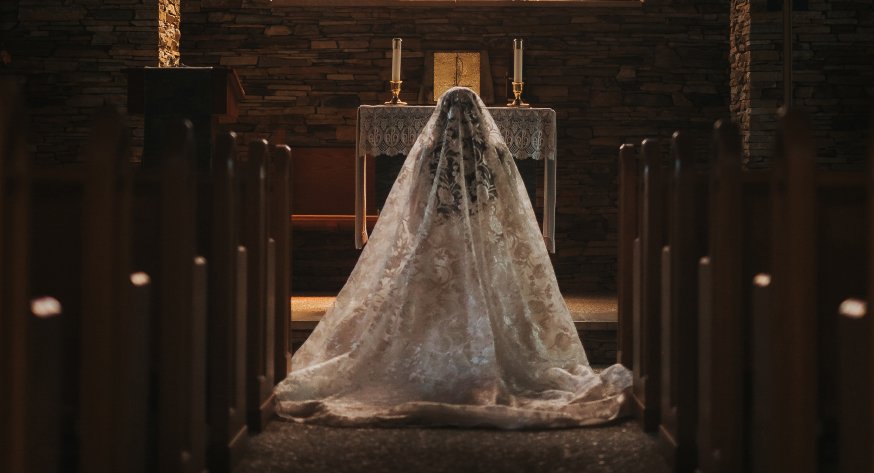
 |
| Charlene, Princess of Monaco |
I have worn hats or veils in church my entire life, except for a few confused years in the late seventies and early eighties. I have repeatedly had women say to me: "I wish we still did that" or "I wish I was brave enough to do that" or "I would wear one but I don't want to appear holier-than-thou." To the first objection, my response is that no one ever came down from heaven and began ripping women's veils off; if you want to wear a veil or a hat at Mass, then wear one. To the second objection, I say that it requires courage to shed one's blood for the Gospel; it does not require courage to wear a scrap of lace on your head. To the third objection, I can merely shake my head and query: "Holier-than-thou?" In seventh grade, at a Catholic school, I remember going into Mass with a gaggle of twelve-year-old veiled damsels who spoke in such a way that would make Cheech and Chong blush. I grew up seeing femmes fatales such asGrace Kelly, Jackie Kennedy, the Duchess of Alba, and Marlene Dietrich wearing mantillas, which speedily disabused me of the notion that wearing a veil confers automatic holiness. Not to mention the variety of feisty and eccentric characters among my own family and friends, and in my parish, who wore an expansive collection of veils and hats over the years, featuring everything from threadbare polyester lace to Parisian couture. None were angels, except perhaps the little girls and the nuns. I
remember when one of my aunts was an unmarried expectant mother,
wearing a cute headscarf at Mass over her stylish bob. I loved how her
scarf and dress matched and wanted the same look. (I was five.) My overall impression, which led to my own decision to veil, was that it is not a matter of conforming to what people might think, but a matter of devotion to God, according to the teachings of both Scripture and Tradition.
From Father Mike Johns at Word on Fire:
The practice of wearing a veil during Mass has seen a bit of a revival among Catholic women in recent times. Find a Catholic parish at random in which to attend Mass, and odds are that at least some of the women present will be wearing a veil. A quick internet search about veiling during Mass results in many articles and videos from both secular and religious outlets commenting on the practice. Some Catholic outlets even go so far as to recommend the use of the veil as a necessary outward sign of a wife’s submission to her husband.
St. Paul’s words in 1 Corinthians 11:3–16 are often at the center of such discussions. In this chapter of his letter, Paul is concerned to correct numerous liturgical abuses taking place among the Corinthians, and the subject of head coverings is at the top of his list. In the words of one Scripture scholar, “Women in Corinth, at least some of them, had stopped wearing head coverings in worship, and that bothered Paul.” In 1 Cor 11:3–16, Paul tackles this issue.
The Catholic Church, however, clearly teaches that the use of the veil is no longer obligatory for women. Under Pope St. Paul VI, the Church maintains that veils “no longer have a normative value” since in passages such as 1 Cor 11:3–16 Paul is addressing “disciplinary practices of minor importance.” In addition, the current Code of Canon Law has also lifted any obligation concerning the use of the veil for women in church. In classifying the use of the veil as a disciplinary practice of minor importance, the Church sees it as on par with other devotions, or perhaps even as a sacramental. That is, it can perhaps aid in the expression of Catholic piety but is not an essential component of faith.
At the same time, Paul’s arguments in 1 Cor 11:3–16 (and his letter as a whole) ought to be taken seriously. The letters of St. Paul are among the most beautiful and rewarding pages of the New Testament. This is especially true of the First Letter to the Corinthians, which has been called “Paul’s most practical and contemporary letter.” (Read more.)
More discussion from The Missive:
We receive Tradition as a holy gift, treasure it, and pass it on to those who come after us. We realize, in humility, that in the long run, Tradition will judge us and that it is really not for us to pass judgement on Tradition. Traditio sacra sacrorum tuitio. Sacred tradition is a safeguarding of sacred things, and more importantly, of being safeguarded by them. For those who are still being formed by Tradition – a formation that can indeed fill a lifetime – it may be hard to understand why it is so important for women to wear veils in church.
Let me begin with an experience that occurred to me some years ago now. Once, when I stopped for gas at a roadside convenience store, the attendant at the cash register saw me in my cassock and asked, completely at a loss, “What’s with…???” and motioned up and down with her hands to indicate that she was referring to my garb. She didn’t even know what to call it. At that time I was still a seminarian, and I explained to her that I was hoping to become a priest.
When we see a policeman or a soldier or a nurse, for example, we know who they are by the way they are dressed. And I hope that when you get ready to come to church, you dress with church in mind: you realize a distinctiveness in being in church. It is not like going anywhere else.
Proper attire for a woman, according to the Tradition given to us clearly by St. Paul in 1 Corinthians 11 and confirmed by Pope St. Linus, who was the second pope, right after St. Peter, is to wear a veil or head covering while in church. I have noticed that men tend to be good in observing the rule that applies to them, namely, that they should not wear a hat in church. I hope that if you saw someone wearing a baseball cap or a fishing hat in church, you would realize that this is not appropriate and indicate in some way to him that he needs to take it off.
Now, you might be wondering why a priest wears a biretta in church and could wear one even during the sermon. Some Fraternity priests do. The answer is that the biretta is a sign of office; a much more striking sign of a higher office is the bishop’s mitre, which he does wear when he preaches.
Dear faithful who are ladies, what I hope you will find in wearing the veil is that you have a particularly strong awareness of where you are, that you are focused completely on Our Lord and not worried about external appearance. (Read more.)
Tea at Trianon has has several posts on headcoverings, including HERE and HERE. A fabulous post, HERE.
Share











No comments:
Post a Comment