A place for friends to meet... with reflections on politics, history, art, music, books, morals, manners, and matters of faith.
A blog by Elena Maria Vidal.
"She was not a guilty woman, neither was she a saint; she was an upright, charming woman, a little frivolous, somewhat impulsive, but always pure; she was a queen, at times ardent in her fancies for her favourites and thoughtless in her policy, but proud and full of energy; a thorough woman in her winsome ways and tenderness of heart, until she became a martyr."
"We have followed the history of Marie Antoinette with the greatest diligence and scrupulosity. We have lived in those times. We have talked with some of her friends and some of her enemies; we have read, certainly not all, but hundreds of the libels written against her; and we have, in short, examined her life with– if we may be allowed to say so of ourselves– something of the accuracy of contemporaries, the diligence of inquirers, and the impartiality of historians, all combined; and we feel it our duty to declare, in as a solemn a manner as literature admits of, our well-matured opinion that every reproach against the morals of the queen was a gross calumny– that she was, as we have said, one of the purest of human beings."
"It is now sixteen or seventeen years since I saw the queen of France, then dauphiness, at Versailles; and surely there never lighted on this orb, which she hardly seemed to touch, a more delightful vision. I saw her just above the horizon, decorating and cheering the elevated sphere she had just begun to move in, glittering like a morning star full of life and splendor and joy. Oh, what a revolution....Little did I dream that I should have lived to see such disasters fall upon her, in a nation of gallant men, in a nation of men of honor and of cavaliers! I thought ten thousand swords must have leaped from their scabbards, to avenge even a look which threatened her with insult. But the age of chivalry is gone; that of sophisters, economists, and calculators has succeeded...."
~Edmund Burke, October 1790
A Note on Reviews
Unless otherwise noted, any books I review on this blog I have either purchased or borrowed from the library, and I do not receive any compensation (monetary or in-kind) for the reviews.
St. John's Eve and St. John's Day were like a summery Christmas in past times. From A Clerk of Oxford:
The first comes from the Menologium, a poem composed probably in the second half of the tenth century. The Menologium catalogues
the cycle of the year and the saints' feasts which occur in each month,
but it's much more than just a functional list; it combines useful
knowledge and Christian learning with the traditional images and
language of Anglo-Saxon poetry. I translated part of the section about
May, full of flowering meadows and noisy birds, in this post. The section quoted below (lines 106-119) describes the month of June - ærra Liða
is the Old English name - as far as June 24th, the feast of John the
Baptist and the traditional date of Midsummer Day. It follows on from
the section on May - naturally! - and so begins by dating the first of
June as the sixth day after the feast of St Augustine of Canterbury,
May 26th.
[...]
Ælfric's description of the sun in his homily on Rogationtide, and 'O Earendel', the Old English version of the antiphon 'O Oriens',
which falls on the winter solstice. The solstices and equinoxes were
intimately connected with the medieval understanding of the church year:
the spring equinox was crucial for the dating of Easter (as discussed here and here), and the solstices for celebrating the birth of Christ and of his herald, þeodnes dyrling, John the Baptist. Bede explains the symbolic relationship between the two solstices in his De temporum ratione:
very many of the Church’s teachers recount... that our Lord was
conceived and suffered on the 8th kalends of April [25 March], at the
spring equinox, and that he was born at the winter solstice on the 8th
kalends of January [25 December]. And again, that the Lord’s blessed
precursor and Baptist was conceived at the autumn equinox on the 8th
kalends of October [24 September] and born at the summer solstice on the
8th kalends of July [24 June]. To this they add the explanation that it
was fitting that the Creator of eternal light should be conceived and
born along with the increase of temporal light, and that the herald of
penance, who must decrease, should be engendered and born at a time when
the light is diminishing.
The study appeared in the journal Manuscript Studies. Researchers
examined 91 parchment manuscripts preserved at Duke University’s David
M. Rubenstein Rare Book & Manuscript Library. The collection
included religious texts, scrolls, legal records, fragments, and
manuscripts written in several languages. The documents came from
England, different parts of Europe, the Middle East, and northeastern
Africa.
For more than a thousand years, parchment served as the
main writing material across Europe and much of the Mediterranean
region. Unlike paper, parchment came from animal hides, usually sheep,
goats, or cattle. Millions of parchment documents still survive in
libraries and museums today. Researchers involved in the study describe
those collections as a large biological archive preserved across
centuries.
Scientists faced a major obstacle for years.
Traditional ancient DNA studies often require researchers to cut,
scrape, or drill into material samples. Archivists and conservation
experts rarely allow such methods on rare manuscripts because even small
damage matters when dealing with cultural heritage objects.
The
team used a different technique. Researchers gently rubbed the parchment
with small cytology brushes, the same type often used in medical
testing. The brushes collected tiny traces of cells from the surface
without leaving visible damage.
After sampling, scientists
extracted DNA from the brushes and analyzed the material with
next-generation sequencing technology. These sequencing methods work
well with old and fragmented DNA, which often survives in poor condition
inside ancient material. (Read more.)
In his short 24-year life, Baldwin IV celebrated many victories against his long-standing rival, Saladin. But his victory at the Battle of Montgisard
is undoubtedly his most famous victory. Still recalled by witnesses 80
years later, Baldwin faced impossible odds. Yet his courage and
fortitude ensured the 16-year-old Leper King delivered a crushing blow to his opponent.
King Baldwin IV came to the throne in 1174, a mere 13-year-old boy
following the death of his father, King Amalric. Like the other Crusader States, the Kingdom of Jerusalem
was a frontier kingdom, surrounded by hostile Muslim enemies. Warfare
and conflict were a fundamental part of life, and kings were required to
lead their troops into battle regularly.
King Amalric had offered the kingdom strong leadership and had been,
in many ways, an ideal king. The accession of a boy untested in warfare
was a huge blow to the kingdom. But youth was not the only hindrance to
Baldwin’s reign. Shortly after his coronation, Baldwin was diagnosed
with leprosy, his illness discovered by his tutor and friend, the
chronicler William, Archbishop of Tyre. (Read more.)
The Fall of the Kingdom of Jerusalem. Also from The Collector:
Crippled by leprosy since his teens, Baldwin IV had been a
surprisingly effective king. His illness elicited compassion from his
subjects, and their loyalty to their sick king was a key factor in the
success of his kingship. In 1185, Baldwin finally succumbed to his illness and died. He was buried close to his father in the Church of the Holy Sepulchre. Within two years of Baldwin’s death, the kingdom he had striven so
hard to defend had fallen into the hands of his longstanding Muslim
rival, Saladin. Events leading up to the Leper King’s death help explain why, after
his passing, the kingdom fell, and the city was lost to Christendom
forever.
Baldwin IV, the Leper King who defied a death sentence, was diagnosed
shortly after his coronation in 1174. It was understood that he would
not father any children to succeed him. His elder sister, Sybilla, and
his younger half-sister, Isabella, were therefore central to the
succession.
Sybilla married William of Montferrat in 1177, and by him she bore a
son named Baldwin. Montferrat died shortly before the child’s birth, and
Sybilla later married a second husband, Guy of Lusignan. By 1183, Baldwin became too ill to rule and needed a regent to govern
alongside him. Guy, as his brother-in-law and the husband of the
heiress to the kingdom, was the natural choice. Guy proved to be a poor
military commander whom the nobles refused to follow, and Baldwin
removed him from his post within weeks of his appointment.
Guy’s unpopularity meant that the prospect of him succeeding to his
brother-in-law’s throne was deeply contentious. Most vocal amongst those
in opposition to Guy was Raymond III of Tripoli, a cousin of Baldwin IV
and a man who served as his regent on several occasions. To ensure Guy would not succeed him and thus tear the kingdom apart,
Baldwin attempted to have Guy’s marriage to Sybilla annulled. But Guy’s
disobedience, along with Sybilla’s refusal to leave the husband she
loved, thwarted Baldwin’s plans. (Read more.)
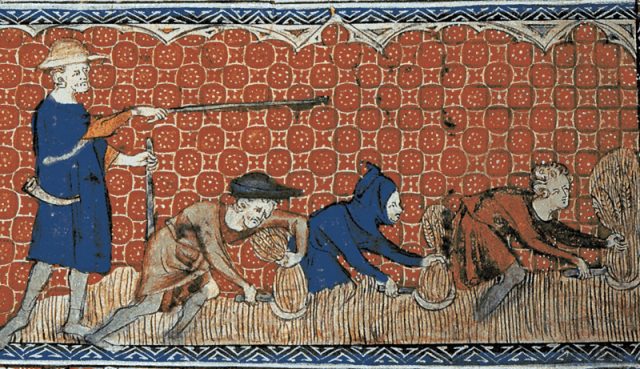
“Before capitalism, most people did not work very long hours at all,” wrote Schor in her book. “Consider a typical working day in the medieval period. It stretched from dawn to dusk (sixteen hours in summer and eight in winter), but, as the Bishop Pilkington has noted, work was intermittent – called to a halt for breakfast, lunch, the customary afternoon nap, and dinner.”
Depending on time and place, there were also midmorning and midafternoon refreshment breaks. These rest periods were the traditional rights of laborers, which they enjoyed even during peak harvest times. During slack periods, which accounted for a large part of the year, adherence to regular working hours was not usual. According to Oxford Professor James E. Thorold Rogers, the medieval workday was not more than eight hours.
Plowing and harvesting were backbreaking toil, no doubt, but the peasant enjoyed anywhere from eight weeks to half the year off.
The Catholic Church, mindful of how to keep a population from rebelling, enforced frequent mandatory holidays. Weddings, wakes, and births might mean a week off to celebrate, “and when wandering jugglers or sporting events came to town, the peasant expected time off for entertainment,” according to Business Insider. “There were labor-free Sundays, and when the plowing and harvesting seasons were over, the peasant got time to rest, too.”
In fact, Schor found that during periods of particularly high wages, such as 14th-century England, peasants might put in no more than 150 days a year. “All told, holiday leisure time in medieval England took up probably about one-third of the year,” she wrote in her book. “And the English were apparently working harder than their neighbors. The ancien règime in France is reported to have guaranteed fifty-two Sundays, ninety rest days, and thirty-eight holidays. In Spain, travelers noted that holidays totaled five months per year.” (Read more.)
Before we wrote things down on paper, we passed them down through oral
tradition. Ancestral lineages, mythologies, folk tales, and songs were
the sort of thing you might expect to hear recited around the hearth
each night. Eventually, trade records were inscribed on stone or
papyrus: the very first receipts. As cultures began to create more
symbols representing phonetic sounds, more things were recorded. By the
14th century, a wealth of information was available in the form of a
book. But who wrote them? Let’s learn about medieval scribes.
So, what is a scribe? “Scribe,” a contemporary word derivative of the medieval scrībere,
or “to write,” was a person whose entire life’s work consisted of
copying texts. The beauty of the scribe is in its diversity: a monk or
nun could be one as an act of devotion, a literate tradesperson could be
one for commission, even a creative courtesan could become a scribe if
they had the means.
Where you were writing and who the work was commissioned for largely
dictated the content of the work. For example, a monastery would likely
be commissioned to write a large religious text, whereas a private
scribe could be commissioned to copy secular works, such as Roman de la Rose,
one of the most popular stories of the period. In some unique cases,
the scribe had complete creative liberty over the content as well as the
style of the manuscript. (Read more.)
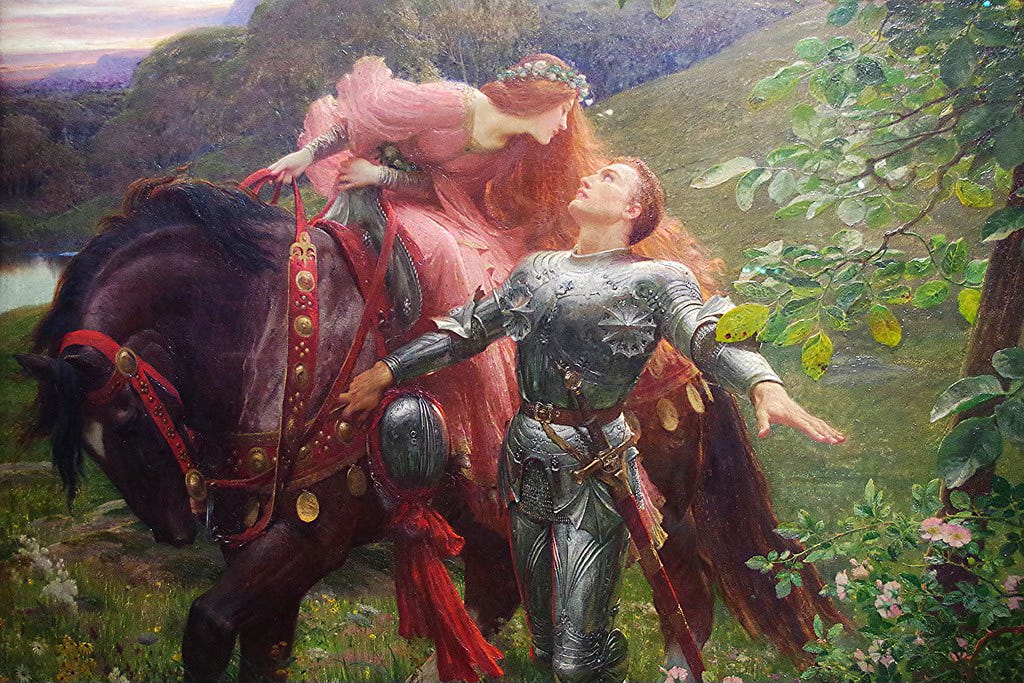
I love Arthurian legend, the basis for "courtly love" which the article refers to as "Arthurian" chivalry or "loverboy" chivalry. Courtly love was essentially invented by Eleanor of Aquitaine, inspired by the troubadour culture of the south of France, cultivated by her grandfather Duke William of Aquitaine. Queen Eleanor founded the "courts of love" in which great ladies would play lawyers and debate the highly romanticized and highly idealized manners and general behavior of their knighted admirers. It allowed women to hold forth upon matters of deportment and courtesy as well as discussing poems,songs and ballads. The bottom line was the respect and reverence which noble men were expected to show to noble ladies. It gave agency to women in an era of arranged marriages, when people did not marry for love. Women of all classes could be beaten by their husbands and mistreated in any number of ways. There was always the danger of both men and women finding love outside of marriage. Courtly culture acknowledged that such forbidden love happened but channeled it into chaste manifestations, because when actual adultery occurred it could lead to war, imprisonment or corporal punishment, depending upon the rank of the lady and her husband. Not a Christian ideal but then many think it was influenced by the Cathars, as I explore in my novel The Night's Dark Shade. From The Chivalry Guild Letters:
Carolingian chivalry is the essentially French version, and its mythos is the chansons de geste (“songs of great deeds”) involving Charlemagne and his paladins—the most famous of which is The Song of Roland.
Carolingianism is about war and God. It is the chivalry, Gautier
writes, of the “11th and 12th centuries—that of the crusades, that of
our [epic poetry]. It will appear rude and barbarous to some people, but
in truth is strong and healthy, and has formed for us the powerful race
whose glory has filled the world.” Roland and company don’t have much
time for the finer points of etiquette and don’t dedicate themselves to
idealized romantic love; they are too busy fighting Saracens and
protecting Christian civilization.
As for the more popular Arthurian or English chivalry, Gautier has less fond things to say. He writes:
The
romance of the Round Table spread amongst us the taste for a less wild
but also a less manly chivalry. The elegancies of love in them occupied
the place formally reserved for the brutality of war and the spirit of
adventure in them extinguished the spirit of the crusades. One will
never know how much harm this cycle of the Round Table inflicted on us.
It’s civilized us no doubt; but effeminated us. It took away from us our
old aim, which was the tomb of Christ gained by blood in battle. For
the austerities of the Supernatural it substituted the tinsel of the
Marvelous. It is to this dangerous but charming literature that we owe
for theatrical, the boastful, rash chivalry which proves so fatal during
the Thirty Years’ War.
This kind of chivalry also
gives birth to the satires of Cervantes and company, which aren’t making
fun of paladins defending Christendom but instead the errant knights
roaming the countryside looking for damsels to rescue. “And we must
confess,” Gautier notes, “that some complaints of the great satirist are
not without foundation.” (Read more.)
Modern discourse offers only impoverished models for women. Feminism
dismantled an older understanding of womanhood without replacing it with
a sustainable alternative. It treats the household as a prison,
motherhood as an obstacle to self-realisation, and the virtues
historically cultivated by women as instruments of oppression.
Ironically, in so doing, it foreclosed many of the domains by which
women wielded substantial influence over civilization.
The
reaction is equally impoverished despite its superficial conservatism.
The trad-wife thing, to take the obvious example, is a performance of
homemaking that lacks any serious theological or historical foundation.
It reduces womanhood to a visual display of domestic labour, detached
from the actual structures of authority, education, and spiritual
responsibility that characterised the aristocratic household. At bottom,
it is a reaction to feminism conducted on feminism’s own materialist
terms.
The home-schooling mother model
is a significant improvement but still shares a visceral and fatal
error which precludes its wider adoption. These approaches treat the
domestic as something small. None advances the majesty of the Christian
aristocratic tradition: that the household is the foundational unit of
civilisation, that its proper ordering is a matter of cosmic
significance, and that the woman who presides over it wields a form of
distinct and profound authority. (Read more.)
"Not to us, O Lord, not to us; but to thy name give glory." Psalm 113 (Vulgate), motto of the Templars
Once in a discussion with a fellow historical novelist I was informed that the crusades are the earliest examples of genocide. I was surprised that the novelist, being Jewish, seemed unaware of the various ancient persecutions against her own people, including that of the Greeks in the days of the Maccabees, that might be considered genocidal. I reminded her of that, as well as of the fact that there were twelve major crusades, taking place over nearly three hundred years. They were led by different people, with the principle goal of liberating the Holy Land from Muslim rule and thus delivering the Christian population from slavery and oppression. Some were more successful than others. Some, like the Fourth Crusade, were total disasters. In fact, the Fourth Crusade is the one which most people think of when they view the crusades as orgies of mass murder. In that case, those being killed were other Christians. Did other massacres of the innocent occur during the course of the various crusades? Yes. So, did the crusaders journey hundreds of miles to the Middle East, braving fatal diseases, pirates, brigands and an ocean of foes, just for the joy of killing people? That is one of the questions answered by Raymond Ibrahim in his brilliant trilogy about the centuries-long conflict between Christianity and Islam. Ibrahim's books are The Sword and the Scimitar, Defenders of the West, and The Two Swords of Christ. The books present a background to the crusades, containing detailed information of which most contemporary people are unaware, as well as the histories of heroes like El Cid and the rise of the two greatest military orders, the Templars and the Hospitallers.
In the early Church the practice of Christians was, even in the era of persecution, to visit the places where Jesus Christ had been born, lived, died and risen. Pilgrimages were regarded as highly penitential, in which the pilgrim would not only risk life and health, but leave behind property, home, family, occupation and offices. The Romans built pagan shrines over the venerable spots like the stable at Bethlehem and the Holy Sepulcher but those temples only served to remind everyone where the sacred sites were hidden. When Emperor Constantine legalized Christianity in the Fourth Century, his mother Empress St. Helena went on pilgrimage to the Holy Land, where she discovered not only the True Cross, but found and reopened many of the other places sacred to the memory of the Savior. This ignited centuries of pilgrimage to the Middle East. Rich and poor would go, often in parish-sponsored groups as now. Special costumes were worn when on pilgrimage, and one was often regarded as being temporarily in religious life when journeying to a holy site. For Jerusalem was not the only destination; there were shrines throughout Europe, including Rome and Compostela. But the pilgrimage to the Holy Land remained the ultimate of penitential practices, with many indulgences attached. People would go for themselves and for loved ones who were sick or who had died.
All this changed with the rise of Islam in the 7th century, meticulously described by Ibrahim in his book Sword and Scimitar. Founded by Mohammed, an Arabian who claimed to be a prophet of the One True God, Islam combined elements of Nestorian Christianity and Judaism with the prophet's own inspirations, many of which included teachings abhorrent to Judeo-Christian morality. One such teaching permits Muslim men to take a non-Muslim "infidel" woman by force. Mohammed commanded his followers to spread Islam by warfare. Within 200 years, the Christian lands in North Africa, Spain, Arabia, and the Middle East were conquered. Great Christian cities like Antioch and Alexandria, which had been Apostolic sees, fell to Islam, with the churches and basilicas becoming mosques. Christians, especially children, young men and young women, were made into sex slaves and concubines, including monks and nuns. Many boys were castrated to be eunuchs in the harems of the various Muslim elites. Hatred in the form of desecration was lavished upon Christian shrines, churches, monasteries, and cathedrals, with special contempt reserved for icons, church bells and crosses. The latter were dragged upside down through the streets, to be spat and urinated upon by the disciples of the prophet. Altars were sometimes desecrated by the gang-rape a Christian virgin. Those Christians and Jews who were not killed or sold were subject to oppressive laws and taxes in their own lands. This is documented in Muslim sources which repeatedly rejoice when describing the oppression of "infidels" and especially the defilement of Christian women.
A war-like, nomadic people called the Turks embraced Islam; they eventually overran the old Roman province of Anatolia so it became "Turkey." In the late 11th century, Jerusalem, which had fallen into Muslim hands before, was captured by the Seljuk Turks, who tortured, raped, and sold into slavery the Christians of the region. Those who were killed were regarded as lucky. The violence disrupted the flow of pilgrimages from Europe to the Holy Land. The Muslims made a point of harassing and robbing pilgrims, sometimes capturing them to be sold into slavery. Blond and red-haired girls and boys with blue, gray or green eyes were especially favored for the slave markets. Although one beautiful abbess from Germany, traveling with a group of pilgrims to Jerusalem, was waylaid by Muslim bandits and raped to death in front of her fellow Christians, who were also mistreated in various horrific ways. This led Pope Urban II at the Council of Clermont in 1095 to call for a crusade of Christian soldiers to deliver the Christians in the Holy Land. Thus began the era of the crusades. Defenders of the Westdescribes some of the great heroes of Christendom who kept Islam out of Europe, including at least one from Albania whom I had never heard of before. My opinion of Richard I "Lionheart" had suffered in the past but in Defenders he is revealed as among the bravest of the brave. The Two Swords of Christ traces the history of the two great military orders in a deeply inspiring way. For when the weak and innocent are attacked, it is unquestionably the duty of Christians who are able to defend them.
If I had to pick the best way to describe the recent works of Raymond Ibrahim—Sword and Scimitar(2018)and Defenders of the West (2022)—I’d
call them no-going-back books. The equally chilling and invigorating
experience of his histories cannot be undone and you cannot see the
world the same way afterwards—especially since it’s not just history,
but a forgotten prelude to what we’re living with today. Reality looks
different post-Ibrahim.
Sword and Scimitar
takes the reader through fourteen centuries of warfare between Islam and
the West, with emphasis on eight great battles within that conflict.
Better than any book I know, it dynamites the old public school
narrative about the Crusades as a brutal act of Christian aggression
against those poor, peaceful, tolerant Muslims. Ibrahim tells a much
darker story about our ancient adversaries, documenting the scale of
their conquests and the horrors that followed pretty much everywhere the
armies of the prophet went. What we call “the West,” he writes, is but
“the last and most redoubtable bastion of Christendom not to be
conquered by Islam. Simply put, the West is actually the westernmost
remnant of what was a much more extensive civilizational block that
Islam permanently severed.” Three-quarters of the formerly Christian
world was conquered by these people. It is both chilling and
invigorating, like I noted, to think about how much danger we were
in—and what kind of virtue was required to meet that danger and triumph
over it, at least for a time.
Defenders of the West
is an even more important book. It’s personal and compelling, and it
reverses a long trend of hiding Christian heroes from those of us who
need to learn about them. Thanks to Enlightenment propagandists, a vague
narrative persists that heroism basically died out after the
assassination of Julius Caesar and wasn’t revived again until Napoleon
and George Washington walked the earth. The intent is a broadside
against the Faith, leaving you with the vague impression that the
teachings of Christ and his Church effectively snuff out all martial
virtue, as though heroics cannot co-exist with the Gospel. Ibrahim shows
this to be absolute nonsense. With his chronicles of Godfrey of
Bouillon, El Cid, Richard the Lionheart, Fernando III, Louis IX, John Hunyadi, Scanderbeg, and Vlad Dracula, he brings to life eight legends whose deeds rival or exceed those of any heroes of any age.
These
works are, in my humble opinion, on the shortlist for books of the
century. So it was with special interest that I anticipated his
follow-up effort. The Two Swords of Christ(published November ’25) continues with his major theme but looks at a
different aspect of the conflict: the crucial work done by the Templars
and the Hospitallers, basically the special forces of Christendom.
Ibrahim’s
title comes from Luke 22, in which Jesus tells his disciples to buy a
sword. When they reply, “Look, there are two swords here,” Jesus says,
“It is enough!” What’s fascinating is his use of the singular pronoun it rather than the plural they. It suggests
not the swords, but a way of life that employs “a spiritual sword
against spiritual enemies, and a physical sword against physical
enemies.” If your religious education was anything like mine, your
teachers blithely passed over this and similar passages in favor of all
the nicer-sounding directives about loving everybody and just being
nice, along with never fighting—because fighting is unchristian. For
those looking for simplistic formulas for life, it’s far easier to
reduce the character of the Lord to that of a harmless meditation
instructor, rather than wrestling with the much more challenging and
dynamic truth.
The two swords also work as a metonymy for
the knightly orders, filled with men whose particular way of serving God
and their neighbors was with weapons. (Read more.)
All three books are so detailed in citing source material that one comes away with a refreshed world-view, for a deeper understanding of history leads to a more profound comprehension of the present. Plus Raymond Ibrahim is an engaging and descriptive writer so that I often felt I was watching a film of the events he has so richly described. I recommend this excellent trilogy for every home library and every college history class.
Unlike [Frederick II of Germany], Louis frequently ignored a
practical course of action that would derive a benefit for himself and
chose instead one that entailed suffering for the benefit of the Church
and Christendom. Of all the problems that beset Christian life, the
continual harassment by the Saracens of the Holy Places, the pilgrims
and the few hundred knights that protected them troubled Louis the most.
In 1248 he embarked on an extremely well planned crusade against the
Sultan of Egypt since Palestine at that time was under his control. Once
again the crusaders stormed and captured Damietta on the eastern branch
of the Nile. Proceeding up the river on the right bank towards Cairo,
they arrived at the fortress of Mansourah. Robert of Artois, the King’s
oldest brother, crossed the protecting channel, routed a detachment of
guards and rode on to an enemy encampment outside the wall where they
killed everyone they found. Instead of returning to guard the bridgehead
and allow the main body of Louis’ army to cross and reinforce him,
Robert impetuously invaded the fortress. That blundering imprudence cost
him and 280 knights, most of them Templars, their lives.
With the threat of torture and death hanging over his head, the embattled saint carried himself with such dignity that the impressed Moslems agreed to release him and many other prisoners upon the surrender of Damietta and the payment of a large ransom.
Awhile ago I listened to a fabulous book on the Templars by historian Barbara Frale, who spent years researching in the Vatican secret archives. Templars were not ordained to the priesthood but professed vows like monks. They were accused of heresy by King Philip IV of France. The Templars were absolved of the accusations of heresy by the Pope, only to be executed by King Philip. Philip wanted the wealth of the Templars and would stop at nothing to get it. The execution of the Templar Grand Master Jacques de Molay and his brethren was in violation of Church law, rather like the execution of St. Joan of Arc. When Jacques de Molay was bound to the stake on an island in the Seine near Notre Dame de Paris, he asked that his arms remain free. While burning, the Grand Master lifted his arms towards the spire of Notre Dame, offering his life to Our Lady, as once his order had been completely consecrated to her. From Dominic Selwood:
In
Paris, King Philip immediately saw that the tide was turning against
him, and that he needed to do something decisive. He therefore summoned
the bishop of Sens and forced him to re-examine the Templars in his
diocese. When 54 Templars insisted on their innocence, the bishop
dutifully denounced them as relapsed heretics.
As Philip had known
all along, a heretic who confessed was welcomed as a lost sheep, given
penance, and reconciled to the Church. But if the penitent then slipped
back into the heresy, he had rejected all grace, spurned salvation, and
was a direct threat to Christian society.
On the 12th of May 1310,
as Philip knew he would, the bishop of Sens burned the 54 Templars
alive. This appalling cruelty gave Philip the shot in the arm he needed.
The remaining Templar resistance petered out.
The sorry tale was
drawing to a close. In October 1311, the long-awaited Council of Vienne
opened to give final judgement. The evidence did not amount to much. The
only Templars who had comprehensively confessed to Philip’s 127 charges
were the ones tortured in his dungeons or those in territories loyal to
him. There were virtually no confessions from abroad.
True to
form, Philip showed up to threaten Clement with physical violence unless
he shut down the Templars. There were protests from the other church
delegates, who felt the Templars had not been given an opportunity to
defend themselves. They also pointed to the suspicious similarity of the
charges with those Philip had recently brought against the dead Pope
Boniface VIII. None of this helped Clement, who threatened anyone who
spoke further with excommunication.
Finally clear to impose Philip’s will, in March 1312, with Philip and his son flanking him, Clement issued the bull Vox in excelso.
Citing the irreparable damage done to the Templars’ reputation, he
pronounced judgement with a formula that completely sidestepped the
question of innocence or guilt:
We suppress, with the approval of
the sacred council, the order of Templars, and its rule, habit and name,
by an inviolable and perpetual decree, and we entirely forbid that
anyone from now on enter the order, or receive or wear its habit, or
presume to behave as a Templar. (Vox in excelso)
It was
over. All that remained was to tie up the loose ends. Templars who had
confessed crimes were sentenced to imprisonment. Those who had remained
silent were sent to other religious Orders.
To draw down the final
curtain, on the 18th of March 1314 the four most senior living Templars
were hauled to Paris. On a rostrum erected on the parvis before the
great cathedral of Notre-Dame, they were publicly condemned to perpetual
imprisonment. Hugues de Pairaud and Geoffroi de Gonneville accepted the
sentences in silence. But Jacques de Molay and Geoffroi de Charney
stunned the crowd by talking over the cardinals and professing their
innocence and that of the Temple.
The electrifying news was rushed
across the city to King Philip at the Louvre. Desperate to crush this
dangerous new defiance, he abandoned all legal procedures and ordered
the two old Templars to be burned without delay.
So as dusk fell and the canons of Notre-Dame lit the candles and incense for the lucernare before
Vespers, the provost of Paris’s men torched two nearby pyres and sent
de Molay and de Pairaud up in smoke alongside the canons’ prayers.
A royal chaplain eyewitness described de Molay’s last words (in verse):
“God
knows who is in the wrong and has sinned. Misfortune will soon befall
those who have wrongly condemned us; God will avenge our deaths. Make no
mistake, all who are against us will suffer because of us. I beseech
you to turn my face towards the Virgin Mary, of whom our Lord Christ was
born.” His request was granted, and so gently was he taken by death
that everyone marvelled. (Geoffroi de Paris)
Rumours began to
circulate that, at the end, de Molay had also shouted out, summoning
Philip and Clement to meet him within a year and a day before God, where
they would be judged for their crimes. (Read more.)
Chivalry, as we said, wasn’t only a martial code. It
was a way of life. It was, as one scholar put it, the “framework for
lay society” in the Middle Ages. The Middle Ages, meanwhile, were
nothing more or less than the application of Christianity to the whole
of society. The so-called Dark Ages nearly severed the former Roman
Empire from its pagan roots. Every aspect of religious, political,
economic, military, and cultural life was reorganized by the Church
along Christian grounds; that was their only point of reference.
The Church was unfettered from control by emperors and dictators.
Slavery was abolished. Every aspect of public and private life was
ordered to the salvation of souls through the Faith.
I have written here before that the West is on its way to another
Dark Age. Ours is no longer a Christian society, but a pagan one. Our
liberal democracies are now succumbing to the same twin errors—decadence
and gnosticism—that destroyed the Roman Empire. Within a few centuries,
nothing of the old order will remain. We Christians will have to
rebuild civilization from its ruins. It’s only natural, then, that we
should look to the Middle Ages for guidance.
Rod Dreher has been thinking along these lines for years. His book The Benedict Option
urged us to look to the example of another great Medieval saint,
Benedict of Norcia, for inspiration on how to build strong “intentional
communities”: bastions of Christendom, safe-havens for the faithful,
which can withstand the terror that will inevitably follow when our own
Empire collapses. I agree with him wholeheartedly.
Yet it won’t be enough to build intentional Christian communities. We must also build intentional Christian men. Those
men must be capable of building those communities and, when the time
comes, defending them against the barbarian hordes—winning new souls for
God all the while. To this end, I propose that we also follow the
example of Saint Francis of Assisi. Call it the Francis Option. (Read more.)
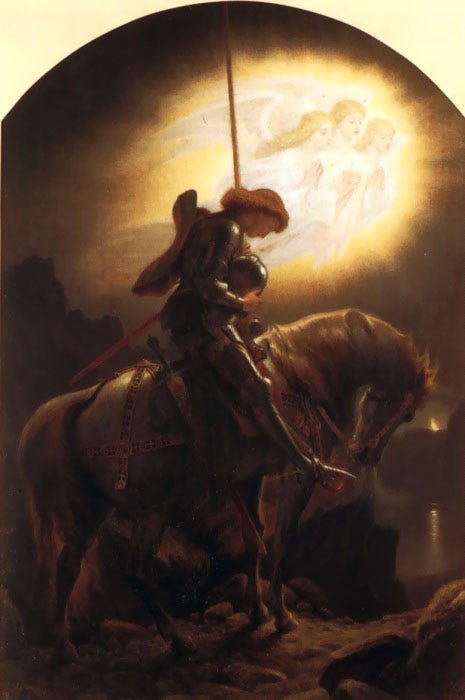
SS. Michael, Margaret and Catherine appear to St. Joan
If I had to pick the best way to describe the recent works of Raymond Ibrahim—Sword and Scimitar (2018)and Defenders of the West (2022)—I’d
call them no-going-back books. The equally chilling and invigorating
experience of his histories cannot be undone and you cannot see the
world the same way afterwards—especially since it’s not just history,
but a forgotten prelude to what we’re living with today. Reality looks
different post-Ibrahim.
Sword and Scimitar
takes the reader through fourteen centuries of warfare between Islam and
the West, with emphasis on eight great battles within that conflict.
Better than any book I know, it dynamites the old public school
narrative about the Crusades as a brutal act of Christian aggression
against those poor, peaceful, tolerant Muslims. Ibrahim tells a much
darker story about our ancient adversaries, documenting the scale of
their conquests and the horrors that followed pretty much everywhere the
armies of the prophet went. What we call “the West,” he writes, is but
“the last and most redoubtable bastion of Christendom not to be
conquered by Islam. Simply put, the West is actually the westernmost
remnant of what was a much more extensive civilizational block that
Islam permanently severed.” Three-quarters of the formerly Christian
world was conquered by these people. It is both chilling and
invigorating, like I noted, to think about how much danger we were
in—and what kind of virtue was required to meet that danger and triumph
over it, at least for a time.
Defenders of the West
is an even more important book. It’s personal and compelling, and it
reverses a long trend of hiding Christian heroes from those of us who
need to learn about them. Thanks to Enlightenment propagandists, a vague
narrative persists that heroism basically died out after the
assassination of Julius Caesar and wasn’t revived again until Napoleon
and George Washington walked the earth. The intent is a broadside
against the Faith, leaving you with the vague impression that the
teachings of Christ and his Church effectively snuff out all martial
virtue, as though heroics cannot co-exist with the Gospel. Ibrahim shows
this to be absolute nonsense. With his chronicles of Godfrey of
Bouillon, El Cid, Richard the Lionheart, Fernando III, Louis IX, John Hunyadi, Scanderbeg, and Vlad Dracula, he brings to life eight legends whose deeds rival or exceed those of any heroes of any age.
These
works are, in my humble opinion, on the shortlist for books of the
century. So it was with special interest that I anticipated his
follow-up effort. The Two Swords of Christ
(published November ’25) continues with his major theme but looks at a
different aspect of the conflict: the crucial work done by the Templars
and the Hospitallers, basically the special forces of Christendom.
Ibrahim’s
title comes from Luke 22, in which Jesus tells his disciples to buy a
sword. When they reply, “Look, there are two swords here,” Jesus says,
“It is enough!” What’s fascinating is his use of the singular pronoun it rather than the plural they. It suggests
not the swords, but a way of life that employs “a spiritual sword
against spiritual enemies, and a physical sword against physical
enemies.” If your religious education was anything like mine, your
teachers blithely passed over this and similar passages in favor of all
the nicer-sounding directives about loving everybody and just being
nice, along with never fighting—because fighting is unchristian. For
those looking for simplistic formulas for life, it’s far easier to
reduce the character of the Lord to that of a harmless meditation
instructor, rather than wrestling with the much more challenging and
dynamic truth.
The two swords also work as a metonymy for
the knightly orders, filled with men whose particular way of serving God
and their neighbors was with weapons. (Read more.)
In the 9th century, the County of Aragon was part of the Frankish dominion, ruled over by the Carolingians.
Its people had weathered the storm that accompanied the fall of the
Roman Empire and the ensuing chaos afterwards. In the 900s, Aragon came
under the rule of the Kingdom of Pamplona (also known as Navarre). The county’s capital was located in the small city of Jaca in the northeast of the Iberian Peninsula.
After the death of King Sancho III
of Navarre in 1035, his kingdom was partitioned into multiple
territories. One of the territories contained Sobrarbe, Ribagorza, and
Aragon, all of which went to different nobles. However, the rulers of
Sobrarbe and Ribagorza both died, enabling Sancho’s illegitimate son
Ramiro to annex both territories
into his realm. Despite being nominally linked to Navarre, Ramiro’s
expanded Aragon now became one of the larger states in the region.
Ramiro never personally called himself the King of Aragon, although
his subjects referred to him as king, and he is known to history Ramiro I
of Aragon. His rule was brief and focused on expanding the kingdom’s
borders. In 1063, he died while unsuccessfully besieging the city of Graus from the Castilians. He was succeeded by Sancho Ramirez, his eldest son. (Read more.)
Burton’s awareness and interest in the specific story of Hellelil and
Heldebrand can likely be traced to his friend Whitley Stokes, a Celtic
scholar who translated and published the medieval Danish ballad in the
mid-1850s.
In the story, the noblewoman Helleil fell in love with one of her
personal guards, Heldebrand, Prince of Engelland. When her father finds
out about the affair, he, along with his seven sons, set out to kill
Heldebrand. In an act of honor, Heldebrand fights her kin, killing the
father and six of the seven brothers. Hellelil, watching from afar,
calls out to her beloved before he slays the youngest brother, asking
him to stay his hand. Though Heldebrand spared him, the brother took it
as a moment of opportunity and dealt Heldebrand a mortal blow in return.
Ultimately, after relating the series of events to her mother, Helleil
died of a broken heart.
Like many medieval love stories, it is a tragic one, and Burton takes
focus on the poignant last meeting of the ill-fated lovers. Hellelil is
turned away in sorrow, stepping up the turret stairs to safety, and a
trampled white rose, a symbol of innocence and purity, lies trampled
near her feet. Heldebrand moves down the stairs to go meet her father,
brothers, and, unbeknownst to him, his demise, holding her arm in a
farewell embrace. It is a tender, prescient moment that bears the weight
of what is to come. (Read more.)
In wealthy households, bathing was
carefully staged rather than casually undertaken. Servants prepared
wooden tubs filled with heated water, hung tapestries for warmth and
privacy, and supplied scented sponges, oils, and cloths. Bathing here
was as much ceremony as hygiene. Monasteries also maintained bath
facilities, though monks generally bathed infrequently, often only on
feast days or for medical reasons.
For
most people, bathing was simpler and more practical. Peasants washed in
rivers during the warmer months or used basins at home when water could
be spared. Heated baths were rare luxuries. Only nobles and prosperous
townspeople enjoyed them regularly. Even so, kings were not exempt from
the need to wash. King John travelled with his own bathtub, while Edward
III installed hot and cold running water at Westminster Palace.
Across
the Alps, bathing culture was even more deeply rooted. In Italy,
long-standing spa traditions endured. A fourteenth-century physician,
Pietro de Tussignano, laid down strict rules for visitors to an Alpine
bath: bathers were to arrive fasting and shaved, swim daily, and abstain
from sex in order to purge bodily impurities. Soldiers on campaign
sometimes carried portable tubs, while retired clergy in France
occasionally installed private baths of their own. The familiar image of
a universally filthy Middle Ages becomes difficult to sustain when set
beside such scenes of steaming water and scented herbs. (Read more.)
Galahad’s role in the Arthurian legend, particularly his quest
for the Holy Grail, is a later addition to the mythos. His character
first emerges in the 13th century within the “Lancelot-Grail” (Vulgate)
Cycle, a series of Arthurian romances that expanded the legend and
positioned Galahad as central to the Grail quest. The name Galahad is
thought to derive from the Welsh Gwalchaved, meaning “Falcon of Summer,” linking him to Celtic origins and mythological traditions.
The
original portrayal of Galahad may have been influenced by the mystical
ideals of the Cistercian Order and figures like St. Bernard of
Clairvaux, whose vision of ascetic, spiritualized knighthood echoed
through Galahad’s character. This is reflected in Galahad’s celibate and
otherworldly nature, his white shield bearing a vermilion cross, and
his embodiment of Catholic warrior asceticism, mirroring the ideals
outlined in St. Bernard’s Liber ad milites templi de laude novae militiae for the Knights Templar. (Read more.)
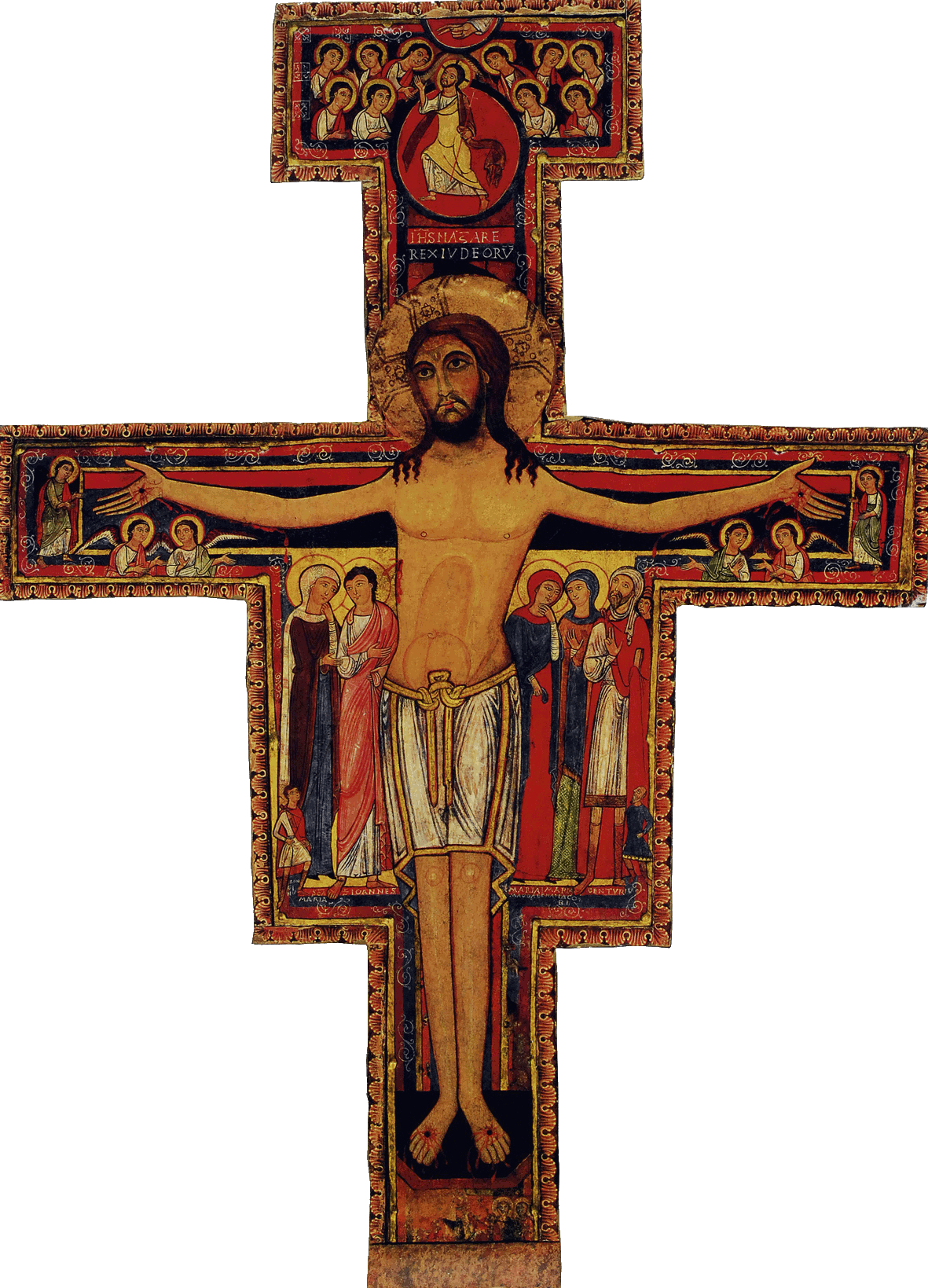
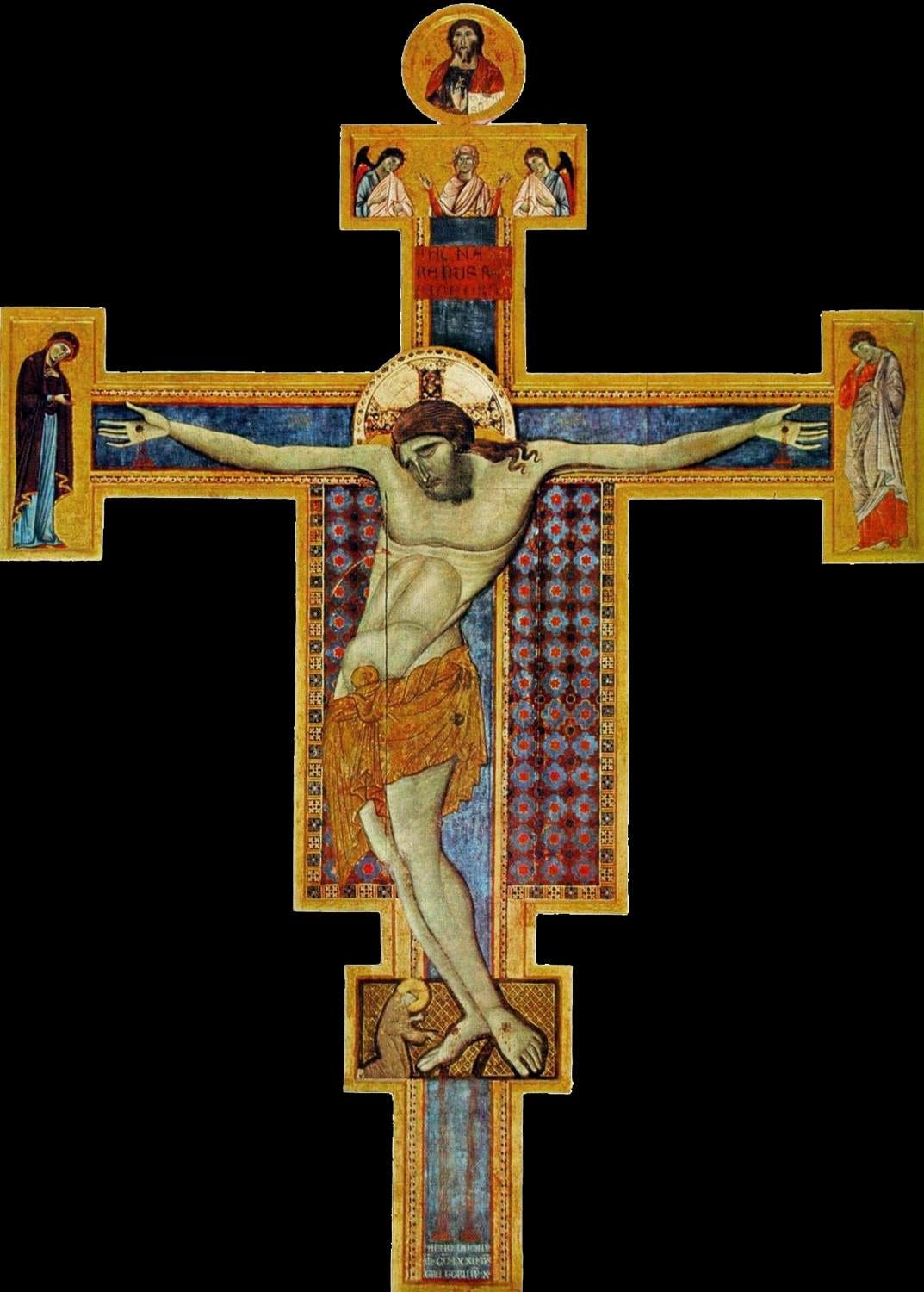
These icons were in the line of a movement that started in the 12th
century of showing the physical and real suffering and death of Christ
on the cross that led to the naturalistic depictions of the crucifixion
we’re familiar with today. The intention is to generate an emotional
response of pity, empathy, sorrow and repentance in the viewer. And this
is part of a greater spiritual movement that was later to be
popularised by the new mendicant orders, Franciscans and Dominicans, who
emphasized the importance of Christ's human and physical suffering and
our own ability to “enter into” and participate in it through our
affections. Of course, the creation of sacred art is a key component of
this kind of evangelisation.
[...]
As such, the artistic development of these paintings over the
following 200 years would be part of a larger and permanent change in
the way Christians thought about Christ, their ideas of having a genuine
affective relationship with a real person, who knew pain and understood
them at a visceral level. The Italo-Byzantine and Duecento panel
paintings showing Christ in agony only intensified as more natural
looking figures were created.
Master
of St. Francis. Perugia National Gallery. It’s impossible for a photo
to do justice to it. It smacks you in the head when you walk into the
very large room it’s housed in. At least 12 feet tall. You have to stand
on the other side of the room to take the whole thing in.
And
this movement, in both spirituality and art, is thought by some
scholars as a response to the materialist ideas of the Cathar heresy1
that was spreading in Northern Italy and southern France at the time.
In the early 12th century the idea that Christ was just a man and His
death was of no redemptive significance, were growing.
The
Cathars adopted the ancient Manichaean dualistic ideas of two gods; an
evil god who created material reality and a good god who created
spiritual beings like angels and human souls. The soul was entrapped in
the material body and had to be released by a process of spiritual
purification and ultimately death. Catharism rejected Catholic
sacraments and authority, including the Bible, and its popularity
ultimately threatened the political and economic stability of Europe.
Of
course this all meant that the Cathars also rejected the redemptive
value of the crucifixion, holding that Jesus was just a human being,
perhaps inspired by the Holy Ghost, and that the only way to be “saved”
was to free the soul from the evil material world. (Read more.)
William Sandys
(1792-1874) was an antiquarian by hobby—a “person who collects or
studies old things” or “a student of the past,” according to Webster’s.
The things Sandys happened to collect were Christmas songs. His 1833
publication Christmas Carols Ancient and Modern
helped to launch the Victorian revival of the holiday, a revival that
followed centuries of puritan neglect.[*] Sandys claimed in his book to
have unearthed English yuletide songs dating back four centuries. Making
their first appearance in print were many carols we now take for
granted, such as “The First Noel,” “God Rest Ye Merry, Gentlemen,” and
“Hark, the Herald Angels Sing.”
Although it hasn’t
soared to those heights of popularity, “Tomorrow Shall Be My Dancing
Day” is richly fascinating nonetheless. The text has turns of phrase
redolent of the Middle Ages or Renaissance, yet no source for the song
prior to Sandys has been found. What is most remarkable about “Dancing
Day” is that it narrates the entire story of Christ’s life in Christ’s
own voice, and that it describes the story of salvation with the image
of a dance:
Tomorrow shall be my dancing day;
I would my true love did so chance
To see the legend of my play,
To call my true love to the dance.
Refrain:
Sing, oh! My love, oh! My love, my love, my love, This have I done for my true love.
Most scholars agree
that the text goes back far earlier than 1833, with the phrase “legend
of my play” a possible clue that the carol was connected to the medieval
mystery plays. Musicologists Hugh Keyte and Andrew Parrott write:
It seems possible that
‘Tomorrow shall be’ was devised to be sung and danced at the conclusion
of the first day of a three-day drama . . . The actor portraying Christ
would have sung the verses and the whole company and audience the
repeats of the refrains.
Hymn texts in which Christ himself speaks—a device one commentator refers to as vox Christi—are rare, making a theatrical origin for “Dancing Day” even more likely.
Mystery plays were one
of the three distinctive medieval forms of theater, the other two being
miracle plays and morality plays. All three types evolved out of short
scenes performed in church by the clergy as an adjunct to the liturgy
and depicting biblical subjects such as the Creation, Adam, and Eve, or
the Last Judgment. Mystery plays eventually moved out of church premises
into the village square, often traveled from town to town on wagons,
and became increasingly elaborate.
As the plays traveled
to various locales, they were often advertised by the players in a song
called a “banns.” If our carol originally formed part of a mystery play
about the life of Christ, the “dancing day” on the “morrow” might refer
to the subsequent part of the play, treating the Redemption.
Most striking is the
relationship between Christ and humanity being likened to that of a
lover and his “true love,” with the refrain’s expressive repetitions of
“my love.” This motif hearkens back to the love poetry of the Song of Songs,
in which the lover and beloved are traditionally interpreted as
representing Christ and the church or Christ and the soul. The idea of
Christ and humanity being united as bridegroom and bride is a classic
Christian motif, but we are surprised to find it in a popular Christmas
carol, and even more to find the image extended to depict Christ as our
dancing partner. There is a good amount of theology and scripture in
“Dancing Day,” such as the treatment of the Incarnation:
Then was I born of a virgin pure;
Of her I took fleshly substance.
Thus was I knit to man’s nature
To call my true love to the dance.
In a manger laid and wrapped I was,
So very poor; this was my chance,
Betwixt an ox and a silly poor ass,
To call my true love to my dance.
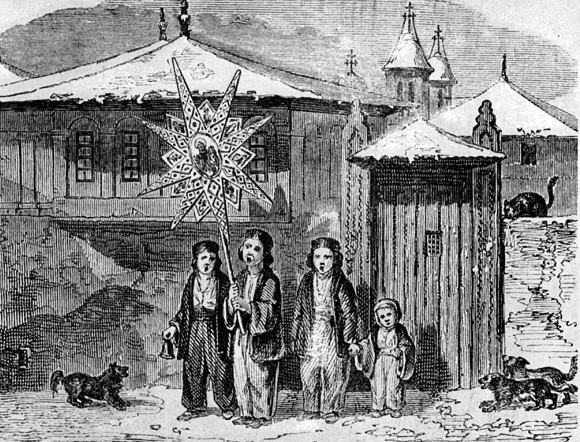
The story of Christmas caroling is full of unexpected surprises. The
practice itself has gone through many changes over the centuries, and
our perception of caroling today is based only on the very recent
history. We think of Christmas caroling as a wholesome, and even
religious, activity. Caroling seems to speak of the beauty, innocence,
and magic of the Christmas season. However, in researching this
practice, I have discovered that caroling was not as innocent as we
might think. In fact, the act of caroling was actively combatted by the
Church for hundreds of years.
Uncovering the origins of caroling has proven difficult. Some sources
give the 14th or 15th centuries as the earliest date for caroling. I
believe the reason for this is because this is the period when caroling
began to be adopted by the church, and this is when carols first began
to be written down. However, there is much evidence that caroling was
around long before that. We don’t have written carols from the early
periods, but what we do have are edicts from the Church and recorded
sermons which make reference to caroling. (Read more.)
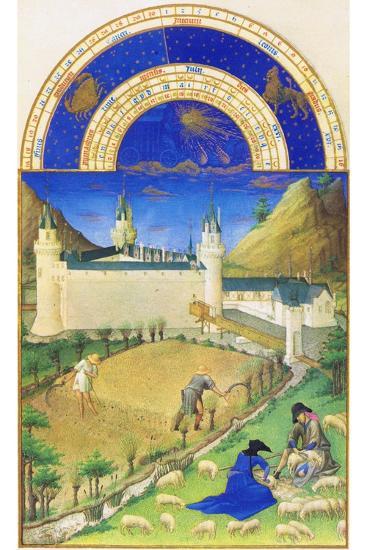
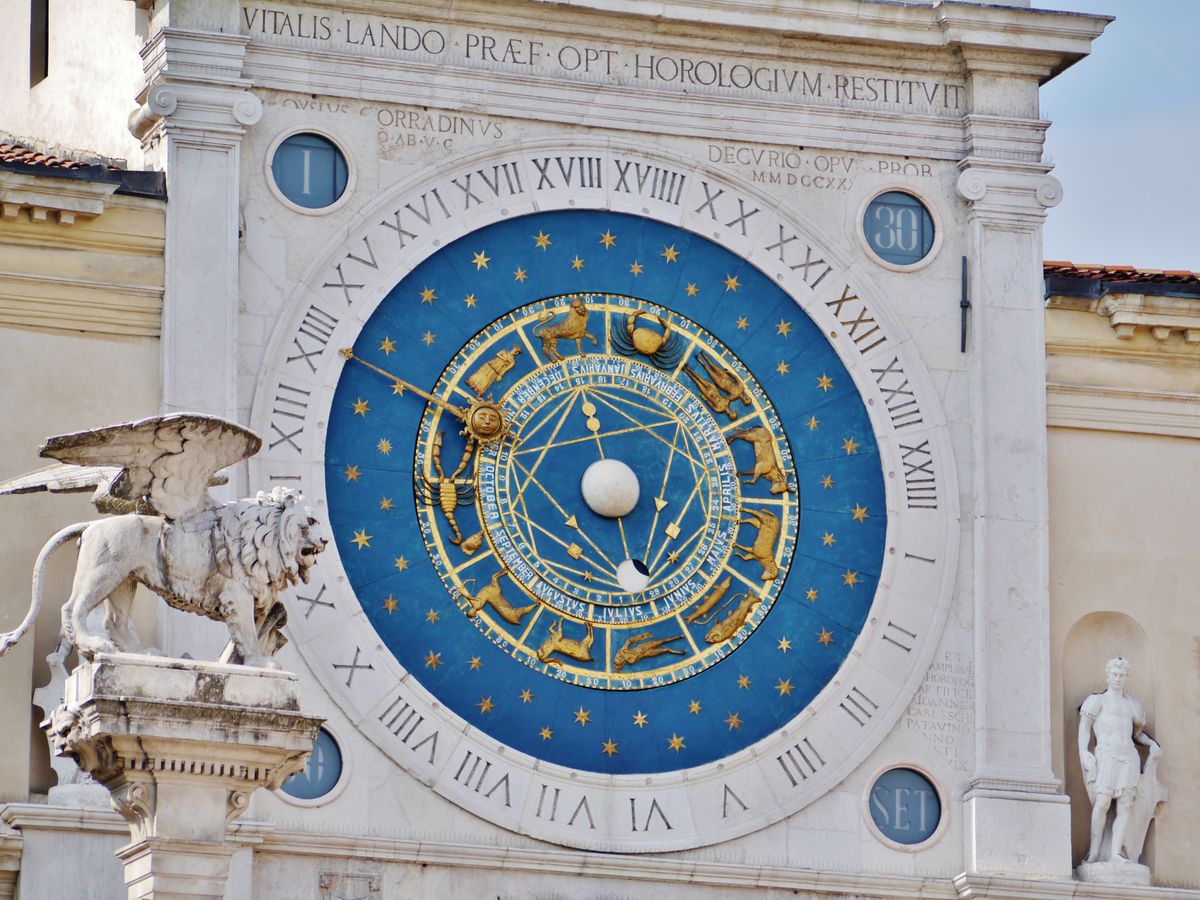
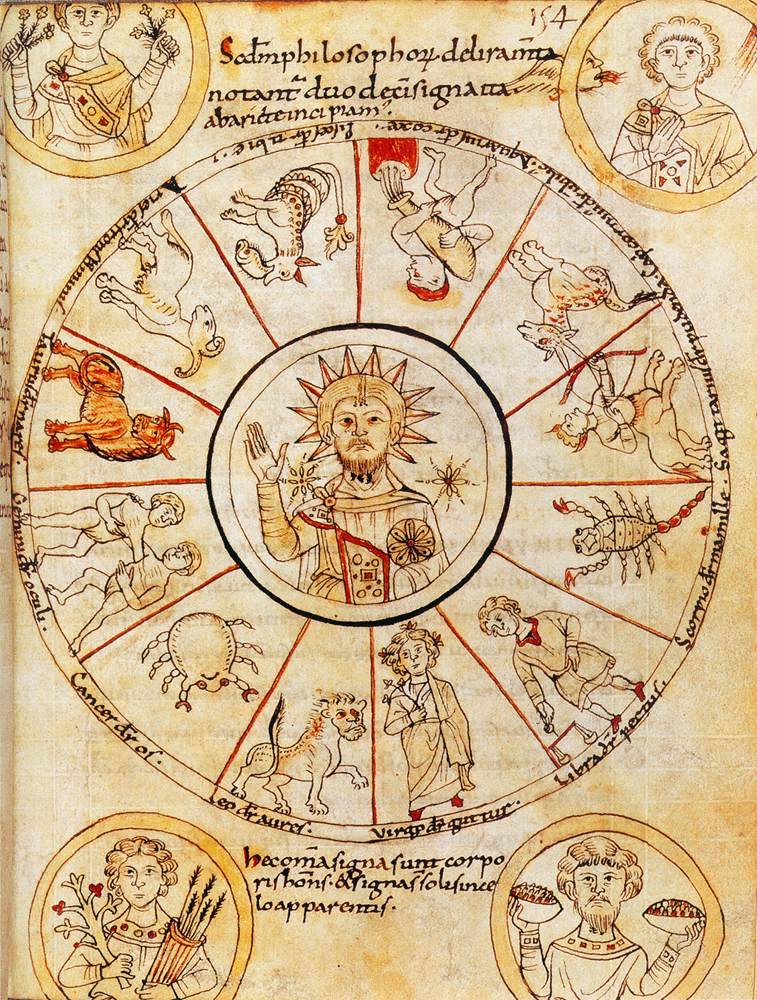
If you ever wondered why zodiac signs often appear in old missals and breviaries (books of hours), in medieval art and on Renaissance clocks, it is because, while the Church bans divination and fortune-telling, it has never banned what is called "natural astrology" which, for most of the history of the world, was counted among the sciences. It is why many saints such as St. Hildegard, St. Thomas Aquinas, and St. Albert the Great, whose feast is today, and other holy persons, referred to the zodiac in their medical writings and "scientific" treatises. From Marina Marchione at Darkstar Mythology:
For much of history, the study of the stars was not a mystical art, but a
science. The same doctors who tended the sick and studied anatomy also
charted the movements of the moon and planets. To a medieval physician,
the heavens and the body were woven together in one great pattern of
divine design. Understanding that pattern was seen as an act of
reverence for the Creator, not a defiance of Him.
In the great universities of the Middle Ages — Paris, Bologna, Oxford
— medical students learned both astronomy and astrology. Astronomy
meant the measurement and geometry of the heavens: how the moon moved,
how eclipses worked, and how to calculate the calendar. Astrology meant
understanding how those heavenly rhythms affected life on earth —
weather, crops, tides, and the human body.
The body itself was
believed to reflect the cosmos. Medieval manuscripts often show the
“Zodiac Man,” a figure mapped from head to foot with the twelve signs:
Aries ruling the head, Taurus the neck, Leo the heart, Pisces the feet.
The
moon’s monthly journey through those signs guided physicians in their
timing of treatments. They believed that when the moon was passing
through the sign that governed a particular part of the body, that area
was more “sensitive” — so operations or bloodletting were best avoided
then.
This was not superstition to them, but science — an attempt
to work with the rhythms of nature rather than against them. Their
calendars of moon phases and star signs were tools for health, just as
stethoscopes are today. (Read more.)
Marie-Antoinette "en gaulle" by Elisabeth Vigée-Lebrun
Generalissima: A Novel of Henrietta Maria
Book Two in the "Henrietta of France Trilogy"
#1 in Kindle Biographies of Royalty!
Marie-Antoinette, Daughter of the Caesars: Her Life, Her Times, Her Legacy
An Audible Bestseller
Marie-Antoinette, Daughter of the Caesars: Her Life, Her Times, Her Legacy
An Amazon Bestseller
Trianon: A Novel of Royal France
My Queen, My Love: A Novel of Henrietta Maria
Available from Amazon
The Saga of Marie-Antoinette's daughter, Marie-Thérèse of France
A Novel of the Restoration
In Kirkus Top 20 for 2014! And #1 in Kindle Historical Mystery, Thriller & Suspense Fiction
"In every Eden, there dwells a serpent . . . ."
#1 in Kindle History of France!
The Night's Dark Shade: A Novel of the Cathars
Join me on Facebook!
Elena Maria Vidal Author Page
Join me on X!
@emvidal
Visit My Tumblr!
East of the Sun, West of the Moon
St. Teresa of Avila, pray for us!
"...Bud forth as the rose planted by the brooks of waters. Give ye a sweet odor as frankincense. Send forth flowers, as the lily...and bring forth leaves in grace, and praise with canticles, and bless the Lord in his works." —Ecclesiasticus 39:17-19
The fact that a link is provided here in no way constitutes an endorsement of everything on the other end of the link.
Comments Policy
Comments are moderated. If a comment is not published, it may be due to a technical error. At any rate, do not take offense; it is nothing personal. Slanderous comments will not be published. Anonymity may be tolerated, but politeness is required.
I would like to respond to every comment but my schedule renders it impossible to do so. Please know that I appreciate those who take the time to share their thoughts.