Showing posts with label Headcoverings. Show all posts

Saturday, May 23, 2026

What Does St. Paul Say About Veils?

https://fssp.com/wp-content/uploads/Wedding-Veil-Cropped-1.jpg 

Charlene, Princess of Monaco

 I have worn hats or veils in church my entire life, except for a few confused years in the late seventies and early eighties. I have repeatedly had women say to me: "I wish we still did that" or "I wish I was brave enough to do that" or "I would wear one but I don't want to appear holier-than-thou." To the first objection, my response is that no one ever came down from heaven and began ripping women's veils off; if you want to wear a veil or a hat at Mass, then wear one. To the second objection, I say that it requires courage to shed one's blood for the Gospel; it does not require courage to wear a scrap of lace on your head. To the third objection, I can merely shake my head and query: "Holier-than-thou?" In seventh grade, at a Catholic school, I remember going into Mass with a gaggle of twelve-year-old veiled damsels who spoke in such a way that would make Cheech and Chong blush. I grew up seeing femmes fatales such asGrace Kelly, Jackie Kennedy, the Duchess of Alba, and Marlene Dietrich wearing mantillas, which speedily disabused me of the notion that wearing a veil confers automatic holiness. Not to mention the variety of feisty and eccentric characters among my own family and friends, and in my parish, who wore an expansive collection of veils and hats over the years, featuring everything from threadbare polyester lace to Parisian couture. None were angels, except perhaps the little girls and the nuns. I remember when one of my aunts was an unmarried expectant mother, wearing a cute headscarf at Mass over her stylish bob. I loved how her scarf and dress matched and wanted the same look. (I was five.) My overall impression, which led to my own decision to veil, was that it is not a matter of conforming to what people might think, but a matter of devotion to God, according to the teachings of both Scripture and Tradition.

From Father Mike Johns at Word on Fire:

The practice of wearing a veil during Mass has seen a bit of a revival among Catholic women in recent times. Find a Catholic parish at random in which to attend Mass, and odds are that at least some of the women present will be wearing a veil. A quick internet search about veiling during Mass results in many articles and videos from both secular and religious outlets commenting on the practice. Some Catholic outlets even go so far as to recommend the use of the veil as a necessary outward sign of a wife’s submission to her husband.

St. Paul’s words in 1 Corinthians 11:3–16 are often at the center of such discussions. In this chapter of his letter, Paul is concerned to correct numerous liturgical abuses taking place among the Corinthians, and the subject of head coverings is at the top of his list. In the words of one Scripture scholar, “Women in Corinth, at least some of them, had stopped wearing head coverings in worship, and that bothered Paul.” In 1 Cor 11:3–16, Paul tackles this issue.

The Catholic Church, however, clearly teaches that the use of the veil is no longer obligatory for women. Under Pope St. Paul VI, the Church maintains that veils “no longer have a normative value” since in passages such as 1 Cor 11:3–16 Paul is addressing “disciplinary practices of minor importance.” In addition, the current Code of Canon Law has also lifted any obligation concerning the use of the veil for women in church. In classifying the use of the veil as a disciplinary practice of minor importance, the Church sees it as on par with other devotions, or perhaps even as a sacramental. That is, it can perhaps aid in the expression of Catholic piety but is not an essential component of faith.

At the same time, Paul’s arguments in 1 Cor 11:3–16 (and his letter as a whole) ought to be taken seriously. The letters of St. Paul are among the most beautiful and rewarding pages of the New Testament. This is especially true of the First Letter to the Corinthians, which has been called “Paul’s most practical and contemporary letter.” (Read more.)


More discussion from The Missive:

We receive Tradition as a holy gift, treasure it, and pass it on to those who come after us. We realize, in humility, that in the long run, Tradition will judge us and that it is really not for us to pass judgement on Tradition. Traditio sacra sacrorum tuitio. Sacred tradition is a safeguarding of sacred things, and more importantly, of being safeguarded by them. For those who are still being formed by Tradition – a formation that can indeed fill a lifetime – it may be hard to understand why it is so important for women to wear veils in church.

Let me begin with an experience that occurred to me some years ago now. Once, when I stopped for gas at a roadside convenience store, the attendant at the cash register saw me in my cassock and asked, completely at a loss, “What’s with…???” and motioned up and down with her hands to indicate that she was referring to my garb. She didn’t even know what to call it. At that time I was still a seminarian, and I explained to her that I was hoping to become a priest.

When we see a policeman or a soldier or a nurse, for example, we know who they are by the way they are dressed. And I hope that when you get ready to come to church, you dress with church in mind: you realize a distinctiveness in being in church. It is not like going anywhere else.

Proper attire for a woman, according to the Tradition given to us clearly by St. Paul in 1 Corinthians 11 and confirmed by Pope St. Linus, who was the second pope, right after St. Peter, is to wear a veil or head covering while in church. I have noticed that men tend to be good in observing the rule that applies to them, namely, that they should not wear a hat in church. I hope that if you saw someone wearing a baseball cap or a fishing hat in church, you would realize that this is not appropriate and indicate in some way to him that he needs to take it off.

Now, you might be wondering why a priest wears a biretta in church and could wear one even during the sermon. Some Fraternity priests do. The answer is that the biretta is a sign of office; a much more striking sign of a higher office is the bishop’s mitre, which he does wear when he preaches.

Dear faithful who are ladies, what I hope you will find in wearing the veil is that you have a particularly strong awareness of where you are, that you are focused completely on Our Lord and not worried about external appearance. (Read more.)

Tea at Trianon has has several posts on headcoverings, including HERE and HERE. A fabulous post, HERE.

Share

Thursday, May 21, 2026

Headpiece Renaissance

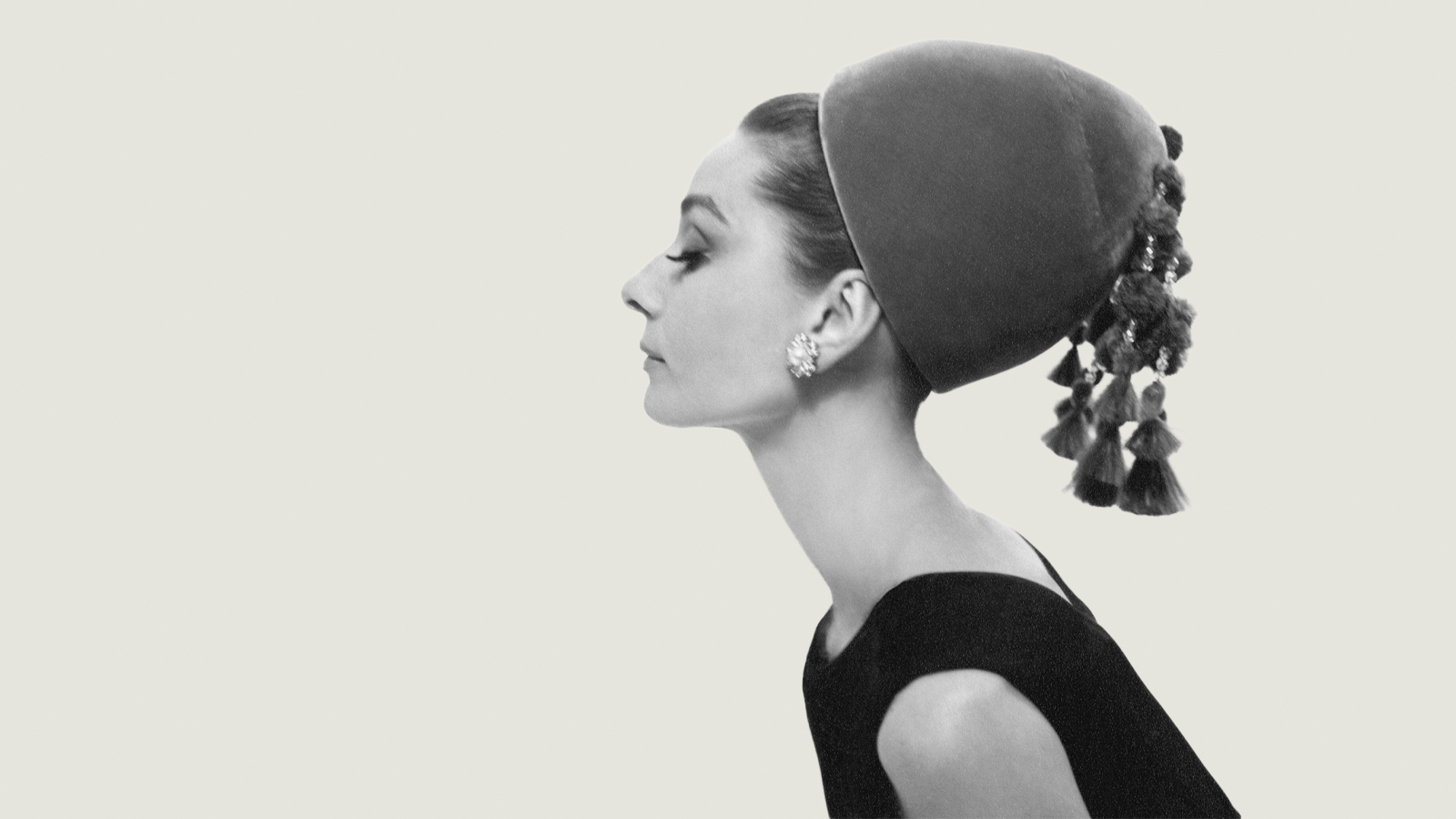
 Audrey Hepburn in profile 

From Country Life:

Headdresses have been making, well, headline news, thanks in part to one of the UK’s most famous wearers of headpieces, Isabella Blow, whose biopic The Queen of Fashion is due out this year.

Issy, as she was known, saw them as not merely a fashion statement, but as an extension of her identity, famously saying: ‘I don’t use a hat as a prop. I use it as part of me.’

Their renaissance has also been fuelled by Instagram and a flurry of lavish country-house celebrations. At a party at Cornbury Park, Oxfordshire, home of the Howden family, headpieces were as central to the spectacle as the setting itself.

For the Narnia-themed event, the insurance magnate David Howden wore a spectacular Aslan-inspired lion headdress commissioned from the Canadian costume designer Maryam of Eastern Wind Studio by his wife, Fiona, who has long been a passionate hat collector and wearer of headpieces.

She sees them as ‘an opportunity to dress up as a character and add glamour, fun and theatre to events’. Her hat collection, sourced from street stalls in Venice, Italy, together with commissioned pieces, ‘makes great dressing-up material for my girlfriends and daughters’ — and for Royal Ascot, which David's company sponsors. Both David and Fiona were in the Royal Procession last year.

Hats and headpieces have long been regarded as little pieces of theatre, as well as signifiers of status in country-house circles. They acted as a kind of visual shorthand, announcing style, self-assurance and, occasionally, the scale of one’s estate. (Read more.)


Hat etiquette (a snob's guide), HERE.

Share

Tuesday, April 7, 2026

Easter Bonnets

Miss Janice explains the etiquette of wearing hats, gloves and corsages.

 Hats are a beautiful accessory and certainly popular to wear on Easter Sunday. You may keep your hat on while indoors, but should remove it at dusk. Gentlemen should remove their hats when entering a building. Hat pins are lovely adornments to a hat and should be pinned on the right side of a lady's hat and on the left side of a gentleman's hat. Make it Southern...A lot of Southern gentlemen still tip their hat to a lady (some men were just raised right)!...All y'all know by now that you may start wearing your white shoes and carrying your white pocketbooks on Easter Sunday...Here's Jacqueline Bouvier Kennedy with Young John Fitzgerald, Jr. on Easter Sunday 1963...

 There is also etiquette to be followed when wearing gloves and corsages. Proper etiquette dictates that gloves are removed when entering a building, whether it is a tearoom or a church. It is not considered proper to shake hands while wearing gloves (only the Queen of England can get away with this) or to eat or drink while wearing gloves. Remove your gloves in a lady like fashion, one finger at a time. Always hold your pocketbook and gloves in your left hand so that you will be ready to shake hands at any time.Remember, only the Queen of England may wear gloves while shaking hands! Corsages are a tradition in the South and may be worn on Easter Sunday. Corsages are pinned to the clothing on the left shoulder. (Read more.)


(Artwork courtesy of Hermes)

Share

Tuesday, May 20, 2025

Le Privilège du blanc, 2025


Princess Charlene and Prince Albert of Monaco looked smart as they arrived for the Inauguration Mass of Pope Leo XIV in St Peter's Square on Sunday
Prince and Princess of Monaco
Queen Mathilde of Belgium and King Philippe of Belgium arrived arm-in-arm ahead of the Inauguration Mass of Pope Leo XIV
King and Queen of Belgium
Spain's Queen Letizia and King Felipe smiled as they arrived at the historic inauguration mass today
King and Queen of Spain

 The Privilège du blanc is the privilege granted to Catholic Queens, Princesses of the House of Savoy, the Princess of Monaco and the Grand Duchess of Luxembourg to wear white in the presence of the Sovereign Pontiff. Women ordinarily wear black, including a black mantilla, when having an audience with the Pope, according to the long-standing Vatican dress code. From The Royal Watcher:

The Queens of Spain and Belgium, the Grand Duchess of Luxembourg, and the Princess of Monaco exercised their ‘Privilège du Blanc’ at the Inauguration Mass of Pope Leo XIV yesterday, the special Papal Privilege which allows certain Catholic Queens and Consorts to wear white in the presence of the Pope at the Vatican. Traditionally, protocol for papal audiences required that women wear long black gowns with a black mantilla, with the colour signifying virtues of piety and humility. However, certain Catholic Queens and Consorts have traditionally been exempted from wearing black garments and are instead allowed the special Privilège du Blanc, to wear white in the presence of the Pope, which remains in affect despite papal protocol having changed over the years. (Read more.)
Photos, HERE and HERE.

Share

Sunday, April 27, 2025

Why Veils Mattered at the Pope’s Funeral

I have no idea why a hat with a black netting would be considered particularly "British." From MSM:

The European royals are masters when it comes to dressing for formal ceremonies. But Melania Trump proved she could hold her own amongst them at the funeral of Pope Francis in the Vatican City’s St Peter’s Square on Saturday.

The US first lady wore a black double-breasted coat-dress, lace gloves and a black lace mantilla-style veil over her hair. Her predecessor, Dr Jill Biden, also adhered to the dress code flawlessly, donning a veil and sheer black tights. Among the royals in attendance were Queen Letizia of Spain, Crown Princess Mette-Marit of Norway, Queen Mathilde of Belgium and Queen Silvia of Sweden – they all wore similar head coverings, but chose to eschew the requirement for gloves. If anyone has a sense of when to bend the rules, it would be them, so Prime Minister Keir Starmer’s wife Victoria was in good company. Her black circular hat with black netting made for a very British twist on head covering. (Read more.)


Share

Thursday, August 29, 2024

Young Catholic Women Bringing Back Veils

 From The Free Press:

Nicole Moore, 30, wears a veil to church every Sunday. Sometimes called a mantilla, these sheer head coverings are usually made of lace or silk; Nicole’s is gray, with a floral-like pattern. Worn by women throughout the Catholic church’s history, chapel veils fell out of favor during the late twentieth century, but in recent years there’s been “an explosion of veiling,” says Moore, who attends St. Vincent Ferrer Catholic Church in Manhattan.

Her pastor, Father Peter Martyr Yungwirth, 39, tells The Free Press he has also noticed an increase in veiling over the last two decades. Indeed, Veils by Lily, a website that sells mantillas, has gone from filling 30 to 60 orders per month to an average of 900 in the last ten years. And it seems to be young Catholics driving the trend. “I have definitely noticed an increase of women, especially young adult women, wearing veils,” says Father Roger Landry, 54, Catholic chaplain of Columbia University. He interprets the veiling trend “as an attempt to be maximally reverent to God at Mass and in receiving Holy Communion.”

That may be the ultimate reason for veiling, but it’s not the only one. To better understand what’s behind the boom, I reached out to over a dozen Catholic women, ranging in age from 19 to 42, who choose to wear a veil to church. (Read more.)
Share

Saturday, January 20, 2024

Chinese Lab Crafts Mutant COVID-19 Strain

 What are "humanized" mice? From the New York Post:

In a Wuhan-esque study, Chinese scientists are experimenting with a mutant COVID-19 strain that is 100% lethal to “humanized” mice. The deadly virus — known as GX_P2V — attacked the brains of mice that were engineered to reflect genetic makeup similar to people, according to a study shared last week out of Beijing.

“This underscores a spillover risk of GX_P2V into humans and provides a unique model for understanding the pathogenic mechanisms of SARS-CoV-2-related viruses,” the authors wrote. The deadly virus is a mutated version of GX/2017, a coronavirus cousin that was reportedly discovered in Malaysian pangolins in 2017 — three years before the pandemic. Pangolins, also called scaly anteaters, are mammals found in warm areas of the planet. All the mice that were infected with the virus died within just eight days, which researchers noted was a “surprisingly” rapid death rate. (Read more.)


Share

Wednesday, May 10, 2023

Silent Witness of a Veil


Share

Monday, October 24, 2022

Formed by Tradition: On Veils


 From The Missive:

We receive Tradition as a holy gift, treasure it, and pass it on to those who come after us. We realize, in humility, that in the long run, Tradition will judge us and that it is really not for us to pass judgement on Tradition. Traditio sacra sacrorum tuitio. Sacred tradition is a safeguarding of sacred things, and more importantly, of being safeguarded by them. For those who are still being formed by Tradition – a formation that can indeed fill a lifetime – it may be hard to understand why it is so important for women to wear veils in church.

Let me begin with an experience that occurred to me some years ago now. Once, when I stopped for gas at a roadside convenience store, the attendant at the cash register saw me in my cassock and asked, completely at a loss, “What’s with…???” and motioned up and down with her hands to indicate that she was referring to my garb. She didn’t even know what to call it. At that time I was still a seminarian, and I explained to her that I was hoping to become a priest.

When we see a policeman or a soldier or a nurse, for example, we know who they are by the way they are dressed. And I hope that when you get ready to come to church, you dress with church in mind: you realize a distinctiveness in being in church. It is not like going anywhere else.

Proper attire for a woman, according to the Tradition given to us clearly by St. Paul in 1 Corinthians 11 and confirmed by Pope St. Linus, who was the second pope, right after St. Peter, is to wear a veil or head covering while in church. I have noticed that men tend to be good in observing the rule that applies to them, namely, that they should not wear a hat in church. I hope that if you saw someone wearing a baseball cap or a fishing hat in church, you would realize that this is not appropriate and indicate in some way to him that he needs to take it off.

Now, you might be wondering why a priest wears a biretta in church and could wear one even during the sermon. Some Fraternity priests do. The answer is that the biretta is a sign of office; a much more striking sign of a higher office is the bishop’s mitre, which he does wear when he preaches.

Dear faithful who are ladies, what I hope you will find in wearing the veil is that you have a particularly strong awareness of where you are, that you are focused completely on Our Lord and not worried about external appearance. (Read more.)

Tea at Trianon has has several posts on headcoverings, including HERE and HERE. A fabulous post, HERE.

Share

Sunday, July 31, 2022

Princess Charlene at the Vatican

2013

2022

There was some discussion online of  privilège du blanc and Charlene, Princess of Monaco. As the Catholic wife of a Catholic head of state she may wear white in the presence of the Pope. Others with the privilege are Catholic queens, princesses of the House of Savoy, and the Grand Duchess of Luxembourg. From The Court Jeweller:

Charlene’s wedding and engagement rings sparkled on her left hand as she and Albert departed after the audience. The other big question I’ve seen raised about this meeting has to do with the color that Charlene is wearing. As the wife of a Catholic head of state, Charlene is entitled to wear white when meeting with the Pope. (It’s called the privilège du blanc.) So why wasn’t she wearing white for this audience?

The answer is that sometimes Charlene wears white when meeting with the Pope, and sometimes she doesn’t. There doesn’t seem to be an identifiable pattern to the instances where she wears white vs. black. I’m guessing it’s just a personal decision on each individual occasion. Above, for example, Charlene wears white for a private audience with Pope Benedict XVI at the Vatican in January 2013. (Read more.)
Share

Saturday, July 30, 2022

To Veil or Not to Veil?

 So many women agonize over this when it is a matter of joy and reverence, not scruples. From Catholicism Rocks:

One day after Mass, I bravely approached a mother and her daughters to ask about their veils, which I'd noticed had been unceremoniously pushed back from their heads immediately upon exiting the church and now rested like dainty neck scarves around their chins.

“We wear mantillas as a token of modesty and purity,” the mother replied. “It covers the hair which is a women’s crown so that our beauty is not in competition with the Mass or distracting to those around us.”

Later, in a book explaining the treasure and tradition of the Latin Mass, I found this explanation:
When we think of those things which are most sacred, we find that they are often veiled in mystery: the secret vessels are kept under a veil; the tabernacle is veiled; the Ark of the Covenant is veiled. Out of respect for the dead, we cover their faces; at Life’s beginning we are hidden in our mother’s womb. Our Lady, the blessed vessel by which our Lord was made flesh and dwelt among us, is never without a veil. God created woman to fulfill the sacred mystery of bringing new life into the world. Thus we should consider it a privilege to be veiled in the Sanctuary.[1]
It should be noted that on the occasion when these same women are present at Mass in the Ordinary Form, they still veil and dress modestly. Veiling has meaning to them that goes beyond Tradition. (Read more.)
Share

Sunday, April 17, 2022

Nineteenth-Century Easter Bonnets


From Mimi Matthews:

In the nineteenth century, Easter Sunday was an occasion for ladies of all classes to don their most fashionable bonnets.  Some of these bonnets were specially bought for the holiday.  Others were old bonnets made up with new trimmings.  In either circumstance, Easter bonnets were as essential to celebrating Easter as were eggs and bunnies.  An 1889 edition of the Ladies Home Journal even went so far as to declare that it was “an accepted fact that every woman who can buy or make a dainty bonnet for Easter-day must wear it.”

[...]

Nevertheless, the Globe states that “this, the season of rejoicing through all Christendom, is emphasised by a woman in a bonnet” and that “on Easter Sunday a new bonnet is de reigueur.”  What were these Easter bonnets like?  Addressing the Easter bonnets of 1889, the Ladies Home Journal reports that:

“There are large hats and small ones, though the tendency, as is usual in summer time, is to large hats. There are tiny bonnets, and those a little larger. There are bonnets that affect an air of primness, and there are those that are really frivolous looking.”

 (Read more.)


Easter bonnets and church hats are not a thing of the past. From Southern Living:

In many congregations across the country, statement-making hats are as synonymous with Sunday mornings as robed choristers and gospel readings. For writer Craig Marberry, who grew up in a Chicago congregation of the Church of God in Christ, the spectacular toppers were just part of the sanctuary topography. "In my church, women only wore three types of hats," he says. "Large hats, larger hats, and 'why'd you have to sit in front of me?' hats."

While the pastor's grandson took the tradition for granted as a boy, Marberry gained new appreciation for the fabulous church hats of his youth when he partnered with photographer Michael Cunningham to produce a tome filled with portraits of church-hat-wearing Southern women and their stories—Crowns: Portraits of Black Women in Church Hats, published in October 2000.

"I realized that church hats weren't merely fashion accessories," he says. "They are an expression of faith, as well as a celebration of fashion. Every woman has a different and compelling story about what church hats mean to them."

The tradition of church hats has its roots in scripture—in particular, a passage from one of Paul's letters to the Corinthians declares that women should cover their heads during worship to honor God. "In many religious denominations, women cover their heads for worship as a sign of respect for God and the church hierarchy," says Marberry. "But Black women alone have interpreted that edict with singular flair."

There's an important cultural element at play too, he notes. "African Americans oftentimes think we were severed from our African culture, our heritage because of slavery," says the author. "But there are a lot of things we do without realizing that they're connected to the motherland." Hats are one of them. "Many African societies believe that the soul is housed in the head, not in the heart, and therefore you adorn the head as a way of honoring it," he says.

Perhaps that's part of the reason women leaders of the Civil Rights Movement often marched in their church hats, a symbol of dignity.

 "If you look at the photos of Civil Rights marches from the '60s, you'll see women wearing church hats: Dorothy Height, Coretta Scott King, and countless others," says Marberry. "Even Rosa Parks, the mother of the Civil Rights Movement, had on a hat the day that she refused to give up her seat to a white man."

Church hats, in other words, are a proud declaration of who you are, how you worship, and what you stand for. And the grander the hat, the better. (Read more.)


Share

Thursday, March 17, 2022

The Future of Mental Health Diagnosis

 From Wired:

DO YOU HAVE five or more symptoms of inattentiveness, including trouble staying organized, difficulty paying attention, and feeling easily distracted? What about five or more symptoms of hyperactivity or impulsivity? Have your symptoms been present for six or more months? Do they interfere with school, work, or your social life?

If you answered “yes” to these questions, a mental health professional in the United States may diagnose you with attention deficit/hyperactivity disorder, or ADHD, a neurodevelopmental disorder that’s often treated with cognitive behavioral therapy and stimulants.

But what if the conversation went a different way—less Buzzfeed quiz, more detailed character study? Perhaps, instead of a specific label, you should be grouped with other people who struggle to prioritize long-term consequences over short-term gratification—a big tent that includes not only ADHD but also those with substance use problems and even some personality disorders. Or maybe you don’t need to be labeled at all. Instead of selecting a diagnosis from a big book, a therapist could help you see how what might feel like an internal struggle is really a response to your life circumstances and the power structures that surround you.

These are just two of the visions of psychiatry proposed by renegade psychologists and philosophers working to imagine a different future, free from the unscientific and often-stigmatizing diagnostic labels plaguing the field today.

They face an uphill battle. Psychiatry in the United States and in many places around the world has been dominated by the Diagnostic and Statistical Manual of Mental Disorders, or DSM, for 70 years. The so-called Bible of psychiatry, published by the American Psychiatric Association, is used in prisons, hospitals, and outpatient clinics to diagnose patients, prescribe medications, dictate future treatment, and get it paid for.

Despite its prevalence, the APA has faced consistent criticism for its manual, including its failure to incorporate new scientific evidence, tendency to pathologize “normal” human experience, and the outsized financial influence of the pharmaceutical industry on its formulation. (Read more.)


From Neuroscience:

The study appeared in the journal Translational Psychiatry. Chronically stressed people often show abnormalities in their motor skills, such as poorer fine motor control. However, how these symptoms occur has hardly been studied so far. “We investigated this question in our study,” explains Prof. Dr. Valentin Stein from the Institute of Physiology II at the University of Bonn.

The researchers used mice as experimental animals, some of which they exposed to a stressful situation for a few days. Meanwhile, they used a special microscopy method to take pictures of the rodents’ brains. They focused on parts of the cerebral cortex responsible for motor control and learning new movements. (Read more.)


Also from Neuroscience:

For the first time, researchers looked at the entire duration of such a situation. They found not only changes in the communication of brain regions, but also a dynamic process: Different networks behaved differently during acute stress.

From this, the scientists were able to determine how susceptible a person is to negative mood and how much this increased their risk of mental illness.

Until now, experts knew little about the dynamic processes in the brain during acute stress. Research has usually focused on the brain areas that are active at a given time. Now, however, scientists from the Max Planck Institute of Psychiatry (MPI) and the Department of Psychiatry and Psychotherapy at Tübingen University Hospital have observed what happens in the brain over the entire period of a stressful situation, such as while solving a tricky math problem.

“Our study shows not only where changes occur, but how different brain regions interact and how their communication changes over the course of the situation,” summarizes first author Anne Kühnel from the MPI. (Read more.
Share

Sunday, February 20, 2022

Smashing 'Idols'

We practicing Catholics just have to stop judging each other. Often converts, and anyone embarking on a more devout life, will change their manner of dress to something that reflects their inner transformation. For women this could mean renouncing cosmetics, or wearing long skirts, or any number of austerities. Unless they are called to monastic or consecrated life, they will probably not be that way forever. We who have been Catholics for a long time must be patient with those starting their journey, trying to find their way, going through transformations. However, I never thought of a head-covering as an idol but apparently it can be to some people. I disagree that wearing a head-covering makes one "holier than the Church." How can following a practice mandated by Scripture and Tradition make one holier than the Church? To quote Emily Stimpson Chapman at Through a Glass Darkly:

There was a time, long ago now, when I never went into a church without a chapel veil on my head and never left the house without wearing a skirt or a dress. I was in my early 30s then and, in the abstract, had good reasons for what I did. The Cliffs Notes version of those reasons is that I saw the chapel veil as a symbol of humility, reverence, and tradition. I saw the skirts and dresses as symbols of femininity, grace, and beauty. I saw both could be outward signs of inner realities, signaling to the world the importance of reverence and femininity. And I saw both also could be a sort of sacramental, helping me become more of what they signified—more humble, reverent, feminine, graceful, and beautiful.

For years, I wore that chapel veil and those skirts. They were, in a sense, my personal protest against a society which denies the sovereignty of God, the divinity of Christ, the reality of the Eucharist, and the difference between men and women.

But no longer. The veil came off in 2008. I still wear skirts and dresses, especially in the summer. But in the colder months, unless I’m dressing up, you’ll rarely see me wearing anything but jeans. Why?

 Simply put—because that chapel veil and those skirts made me a self-righteous ass.

Okay, that’s a little too simply put. It’s more accurate to say that wearing a chapel veil and never wearing jeans helped reinforce some of my besetting sins. They didn’t make me a self-righteous ass. But the devil did use them to encourage my natural inclination to be one.

But, while more people may drift left of the Church’s heart, I suspect the devil rejoices a bit more when he convinces someone to drift right of the Church’s heart. Partly, because once he has done that, we start doing his work for him, pushing and pulling our fellow Catholics away from the Church as we waste our energy judging, confusing, guilting, and shaming one another, instead of proclaiming the saving truths of the faith we profess. Also, because that drift can be more subtle, making it harder for us to see. And what we can’t see in ourselves, we can’t correct in ourselves. We fool ourselves into believing we’re holier than everyone else and become hardened in our self-righteousness…like the devil himself. (Read more.)

It never occurred to me that the wearing of dresses and mantillas might be idolatrous because they can make you think you are a better Catholic than those other Catholic ladies with bare-heads and jeans. I keep reading women saying that a head-coverings might make them think they are holier than every one. I guess they did not grow up when I did. When I was a small child every female covered their heads in church, even non-Catholics when they came to Mass, among them saints and sinners. I recall being extremely naughty in church with a doily on my head. I remember when one of my aunts was an unmarried expectant mother, wearing a cute headscarf at Mass over her stylish bob. I loved how her scarf and dress matched and wanted the same look. (I was five.) I recollect being at First Friday Mass with my seventh grade class, sitting with a bunch of white-veiled mademoiselles who used language that would make Cheech and Chong blush. I know now, as I knew then, that a piece of lace does not make you into a saint, or even into a well-behaved person. Therefore a head-covering at Mass does not automatically signal holiness to me. I have no control over whether it does to others. What I keep seeing now is women becoming obsessive about head-coverings, and whether or not to wear them, and when or where. If a sacramental becomes more a focus of one's thoughts than Jesus, it is time for some detachment. Meanwhile, let us keep in mind that the abuse of a sacramental by individuals does not make the sacramental bad nor take away the blessing from those who use it worthily and in good faith.

Here is a beautiful post which sums up the ancient practice of veiling, found in both Scripture and Tradition. From A Touch of Beauty:

-There are thousands of years of recorded history across cultures especially related to worship, even pagan women veiled
-A practice in modesty and humility as these virtues are defined by the Church (not colloquial usage). That is related to your state in life and focused toward God (rather than man). 
-Veiling is part of the larger liturgical tradition of the Church for 2000+ years. Other things, aside from women, are also veiled during the liturgy. 
-Veiling, like MANY other things in the Catholic tradition, is more about an outward sign of a spiritual reality or internal disposition.
-Veiling also recognizes that men and women are different by supernatural design, and we have different roles, challenges, and opportunities for merit. 
-Some contemplative nuns use veils as a way to reduce distractions. They wear veils to create their own little world where they can pray without something distracting them from just beyond their field of vision. This is not as practical for mothers. 

And a fun bonus:

-If you haven’t gotten a chance to do your hair because you just got a bazillion people ready for church, a hat or scarf or something is a life saver.  (Read more.)


Share

Wednesday, June 10, 2020

“Weird” Christians

From The Catholic Thing:
Secular liberals observing the trend face a similar perplexity. They try to explain away this religious attraction as a youthful craze. They blame it on a superficial and fetishized attachment to “otherworldly aesthetics,” which leaves them exasperated, labeling what they cannot understand as “weird.” Burton and many who join her online have adopted the label with a certain irony. 
Thus, “weird” Christians are appearing on the cultural scene, often in Internet spaces where they can congregate and share their views. Burton claims that “More and more young Christians, disillusioned by the political binaries, economic uncertainties and spiritual emptiness that have come to define modern America, are finding solace in a decidedly anti-modern vision of faith.” 
These millennials and Gen Zers sense the hollowness of the postmodern cultural wasteland. They also reject the shallowness of the mainline Protestant churches that have watered-down supernatural truths and exalted the trivial. These online pilgrims detest the barren, ugly and brutal aspects of modern life. 
They want something real and profound. Their penchant for returning to the Middle Ages and traditional belief is a liberal’s worst nightmare. What disconcerts liberals is not only the attraction these young people have for a robust Christianity but also their rejection of the liberal order’s anti-metaphysical foundations, which has been accelerated by the political and economic breakdown of that order wrought by the coronavirus. 
The problem with this counter-cultural current is its difficulty in defining and expressing itself. Its followers never knew the traditional world they now admire. They are victims of a chaotic postmodern culture without structures and stability. Burton claims a “punk” rebelliousness characterizes the movement, which seems to be against everything establishment, including the modern economy. (Read more.)
Share

Wednesday, June 19, 2019

Is Dressing Appropriately for Mass Really that Important?

Let us keep in mind that one of the only times Jesus displayed wrath was due to disrespect in the House of God. From EpicPew:
From that day forward, I learned how to wear appropriate clothing to Mass every Sunday. Did I dress in a suit every Sunday? No, but I wore dress pants, dress shoes, a polo or button-down shirt (most often a button down with a sweater) and, on occasion, a tie. I am grateful that this lesson was taught to me. Dressing appropriately for Mass completely changed my disposition at Mass. My outer disposition and the clothing I wore now reflected my inner disposition.

I am writing this article to everyone that attends Mass, however, I hope that my fellow Catholic men who read this article will take these words to heart. If you wear dress pants/khaki’s and a polo shirt/button down to work every day, but come to Mass dressed in shorts or jeans,  a t-shirt, and flip flops—there is a disconnect. I asked myself a few questions: Why would I dress appropriately for work, but dress casually for Mass? Would I wear my work clothes to go to the pool, the beach or the lake? These questions challenged me. (Read more.)
Share

Friday, November 23, 2018

Millennials, Authenticity and the Latin Mass

From Crisis:
The antiquity of the Mass contrasts with the youth of the congregation. Numerous little children filling the nave provide a background noise of crying, cooing, crawling over pews, and scuffling into laps. These sounds of family life contrast with other parishes where children depart for children’s liturgies or cry rooms, or are simply absent. The adults also present a diverse group. A majority are young families and adults under 50. Although the Catholic Church has hemorrhaged men for decades, men and women are about evenly split here. Nor is it all white people. Despite being low overall percentage of the local population, a good number of Hispanics are present. Three or four black families and some Asian couples also attend. The congregation more obviously runs the gamut from rich to poor than your typical American parish. “Here,” in Joyce’s mocking but true words, “comes everybody.”

My wife and I are Millennials. Like most of my cohort, I exclusively attended the Novus Ordo in English growing up. My wife converted from Evangelical Protestantism during college. Yet we are poised to join a puzzling trend of modern American Catholicism: the small but growing set of Millennials finding a home in the Mass of Trent.

This confuses our bishops and elders. Catholicism, they say, should make itself more understandable to the modern world. Father Thomas Reese once likened the Mass to new software versions in need of occasional upgrades—like DOS, the Extraordinary Form should be made obsolete. Some think Millennials are revolting against their Baby Boomer parents. Others see Millennials attracted to the mystery of the older form, seeing it as something new and different from their childhood. Many think Millennials have a false nostalgia for a Catholicism that never existed before Vatican II. Still others think this attraction stems from a desire for comfort, secure, belief, and ease to avoid the messiness of modernity. (Read more.)
Share
Saturday, November 10, 2018

Crowned in Glory

From The Catholic Gentleman:
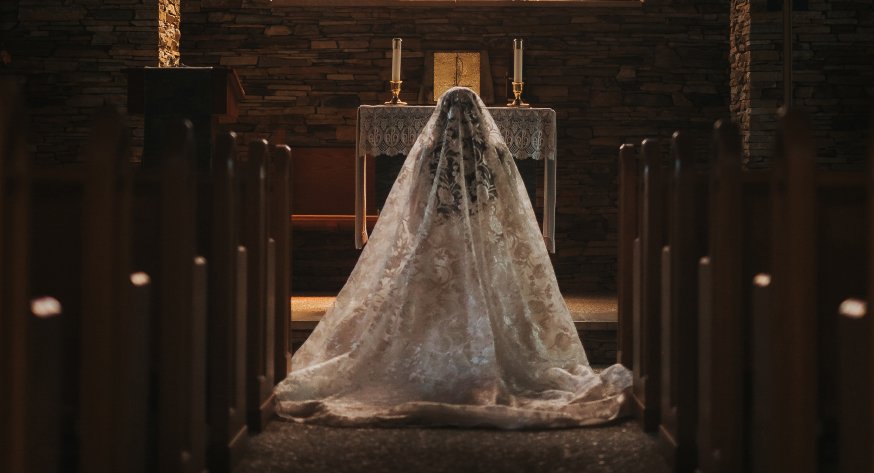
Men, we must never forget that Christ was crowned with bloody thorns so that his Bride might be veiled in spotless white. We were naked in our sins, and he clothed us. From Genesis to Revelation, we do not deserve our Savior’s self-donation, the total, cruciform gift from our Husband and Head Jesus Christ. When St. Paul talks about head coverings, we need to remember that his understanding of gender and clothing is culture-bound…to the culture of Christ. Everything about being a man or a woman is meant to tell the story of the wedding of Heaven and Earth, Christ and his Bride. Chapel veils help tell the story. Although veils are no longer required for women attending the Novus Ordo Mass, they are still encouraged because they are a reminder of what all of us—men and women together—are by Baptism: the Bride of the Lamb. And the “it’s not required” attitude makes it even more awesome. So if your wife ever decides she wants to wear a chapel veil, don’t be afraid of the small persecution that might come your way. Take a stand with your better half, and defend what she’s defending: God’s Bride, the Church. What a gift! To be a tiny snapshot of Mary and the Church in the presence of the congregation, in the sacramental Presence of the God. Mantillas are a clarion reminder that gender roles in the culture of Christ are not a power trip, but a love trip. Christ’s head was crowned with thorns so that his Bride’s head might be crowned with stars. (Read more.)
Share

Sunday, April 8, 2018

A Vintage Milliner

From Victoria:
Antique-millinery specialist Barbara Troeller remembers the first hat that stirred her heart. A gift from her older sister in the 1970s, the chic black felt 1940s cocktail chapeau captivated the then 16-year-old with its sophisticated form, sultry veil, and glittering rhinestone brooch. The mysterious origins of the vintage find intrigued the budding fashionista—a curiosity that, to this day, is rekindled each time she takes a new discovery in hand. “I think about the woman who made this hat, the lady who wore it, and where she wore it,” she says wistfully. “I get lost in the passion.” That first hat sparked a love affair that has endured for four decades. The owner of the online boutique Rue de la Paix, Barbara has a private collection comprising more than eight hundred toppers from three centuries, with heirlooms ranging from lavishly embellished Victorian-era bonnets to more streamlined midcentury styles. When she entered the antiques business over twenty years ago, her focus was unique: “Back in those times, dealers didn’t see hats as valuable at all,” she explains. “I was able to rescue a lot of rare and valuable millinery from being discarded or tossed into a toy box.” (Read more.)
Share

Friday, December 15, 2017

Hoop Skirts and Equality


 From Racked:
In 2015, as part of a broader effort to excise Confederate symbology, the University of Georgia banned hoop skirts at official Greek functions. Administrators and Greek leaders couched their decision in vague, almost bureaucratic language. “We will continue to review costuming and themes for future events to ensure their appropriateness for our organizations,” wrote Ashley Merkel, president of UGA’s Panhellenic Council. Vice president for student affairs Victor Wilson bolstered her statement: “The discussion was about more than dress,” he wrote, “but about how you present yourself, and dress was part of that.”

Other proponents took a more vehement tone. “Remove the Southern belle from her inglorious perch,” urged Elizabeth Boyd, a University of Maryland American Studies professor. She continued, ““The Southern belle performances routinely staged on campuses across the South constitute choreography of exclusion.” It’s true: The hoop skirt has aged poorly. Its connotations 150 years post-heyday are antiquated at best, antagonistic at worst. From an inside view, though, this “choreography of exclusion” was anything but. Just the opposite, in fact: Its rebellion was quiet, subdued, and feminine, but a rebellion nonetheless. The skirts have lived long enough to become a villain of our racial imagination. To the women who wore them, they were heroic.

The hoop skirt lived many lives before reaching the antebellum South, known as the farthingale (to the Elizabethans) and the pannier (to French nobility circa 1718). The latter reached objectively absurd proportions in the later 18th century. If any garment can be considered choreographed exclusion, it’s the pannier. Handmade from whalebone or basket-willow and jutting several feet to each side, panniers embodied the conspicuous consumption of Louis XVI and his court. (Read more.)
Share