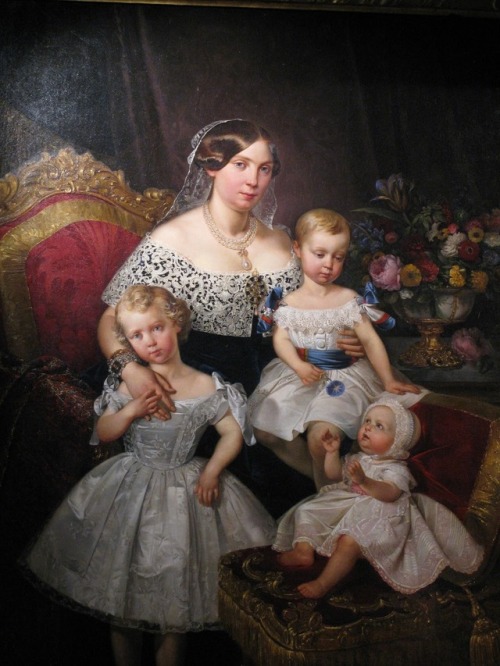
It is a strange historical twist that the first "Russian" woman to be canonized in the Orthodox Church was a Viking warrior princess who spent much of her life as a pagan. Olga earned her sainthood by becoming the first member of the house of Riurik, the dynasty that ruled European Russia and parts of Ukraine and Belorus for more than seven centuries (860s – 1598), to convert to Christianity. But the role of this battle maid in the spread of Christendom to the eastern Slavs is only part of her remarkable contribution to the history of Eastern Europe.Share
Olga is the only woman for whom we possess significant biographical details in the written sources for the Kievan Rus period of Russian history (860s – 1240). In contrast with Western Europe and the Byzantine Empire, medieval Russian women did not participate in literary culture aside from the occasional inscription or letter of the type found on birch bark in the excavations of medieval Novgorod. The laws of the period reveal that women enjoyed few legal protections compared with their male peers. Women could inherit property from their parents or husbands, but only in the absence of brothers and sons. If the sons were young, the widow managed the family's estate until the sons reached their majority.
Olga is in this way typical of the free elite women of Kiev.1 For nearly two decades (945 to 962) Olga ruled the rapidly expanding kingdom of Kievan Rus,2 which received its name from its capital Kiev on the middle Dniepr River, as regent for her young son Sviatoslav. And she did so in stunning fashion despite significant obstacles. Olga assumed power at a time when the realm was shaken by tribal violence and administrative disorder. She bloodily pacified rebellious tribes and replaced tribute taking with a regular system of taxation. Olga's decision to convert to eastern Christianity instead of Catholicism was also a fundamental step in the spiritual and political alliance of Kievan Rus with the Byzantine Orthodox world rather than with Latin Christendom. In short, it took the will and perspicacity of a barbarian widow to begin the transformation of the Rus lands from a loosely knit pagan chieftaincy into a more stable and centralized Christian kingdom. (Read entire post.)
Tuesday, March 31, 2026
Baptism of St. Olga
Spanish Euthanasia Case Triggers Worldwide Debate
From The European Conservative:
The euthanasia of 25-year-old Noelia on Thursday, March 27th in Spain has made headlines around the world. Not because of its legal exceptionalism—it was upheld by all judicial instances—but because of what it represents: the shift of euthanasia from extreme cases of terminal illness into far more shaky territory, such as psychological suffering.
In just a few days, her story has spread across national and international media. Noelia’s life was marked by institutional neglect, episodes of violence and sexual abuse, severe depression, and a fractured family environment. And there is a lingering sense, shared by many, that things should have gone differently.
Noelia’s death was the result of a series of events that led to grave emotional and physical suffering. Her parents lost custody of her and she spent time in state care. According to her own account, it was in that context that she suffered abuse and episodes of violence that were never investigated judicially.
Years later, those traumatic experiences led to a suicide attempt in 2021, leaving her with partial paraplegia. From that point on, her situation worsened. She was diagnosed with borderline personality disorder, underwent multiple psychiatric admissions, and lived with a persistent sense of isolation.
Medical reports—central to the process—concluded that her suffering was “serious, chronic and incapacitating,” and that there was no prospect of improvement. On that basis, the Catalonia Guarantees Commission authorized euthanasia in 2024. Formally, the procedure met all legal requirements. But the case was never as closed as it appeared. (Read more.)
‘National Geographic’ Reclaims Its Legacy
From Mark Judge at Chronicles:
On June 1, the National Geographic Society is opening a new, stunning, multimillion dollar museum. According to its promotional material, the 2026 debut of NatGeo’s “Museum of Exploration,” will feature
a state-of-the-art pavilion entrance, auditorium, iconic photo gallery, exhibition space, immersive walk-through attraction, retail, food and beverage, education center, archives, tours, and exciting new event space. The capstone of the renovation is a one-of-a-kind nighttime experience in the courtyard.
The new museum opens just as the National Geographic Society appears to be reclaiming the grand legacy it lost over several decades in the jungle of wokeness. The spiral has been particularly difficult for me to watch because my father was a writer and editor at National Geographic for the better part of 30 years, from the early 1960s to 1990. This storied organization that was so much a part of my early life and education devolved into a habit of promoting pseudoscience, anti-white racism, and transgenderism. If the new museum, and some recent issues of the magazine, are any indication, National Geographic may be on the path to getting its mojo back.
First, however, a quick journey through NatGeo’s descent into liberal madness. In 2017, the magazine ran a special issue on “The Gender Revolution,” which became the basis for a documentary hosted by left-wing dingbat and TV personality Katie Couric. The magazine issue itself featured a “girl” on the cover—that is to say, a confused and exploited boy—and the section titled “Helping Families Talk about Gender” offered this: “Understand that gender identity and sexual orientation cannot be changed, but the way people identify their gender identity and sexual orientation may change over time as they discover more about themselves.”
As Andrew T. Walker and Denny Burke wrote of it in Public Discourse,
the first half of this sentence asserts the immutability of gender identity, but the second half of the sentence claims that people’s self-awareness of such things can change over time. But is there not a contradiction here once we define our terms? Gender identity is not an objective category but a subjective one. It is how one perceives his or her own sense of maleness or femaleness….If that perception is fixed and immutable (as the first half of the sentence asserts), then it is incoherent to say that one’s self-perception can change over time (as the second half of the sentence asserts).
Another article offers a full-page picture of a shirtless 17-year-old girl who recently underwent a double mastectomy in order to “transition” to being a boy. Walker and Burke ask this probing question that gets to the heart of the matter: “Why do transgender ideologues consider it harmful to attempt to change such a child’s mind but consider it progress to display her bare, mutilated chest for a cover story?”
National Geographic received significant blowback for the issue, prompting a defense from Editor Susan Goldberg. A key paragraph:
We realized several years ago that beliefs about gender were shifting rapidly and radically. For almost 130 years, National Geographic has explored the world through science, exploration, and storytelling. Gender permeates every part of what it means to be human, and reporting on the changing understandings of a biological and social concept is, put simply, what we do. Our coverage doesn’t come with a political or partisan agenda. We created the gender issue—as we do every issue—with the intent to research, understand, and explain.
So gender is not a reality but “a biological and social concept.” Goldberg also equivocated about hormone blockers, which have since been proven to be dangerous.
As part of the magazine’s April 2018 edition, “The Race Issue,” Goldberg offered this headline: “For Decades, Our Coverage Was Racist. To Rise Above Our Past, We Must Acknowledge It.”
Goldberg hired John Edwin Mason, a scholar at the University of Virginia, to dig through the archives to find evidence of white supremacy. Interviewed by Vox, Mason announced that National Geographic “was born at the height of so-called ‘scientific’ racism and imperialism—including American imperialism. This culture of white supremacy shaped the outlook of the magazine’s editors, writers, and photographers, who were always white and almost always men.” Responding to a 2018 cover featuring a cowboy on horseback, Mason argued that “the image of the white cowboy reproduces and romanticizes the mythic iconography of settler colonialism and white supremacy.” (Read more.)
Monday, March 30, 2026
Marie-Antoinette's Gambling Addiction
I have many times been accused of making Marie-Antoinette into a saint. Just because I believe, as most of the evidence indicates, that Marie-Antoinette was faithful to her husband, does not mean I think she was the Little Flower. Endeavoring to observe the sixth commandment is a basic duty which does not mean automatic sanctity. We all know many faithful spouses who are not saints (at least, not yet.) The New Advent article presents a fairly balanced view of Marie-Antoinette:In her private life, Marie Antoinette may justly be blamed for her prodigality, for having, between 1774 and 1777 -- by certain notorious escapades (sleigh racing, opera balls, hunting in the Bois de Boulogne, gambling) and by her amusements at the Trianon -- given occasion for calumnious reports. But she confessed to Mercy that she indulged in this dissipation to console herself for having no children; and the tales of Besenval, Lauzun, and Soulavie, about the amours of Marie Antoinette, cannot stand against the testimony of the Prince de Ligne: "Her pretended gallantry was never any more than a very deep friendship for one or two individuals, and the ordinary coquetry of a woman, or a queen, trying to please everyone." De Goltz, the Prussian minister, also wrote that though a malicious person might interpret the queen's conduct unfavourably there was nothing in it beyond a desire to please everybody. Besides, the queen continued to give edification by her regular practice of her religious duties....
Her historian, M. de la Rocheterie, says of her: "She was not a guilty woman, neither was she a saint; she was an upright, charming woman, a little frivolous, somewhat impulsive, but always pure; she was a queen, at times ardent in her fancies for her favourites and thoughtless in her policy, but proud and full of energy; a thorough woman in her winsome ways and tenderness of heart, until she became a martyr."The "notorious" escapades of sleigh-riding, going incognito to the opera ball, hunting and watching the horse races in the Bois de Boulogne, were fairly innocent past-times for a twenty year old queen. The gambling, however, became a serious addiction. It must be kept in mind, however, that she was not the not the only one. Gambling was an entrenched part of court life from the days of Louis XIV. As scholar Ross Hamilton describes it:
Gambling obsessed all levels of French society during the Enlightenment. Louis XIV held appartements du roi given over to gambling three times a week at Versailles, the queen hosted a nightly game, and courtiers scheduled additional occasions for play. Hosts so frequently acted as bankers for games to entertain their guests that satirists, chroniclers, and moralists complained that compulsive gambling had destroyed other forms of social entertainment. In Paris ten authorized maisons de jeux operated games involving some degree of skill (jeux de commerce) but essentially they served as fronts for more lucrative chance-driven games (jeux de hasard). Gambling also took place at the two great Paris fairs during almost four months of the year, all year long at foreign embassies, and eventually at gambling houses at the Hotel de Gesvres and later at the Hotel de Soissons. In addition to these legal venues, the large number of clandestine Parisian gaming rooms, lighted by tripots, made one visitor comment that "flaming pots set Paris ablaze," and gambling was by no means restricted to Paris. (2) The "Age des Lumieres" was lighted by gambling. Although official prohibitions referred to both religious and sociological dangers from gambling, within the context of the period, risking large sums at play became an analogy for risking one's life in battle. Having the courage to risk and winning or losing with equal equanimity demonstrated indifference to material gain and thus served as a means of displaying hereditary status.Author Lisa Hilton in the biography Athenais (Back Bay, 2004) explains how gambling was one of the only "honorable" ways in which the often cash-strapped aristocrats, who were forbidden to engage in trade, could make money. It also replaced the thrill of war. As Hilton says:
Psychologically, gambling can be seen as a rebellion against logic, intelligence, moderation and renunciation, amorally appealing to those who in some way feel their lives constricted, and yet containing its own penance from the guilt it provokes from the losses it entails.It required a certain amount of discipline to gamble well; one had to have mastery over facial expressions so as not to reveal one's thoughts about winning or losing, or one's strategy. A noble had to be able to lose with grace and promptly pay debts.
Marie-Antoinette had been taught as a child by her own mother to gamble, because the Empress knew that a princess who could not play well would soon be separated from her money. Futhermore, the stakes at the court of Austria were much higher than at the court of France, which made Antoinette an intrepid player. As a teenager, she became inordinately attached to the practice. As she began to have gambling debts, Louis XVI, who was trying to save the government finances and give an example of thrift, forbade her to play anymore games of chance. She begged her husband to let her have one last game. He gave permission, and naughty Antoinette made sure the game went on for three days. Louis was disgusted.
Gambling in France did not disappear with the fall of the monarchy. The revolutionaries who replaced Louis and Antoinette had their own share of gambling debts. According to historian Russell T. Barnhart:
The mania for gambling had been transferred from defunct, monarchical Versailles to the thriving, bourgeois Palais Royal, where the five main gaming clubs throbbed from noon till midnight. During the Revolution, Prince Talleyrand won 30,000 francs at one club, and after Waterloo in 1815, Marshal Blucher lost 1,500,000 francs in one night at another. To bring the situation under control and raise taxes for the state, in 1806 Napoleon legalized the main clubs, which from 1819 to 1837 grossed an enormous 137 million francs.Gambling took up only a short period of Marie-Antoinette's life, and yet it is something for which she is remembered, even before her numerous charities. In order for the excesses of the Revolution to be justified, the failings of a teenage queen are held up for posterity.
Iran Studied the Wrong War Game
From Alexander Muse:
ShareThere is a particular species of institutional error that only becomes visible in hindsight, and only then at considerable cost. It is not the error of building the wrong weapon. It is the error of discarding the right one because it does not fit the threat you expect to fight. The US Air Force spent the better part of a decade trying to retire the A-10 Thunderbolt II, requesting $57M in its fiscal year 2026 budget submission to decommission the remaining 162 aircraft, two years ahead of its own previously stated schedule. Congress blocked the effort, mandating a minimum fleet of 103 aircraft through September 2026. And then Operation Epic Fury began, the Strait of Hormuz closed, and the aircraft the Air Force wanted to scrap became the one the joint force needed most. The irony is not that the Warthog proved useful. The irony is that the environment where it proved essential was one American planners should have anticipated for decades.
American carrier aviation and Aegis destroyer capabilities were engineered for the open ocean, for blue-water engagements against sophisticated adversaries operating capital ships, cruise missiles, and ballistic anti-ship weapons. That engineering represents the correct solution to the problem it was designed to solve. The Strait of Hormuz presented a categorically different problem. Iranian tactics relied on swarm attacks using fast, low-signature boats, often armed with rockets, mines, and short-range anti-ship missiles. These are targets that are difficult to detect and track using conventional high-altitude strike profiles. The IRGC operated more than 1,500 such craft, composite and fiberglass hulls mostly under 15 tons, running between 50 and 70 knots, each carrying a Naser-1 anti-ship missile with a 35-kilometer range and a terminal speed of Mach 0.9, sufficient to mission-kill a frigate. Their doctrine was swarm, overwhelm, and saturate, forcing the defender to choose which threat to engage while knowing that every defensive weapon fired costs more than every offensive boat it destroys. (Read more.)
An Invitation to Premier 'Dune: Part Three' at the Anti-Communist Film Festival
From Mark Judge at Hot Air:
At its heart, Dune and its sequels offer a powerful argument against big government, high taxes, and political messiahs who promise to save the world. In fact Dune: Part Three would be a perfect fit for the Anti-Communist Film Festival. Director Villeneuve and star Timothee Chalamet can consider themselves both invited.
The world and politics of Dune have been expertly analyzed by Daniel Immerwahr, a professor at Northwestern University. Immerwahr has explored the two sides of Dune author Frank Herbert: The environmentalist who grew up in Washington state, hung out with hippies and did drugs in the 1970s, and whose mentor was an American Indian, and Frank Herbert, the conservative Republican who hated taxes and leaders who promised people everything only to go on a power trip.
Although raised by socialist parents, Herbert experienced commune living with Native Americans, and it filled him with hostility to the federal government. Herbert rejected “any kind of public charity system” because he “learned early on that our society’s institutions often weaken people’s self-reliance.” Herbert worked for four Republican candidates, including very conservative Guy Cordon, the US senator from Oregon. Cordon was pro-logging, pro-business, pro-military, anti-labor, anti-regulation, and a supporter of Joseph McCarthy. A book Herbert wrote before Dune calls Soviet agents “the sinister embodiment of everything evil.” (Read more.)
Sunday, March 29, 2026
Jewels of Queen Marie-Amélie
Niece of Marie-Antoinette. From The Royal Watcher:
After the July Revolution of 1830, the Duke was made the King of the French, and despite being loyal to the Bourbon Monarchy, the new Queen Marie-Amélie resigned herself to her new role, saying: “Since by God’s will this Crown of Thorns has been placed upon our heads, we must accept it and the duties it entails.” After a subdued reign marked by religious duties and charitable work, when the King was forced to abdicate after the 1848 Revolution, Queen Marie-Amélie said to the presiding minster “Ah Monsieur, you were not worthy of such a good king!”. The family went into exile in England and lived a private life at Claremont House, where the now widowed Queen Marie-Amélie supported her grandson’s reconciliation with the Count of Chambord, the head of the senior Bourbon line, who made him his Heir. When she died in 1866, the Queen asked to be buried as the Duchess of Orléans at the Chapelle Royale de Dreux. As she still supported the senior branch of the House of Bourbon, Queen Marie-Amélie famously refused to wear the French Crown Jewels but had a magnificent personal Jewellery Collection which was documented even in her day! (Read more.)
Share
Shelby and Eli Steele’s New Film
From Man of Steele:
The director (Eli Steele) shared his philosophy behind the film via his Substack platform.
”White guilt is the most important story no one is telling honestly. Not Marxism. Not woke ideology. Not suicidal empathy. Those are symptoms. White guilt is the disease that allows these other ideologies and behaviors to take hold. It’s the grease that makes all of it possible, and until we name it clearly, we have no chance of reversing it.”And then Owen Anderson (his recent podcast with me is worth a listen) wrote in The Blaze:
Are you guilty? That depends. Are you white? Then yes, you are guilty. But whiteness is no longer the only offense. Believe in God? Believe Christ saves sinners? Believe in objective morality, the rule of law, or marriage between one man and one woman? Then skin color hardly matters. You are guilty anyway.
Guilty of what? Guilty of the sins of history, the inequities of the present, and whatever new offense the racial racketeers invent tomorrow. At least that is what grifters like Ibram X. Kendi and Robin DiAngelo have spent years selling to America, often for staggering sums underwritten by universities eager to flatter the ideology. Arizona State University, where I teach, has offered classes on the problem of whiteness. ASU’s Barrett Honors College teaches the evils of settler colonialism…
Much of the left’s social justice industry runs on a simple formula: Manufacture guilt, divide people by race, promise absolution, then collect money, influence, and institutional power. Sell moral panic to well-intentioned Americans, then invoice them for redemption.
Want to end racism? Write a check. Sign the DEI pledge. Sit through the seminar. Keep your head down while the consultants explain that your skin makes you complicit and your silence proves your guilt.
(Read more.)
Saturday, March 28, 2026
La Duchesse de Berry Dedicates Her Daughter to the Blessed Virgin
Share
Rubio Is Impressive, DeSantis Is Formidable, but Vance Is the Future of the GOP
From Alexander Muse:
Vance is the heir apparent not because of proximity to power, though that matters, but because of ideological coherence. He did not arrive at the America First agenda because a president asked him to implement it. He arrived there on his own. His 2022 Senate campaign in Ohio was built on the same economic nationalism, immigration hawkishness, and skepticism of elite consensus that defines the MAGA coalition. His 2016 conversion story, the man who wrote about Appalachian working-class disintegration and then found in Trump a political vehicle for addressing it, is authentic in a way that cannot be manufactured. When Vance argues that illegal immigration drives up housing demand, depresses wages for working Americans, and strains public services, he is not reading from a briefing book. He is articulating a worldview he has held and defended for years. That is an enormous political asset. Voters, especially the working-class voters who form the backbone of the MAGA coalition, have finely tuned instincts for distinguishing a true believer from an executor. Vance is the former.
His voting record confirms it. On April 23, 2024, Vance voted against the supplemental spending vehicle that contained Ukraine aid, placing himself firmly in the domestic-first, skeptical-of-foreign-entanglement wing of the party at a moment when that vote carried real political cost. He did not hedge. He did not triangulate. He voted the way a man who genuinely believes the US should put its own border before someone else’s would vote. That kind of documented consistency is worth more than any speech.
Now, the most common criticism of Vance right now is that he is invisible. Voters who follow politics closely see Marco Rubio on every front page, at every summit, managing every diplomatic crisis, and they ask a reasonable question: what is JD Vance doing? The answer, though it requires some civic patience to appreciate, is that he is doing his job. The vice presidency is constitutionally modest by design. The VP casts tie-breaking Senate votes, represents the administration at ceremonial functions, provides counsel in private, and, most importantly, prepares to assume the presidency if called upon. Vance has executed that role with discipline and loyalty. He has not upstaged the president. He has not freelanced on policy. He has not leaked to reporters or positioned himself as a rival power center inside the administration. For a man who is widely regarded as the leading candidate to succeed Trump, this restraint is a feature, not a bug. The problem is that restraint is hard to photograph. (Read more.)
Russia after Putin
From Paul Gilbert:
Despite Western predictions of Russia’s pending economic collapse, the country appears to be adapting to sanctions imposed by the United States, Great Britain, and European Union. Growing demand for Russian energy imports has helped keep the country’s besieged economy afloat. China and India, Asia’s biggest and third-biggest economies, respectively, have been the biggest drivers of the trend. This includes crude oil, pipeline gas, liquefied natural gas and coal.
According to Fareed Zakaria: “Russia’s performance in the war has been poor, but it is doing better, especially at holding territory. Russia has also been able to stabilize its economy, which the IMF projects will do better this year than the UK’s or Germany’s. Russia is trading freely with such economic behemoths as China, and India, as well as neighbors like Turkey and Iran. Because of these countries and many more, outside of the advanced technology sector, it has access to all the goods and capital it lost through the Western boycott. There is now a huge world economy that does not include the West, and Russia can swim in those waters freely.”
In addition, the Russian ruble has gained against the dollar after collapsing immediately after the Ukraine invasion.
While Putin remains unpopular in the West, his popularity among his own people remains high. In January 2023, over 80 percent of Russians approved of activities of the Russian President Vladimir Putin. The popularity level saw an increase compared to September 2022, when it stood at 77 percent.
Contrary to Western media hype, President Vladimir Putin, now 70, looks remarkably healthy and shows no sign of stepping down any time soon . . . but, “what if” he decided to step down as president, “what if” he was forced from office or “what if” he died in office, who would succeed him? Would Putin repeat Franco’s historic decision, and restore the monarchy in modern day Russia? (Read more.)
Friday, March 27, 2026
Miniature of the Duc de Normandie (Louis XVII)
Dauphin Louis-Charles a couple of years later, at six or seven. Small boys wore pink in those days. Share
'Final Blow' Options
From Newsmax:
ShareThe Pentagon is preparing potential "final blow" military options against Iran, including precision invasions of strategic islands and possible ground operations inside the country as President Donald Trump weighs how to end the conflict quickly while avoiding a prolonged war. According to U.S. officials cited by Axios on Thursday, the plans under discussion include seizing or blockading key Iranian positions such as Kharg Island — the country's main oil export hub — and islands near the Strait of Hormuz, including Larak and Abu Musa.
Other options involve intercepting Iranian oil shipments or launching large-scale airstrikes on nuclear facilities. Some scenarios also contemplate deploying ground forces to secure enriched uranium sites, though such operations are described by the White House as hypothetical and highly risky. The proposals reflect growing pressure on Tehran as diplomatic efforts stall and the strategically vital Strait of Hormuz remains threatened. (Read more.)
Under House Arrest
From Paul Gilbert:
ShareOn this day – 22nd March (O.S. 9th March) 1917 – the Provisional Government decreed that Emperor Nicholas II, his wife and five children should be held under house arrest in the Alexander Palace at Tsarskoye Selo.
At eleven in the morning, the Imperial Train pulled into the Imperial Railway Pavilion at Tsarskoye Selo. Nicholas emerged wearing a Caucasian fur cap and soldier’s greatcoat. Behind him the members of his suite began to jump off the train – like rats abandoning a sinking ship – and run down the platform. Not looking back – they fled.
According to Count Paul Benckendorff (1853-1921), the Emperor’s motorcar arrived at the gate of the Alexander Palace and was stopped by the sentry, who summoned the Commandant. The Commandant went down the steps and asked in a loud voice who was there. The sentry cried out, ‘Nicholas Romanov’. ‘Let him pass,’ said the officer.
During his captivity, the Tsar was subject to constant harassment and humiliation from the soldiers – most of whom were thugs – stationed in and around the Alexander Palace.
According to Pierre Gilliard: “The Emperor accepted all these restraints with extraordinary serenity and moral grandeur. No word of reproach ever passed his lips.” (Read more.)
Thursday, March 26, 2026
Marie-Antoinette Gives Alms to the Blind
Republicans Can Win on Health Care Affordability
From AMAC:
ShareFor most of the last 40 years, pollsters have asked voters: Which party do you trust more on health care? The answer has been pretty much the same over this whole period. Voters trust Democrats more, sometimes by a two-to-one margin.
When I’ve asked my Republican politicos why that is, the answer I typically receive is: Our party doesn’t do health care. Then they crouch in the fetal position.
Well, the GOP certainly better start “doing health care,” because the issue of medical care access and affordability is front and center for American families.
The Republican promise to voters should be better health care at half the cost.
Here are five easy pieces to this saner and higher-quality health care system.
First, follow President Donald Trump’s lead from his State of the Union: “I want to stop all payments to big insurance companies and give that money to the people.” That’s you and me.
This “patient power” approach is a direct assault on Washington’s long-held allegiance to hospital oligopolies, insurance companies and pharmacy benefit managers. The medical care dollars should follow the patients, and that means a range of options in how that money is spent to improve health.
One of those options should be the expansion of health savings accounts, which will incentivize patients to shop around for the best price they can find for health services. Another option should be low-premium catastrophic coverage plans that cover major, but not routine, costs. This is supported by 78% of voters. (Read more.)

Don’t Take Advice From Arthur C. Brooks
From Mark Judge at Chronicles:
ShareIn 2017, Brooks gave a speech at the annual prayer breakfast in Washington, D.C. Trump was in the audience. Brooks ladled out his message of human flourishing and “loving your enemies.” He exhorted Trump to follow the words of Jesus. After Brooks took his seat on the dais, Trump stepped up to the mic. “Arthur, I don’t know if I agree with you—and I don’t know if Arthur is going to like what I’m going to say,” Trump said, before ripping into the “very dishonest and corrupt people” who had “done everything possible to destroy us, and by so doing, very badly hurt our nation.” “They know what they are doing is wrong,” Trump went on, “but they put themselves far ahead of our great country.”
Politico described the fallout this way: “In the media firestorm that ensued, observers quickly pointed out that Trump had not just repudiated Brooks’ advice; he had questioned the teachings of Jesus Christ himself.”
To the contrary, President Trump was reminding the audience of the reality and nature of evil. Unlike Arthur Brooks, Trump rejects the lazy theology that pretends evil must be tolerated. Yes, Jesus taught us to love our enemies. He also cast out demons. (Read more.)
Wednesday, March 25, 2026
Lady Day
From A Clerk of Oxford:
Today is the feast of the Annunciation, 'Lady Day'. As I explored last year, the medieval church considered 25 March to be the single most important date in history, at once the beginning and the end of Christ's life on earth: it was the date of the Annunciation, the Crucifixion, the eighth day of Creation, the crossing of the Red Sea, and the sacrifice of Isaac, all profoundly meaningful events in the carefully-crafted divine story of salvation history. Its resonances reached even unto Middle Earth, as Tolkien aligned the downfall of the Ring to this most auspicious of dates. (Read more.)Share
Iran's Qatar Strike Exposed China's Secret Industrial Vulnerability
From Amuse on X:
This is the counter-intuitive turn in the argument, so it is worth pausing to set it up carefully. China produces only about 3 million cubic meters of helium per year, roughly 1.6% of world production, despite having the largest semiconductor manufacturing ambition outside of Taiwan. China’s domestic helium supply is negligible relative to its industrial appetite. For years, China closed this gap primarily through long-term supply contracts with the two largest producers, the US and Qatar. Those contracts gave Chinese fabs, research institutions, and aerospace programs a reliable pipeline of one of the most irreplaceable industrial inputs on earth, and they did so at prices that reflected relatively stable long-term supply arrangements rather than emergency spot procurement. Iran’s strikes effectively severed one of those two pipelines at the source. The Qatari helium that was contracted to flow to Chinese buyers cannot flow if the facilities that produce it are not operating. Force majeure provisions will be invoked. Allocations will be cut. And because the helium market allocates under scarcity by priority, with medical imaging and aerospace applications receiving near-full coverage and lower-priority industrial uses taking the deepest cuts, Chinese semiconductor manufacturing, which sits in the middle tier of that allocation hierarchy, is precisely where the pain is likely to concentrate. (Read more.)
Share
A Celebration of Motherhood
From Word on Fire:
ShareThe trajectory of influencer culture on the small scale that I witnessed with Catholic women looked something like this: First you share your foliage photos with a dress that you have a coupon code for, and then you’re sharing deeply personal information about your family drama (with a link to the lipstick in bio), and when you’ve run out of ways to monetize your story, you peter out a bit. Maybe you begin to work outside of the home or your children age out of wanting to wear matching neutral linen outfits for your photo shoot (ahem, yes, mine have) or your lifestyled home no longer looks photographable, and that is more than okay. Maybe you are writing in a spiral-bound journal with an ink pen to process your own story instead of reaching for the calming, numbing effect of punching it out in a caption and watching the likes and comments flow in. I am speaking truly and firstly about myself here.
Many Catholic women online with audiences of a variety of sizes are demonstrating setting healthy boundaries with their online presence or simply moving off of it altogether. They’re weary of being told how to think, dress, feel, be as a wife, be as a friend, and that if they only buy this course, then they’d know how to be as a daughter of God too. They’re weary of being the content producers packaging up these instructions. They’d like to connect with real, awkward friends in person where one person interrupts the other and the other’s child shouts, “I have a butt!” at their child, and then they all get to practice working through being real people in a real world and all that the incarnation entails. And this means we have a chance at growing into a culture transformed by Christ. The screen is a starting point, but we must jump off to evangelize face-to-face, heart-to-heart, friend-to-friend. Otherwise we live in a fishbowl of one-way mirrors, and nothing is less interesting than the narcissistic navel-gazing promoted by the dopamine hamster wheel that is social media. (Read more.)

Tuesday, March 24, 2026
The Buried City – Unearthing the Real Pompeii
From Reid's Reader:
ShareZuchtriegel makes it clear that Romans followed and copied Greek art. In fact at one point he notes that Pompeii did not ever have the best art work. He says that ancient Rome, Capua and Verona had more great art works than Pompeii ever had, and they had larger arenas. He spends some time examining the famous copy of the statue of the Greek god Apollo and its connection with Greek culture. Sensuality and eroticism were displayed in some of the houses of the rich. Zuchtriegel spends some time with freaks and hermaphrodites as they were depicted in Greek tales. Wealthy people’s walls were painted with images of Greek fables and the doings of the Greek gods, sometimes dealing with rape or violence but just as often dealing with images of serenity or weddings. One house, excavated in the early years of archaeologism [in the late 19th century] was named as the House of the Vetti, generally interpreted as a brothel. Wealthy people also had slaves, and the prostitutes were slaves. Slaves could be freed sometimes, but often this would simply mean that an old slave was of no worth anymore and the freed slave was left in poverty and would have nowhere to go.
Having explained all of this, Zuchtriegel notes that in the last years of Pompeii there was a god that was very popular. This was the Greek Dionysus. But he also notes that the very ground Pompeii was built on was originally Etruscan land, and the Etruscan gods were related to nature and agriculture. There were many rituals that had been carried through to the late years of Pompeii. He then returns to the state of the city as it now is. Among other things, some of the ruins were destroyed during the Second World War due to American bombing near to Naples. For a long time there were misunderstandings about the meanings of some buildings that had been buried in the 79 A.D. earthquake. For example, one building that was dug up by amateur archaeologists in the early 20th century, became known as the Villa of Mysteries because it looked dark and there was a long frieze whose meaning was difficult to understand. Could it have been the site of a forbidden cult? But it is now understood that there was no mystery at all. The villa, as it originally stood, was open to the passing public, there were no orgies taking place in it, and the images on the wall had to do with celebrations of a wedding.
It is in the last parts of The Buried City that Gabriel Zuchtriegel goes back to what actually happened when Pompeii was almost obliterated. He likes to show how ordinary people – not just the rich – were going through the streets of the city just before the sky fell in. One example was a chariot that has only recently been dug up by modern archaeologists. Only parts of it survived, but it was clearly being driven on its way to some ordinary event. Zuchtriegel also often reminds us that those who lived in the most horribly cramped quarters were the poor people – who made up most of the population – and the slaves. As he sees it, the most important people in Pompeii were the poor and the slaves who kept the city running. They were the ones who drove carts bringing into the city the food that came from the fields and the fishing boats, cooked and produced meals, looked after the children of rich etc. Yet they had to live in the worst houses.
Regrettably, says Zuchtriegel, despite all the help of the police, there is still in Naples the Camorra – the Neapolitan version of the Sicilian Mafia - which illegitimately raids parts of Pompeii, stealing antiquities and selling them to the rich in the black market. But things are now being tightened. There is the frequently-asked question “How many people lived in Pompeii at the time it was destroyed?” Answers range from 40,000 to 20,000, but one also has to be aware of the fact that the rural areas, which brought in grain, stock and milk, should also be seen as part of Pompeii. At an odd point, too, Zuchtriegel says that Pompeii was probably economically declining in the years before its ruin. Apparently more local farmers now raised grapes as wine became most important… but this meant that grain had to be imported from different countries – like Egypt - at great price. (Read more.)
Blood and Progress: New Book Reveals the Left’s History of Violence
From Mark Judge at Hot Air:
Blood and Progress is a corrective to the censored history of the left’s political violence in America, going back at least a century. I’ve obtained an early copy, and Blood and Progress is must-reading.
Here is the thesis as laid out by Rothman: “It is necessary to bring a gratuitous amount of evidence to bear in support of the observable fact that the American left—too often, fringe and mainstream alike—either refuse to confront or are disconcertingly comfortable with a certain level of domestic political violence. Indeed, its members will heartily protest the allegation that there is a rising tide of left-wing violence to speak of. They are inclined to ignore it, excuse it, explain it away, or marshal their own evidence in support of their belief that the American right is the font from which all political violence springs.”
Rothman emphasizes that he is not dismissing right-wing violence, only arguing that the media, academia, and politicians explain away the violence on their own side while trumpeting the problem on the right. Liberals will talk about January 6th for decades while watching their own cities burn to the ground or their children get assaulted by illegal immigrants.
In 1995, community activist Barack Obama launched his first run for the Illinois state Senate at the house of Bill Ayers and his wife, Bernadine Dohrn. In 1970, Ayers and Dohrn were indicted for inciting a riot and conspiracy to bomb government buildings. Dohrn was convicted; Ayers was not. Ayers is not sorry, telling The New York Times in 2001, “I don’t regret setting bombs. I feel we didn’t do enough.” Ayers and his fellow terrorists bombed the Pentagon as part of their anti-war activities. As journalist Bernie Quigley once put it, “Maybe we should begin to ask ourselves where we are going in our world today when a right-wing terrorist, resolute in his conviction to the very last, like Ayers, gets a quick and short ride to the death chamber and a shallow and forgotten grave, while bombers from the ’60s get tantalizing offers from Harvard, $100 million grants from Ambassador Walter Annenberg and dinner with [celebrity academic professors].” (Read more.)
The ‘Polar Unity’ of the Two Forms of the Roman Rite
From The Catholic Thing:
The motu proprio Summorum Pontificum (2007) of Pope Benedict XVI introduced into the contemporary ecclesial vocabulary a distinction that has since become both fruitful and contentious: the “Ordinary Form” and the “Extraordinary Form” of the one Roman Rite. Benedict was at pains to insist that these are not two rites but two usages of the same lex orandi. The Missal promulgated by Pope Paul VI after the Second Vatican Council constitutes the Ordinary Form; the Missal of Pope John XXIII (1962), standing in organic continuity with the Tridentine codification of Pope Pius V, may be celebrated as the Extraordinary Form.
Benedict’s claim was juridical and pastoral, but its deeper import is theological. The coexistence of the two forms within one rite can be understood as a “polar unity” in the sense articulated by Hans Urs von Balthasar: a living tension of complementary principles whose unity is not the flattening of difference but its orchestration.
Benedict himself rejected the hermeneutic of rupture that would pit preconciliar and postconciliar liturgy against one another. In his famous 2005 address to the Roman Curia, he contrasted a “hermeneutic of discontinuity and rupture” with a “hermeneutic of reform in continuity.”
The liturgy, precisely because it is the Church’s most public act of faith, must embody this continuity in a way that is not merely conceptual but sacramental. The two forms of the Roman Rite thus stand as a visible sign that tradition is not a museum piece nor a revolutionary program, but a living stream whose depth and breadth can be perceived only by holding together its historical strata.
To interpret this polarity in a richer theological key, it is helpful to turn to Balthasar’s account of the Marian and Petrine dimensions of the Church. For Balthasar, the Church is first Marian before she is Petrine. Mary, in her fiat and her immaculate receptivity, embodies the Church’s contemplative, bridal, and receptive essence. Peter, in his confession and commission, embodies the Church’s apostolic, juridical, and governing mission.
These two dimensions are inseparable; yet they are not identical. The Marian dimension grounds the Petrine; the Petrine serves the Marian. The Church is not an institution that happens to have a mystical interior; she is a mystery that necessarily assumes institutional form. (Read more.)
Monday, March 23, 2026
Royal Escape from Falmouth
![]() |
| Henrietta Maria by Van Dyck |
As a dynasty the Royal Stuarts are known for harrowing escapes, with the family of Charles I and Henrietta Maria having more than their share. As I discovered as I wrote the second novel of the Henrietta of France trilogy, the Queen, on more than one occasion, found herself fleeing for her life. From The National Maritime Museum:
The Queen who had been suffering with pains in her limbs throughout the previous winter was now extremely ill which prompted the King to beg his elderly physican ‘Mayerne, for the love of me, go to my wife’, to attend her in Exeter.2 Help was sent also from the Queen’s sister in law the Queen Regent in France and it is probable there were negotiations underway at this time for Henrietta Maria’s eventual flight to France. The Queen gave birth to a healthy baby on 16 June but her symptoms persisted causing serious concern for her life. With the Parliamentary forces advancing on Exeter, just a fortnight after giving birth and still suffering severe ill health, Henrietta Maria set out for Cornwall. Her newly born daughter had been left behind in Exeter probably considered as being too frail for the journey and entrusted by the Queen to the care of her lady in waiting and friend Anne Villiers, Lady Dalkeith.3
The Queen’s party were making for Falmouth. ‘The Queen is this day gone towards Falmouth, intending to embark herself for France’ her secretary Henry Jermyn had written to George Digby on 30 June.4 Cornwall was in royalist hands and Falmouth was one of the most valuable royalist ports supplying arms and munitions for the cause and allowing trade and passage to and from the continent. It had the important anchorage of the Carrick Roads in the deep estuary at the mouth of the river Fal and was protected by the garrisons of Pendennis and St Mawes castles. The castles had been built in the reign of Henry VIII as artillery forts to protect the Carrick Roads. Pendennis, the larger of the two, on its rocky headland with an elevated position overlooking Falmouth was perfect for defence both from the land and the sea and the manor of Arwenack, seat of the Royalist Killigrew family, was nearby. Falmouth offered an ideal point of departure for the Queen’s escape. (Read more.)

Volume 1 of the Henrietta of France trilogy is available HERE. Volume 2 is HERE.
Dirty Cops: Mueller, Comey, and Weissmann
From Tierney's Real News:
For years, I trusted the FBI and DOJ to be impartial guardians of justice. Then came the Trump–Russia hoax—a three‑year circus of leaks, indictments, and process crimes that never proved the core allegation of collusion.
Digging through thousands of pages of research over the past several years opened my eyes: Robert Mueller, James Comey, and their top lieutenant Andrew Weissmann perfected what it means to be a dirty cop over decades. This article reflects my interpretation of publicly available information and court documents. This is long and complicated but necessary reading if you want to understand the total picture.
They ruined lives through withheld evidence and “gotcha” charges while shielding their own circle. Here’s their story in chronological order, straight from the file’s documented cases.
Early Roots: Mueller’s Boston Cover-Up (1980s)
People say Mueller served his country, so we should trust him implicitly. His career says otherwise.
Mueller’s career kicked off as acting U.S. Attorney in Boston during the 1980s, where he directly oversaw the FBI’s catastrophic handling of mobster Whitey Bulger. FBI handler John Connolly actively protected Bulger while the gangster committed at least 19 murders, yet Connolly coerced innocent men like Joseph Salvati into prison on fabricated testimony from turncoats.
Two of those framed men died behind bars before their names were cleared. Courts later determined the FBI had deliberately buried exculpatory evidence, leading to over $100 million in taxpayer-funded settlements for the victims’ families. Critics argue Mueller’s office either ignored these red flags or actively enabled the corruption, establishing an early pattern: protect powerful insiders like Bulger, frame expendable outsiders, and pay no personal or institutional price for the scandal.
Bulger was later killed in prison under mysterious circumstances—some observers have speculated it happened just as he was poised to talk about his past FBI dealings. Coincidence? You decide.
Mueller was nominated by President George W. Bush on July 5, 2001, confirmed unanimously by the Senate (98-0) on August 2, 2001, and officially sworn in as FBI Director on September 4, 2001—just one week before the 9/11 attacks.
This timing often gets highlighted in critiques of his tenure, as he immediately oversaw the post-9/11 FBI transformation amid massive scrutiny. (Read more.)
Conservatives Have Failed at Culture
Well, at least one of my books has been made into a film. I never received a cent, however. From Splice Today:
Over the last century, beginning with movies, jazz and literature, liberals have been the great artistic visionaries. They defended James Joyce. They founded magazines like Rolling Stone and The New Yorker. Orson Welles put on groundbreaking plays in the 1930s and directed Citizen Kane. The Beatles worked all-nighters in Hamburg. Jann Wenner turned a $7500 loan into Rolling Stone magazine. And Lena Dunham was 24 when she wrote and directed Tiny Furniture. Go ahead and hate her and the film. Then shut up and make a better one.
Wealthy people like Ben Shapiro won’t even fund the arts that could change the culture. Writing for Commentary, social historian Fred Siegel once explored how the American masses embraced the art in the 1950s even as philanthropists and gatekeepers were offering the best of Western culture. Americans at the time, wrote Siegel, “were sampling the greatest works of Western civilization for the first time.” The book Mass Culture: The Popular Arts in America revealed that “twenty years ago, you couldn’t sell Beethoven out of New York. Today we sell Palestrina, Monteverdi, Gabrieli, and Renaissance and Baroque music in large quantities.” There was a 250 percent growth in the number of local symphony orchestras between 1940 and 1955.
In 1955, writes Siegel, “15 million people paid to attend major league baseball games. 35 million paid to attend classical music concerts. The New York Metropolitan Opera’s Saturday afternoon radio broadcast drew a listenership of 15 million out of an overall population of 165 million.”
Siegel notes there were gatekeepers to get this great art to the people: “NBC spent $500,000 in 1956 to present a three-hour version of Shakespeare’s Richard III starring Laurence Olivier. The broadcast drew 50 million viewers; as many as 25 million watched all three hours.” Siegel observes that “on March 16, 1956, a Sunday chosen at random,” the viewer could have seen a discussion of the life and times of Toulouse-Lautrec by three prominent art critics, an interview with theologian Paul Tillich, an adaptation of Walter Van Tilburg Clark’s Hook, a documentary on mental illness with Dr. William Menninger, and a 90-minute performance of The Taming of the Shrew. Saul Bellow’s “The Adventures of Augie March,” a National Book Award winner, sold a million copies in paperback in the early-1950s.
John F. Kennedy supported the arts. “The life of the arts,” he said, “far from being an interruption, a distraction, in the life of a nation, is very close to the center of a nation’s purpose.” (Read more.)
From The Chivalry Guild:
ShareI often read complaints about the failure of Hollywood to bring the life of Richard the Lionheart or Scanderbeg or Godfrey of Bouillon to the screen in a blockbuster epic.1 It certainly sounds like a grand idea—but always be careful what you wish for. Even if the studios could be trusted to depict the hero as heroic (rather than “problematic,” perverted, or overrated) and show his cause to be just (rather than brutal Christian aggression against noble Muslim victims), little subversions still have a way of creeping into the projects and undermining the whole thing—democratic cliches, enlightened pieties. Then there’s the question of quality. Truly getting Richard right would require a director with elite vision, a screenwriter with a deft touch and knowledge of the past, an actor who could credibly pass as one of the greatest men who ever lived, and more—and the likelihood of all these pieces coming together are increasingly slim. More likely they would just make him a toxic mediocrity and/or a repressed homosexual.
Would you rather have a C- version of the hero or no movie at all?
With every passing year I grow less and less interested in shows and movies. My divorce from Hollywood is certainly made easier as everything on the screen turns embarrassingly shoddy and emotionally manipulative—an inevitable consequence of frenzy for sidelining talented white men in favor of DEI hires. But I’ve come to suspect something larger at work than just declining skill and political machinations. The current embarrassments are likely more of a feature than a bug, the kind of thing that can’t really be solved by simply putting “based” people in charge of the studios.2 (Read more.)
Sunday, March 22, 2026
Remembering the Past in Restoration France: An Expiatory Chapel for Marie-Antoinette
![]() |
| The recreated prison cell of the Queen |
| The actual prison cell of the Queen |
After its restoration, the Conciergerie in Paris was reopened to the public in 1989, the year of the "Bicentenaire" celebrating the 200th anniversary of the French Revolution.[1] The new historical museum of the Conciergerie, formerly the most famous prison in France, offers visitors an almost authentic look at the conditions of living—or rather dying—during the revolutionary Terreur, the period of violence and mass executions that started in September 1793 and ended in July 1794 with the "Thermidorian Reaction." Visiting the Conciergerie today, one enters the gloomy atmosphere of 18th-century crime, grim with punishment and death, reminiscent of Madame Tussaud's Chamber of Horrors. Visitors are faced with life-sized figures of incarcerated men in small dark cells recalling some well-known and, in addition, thousands of nameless victims of the Terror. The representation of one of the most famous inmates of the Conciergerie is especially striking. Marie-Antoinette, Queen of France, spent the final two months of her life in this prison, before her execution on October 16th, 1793. Her figure, which can only be seen from behind, is shown sitting in a cell at a small wooden desk, guarded by a member of the National Guard (fig. 1). Contrary to its appearance, this scene is not set in the cell in which the queen was actually imprisoned, but is only meant to be an accurate reconstruction.[2] The cell in which Marie-Antoinette was imprisoned still exists, but not as a cell. In 1816, during the French Restoration era, it was transformed into a chapelle expiatoire—expiatory chapel (fig. 2). Unchanged during the Conciergerie's restoration before its reopening in 1989, it can still be visited within the prison complex. This small chapel that the newly restored Bourbon monarchy built in honor of Marie-Antoinette confronts the visitor with a staging of history that differs considerably from that of the reconstructed cell. Marie-Antoinette's chapelle expiatoire is in fact a true chapel. It consists of a very small room painted entirely in dark blue, a colored glass window reminding one of ordinary church windows, a cenotaph on one side of the room, and an altar on the other. Here we see the queen again, this time not "in person," but appearing on three paintings representing memorable events of her last days.
In the Conciergerie, the fate of Marie-Antoinette is therefore recalled in two very different ways. On the one hand, we are confronted with a setting that seems to be authentic when in fact it is not; on the other hand, the original queen's cell has been so radically changed that it no longer appears as an authentic historical site. The commemoration of the queen within the prison complex of the Conciergerie is hence somewhat contradictory: the lines between authenticity and historical falsity, between fact and fiction are not as clear as they seem to be at first glance. This deliberate delusion especially draws one's attention to the queen's expiatory chapel of 1816, which is the main subject of this article. This slightly kitsch memorial raises questions that not only concern the construction, political context, and iconography of the chapel, but also consider the notion of authenticity and the ways in which history has been staged and commemorated throughout the ages. Therefore, the focus of my article is twofold: first, I will put the queen's expiatory chapel in the political and cultural context of its creation and discuss its iconography and propaganda content. In doing so, I will also consider some other expiatory monuments of the Restoration era. Then, I will focus on the queen's chapel as a memorial and historical site. I will especially raise the question as to whether notions of authenticity had been accounted for by the authorities and artists who were involved in the chapel's construction. With this twofold approach I particularly want to broaden the art-history research perspective which until now has been focused on the iconography and political relevance of the Restoration's expiatory monuments.[3] (Read more.)
Americans, Learn From the UK’s Grooming Gang Scandal
From AMAC:
A grooming scandal that has been discussed for years in London is finally getting attention.
MPs and London Assembly members are demanding an urgent investigation into grooming gangs in the city. They say authorities have failed to act on reports from survivors about the systematic abuse and exploitation of girls as young as 14.
This comes after a BBC investigation uncovered stories of young women being drugged, assaulted by multiple men, and forced into sex work to pay off drug debts. These cases are similar to those in Rotherham and Rochdale, where thousands of girls were abused over many years.
The letter, signed by figures such as Shadow Home Secretary Chris Philp and former Conservative leader Iain Duncan Smith, was sent to Home Secretary Shabana Mahmood and London Mayor Sadiq Khan. It calls for the national inquiry into grooming gangs to focus on London.
Khan has been criticized for saying there were “no reports and no indication” of organized abuse in the city and for not addressing questions about whether Muslim rape gangs have operated there. Critics now accuse him of ignoring the issue.
The Metropolitan Police are reviewing 9,000 child sexual exploitation cases, with estimates suggesting that 2,000 to 3,000 involve grooming gangs. As in earlier scandals, most suspects are men of Pakistani heritage accused of targeting white English non-Muslim girls.
Grooming gangs have operated for decades and have faced little interference, with group-based child exploitation dating back to at least the mid-1970s. Authorities often overlooked these crimes while focusing on other types of child abuse. The problem became widely known in the 1990s and 2000s, but institutional failures allowed it to continue.
Nearly 100 trials and convictions have occurred in over 40 towns and cities across the U.K., including Rotherham, where more than 1,400 victims were identified between 1997 and 2013, as well as in Rochdale, Oxford, Telford, and Huddersfield.
Despite this, London’s mayor has said there are no such cases, or none on the same scale, in the capital. This has led to public anger, especially as the Metropolitan Police review thousands of old cases. (Read more.)
How American Sexuality Was Ruined
Disturbing. Read with discernment. From Welcome to Absurdistan:
ShareKinsey’s conclusion, promoted like wild fire for fifty years, relentless and geopathic by the Rockefeller-guided press, has embedded itself in our consciences, like the Rockefeller-promoted Paul Erlich and his every-word-a-lie-population bomb, climate change and the Sixth Great Extinction, all lies. Reissman’s keystone, necessary work traces that, and it is instructive to remember that Time Inc., where I was trained, is located in Rockefeller Centre. Time’s stable of magazines slowly, over time, promoted sexual libertinage as normal and the Rockefellers acted like censors on the rest of the media, stamping out anyone who objected. Reisman herself was the victim of a $50,000 a month PR campaign meant to ruin her and malign her research.
Alfred Kinsey was a barely talented biologist focused on a subspecies of wasp before the Rockefellers picked him up, almost certainly because he was part of the underground cult of people who sexually abuse children. He showed no promise otherwise. He was a sado-masochist whose family films found in the attic after his death showed him sexually and physically abusing his children. He literally masturbated himself to death - orchitis - which is associated with sado-masochistic trauma and venereal disease.
According to Reisman who made his work a life-long study, he did not complete his medical degree. He was an obsessed eugenicist, an atheist, adulterous misogynist, committed racist, a reckless bi/homosexual, addicted masturbator, masochist, pornography producer and performer, and mass pedosadist. (Read more.)