Showing posts with label Byzantium. Show all posts

Sunday, July 26, 2026

Narrative Icons


From Hilary White at The Sacred Images Project:

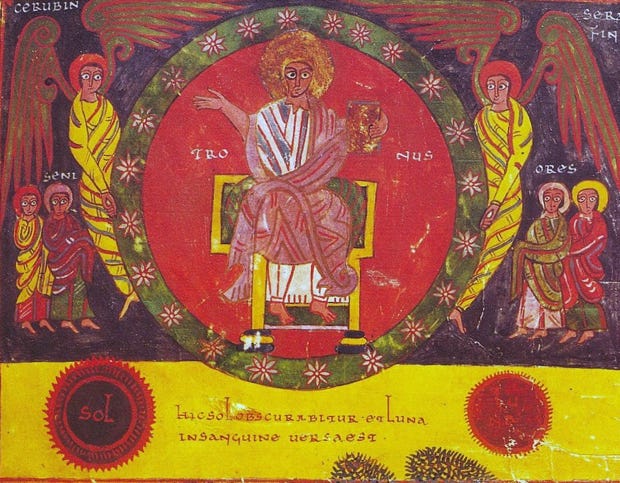
One of the most useful distinctions made by people who analyse art is between an image that simply presents something, and an image that tells a story. A portrait of a king, a still life of a bowl of fruit, a simple landscape, or an icon of Christ Pantocrator asks us to contemplate a single subject. They are essentially static images, like a single object in a dark room under a spotlight. Nothing is happening, and nothing is about to happen. It’s just Him and you.

But iconography is about making a visual statement about some eternal reality, even when the image itself is a story being told. We are all familiar with the single-figure icons of course, but there are narrative icons as well. The Nativity icon is a good example of this, where a single image will have several elements of a story presented as if they’re all happening at the same visual “time”1. The format here is to have the most important thing - the Nativity itself - in the centre, with all the side adventures going on around it.

This is called “continuous narrative,” in which the same characters appear multiple times within a single image to depict successive moments in a story. Time is compressed into one pictorial space. But instead of reading left-to-right like a comic strip, the viewer follows the action throughout the composition.

This technique goes back to classical Roman art (for example, Trajan’s Column) and was taken east by Byzantine artists, where it became especially common in manuscript illumination, fresco cycles, and some icons. (Read more.)


Share

Wednesday, July 8, 2026

The Mysterious Frescoes of Castelseprio


 From Hilary White at The Sacred Images Project:

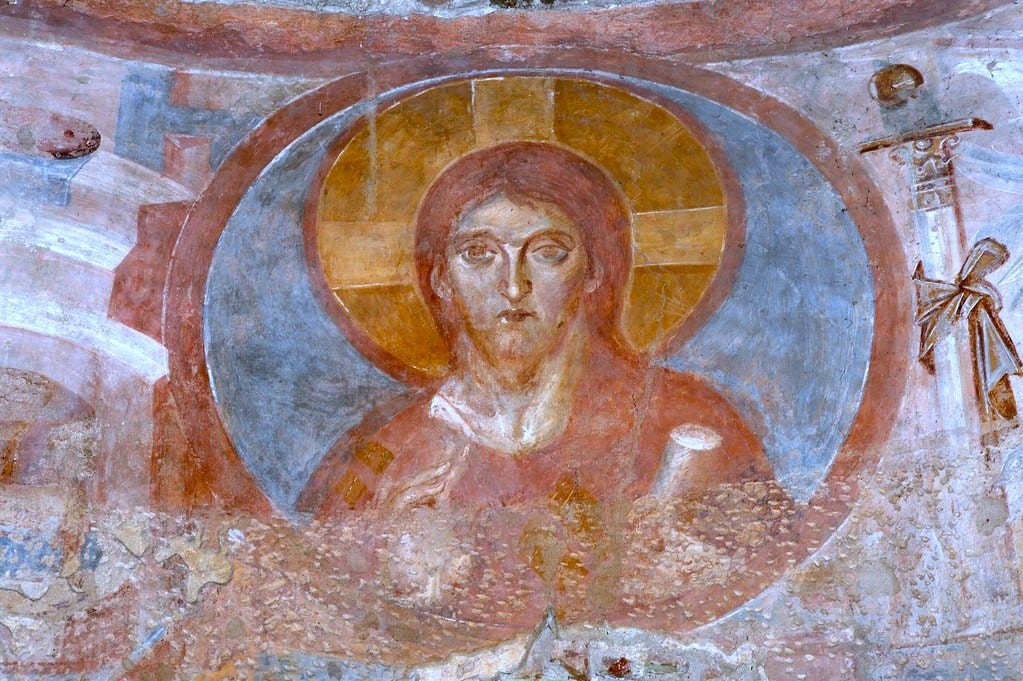
It might seem surprising that this fresco of Christ Pantocrator, discovered in the apse of a small obscure church in the north of Italy, is so unusual that it caused a major re-write of the art-history timeline. It looks like any early Byzantine image that we’ve seen hundreds of times: serene, otherworldly, with the face symmetrical with classical proportions, modelled with lights and darks to give the impression of lifelike three-dimensionality. But at the same time, we can see it is stylistically different: the softness of the facial modelling, the natural fall of the hair, the subtly rendered shadow beneath the chin, the piercing gaze and human expression.

In fact, it immediately reminds me in its naturalism of the frescos discovered at Pompei and Herculaneum. It might not be surprising to find that it dates to the earliest paleo-Christian period, when Roman standards were still in use.

But that would be the wrong guess. 

In today’s post for all subscribers, we will explore the treasure left forgotten in a tiny church in the forests of Lombardy. Hidden for centuries beneath layers of plaster, the exceptionally beautiful and lively Byzantine frescoes of Castelseprio challenge everything scholars thought they knew about Western art of the early middle ages - the time of the Lombard Kingdom, Carolingian and Ottonian empires.

Were they painted by a wandering Byzantine master, or do they reveal a local tradition that quietly preserved the grace and theology of late antique sacred art? (Read more.)

Share

Tuesday, June 23, 2026

The Lost Basilica of Saint John at Ephesus

 From Liturgical Arts Journal:

This basilica was constructed by the Emperor Justinian in the sixth century over what was said to be the site of tomb of the apostle John. It replaced another, even earlier church founded on this same site, a church that was already ancient and worn down by Justinian's time. This new church was constructed in a typical Eastern Roman, Byzantine style and, according to the Greek historian Procopius, it took its design inspiration from the Church of the Holy Apostles in Constantinople. The actual dates for its construction are A.D. 548-565 and the construction was overseen by the local bishop of Epheuus, Hypatius. 

This basilica was cruciform in shape and included typical features such as a long, columned nave; a sanctuary surrounded by a balustrade, a ciborium covering the altar and tomb of St. John, and a synthronon located behind. There was also an octagonal baptistery attached to the basilica, as well as a forecourt. 

The interior walls of the basilica were covered in polychrome marbles, as were the columns and there was a decorative stone pavement for the basilica's floor. Mosaic work ornamented the ceiling and at some point following the main construction of the church, iconographic paintings were also added, a few of which are still extant.  

In short, it sounds like both familiar and noble, and between the basilica's imperial patronage and its connection with the Apostle John, it would go on to become one of the most important Christian sites in the region -- though one which, sadly, history would not be as generous toward. (Read more.)

Share

Sunday, June 7, 2026

Victory of the Leper King

 From The Collector:

In his short 24-year life, Baldwin IV celebrated many victories against his long-standing rival, Saladin. But his victory at the Battle of Montgisard is undoubtedly his most famous victory. Still recalled by witnesses 80 years later, Baldwin faced impossible odds. Yet his courage and fortitude ensured the 16-year-old Leper King delivered a crushing blow to his opponent.

King Baldwin IV came to the throne in 1174, a mere 13-year-old boy following the death of his father, King Amalric. Like the other Crusader States, the Kingdom of Jerusalem was a frontier kingdom, surrounded by hostile Muslim enemies. Warfare and conflict were a fundamental part of life, and kings were required to lead their troops into battle regularly.

King Amalric had offered the kingdom strong leadership and had been, in many ways, an ideal king. The accession of a boy untested in warfare was a huge blow to the kingdom. But youth was not the only hindrance to Baldwin’s reign. Shortly after his coronation, Baldwin was diagnosed with leprosy, his illness discovered by his tutor and friend, the chronicler William, Archbishop of Tyre. (Read more.)


The Fall of the Kingdom of Jerusalem. Also from The Collector:

Crippled by leprosy since his teens, Baldwin IV had been a surprisingly effective king. His illness elicited compassion from his subjects, and their loyalty to their sick king was a key factor in the success of his kingship. In 1185, Baldwin finally succumbed to his illness and died. He was buried close to his father in the Church of the Holy Sepulchre. Within two years of Baldwin’s death, the kingdom he had striven so hard to defend had fallen into the hands of his longstanding Muslim rival, Saladin. Events leading up to the Leper King’s death help explain why, after his passing, the kingdom fell, and the city was lost to Christendom forever.

Baldwin IV, the Leper King who defied a death sentence, was diagnosed shortly after his coronation in 1174. It was understood that he would not father any children to succeed him. His elder sister, Sybilla, and his younger half-sister, Isabella, were therefore central to the succession.

Sybilla married William of Montferrat in 1177, and by him she bore a son named Baldwin. Montferrat died shortly before the child’s birth, and Sybilla later married a second husband, Guy of Lusignan. By 1183, Baldwin became too ill to rule and needed a regent to govern alongside him. Guy, as his brother-in-law and the husband of the heiress to the kingdom, was the natural choice. Guy proved to be a poor military commander whom the nobles refused to follow, and Baldwin removed him from his post within weeks of his appointment.

Guy’s unpopularity meant that the prospect of him succeeding to his brother-in-law’s throne was deeply contentious. Most vocal amongst those in opposition to Guy was Raymond III of Tripoli, a cousin of Baldwin IV and a man who served as his regent on several occasions. To ensure Guy would not succeed him and thus tear the kingdom apart, Baldwin attempted to have Guy’s marriage to Sybilla annulled. But Guy’s disobedience, along with Sybilla’s refusal to leave the husband she loved, thwarted Baldwin’s plans. (Read more.)

Share

Sunday, May 31, 2026

Why Constantinople’s Fall Was Not Inevitable

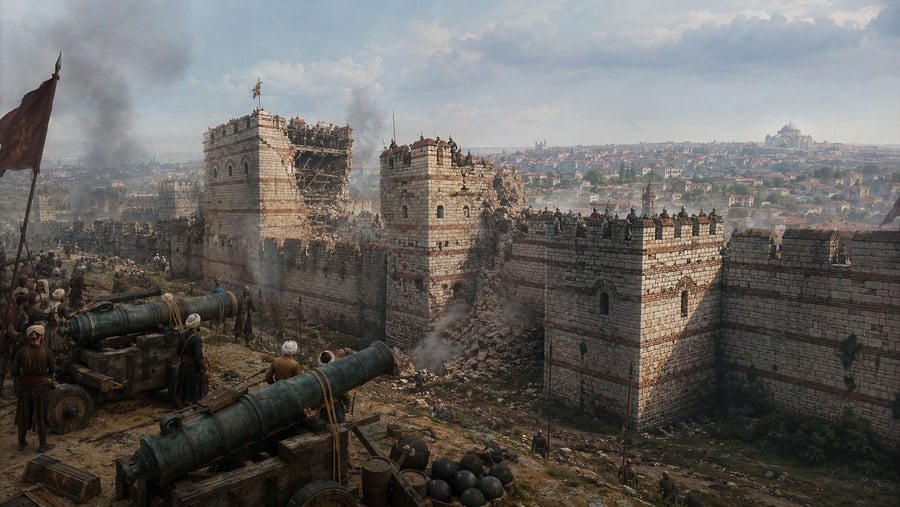
Illustration of the 1453 siege of Constantinople, showing Ottoman artillery attacking the Theodosian Walls 

From The Greek Reporter:

Historian Anthony Kaldellis, Professor of Classics at the University of Chicago, challenges the long-held idea that the Fall of Constantinople in 1453 was inevitable, arguing that the siege should be understood through the specific military and tactical factors that shaped its outcome.

Speaking to Greek Reporter about his new book, 1453: The Conquest and Tragedy of Constantinople, Kaldellis explains that historians cannot prove that an event was inevitable because they have only one historical timeline to go by. “In a sense, nothing in history is inevitable,” Kaldellis tells Greek Reporter. “We can’t go back and run experiments to see if we change certain variables what would happen.”

His argument is directed against the idea that Constantinople’s fall was inevitable, a view he noted appears across scholarship, novels, journalism, and online commentary. Rather than reading 1453 backward from its outcome, Kaldellis argues that the event should be examined through the variables that determined the result “one way or another.” (Read more.)

More HERE, HERE, and HERE.

Share

Sunday, May 3, 2026

Raymond Ibrahim's Trilogy

undefined
Baucent of the Templars


 "Not to us, O Lord, not to us; but to thy name give glory." Psalm 113 (Vulgate), motto of the Templars

Once in a discussion with a fellow historical novelist I was informed that the crusades are the earliest examples of genocide. I was surprised that the novelist, being Jewish, seemed unaware of the various ancient persecutions against her own people, including that of the Greeks in the days of the Maccabees, that might be considered genocidal. I reminded her of that, as well as of the fact that there were twelve major crusades, taking place over nearly three hundred years. They were led by different people, with the principle goal of liberating the Holy Land from Muslim rule and thus delivering the Christian population from slavery and oppression. Some were more successful than others. Some, like the Fourth Crusade, were total disasters. In fact, the Fourth Crusade is the one which most people think of when they view the crusades as orgies of mass murder. In that case, those being killed were other Christians. Did other massacres of the innocent occur during the course of the various crusades? Yes. So, did the crusaders journey hundreds of miles to the Middle East, braving fatal diseases, pirates, brigands and an ocean of foes, just for the joy of killing people? That is one of the questions answered by Raymond Ibrahim in his brilliant trilogy about the centuries-long conflict between Christianity and Islam. Ibrahim's books are The Sword and the Scimitar, Defenders of the West, and The Two Swords of Christ. The books present a background to the crusades, containing detailed information of which most contemporary people are unaware, as well as the histories of heroes like El Cid and the rise of the two greatest military orders, the Templars and the Hospitallers.

In the early Church the practice of Christians was, even in the era of persecution, to visit the places where Jesus Christ had been born, lived, died and risen. Pilgrimages were regarded as highly penitential, in which the pilgrim would not only risk life and health, but leave behind property, home, family, occupation and offices. The Romans built pagan shrines over the venerable spots like the stable at Bethlehem and the Holy Sepulcher but those temples only served to remind everyone where the sacred sites were hidden. When Emperor Constantine legalized Christianity in the Fourth Century, his mother Empress St. Helena went on pilgrimage to the Holy Land, where she discovered not only the True Cross, but found and reopened many of the other places sacred to the memory of the Savior. This ignited centuries of pilgrimage to the Middle East. Rich and poor would go, often in parish-sponsored groups as now. Special costumes were worn when on pilgrimage, and one was often regarded as being temporarily in religious life when journeying to a holy site. For Jerusalem was not the only destination; there were shrines throughout Europe, including Rome and Compostela. But the pilgrimage to the Holy Land remained the ultimate of penitential practices, with many indulgences attached. People would go for themselves and for loved ones who were sick or who had died.

All this changed with the rise of Islam in the 7th century, meticulously described by Ibrahim in his book Sword and Scimitar. Founded by Mohammed, an Arabian who claimed to be a prophet of the One True God, Islam combined elements of Nestorian Christianity and Judaism with the prophet's own inspirations, many of which included teachings abhorrent to Judeo-Christian morality. One such teaching permits Muslim men to take a non-Muslim "infidel" woman by force. Mohammed commanded his followers to spread Islam by warfare. Within 200 years, the Christian lands in North Africa, Spain, Arabia, and the Middle East were conquered. Great Christian cities like Antioch and Alexandria, which had been Apostolic sees, fell to Islam, with the churches and basilicas becoming mosques. Christians, especially children, young men and young women, were made into sex slaves and concubines, including monks and nuns. Many boys were castrated to be eunuchs in the harems of the various Muslim elites. Hatred in the form of desecration was lavished upon Christian shrines, churches, monasteries, and cathedrals, with special contempt reserved for icons, church bells and crosses. The latter were dragged upside down through the streets, to be spat and urinated upon by the disciples of the prophet. Altars were sometimes desecrated by the gang-rape a Christian virgin. Those Christians and Jews who were not killed or sold were subject to oppressive laws and taxes in their own lands. This is documented in Muslim sources which repeatedly rejoice when describing the oppression of "infidels" and especially the defilement of Christian women.

A war-like, nomadic people called the Turks embraced Islam; they eventually overran the old Roman province of Anatolia so it became "Turkey." In the late 11th century, Jerusalem, which had fallen into Muslim hands before, was captured by the Seljuk Turks, who tortured, raped, and sold into slavery the Christians of the region. Those who were killed were regarded as lucky. The violence disrupted the flow of pilgrimages from Europe to the Holy Land. The Muslims made a point of harassing and robbing pilgrims, sometimes capturing them to be sold into slavery. Blond and red-haired girls and boys with blue, gray or green eyes were especially favored for the slave markets. Although one beautiful abbess from Germany, traveling with a group of pilgrims to Jerusalem, was waylaid by Muslim bandits and raped to death in front of her fellow Christians, who were also mistreated in various horrific ways. This led Pope Urban II at the Council of Clermont in 1095 to call for a crusade of Christian soldiers to deliver the Christians in the Holy Land. Thus began the era of the crusades. Defenders of the West describes some of the great heroes of Christendom who kept Islam out of Europe, including at least one from Albania whom I had never heard of before. My opinion of Richard I "Lionheart" had suffered in the past but in Defenders he is revealed as among the bravest of the brave. The Two Swords of Christ traces the history of the two great military orders in a deeply inspiring way. For when the weak and innocent are attacked, it is unquestionably the duty of Christians who are able to defend them.

From The Chivalry Guild:

If I had to pick the best way to describe the recent works of Raymond Ibrahim—Sword and Scimitar (2018) and Defenders of the West (2022)—I’d call them no-going-back books. The equally chilling and invigorating experience of his histories cannot be undone and you cannot see the world the same way afterwards—especially since it’s not just history, but a forgotten prelude to what we’re living with today. Reality looks different post-Ibrahim.

Sword and Scimitar takes the reader through fourteen centuries of warfare between Islam and the West, with emphasis on eight great battles within that conflict. Better than any book I know, it dynamites the old public school narrative about the Crusades as a brutal act of Christian aggression against those poor, peaceful, tolerant Muslims. Ibrahim tells a much darker story about our ancient adversaries, documenting the scale of their conquests and the horrors that followed pretty much everywhere the armies of the prophet went. What we call “the West,” he writes, is but “the last and most redoubtable bastion of Christendom not to be conquered by Islam. Simply put, the West is actually the westernmost remnant of what was a much more extensive civilizational block that Islam permanently severed.” Three-quarters of the formerly Christian world was conquered by these people. It is both chilling and invigorating, like I noted, to think about how much danger we were in—and what kind of virtue was required to meet that danger and triumph over it, at least for a time.

Defenders of the West is an even more important book. It’s personal and compelling, and it reverses a long trend of hiding Christian heroes from those of us who need to learn about them. Thanks to Enlightenment propagandists, a vague narrative persists that heroism basically died out after the assassination of Julius Caesar and wasn’t revived again until Napoleon and George Washington walked the earth. The intent is a broadside against the Faith, leaving you with the vague impression that the teachings of Christ and his Church effectively snuff out all martial virtue, as though heroics cannot co-exist with the Gospel. Ibrahim shows this to be absolute nonsense. With his chronicles of Godfrey of Bouillon, El Cid, Richard the Lionheart, Fernando III, Louis IX, John Hunyadi, Scanderbeg, and Vlad Dracula, he brings to life eight legends whose deeds rival or exceed those of any heroes of any age.

These works are, in my humble opinion, on the shortlist for books of the century. So it was with special interest that I anticipated his follow-up effort. The Two Swords of Christ (published November ’25) continues with his major theme but looks at a different aspect of the conflict: the crucial work done by the Templars and the Hospitallers, basically the special forces of Christendom.

Ibrahim’s title comes from Luke 22, in which Jesus tells his disciples to buy a sword. When they reply, “Look, there are two swords here,” Jesus says, “It is enough!” What’s fascinating is his use of the singular pronoun it rather than the plural they. It suggests not the swords, but a way of life that employs “a spiritual sword against spiritual enemies, and a physical sword against physical enemies.” If your religious education was anything like mine, your teachers blithely passed over this and similar passages in favor of all the nicer-sounding directives about loving everybody and just being nice, along with never fighting—because fighting is unchristian. For those looking for simplistic formulas for life, it’s far easier to reduce the character of the Lord to that of a harmless meditation instructor, rather than wrestling with the much more challenging and dynamic truth.

The two swords also work as a metonymy for the knightly orders, filled with men whose particular way of serving God and their neighbors was with weapons. (Read more.)

  All three books are so detailed in citing source material that one comes away with a refreshed world-view, for a deeper understanding of history leads to a more profound comprehension of the present. Plus Raymond Ibrahim is an engaging and descriptive writer so that I often felt I was watching a film of the events he has so richly described. I recommend this excellent trilogy for every home library and every college history class.

Share

Tuesday, April 21, 2026

Romans, Not “Byzantines”

 From Medievalists:

Few historical civilizations suffer from a greater identity mismatch than the Byzantine Empire. To modern readers, “Byzantine” conjures images of decadence, intrigue, and a shadowy afterlife of ancient Rome. Yet to the people who lived in the empire we now call Byzantine, this label would have been meaningless. They did not call themselves Byzantines. They did not believe they lived in a successor state. They were Rhomaioi—Romans—and their empire was the Roman Empire.

Understanding how Byzantines saw themselves is more than a matter of semantics. It reshapes our understanding of medieval history, Roman continuity, and the profound cultural divide between Eastern and Western Europe. The Byzantine self-image as Roman endured for more than a thousand years, surviving language change, religious transformation, territorial loss, and even the fall of Rome itself. (Read more.)

Share

Wednesday, April 8, 2026

The Greatest Byzantine Greek Scholars of the Renaissance

 From The Greek Reporter:

Between the 14th and 15th centuries, a wave of Greek scholars left their beleaguered homeland in the Byzantine Empire for the Italian Peninsula, where their work would play an important role in the flowering of the Renaissance. The Renaissance, which literally means “rebirth”, was a period usually identified as lasting between the 14th and 17th centuries. It was characterized by an increased interest in the Greek and Roman past, with the scholars of the time looking back to Classical civilization for inspiration in the arts and sciences.

When the Byzantine Greek scholars arrived in Italy, they brought centuries of knowledge from Greco-Roman civilization with them. Medieval Italian scholars had already taken an interest in Classical Roman civilization, but this new wave of Byzantine intellectuals were well versed in ancient Greek sources and greatly widened the scope of the academic and artistic endeavors that were then possible. (Read more.)

Share

Monday, April 6, 2026

Sacred Art and the Coming of Islam

 From Hilary White at the Sacred Images Project:

And yet, despite the chaos, the sacred arts flourished. In Constantinople, the domes of Hagia Sophia shimmered with gold and glass mosaics that captured the uncreated light of heaven. In Ravenna, Christ gazed out from apse and arch with the serene confidence of divine kingship. Processions of saints in jewel-toned robes crossed the walls of sanctuaries like heavenly courtiers. The image of God made visible, incarnate, and triumphant had become the cornerstone of Christian art.

To the west, Britain and Ireland, far from the imperial centres, were stirring with new creative energy. Missionaries and monks were carving a fresh Christian identity into the raw material of a post-Roman world. The Book of Durrow, the Lindisfarne Gospels, and the carved stone crosses of Iona emerged from this wild frontier of the faith, filled with patterns and symbols that spoke of eternity in knots and spirals.

But across the deserts of Arabia, something was stirring, something that would soon cast a long and complex shadow over the entire Christian world.

Within a single lifetime, Islam would rise from obscurity and sweep across the old heartlands of Eastern Christianity. Antioch, Damascus, Jerusalem, and Alexandria, centres of theology, pilgrimage, monasticism, and sacred art, would fall under a new religious power. The sea that had been a Christian sea, ringed by basilicas and monastic foundations, would become the heart of an Islamic empire.

The world had changed, and Christian culture would never be the same. (Read more.)

Share

Tuesday, March 31, 2026

Baptism of St. Olga

From World History Connected:
It is a strange historical twist that the first "Russian" woman to be canonized in the Orthodox Church was a Viking warrior princess who spent much of her life as a pagan. Olga earned her sainthood by becoming the first member of the house of Riurik, the dynasty that ruled European Russia and parts of Ukraine and Belorus for more than seven centuries (860s – 1598), to convert to Christianity. But the role of this battle maid in the spread of Christendom to the eastern Slavs is only part of her remarkable contribution to the history of Eastern Europe. 
 
     Olga is the only woman for whom we possess significant biographical details in the written sources for the Kievan Rus period of Russian history (860s – 1240). In contrast with Western Europe and the Byzantine Empire, medieval Russian women did not participate in literary culture aside from the occasional inscription or letter of the type found on birch bark in the excavations of medieval Novgorod. The laws of the period reveal that women enjoyed few legal protections compared with their male peers. Women could inherit property from their parents or husbands, but only in the absence of brothers and sons. If the sons were young, the widow managed the family's estate until the sons reached their majority.

     Olga is in this way typical of the free elite women of Kiev.1 For nearly two decades (945 to 962) Olga ruled the rapidly expanding kingdom of Kievan Rus,2 which received its name from its capital Kiev on the middle Dniepr River, as regent for her young son Sviatoslav. And she did so in stunning fashion despite significant obstacles. Olga assumed power at a time when the realm was shaken by tribal violence and administrative disorder. She bloodily pacified rebellious tribes and replaced tribute taking with a regular system of taxation. Olga's decision to convert to eastern Christianity instead of Catholicism was also a fundamental step in the spiritual and political alliance of Kievan Rus with the Byzantine Orthodox world rather than with Latin Christendom. In short, it took the will and perspicacity of a barbarian widow to begin the transformation of the Rus lands from a loosely knit pagan chieftaincy into a more stable and centralized Christian kingdom. (Read entire post.)
Share

Saturday, January 31, 2026

The Transformation of the Roman Empire Into Byzantium

 From The Greek Reporter:

The transformation of the Roman Empire into what modern historians call Byzantium was not a single event but a gradual process, reaching a profound turning point in the 7th century. By this time, the Roman state had changed in territory, culture, language, religion, and political structure, becoming something new—yet it continued to call itself Roman. The 7th century marked the moment when the Ancient Roman world evolved into the medieval Byzantine Empire, which had previously been known as the Eastern Roman Empire.

Although Hellenistic culture had long prevailed, cemented by the founding of Constantinople in 330, the Eastern Roman Empire retained the core elements of imperial Rome. Its administration remained rooted in Roman institutions, its cities preserved Classical urban culture, and its emperors regarded themselves as heirs of Augustus and Constantine. Latin was in decline, however, even as it remained the official language and the emperors claimed dominion over the entire Mediterranean.

 The transformation was inevitable: Constantinople was emerging as the center of the empire while Rome’s influence waned. As historian Peter Brown observed, Byzantium represents continuity: “The Roman Empire did not fall in the East. It was transformed.” Centered in Constantinople, the Eastern Roman Empire remained a powerful and sophisticated Roman state but with a distinct Byzantine character—while still seeing itself as Roman. (Read more.)


A Byzantine princess in Kyivan Rus. From History of Royal Women:

As the sister of the Byzantine Emperor and as a princess born in the purple, Anna was a highly desirable bride. In 972, the Holy Roman Emperor, Otto II, married Theophano, a relative of the Byzantine Emperor, after requesting an imperial princess. Sometimes Theophanu is thought to have been a sister of Anna, but she was probably related to her more distantly. It is possible that Otto may have wanted to marry Anna instead. In 986, a Bulgarian prince appears to have asked Basil for his sister’s hand in marriage, but this was rejected.

In 988, the new French king, Hugh Capet, sent a letter to Basil, asking him to find a bride for his son, the future Robert II, of equal rank. It was likely Anna, who he was asking for. This arrangement did not go through either. It is believed that all of these proposals were turned down because, at the time, Byzantine princesses born in the purple were considered too important to marry foreigners, even if they were kings or emperors. The Byzantines at this time were also said to have still considered the Western Europeans as barbarians. Everything changed in 988 when Vladimir, Grand Prince of Kyiv, wished to marry Anna. (Read more.)

Share

Wednesday, November 26, 2025

Alix and Nicky: The Passion of the Last Tsar and Tsarina

 The wedding of Tsar Nicholas II and Princess Alix of Hesse-Darmstadt -  1894, doing research on her, this is an amazing painting~

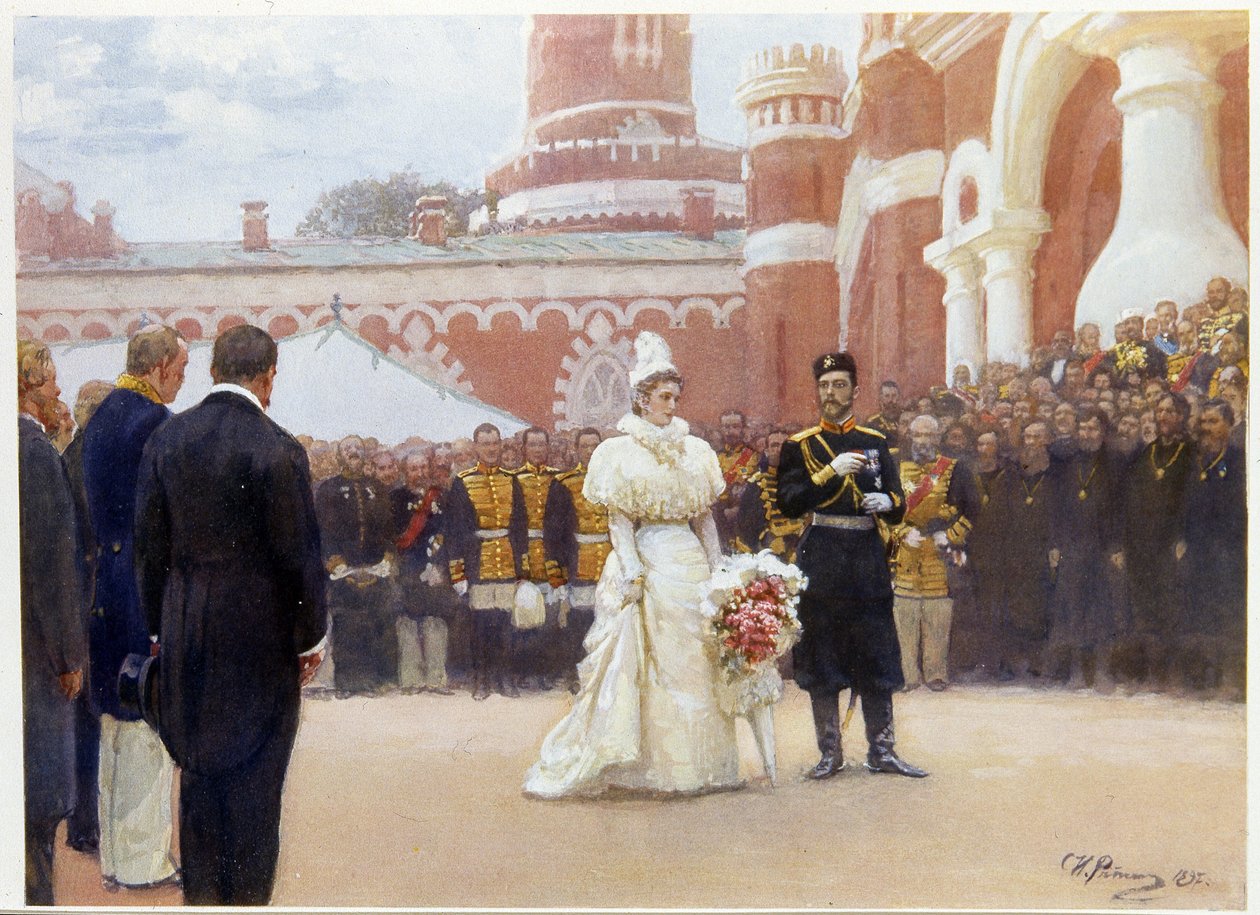
Nicholas II and His Wife, Alexandra Fedorovna, Receiving Rural District Elders on May 18, 1896 by Ilya Efimovich Repin 
On the wedding anniversary of Nicholas and Alexandra I thought I would revive this old review:

 In Alix and Nicky: The Passion of the Last Tsar and Tsarina Virginia Rounding offers a fresh look at the relationship of Tsar Nicholas II and Alexandra (Alix) his Empress, their accomplishments and fatal flaws, in this intriguing biographical study. For those not familiar with the Romanovs, there is enough background not to get lost. For those who are familiar with the topic, Rounding provides unique insights focusing on aspects of the imperial marriage and political policies too often ignored.

Rounding explores Nicholas’ political achievements and his oft-demeaned temperament and Alix’s mysterious, incapacitating ailments. While her symptoms are usually claimed to be the result of hysteria, Rounding surmises that the Empress may have had some genuine health issues, together with emotional instability. The strange dynamic between the imperial couple and Alix’s friend Anna Vyrubova is scrutinized in detail. Alix’s belief in Rasputin is blamed for precipitating the catastrophes which followed, not so much what Rasputin did as what he was perceived to have done by the public. Most enlightening is the treatment of the spiritual lives of Nicky and Alix and how their faith flowed into their love for each other. As a stirring portrait of a marriage, this book is second to none.
https://m.media-amazon.com/images/I/81Ts+4dnDAL._SL1500_.jpg
  This review first appeared in the May 2012 edition of the Historical Novels Review. The book is available HERE.

(*NOTE: This book was sent to me by the Historical Novel Society in exchange for my honest opinion.)


Share

Wednesday, October 15, 2025

The Spectacular Byzantine Churches That Still Exist in Italy

 From The Greek Reporter:

The Italian peninsula is the birthplace of the Romans and their mighty empire. During Rome’s rule over much of the known world, Christians were persecuted without mercy. However, within a few decades, this new religion transformed the empire, turning the most powerful state of its time upside down.

After the collapse of the Western Roman Empire and the rise of the Eastern Roman Empire, later known as the Byzantine Empire, Italy became home to some of the most spectacular churches, profoundly influenced by the Eastern territories of the empire.

The Basilica of San Vitale in Ravenna, Italy is a masterpiece of early Byzantine church architecture and art, which was completed in 547 AD.

Its impressive octagonal structure combines Roman and Byzantine elements, featuring a modest dome that is supported by a total of eight pillars. The basilica is famous across the world for its stunning mosaics, particularly those depicting Emperor Justinian and Empress Theodora. The reigning couple were very proud of their grandiose constructions and their presence in churches across the Empire symbolize the union of political and religious power in the early Eastern Roman (Byzantine) Empire. The mosaics also include biblical scenes and beautiful designs. (Read more.)

Share

Wednesday, August 6, 2025

Emperor Constantine Palaiologos’ Heroism

 From The Greek Reporter:

If the urban legends are to be believed, “The city has fallen and I am still alive” were the last, painful words of Constantine XI Palaiologos, the last Byzantine Emperor.

On May 29 1453, as the world of Byzantium crumbled around him, its last emperor faced an impossible choice between heroism and humiliation. The story of his final hours on the walls of Constantinople is a blur of history, covered in myth and proud stories of national identity. It is a story that still moves modern Greece, showing how interconnected the identities of the Byzantines, the Eastern Romans and the modern Greeks are. While no one doubts that Constantine Palaiologos died like a hero, how exactly he fell remains a mystery that gave rise to one of Greece’s most prominent modern legends.

The facts, as much as we can ever know them, are pieced together from the accounts of men who were there at these historic moments for the entire region. The Venetian surgeon Nicolò Barbaro wrote in his ”Giornale dell’assedio di Costantinopoli” about the pure chaos that engulfed Constantinople as the Turks were advancing towards the once mighty Byzantine capital. Similar accounts we find in Archbishop Leonard of Chios’ writings in his letter he sent to Pope Nicholas V. Their accounts agree that Constantine, facing the vast army of Sultan Mehmed II, refused to flee or surrender his city. (Read more.)

Share

Monday, August 4, 2025

The Romanesque Gaze


Anyone who is interested in sacred art and beautiful writing should subscribe to The Sacred Images Project. From Hilary White:

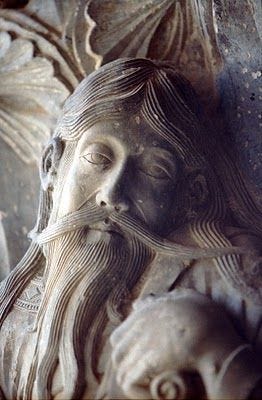
Why do these faces feel at once so strange and so compelling? However abstract or otherworldly they appear, we are caught by them; their gaze captures ours. They seem to defy our ideas about what sacred art is for; they do not invite us into a personal, interior, intimate moment. We feel silenced when looking, as if we are being in turn looked at, from an unimaginable distance.

We call it “Romanesque” today but this is a much later academic nomenclature; a term from academics of the early 19th century, whose attention was always trained on Imperial Rome. They saw the architecture, the barrel vaults, rounded arches and solid stone construction, as a “revival” of Roman imperial greatness. But this label risks obscuring the deeper and more immediate roots of the style in monastic liturgy, Christian cosmology and the symbolic imagination of the Middle Ages - all greatly despised by 19th century “men of reason”. 

 Much later, post-Christian scholars may have named it “Romanesque” but at the time it wasn’t a conscious revival of Classical Antiquity; medieval men would probably have thought that ancient, Classical pagan Rome deserved its fate for murdering the saints. The churches, paintings and sculptures of the eleventh and twelfth centuries were shaped by the practical and spiritual needs of a new Western Christian society, defined by Benedictine monasticism, growing pilgrimage networks and a theology that prioritised symbolic meaning over naturalistic representation. When we talk about early medieval western sacred art, we’re talking about Romanesque.

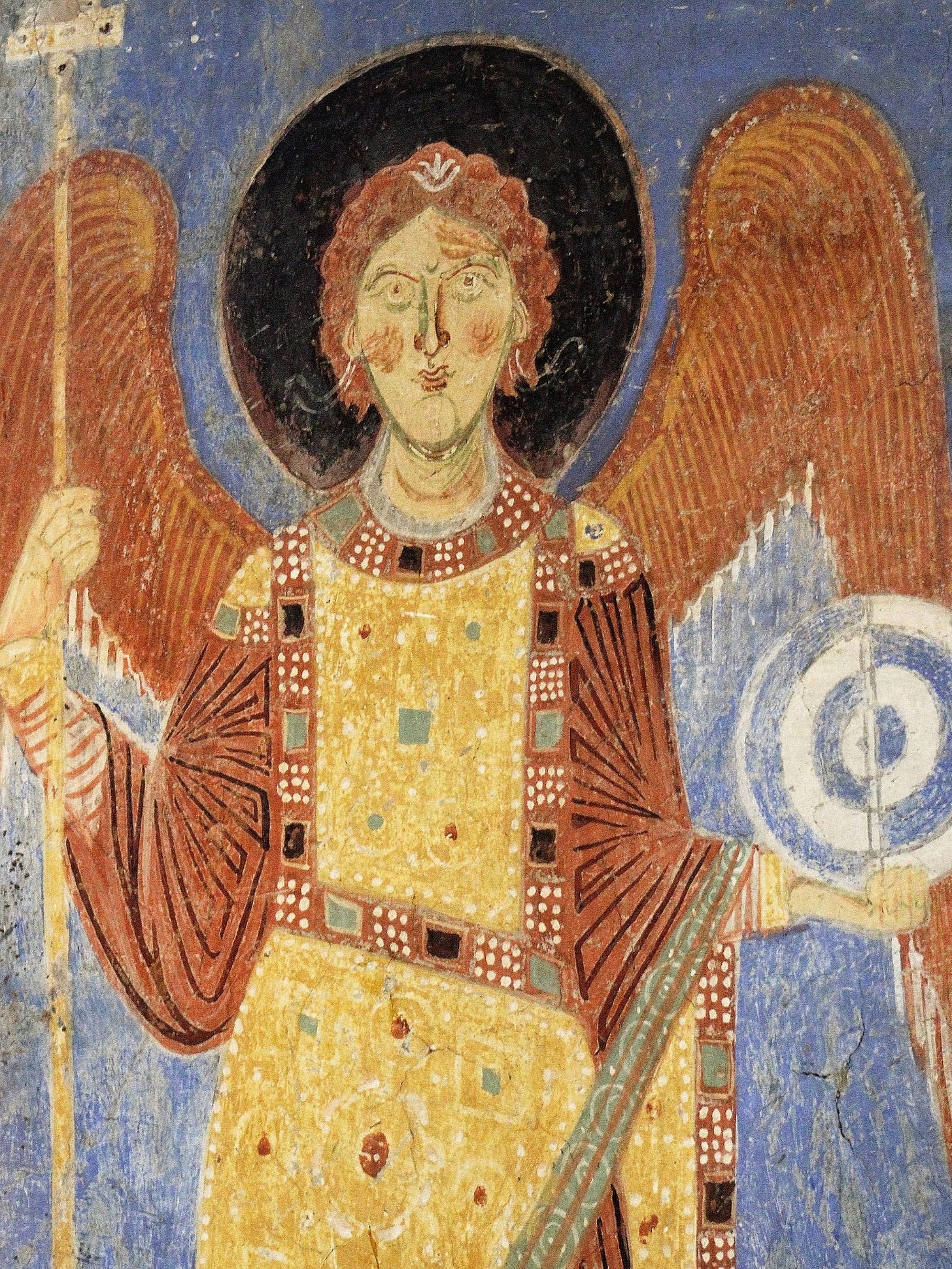
 In the Romanesque, the human faces and figures of Christ, the Virgin, the saints and angels were not painted to resemble any specific individual. Far from it. These are faces abstracted sometimes almost out of recognition into stylised, linear geometric forms intended to express visually the eternal mysteries. In manuscripts, frescoes and sculpture, these faces served as symbols: condensed signs of a humanity transfigured by divine life. (Read more.)

Share

Wednesday, July 23, 2025

Byzantine and Carolingian Art


Brilliant. From Hilary White at The Sacred Images Project:

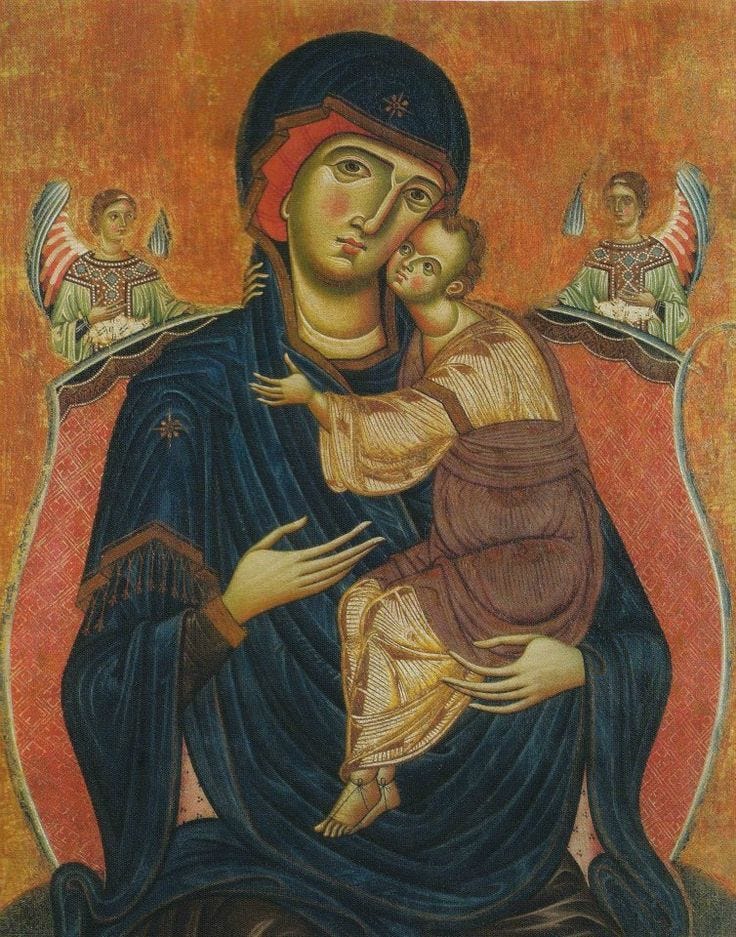
Icons to the eastern Christian to this day, are not “illustrations of the faith” intended to “teach illiterates Bible stories,” but points of immediate contact with the reality of the Incarnation, rendered in a symbolic style meant to invite prayer and communion, not analysis. The Carolingian north, however, increasingly favoured legibility, narrative story telling, hierarchy and natural form in service of a more didactic, rationalised approach to religion and governance. In one sense, these two ways of thinking about sacred art represent the theological divergence that was already unfolding between East and West. Rome’s was consolidating power around a Latin, imperial western Christendom on the one hand, and Constantinople maintaining the ancient mystical, liturgical cosmology on the other.

These two streams would sometimes clash and sometimes blend and finally the resulting hybrid would see unique new expressions in art, architecture and monastic life, which we’ll eventually see more fully in the Norman period, with the Italo-Byzantine and early Romanesque. But in the 9th and 10th centuries, they still stood largely apart, like two rival visions of what Christian civilisation could be. (Read more.)

Share

The Rise and Fall of the Holy Roman Empire

 From Charles Coulombe:

The French Revolution would ultimately doom the venerable old Imperial edifice.  By 1795, Revolutionary France had annexed Belgium and the Left Bank of the Rhine.  The martyred Marie Antoinette’s brother, Francis II, had been crowned Holy Roman Emperor in 1792.  In an attempt to shore up Germany against the French menace, Francis allowed the annexation of hundreds of smaller German states by the larger ones.  It was hoped that the score that remained would be better able to resist the foe, now ruled by Napoleon Bonaparte.  But the defeat of the Second Coalition in 1804 led Napoleon, who had begun to speak of himself as the new Charlemagne, to have himself crowned Emperor of the French.  At the ceremony in Paris’ Notre Dame Cathedral, Napoleon took the crown from the hands of a startled Pope Pius VII, and crowned himself with it.  This in turn led Francis to suspect that Napoleon wished to make himself Holy Roman Emperor.  In response, he created a new crown and entity over which to reign: the Hereditary Empire of Austria.

Made up only of the hereditary Habsburg Lands, this new creation still featured the Double Eagle – the symbol of the Christian Empire that through long use had become associated with the Habsburgs.  In 1806, Francis led his country into another conflict with France, the War of the Third Coalition.  Defeated at the Battle of Austerlitz, he was forced to sign a treaty with Napoleon that greatly weakened Austria.  In August, Napoleon created the Confederation of the Rhine, into which he compelled Bavarian and fifteen of the other larger German States to enter – while withdrawing from the Holy Roman Empire.  On July 22, Napoleon issued an ultimatum ordering Francis to abdicate as Holy Roman Emperor by August 10.  He did so, but declared the bonds tying the estates to him and so each other dissolved – in effect, dissolving the Empire.

It had endured 1006 years since Bl. Charlemagne was crowned.  In 1815, there was an attempt to revive it; but Emperor Francis I (as we must call him in his role as Emperor of Austria) was against this idea.  In its place, the Germanic Confederation, a loose grouping of the German States, was erected with the Austrian Emperor as president.  In 1848, a German Empire was briefly revived, but collapsed ultimately through the then-impossibility of including both Prussia and Austria in one centralised nation.  Bismarck solved the issue in 1866 by driving Austria militarily out of Germany, as a prelude to the creation of the German Empire in 1871. Comparing it to the Holy Roman Empire, Dom Guéranger observed rather caustically in his entry on St. Boniface: “Upon its ruins, like a woeful mimicry of the Holy Empire, Protestantism has raised its false Evangelical Empire, formed of naught but encroachments, and tracing its recognized origin, to the apostasy of that felon knight, Albert of Brandenburg.” (Read more.)


Share

Wednesday, July 2, 2025

The Fall of Rome, Revisited

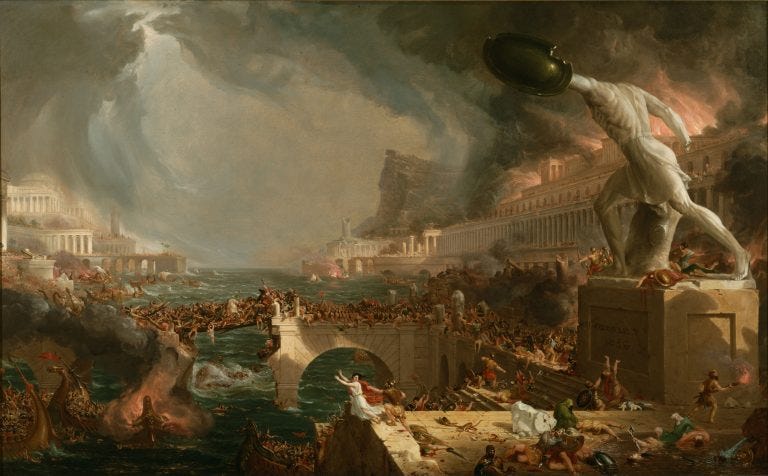
 Roman empire fall painting: Fall of the Roman Empire in painting: Thomas Cole, The Course of Empire, Destruction, 1836, The Metropolitan Museum of Art, New York, NY, USA. Wikimedia Commons (public domain).
 

From Hilary White at The Sacred Images Project:

I may have forgotten to cover it because in reality it was a bit of a non-event. Thomas Cole’s fanciful academic painting here shows a cataclysmic, all-consuming disaster: temples burning, mobs rioting, statues toppling, ships sinking, bodies strewn across a collapsing cityscape, which is more or less how we’ve been taught to think of it. But this is not what happened in Rome in 476. The last western emperor, Romulus Augustulus, was quietly deposed and sent off to retirement. There was no sack in 476, no flames, no tidal wave of chaotic destruction. Unfortunately for romantic painters, the historical reality was gradual, bureaucratic and anticlimactic.

In 476 AD, the boy-emperor Romulus Augustulus1 was deposed, after reigning only about ten months, by the barbarian general Odoacer, and that’s the conventional date for the “fall” of the Western Roman Empire. But what actually fell was the last remaining shred of imperial authority in the West. In the east, emperors carried on in Constantinople for another thousand years. In the West, daily life didn’t suddenly stop, though it certainly changed. The Church remained standing and bishops and clerics stepped into civic leadership roles as senatorial power faded. Many Roman churches from this period are still in use, and had already provided shelter to the city’s population during the sack of 410 by Alaric.

What really collapsed was centralised administration and senatorial power. It hardly needs saying that Odoacer didn’t overthrow the Roman Empire at its peak of peace, power, and prosperity. By 476, the Western Empire was already a shadow of its former self; militarily overstretched, economically broken, politically fragmented and increasingly reliant on barbarian generals to do the actual ruling. (Read more.)

Share

Tuesday, June 24, 2025

Walking Inside Christian Eschatology


From Hilary White at The Sacred Images Project:

In last week’s post for all subscribers, we talked about the iconographic programmes; the carefully planned cycles of images in fresco or mosaic, that covered all the surfaces of the interiors of Byzantine and western early medieval churches. These cycles structured how sacred images were arranged to tell the story of salvation, that would have been understood by worshippers, transforming the space inside the church into an elevated, sanctified place where those realities were made present.

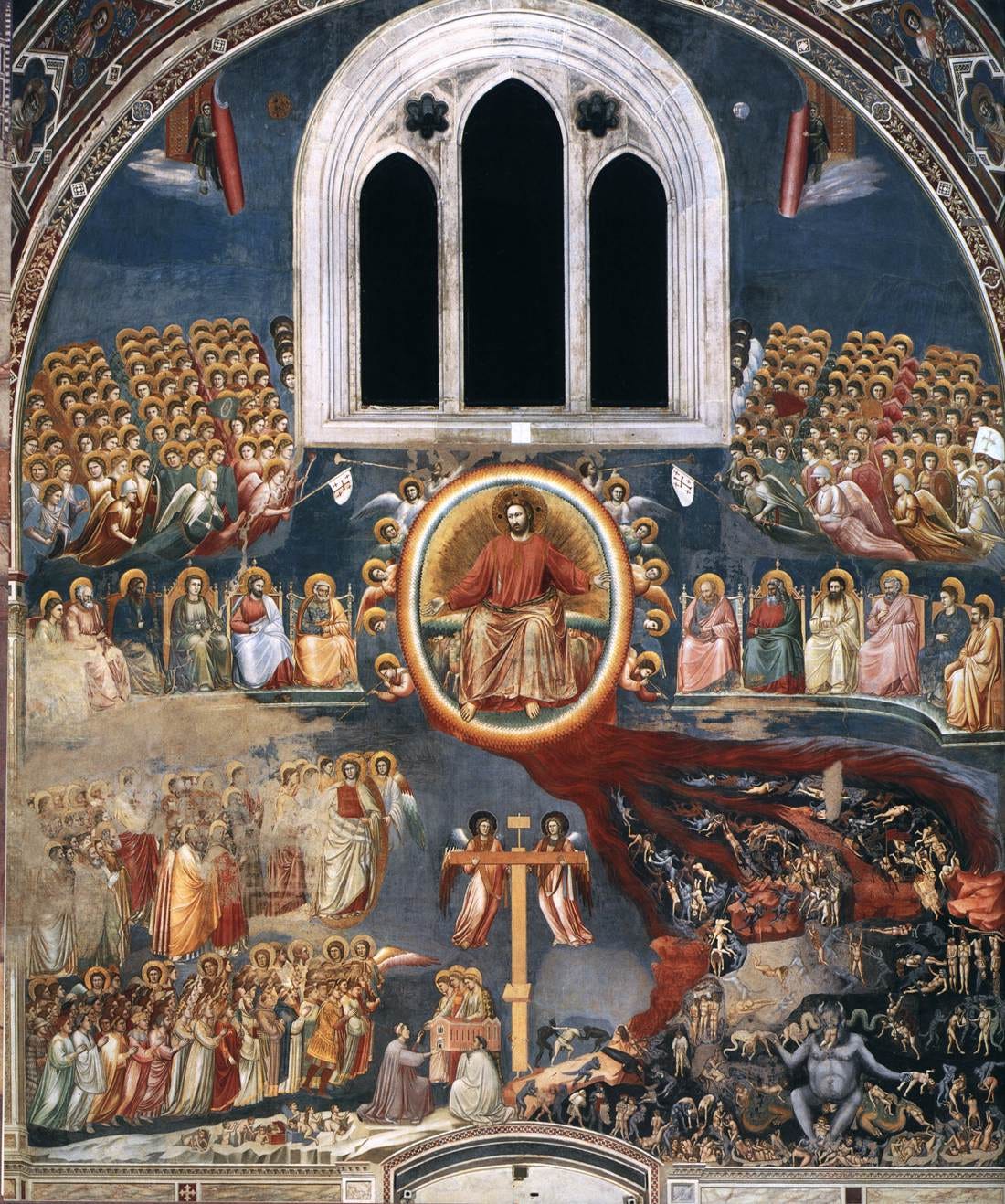
In many churches, all the way up to the late Gothic (or “proto-Renaissance”), a typical feature of these programmes was the back wall of the church - the opposite end of the nave from the sanctuary, or the west wall - being decorated with often shocking and arresting images of the Last Judgment. This was an innovation that came to Western Christendom during the 11th and 12th centuries.

 In today’s post for all subscribers, we’ll look closely at three examples of these commanding scenes, starting in the period when Italo-Byzantine was established throughout the Italian peninsula and was beginning to merge into the Romanesque style. We’ll look at Torcello’s Basilica of Santa Maria Assunta, a mid-11th century grand, multi-tier mosaic cycle and Sant’Angelo in Formis (Capua) early 12th c. where Romanesque style first appeared. We’ll briefly compare these antecedents to the great fresco of the Arena Chapel in Padua, where Giotto took the motif and translated it into his more naturalistic style. (Read more.)

Share

Monday, June 23, 2025

The Mysterious Frescoes of Castelseprio

 From Hilary White at The Sacred Images Project:

It might seem surprising that this fresco of Christ Pantocrator, discovered in the apse of a small obscure church in the north of Italy, is so unusual that it caused a major re-write of the art-history timeline.

It looks like any early Byzantine image that we’ve seen hundreds of times: serene, otherworldly, with the face symmetrical with classical proportions, modelled with lights and darks to give the impression of lifelike three-dimensionality. But at the same time, we can see it is stylistically different: the softness of the facial modelling, the natural fall of the hair, the subtly rendered shadow beneath the chin, the piercing gaze and human expression.

In fact, it immediately reminds me in its naturalism of the frescos discovered at Pompei and Herculaneum. It might not be surprising to find that it dates to the earliest paleo-Christian period, when Roman standards were still in use.

But that would be the wrong guess. (Read more.)

Share