


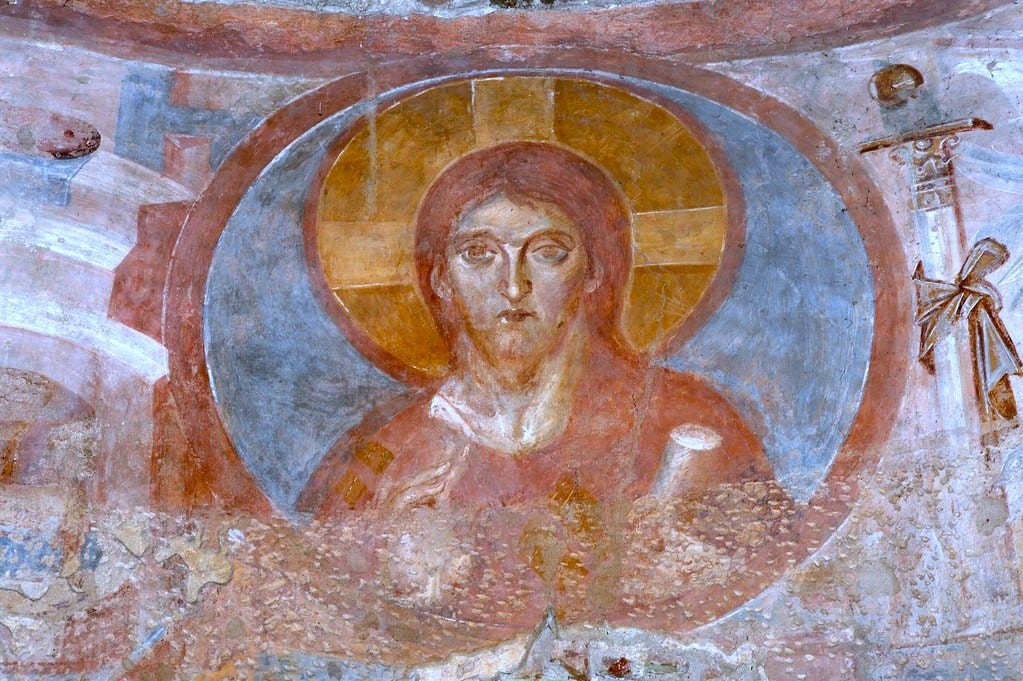
From Hilary White at The Sacred Images Project:
ShareIt might seem surprising that this fresco of Christ Pantocrator, discovered in the apse of a small obscure church in the north of Italy, is so unusual that it caused a major re-write of the art-history timeline. It looks like any early Byzantine image that we’ve seen hundreds of times: serene, otherworldly, with the face symmetrical with classical proportions, modelled with lights and darks to give the impression of lifelike three-dimensionality. But at the same time, we can see it is stylistically different: the softness of the facial modelling, the natural fall of the hair, the subtly rendered shadow beneath the chin, the piercing gaze and human expression.
In fact, it immediately reminds me in its naturalism of the frescos discovered at Pompei and Herculaneum. It might not be surprising to find that it dates to the earliest paleo-Christian period, when Roman standards were still in use.
But that would be the wrong guess.
In today’s post for all subscribers, we will explore the treasure left forgotten in a tiny church in the forests of Lombardy. Hidden for centuries beneath layers of plaster, the exceptionally beautiful and lively Byzantine frescoes of Castelseprio challenge everything scholars thought they knew about Western art of the early middle ages - the time of the Lombard Kingdom, Carolingian and Ottonian empires.
Were they painted by a wandering Byzantine master, or do they reveal a local tradition that quietly preserved the grace and theology of late antique sacred art? (Read more.)











No comments:
Post a Comment