


Thomas Merton on Noise
1 week ago


From Mark Judge at Hot Air:
Will Woodward have the guts in Secrets to criticize the press? To “walk down the painful road of introspection” about his own profession? It’s possible. The phrase “walk down the painful road of introspection” is one Woodward himself used to criticize his colleagues at the Washington Post. It appeared in “The Press vs the President,” a long series of articles by Jeff Gerth that were published in January 2023 in the Columbia Journalism Review. The intelligence community set up President Trump for failure in 2016 by falsely claiming he was a tool of the Kremlin. The media peddled garbage, ignored contradictory evidence, and flat-out lied. “The Press vs the President,” which is a comprehensive and damning indictment of the media. (Seriously, go read it.)
One of the people interviewed in Gerth’s series is Bob Woodward. In January 2017, Woodward went on Fox News and criticized the Steele dossier, the anti-Trump file which was funded by Hillary Clinton’s campaign and compiled by ex-British spy Christopher Steele. Woodward called the dossier a “garbage document.” The Steele dossier claimed Trump was hanging out with prostitutes in Moscow.
Jeff Gerth describes what happened next: “After his remarks on Fox, Woodward said he ‘reached out to people who covered this’ at the paper, identifying them only generically as ‘reporters,’ to explain why he was so critical. Asked how they reacted, Woodward said: ‘To be honest, there was a lack of curiosity on the part of the people at the WashingtonPost about what I had said, why I said this, and I accepted that and I didn’t force it on anyone.’” Woodward also told Gerth that the Mueller report was a ‘fizzle’ but reporters were ‘never going to declare it was going to end up dry.’” (Read more.)
From The New Criterion:
ShareOne novel that arose from the disastrous impact of the Second World War that will endure, I believe, is Evelyn Waugh’s last masterpiece, the trilogy Sword of Honour, which appeared between 1952 and 1961. He initially planned a single volume but found the story so compelling he produced three distinct novels built around the character Guy Crouchback, a figure not unlike himself in some ways.
The novels originated from what Waugh saw as a crisis of faith in Western values. He saw the enemy clearly—the war was nothing less than “the Modern Age in arms,” totalitarianism and secularism at their worst. The crisis of the times, the war and its aftermath, was also a personal one for Waugh. He believed he was witnessing the decline of the Catholic Church he had joined as a convert, a theme that dominated his writing after the war, and especially after Vatican II, which he distrusted.
The great success of Brideshead Revisited (1945), which was written towards the end of the war, had solidified Waugh’s reputation as not just the author of biting satires, but also the most significant writer of serious English prose. Yet he had written little of importance after Brideshead save for his savagely funny indictment of Hollywood and American values, The Loved One (1948), which was on par with his comic masterpieces of the 1930s as well as being a financial success. Interestingly, he offered the profits from The Loved One to the Catholic Church in England, only to have the offer declined on the grounds that the novel’s content was too scandalous to be associated with the Church. (Read more.)
 It is Michaelmas Day. According to Lives of the Saints:
St. Michael, who ranks among the seven archangels, is also one of the three angels mentioned by name in the Scriptures, the others being St. Raphael and St. Gabriel. St. Michael is spoken of twice in the Old Testament, and twice in the New. The first reference occurs in the Book of Daniel (chapter x), where Michael comes to comfort Daniel after he has had a vision, and promises to be his helper in all things. In Daniel xii, Michael is called "the great prince who standeth for the children of Thy people." In these references Michael is represented as Israel's great support during the seventy years of the Babylonian captivity. Daniel, wise and holy leader that he was, wanted his people to understand that God had not forgotten them, and that, even though enslaved, they had a royal champion. In the New Testament (Jude ix), we are told that Michael disputed with the devil over the body of Moses; this episode is not mentioned elsewhere in the Bible.
In the Apocalypse (chapter xii) we find the most dramatic reference to St. Michael. Here John recounts the great battle in Heaven, when the wicked angels under Lucifer revolt against God, and how Michael, leading the faithful angels, defeats the hosts of evil and drives them out. In this role he has been painted by many artists, and the poet Milton, in book vi of, recounts the famous struggle. Because of this victory, St. Michael is revered in Catholic tradition and liturgy as the protector of the Church, as once he was regarded as the protector of the Israelites. In the Eastern Church, as well as among many theologians in the West, St Michael is placed over all the angels, as prince of the Seraphim. He is the special patron of sick people, mariners, and grocers; in Asia Minor many curative springs were dedicated to him. His cult has also been popular in Egypt, Rome, France, and Germany. His emblems are a banner, a sword, a dragon, and scales. The name Michael is a variation of Micah, meaning in Hebrew, "Who is like God?"
From AMAC:
ShareBack in April, The New York Times reported that lawyers for ActBlue, the leading Democrat fundraising platform, “may have misled Congress on vetting foreign donations.”
Now the scandal has gotten even deeper, with House Republicans alleging even more serious fraud and wrongdoing. But with Election Day right around the corner, the liberal media has suddenly gone mute on this bombshell story implicating scores of Democrat politicians and campaigns.
ActBlue is the dominant platform used for Democrat small-dollar fundraising – the liberal counterpart to WinRed. It has processed some $19 billion in contributions since 2004, with candidates and groups raising nearly $1.8 billion from 52 million individual contributions through ActBlue in 2025 alone.
In this campaign cycle, high-profile Democrats including Jon Ossoff, Abdul El-Sayed, James Talarico, Roy Cooper, Mary Peltola, and Josh Turek have all used ActBlue. Democrat House and Senate leaders, as well as countless congressional candidates, also use the platform.
Foreign nationals are prohibited from making contributions in connection with federal, state, or local U.S. elections, and campaigns may not knowingly accept such contributions. Americans living abroad, including military personnel, diplomats, and students, can donate. There are also comprehensive campaign finance laws requiring platforms like ActBlue to take steps to identify and prevent fraud, such as foreign entities or individuals making donations in the name of U.S. citizens.
According to a new joint report from the House Judiciary, Administration, and Oversight committees, however, ActBlue did not investigate warning signs seriously enough to distinguish lawful American donors from prohibited foreign contributors. (Read more.)
From Lit Hub:
ShareI do not remember my father Eddie, Shackleton’s youngest child, ever sitting me down and telling me about his father. Indeed, he hardly knew him, being only 10 years old when Ernest died of a heart attack on January 5, 1922, during the Shackleton-Rowett Quest expedition.
I learned the story by asking about the Hurley photographs on the walls. They were sometimes confusing for a child: “Why was it dark when it was not night?” and “Why did all the men have beards?” I was particularly intrigued by one photograph showing Endurance in the ice, reduced to a skeleton, and the sled dogs sitting around her. I would ask, “What happened to the dogs?” The grownups would never give me a straight answer, and it was not until years later that I was deemed old enough to know the truth, that as on most expeditions of the era, the men killed and ate the dogs when food ran short.
It was not only children who were sometimes confused by a Hurley image. I remember one visitor spending ages contemplating a view of rocky, snow-covered peaks, brooding over a magnificent glacier tumbling into a large fjord, full of huge blocks of floating ice. Eventually, our visitor announced triumphantly, “I know where that is! It is Lulworth Cove!” Hereafter, it was known as Lulworth Cove in the family. In fact, it was South Georgia.
Hurley’s cine film South, originally released in 1919 as In the Grip of the Polar Pack-Ice, was also of significance for me, since it was the first time I saw my grandfather moving and smiling. The film shows astonishing images of the death of the Endurance. Hurley set cameras around her and showed her masts crashing down. (Read more.)
 |
| Pope Leo at Notre Dame with the statue of Our Lady of Charles X |
From Vatican News:
Light inundated Notre-Dame as Pope Leo XIV celebrated vespers in Paris' beloved Cathedral. It felt like a fitting celebration for the restored and renewed basilica, a place of worship and iconic symbol of the “Ville Lumière“, badly damaged by fire on 15 April 2019.
On that day, dramatic images and videos of the cathedral engulfed in flames, and of people praying in the streets as the fire consumed the building, spread around the world through social media and news outlets.
Today, the French Church has come together again. This time to rejoice, as the Pope visited the Cathedral and celebrated Vespers, almost two years after its reopening in December 2024, following a long and meticulous restoration process.
As the sun shone through the stained-glass windows, colorful patterns moved slowly across the walls. Meanwhile, an organ played and the choir sang while the bishops, priests, consecrated men and women, seminarians, and other members of the French Church solemnly prayed together with the Successor of Peter.
Before the Vespers, Pope Leo venerated a relic of the crown of thorns, which was placed on Christ’s head during his Passion. A symbol of his suffering and sacrifice before his Resurrection.
“We are gathered for Evening Prayer in this place which, more than any other, has invited the people of Paris for centuries to lift their eyes towards heaven,” Pope Leo said in his homily. (Read more.)
 |
| Mass at the Place de la Concorde, where thousands were guillotined (Via Daily Mail) |
I wish instead of Robespierre the article had mentioned Madame Elisabeth. From Rome Reports:
The Place de la Concorde in Paris is a site marked by some of the darkest moments in French history.
During the Revolution, the guillotine stood here, and more than a thousand people were executed. Louis XVI, Marie Antoinette and Robespierre were among them.
Two centuries later, Pope Leo XIV celebrates the Eucharist here before nearly 600,000 people. A turnout that marks a new chapter in the Church in France.
The pope is using this celebration to call for a secular society.
LEO XIV
Seeing you gathered here, brothers and sisters, heirs to a long and beautiful history of holiness in France, I say to you: in turn, drink deeply from this spring that is the pierced Heart of Jesus. Yes, you thirst for God, for life, for truth, for unity, for peace, for communion, for happiness. You long to rediscover a radiant horizon, to build a renewed nation rooted in a faith that nourishes its very foundations.
But the pope does not stop with France’s religious identity. He goes straight to the individual and a much more universal question: what does a Catholic drink from when he or she thirsts for life?
LEO XIV
Brothers and sisters, we must acknowledge that here on earth, nothing can fully satisfy us. Just when we think our search is finally over and our efforts have been rewarded, that inner emptiness often resurfaces, even more profound than before.
Are we content with material possessions, immediate gratification, and the countless little idols that promise the world but leave our hearts empty?
And while, in 2008, Benedict XVI came to France asking how faith could survive in a secularized society, today, Pope Leo XIV is not talking about survival.
He is talking about renewing the country from its roots: building a renewed nation through a faith that can once again nourish society.
This is not about rebuilding a blood-soaked square, but renewing a society that, according to the pope, thirsts for truth, peace and happiness. (Read more.)
 |
| Pope Leo in Lourdes |
From EWTN:
Leo met Sept. 27 with staff and sick guests of the Accueil Notre-Dame (Notre Dame Home), a residential accommodation classified as a healthcare facility, which hosts sick, disabled, and frail pilgrims to Lourdes.
The Catholic shrine is one of the most visited in the world, drawing more than 3 million people every year, many in search of miraculous physical healing.
The 136-acre property includes the Grotto of Massabielle, where a young St. Bernadette Soubirous saw 18 apparitions of the Virgin Mary starting on Feb. 11, 1858. Today, pilgrims to the sanctuary bathe themselves in the freshwater spring Mary revealed to Bernadette.
Visitors have reported 7,000 healings since the apparitions; after lengthy investigations, the Church has declared that 72 of the recoveries were miraculous, meaning unexplainable by science. (Read more.)
From CWR:
The Sanctuary of Our Lady of Lourdes is among the most popular Catholic shrines in the world, built on the site of Mary’s apparitions to St. Bernadette in 1858. It is particularly visited by the sick, who come to bathe in or drink its healing spring water.
In his homily, Pope Leo noted that a “call to conversion, both tender and urgent,” was a central part of the message the Virgin Mary entrusted to Bernadette, and that “it is today, not tomorrow, that we must repent.”
He said Jesus is quite direct about the call to repentance: “As St. Luke tells us, ‘Unless you repent, you will all perish.’ But he also extends our horizon beyond this earthly life to the horizon of eternal life.”
“Did not the Virgin Mary say to St. Bernadette, ‘I do not promise to make you happy in this world but in the next’?” Leo said.
The pope noted that we can often forget this in an age and society focused on progress and material wellbeing.
Eternal life is already won for us by Jesus’ sacrifice, he continued, but “the obstacle to grace and eternal life — the only obstacle to this love — is sin.” (Read more.)
From OSV:
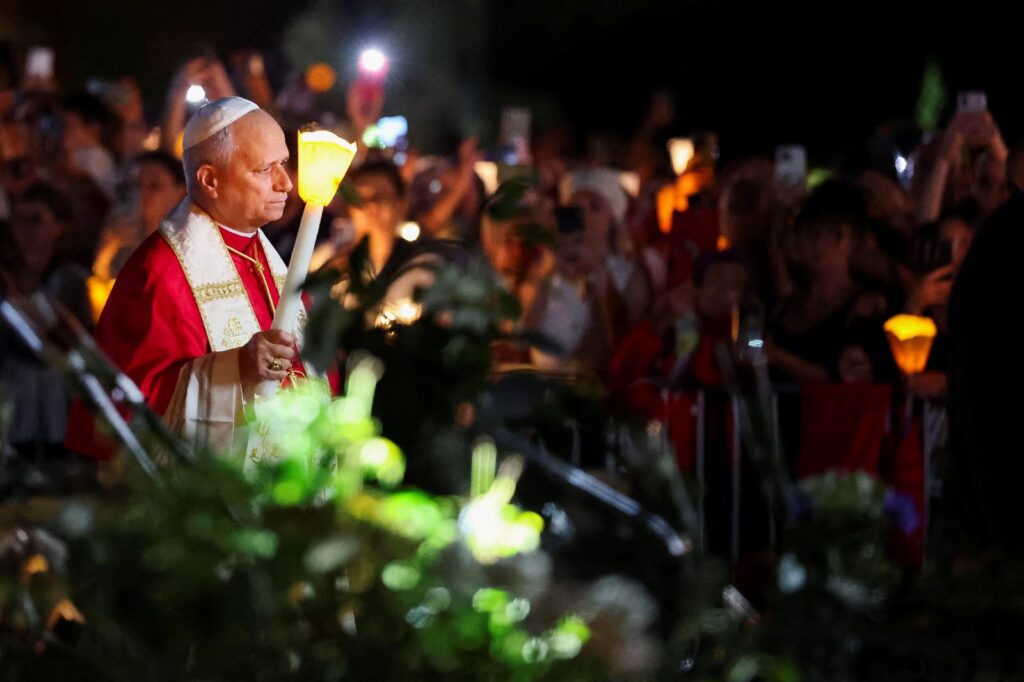
Holding a large candle in his right hand and a rosary in his left, Pope Leo processed slowly behind an illuminated statue of the Virgin Mary through the crowd of pilgrims holding candles, as the five decades of the glorious mysteries of rosary were prayed in multiple languages.
As the “Ave Maria” Lourdes hymn was sung between mysteries, all of the pilgrims in the square in front of the Basilica of Our Lady of the Rosary lifted their candles high in the air, creating a sea of lights.
“The light that guides us and draws us onward is the light of hope, which never abandons us even as we journey through this life — a life often marked by trials, yet already filled with the joy of knowing ourselves to be children of God, loved and saved by Jesus,” the pope said.
“Those who are sick are privileged witnesses to this transfiguration of our lives through faith and love of God and neighbor.” (Read more.)
From AMAC:
Teachers' unions should want the best interests of children. So why is the American Federation of Teachers (AFT) suing to keep drivers who can't read English behind the wheel of school buses?
Leftist groups are fighting to keep dangerous alien commercial drivers on the road. The AFT, one of the nation's largest teachers' unions, just joined a lawsuit aimed at blocking the Trump administration's efforts to remove them.
The Transportation Department's (DOT) rules require that "non-citizens will not be eligible for a non-domiciled CDL unless they meet a much stricter set of rules, including an employment-based visa and undergoing a mandatory federal immigration status check using the SAVE system."
The Trump administration is cracking down on non-compliant training centers that provide instruction for commercial driver's licenses (CDL). In February, the DOT discovered more than 500 sham CDL training schools including one that specialized in teaching school bus drivers.
Transportation Secretary Sean Duffy said, "If you can't be properly trained, read our road signs, or communicate with law enforcement, you have no business driving a bus."
Teachers' unions nevertheless want to put these drivers behind the wheel of school buses carrying American children. (Read more.)
From Dominique Seraphin:
Share“God does not love us because we are valuable. We are valuable because God loves us.”
I have read those words many times. Each time, they seem to reach a little deeper.
It is easy to admire Fulton Sheen for what he accomplished. He was a brilliant scholar, a gifted preacher, a bishop, an author, and a pioneer who used radio and television to bring the Gospel into people’s homes. He knew how to speak about eternal things in a way that made people stop and listen.
But the part of his life that moves me most happened away from the cameras.
At his priestly ordination, Sheen promised to spend a Holy Hour each day before the Blessed Sacrament. He kept that promise for the rest of his life. Before he spoke publicly about Christ, he went to be with Christ. Before he asked others to listen, he listened. He brought his work, his questions, his gifts, and his need before Jesus in the Eucharist.
I wonder how many of his most powerful words began in that silence.
There is something beautiful about a man whose voice reached millions choosing, day after day, to be quiet before the Lord. The world knew Sheen for what he could say and do. In the chapel, he could simply be a beloved son in the presence of his Father.
Maybe that is why his words about our value carry such weight.
We hear “Jesus loves you” so often that we can forget how astonishing it is. We may readily believe that God loves humanity, the Church, our families, and the people we pray for. Yet when His love becomes personal—when we have to say, Jesus loves me, knowing everything about me—we sometimes hesitate.
We know the parts of ourselves we would rather hide. We remember the harsh words we said yesterday, the resentment we keep revisiting, the prayer we promised to make time for and didn’t. We know how quickly we compare ourselves with someone who seems more patient, more generous, more joyful, or more holy. (Read more.)

In the portraits the King can clearly be seen wearing the sky blue moiree riband of the Order and the breast star with its motif of the Dove. The riband was the first to be prescribed in the statutes of an order, and is the origin of the term 'cordon bleu' as asign of honour. The Order specifically commemorated King Henri's accession to the thrones of Poland on Whitsunday 1573, and to that of France on Whitsunday 1574, and hence the use of the Dove as a symbol. It also served to recall the account of the Holy Dove bringing the Sainte-Ampoulle at the baptism of Clovis in 496, and the source of the Holy Oil used at the Sacre of the King at Rheims. The design of the breast star and badge of the Order was to be copied and adapted by many other orders in Spain, Sicily, Sweden and Great Britain with the badge of the Military Division of the Order of the Bath, with lions and unicorns replacing the fleur-de-lys.Share
The Daily B.S:
The White House restored access to CNN, MS NOW and Politico on Thursday, complying with a federal judge’s order by creating a new press section inside the White House with full access to the building and no discernible view of the president.
The three outlets were issued restored hard passes and assigned seats in the newly designated Brady Briefing Room Restricted-View Annex, located directly behind the briefing-room wall.
“The court ordered access to the White House, and they have access to the White House,” a senior administration official said. “They’re in it right now.”
The annex contains three folding chairs, a water cooler and a narrow opening in the wall through which credentialed reporters can hear approximately 70 percent of each briefing.
Officials said the opening was already there. CNN asked whether it could be enlarged. The request was denied.
Under the new arrangement, reporters wishing to ask a question may write it on an index card and slide it through the opening.
Questions deemed appropriate will be read aloud by a White House staffer. Follow-ups require a second index card.
Politico asked whether reporters would be permitted to enter the actual briefing room. “The judge ordered us to restore their White House access,” an official said. “Nobody said anything about a good seat.”
MS NOW objected that reporters could not see the podium from the annex. The White House responded Thursday afternoon by installing a mirror. (Read more.)
From Sensus Fidelium:
These questions are not foreign to me. I knew someone who took an SSRI, developed suicidal thoughts that frightened him, and flushed the pills down the toilet. Years ago, while driving for Uber, I met a veteran who told me that he took a pill, blacked out, and awoke in handcuffs. He later learned that he had wrecked his car and fought with police, but he remembered none of it. Those stories cannot establish what caused the reactions; I do not know the complete medical histories, diagnoses, dosages, or other substances involved. They are anecdotes, not clinical trials. Yet they explain why I cannot dismiss reports of sudden, frightening behavioral change as imaginary simply because they are unusual.
To explore these issues, I recently interviewed Dr. Josef Witt-Doerring, a board-certified psychiatrist and former medical officer in the FDA’s Division of Psychiatry who now works extensively with psychiatric-drug adverse effects and withdrawal. His perspective deserves a hearing, but it also needs to be placed within proper limits. He did not examine Lindsay Clancy, he was not her treating physician, and an interview cannot decide a criminal case. His value here is that he helps identify medical possibilities that toxicology numbers and outward appearances do not necessarily settle.
The prosecution in the Clancy case emphasized apparently organized behavior: she arranged for her husband to leave the house, acted while he was away, and took steps that can be described as planned. For many observers, planning seems to end the insanity question. A person capable of organizing means, they reason, must also understand the end toward which those means are directed.
Dr. Witt-Doerring challenged that assumption. A person experiencing psychosis may still speak coherently, perform household tasks, conceal disturbing thoughts, and appear outwardly composed. As he put it during our interview, a person can look “really put together” while being driven by “bizarre, delusional thoughts in the background.” The crucial distinction is between the ability to reason instrumentally and the ability to judge reality correctly. Someone may connect steps A, B, and C with terrible efficiency while beginning from a premise that is entirely false. (Read more.)

From Léonce:
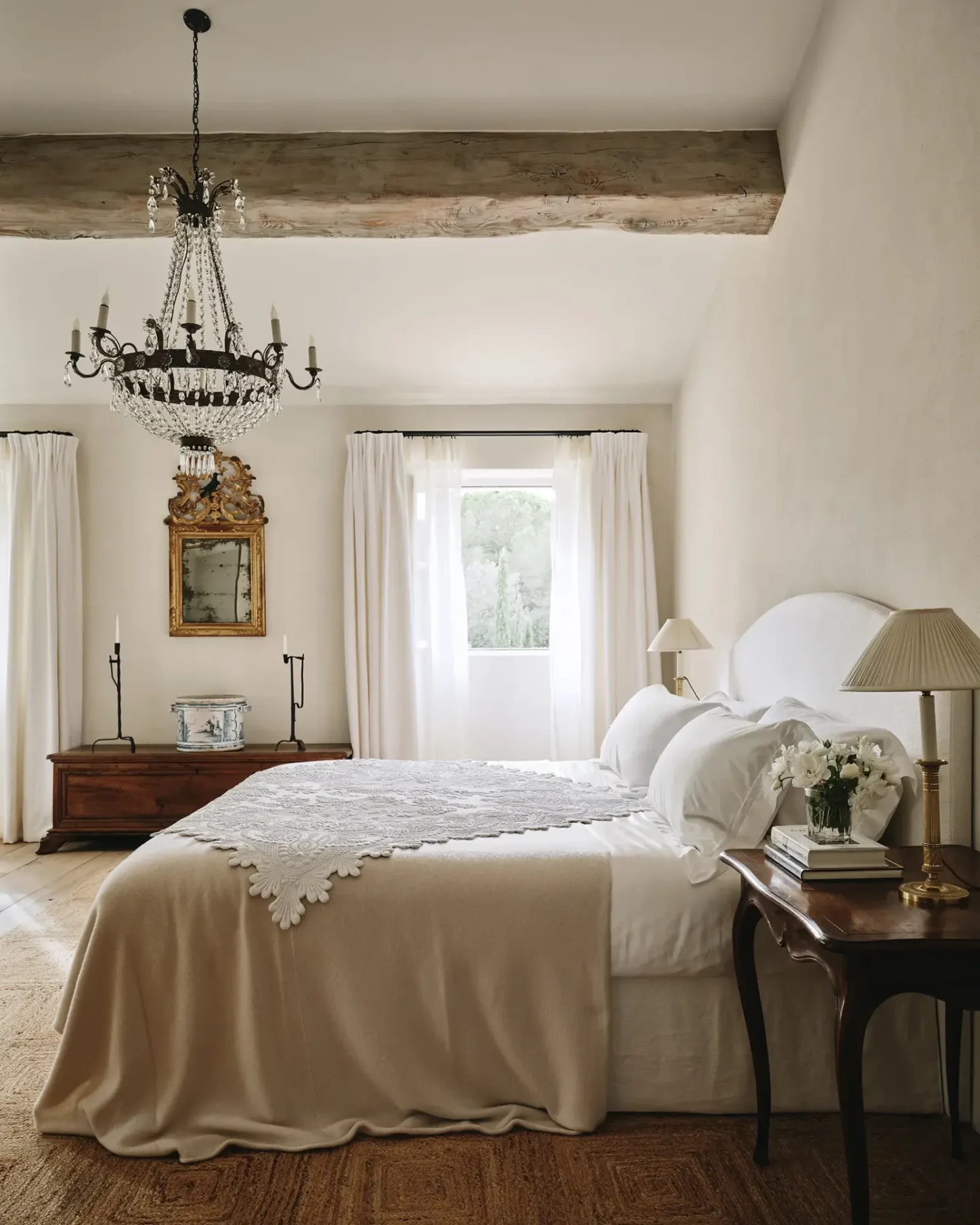
Over the past few months, I’ve saved countless home décor images on Pinterest (and if you enjoy French and Parisian inspiration, feel free to follow me there for more). Not that I’m currently renovating my apartment here in Amsterdam (although, truth be told, that would be one of my dreams) but I recently realized that many of the images I had saved seemed to gravitate toward the same aesthetic: French country style, sometimes also called French cottage style.
And without quite realizing it at first, this is also the direction my own Amsterdam home has slowly been evolving toward over the past few months. An aesthetic that feels rustic yet chic. Simple and unpretentious. Filled with natural materials: wood, linen, glass, ceramics, copper, and brass. A touch of vintage, but never kitsch. The kind of interior that creates a warm and welcoming atmosphere and that, to me, often evokes the charm of grandmother’s houses, countryside homes where everything feels convivial and where one immediately feels at ease.
Amsterdam, and the Netherlands more broadly, have influenced this shift more than I expected. Kitchens here often feel more rustic than Parisian ones, and because winters can be long and sometimes harsh, homes and apartments tend to have a naturally cozy and comforting quality that I’ve come to appreciate more and more.
This article is therefore a blend of different European influences which I hope will inspire you and perhaps give you a few ideas for bringing the charm of a French country home into your own space, wherever you may live. My inspirations draw from several places: the interior of Claude Monet’s house in Giverny, the Parisian atelier of Astier de Villatte in the 5th arrondissement near Place Maubert, the architecture and interiors typical of Amsterdam houses, as well as the timeless charm of traditional British cottages. (Read more.)
From Tierney's Real News:
ShareWhat will happen in the midterms? Here’s my best thinking right now.
Republicans currently hold both the House and Senate by narrow margins.
Left-leaning pollsters project Democrats will flip the House in 2026 by 9–15 seats while Republicans cling to the Senate by a single vote.
A few weeks ago, right-leaning pollsters expected Democrats to take the House by one seat and Republicans to expand their Senate edge to 2–3 seats.
In the past week, however, many of those same voices on the right have flipped: they now predict the GOP will hold both chambers—again by narrow margins.
All bets are off.
Here’s a sample of what some conservatives are saying on X right now:
David Marcus: GOP hold in both houses.
Ted Cruz: If we show up and unify, the GOP can grow our majorities in both the House and Senate. It’s all about turnout.
Bill Mitchell: Democrats are going to lose in November in the most humiliating fashion possible.
RNC Chair Joe Gruters: I expect Republicans to hold both chambers—220 House seats and 53 Senate seats.
Seth Levy: 53-47 GOP in the Senate and 218-217 Republican in the House. Republicans hold both.
House Speaker Mike Johnson: Republicans will hold and grow the House majority.
Unseen1: With all the propaganda and fake polls, there’s no way of predicting. 50/50 chance the GOP keeps the House; I think they hold the Senate.
(Read more.)
From The Logres Institute:
Unlike many other authors, we have explicit writings from Lewis explaining what he was trying to portray. In the remainder of this article, I presume that Rice is writing from a position of ignorance. To cure his lack of knowledge, I invite him to acquire a copy of Lewis’s Letters to Children before he writes about Narnia in the future. Lewis was transparent in his explanations, and his actual letters to the children who wrote to him explain why Christians are justly upset by this casting decision. You mess with Jesus, and you mess with the literal foundations of the Christian faith. Aslan is Jesus, in another world.
To truly understand Lewis, one must read Lewis; and more of his writings than just Narnia. Any claims on what he thought as he wrote the Narnia tales need to be backed by primary source material to be valid, not by opinion that fits one’s own personal narrative. Lewis’s replies to his youngest readers provide helpful insight.
In a letter written by Lewis from Magdalen College Oxford, 22nd. January 1952, Lewis writes to a child named Carol about how to pronounce Aslan and who He is:
Dear Carol,
It is a pleasure to answer your question. I found the name in the notes to Lane’s Arabian Nights: it is the Turkish for Lion. I pronounce it Ass-lan myself. And of course I meant the Lion of Judah. I am so glad you liked The Lion, the Witch and the Wardrobe. I hope you will like the sequel (Prince Caspian) which came out in November.
Yours sincerely,
C.S. Lewis

Around midday on July 4, 1643, in the countryside just north of Birmingham, Queen Henrietta Maria was in her battle tent. Outside, shells exploded. Musket balls* zoomed past. Anxiously, the Queen of England waited. Taking Burton-Upon-Trent, a strategic town with a river crossing connecting northern and southern England, was her army’s first real challenge. Defeat was not an option. But the fighting had already raged for five hours—how much longer would it take to deliver a victory? Three hours later, the queen got her answer. Her royalist army had finally broken through the town’s defenses. Victory was secured.
Eighteen years earlier, the queen had arrived on English shores as a 15-year-old French bride. And now, at 34, she was a warrior queen. The queen would jokingly call herself “she-majesty generalissima.” Lines from a contemporary poem, its author unknown, portrayed her as not just defeating but unmanning Parliament’s forces, literally: “Tis here a woman leads; but one would swear, the armies did consist of women there.” Her skill garnered wide respect from diplomatic elites; the Venetian ambassador observed, “Without [the queen’s] encouragement and aid the king would never have put himself into a position to resist.” During the English Civil War, Queen Henrietta Maria was, it seems, all that stood between King Charles’s sure defeat at the hands of Parliament. (Read more.)
 |
| Henrietta Maria and her household hiding in a ditch during the bombardments at Bridlington in 1643 |
 |
| Henrietta Maria hiding from Parliamentarians during her escape to France in 1644 |
The novel Generalissima is available HERE.
From AMAC:
A groundbreaking report has demolished a favorite rhetorical tactic used by transgender activists to argue in favor of harmful procedures for gender-confused minors.
For years, the left has emotionally blackmailed the parents of gender-confused kids, insisting that families must sign off on dangerous, irreversible drug regimens or even surgeries, or else their child will surely commit suicide. But independent researchers recently confirmed there is no proof that restricting minors from this so-called “gender-affirming care” leads to more suicides.
A favorite line of transgender activists and their allies in the medical establishment is this: “Would you rather have a dead son or a live daughter?”
Medical professionals and social workers will frighten parents with some form of this bad-faith argument, claiming that “treatments” like cross-sex hormones, puberty blockers, or surgeries that leave kids permanently disfigured are “life-saving.” A compliant liberal media has willfully repeated this lie in their own biased coverage of debates about transgender drugs and surgeries.
But a comprehensive study from Do No Harm looked at Centers for Disease Control and Prevention data across 23 states that have banned transgender drugs and surgeries for minors. Their conclusion? There is “no evidence that these bans have increased suicide rates.”
Do No Harm is an advocacy group which “represents physicians, nurses, medical students, patients, and policymakers focused on keeping identity politics out of medical education, research, and clinical practice.” It was founded in 2022 and opposes transgender drugs and surgeries for minors.
“The alarmist prediction that restricting medicalization of gender-distressed minors would produce a spike in youth suicides is not supported by the data,” Do No Harm scholars Jay Greene and Ian Kingsbury write in their new report. (Read more.)
From Express:
In a time of tech-bro billionaires, a meaning crisis among an anxious youth and questions surrounding national identity, where better to go than back to the old stories to have one’s heart reenchanted? That’s something poet, scholar and priest Malcolm Guite has become renowned for on his popular self-titled YouTube channel, which has 220,000 subscribers and counting. The real-life waistcoat-wearing hobbit, with wizard-like long silver hair and beard, has charmed millions around the world with his videos from the perspective of a visitor to his cosy, book-lined study. For each typical upload, Guite will settle into his wing armchair, light one of his many pipes, and usually read aloud from a chapter of JRR Tolkien or CS Lewis.
The 68-year-old author of several books, including five collections of poetry, realised that it’s been about a century since there was a proper re-telling of Britain’s great myth, the Arthurian legend. In what could well be his magnum opus, Guite has set about writing Merlin’s Isle: An Arthuriad, a four-volume epic ballad of King Arthur and the Knights of the Round Table.
Beautifully illustrated by Stephen Crotts, the first volume, Galahad and the Grail, is set in the 5th century, after the Romans have departed, leaving Britain in a chaotic mess of savage warlords before the Anglo-Saxon invasion. King Arthur seeks to unite the realm by establishing a kingdom of peace and stability, one led by his chivalric knights who are fierce in battle against the “might is right” pagans, while being gentle and kind to the weak and vulnerable they are sworn to protect. (Read more.)

Yet another descendant of Mary Boleyn. From History Extra:
In the preface to The Three Musketeers, Dumas claims that he was researching Louis XIV in the Bibliothéque nationale de France when he happened upon the first volume of The Memoirs of M. d’Artagnan. This is not entirely true: he found the book in the public library in Marseilles, borrowed it and never returned it.
The Memoirs of M. d’Artagnan is a first-person pseudo memoir written by a former soldier, Gatien de Courtilz de Sandras, and first published in 1700. It tells the story of d’Artagnan, a young man setting out on his journey to become a musketeer. As well as d’Artagnan, Dumas discovered Athos, Porthos and Aramis, who would eventually become major characters in The Three Musketeers. He also found Milady de Winter. Courtilz never gives Milady’s name. Instead, she is referred to simply as ‘Milady’ followed by a dash or asterisks where her name should be. She is introduced as a maid of honour to Henrietta Maria, queen to the executed Charles I of England, whose exile in France Milady shares.
The daughter of an English peer, Milady has as much wit as beauty, and d’Artagnan thinks her the most beautiful woman he has ever seen. He promptly falls in love with her. There then follows a complicated sexual intrigue, one of several for Courtilz’s d’Artagnan. Once it is over, Milady is never heard from again. This is the episode that Dumas adapted for The Three Musketeers. The affair of the queen’s diamonds is absent from Courtilz, but at least part of the story as Dumas told it is supported by several contemporary memoirs. Those of Françoise Bertaut de Motteville, Pierre de La Porte and Henri-Auguste de Loménie, Comte de Brienne – all of whom served at the royal court of France – each provide an account of the Duke of Buckingham’s visit to France in 1625. Buckingham had been sent to escort Henrietta Maria, then Charles I’s new queen, to England. While in France, he ostentatiously courted the queen, Anne of Austria.
None of these memoirs, however, mention the diamonds that Anne was said to have given to the duke. For this part of the story, it is necessary to consult the memoirs of Henri-Auguste's son, an obscure publication known as Recueil A, and the memoirs of François de La Rochefoucauld. Louis-Henri de Loménie, Comte de Brienne served Louis XIV as secretary of state, a position he inherited from his father. He left a memoir, which was published in the early 19th century. Certain editions, particularly that edited by Jean François Barrière, include an account of the queen’s diamonds.
It does not form part of Brienne’s original narrative – he was not even born at the time of the alleged diamond affair. Instead, it is mentioned in an introductory essay, written by the editor, explaining the manners and customs of 17th-century France. It is then related in full in an appendix, Éclaircissements historiques, or ‘historical clarifications’. In this version, the diamond thief is named as Lady Clarik. However, the story was lifted word-for-word from Recueil A, and inserted into the memoir. Recueil A is the first volume of a large collection published in the 18th century. It comprises an assortment of documents, including extracts of memoirs, concerning the history of France. The author of the account of the diamond affair is enigmatically identified as ‘M. le M. de T’. Behind these initials, according to the anonymous editor of the Recueil, is René de Froulay, Comte de Tessé.
The Comte de Tessé was a real person. Born in 1651, he was a military man, diplomat and courtier. He did indeed leave a memoir, but the diamond affair does not appear in it. The story as found in Recueil A and later inserted into the memoir by Brienne is, therefore, unreliable. What then of La Rochefoucauld? In his memoir, the lady who stole the diamonds was not Lady Clarik but the countess of Carlisle. In fact, Lady Clarik did not exist – but Lady Carlisle certainly did. (Read more.)
Read about the Countess of Carlisle in my Henrietta Maria novels, HERE and HERE.
From Tierney's Real News:
Voting third-party (Libertarian, independent, or any other) in a tight race does nothing but help Democrats win. In America’s winner-take-all system it functions as a split of the conservative vote. Those ballots come disproportionately from voters who would otherwise support the Republican.
Those of you who have followed me for years know that I despise the Koch Libertarians and the fake influencers for this very reason. They are a greater danger to America than the Democrats. Why? Because their entire purpose is to fool conservatives into voting for 3rd party candidates in the name of Liberty. They convince good conservatives and Christians to waste a conservative vote on a Koch Libertarian or "Freedom” candidate.
What does this do? It takes votes away from Republicans so that Democrats win, every time! In most states, let’s say that roughly 51% of the population is conservative, 49% liberal. If the Koch Libertarians can convince just 3% of the population to vote Libertarian or independent - the end result looks like this: Democrats 49%, Republicans 48%, Libertarian 3%. DEMOCRATS WIN. EVERY TIME.
3rd party ringers (Libertarians & Independents) ALWAYS HELP DEMOCRATS win. That's how Bill Clinton, a Democrat, won the presidency with only 43% of the vote - because Ross Perot took HALF THE CONSERVATIVE vote and helped the Democrats win in 1992!
The Kochs saw how successful this approach was to flip the country BLUE and have been running with it ever since.
If you want conservatives to govern, vote Republican and MAGA - not third party. Otherwise you’re just helping the Democrats win. (Read more.)
From Léonce:
Over time, we have done away with waiting, boredom, and much of uncertainty. We have learned to plan our routes, order food before we are hungry, know whether a restaurant is worth going to before we step inside, check the weather before we look at the sky. We can fill almost every empty minute, find an immediate answer to almost any question, see a place before we have ever set foot there. All of this is, of course, very convenient.
But I sometimes wonder whether, in removing so many small frictions and in-between moments from our lives, we have also removed, almost by accident, some of the conditions that allowed the world to surprise us. Perhaps enchantment depends on some of the very things we have spent years trying to eliminate: waiting, uselessness, mystery, slowness, surprise, imagination, attention.
There is a concept that has stayed with me since my student days: Max Weber’s idea of the “disenchantment of the world.” Very roughly put, it describes the way modernity made the world more rational, more explainable, more calculable. I would be hard-pressed now to reproduce everything I learned about it then, but the phrase itself has never quite left me.
The disenchantment of the world. (Read more.)
%20-%20Study%20of%20Queen%20Victoria%20and%20Prince%20Albert%20in%20costumes%20of%20the%20time%20of%20Charles%20II.jpg) | ||||
| Victoria and Albert as Catherine of Braganza and Charles II by Winterhalter |
 |
| Gown worn by Victoria at her Stuart Ball |
 |
| Tartan dress of Queen Victoria |
 |
| Royal Family in Highlands |
Scotch air, Scotch people, Scotch hills, Scotch rivers, Scotch woods, are all far preferable to those of any other nation in or out of this world.~Queen Victoria, ca. 1849.
In the mid-18th century, in an uprising known as "The 45" Prince Charles Edward Stuart tried to reconquer the thrones of England and Scotland for his father James III, known as the "Old Pretender." The thrones had been usurped by the German and Protestant House of Hanover in spite of the fact that the legal Catholic sovereign was alive and well. The Scots in particular did not take well to their rightful sovereign being disinherited because of the English preference for German Protestants. The uprising failed miserably, bringing more hardship and tragedy to the Scottish people for the remainder of the century. Meanwhile many songs, tales and legends of that time imprinted themselves upon the land and the people. Many of those tales and legends found their way into the writings of Sir Walter Scott, one of the first historical novelists, whose Waverley novels of the early 19th century brought the lost Stuart rebellions and their heroes to life for a new generation. The prince Regent, the future George IV, rebelled against his Hanoverian patrimony after reading the Scott novels, and headed for Scotland.
From Peter Harrington:
The romanticisation of Scotland can be most definitively linked in literature with the Waverley novels of Sir Walter Scott. The first of the Waverley novels was published in 1814 and was set during the Jacobite uprising which took place almost a century earlier. The novels were so popular that Scott was propelled to fame, and was invited to dine with King George IV, (then Prince Regent). When, several years later, the Scottish ‘Radical War’ of 1820, inspired by the American and French Revolutions, caused King George to plan the first royal visit to Scotland in over two hundred years in an effort to quell unrest, it was Scott he called on to carefully stage manage the visit. By now a baronet with numerous valuable connections to Scottish nobility, Scott saw the opportunity both to avert an uprising and to promote highland culture. He reasoned that, because of George’s lineage, the king could legitimately claim as much Stuart heritage as Bonnie Prince Charlie and could thus present himself as a Jacobite prince, properly accoutred Royal Stuart tartan. Kilts at this time were no longer generally worn, having been banned by the Dress Act of 1746, which made the wearing of ‘Highland dress’ illegal. Though the act was repealed in 1782, kilts had only come back into fashion with the Scottish gentry, a number of whom set up ‘Highland Societies’.... For the king to appear so attired was not only an attempt to appeal to the heritage of the Scottish people but also to gloss over old wrongs.
George’s visit sparked an interest in Scottish dress, and, in its wake, the demand for kilts grew so high that Scottish weaving mills were unable to cope with the demand. It was in this period that (contrary to the generally assumed belief that individualised tartans are a much older tradition) many of the clan tartans were designated. (Read more.)
George IV died and was succeeded by his brother William IV, who in turn left the throne to their niece Victoria in 1837. It was the Romantic Era, and Queen Victoria also loved the Waverley novels. In general she found the Stuarts far more romantic than her own Hanoverians and decided to fill her life with tokens of the Stuart homeland of Scotland. Her beloved husband Prince Albert shared her predilection, in spite of being German himself and in the 1840's they began spending as much time as possible in their northern kingdom.
From Quartermile Blog:
The first land to capture the Queen’s heart wasn’t Scotland, but Ireland. Early in her reign, Victoria spent her holidays in. Yet after the potato famine of 1845 irreparable damage was done to the relationship between the British government and the people of Ireland. Despite Victoria’s personal donation of £5,000 to the cause (nearly £600,000 in today’s money) and her visit to the country in 1849, the relationship never recovered....Scotland fared much better in Victoria’s eyes. In fact, Victoria made frequent visits north of the border during her reign despite the fact that Scotland had only been visited twice by reigning monarchs in the previous two centuries.
Victoria and Albert’s love for Scotland drove them to take out a long-term lease on the stunning Balmoral Castle in Deeside in 1848. Later, in 1852, the royal couple permanently purchased the property for £31,500 (£4million today) and had it significantly extended. From this point on, Victoria and Albert spent a section of each summer in Balmoral, thanks to the advances in British rail travel....Victoria’s ever growing affection for Scotland didn’t just stretch to the land itself, but to the culture and fashion too. Through their experience of Scotland, Victoria and Albert both became big fans of tartan, and helped to elevate the status and reputation of the pattern south of the border.
According to accounts from the time, Victoria and Albert enthusiastically redecorated Balmoral Castle with reams of “Balmoral tartan, in red and grey” furnishings. They even included “innumerable stags’ antlers” in their décor. For Victoria, the use of tartan was an outward sign of being connected to her favourite part of the world. (Read more.)
Victoria showed that she not only loved Scotland but cherished the memory of the Stuarts, masquerading as Catherine of Braganza, consort of Charles II, at a ball. She had an Italian sculptor create a marble statue of Princess Elizabeth Stuart, the daughter of Charles I who died in prison at age thirteen, reputedly with her head on her murdered father's Bible. She passed the interest on to her children, as can be seen from a water color of Mary Queen of Scots by the Princess Royal. The Stuarts must have fulfilled Victoria's vision of a monarchy in which the kings and queens did not only reign but ruled, had adventures, tragedies, romances and died for love.
 |
| Princess Elizabeth Stuart: "Go ... And see the tomb of Charles's child wet with Victoria's tears" |
 |
| Carl Haag’s "Luncheon at Cairn Lochan" depicts the royal family picnicking in Scotland. |
 |
| Balmoral today with flock wallpaper ordered by Queen Victoria |
 |
| Painting of Mary Queen of Scots by Queen Victoria's daughter the Princess Royal |
From Tierney's Real News:
ShareToday, President Trump addressed the 81st session of the United Nations General Assembly and delivered a powerful message: America is back and we’re not putting up with nonsense any longer...
President Trump declared that under his leadership, America is stronger than ever — and we will use our strength to confront our enemies, protect our interests, forbid communism, combat terrorism, reject global control, make the world a safer place for all and always defend our sovereignty.
The camera focused on each of our adversaries while he warned them of his resolve and some walked out in fear and anger. I loved every minute!
Here are some highlights followed by a transcript of the entire speech. I strongly encourage you all to read or watch the entire thing. He covered two months worth of news in just 30 minutes - telling us the truth about many issues that the fake news refuses to accurately report or report at all:
“Two and a half centuries after the cause of liberty found its home on this continent, I can report to you with pride that America is back, and our country is stronger today than ever before.” (Watch)
“As President of the most extraordinary nation in history, I have no interest in leaving dangers to grow for another day. I do not believe in letting problems fester; they only become harder to solve. So, while others have talked, I have acted. While others have spoken of peace, I have made peace. While others have ignored threats, I have confronted them. While others have talked of courage, America has shown it. While others have promised strength, I have used it to make America the most powerful country in the world. Working with many nations in this room, we are solving decades of intractable challenges — and we are settling years of unfinished business.” (Watch)
“There is no better example of a danger that was allowed to gather strength at the world’s peril than the number one sponsor of terror, the Islamic Republic of Iran… From the first day I entered the political arena, I have been unwavering — I will never allow Iran to have a nuclear weapon.” (Watch)
“In America, we just marked the 25th anniversary of the worst terror attack in history, September 11th, which killed 3,000 people just a few miles from here. In two weeks, we will mark the third anniversary of the October 7th attack in Israel, where terrorists funded by Iran tortured, mutilated, and killed 1,200 very innocent civilians, including dozens of Americans… Iran’s Supreme Leader celebrated that massacre and called it a ‘service to humanity.’ The same regime slaughtered over 72,000 of its citizens this year; recently, 10,000 were killed for protesting. Just imagine if such a vile regime were ever empowered to carry out large-scale terror attacks from behind a nuclear shield. This was the reality we had to confront — a reality that far too many preferred to ignore.” (Watch) (Read more.)
From The Abbey of Misrule:
Long before the digital age, artists have pondered both the promise and peril of artificial intelligence. Homer’s Iliad described automaton tripods made by Hephaistos that might be confused with Elon Musk’s dream of putting an Optimus robot in every home. Ovid’s Metamorphoses tells of Pygmalion, disappointed in his marital prospects, carving his perfect woman and bringing her to life with the help of Venus. She was the first romantic chatbot, a reflection of Pygmalion’s self-love. Mary Shelley’s Frankenstein warns us what can happen when scientific hubris puts the creation of life and intelligence in its crosshairs. More recently, we have Frank Herbert’s Dune, with the maxim “thou shall not make a machine in the likeness of a human mind.”
Yet we are here, crafting such a machine. Many, perhaps the majority of us, have deep reservations about AI, yet struggle to explain why. We think it could create trouble but also see the great benefits. As a result, nearly all the arguments have been around the outcomes of AI. This is the modern approach - judging something by what it can do, rather than what it is.
If artificial intelligence were a tree, then nearly every discussion we are currently seeing concerns its fruits. An AI optimist predicts a cure for cancer, where a pessimist sees the elimination of the doctor-patient relationship. Mass prosperity! Or is it mass layoffs? For every rotten apple I spot, another sees a juicy golden delicious. How can we make sense of it all?
Arguing about the fruits is problematic. First, predictions are tricky business. Remember when social media was supposed to bring people together? Second, Christianity focuses on the means, not the ends. We care more about whether eggs are getting cracked than how tasty the future omelette may be. (Read more.)

Here are some of the reforms of Louis XVI, made of his own free will beginning from the moment he ascended the throne. He was considered quite the Liberal.
1774 Louis XVI placed Turgot in charge of finances and introduced free circulation of grain. Founded School of Medicine in Paris.
1775 Droits d'octroi were reduced, prison reform begun, and the death penalty for deserters was abolished.
1776 The king signed the six edicts of Turgot comprising the abolition of the corvée. The parlements resisted the edicts, preventing them from becoming law. In the same year he reduced his household.
1778 More taxes reduced.
1779 The king abolished servitude and other reforms were made.
1780 Further reductions in the Royal household were made, hospital reform was begun, prison reform continued, most torture was abolished.
1784 Relief given to Jews.
1786 More hospital reform, aid to the deaf, and provisions made for lost children.
1787 Steps taken towards the total abolition of the corvée, more reductions in royal household, civil rights accorded to Jews and Protestants.
1788 All forms of torture were abolished, greater freedom given to press, steps towards abolition of lettres de cachet.
All of the above is taken from Nesta Webster's Louis XVI and Marie-Antoinette during the Revolution, but it is a matter of public record as well. There are also discussions on the king's reforms in Simon Schama's Citizens and Vincent Cronin's Louis and Antoinette. Anyone who thinks Louis XVI was a lazy, sluggish, do-nothing king need only examine the six volumes of laws passed during his reign. He wanted to reform the feudal tax system, which is why he called the Estates-General. If all the nobles and wealthy clergy had been minimally taxed, there would have been no deficit. The enemies of the king were determined his plans were not to succeed. They had been planning for years. As Marie-Antoinette wrote to her brother Leopold II in August 1790 about the society she had once thought to be innocuous:
Be well on your guard where you are with regard to all associations of Freemasons. You must already have been warned that it is by this means that all the monsters here count on attaining the same end in every country. Oh, God, preserve my fatherland and you from such misfortunes.(Image: Louis XVI rendant la liberté aux serfs de son royaume. Dessin de Charles de Wailly, 1783.) Share
From Bo Snerdley:
ShareOpenAI’s head of ChatGPT Nick Turley wrote that the company’s products “are largely substitutive, period” and will become even more so as the technology improves, according to a brief The New York Times and other news publishers made public Thursday in their Manhattan copyright case against the tech companies. Microsoft Director of Applied Science Brent Hecht warned that “millions of people around the world will soon consider large models ‘hoovering up’ all their work to be an astonishing theft of unprecedented proportions,” the brief stated in part.
The Department of Justice previously told a federal judge that AI training is fair use because models learn patterns from text rather than duplicate it, an argument the companies’ internal messages seemingly undercut.
Turley also wrote that publishers face an “existential threat” from those products, according to the brief.
The brief also cites a document describing the practice as potentially the “largest theft of labor in human history,” and says Hecht recognized that a fair use win for the companies would arguably “make a complete mockery of the idea of ‘fair use.’” (Read more.)
From EcoNews:
Ancient DNA from Belgium and France challenges the idea that Neanderthals faded away as isolated, increasingly inbred groups. Researchers found signs of connected populations in northwestern Europe, without evidence of an increasing burden of harmful genetic variants.
Neanderthals disappeared roughly 40,000 years ago, but the findings do not explain why. Instead, they challenge a simple story of biological decline, suggesting that the final chapter of Neanderthal life differed across regions rather than following one inevitable genetic downward spiral.
The research examined ancient remains from present-day Belgium and France dating to less than about 52,500 years ago. Nature’s press summary describes 27 remains representing at least 11 distinct individuals, an important distinction because several bone fragments can belong to the same person. (Read more.)











