


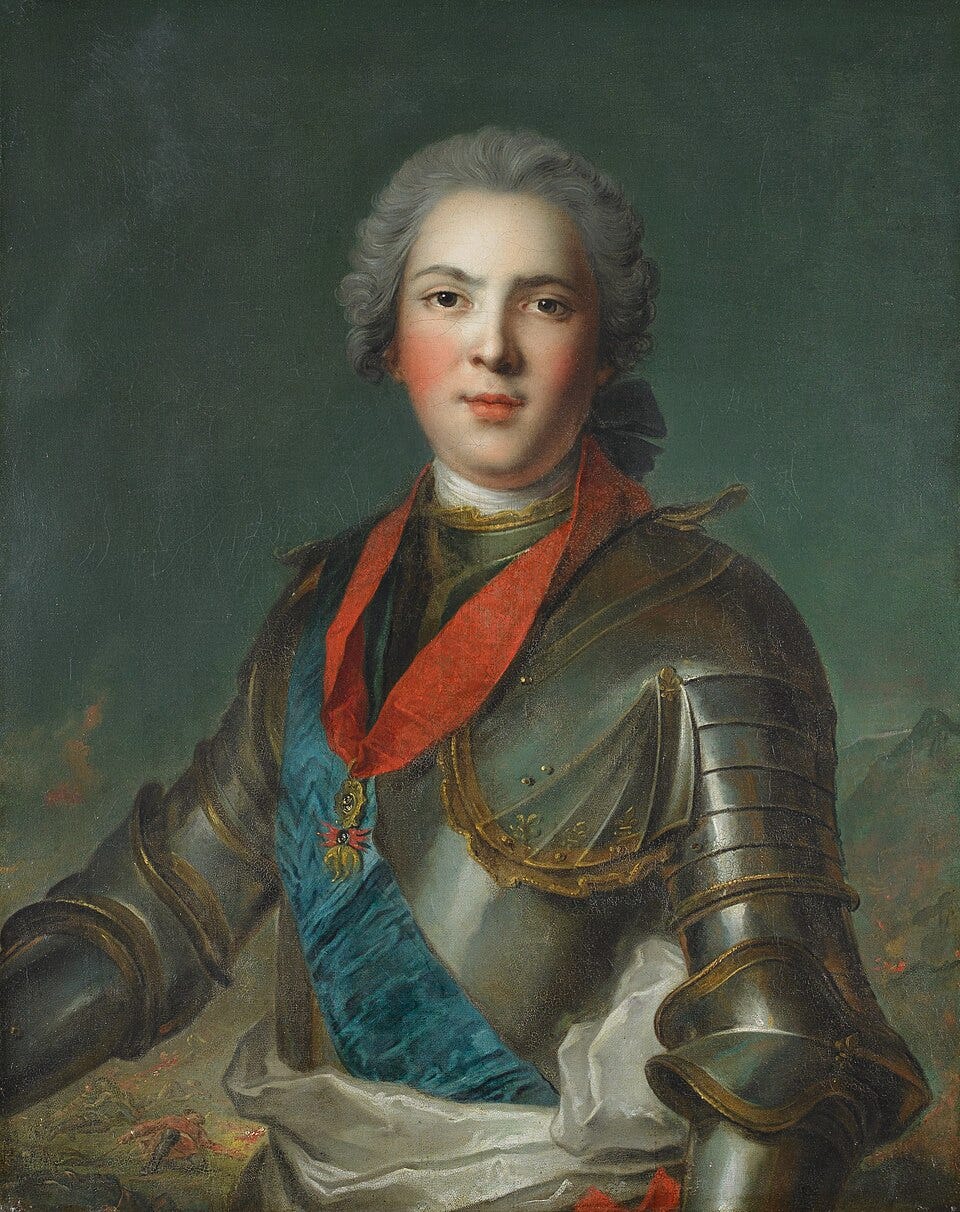
From Philip Diaz-Lewis at Rationis Fines:
In December 1765 the heir to the French throne died at Fontainebleau, aged thirty-six. Louis-Ferdinand, Dauphin of France, had been trained from childhood for kingship and had spent fifteen years attending the councils of his father Louis XV. He would never reign. Three of his sons eventually did. The (in)famous career of his son, Louis-August, the future Louis XVI, would overshadow the memory of his father.
The funeral preaching at once made him into the exemplary figure of an ideal Christian prince. First the Jesuits, then the bishop Loménie de Brienne, then the abbé de Boismont, lined up to preach orations. In their eyes Louis-Ferdinand was a model of rational religion (religion eclairée), and piety (pieté).1 His former confessor, the abbé Soldini, then composed in 1766 the work Essai sur la vie de Mgr Louis Dauphin. He set Louis-Ferdinand against the sensualism and materialism that had come to characterise the radical French Enlightenment of the philosophes.2
Scarcely had his body been laid to rest, however, that his legacy would be contested. For the poet and literary critic Antoine-Léonard Thomas had written a great elegy in his praise, likening the prince to ancient Roman heroes and sages like the general Germanicus, and the emperor Marcus Aurelius. Catholic admirers complained that he was turning the late Dauphin into a virtuous pagan instead of a Christian.3 (Read more.)











No comments:
Post a Comment