


If we want things to stay as they are, things will have to change. ~The Leopard
The new series is in the grand tradition, with all the cinematic bells and whistles (no matter that I watched it on my laptop). Wikipedia says this:
Principal photography began in April 2023. Filming took place over 105 days and required the use of 5,000 extras; 130 carriages, carts and boats; 100 animals; and 12 animal trainers.
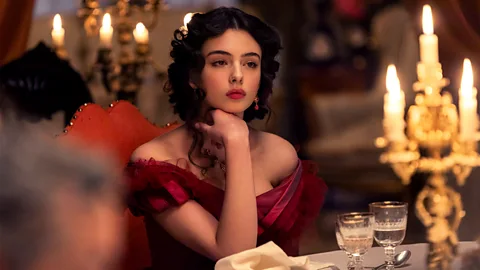
A friend of mine (Italian) said, “The real star of the show is Sicily.” She makes a good point. I’m not sure that Sicily has ever been more beautiful or alluring than in this show. The Netflix Leopard is a feast for the eyes. Almost indecently sumptuous. The flowers, the lemon groves, the palazzos — the food! And, of course, the people: the principal actors and actresses. Gorgeous people, on a gorgeous island, gorgeously shot. That is a commendation already.
The title character — the prince, the Leopard, also known as Don Fabrizio — is portrayed by Kim Rossi Stuart. (One of his grandparents was Scottish. He was named for Kipling’s title character.) Stuart’s prince is suave, worldly, world-weary, charismatic — every inch a prince, really.
Tancredi, that Garibaldian rascal, is played by Saul Nanni, born in 1999. I came to detest the character — not because the actor does anything wrong but because I wanted Tancredi to do right by Concetta and Angelica (and he does right by neither). Do you ever try to “edit” a movie, so as to make it come out right, by your lights? Life can be frustrating, onscreen as off . . .
Concetta is Benedetta Porcaroli, who reminds me of Lady Di, as we knew her, before she became a princess. Angelica is Deva Cassel, born in 2004. Signorina, or Mademoiselle, Cassel is the daughter of Vincent Cassel (the French actor) and Monica Bellucci (the Italian model and actress). How ugly can she be, I ask you? Angelica in this series is sex on wheels — a danger to young men, old men, and, you could say, herself.
Don Calogero is portrayed by Francesco Colella. The character is supposed to be a villain of the piece, and in a way he is: he behaves badly. But many do. And he is a man born poor who is trying to rise in the world: trying to have some of the money, influence, and power that the likes of Don Fabrizio have dropped into their laps at birth. (Read more.)
One would think that a film about Sicilian aristocrats would have nothing to say to American audiences. Yet the story is essentially about family cohesion in a rapidly changing world, to which just about anyone alive today can relate. Dysfunctional dynamics can haunt palaces as well as cottages, with petty jealousies, spousal disagreements, infidelities. But devotion and sacrifice are also there, as well as shared jokes and effervescent joy. Most of all the roles of the father and the mother in keeping the family together, in spite of their personal issues, are inspiring.
At the core of the story is Don Fabrizio's daughter Concetta, a devout and disciplined principessa, convent-bred, who is in love with her cousin Tancredi. In the course of the series, Concetta is faced with painful choices, but in spite of being as passionate and headstrong as the men in the family, chooses the most noble courses of action. Both her suffering and contentment are projected in her jewel-like eyes, even while her modest and dignified bearing attempt to hide her emotions.
Fabrizio himself tries to follow the traditional code of chivalry. His patriarchal duties, especially the duty to protect his family, are second nature to him. When the mayor's daughter, the magnificent Angelica, hints that being his mistress would not be distasteful to her, the Prince lightly dismisses the idea, ignoring his own desire for the girl. He encourages her to marry his nephew, knowing that will be the best thing for everyone. He comes as close as he can to her in a single waltz, in which he maintains a gentlemanly reserve. Meanwhile, the new order has triumphed, as the characters dance in resplendent, frescoed rooms built by the old order.
There is one glimpse of boudoir activity which renders the series unsuitable for children. It would be odd to make a series about Sicily without scenes of religious faith. The Leopard
is full of displays of piety, such as when the family prays the rosary
together, although in the old film they were kneeling, not sitting. But there is certainly more Catholic imagery than there is sex. The family chaplain is in practically every scene, along with discussions of heaven and hell. The
visuals are stunning on a life-changing level; the costumes prove that
authenticity and artistry can work side-by-side. It shows what beauty Netflix can produce when willing to do so.

.jpg)











No comments:
Post a Comment