


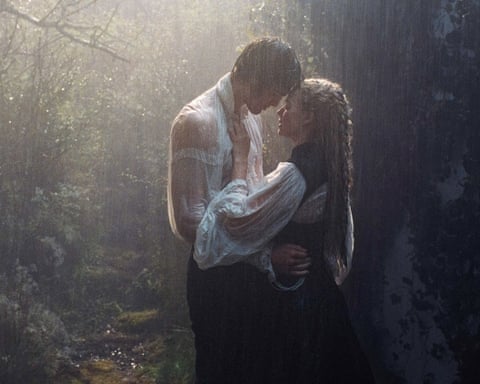
I am beginning to resent the fact that they are even using the name "Wuthering Heights" for Emerald Fennell's sexed-up clown show. Emily Brontë was a highly intelligent and dignified lady, a devout Christian, and whether or not a person likes her writing style they should show some respect. The costumes are deliberately inaccurate. The story begins in the 1780's but the costumes have no connection to the era. The chunky jewelry is of the sort which may have been worn in Imperial Russia but are out of place in a film about Yorkshire gentry. As for the casting, Margot is lovely but too old to play teenager "Catherine Earnshaw," the "Edgar Linton" character is too dark for Catherine's pallid husband. I do think Jacob Elordi is perfect for "Heathcliff." Yes, he is described as being "dark" like a gypsy but to the English at the time that could have meant someone with black hair from Wales or Ireland. Having an Asian actress for the part of Ellen Dean is odd since the whole point of Ellen is that she is a tough, no nonsense Yorkshire woman, the same age as the protagonists but reared to be a servant. Ellen as principle narrator has a decidedly unromantic view of the characters as expected of a person with such a background. Replacing her with an Asian adds an air of exoticism to the Earnshaw household, which was a place of dreary abuse and harsh fanaticism. And then there is the matter of Hindley. Nobody likes Hindley, except perhaps Mrs Hindley, and Ellen. And yet he is an important character in the novel, as Heathcliff's chief tormentor. But Ms. Fennell has completely excised Hindley from the film. I am appalled. From The Guardian:
This then is Fennell’s Wuthering Heights, or rather “Wuthering Heights”; the title archly appears in inverted commas, although the postmodern irony seems pointless. Cathy is a primped belle quivering in the presence of Heathcliff, who himself is a moody, long-haired, bearded outsider, as if Scarlett O’Hara were going to melt into the arms of Charles Manson. However, he does get substantially Darcyfied up later on, rocking a shorter and more winsome hairstyle, his gossamer-thin shirt never dry.
As a child, young Cathy Earnshaw (Charlotte Mellington) is a pert miss, indulged by her roistering old twinkly eyed squire of a dad, in which role Martin Clunes pretty much pinches the whole film. Fennell incidentally abolishes the character of Cathy’s elder brother Hindley from the book (along with his wife and son) reassigning Hindley’s ruinous boozing and gambling to the father; Fennell also, in line with traditional WH adaptation, loses the next-gen second half of the novel, about the grownup children of Cathy, Hindley and Heathcliff. She also very feebly erases the issue of Heathcliff’s dark skin – and maybe those inverted commas are intended to shrug off issues of “authenticity”. (Read more.)
Apparently, the wall of a room is made to look like Cathy's skin. From Roger Ebert:
On paper, the stakes couldn’t be higher. But in Fennell’s hands, the all-consuming nature of the world feels softened, even flattened. Then again, maybe it is just crushed under the production design and costuming choices, often eye-popping in all the wrong ways. There is something too tidy and uninteresting about the great majority of Robbie’s garments during Cathy’s Thrushcross Grange years. The problem isn’t the contemporary liberties the costuming takes with the Georgian era of the story—period inaccuracy in aesthetics can be a wonderful creative asset in film—but the taste level.
There are some inspired pieces, like Cathy’s lush wedding gown, and a richly draped black frock that Linus Sandgren’s high-contrast lensing casts in white light. But for the most part, the costuming reminded this critic of the standard-issue Barbie doll gowns she used to collect in her dollhouse. (Peerless costume designer Jacqueline Durran dressed Robbie in “Barbie” too.) And Suzie Davies’ production design explores several interesting concepts, but many of them don’t blend into the story’s Gothic hues. Cathy’s pink Thrushcross Grange room feels almost comically bare, going against the visual excess we yearn for in these types of melodramas. And the wall dressings that are supposed to represent Cathy’s freckled skin are certainly an idea, but whether it’s a good one is debatable. Elsewhere, the location (shot actually in Yorkshire) and Sandgren’s cinematography of high contrasts, deep reds, and fog—lots of fog—feel cinematic enough. Though the whole thing feels like an artificial music video, rather than an inviting fantastical world we want to get lost in. Charli xcx’s admittedly beautiful (but ultimately distracting) songs and musical cues further this feeling. (Read more.)
From The New Yorker:
Like some other adaptations—including those directed by Wyler, Luis Buñuel, and Andrea Arnold—this one steers clear of the novel’s second half, in which the torments of Catherine and Heathcliff’s doomed romance rebound, cruelly, on their descendants. Fennell has also dropped the elaborate framing devices that make Brontë’s book, among other things, a feast of unreliable narration. Everything that happens in its pages is relayed to us by Mr. Lockwood, a nosy tenant at Thrushcross Grange, or Nelly Dean, the Earnshaws’ ever-watchful housekeeper. (Fennell dispenses with Lockwood entirely; Nelly is played, with formidably chilly side-eye, by Hong Chau, but her narrator function has been excised.) The impact, on the page, is of a ghostly melodramatic hearsay: Catherine and Heathcliff, for all their vividness, can seem more like spectres than characters. They flicker in the darkness like candlelight, incandescent yet ephemeral.
Fennell, it’s safe to say, has little interest in ephemera; she wants to emblazon her Catherine and Heathcliff on our brains. To that end, she and her collaborators, including the cinematographer Linus Sandgren and the production designer Suzie Davies, paint in the broadest of strokes. They unleash a full-blown stylistic assault roughly halfway through the film, around the time that Catherine becomes mistress of Thrushcross Grange. The hallways take on the gleaming aspect of a fashion runway, and in one room the floor is such a thick, gaudy shade of red that you half expect to find the elevator from “The Shining” around the corner. A dining table overflows with jellied extravagances; I’ve never seen a film with a greater aspic ratio. As for Catherine’s bedchamber, the walls almost qualify as body horror; they match her skin tone perfectly, right down to the blue-vein marbling. If Heathcliff won’t lick them, Hannibal Lecter surely would. (Read more.)
The novel has more violence than romance. From The Times:
Wuthering Heights is equally full of nasty surprises. In the first half alone, which describes in a series of flashbacks the arrival of a mysterious boy named Heathcliff at the isolated Wuthering Heights and his developing relationship with the family’s young daughter Catherine, we read about young Heathcliff being thrashed so often that his arm is “black to the shoulder”, Catherine pinching and slapping a servant, and the narrator responding to the appearance of a ghostly figure at his window by pulling its wrist on to a broken pane of glass and rubbing it back and forth “until the blood ran down and soaked the bed-clothes”.
The second shock I experienced when reading the novel was its second half. The 1939 film had given the story of Catherine and Heathcliff a neat Hollywood ending. She dies, he follows soon afterwards, and in the last scene their ghosts are seen happily wandering off together across the snowy moor. The novel is far messier. Catherine dies shortly after marrying another man and giving birth to a daughter, and Heathcliff swears revenge on everyone who has wronged him: “I have no pity! The more worms writhe, the more I yearn to crush out their entrails!” That occurs almost exactly halfway through the story.
What happens next is relentlessly grim: a further two decades of misery involving the children Heathcliff and Catherine have each produced with their respective partners. Once again, a doomed relationship threatens to destroy everyone who comes within its gravitational pull; once again, love and hate become as hard to distinguish as the two sides of a spinning coin. (Read more.)
Share








No comments:
Post a Comment