


From The Collector:
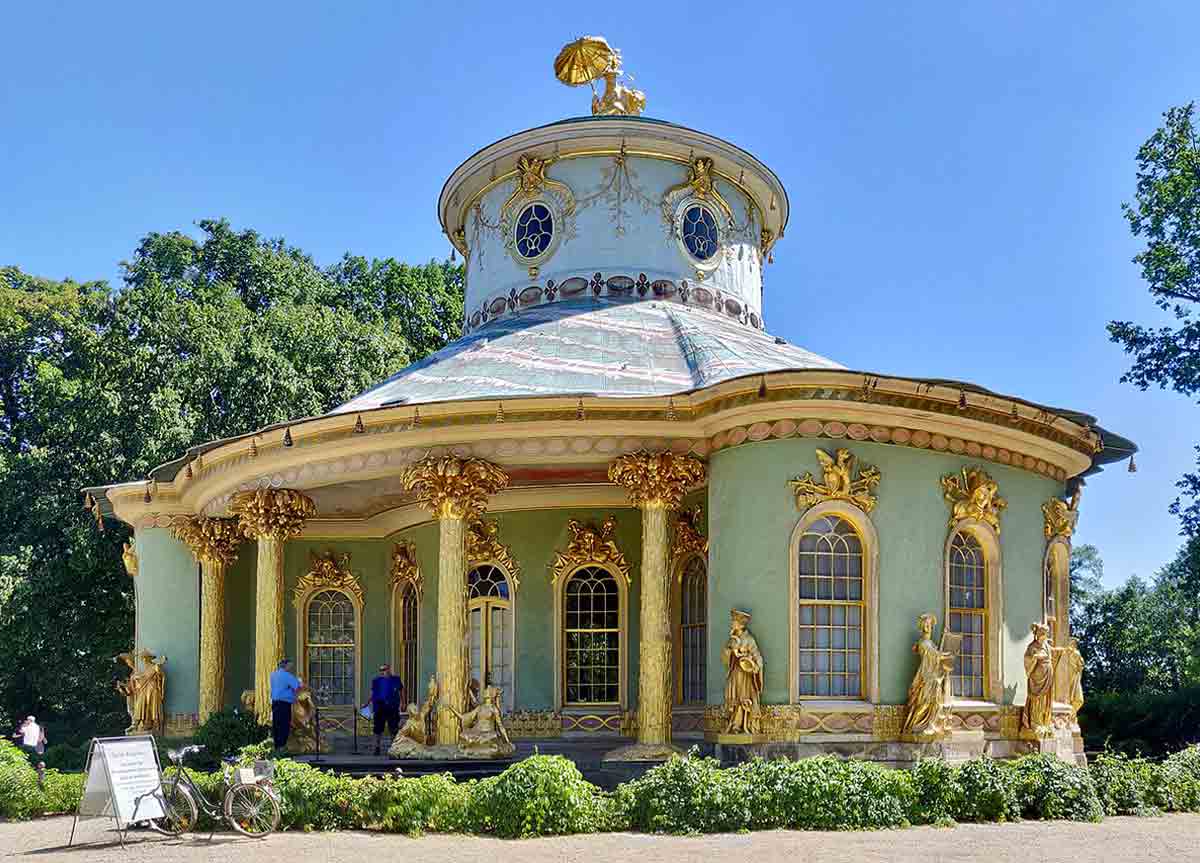
Located in the Sanssouci Park, the Chinesisches Haus (“Chinese House”) in Potsdam, Germany, was built between 1755 and 1764. Commissioned by Prussian king Frederick the Great, the project was headed by German master builder Johann Gottfried Büring. The Chinese House is characterized by its trefoil shape, which was inspired by the Maison du Trèfle at the Palace of Lunéville in Lorraine. Its exteriors feature four prominent gilded sandstone columns alongside several playful, life-sized gilded sculptures of Chinese musicians and tea drinkers. These were the works of German sculptors Johann Melchior Kambly, Johann Gottlieb Heymüller, and Johann Peter Benckert.
The Chinoiserie style continues in the building’s interiors with a vast collection of 18th-century porcelain and a large fresco depicting a whimsical gathering. It features numerous Chinese men standing behind a balustrade, some glancing around and others engaged in conversation. In the surroundings, there are peacocks, parrots, monkeys, statues of Buddha, and many other Chinoiserie motifs. Frederick the Great, as a fervent admirer of Chinoiserie, would later follow up with two additional Chinese-style structures. One was the Chinese Kitchen, located just a stone’s throw from the Chinese House, and the other was the Drachenhaus (“Dragon House”), located at the northern part of the Sanssouci Park. (Read more.)










No comments:
Post a Comment