Friday, November 17, 2023

Christian Burial Through the Ages

 From Catholic Exchange:

Care of cemeteries has a long pedigree within Catholicism. It is well known that during the age of the persecutions, Christians maintained their own cemeteries in the famous catacombs, subterranean chambers cut out of the earth. These tombs were cared for by a special class of craftsmen known as fossors, or fossores in Latin. Fossors performed a variety of tasks, most notably digging the passages within which Christians would bury their dead. A famous fresco of a 4th century fossor known as Diogenes was discovered in the 1700s during the excavations of Antonio Boldetti. An inscription identifies Diogenes as a fossor while the image shows a man holding a pickaxe (a reproduction of the image can still be seen in Rome’s St. Marcellino church today).[1] (Read more.)

Share

Gudrid the Far-Traveled

 From The Big Think:

Her full name, in modern Icelandic, is Guðríður víðförla Þorbjarnardóttir — Gudrid the Far-Traveled, daughter of Thorbjorn. She was born around 985 AD on the Snæfellsnes peninsula in western Iceland and died around 1050 AD at Glaumbær in northern Iceland. This map shows the extraordinary extent of her travels in between those dates and places. In all, she made eight Atlantic sea voyages, at a time when those were very dangerous and often deadly. What little we know of her comes from the Saga of Erik the Red and the Saga of the Greenlanders. These are collectively known as the Vinland Sagas, as they describe the Viking exploration and attempted settlement of North America — part of which the explorers called “Vinland,” after the wild grapes that grew there. (Read more.)

Share

Thursday, November 16, 2023

The Real Josephine

 
Of course, Josephine spent more money in one year than Marie-Antoinette did in her entire life. Yet she was always beloved by the French people. From Tatler:

Joséphine first met Napoleon in 1795 at a society ball, hosted by Paul Barras, the Vicomte de Barras, her then lover. At the time, though he was serving as a major-general in the military, he was not quite the Alexander the Great-esque conqueror he would soon become. She was put off by his somewhat socially awkward demeanour but the two would eventually fall in love. Seven years his senior, they married the following year in 1796. While Napoleon was undeniably smitten with her, she was more reserved in her own affection towards him.

In 1804, once Napoleon was crowned Emperor of France, Joséphine would be known as the Empress of France. She also became Queen of Italy, since Napoleon had taken control of the country's government in 1805. It was a marriage of hardship, where the Emperor would often be away for months on end due to his military conquests. Both with involved in numerous affairs, with Joséphine engaging in a relationship with French army officer Hippolyte Charles. Napoleon would have his own excursion with Pauline Fourès, the wife of a cavalry officer. They also never had children together, a source of great discomfort for the Emperor. (Read more.)

Share

The ‘White Privilege’ Smear

 From The Blade of Perseus:

One of the many satanic paradoxes of the Third Reich’s architecture of the Final Solution was the requirement—mandated after the 1939 outbreak of the war—that Jews anywhere under German rule or occupation had to wear a yellow badge or armband with the Star or David.

Yet was not all this elaborate bureaucratic need for identification embarrassing to the Nazi apparat?

After all, if Nazi doctrine about supposedly manifest Aryan “racial” superiority—Nordic looks and build, superior intelligence, stable disposition—were so persuasive, then why the need for Jews to identify themselves?

In contrast, the Star-of David IDs were prima facie proof that the entire bankrupt Nazi project was based on the unspoken fear that millions of Jews were indistinguishable in all respects from other Europeans.

In other words, on the fascist right, anti-Semitism was predicated on the pseudo-science that Jews were not European and thus somehow racially inferior. Yet currently, the entire industry of anti-Semitic hatred has flipped, from Jews as toxic non-whites to Jews as toxic whites. The two common denominators of racial obsession and hating Jews remain the same.

One of the key reasons leftwing anti-Semites have been so effective at galvanizing campus hatred of Israel, and by association of Jews in general, is their careful effort to brand themselves DEI victims why tarring Jews with the empty white supremacy slur.

Accordingly, Jews and Israel now supposedly enjoy toxic white privilege. They are libeled as veritable white supremacists illegitimately in the Middle East to colonize “Palestine,” and as European imperialists picking up the mantle of the earlier 19th century British and French—as if a prior 400 years of Ottoman imperialism in the Middle East never occurred. (Read more.)
Share

Unopened Love Letters

From History First:

“I could spend the night writing to you. I would not find space to sign. I am your forever faithful wife. Good night, my dear friend. It is midnight. I think it is time for me to rest.”

These words of 32-year-old Marie Dubosc were written to her husband, Louis Chambrelan, the first lieutenant of the French warship Galetée in 1758, during the Seven Years’ War. He never received the letter, which is one of over 100 sent to the crew and now read for the first time after they were discovered by a historian in Britain’s National Archives.

Galatée, a frigate of 200 tons, was escorting troop ships from Bordeaux to Quebec when it was captured by the British ship Essex in the Bay of Biscay on April 8, 1758, and sent to Portsmouth. Marie and Louis, who had a young daughter, would not meet again. Marie died the following year in Le Havre, before her husband’s release. In 1761, safely back in France, he remarried.

The journey of the letters to storage in Kew, southwest London, was circuitous. After they were penned, the French postal administration attempted to deliver them to Galatée, sending them to multiple ports in France where they always arrived too late. Once the ship was reported captured, the letters were sent to England, where they were handed to the Admiralty and apparently forgotten.

“It’s agonising how close they got,” said Professor Renaud Morieux, from Cambridge University’s history faculty and Pembroke College, who discovered the box of 104 letters. He believes officials opened two letters to see if they contained anything of military value and intended to check others before sending them on to the prisoners. “In my opinion they were waiting for an opportunity to open more, but they didn’t take the time or just forgot.” (Read more.)
Share

Wednesday, November 15, 2023

"Regal Queenly Elegant Historical Fiction"

Henrietta of France
 
Charles I
 A reader writes:

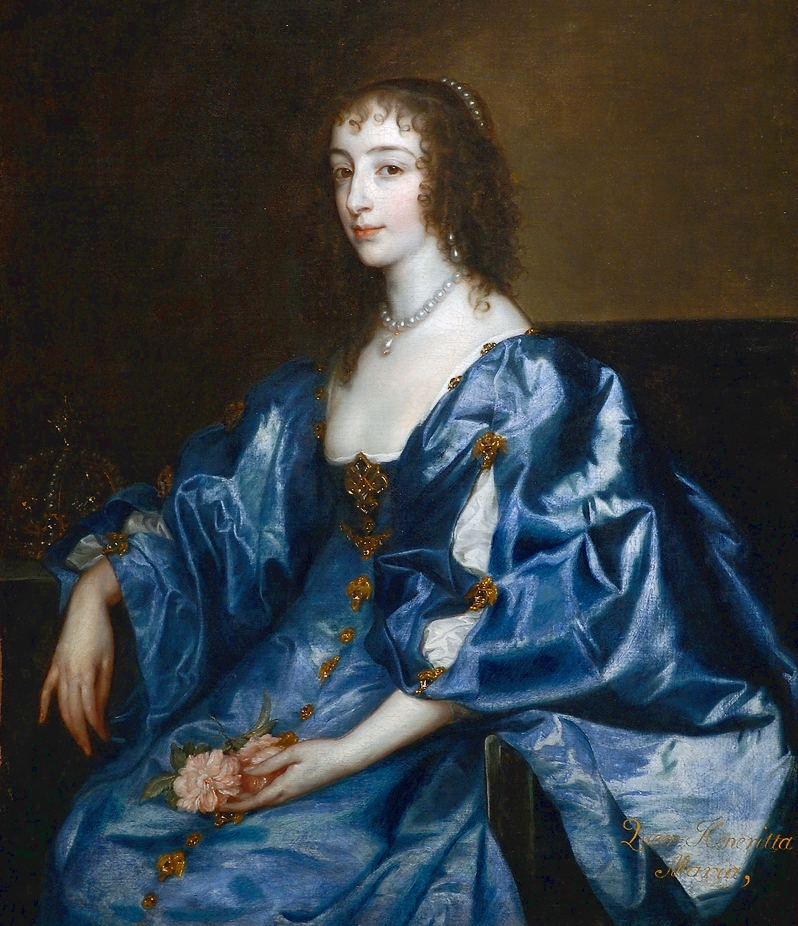
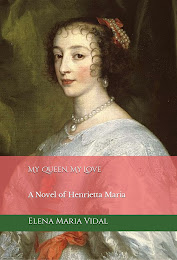
Elena Maria Vidal's novel, My Queen My Love: A Novel of Henrietta Maria, the first book in the Henrietta of  France Trilogy tells of this tumultuous history through the perspective of Queen Henrietta Maria. This book covers her early years as a young princess being molded by her powerful mother, Marie de Medici on how to use her own power even if she has to marry into it. Her marriage to Charles is arranged but grows into a love match. Unfortunately one person is standing in Henrietta Maria's way, George Villiers, Duke of Buckingham, Charles's advisor and also the advisor and best friend (and possible lover) of Charles's father, King James I. Villiers is a conniving social climber and will be a sworn match against the strong willed Queen.

It becomes apparent that this book is a chess match between Henrietta Maria and the Duke of Buckingham. We don't even get to the English Civil War yet (Considering this series is supposed to be a trilogy, that is literally a Future Charles and Henrietta Maria problem).

These are two characters with differing religions, ideologies, and views but both have the love and ear of the King in common.

Henrietta Maria is strengthened by two very important assets: The legacy of her maternal family the Medicis and her Catholic religion. With her mother's name practically being a byword for power, influence, and playing the game of leadership, Henrietta Maria is well trained in the art of court intrigue. She had already been warned about Buckingham’s influence so she is on the lookout for corruption and deceit. Being a Medici, she is able to grant that influence for herself as well. When Buckingham tries to convince Charles to get rid of her French allies, Henrietta Maria is able to play the loving wife card and keep them. It helps that their marriage is a loving one and Charles relies on his wife for support and advice. Her French courtiers are extremely loyal to her and are able to spy and report on the ever changing tide of English loyalty towards their new queen.

Henrietta Maria's faith becomes a bond of contention in her adopted country through no technical fault of her own. It's clear that even after a century has passed since Henry VIII’s reign, England still hasn't recovered from the religious split that occurred within the lifetimes of Henry, Mary, Elizabeth, and James. When faiths change based on the whims and loyalties of a country's leader, instability is bound to occur when some are desperate to cling to the Catholic Church, others to the Protestant, and others to the newer sects of Anglicanism and Puritanism. (It doesn't help that while the Anglican church was meant to be created as a compromise between the Catholic and Protestant churches, there were still plenty of questions regarding doctrine, practices, how much of each religion is permitted, and whether conversion is necessary.)

For the Catholic believers, Henrietta Maria presents them with a voice that they haven't had for some time and representation that had been lost. For the Protestants and other sects, Henrietta Maria is a dangerous interloper and a compelling reason that the Crown is out of touch and has lost its way.

Henrietta Maria herself is devout and her religion eases her during a period of stress and adjustment. While being Queen, she seeks solace from her faith and its rituals and iconography. If it makes her an enemy in other’s eyes, then so be it.

Meanwhile on the other side of this conflict is Buckingham. Once the confidant of Charles's father, James, Buckingham acts as a surrogate brother and best friend to the king by guiding him through insecurities and anxieties about his role. Unlike Henrietta Maria’s familial and religious connections, Buckingham is motivated by ambition and his own placement within the court. He is someone who isn't above throwing a former ally or Charles's wife under the carriage to get his way. He is an upwardly mobile schemer who will claw and connive to hold onto what power he has and to obtain more.

Buckingham shows a loyal and protective side towards Charles even engaging in masquerades and adventures with Charles while he was still a prince. It's clear that his love for James transformed into love for Charles and he sees himself as a guide to the young king whom he still thinks of as a kid. However, his influence in court has grown complacent between the two generations. What he had with James cannot be duplicated with his son and in some ways, he knows it too. That's why he's so desperate to hold onto what he has and sees Henrietta Maria as a threat. His security and placement with Charles's father is now taken by Charles's wife and he does not like that.Buckingham really underestimates who he is dealing with and unfortunately finds out too late.
(Read more.)


Assassination of the Duke of Buckingham
 
Medici Coat of Arms

Share

The Real Reason Young Progressives Now Hate JK Rowling

 I was never a fan of the Harry Potter books or films but the hatred vented against JK Rowling is bizarre. From The Daily Wire:

Mystery novelist Daniel Friedman took to X on Saturday to explain why so many young progressives — many of whom had grown up reading and loving the Harry Potter series — had grown so angry with author J.K. Rowling in recent years.

On the surface, many claim to be upset with her insistence on protecting sex-based rights and access, particularly for women, to single-sex spaces — and to trans-rights activists, that makes Rowling a “Trans Exclusionary Radical Feminist” (TERF). But Friedman’s theory is that the anger is rooted a bit deeper than that.

 “The reason a lot of young progressives are so mad at JK Rowling is that they read the books as kids, and they thought they were Harry or Hermione. But they grew up into people like Percy or Dolores Umbridge or Cornelius Fudge or Rita Skeeter,” Friedman began, naming characters who either actively denied reality or dutifully tattled on friends, neighbors, and even family members who refused to do the same. “And they know it. And on some level, they’re ashamed.” (Read more.)

Share

Sunlight and Language

 From Science:

Color is a spectrum: Red fades from orange to yellow, whereas green merges to turquoise, then blue. Languages treat this spectrum in different ways: Some have separate words for “green” and “blue,” others lump the two together. Some barely bother with color terms at all.

“The question is, why?” says Dan Dediu, an evolutionary linguist at Lumière University Lyon 2. Now, he and his colleagues have found evidence for an unexpected answer: People with more exposure to sunlight are more likely to speak languages that lump green and blue together, under a term that linguists dub “grue.” That’s because of the effects of a lifetime of light exposure, the team speculates: Lots of Sun causes a condition called “lens brunescence” that makes it harder to distinguish the two hues.

Lens brunescence is just one of many theories explaining why color vocabulary is so different across languages, says study co-author Asifa Majid, a psychologist at the University of York. Others originate primarily with the environment: One theory holds that people who live near large bodies of water—like seas or lakes—could be more likely to have a word for blue. And if cultures begin to dye clothing with hard-to-produce blue pigments, that could also prompt the emergence of new color terms. (Read more.)
Share

Tuesday, November 14, 2023

New York Gives Up Attack on Nuns

 From Becket:

A Catholic community of religious sisters today declared victory in their lawsuit against government officials who wanted access to the Sisters’ sensitive internal documents. In June 2022, New York passed a law targeting life-affirming pregnancy centers for government investigation. In Sisters of Life v. McDonald, the Sisters of Life—a community of Catholic women who have given their lives to serve pregnant women in need—asked a federal court for an order protecting them from such government intrusion. The State of New York agreed to a court order, which was granted today, that forbids them from demanding the Sisters’ information or punishing the Sisters for refusing to provide it.

Founded in 1991 by the late Archbishop of New York, Cardinal John O’Connor, the Sisters of Life devote themselves to God by professing vows of poverty, chastity, and obedience. The Sisters believe that every person is valuable and sacred, which is why they also take a vow to protect human life. In keeping with that vow, the Sisters offer holistic care for women in crisis pregnancies by attending to their emotional, spiritual, and physical needs at their Visitation Mission in New York. The Sisters provide women with housing, maternity clothes, baby formula, and other supplies for well after birth and connect women and their children to a wide array of free medical, legal, and social services. The Sisters also accompany women who are seeking hope and healing after their experience of abortion.

“As Sisters of Life, it’s our privilege to walk alongside each woman who comes to us and to stand in solidarity with her, helping her to move in freedom, not in fear,” said Sr. Maris Stella, Vicar General of the Sisters of Life. “We are grateful for this victory, which protects our right to continue to uphold and defend the beauty and strength of women. In over 30 years of serving women in the State of New York, we have learned that what a woman really needs is to be seen, heard, and believed in, which is why we are committed to providing the necessary emotional, practical, and spiritual support for her to flourish. We are called to bring hope, comfort, and joy to women who feel they have nowhere else to turn. The judge’s order will protect us as we continue our ministry.”

Two weeks before the Supreme Court’s decision in Dobbs v. Jackson Women’s Health Organization, New York passed a law targeting the life-affirming work of pregnancy centers by authorizing the New York Commissioner of Health to demand private information from pregnancy centers that do not offer abortion services. The law would have allowed government officials access to the Sisters’ most sensitive internal documents and forced them to turn over private information that would jeopardize their trusting relationships with women in need. After the Sisters sued New York in federal court last year, the State agreed today to back down, allowing the Sisters to continue helping women in crisis pregnancies who seek their help. (Read more.)

Share