


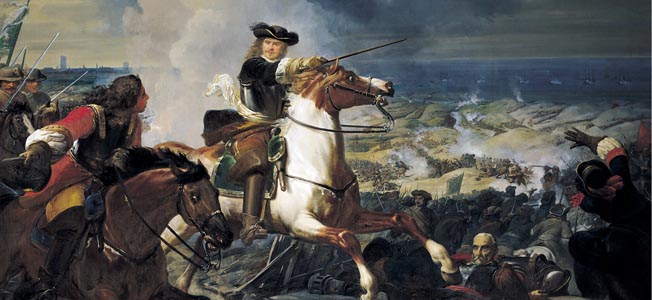
 The future James II fought under the great Turenne as a young man in exile. From Warfare History Network:
France intervened directly in the Thirty Years War in 1635. Turenne participated in the Lorraine and Rhine campaign under Louis de Nogaret, Cardinal de la Valette. After raising the siege of Mainz, the French and their allies had to fall back after their supply lines were cut by the enemy. During a disastrous retreat marked by great privation suffered by the allied forces, Turenne did yeoman service conducting a series of rearguard actions that saved the army from dissolution. During this episode the general not only showed great personal courage and an understanding of the need for proper army logistical management, but also a sincere regard for the welfare of his men.
Turenne was wounded in the right arm dur- ing the storming of Saverne in 1636. He was then given his first independent command with orders to drive an Imperialist army out of Hapsburg-controlled Franche-Comte, which he achieved rapidly and with few losses. The fol- lowing year he took part in the Flanders campaign. Although that year’s fighting proved indecisive, Turenne, who by then was a lieutenant general, again proved himself to be a competentcommander. In 1638 he was instrumental in taking the key fortress of Breisach on the right bank of the Rhine River. The capture of Breisach safeguarded French control of Alsace and Burgundy.
Sent to Italy by his patron, Richelieu, Turenne took part in the continuing Franco-Spanish War, serving under Henri de Lorraine, Count of Harcourt. Turenne performed ably in the complicated siege operations that enabled the French to capture Turin on September 20, 1640.
Afterward, he helped capture the Piedmontese cities of Cuneo, Ceva, and Mondovi in 1641. The following year he served as second in command of the French forces that con- quered Roussillon in Catalonia.
France bestowed the rank of Marshal of France on 32-year-old Turenne on December 19, 1643. His first orders were to reorganize French forces on the upper Rhine in the aftermath of the embarrassing defeat of French forces at Tuttlingen in Swabia on November 24-25, 1643, at the hands of General Franz von Mercy’s Bavarian army.
In the spring of 1644, Turenne crossed the Rhine at Breisach and defeated an Imperialist force near the source of the Danube River and Black Forest. He joined forces with Louis de Bourbon, Duke of Enghien, known as the Great Condé, and with a force of 19,000 men the two French commanders defeated Mercy’s Bavar- ian army at Freiburg in August 1644. Although Condé was in charge of the French forces because he was a royal prince, it was Turenne’s tactical abilities that compelled Mercy to retreat east from Freiburg. (Read more.)
Via Tony Riches.











No comments:
Post a Comment