Saturday, July 6, 2013

Executions at Pontefract

An account of the executions of Queen Elizabeth Woodville's brother and son. To quote:

"O Pomfret, Pomfret! O thou bloody prison,
    Fatal and ominous to noble peers!
    Within the guilty closure of thy walls
    Richard the second here was hack'd to death;
    And, for more slander to thy dismal seat,
    We give thee up our guiltless blood to drink."

Shakespeare Richard III Act 3 Scene 3

Thus does the character of Anthony Woodville Earl Rivers apostrophise the castle at Pontefract in Richard III. In the scene he, his nephew Lord Richard Grey and Sir Thomas Vaughan are about to be decapitated on the orders of Richard Duke of Gloucester as part of his seizure of the throne 525 years ago in June 1483. The Pontefract executions occurred on June 25th. (Read entire post.)
Share

Friday, July 5, 2013

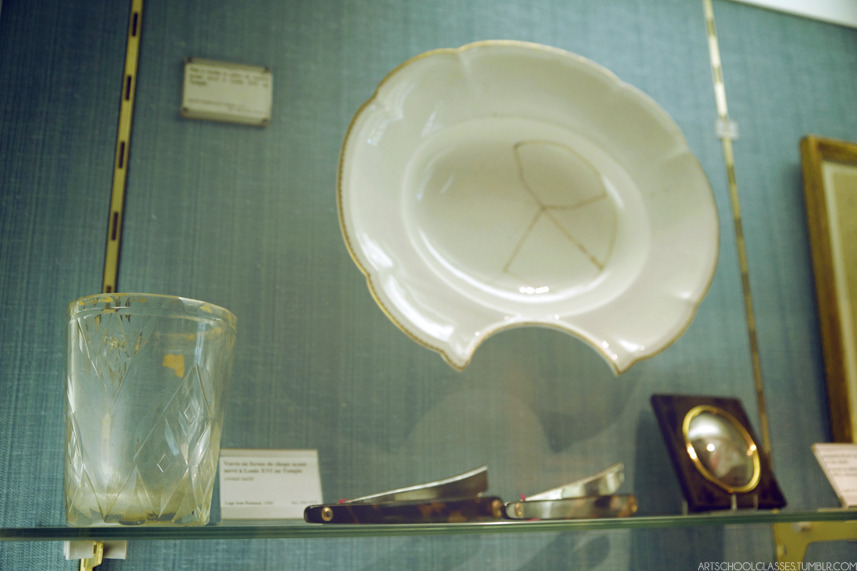
Louis XVI's Shaving Kit

From the Temple prison. (Via Tiny-Librarian.) Share

Blessed Maria Teresia Ledóchowska

The Polish countess who worked against slavery. To quote:
She was the eldest of seven children. Members of the Polish nobility, she and her siblings – including Wlodimir Ledóchowski, Ursula Ledóchowska and Ignacy Kazimierz Ledóchowski were born on the estate of their father, Count Antoni Halka-Ledóchowski. Their uncle was Mieczysław Cardinal Ledóchowski.

From 1885 to 1890, Maria Teresia was lady-in-waiting to the Grand Duchess Alice of Tuscany. Two Franciscan Missionaries of Mary came to Salzburg to seek financial help for their missionary work. The lady-in-waiting listened raptly as the two women religious shared their experiences of working with the lepers in Madagascar. Her interest in the missions increased when she read a pamphlet on Charles Lavigerie’s anti-slavery campaign. Pope Leo XIII had entrusted the evangelization of Africa to Lavigerie. She began to publicize his cause, which soon attracted donations.

As Mary Theresa’s involvement with the missions grew, she began a mission page in a Catholic periodical. These mission features, called “Echo From Africa”, were based on correspondence from African missionaries. The page of letters evolved into a monthly magazine, which made its debut in 1889, even though the nineteenth century was not ready for a woman publisher. The magazine soon became a full-time job, and Emperor Franz Joseph personally released Mary Theresa from her court duties in 1891 so that she could devote all of her time and energy to the missions. (Read entire post.)
Share

Thursday, July 4, 2013

Guilty of Being a Southerner

How the South has changed. To quote:
Where did the media elite’s sense of outrage come from? It’s simple, actually. To admit that the South had changed would mean letting go of their own cultural and moral superiority, of their sense of regional superiority with respect to the issue of race. Media and academic elites believe that, but for proper adult supervision, the South will return to its racist roots and that they alone can protect helpless black southerners from the perfidy rooted in white southerners’ DNA.

In his questioning from the bench back in February, as George Will pointed out, Justice Breyer revealed not only his distrust of southerners, but his disdain: “Imagine a State has a plant disease, and in 1965 you can recognize the presence of that disease. . . . Now, it’s evolved. . . . But we know one thing: The disease is still there.” Breyer’s disease metaphor was not only crude and condescending, it was rank regional bigotry — and from a sitting Supreme Court justice, no less. (Read entire article.)
Share

Wednesday, July 3, 2013

Autochromes of Life at Versailles

If photographs had existed in the eighteenth century, they might have looked like the autochromes of Jules Gervais-Courtellemont. From Reading Treasure:
Jules Gervais-Courtellemont (1863-1931) was a French photographer who is most well known for his color autochromes of World War I, which were so popular that Courtellemont had them published in a 12 volume series. In addition to his photography of the battlefield, Courtellemont also took many photographs of scenes of homes, landscapes and people. His composition style, especially when taking photographs of people, was often intimate but deliberately artistic. Courtellemont loved using symbolism, such as ensuring that certain colors or people were distanced or contrasted with others, to create an appearance of structured--and yet realistic--life. (See entire post.)
Share

Tinderboxes

From English Historical Fiction Authors:
The tinderbox usually  contained at least three items - a flint, a firesteel  (like the one above) and a piece of tinder (typically charcloth). It might also contain  "matchsticks," made of deal dipped in  brimstone, which would be lit from the charcloth, and  a damper (to extinguish the charcloth after it had been used).

The charcloth was made by scorching a piece of material so that it was easy to ignite. An old piece of linen would be held by tongs close to the flames until it blackened. It would then be allowed to burn for a fraction of time before being extinguished, and popped into the box for future use. If charred cloth was not available then straw might be used or even, or if you were French, a thin slice of a mushroom known as 'amadou' dipped in saltpetre. In England it was known as "horse’s hoof fungus"  because of its shape. (Read entire post.)
Share

Tuesday, July 2, 2013

A Grandfather's Style

How young men are looking to the past for wardrobe ideas. From The Wall Street Journal:
These men reflect what's been going on in American menswear for several seasons: the revival of a traditionalist aesthetic, which dovetails at times with the heritage movement. You can see it everywhere from J. Crew to up-and-coming New York label Bespoken.

"They're not rediscovering old-timey men's shops or department stores their grandfathers frequented," said Tyler Thoreson, vice president of men's editorial and creative at Gilt Groupe. "They're going to the new breed of store that references the past, but in a modern way."

The grandpa-admiration society has a growing number of excellent outfitters for its pocket squares, patterned bow ties and custom shirts—from Sid Mashburn in Atlanta and Haberdash in Chicago to Brooklyn Tailors in New York and Aidan Gill for Men in New Orleans.

Some of the society's card-carrying members have been inspired enough to start labels of their own. British-born Robert Godley founded classic-with-a-twist neckwear company Psycho Bunny with his American partner Robert Goldman in 2006. They use English silks made in a 270-year-old mill that are then sewn by hand in Mr. Goldman's family-owned third-generation tie workshop in Belleville, N.J. The collection has grown to include polo shirts, swim trunks and socks.

Mr. Godley, 41, who now lives in New York, talked about his grandfather Antony Opie, who wore plus-fours when golfing. "He was always well presented," said Mr. Godley. "He smoked a pipe and if it was not in his hand you would often see smoke pouring out of the pocket on his sport coat." Mr. Godley's uniform consists of bench-made English shoes, a spread-collar shirt under a sport coat and, of course, a tie. His modern twist: It's all worn with jeans.

Mark "Mac" McMillan, 38, owner of Pierrepont Hicks, the Minneapolis specialty clothing shop, started his company in 2009 with a collection of trim and classic ties, partly as a reaction to his own father's "cheesy and '70s-style wide" neckwear, which was handed down to him. He has since expanded to outerwear and shoes.
Mr. McMillan said that at least half of his customers are in their 20s, and reported that one of his best-selling items is a square-ended bow tie inspired by those worn by designer Charles Eames in the '50s and '60s. What Mr. McMillan thinks is partially propelling a new interest in dressing well among the younger set is the removal of a men's style taboo. "It's OK now for guys to discuss clothing the way they discuss gadgets," he said.

That's one major difference between these men and their granddads: the element of choice. For the earlier generation, said Mr. McMillan, dressing well was "just what they did."

"What I love is that the current generation is discovering the pleasures of putting some effort into how they look," said Gilt's Mr. Thoreson. "But now it's out of choice, not obligation."

Men of bygone eras, of course, dressed accordingly out of sheer respect for themselves and others. In the hazy light of nostalgia, the first half of the last century has a firefly-catching innocence. It was a simpler time when men donned hats out of civility, not as affectation. That feeling in itself can be very attractive in today's fully wired world. (Read entire article.)
Via A Conservative Blog for Peace. Share

Monday, July 1, 2013

Anna Karenina (2012)

Keira Knightley as Anna Karenina, courtesy of Vogue
Levin: Sensual desire indulged for its own sake is the misuse of something sacred. ~from Anna Karenina (2012)
I have never considered myself to be a true intellectual and now I know for certain that I am not one. If I were an intellectual I would surely understand the reasoning behind filming most of the scenes from the 2012 version of Anna Karenina as a stage play, yes, even the horse race scene. As it is, I do not "get it." It seems like a conceit which serves to distract not only from the power of the story but from the power of the performances which move the story along. Neither do I understand the ballet-like quality of the beginning of the film, in which all the actors moved as in a dance without really dancing. The ball room sequence is especially disconcerting since the actors are supposed to be waltzing and yet keep flapping their arms and hands about like chickens. I know there is supposed to be a deep meaning to such gestures but not anything that makes sense to me.

The late Roger Ebert explains some of the reasons for the unusual staging:
As much as half of Wright's film is staged within an actual theater and uses not only the stage but the boxes and even the main floor — with seats removed — to present the action. We see the actors in the wings, the stage machinery, the trickery with backdrops, horses galloping across in a steeplechase.

All the world's a stage, and we but players on it. Yes, and particularly in Karenina's case, because she fails to realize how true that is. She makes choices that are unacceptable in the high society of St. Petersburg and Moscow, and behaves as if they were invisible. She doesn't seem to realize the audience is right there and paying close attention. She believes she can flaunt the rules and get away with it....

This is a sumptuous film — extravagantly staged and photographed, perhaps too much so for its own good. There are times when it is not quite clear if we are looking at characters in a story or players on a stage. Productions can sometimes upstage a story, but when the story is as considerable as "Anna Karenina," that can be a miscalculation.
Another thing I do not understand is why Keira Knightley is repeatedly cast as a heroine in historical roles. Anyone before the 1920's who was as thin as Keira is would have been considered consumptive or at least malnourished; they would not have been regarded as a beauty and certainly not as a  femme fatale. The thinner Keira becomes the more pronounced her jaw appears; in the film her strangely elongated face is yet another distraction from the complicated character she is portraying. Not that lovely heroines necessarily have to be portrayed by flawless beauties; Bette Davis was not a beauty but when she set out to play one in a film she was utterly convincing. Bette, however, was a great actress, which Keira is not. Furthermore, while Audrey Hepburn was also extremely thin, what she lacked in voluptuousness she made up for in the gracefulness of her movements. Miss Knightley has poor posture; anyone would hope that after so many historical roles she would have had some lessons in poise and deportment by now but obviously not. However, what saves her performance for me is her enormous dark eyes which convey Anna's growing despair as well as her ecstasies of passion. Her wardrobe is stunning as well.

The latest Anna Karenina conveys like no other precursor the pain suffered by a spouse who is betrayed and wounded by adultery. Even more so than in Tolstoy's novel, the character of Karenin as depicted by Jude Law is a sympathetic one, and in some ways the true hero of the story. He does everything he can to protect Anna from herself and her fatal passion for Vronsky but she is intent upon her own destruction. Without a word, Law can convey the magnitude of outrage, shame, horror, and heartbreak that Karenin is experiencing inside. He sees, if Anna does not, how her obsession with her lover will destroy not only herself but the home she and her husband have created, causing endless suffering for her children. It is a magnificent and soul-searing performance.

The film also conveys the main characters' sense of God in a way that is subtle but stirring. As Anna and her lover embrace in the forest, rejoicing in their solitude, Anna for a moment looks to the sky, aware that she cannot hide from God. Her sensual obsession with Vronsky becomes embittered and paranoid, leading to despair. Her despair hastens her end, especially as she knows she can no longer be with her son. As for the other women in the play, they come to happiness and love through caring for their children, which is an aspect of the book which the film seems to emphasize. Although the themes of religious hypocrisy and false societal values are explored as in the novel, the gist of the latest Anna Karenina is that family is everything and once outside of the family sphere there is nothing but death.

The odd ballroom dancing
Share

How Fire Makes Us Human

The cooking of food was a major step forward in human history. From Smithsonian:
In essence, cooking—including not only heat but also mechanical processes such as chopping and grinding—outsources some of the body’s work of digestion so that more energy is extracted from food and less expended in processing it. Cooking breaks down collagen, the connective tissue in meat, and softens the cell walls of plants to release their stores of starch and fat. The calories to fuel the bigger brains of successive species of hominids came at the expense of the energy-intensive tissue in the gut, which was shrinking at the same time—you can actually see how the barrel-shaped trunk of the apes morphed into the comparatively narrow-waisted Homo sapiens. Cooking freed up time, as well; the great apes spend four to seven hours a day just chewing, not an activity that prioritizes the intellect. (Read entire article.)
Share