Sunday, June 4, 2023

The Soldier

 From Dr. Esolen at Word and Song:

When I was a boy, I saw, every week when we had Sunday dinner with Grandma and Grandpa, a studio photograph of my father’s father in uniform, as a soldier in the American army during World War One. He looked rigid, uncomfortable, but proud. He’d arrived in America from Italy only a few years before. But when my father was small, he told him that if anybody should ever ask him if he was Italian, he was to answer, “I’m an American!” My father didn’t see action in wartime, but he too served his two years as a soldier, attaining the rank of sergeant. I used to have a couple of photographs he took when he was stationed in Europe. He had a few days’ leave, so he and a couple of his buddies took a train from their post in Germany down into the Campagna, in Italy, to the small mountaintop village, Caserta Vecchia, where his parents’ people came from. Those people welcomed him with open arms. That was around 1955. In those days, Italians, especially in the south, were fond of American soldiers, and the soldiers were fond of them too. In 1983, I traveled to that same Caserta Vecchia, where I met my great-uncle Luigi, and my great-aunt Rosina just this side of 100 years old, and a few others who remembered my father’s visit. But I was no soldier. (Read more.)
Share

Saturday, June 3, 2023

Radical Leftism Linked to Narcissism and Psychopathy

 From The Blaze:

Radical leftism is linked to both psychopathic tendencies and narcissism, according to a new study out of Switzerland.

"Individuals with dark personalities – such as high narcissistic and psychopathic traits – are attracted to certain ideologies and forms of political activism," said the researchers, citing the 2020 BLM riots as one example. Those whose authoritarian reflex predisposes them to leftist causes reportedly tend not to care about social justice or equality, contrary to whatever rhetoric they deal in; rather, they gladly partake in coercion, censorship, and violence to satisfy their own "ego-focused needs."

Researchers Ann Krispenz and Alex Bertrams from the University of Bern noted that past research into authoritarianism and the corresponding mindsets has focused almost entirely on rightist political formations. Past attempts to investigate left-wing authoritarianism have, on the other hand, been downplayed or met with skepticism in the leftist-dominated academy, "even though some empirical studies found evidence for the existence of authoritarianism also on the left side of the political spectrum." (Read more.)


Share

Laura Speaks History

From The History Desk:

The study of history in this present era, has become the study of nothing. We learn about individuals, that are high and mighty, but we forget to ask, “What about the people?” Asking about the people opens up a huge can of worms. Because it is complex. The modern educational system prefers to dumb people down. In spite of this dumbing down costing us, they do it anyway. Why?

Ego.

The past can answer many of the questions if you look at it from a different angle. And keep your nose out of high school and college textbooks. There are other books out there that answer that question, about the people. The first is a five volume set, titled, “A History of Private Life.” Another series, “Civilization and Capitalism, 15th -18th Century,” which is three volumes, is also an excellent review of how our modern, commercial world, developed, and who did the developing. In these books you examine context, not decisions by the usual suspect leaders. By studying the context, you come to an understanding of why the leaders made the decisions that they did.

You will also come to an understanding of the ancestors. This is not about ancestor worship, but being grateful to them for getting us to this point, wherein I can sit at a desk without fear of invasions, the plague, or having enough resources to keep myself fed. Well, I confess. I do live in farm country. That is on purpose too. Because it is the farmers that are key players in our modern world. Not just in feeding us, but in giving us the raw materials for clothing, bed sheets, towels, and the upholstery on your couch.

Industry began on the farms. And remained on the farms until the Industrial Revolution. Farmers’ wives no longer weave flax and cotton. But farmers still grow the plants that give us linen and cotton. People in cities are so cut off from these facts of life, they forget that the food in their grocery stores began in places like the San Joaquin Valley. They probably don’t know where the San Joaquin Valley is. Google it.

In the mean time, here in my new digs, with, count ‘em, two studios, I am having a ball. I have a room dedicated as a recording studio, (see the pic) and one as a design studio. The design studio is not ready to be photographed. But soon. Stay tuned, history/mythology lovers. I will speak the history, as well as write it. And the classes are coming along as well. My goal there is to provide fun and interesting material for home schoolers. (Read more.)
Share

Friday, June 2, 2023

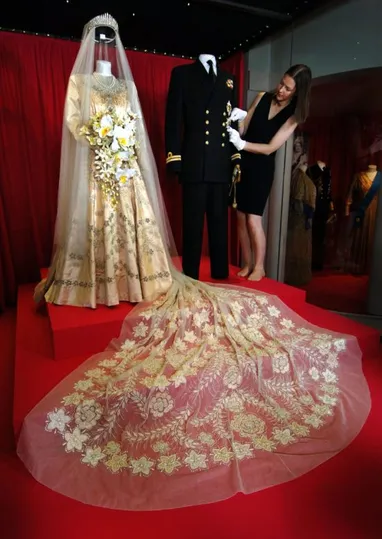
Queen Elizabeth II's Gown


From The Royal Order of Sartorial Splendor:

The bride selected court dressmaker Norman Hartnell for the design duties, as she would continue to do for decades to come. Hartnell's inspiration for the gown was Botticelli's Primavera (above left), which symbolizes the coming of Spring - certainly a metaphor for England's rebirth after the war. The result (his sketch, above right) was a rather intricate and dreamy creation in ivory duchesse satin that was both extravagant and yet somehow fitting for the austere times. Just like everyone else in the country, Princess Elizabeth had to fund her gown with clothing ration coupons. Unlike everyone else, she was allowed 200 extra coupons by the government. Famously, people sent in their own coupons to help the Princess out (these were sent back with a note of thanks, since it was illegal for her to use them). In another sign of the times, the public had to be reassured that the silkworms used to create the gown came from China, rather than enemy countries such as Italy and Japan. (Read more.)


Here is a novel about the royal wedding that I recently enjoyed:

Share

The 1980s Satanic Panic and Transgenderism Today

 From American Greatness:

The Satanic panic created the “Believe the Children” movement. No matter how insane and improbable the claims—and read that list from above, it was insane—their stories must be believed. This is fully mimicked in the supposed explosion of transgender children. Help them mutilate themselves—with abundant coaching from the industry—or they will commit suicide and the blood will be on your hands.

On the transgender front, these kids are forever cash cows as they will be taking expensive drugs—and probably using mental health services—for the rest of their lives.

In 1983 “Dr. Roland Summit publishes an article about Child Sexual Abuse Accommodation Syndrome, which convinces many therapists and prosecutors that if a child denies that anything happened to him or her, they are hiding the truth.” Read that again. No matter what the child says, unless they support the insanity, they are hiding the truth.

Again, doesn’t this sound just like what is happening with the transgender craze? (Read more.)

Share

The Last Knight: Emperor Maximilian I

 From Medievalists:

The son of Frederick III, Holy Roman Emperor (1452-1493) and member of the flourishing House of Hapsburg, Maximilian seems to have had an awkward childhood, apparently not even able to talk until he was eight years old. His father even once remarked “I know very well that when he was twelve years old, I was afraid that he would be either stupid or mute.’’ But in his teenage years he began to excel at learning, including languages; eventually he spoke six. His education soon focused on all the subjects required of a king, and Maximilian was a quick learner, especially in military affairs.

However, his father now had new worries about his son. He could see that Maximilian was behaving extravagantly and recklessly, whether at parties, jousting, or in the bedroom with numerous women. The emperor tried to contain his son’s worst tendencies, but by eighteen years of age Maximilian was leading his first major military campaign. (Read more.)

Share

Thursday, June 1, 2023

The Pain, Humanity, and Ascension of Hans Christian Andersen’s “The Little Mermaid”

 From TOR:

Hans Christian Andersen’s earliest years were marked by extreme poverty. His parents did not live together until nine months after his birth, leading Andersen and others to wonder if his father of record—also named Hans Andersen, a shoemaker—was indeed his father. Highly dubious legends later insisted that Andersen was the illegitimate scion of noble, even royal blood, but if so, noble and royal money was distinctly absent in those early years. His maternal grandmother died in a poorhouse, as did his mother. His (probable) paternal grandfather became mentally ill later in life, and also landed in a poorhouse, leaving his wife and children in desperate financial straits. A cousin landed in jail for begging.

What saved Andersen’s soul, then and later, were fairy tales about magical things like little mermaids.

Andersen probably first heard traditional folk tales from his grandmother and other relatives, tales he later worked into his own fiction. Despite the family poverty, the young Andersen also managed to attend, if irregularly, two infant schools and the town’s charity school, which gave him the ability to read a book that transformed his imagination: The Arabian Nights. He also discovered the theatre, another source of magic. When he was fourteen, he travelled to Copenhagen to work in a theatre there, a job that brought him the opportunity for more schooling and exposure to more books. Slowly, he became a writer and creator of new fairy tales.

His initial fairy tales tended to stay close to their oral roots, but gradually, Andersen began to add his own elements to his tales, creating stories that combined elements of folklore, romance, angst, social commentary, angst, delicate magical details, and, for a change, angst. His first volume of fairy tales, which initially appeared as a series of three thin booklets between 1835 and 1837, included a mix of retold folktales and original work, including “The Little Mermaid,” which was first translated into English in 1872.

Andersen had undoubtedly heard legends of mermaids and selkies and sirens and other creatures of the water. The stories date well back into ancient times, and European interest in mermaids had recently resurged thanks in part Frederick de la Motte Fouque’s worldwide bestseller Undine (1811), the tragic story of a water spirit and a knight. Andersen certainly knew the book; he may also have known the E.T.A. Hoffman opera based on the book, first performed in 1814. It reminded him that not all fairy tales need to have a happy ending, and that the quest for a soul can be a dangerous one.

“The Little Mermaid” opens happily enough, with a rich description of the underwater palace of the Sea King. Andersen, unlike other fantasy writers who told stories of similar underwater kingdoms, makes no attempt here for any oceanographic accuracy: his intent here is to build fantasy, and so the palace windows, for example, are made of amber, not exactly a sea product—although later, the little mermaid has to pass through what sounds suspiciously like fire coral, very definitely a marine product, to reach the sea witch.

The little mermaid is the youngest of six sisters, eagerly waiting her chance to head up to the surface of the water where she’ll be able to see humans and other surface wonders as well. The minute she does, things go wrong: she sees glorious fireworks and a handsome prince, but the ship she sees is almost immediately wrecked, with no survivors other than the prince, who only lives because the little mermaid drags him to the shore.

That’s the first hint that the story will not go well. The little mermaid becomes obsessed with the prince—she kissed him a few times in the water—and starts following him as much as she can, and collecting information about him. From this, she learns he’s a good guy—I have my doubts about this, but let’s move on for now—and decides to become human, so she can be with him. The sea witch she consults counsels her against this, since if it doesn’t work out, the mermaid will die, but the mermaid is determined: she gives up her voice, and heads to the surface, to walk on legs that cut like knives at every step.

Once on the surface, the prince dresses her up as a pageboy, and occasionally kisses her passionately on the forehead and says that he might—he might—just marry her. And then he marries someone else—the girl he thinks saved his life, who is also very beautiful, and, I might note, not dressed up as a pageboy, and who does not ask any pointed questions about the beautiful voiceless girl who has been sleeping at the prince’s door on a velvet cushion. Prince, I feel we need to talk about a few things, including the sleeping arrangements you’ve made for little voiceless foundling girls that you occasionally kiss on the forehead, but we may not have that kind of time. (Read more.)


Share

The Politics of Inertia

 From American Greatness:

The Democrat will be up against literally Adolf Hitler, whether his given name is Don or Ron, so you can expect the ballot manufacturing turbines to be grinding away on overdrive in their underground bunkers.

But it is suddenly unclear for whom they will be manufacturing votes. The political weathermen all say “Joe Biden.” But there are many indications that the force field of Biden’s forward-moving inertia has been compromised. Damaging stories are accumulating, and not only in the right-wing press.

Remember that letter from 51 former intelligence officials insisting that news about Hunter Biden’s “laptop from hell” was really just Russian disinformation? Their letter provoked Twitter to suspend the account of the New York Post, which broke the story. But it turns out that the letter was agitprop orchestrated by Antony Blinken, then a senior member of Joe Biden’s campaign, now, God help us, secretary of state.

But now we have the New York Times and even CBS rooting about in the Biden midden. Just a few days ago, CBS interviewed Gary Shapley, a veteran IRS investigator, who detailed how the Justice Department intervened to “slow walk” and otherwise obstruct the agency’s investigation into Hunter Biden’s alleged tax fraud. Other outlets are casting a gimlet eye on reports that the Bidens, while Big Guy Joe was vice president, hoovered up more than $10 million from the companies of various foreign nationals.

Recalling the effect of Walter Cronkite’s critical report on the course of the Vietnam War in 1968—it was widely credited with forcing Lyndon Johnson out of the race for president—one commentator wonders whether the CBS report might have a similar effect on Joe Biden, forcing him from the 2024 race. “Now,” the report speculates, “the country could be witnessing a similar watershed moment as CBS signals its willingness to treat the Biden family’s corruption with the scrutiny it deserves.” (Read more.)


 Also from American Greatness:

Left-wing politicians and activists from then-vice presidential candidate Kamala Harris (“They’re not going to let up, and they should not, and we should not.”) to Nikole Hannah Jones (“Destroying property, which can be replaced, is not violence.”) either excused the often violent protests or urged that they continue. Far from sending in 20,000 federal troops, as occurred after January 6, the Left demanded that then President Trump not resort to such Draconian measures.

Note that there were lots of government properties deliberately targeted in iconic fashion. A Seattle police precinct (with officers inside ) was set afire. A mob in Washington, D.C. tried to storm the White House grounds in a fashion that sent the president and secret service agents into a subterranean bunker. A historic Washington, D.C. church was torched. Violent mobs set federal and state courthouses on fire in Las Vegas, Minneapolis, and Portland. (Read more.) 
Share

The Crucial Difference Between Being Educated and Being Cultured

 From Marginalian:

“In order to be cultured and not to stand below the level of your surroundings it is not enough to have read ‘The Pickwick Papers’ and learnt a monologue from ‘Faust,’ Anton Chekhov wrote in an 1886 letter to his brother, outlining the eight qualities of cultured people — among them sincerity, “no shallow vanity,” and a compassionate heart that “aches for what the eye does not see.” This essential difference between being educated and being cultured is what the great British novelist, philosopher, literary critic, educator, and poet John Cowper Powys (October 8, 1872–June 17, 1963) examined in greater dimension a generation later in the 1929 masterwork The Meaning of Culture (public library) — one of the most thoughtful and beautifully written books I’ve ever encountered.

Powys begins with the tenet that “culture is what is left over after you have forgotten all you have definitely set out to learn” and sets out to examine what, exactly, is left over — which is often too surprising and subtle, too aglow with inarticulable radiances, to fit into our intellectual templates of understanding. (Read more.)

Share