Wednesday, May 3, 2017

Amalia

From Tiny-Librarian:
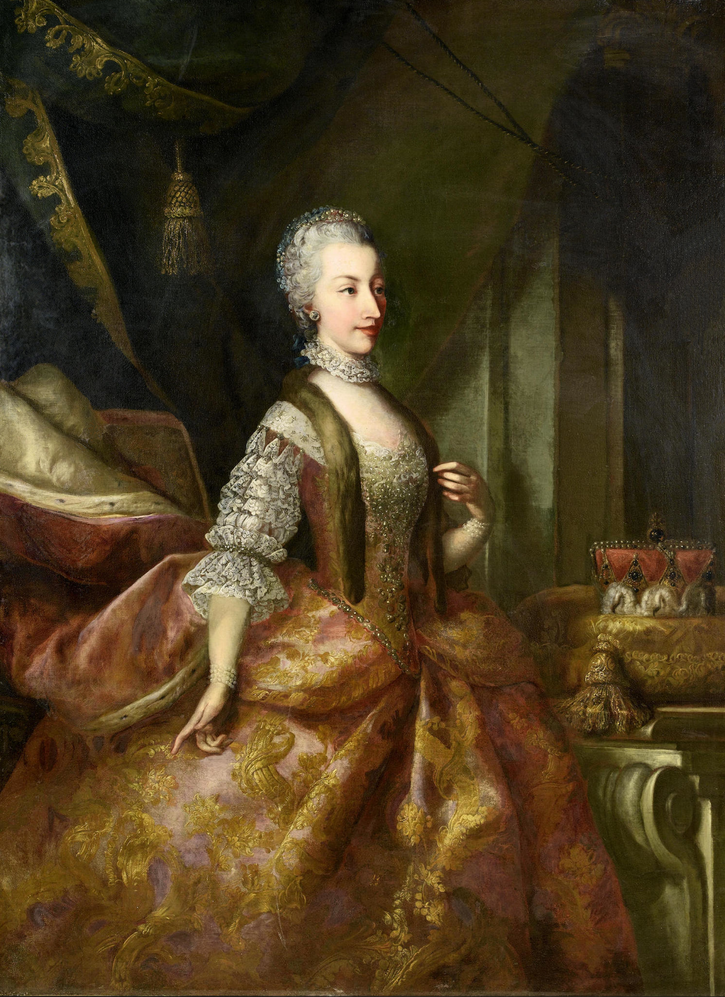
Archduchess Maria Amalia had a stubborn disposition and was the only daughter who refused to even to pretend to follow her mother’s advice after she was married. She was therefore shunned by the Empress, although her younger sisters were quite fond of her. Considered one of the prettiest sisters in a family of beauties, she had been determined to marry the man she loved the way Mimi had. Maria Theresa, having recovered her strength of mind, would not hear of it. Instead Amalia had to marry Ferdinand of Parma, another grandson of Louis XV. They had several children although they both cheated on each other, and Amalia later behaved so badly people thought she was mad. Maria Theresa worried that the rumours about Amalia would make it to France and soil Antoine’s reputation; indeed it may have contributed to the French people’s readiness to believe anything unsavoury about their Queen. As a widow, Amalia was driven out of Parma by Napoleon’s army and sought refuge in Bohemia, where she died in Prague in 1804.
Marie-Antoinette, Daughter of the Caesars: Her Life, Her Times, Her Legacy- Elena Maria Vidal

Share

A Letter from St. Maximilian

From Vultus Christi:
There are two moments in every sacrificium or consecration. The first moment corresponds to the Offertory of the Mass. One hands oneself over, offering to God one’s body and soul, one’s past, present, and future. Here the action is human; it engages one’s free will and, normally, finds expression in the formulation of an “act of consecration.”

From the human perspective, this is the active mode of consecration. One must hold fast, nonethless, to the truth that every good action is a free response, made possible by grace, to a divine solicitation of the heart. One consecrates oneself at the prompting of the Holy Spirit, and in the grace of obedience to that inner prompting. I consecrate myself.

The second moment corresponds to the consecration of the Mass. One is acted upon by the Holy Spirit sent by the Father at the invocation of the Son. Here the action is divine, not human. The agent is God Himself, the work of sanctification/consecration being fittingly attributed to the Holy Spirit. I am consecrated.

Why would one risk an act of consecration, knowing full well that it will bring upon the one making it a configuration to Christ Jesus in the mystery of His sacrifice? One dares to consecrate oneself because it is the only response worthy of the love of God.
He who did not spare his own Son but gave him up for us all, will he not also give us all things with him? (Rom 8:32)
To be consecrated to the Sacred Heart of Jesus, and to be abandoned or given over to His love are, in effect the same thing. By consecrating oneself to the Sacred Heart of Jesus is to hand oneself over to His merciful love. This action on our part allows Our Lord to act upon us freely in view of the glory of His Father, the fruitfulness of His Church, and our own sanctification. Our Lord seeks souls who will hand themselves over to His love, just as He handed himself over to His Father’s love upon the altar of the Cross.

This is where Marian consecration comes in. The most effective way of handing oneself over to Jesus is through Mary. The consecration of oneself, made in her virginal hands, is immediately “handed over” to Jesus, the Eternal High Priest, who, in turn, unites it to His own perfect oblation to the Father. (Read more.)
Share

Smoothies from Magnolia Farm

After my trip to the Philippines I discovered how healthy coconut milk (and oil) can be. From Joanna Gaines at Magnolia Market:
It would be so fun to take the kids to the grocery store with you, and let them choose their own fruits for their smoothie. Then head over to the paper goods section and let them pick out some fun straws. Allow them to be hands on with it, and explain to them how important it is to have healthy treats this summer.
These ingredients yield two servings.
  • 1 ripe mango, cubed (or frozen mango if not in season)
  • 150ml coconut milk (or replace with almond or regular milk)
  • 100g pineapple pieces
  • 100ml mango puree or pineapple juice
Place fruit, coconut milk and mango puree (or pineapple juice) into a blender and puree until smooth. Serve immediately. (Read more.)
Share

Tuesday, May 2, 2017

The Real "Bloody Mary"

From Samantha Wilcoxson:
It may surprise some to learn that Mary’s council frequently accused her of misplaced mercy. She initially refused to have Jane Grey executed for treason, though the woman had ruled in Mary’s rightful position for almost a fortnight. Reluctant queen or not, there was no doubt that this was high treason. Mary also refused to take steps against her plotting sister besides relatively comfortable imprisonment, despite Elizabeth’s hunger for her sister’s throne. Hundreds of soldiers of Wyatt’s Rebellion were pardoned by Mary, as was Henry Grey, Jane’s father, until he rebelled following his original pardon. The woman we know as Bloody Mary would be shocked by the sobriquet, as would most who knew her.
So, why did Mary burn Protestants? Was it because she blamed them for her mother’s downfall or her father’s rejection? Did she simply hate those who did not share her beliefs? The answer is a resounding no. 
Mary believed, as did those who lived during her reign, that burning was a foretaste of hell. It was specifically chosen as a punishment for heresy to give sufferers a chance to repent of their false beliefs and gain entrance to heaven. What we see as a slow, cruel death (and it was) had a purpose. Those who went to their death this way had the opportunity to reject hell and beg God for forgiveness. Witnesses would see what hell would be like – and hopefully see heartfelt recantation – and examine their own faith. As horrid as it seems to us, burning was intended to save the most people for eternity. (Read more.)
Share

"The Negro Project"

The inherent racism of Planned Parenthood. From Too Many Aborted:
The Negro Project was initiated in 1939 by Margaret Sanger, founder of Planned Parenthood. It was a collaborative effort between the American Birth Control League and Sanger’s Birth Control Clinical Research Bureau.1 For a eugenist, it wasn’t controversial, it was integral to the implementation of eugenics to eliminate the ‘unfit’. Eugenics is “a science that deals with the improvement (as by control of human mating) of hereditary qualities of a race or breed”.2 Negative eugenics focused on preventing the birth of those it considered inferior or unfit. This was the foundation of Sanger’s Birth Control Policy and advocated throughout her writings, speeches, and her periodicals including “Pivot of Civilization”, “Plan for Peace” and countless Birth Control Review articles. The pseudo-science (racial hygiene theory) of negative eugenics influenced social policy and eugenics-based legislation (Immigration Act of 19243, segregation laws, sterilization laws) and led to the racial hygiene theory adopted by the Nazis. Noted eugenist, Eugen Fischer, who was funded by The Rockefeller Foundation (one of many same organizations that also financially supported Sanger’s work), was responsible for the Nazi adoption of racial hygiene theory at the Kaiser Wilhelm Institute that led to the eugenics implementation of the holocaust.4 The connections between American Eugenics and the horrors of Nazi Germany are irrefutable. The preponderance of evidence of where Sanger wanted to go (although she decried the atrocities of the holocaust after WWII) shows the ignorance and naivete of eugenics philosophy and its eventual conclusion, left undeterred.  The Negro Project was but a precursor to what eugenists wanted to implement on a much larger scale.

“…those of us who believe that the benefits of Planned Parenthood as a vital key to the elimination of human waste must reach the entire population, also believe that a double effort must be made to extend this program as a public health measure to Negroes who need is proportionately greater.”

— Dr. Dorothy Ferebee (black physician serving as the Chairman of the Family Planning Committee of the National Council of Negro Women) in presentation at 1942 annual meeting of the Birth Control Federation of America (Planned Parenthood) . (One should note that, today, both Planned Parenthood and the National Council of Negro Women are radically pro-abortion.)
(Read more.)
Share

Dynamic Characters

From Reedsy:
A common criticism of fiction — be it in film, television, or novels — is often laid against characters seen as “flat” or “two-dimensional.” Modern audiences know when a protagonist or supporting character isn’t interesting, based on their own lack of emotional investment in that character’s journey. Rightfully fearing this criticism, a lot of new authors are compelled to ensure that their protagonist is a dynamic character. However, as many editors will attest (and as some authors will admit), there is often confusion between “well-written characters” and “dynamic characters” — which are not always one and the same. In this article, we will take a look at what dynamic characters are, how they differ from static characters, what forms their narratives can take, and how authors can write them into their books. (Read more.)
Share

Monday, May 1, 2017

Ask the Expert: Top 5 Spring Decorating Ideas

From Victoria:
Spring is the season that celebrates fresh new beginnings; it’s a season filled with natural beauty and color. Once winter is over, I can’t wait to celebrate spring’s glorious return by infusing our home with the colors, shapes, and scents of the season. It is so rewarding to re-imagine and refresh our existing rooms by adding a few show-stopping accessories, or just rearranging some of the antiques that are already there.

Living in California, our garden bursts into bloom quite early, and I draw inspiration from Mother Nature. The garden is visible through large French windows in the living room, as well as in our master bedroom, and I let it take center stage in my decorating. I bring in lots of soft neutral colors of white, cream, and linen, with just a few colorful accents.

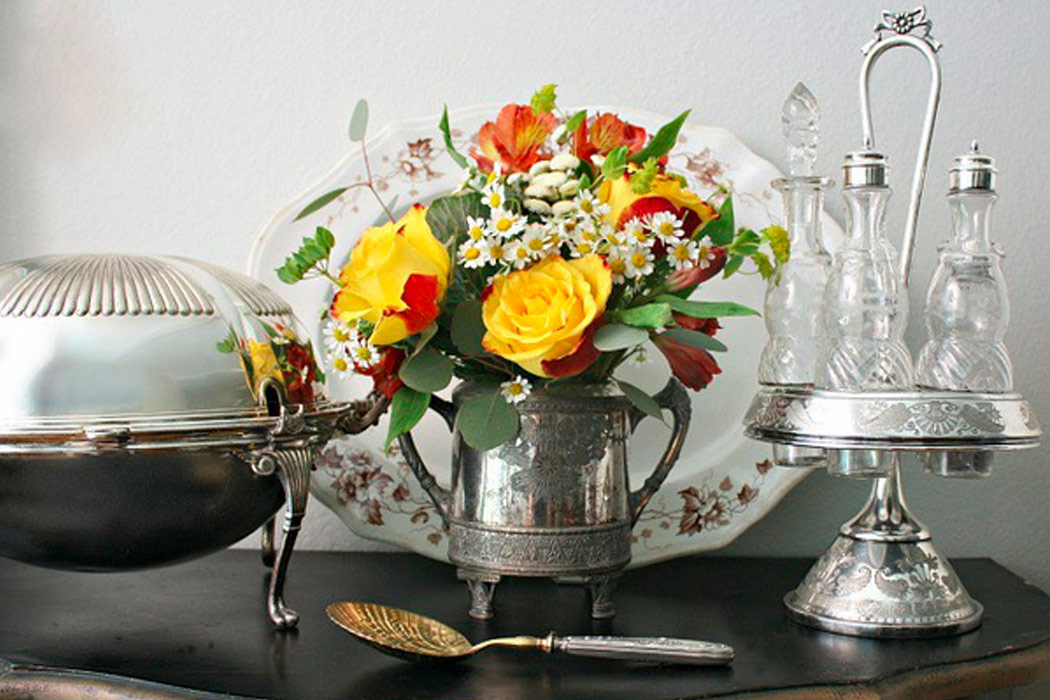
As an antiques dealer, I am always trying to incorporate heirlooms into our home’s design in new ways, so change is a constant. For spring, I edit my collections and display fewer pieces to freshen and lighten the look, like antique Limoges porcelains with pastel colors on a tea tray. Pillows in bright colors line our couch in the living room. I design simpler table settings with silver, china, and antique white table linens, so that my flower arrangements, and spring’s fresh foods, can really take center stage. (Read more.)
Share

A Virtuous Republic Requires Virtuous People

From The Federalist:
Many public documents from the time spoke of the need for social and republican virtues within the populace such as justice (i.e., obeying the law), moderation, benevolence, temperance, industry, frugality, religious piety, and a responsibility among the people’s representatives to secure their good. In times of war, however, virtues of strength such as courage, leadership, bravery, vigor, and manly exertion are required. “Virtue is of concern to government not as an end in itself, but as a means to security and ultimately to happiness,” West concludes.

Opposed to the libertarian ethos that has consumed much of the Right, West argues forcefully that the project of sustaining our republic is not satisfied simply by getting government out of the way. The founders thought it was the duty of government (at least at the state level) to encourage virtue through public education, support for religious instruction, and a vast network of laws that discourage crime and promote stable families. (Read more.)
Share

Of Snuff and Snuff Boxes

From Geri Walton:
Snuff is a pulverized form of tobacco and was created from either the tobacco leaves alone, the leaves and stalk, or just from the stalk. It also required more care to produce than tobacco. For instance, Scott and Irish snuff was achieved using a “liquoring,” process that added water. Although the types of snuff were endless, snuff could be broken into three grades: granulated, impalpable powder, and coarse or bran that was achieved by sifting the impalpable powder. There were also several kinds: High dried (dried to acquire a slight flavor of scorching) and rappee (chiefly from the leaves and in two kinds, brown or black, with the black produced by wetting). Snuff could also be scented, which was claimed to help impart the flavor.

Different people, preferred different types of snuff. For example, Scotch snuff was preferred by females. One writer noted, “with a certain class of old maids, Scotch snuff divides their time and affections with their cats and their parrots.” Those who didn’t like snuff but indulged in it “for the mere sake of ostentation,” were claimed to love scented snuff, and men were noted to prefer rappee snuff. The names for snuff were acquired in different ways. Sometimes the name came from places where it was manufactured. Other times the name was linked to the shop owners who sold it, or to “men of rank and fortune, persons known as great consumers of snuff, [such as] poets, painters, and warriors.” (Read more.)
Here is an article on snuff from the Louvre. Share