


Saint Titus Brandsma
2 days ago


Beijing’s claim to the Spratlys is being contested by Vietnam, Malaysia, Brunei, the Philippines and Taiwan. While Hanoi and Manila have occupied islets and built structures to back their claims, the Chinese have been more aggressive. They have occupied rocks and reefs with troops, dredged and expanded them into artificial islands, fortified them, put up radars and are building air strips and harbors.Share
What the Chinese are about is easy to understand. Having feasted and grown fat on trade surpluses with the United States, the Chinese are translating their economic strength into military power and a new strategic assertiveness. They want to dominate East Asia and all the seas around it. (Read more.)
We live in times in which many call good or “no big deal” what God calls sinful. This is especially true in the area of sexuality, where whole sectors of our society not only tolerate but even celebrate sexual practices that the Scriptures call gravely sinful, and which will lead to Hell if not repented of. Acts of fornication (pre-marital sex) and homosexual acts cannot be considered acceptable by any Catholic or by any person who sincerely accepts the Scripture as the Word of God. And even for those who do not share our faith, acts of fornication and homosexual acts can be plainly seen to cause great harm in the manner in which they spread serious disease, harm marriage and family, lead to abortion, and for the children who do survive abortion, subject them to having single mothers, absent fathers, and a lack of the best environment which they are due. (Read more.)Share

If Robin Hood had been working for Richard in the years of his absence, then if the opportunity did arise for King Richard and Robin Hood to meet, with regard to their individual characters both men would have seized it. Both men had much to gain from mutual support.Via Stephanie Mann. Share
The famous painting Robin Hood entertaining King Richard the Lionheart in Sherwood Forest by Daniel Maclise currently hanging in Nottingham castle depicts the meeting between King Richard I and Robin Hood in Sherwood Forest. In the picture, the initial formalities have obviously having been dealt with and both men are seen amidst scenes of drinking and feasting under broadleaf trees surrounded by lots of people, all paying great attention to Robin Hood and King Richard. Little John looks like Hercules in style and dress, carrying a dead deer over his shoulder - a seriously grave offence under the strict Forest Law at the time. Marian sits demurely at the base of a nearby oak tree crowned with woodland flowers. Robin with a drink in his hand postures before the King whilst recounting a tale - and definitely looking a little tipsy - whilst King Richard is dressed in mail armour ( armour was not worn for hunting as it was considered both uncomfortable, unfair and unsporting ) covered by a white sleeveless surcoat attended by a strange-looking page who pours him wine from a jug. King Richard sits and smiles benevolently at Robin, with his similarly-armoured guards standing well in the background. Friar Tuck is pictured with many other background characters who have been identified as Will Scarlett, Gilbert, Much, Gamwell, Alan a Dale and so on by the eager viewers of the painting. The picture we have is very much part of the 19th century Victorian-period romantic ideal of the meeting between the two men and the steadily increasing tourist trade involving Robin Hood going on in Sherwood Forest at the same time as this image was painted. The most remarkable feature in the painting - often missed by viewers - is that Robin Hood is dressed not in green clothes, but in bright red.
St Mary's Priory would be seen by both sides as 'neutral territory', though Robin Hood's belligerent attitude to the clergy is made pretty clear. The monks there did not permit the wearing or carrying of weapons in the precincts of the Priory so a meeting between Richard and Robin could have been arranged there easily by a go-between prompted by either side. (Read more.)
Sometimes a culture disappears with a whimper, not a bang. Institutions age and are ignored, and the complacent public insidiously lowers its expectations of state performance. Infrastructure, the rule of law, and civility erode — and yet people are not sure why and how their own changing (and pathological) individual behavior is leading to the collective deterioration that they deplore.
ShareThere is still a “West” in the sense of the physical entities of North America, Europe, many of the former British dominions, and parts of Westernized Asia. The infrastructure of our cities and states looks about as it did in the recent past. But is it the West as we once knew it — a unique civilization predicated on free expression, human rights, self-criticism, vibrant free markets, and the rule of law? Or, instead, is the West reduced to a wealthy but unfree leisure zone, driven on autopilot by computerized affluence, technological determinism, and a growing equality-of-result, omnipotent state? (Read more.)
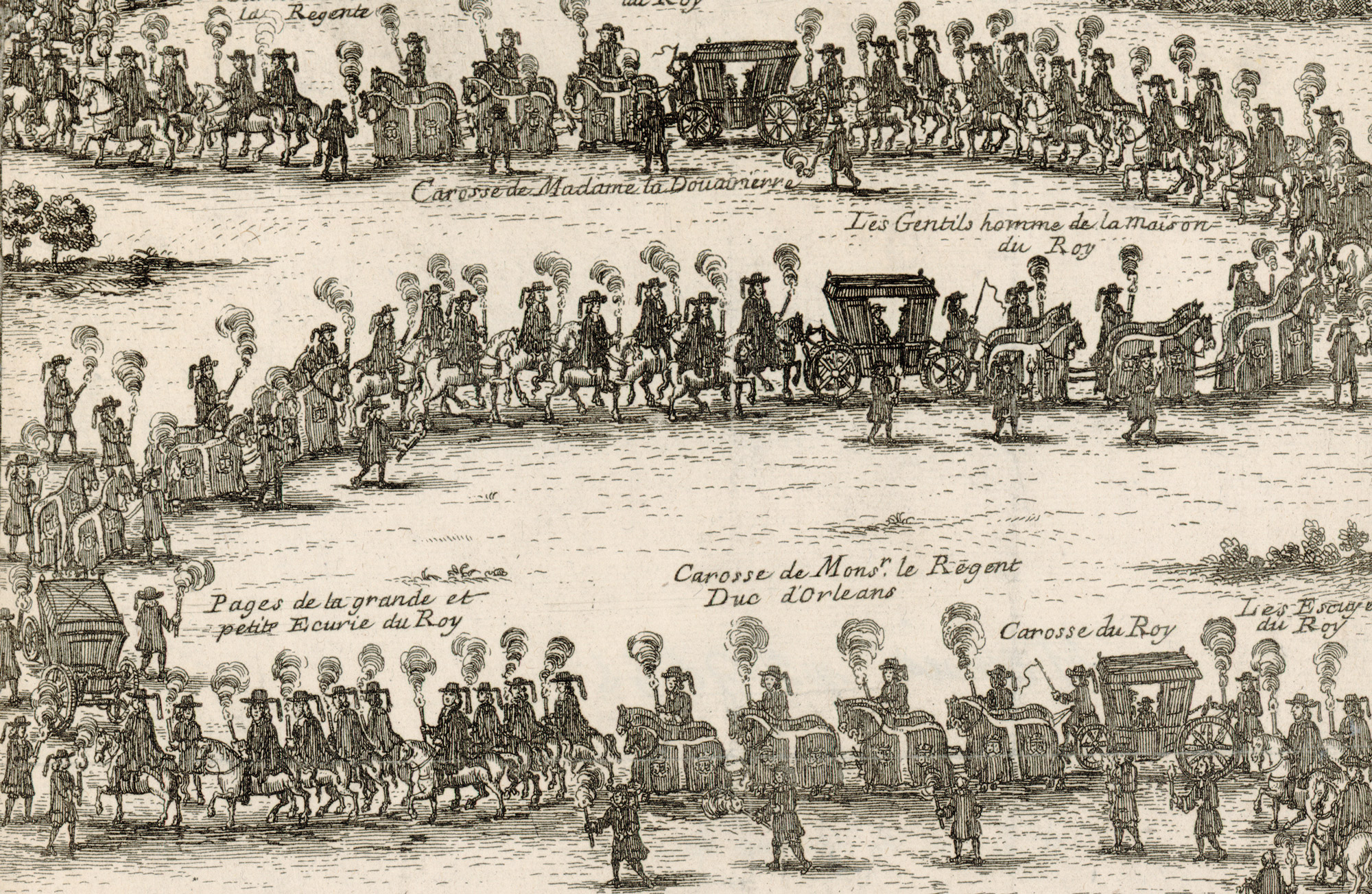 |
| Funeral Procession of Louis XIV |
The death of the king, both as a man and an institution, was a key moment in the construction of the public perception of the monarchy, combining religion (the death of a Christian) and politics (the death and resurrection of the king, who never dies). From his final death throes to the burial it resembled a performance, a great Baroque show of huge significance to courtly society, which was affected more than ever by it.Here is an article on mourning: is black the right color?
The exhibition – the first on the subject – will look back on the details of the death, autopsy and funeral of Louis XIV, which strangely are little known, and to situate them in the funeral context of European sovereigns from the Renaissance period to the Enlightenment. It also discusses the survival – often paradoxical – of this ritual from the French Revolution to the contemporary era.
The exhibition will bring together works of art and historical documents of major importance from the largest French and foreign collections, including ceremonial portraits, funeral statues and effigies, gravestones, the manuscript for the account of the autopsy of the king, coins from the Saint-Denis Treasury, gold medals, emblems and ornaments, and furniture of funeral liturgy. Some of the pieces on display have never been exhibited in public. (Read more.)
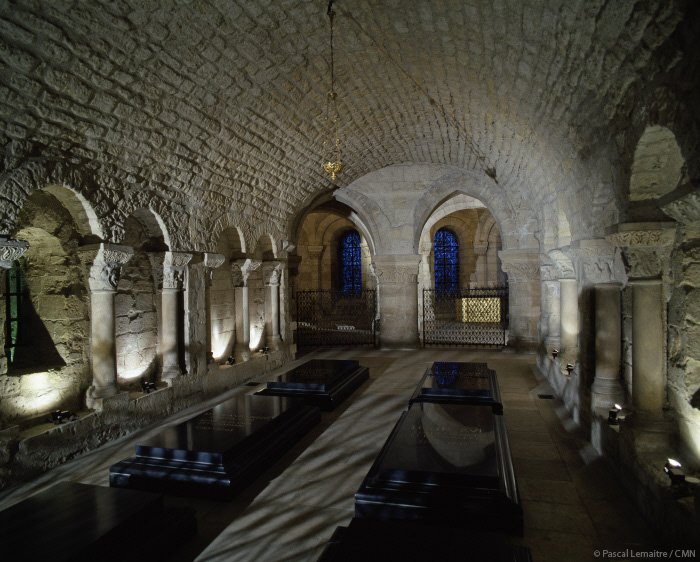 |
| The Bourbon crypt at St. Denis |
 |
| The Funeral of the Duc de Berry (as told in Madame Royale) |
Hunting with hounds played a major role in the life of the medieval nobility. Stags and harts became the preferred quarry. Some packs of hounds stayed on a huntsman's leash; others ran free alongside their mounted masters. Dog packs could range from around twelve animals to up to fifty. In the 1360s, Edward III spent the exorbitant sum of £80 on his pack of seventy dogs and the huntsmen that looked after and worked the animals. Henry of Lancaster paid a goldsmith to make a silver chain for one of his dogs.Share
The fourteenth century Sir Gawain and the Green Knight contains scenes of hunting dogs in action. The unknown poet tells us 'Such a clamour arose from the assembled hounds, that the rocks around rang with the noise.' The dogs bring down deer, but meet their match when they disturb a wild boar: 'Full oft he stands at bay, And maims the pack on all sides. He hurts the hounds and they, Full piteously howl and yell.' (Read more.)
Last Wednesday night October 21st, at my parish of the London Oratory, Fr Douglas Bazi gave a talk in St Wilfrid's hall, the long drawing room with dazzlingly high ceilings. Aid to the Church in Need have brought Fr Bazi from Iraq. He gave one of the most fascinating talks I've ever heard; it was both inspiring and heartbreaking. He says that if a young Catholic man in Iraq decides to become a priest, he knows he will be martyred, 'to be a priest in Iraq is a one way mission; you will be killed.'Share
Fr Bazi knows this viscerally; ISIS terrorists kidnapped him for nine days. He was driving in traffic, when two cars sidled up and blocked him. Chaining his hands, they took him to a toilet where he was kept for several days with the instruction, 'if you open your eyes, we will shoot you.' They starved him and gave him no water for four days. When he thought things were at their worst, Fr Bazi tried off-beat humour to show them they were not getting to him, and thus make them doubt their efforts to hurt him, by saying to the young men of ISIS, 'this is a picnic'. But he concedes that this was, 'a very bad idea' and only motivated the very young Islamic men to torture him more brutally. They went from chaining him to a toilet, to taking a hammer and breaking his back teeth and smashing a disc in his back. When he was alone, Fr Bazi would use the chains that bound him as a means of saying the Rosary, each link would be used to count Hail Mary's. (Read more.)
FDR’s greatest success was dispatching Swedish diplomat Raoul Wallenberg to save thousands of Hungarian Jews near war’s end. But perhaps many more could have been saved across Europe by wider actions earlier, the authors speculated. Winik afterwards told me he thinks Churchill was somewhat more proactive, asking that Auschwitz be bombed, a request that was ignored. Breitman said bombing Auschwitz would have had symbolic importance but likely would not have significantly slowed the Nazi death machine.Share
After Yalta, FDR met the Saudi king to urge Arab acceptance of a Jewish state, pointing out two million Jews had been murdered in Poland. The king caustically responded there should be plenty of room then left for survivors in Poland. So much for Holocaust sensitivity.
Remembering the Holocaust and other genocides is important for, among other reasons, it reminds us of humanity’s endless capacity for evil. Modern, wealthy, protected Americans largely live in functional denial about evil. In our coddled culture, any absence of affirmation and security is a terrible wrong meriting grievance and renumeration. It’s nearly impossible for most Americans to imagine a political upheaval involving orchestrated, sustained mass murder. We believe people are basically nice, and when they’re not, it’s a mysterious aberration. (Read more.)











