From
Greek Reporter:
Netflix’s Queen Cleopatra docuseries has caused an immense
storm of controversy surrounding its depiction of Cleopatra VII
Philopator as a black woman, and whilst Cleopatra herself was not black,
there were indeed black pharaohs who ruled over Egypt at one point in
the 8th and 7th centuries BC.
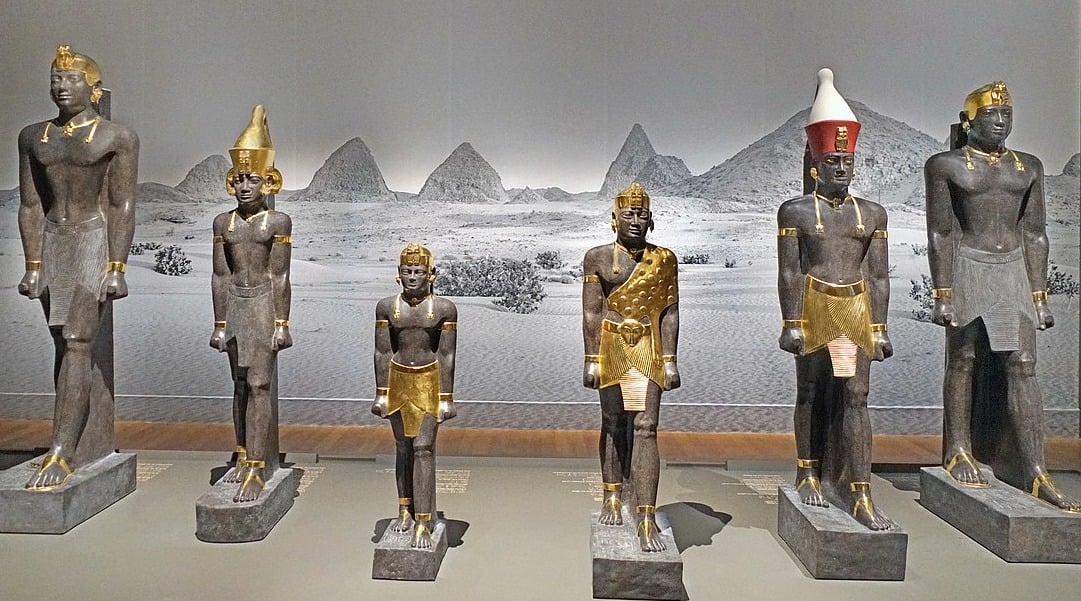
The 25th Dynasty, also known as the Nubian Dynasty, or Black
Pharaohs, ruled Egypt between 744 BC and 656 BC as part of the wider
Kushite Empire. The 25th Dynasty originated from the city-state of
Napata in Nubia, in what is today Sudan.
The Nubian Kushite civilization, from whom the 25th Dynasty
originated, could, like the Egyptians, boast of impressive
architectural, artistic, and cultural achievements. Sadly, this
enigmatic civilization has been overshadowed by its better-known members
and does not achieve the attention it deserves in a mainstream setting. (Read more.)
Cleopatra's dynasty were Greek. Also from The Greek Reporter:
Cleopatra VII Philopator is one of the most famous figures of
antiquity, but few people are familiar with the fascinating history of
her ancestors. The Ptolemaic Dynasty, to which she belonged, was founded by Ptolemy I
Soter, one of the generals of Alexander the Great. This family, of
Macedonian Greek origin, ruled Egypt for almost three centuries, leaving
an indelible mark on one of the oldest civilizations in the world.
Ptolemaic Egypt was an interesting and complex mixture of cultures.
On the one hand, the ruling Hellenistic elite could be incredibly
insular, preferring to marry almost exclusively within their own circles
and preferring to adhere to Greek customs. Yet the Ptolemies also
embraced the syncretism of ancient Greek and Egyptian religious beliefs, aesthetic sensibilities, and culture.
Ptolemy (Greek: Πτολεμαῖος) was born in 367 BC to a Macedonian Greek nobleman called Lagus and a woman called Arsionoe. He was present at the very beginning of Alexander the Great’s
life and has been referred to as a youthful friend of the future king,
although Ptolemy was about 11 years older so he more likely acted as an
adviser throughout Alexander’s life.
Ptolemy accompanied Alexander during his military campaigns where he earned the king’s trust as a dependable companion. In 330 BC he was appointed to be a somatophylax, one of the seven bodyguards and deputies of Alexander. (Read more.)
Many Greeks are upset that Cleopatra's Greek heritage has been whitewashed in a recent Netflix series. From Neo Kosmos:
Never have I seen so many inaccuracies in a documentary that it is
difficult to know where to begin. In a scene which is more comic relief
than historic auctoritas, Afro-American Professor Shelley Haley, a
Netflix chosen expert to comment on Cleopatra tells us that her
grandmother had once advised her that Cleopatra was black. Haley also
notes that in a dream Cleopatra emboldened her to tell the Queen’s
story. As the Americans say, you just can’t make this stuff up.
So let us dissect this claim. Firstly, historical texts note that
Cleopatra belonged to the Graeco-Macedonian Ptolemaic line who had ruled
Egypt from 332-30 BC. Ptolemy I Soter, who had been a friend and
general of Alexander the Great began the dynasty which ended with the
death of Cleopatra. The Ptolemaics continued the Pharoanic custom of
incestual marriages which prevented them from marrying outside their
Graeco-Macedonian blood line. This is where it gets interesting. While
we know that Cleopatra’s father was Ptolemy XII Auletes, it is unclear
to who her mother was. This critical detail has been played up by
Netflix historians to mean that Cleopatra’s mother was possibly of
sub-Saharan origin, just like Professor Haley’s now famous grandmother
had said. Cleopatra’s mother was more likely to have been the Ptolemaic
Cleopatra Tryphaena who was mother to Cleopatra’s sister Berenice. Even
if Cleopatra Tryphaena had some Egyptian blood, as the historian Duane
W. Roller notes, this does not mean that Cleopatra was black African.
This argument can be quickly demolished by the plethora of
representations of Cleopatra depicted in sculpture, paintings and coins
which show her having a Mediterranean appearance. Next, we have a
written account by the Roman philosopher statesman Marcus Tullius Cicero
who had met Queen Cleopatra when she had travelled to Rome in 46 BC to
meet her lover Julius Caesar. Cicero refers to Cleopatra as ‘the
graecula’ meaning ‘Greek woman’ in Latin. There is no mention of her
being black African. Case closed.
Another point of contention of the Cleopatra documentary is its
Afro-centric influence. The word “Afrocentrism” was first coined in 1962
to describe an ideological movement which focuses on the historical
achievements and contributions of Africans. The movement took pace in
the mid 20th century in order to challenge the dominance of European
misconceptions and distortions of African societies. While its initial
motivations were moral and right, Afrocentric thinkers went on to write
their own distorted version of history. For example, a leading
Afrocentrist Cheikh Anta Diop argued that the Egyptian civilisation was a
black African civilisation – the first to develop science, farming
writing, arts and the calendar. Apart from the 25th Dynasty (747-656 BC)
which was ruled by black Kushite kings, all other Egyptian Pharoanic
dynasties were not sub-Saharan Africans. There is no compelling evidence
to support Diop’s claim. On the contrary, extensive archaeological
research reveals that it was the older Sumerian civilisation in
Mesopotamia which had developed the first writing and numerical systems,
the plough, irrigation and farming and the wheel. (Read more.)
Share