Saturday, April 30, 2022

The Bees of Blenheim

 From Chef Kevin Ashton:

The issues of bees and their survival is an important one I have written about before so I was glad to hear that the Blenheim Estate is joining forces with Rowse Honey on a major conservation project to create a sustainable nectar source for local wild bees and other pollinators, as well as introducing new habitats for insects and birds, in and around the Oxfordshire estate.

The new five-year partnership will see the creation of at least 50 acres of pollinator-rich meadows on agricultural land within Blenheim Estate’s pioneering regenerative farming project, as well as help fund new research into the role diverse mixes of pollinators have in farmed landscapes.

In addition to introducing over 70 different species of wildflowers – that have been native to Britain for centuries – to various areas on the land, the project will also see the planting of 200km of hedgerow.

All flora will be introduced to the landscape slowly, to ensure no damage is caused to the existing ecosystem, ultimately securing legacy for future generations.

Dozens of wild honey bee colonies have been discovered living in the ancient woodland of the Oxfordshire UNESCO World Heritage Site. It is hoped the wildflower meadows will enable Blenheim’s existing population of bees, and other invertebrates, to expand and colonise surrounding areas, and in doing so become a catalyst to revive the health of the local countryside. (Read more.)
Share

Friday, April 29, 2022

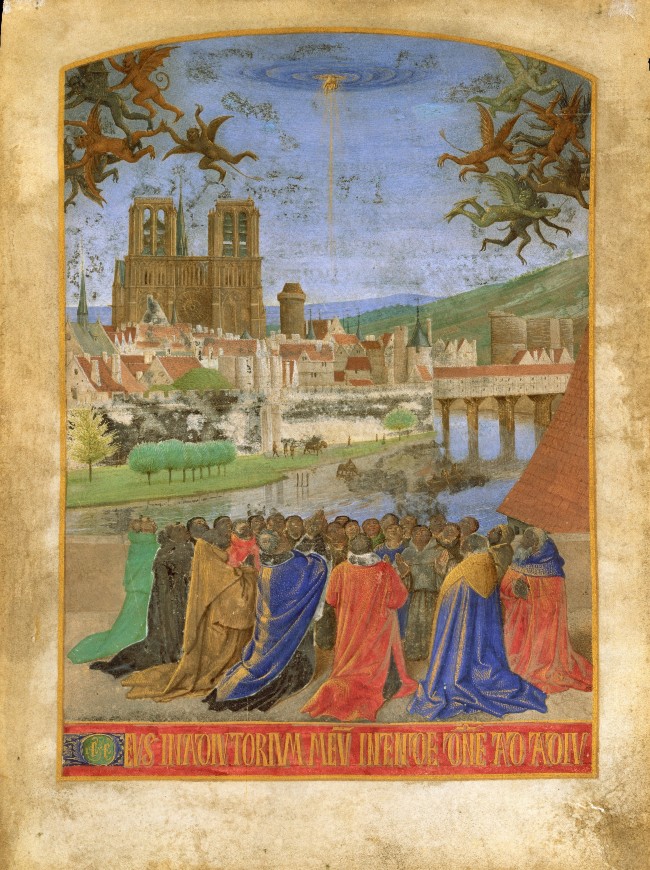
Rare Archaeological Finds at Notre Dame

 From Bonjour Paris:

Since the horrific fire devastated Notre-Dame in 2019, destroying the timber roof and toppling the spire, extensive reconstruction efforts have been underway to rebuild the beloved cathedral. Curious passers-by assemble on the Seine’s quay to watch the cranes at work, or gather on the parvis where musicians play songs and an open-air exhibit covers the temporary walls closing off the construction site. And now there’s been an extraordinary news announcement: archeologists have made an amazing find. As reconstruction teams checked the stability of the ground in order to install scaffolding, they stumbled upon something unexpected under the cathedral.

Beneath the 19th-century underground heating system, burial sites have been discovered with several tombs and a human-shaped sarcophagus made of lead, likely dating from the 14th century. Shortly after the discovery, France’s culture minister Roselyne Bachelot visited the archaeological research site because of its importance. According to Agence France Presse, published in The Guardian, “the burial sites “of remarkable scientific quality” were unearthed during preparatory work for rebuilding the ancient church’s spire at the central spot where the transept crosses the nave.”

 That’s not all. In addition to the sarcophagus, thought to be made for a senior dignitary in the century after the cathedral’s original construction, the archaeological team has found painted sculptures, “identified as parts of the original 13th-century rood screen – an architectural element separating the altar area from the nave.” As they continue their excavation and cleaning, the archeologists have also used a mini endoscopic camera to look inside the sarcophagus. Visible are fabric, hair and a pillow of leaves on top of the head — part of the ceremonial elements of a religious leader’s burial at the time. The body is thus thought to be in a good state of conservation. (Read more.)


From Ancient Origins:

 Experts believe the lead sarcophagus probably belonged to a dignitary from the early 14th century – a very exciting prospect for a better understanding of the Middle Ages, particularly funeral practices, according to Dominique Garcia of the National Institute of Archaeological Research. Ahead of installing scaffolding to rebuild the spire, precautionary testing had been carried out to check the stability of the ground. During this process, an underground heating system from the 19th century was discovered with the sarcophagus lying among the brick pipes. (Read more.)

Share

Twitter Is Worried About Free Speech…In Canada

 From The Daily Wire:

Following proposed legislation in Canada that would give the government greater oversight and control over content on social media, Twitter has expressed opposition to the bill due to its effect on “freedom of expression.”

In statements provided to the government, Twitter explained its objections to the proposal put forth by Liberals in parliament known as the online harms bill. 

According to The National Post, “The online harms bill would take aim at online posts in five categories — terrorist content, content that incites violence, hate speech, intimate images shared non-consensually, and child sexual exploitation content.” Overseen by a new Digital Safety Commissioner of Canada, social media platforms would be required to take down posts that violate any of the content restrictions within 24 hours. 

Twitter claims the bill does not have “the most basic procedural fairness requirements you might expect from a government-run system such as notice and warning.” Furthermore, the social media platform said the “requirement to ‘share’ information at the request of the Crown is also deeply troubling.”

Twitter, whose board is currently in a struggle with billionaire Elon Musk who wants to take control of the company, also expressed concern about the implications of free speech for the law. 

The social media giant said that the proposed law “sacrifices freedom of expression to the creation of a government run system of surveillance of anyone who uses Twitter” and warned that flagging and removing posts might be “used as a political tactic.”

Twitter, which barred the New York Post from its platform for several weeks prior to the 2020 U.S. presidential election after it published a story about Hunter Biden’s laptop, also noted that the new regulations could have an impact on federal elections.

“As lived during the recent Canadian federal election, a general approach to flagging will result in censorship,” Twitter noted, pointing to Canadian politicians pushing to have posts removed for misinformation during the election cycle. 

Regulating social media has become a major priority of Canadian Prime Minister Justin Trudeau’s administration, as it says it is important to ensure online safety for Canadians. An online resource from the government warns that social media platforms can be used to harm “social cohesion or democracy.” 

Other major companies, like Microsoft, also opposed the proposed law noting that it could impose too high of a burden on platforms to monitor and decide what content should be removed per the government’s standards. (Read more.)

Share

First Known Female Pharaoh

 From My Modern Met:

The title of pharaoh is synonymous with the grandeur of the ancient Egyptian civilization. This name—which means “great house” in hieroglyphics—was given to the rulers who led this large empire. And while the majority of these figures were men like King Tut and Ramesses II, there were a few influential women who earned the title. The first recorded female pharaoh was Sobekneferu.

After the death of Amenemhat IV, who may or may not have been her brother and husband, Sobekneferu assumed the throne. Although her reign only lasted about four years, she was the first known female ruler to adopt the full royal titulary and to be recorded in the Turin King List—a recording of ancient Egyptian kings written on papyrus. Her end as ruler marks the end of the Twelfth Dynasty of the Middle Kingdom of Egypt.

Sobekneferu was the first recorded female pharaoh to rule ancient Egypt and the last ruler of the Twelfth Dynasty of the Middle Kingdom (c. 2055 BCE – 1650 BCE). She was one of the daughters of the pharaoh Amenemhat III, although it is unknown which of his wives was her mother.

Her ascension to the throne is also unclear, but it is postulated that after Amenemhat IV died—the heir of Sobekneferu's father who may or may not have been her brother—she was put forth as the next pharaoh in absence of another male heir. Her relationship to Amenenhat III helped her assert legitimacy as a ruler (Read more.)
Share

Thursday, April 28, 2022

The Renovations at Versailles


From Lonely Planet:

Today the hall is welcoming guided tours again after eight months of closure, bringing back motifs that had disappeared after a previous restoration in 1789 and restoring the mammoth Luc-Olivier Merson painting, The Tennis Court Oath.

Elsewhere in the palace, the apartment of the Dauphin – Louis XV᾽s eldest son – is reopening today too after 18 months of work. Considered one of the most prestigious apartments in the palace, the ground floor apartment (made up of a bedroom, library and reception room) rejoins the tour circuit alongside the restored private quarters of Madame Du Barry (Louis XV's mistress).

Museum officials have tried to make the rooms look almost exactly as they did when they were at the height of their power and pomp, hiring local carpenters, gilders, marble and stucco workers to bring back their 18th-century shine. (Read more.)

Share

The Medium Is the Menace

 From City-Journal:

The discussion of the merits and demerits of technology has continued ever since Plato. It has flared up recently, as the pace of technological change has accelerated. Writing took millennia to spread; the Internet conquered the planet in decades. The speed has amplified the shock, making the arguments of the techno-skeptic Thamus more tangible. In the 1990s, the Internet was praised as a great repository of knowledge. In the 2000s, it was hailed as an environment of free communication. But since the 2010s, it has often been considered a danger—both to people and institutions.

The logic of our faculties’ migration into media, extended far enough, leads to a complete human resettling into media. The more our capabilities migrate to media, the more our power grows over our physical and social environments—and the more essential it is to improve the potency of our media. The migration of physical abilities to, say, a stone ax dealt with only a tiny fraction of our needs. The Internet, by contrast, caters to all human collective and personal activities.

Indeed, we are nearly all the way there, save for some physical daily routines. Media are increasingly taking over our body’s work to accomplish those physical and intellectual tasks better and faster, which frees up time to spend on—what else?—consuming and developing media. As McLuhan said, “[M]an becomes, as it were, the sex organs of the machine world, as the bee of the plant world.” In exchange for developing them, media offer us “nectar” in the form of conveniences of all sorts. Convenience can make humans dependent, however; and in the digital universe, this can certainly seem at times like a loss of freedom and independence.

We’re not just spending time on the Internet. We are investing time in its improvement. If value in digital capitalism is created in the very process of a platform’s use, then we are all working for digital capitalism. Every time we click a link, react to a story, or share it with others, we help the Internet to evolve, like a bee pollinating flowers, in McLuhan’s formulation. Improving the relevance of online content, our day-and-night labor of clicks enhances the Internet’s convenience for us, which, in turn, strengthens its power over us, making us develop its protocols and devices. Having collapsed the space between people—as well as between people and knowledge—the Internet has freed up the time formerly needed to cover that space. In exchange for this service, the Internet expropriates our time. (Read more.)


Share

Checking Bags vs Carry On

On our last trip to London, we decided to travel without luggage, and so had carry-on only.  It was very convenient when making an international flight and jumping in and out of taxi cabs, etc. However, we had little room in bags for gifts or souvenirs. From Medium:

There was a recent article on Defector where two of their writers debated the merits of each option. I read the article and commented on Twitter that I had mixed feelings about this decision. I have a flight to Nashville coming in June. I will have to make this decision. Here are the pros and cons of each. I am flying Southwest, so I can check one bag free. The decision changes when there is a fee.

Checking Bags

Pros:
  • You don’t have to limit your packing to make it fit in a carry-on eligible bag.
  • You don’t have to worry about making sure all of your shampoos and such are in a separate clear bag and the right size.
  • The security line is much easier when I am only carrying my phone and the book I plan to read.
  • Boarding is easier when you don’t have to look for overhead space for your bag.
  • You avoid being the annoying person who holds up the boarding process looking for space.
  • If you have a layover you have less stuff to worry about lugging from gate to gate.
Cons:
  • You have to deal with possible lines to check your luggage.
  • You have to deal with baggage claim at the end of the trip.
  • There is the possibility of lost luggage.
  • You might leave your ride waiting while you wait for your luggage.

(Read more.)

Share

Wednesday, April 27, 2022

The History of Kitchens


 From ArchDaily:

The discovery of fire was one of the great events that changed the social organization of human agglomerations, which gradually passed from nomadic to sedentary lifestyle. Fire, which in that context served to keep people warm and protect the group, was also being explored as a source for cooking food, which not only changed human eating habits, but also made it possible to conserve food, changing the social organization of communities. The preparation and meals were collective acts, which brought people together to feed, warm up and protect themselves. It is from this habit that we inherited the practice of large banquets and the appreciation of food and meal times. Food preparation, on the other hand, was gradually marginalized. While the Egyptians, Assyrians, Phoenicians, Persians, Greeks and Romans shared the habit of holding large banquets, the preparation gained less and less prestige, losing its collective social dimension until it was physically segregated in a specific room: the kitchen. (Read more.)


Open kitchens are on their way out. It is nice to have the kitchen as a separate room, where people can work and even have a private chat. From Maison Global:

He found that consciously sealing the kitchen off from the living room with a door and a wall made a noticeable impact. Separating the rooms made each feel properly proportioned. The living room, now more cocoon-like, was easier to furnish. Thus, what’s old is new again.

“Maybe it’s a post-pandemic thing, but nobody wants an open kitchen,” Mr. Potts said. “They want light and spaciousness, but no one wants a mess. It’s more calming, frankly, to have definition and to be able to remove yourself from a room where somebody might be on a video conference, or where you just made lunch but don’t want to do the dishes yet.”

Mansion Global spoke with Mr. Potts about how adding walls and unexpected finishes to kitchens elevates both working and entertaining from home. (Read more.)

Share

An Icon of Courage and Faith

  Rest in Peace, Deirdre. From Kathryn Jean Lopez at Our Sunday Visitor:

One of the things she is known for is handing out the Litany of Trust prayer, written by one of the Sisters of Life. It’s about humble trust in God, and she doesn’t have to hand out those beautiful words, because her life has been a glorious song, an ode to her Creator in love for the life she has been given as a gift from God.

The last time I worked with her professionally, when she was working for the U.S. Conference of Catholic Bishops on pro-life issues, she was working on end-of-life issues. She was a compassionate advocate against doctor-assisted suicide and for palliative care and other merciful alternatives to assisted suicide.

Deirdre introduced me to a woman named Maggie Karner. She had watched her father deteriorate at the end of his life. She reflected later, as she faced her own terminal diagnosis: “He taught me how to live and die with faith and with dignity marked by patience and grace. He taught me that dignity can’t be diminished by pain or loss of personal control. Regardless of our circumstances and whether people acknowledge it, nothing and no one can take away our God-given dignity.”

She was brutally honest about her own illness: “I am certain my God hears my cries, which are sometimes angry, sometimes frustrated and sometimes exhausted. I know this because Jesus also cried out to his Father in pain and showed me that God can handle our questions, our fears, and our uncertainties.”

In 2014, at the death of another icon of courage and faith in the face of a terminal diagnosis, J.J. Hanson, she and her colleague, Greg Schleppenbach, wrote announcing his death: “Given only four months to get his affairs in order when first diagnosed in 2014, he sought a second opinion with a medical team that was willing to fight for his treatment. Sadly, his cancer returned late in 2017, and he passed away peacefully at home, surrounded by his family after receiving hospice care.”

Now Deirdre is in this same position. And every moment, excruciating as it can be with pain and the sure knowledge that life is at its end for family and friends, has dignity. She has dignity. Playing God in ending life prematurely is not worthy of the gift of life God gives us. It closes us off to unexpected graces only God can give in the purifying, humbling, even humiliating moment of our lives, when we are most vulnerable.

I can’t really pretend to know what Deirdre would say if she could say some last words of teaching about what she has learned about her suffering — though I expect those closest to her will share before too long. But she would be delighted if we all got to know the late Sister Thea Bowman, who Deirdre has had as a close friend and intercessor in her cancer battle. She, too, had cancer. And she said something that Deirdre has embodied: “I believe that there are kinds of healing. People are praying for healing for me. I want to be healed. I don’t know what that means in God’s infinite plan, but it’s not problematic for me. If it means to heal the body, thank you, God. If it means to heal the spirit, thank you, God. And I know the healing is already happening.” (Read more.)


Share